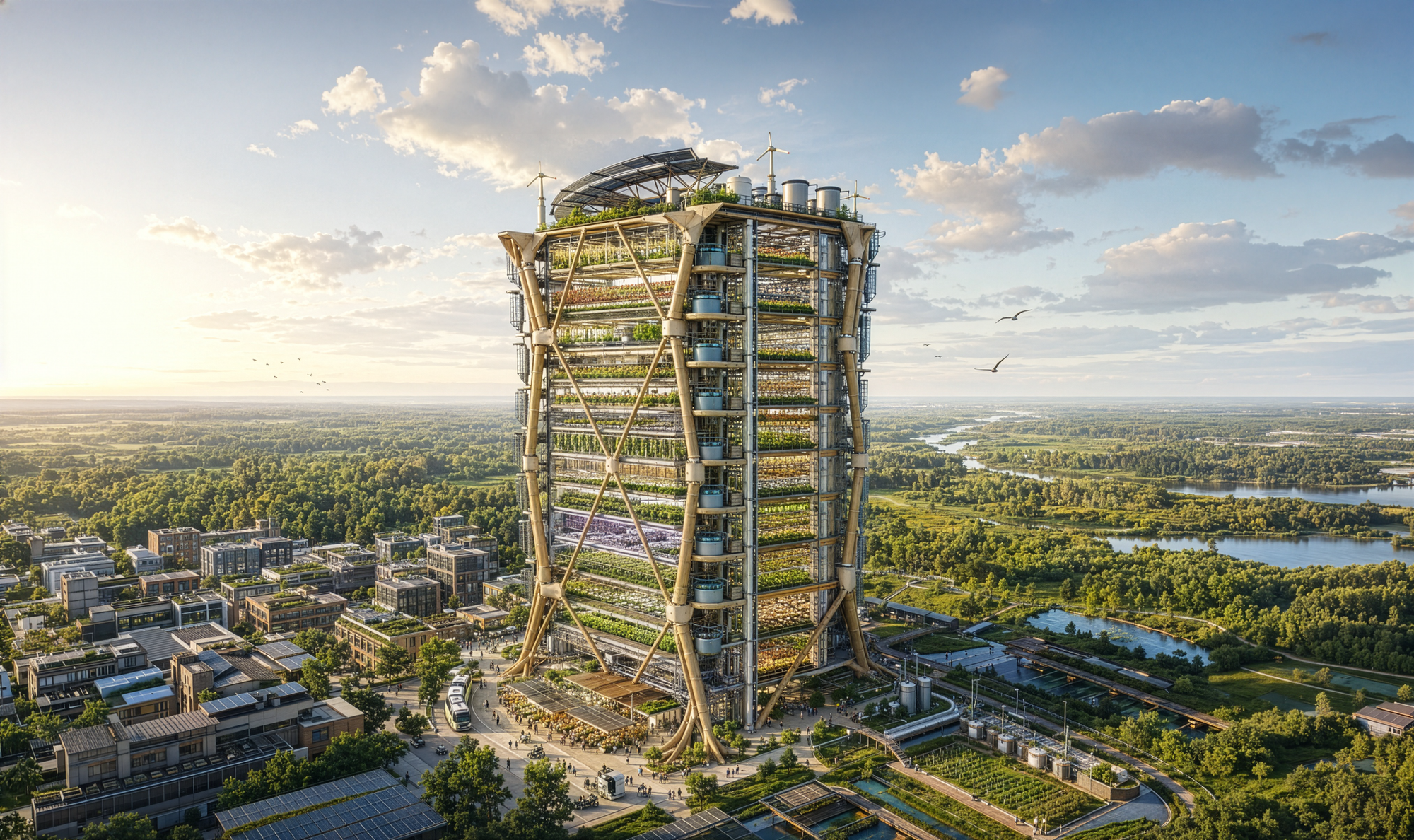
How 80-Story Vertical Farms Could Feed a Fully Renewable Megacity
Skyscraper indoor farming could combine biocomposite structure, solar windows, wind power, geothermal and closed-loop water to feed dense cities.
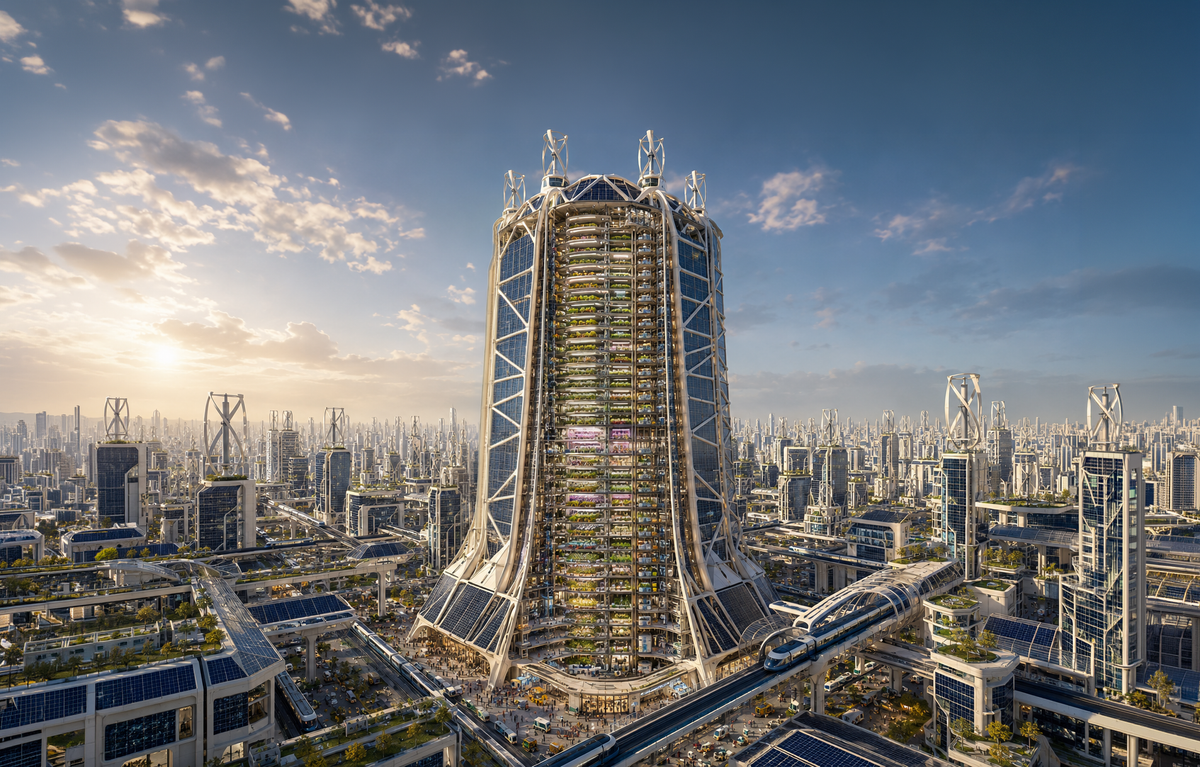
Agricultural Skyscrapers: A Proposal on Vertical Indoor Farming
1. Summary
By 2035, global metropolitan areas will face an unprecedented convergence of food security, climate, and logistical pressures. Traditional horizontal supply chains, spanning thousands of miles, are demonstrating increased fragility due to climate volatility and geopolitical disruptions. In response, the concept of the Agricultural Skyscraper, an 80+ story, fully integrated Controlled Environment Agriculture (CEA) facility, has emerged not merely as an architectural marvel, but as a potential pillar of 21st-century resilient infrastructure. These structures offer a transformative opportunity to transition urban food systems from passive consumption to active production. However, without critical engineering breakthroughs in energy intensity, they risk becoming energetically unsustainable "white elephants," displacing carbon emissions from transport to electricity grids. This study provides a strategic foresight assessment on the potential for tech-driven ecosystem orchestration, localized ROI, and AgTech innovation.
Simultaneously, it rigorously scrutinizes the systemic risks, energy-water-nexus dependencies, and policy barriers to scalability. While highly promising for specific crop types and water-scarce regions, the agricultural skyscraper is not a monolithic solution, requiring nuanced integration with existing energy grids and rural economies to maximize net benefit.
2. Technology Ecosystem & Orchestration
The viability of a 1,000-foot-tall farm is entirely dependent on a sophisticated, multi-layered technology stack. This is a prime opportunity for ecosystem orchestration, linking advanced hardware with cognitive software. The operational core must utilize Controlled Environment Agriculture (CEA) at an unprecedented scale, moving beyond human-scale management to AI-driven systems.
Research suggests that optimized growth requires "spectral hacking", using tuned LED arrays to deliver precise light wavelengths at specific plant growth stages, maximizing photosynthetic efficiency while minimizing waste heat. Furthermore, autonomous robotic harvesting systems are essential, not merely for labor reduction, but to manage crop health in a dense, vertical stack where human access is challenging and introduces contamination risks. Our view indicates that full traceability, from seed to delivery within the same zip code, can be managed via verified supply chains, ensuring premium quality and commanding higher market prices.
However, this extreme digital dependency creates a new risk nexus. A cyberattack on the central AI coordination hub could destabilize food production for an entire city sector, making these structures vulnerable.
Furthermore, Catastrophic System Failure at 80 stories is a serious concern. While the closed-loop hydro/aeroponic systems promise 90%+ water savings, a single pathogen entering the system could spread rapidly through the entire plumbing stack, necessitating a full cull and costing months of production. The complexity of maintaining sterile, yet productive, ecological systems within a rigid engineering framework remains an unresolved engineering bottleneck.
3. Economic Feasibility & Market Dynamics
The business logic of the farmscraper depends on redefining "prime real estate." Vertical farming shifts agriculture from a CAPEX-light/OPEX-heavy model (traditional) to a CAPEX-heavy/OPEX-uncertain model. Our analysis indicates that the construction costs per square meter of an 80-story skyscraper are exponentially higher than acquiring rural land. To achieve a respectable ROI, farmscrapers must initially focus on high-margin crops (leafy greens, herbs, and specialized medicinal plants) rather than staple caloric commodities like wheat or corn, which cannot currently generate the revenue needed to cover operational costs. Consider a model centered on premium, ultra-local produce delivered through subscription services and direct-to-grocery partnerships, eliminating middlemen and competing on freshness, not commodity pricing. The primary unresolved economic bottleneck is the "energy penalty." Traditional farming uses the sun for free; vertical farming must substitute it entirely with electricity for LEDs and climate control. Even with optimizations, energy remains the largest component of OPEX, often exceeding 50% of production costs. If energy prices spike or grids fail, profitability vanishes.
There is also the Rural Displacement Risk. While urbanites might benefit, massive localized urban production could destabilize the economies of surrounding peri-urban or rural farming communities that currently supply cities. We propose a hybrid system that optimizes land use: farmscrapers for perishables, and field agriculture for calorie staples and industrial crops, perhaps incorporating a risk nexus transfer mechanism where urban farm revenues help stabilize rural insurance pools against climate shocks.
4. The Nexus
Critical analysis of vertical farming begins with the energy-security-water nexus. The central challenge is that the concept's massive potential benefit (near-zero food miles) is juxtaposed with a critical, unresolved dependency on intense, reliable electricity generation. Currently, if powered by a standard fossil-fuel grid, vertically farmed produce can have a higher carbon footprint per kilogram than field-grown produce shipped 2,000 miles. Our analysis indicates that for the farmscraper to be a climate solver, it must be co-located with dedicated renewable generation (geothermal baseload or massive solar/wind) and operate near-perfect closed loops. Building-Integrated Photovoltaics (BIPV) (specifically on 80+ stories of facade) cannot generate enough energy to meet the farm’s core demand. They can only offset ancillary building loads. Geothermal is promising but dependent on specific geological locations.
From a resiliency standpoint, the closed-loop water systems (hydro/aeroponics) offer a decisive advantage in water-stressed regions, saving ~90-95% compared to open-field irrigation. However, this creates a new vulnerability: extreme dependence on reliable water pumps, filtration systems, and sensors. The fragility of this interdependent plumbing at 80 stories requires redundant power, as a 24-hour pump failure could lead to complete crop loss through dehydration. Climate modeling suggests farmscrapers are highly resilient to exterior weather events (floods, droughts), but acutely vulnerable to internal grid and mechanical shocks.
5. Public Policy, Zoning, and Urban Integration
Moving from concept to construction requires a complete overhaul of urban regulatory frameworks. Research suggests that existing zoning codes rarely account for "Ag-Residential" or "Ag-Commercial" hybrid uses. Policy levers are needed to create Industrial Agricultural Districts within cities, streamlining permits and providing subsidies for early adopters. Municipalities should classify these structures as Critical Infrastructure, granting them priority access to energy and water grids during shortages, while simultaneously requiring them to have robust, independently-verified cybersecurity protocols.Beyond technology, farmscrapers must integrate with the urban fabric to resolve the logic bottleneck. This includes linking greywater recycling from neighboring residential buildings to the farm’s filtration stack, and utilizing waste heat from the thousands of LEDs to warm nearby commercial spaces during winter. In this scenario, Deloitte envisions municipalities acting as ecosystem orchestrators, mapping energy, water, and heat flows across the city to maximize the net benefit of the farmscraper’s localized production. These facilities can actively combat food deserts by locating in underserved neighborhoods, providing high-tech, local jobs while guaranteeing year-round access to nutritious produce.Section 6: Conclusion: A Dual-Scenarios Outlook
As we look toward 2035, the fate of the Agricultural Skyscraper hinges on resolving the energy-material nexus.
Scenario A (Optimistic): The Circular Hub. Technological breakthroughs in LED efficiency, coupled with modular baseload renewable power (like SMR or geothermal), make 80-story farms OPEX-competitive with rural trucking. These farmscrapers are hubs of the circular economy, co-locating energy generation, food production, and greywater recycling. They are classified as critical infrastructure, providing 30% of a city’s leafy greens and herbs, and stabilizing food prices against global climate shocks. Municipal leaders have mastered ecosystem orchestration, integrating these towers into residential planning and public health mandates.
Scenario B (Pessimistic): The Abandoned Monument. Following a series of energy price spikes and a high-profile "crop cull" caused by a pathogen entering a single tower's water stack, public confidence in vertical staples evaporates. Agricultural skyscrapers are seen as energy-intensive white elephants, unsustainable without massive public subsidies that municipalities cannot afford. Investors flee, leaving behind empty 80-story glass and steel lattices; abandoned monuments to technological hubris. Field agriculture, now more volatile due to climate change, remains the dominant, albeit stressed, supplier.
Recommendation
Future municipal leaders and private investors may view the Agricultural Skyscraper as a highly potent, niche solution for high-margin, water-intensive perishables, particularly in water-scarce regions or high-density Asian metropolises. Investment must be coupled with dedicated, off-grid renewable baseload power. We recommend piloting mixed-use structures (10-20 stories ag + 60 stories residential/commercial) before committing to 80-story pure-play agricultural towers. The future of urban food security is hybrid, resilient, and localized, and the farmscraper is a key, if complex, part of that new ecosystem.