
Introduction to Quantum Electrodynamics
QED is the template for gauge theories and underpins fundamental constants and atomic timekeeping.


TL;DR
- Quantum electrodynamics (QED) is the relativistic quantum field theory of light and electrically charged matter; it describes electromagnetic interactions as the exchange of photons and constitutes the electromagnetic, U(1)-gauge sector of the Standard Model of particle physics.
- QED is the most stringently tested theory in physics: the electron's magnetic moment, measured to 0.13 parts per trillion (Fan et al., 2023), agrees with the multi-loop QED prediction at the level of about one part in a trillion (10⁻¹²), the most precise confrontation of theory and experiment ever achieved.
- Its significance is foundational and metrological, not commercial: QED is the template for all subsequent gauge theories, underpins the determination of fundamental constants and atomic timekeeping, and grounds adjacent fields such as quantum optics and quantum information science; but it is not itself a revenue-generating market.
Key Findings
- QED emerged in the late 1940s from three independent, mathematically equivalent formulations by Sin-Itiro Tomonaga, Julian Schwinger and Richard Feynman, recognized jointly with the 1965 Nobel Prize in Physics; Freeman Dyson demonstrated their equivalence in 1949.
- Two empirical anomalies drove the theory: the Lamb shift (1947), an unexpected splitting of hydrogen energy levels, and the electron's anomalous magnetic moment, the deviation of the electron's g-factor from the value 2 predicted by Dirac's equation.
- QED's predictive machinery rests on three pillars: perturbation theory (an expansion in the fine-structure constant α ≈ 1/137), Feynman diagrams (a bookkeeping and computational device for the terms of that expansion), and renormalization (the procedure that renders otherwise-infinite quantities finite).
- The measured electron magnetic moment g/2 = 1.001 159 652 180 59 (13) matches the QED prediction to about one part in 10¹². The dominant limitation on the theory-experiment comparison is not QED itself but the input value of α, whose two most precise determinations (cesium and rubidium atom interferometry) disagree at the 5.5σ level.
Details
What QED is
Quantum electrodynamics is the relativistic quantum field theory that describes how light and electrically charged matter interact. In its framework, both the electromagnetic field and charged particles such as electrons and positrons are treated as excitations of underlying quantum fields, and the electromagnetic force between charged particles arises through the exchange of photons, the quantized excitations of the electromagnetic field. QED is an abelian gauge theory: its dynamics are dictated by a local U(1) gauge symmetry, meaning the theory is invariant under position-dependent changes in the phase of the charged-particle field, a requirement that mathematically necessitates the existence of the photon as the force-carrying (gauge) boson. Within the Standard Model of particle physics, QED constitutes the electromagnetic sector; at high energies it is unified with the weak interaction into the electroweak theory, but at ordinary energies it stands as the precise, self-contained description of electromagnetism at the quantum level.
Conceptually, QED represents the marriage of two twentieth-century revolutions: quantum mechanics (which governs microscopic systems) and special relativity (which governs objects moving at speeds approaching that of light). Ordinary quantum mechanics cannot consistently describe processes in which particles are created or destroyed (such as the emission and absorption of photons, or the production of electron-positron pairs) whereas QED, as a quantum field theory, treats particle number as a dynamical quantity and thereby handles such processes naturally.
Historical development
The theory's foundations were laid by Dirac, Heisenberg and Pauli in the late 1920s, but a consistent, calculable formulation emerged only after the Second World War. The catalyst was experimental. In 1947, Willis Lamb and Robert Retherford, using microwave techniques at Columbia University, measured a small energy difference between the 2S₁/₂ and 2P₁/₂ states of atomic hydrogen; states that Dirac's theory predicted to be exactly degenerate (equal in energy). This "Lamb shift," which Lamb and Retherford initially placed at about 1000 MHz, demanded an explanation beyond existing theory. Hans Bethe produced the first approximate calculation in June 1947 using the idea of mass renormalization, obtaining 1040 MHz, a result, in the words of a Physics Today retrospective, "agreeing pretty well with Lamb's experiment", and it launched modern QED.
Between 1947 and 1950, three physicists independently produced complete, relativistically consistent formulations: Sin-Itiro Tomonaga in Japan, Julian Schwinger at Harvard, and Richard Feynman at Cornell. Schwinger and Tomonaga employed highly mathematical operator methods; Feynman introduced his now-iconic diagrams, a visual and computational scheme for representing particle interactions. In 1949, Freeman Dyson, then associated with Cornell and the Institute for Advanced Study, demonstrated that these apparently disparate approaches were mathematically equivalent (in "The Radiation Theories of Tomonaga, Schwinger, and Feynman," Phys. Rev. 75, 486), and recast the theory in the systematic language of the S-matrix and perturbation theory ("The S Matrix in Quantum Electrodynamics," Phys. Rev. 75, 1736). Tomonaga, Schwinger and Feynman shared the 1965 Nobel Prize in Physics "for their fundamental work in quantum electrodynamics, with deep-ploughing consequences for the physics of elementary particles." Dyson, though widely regarded as deserving, was not included.
A second empirical anchor was the electron's magnetic moment. Dirac's equation predicts a g-factor of exactly 2. In 1948 Schwinger calculated the first quantum correction (the leading term of the "anomalous" magnetic moment) obtaining a = α/(2π) ≈ 0.00116 (Phys. Rev. 73, 416), a result so celebrated it is engraved on his tombstone. This small deviation, confirmed experimentally by Kusch and Foley, became the proving ground on which QED's precision would ultimately be established.
Calculational architecture
QED's predictions are computed through perturbation theory: physical quantities are expressed as a power series in the fine-structure constant α, a dimensionless number approximately equal to 1/137 that sets the strength of the electromagnetic interaction. As α is small, successive terms in the series contribute progressively less, and a finite number of terms can yield extraordinary accuracy.
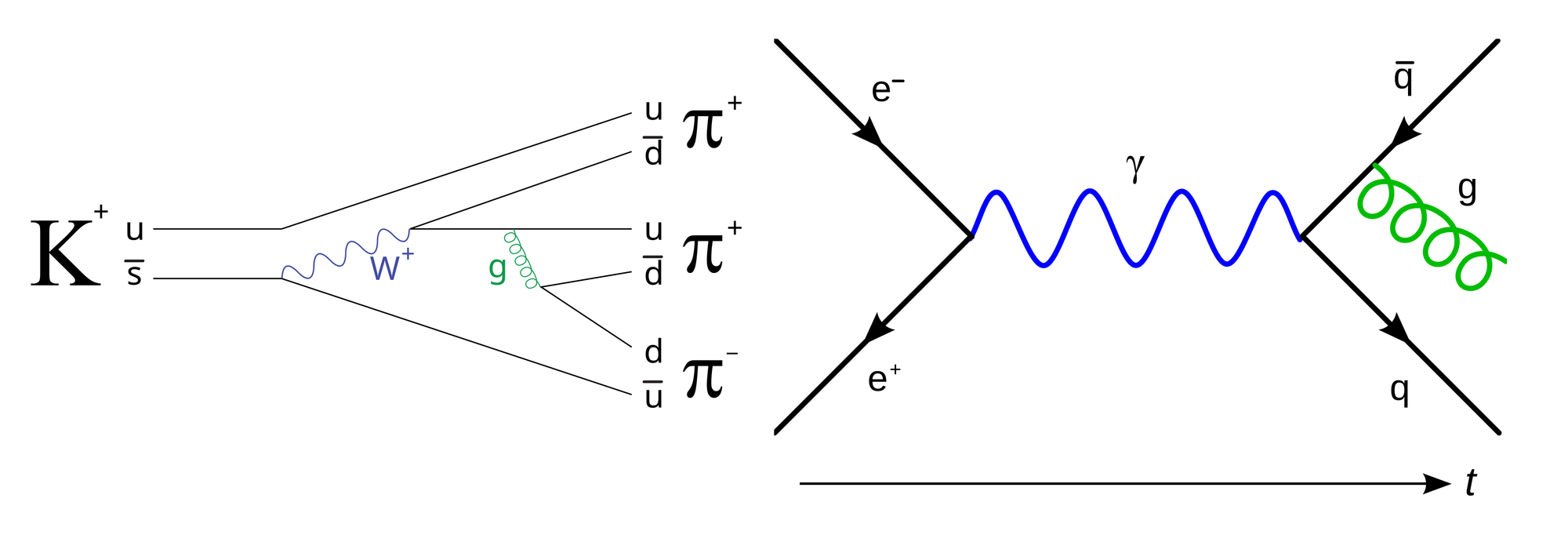
Each term in this expansion corresponds to a set of Feynman diagrams; schematic pictures in which lines represent particles (electrons, positrons, photons) and vertices represent their interactions. Each diagram translates, via well-defined rules, into a mathematical expression contributing to the probability of a process. The number of diagrams grows explosively with each order: the tenth-order (five-loop) contribution to the electron's anomalous magnetic moment involves 12,672 diagrams, whose evaluation required decades of effort and large-scale numerical computation, principally by Tatsumi Aoyama, Masashi Hayakawa, Toichiro Kinoshita and Makiko Nio, with independent verification by Sergey Volkov.
Individually, many diagrams yield mathematically infinite results; divergences that plagued early QED. Renormalization is the systematic procedure that resolves this: the infinities are absorbed into redefinitions of a small number of physically measurable quantities (the electron's mass and charge), leaving finite, unambiguous predictions for all observable quantities. Renormalization is not a mathematical trick appended to the theory but rather a deep statement about how physics at accessible energy scales is insulated from unknown physics at very short distances.
Empirical status: the electron's magnetic moment
QED's most precise test is the electron's anomalous magnetic moment, a_e ≡ (g−2)/2. In 2023, Xing Fan, Thomas Myers, Bassam Sukra and Gerald Gabrielse of Northwestern University reported the measured value g/2 = 1.001 159 652 180 59 (13) — equivalently a_e = 1.159 652 180 59 (13) × 10⁻³ — a precision of 0.13 parts per trillion (Phys. Rev. Lett. 130, 071801). It is, in the authors' words, "the most precisely determined property of an elementary particle," determined 2.2 times more accurately than the prior value that had stood for fourteen years. The measurement uses a single electron confined in a cryogenic Penning trap (a "one-electron quantum cyclotron"), where quantum transitions between the electron's motional and spin states are resolved.
The measured quantity must be distinguished sharply from the calculated prediction. The theoretical value, a_e(theory), is obtained by summing the QED perturbation series (through tenth order/five loops) plus small hadronic and weak contributions, and crucially requires as input an independently measured value of α. Aoyama, Kinoshita and Nio (2019, Atoms 7, 28) obtained a_e(theory) = 1 159 652 181.606 (11)(12)(229) × 10⁻¹² using the cesium value of α, where (in their words) the first two uncertainties come from the tenth-order QED and hadronic terms and "the third and largest uncertainty comes from the current best value of the fine-structure constant." The measurement, per Fan et al., "tests the most precise prediction of the Standard Model (SM) to 1 part in 10¹²", an accuracy Feynman likened to measuring the distance from New York to Los Angeles to within the width of a human hair.
The dominant limitation on this comparison is not QED but the input value of α. The two most precise determinations of α come from atom-interferometry recoil measurements: a cesium-133 measurement by the Berkeley group (Parker et al., Science 360, 191, 2018) giving "the most accurate measurement of the fine-structure constant to date: alpha = 1/137.035999046(27) at 2.0 × 10⁻¹⁰ accuracy," and a rubidium-87 measurement by the Paris LKB group (Morel et al., Nature 588, 61, 2020) determining "the fine-structure constant α⁻¹ = 137.035999206(11) with a relative accuracy of 81 parts per trillion." These two values disagree with each other at the 5.5σ level (Crivellin et al.). Depending on which value is used, the QED prediction for a_e sits either about 2.4σ below the measurement (using cesium α, giving Δa_e ≈ −(8.8 ± 3.6) × 10⁻¹³) or about 1.6–1.7σ above it (using rubidium α, giving Δa_e ≈ +(4.8 ± 3.0) × 10⁻¹³), with opposite signs. Consequently, the electron g−2 comparison currently probes the consistency of α measurements as much as it tests QED; as Fan et al. note, "the test would improve an order of magnitude if the uncertainty from discrepant measurements of the fine structure constant α is eliminated."
Empirical status: the Lamb shift
The Lamb shift remains a benchmark QED test in bound systems. Refined measurements following the 1947 discovery placed the 2S₁/₂–2P₁/₂ splitting at 1057.864 MHz. Modern spectroscopy has extended these tests dramatically. In 2019, Bezginov et al. (Science 365, 1007) made a direct measurement of the n = 2 Lamb shift in atomic hydrogen, extracting a proton charge radius of 0.833 ± 0.010 femtometers; a result bearing on the "proton radius puzzle," a persistent discrepancy between proton-size values inferred from ordinary (electronic) hydrogen versus muonic hydrogen. High-precision optical spectroscopy of the hydrogen 1S–2S transition provides additional stringent tests of bound-state QED: Parthey et al. (Phys. Rev. Lett. 107, 203001, 2011) measured f₁S–₂S = 2 466 061 413 187 035 (10) Hz, a fractional frequency uncertainty of 4.2 × 10⁻¹⁵, feeding directly into the determination of the Rydberg constant.
CODATA recommended values
The internationally recommended values of the fundamental constants are issued by the CODATA Task Group (Mohr, Newell, Taylor and Tiesinga; J. Phys. Chem. Ref. Data 54, 033105, 2025). The 2022 adjustment gives the electron magnetic-moment anomaly a_e = 1.159 652 180 46 (18) × 10⁻³ and the fine-structure constant α⁻¹ = 137.035 999 177 (21) (relative uncertainty ~1.5 × 10⁻¹⁰). The CODATA 2018 value was α⁻¹ = 137.035 999 084 (21). These adjustments incorporate the discrepant α measurements by applying statistical expansion factors (a factor of 2.5 on the atom-recoil data) to reconcile them, and CODATA explicitly notes the unresolved tension.
Significance
QED's importance is foundational and metrological.
First, QED is the conceptual and mathematical template for the entire Standard Model. The non-abelian gauge theories of the weak interaction (SU(2)) and the strong interaction (quantum chromodynamics, SU(3)) were built by generalizing QED's gauge principle. QED demonstrated that a renormalizable, gauge-invariant quantum field theory could make precise, verified predictions; the paradigm on which all subsequent particle physics rests.
Second, QED underpins high-precision metrology. As the electron g−2 and QED theory together yield a value of α, and because α connects to electrical standards and the redefined SI system of units, QED is woven into the international measurement infrastructure. Precision QED tests in hydrogen and hydrogen-like ions contribute to the determination of the Rydberg constant, proton radius, and electron mass, and QED corrections are essential to the accuracy of atomic clocks that define the second and enable satellite navigation.
Third, QED provides the conceptual foundation for adjacent, technologically active fields. Quantum optics, cavity QED (the study of atoms interacting with photons confined in resonators), and circuit QED (its superconducting-circuit analog) all descend conceptually from the QED treatment of light-matter interaction; cavity and circuit QED are, in turn, enabling platforms for quantum computing and quantum networking. This linkage is indirect: these applied fields use the conceptual framework and specific results (such as the Purcell effect and the Jaynes-Cummings model) that QED and its descendants provide, rather than deploying full relativistic QED calculations. The commercial activity resides in the quantum-technology sector built atop these ideas, not in QED as such.
 John D
Recommendations
- For students and research associates: Treat QED as the reference model for how a modern physical theory is structured — symmetry principle (U(1) gauge invariance) → field content (photon, electron) → perturbative calculation (Feynman diagrams) → renormalization → precision test. Master the electron g−2 and Lamb shift as the canonical worked examples of theory-experiment confrontation.
- For engineers and inventors: Look to the descendants of QED — cavity QED, circuit QED, quantum optics — rather than QED itself for applicable tools. The relevant benchmark is the strong-coupling regime of light-matter interaction that these fields exploit for qubits and photonic interconnects.
- For investors and analysts: Do not model QED as a market. It is scientific infrastructure. Commercial exposure exists only downstream, in quantum computing, precision sensing, and metrology firms whose products rest on quantum-optical principles. The threshold that would change this assessment is a breakthrough application unique to relativistic QED effects; none is currently on the horizon.
- For all readers tracking the field: Watch the resolution of the cesium-rubidium α discrepancy. A reconciled α value would immediately sharpen the world's most precise test of the Standard Model by roughly an order of magnitude and could either vindicate QED further or expose a crack pointing to physics beyond the Standard Model.
Caveats
- The theory-experiment agreement for a_e is currently limited by the 5.5σ discrepancy between the two most precise measurements of α, not by QED. The quoted "one part in 10¹²" agreement should be read as the precision of the confrontation, with the caveat that the sign and size of any residual discrepancy (1.6–1.7σ with rubidium α vs 2.4σ with cesium α) depend on which α value is adopted.
- Figures cited are the most recent available primary values as of mid-2026 (Fan et al. 2023 for a_e; CODATA 2022 for recommended constants; Morel et al. 2020 and Parker et al. 2018 for α). The tenth-order QED coefficient has been the subject of independent recalculation (notably by S. Volkov), and small revisions to theory values continue.
- The proton radius puzzle remains partially unresolved; the Bezginov et al. hydrogen result agrees with muonic-hydrogen determinations but not with older electronic-hydrogen averages.
- This briefing is an introduction, not a technical review. Precise definitions of renormalization schemes, gauge fixing, and the mathematical structure of the S-matrix are beyond its scope.
References
- Bethe, Hans A. 1947. "The Electromagnetic Shift of Energy Levels." Physical Review 72 (4): 339–341.
- Bezginov, N., T. Valdez, M. Horbatsch, A. Marsman, A. C. Vutha, and E. A. Hessels. 2019. "A Measurement of the Atomic Hydrogen Lamb Shift and the Proton Charge Radius." Science 365 (6457): 1007–1012. https://doi.org/10.1126/science.aau7807.
- Dyson, Freeman J. 1949a. "The Radiation Theories of Tomonaga, Schwinger, and Feynman." Physical Review 75 (3): 486–502. https://doi.org/10.1103/PhysRev.75.486.
- Dyson, Freeman J. 1949b. "The S Matrix in Quantum Electrodynamics." Physical Review 75 (11): 1736–1755. https://doi.org/10.1103/PhysRev.75.1736.
- Fan, X., T. G. Myers, B. A. D. Sukra, and G. Gabrielse. 2023. "Measurement of the Electron Magnetic Moment." Physical Review Letters 130 (7): 071801. https://doi.org/10.1103/PhysRevLett.130.071801.
- Aoyama, Tatsumi, Toichiro Kinoshita, and Makiko Nio. 2018. "Revised and Improved Value of the QED Tenth-Order Electron Anomalous Magnetic Moment." Physical Review D 97 (3): 036001. https://doi.org/10.1103/PhysRevD.97.036001.
- Aoyama, Tatsumi, Toichiro Kinoshita, and Makiko Nio. 2019. "Theory of the Anomalous Magnetic Moment of the Electron." Atoms 7 (1): 28. https://doi.org/10.3390/atoms7010028.
- Lamb, Willis E., and Robert C. Retherford. 1947. "Fine Structure of the Hydrogen Atom by a Microwave Method." Physical Review 72 (3): 241–243. https://doi.org/10.1103/PhysRev.72.241.
- Morel, Léo, Zhibin Yao, Pierre Cladé, and Saïda Guellati-Khélifa. 2020. "Determination of the Fine-Structure Constant with an Accuracy of 81 Parts per Trillion." Nature 588 (7836): 61–65. https://doi.org/10.1038/s41586-020-2964-7.
- Parker, Richard H., Chenghui Yu, Weicheng Zhong, Brian Estey, and Holger Müller. 2018. "Measurement of the Fine-Structure Constant as a Test of the Standard Model." Science 360 (6385): 191–195. https://doi.org/10.1126/science.aap7706.
- Parthey, Christian G., et al. 2011. "Improved Measurement of the Hydrogen 1S–2S Transition Frequency." Physical Review Letters 107 (20): 203001. https://doi.org/10.1103/PhysRevLett.107.203001.
- Schwinger, Julian. 1948. "On Quantum-Electrodynamics and the Magnetic Moment of the Electron." Physical Review 73 (4): 416–417. https://doi.org/10.1103/PhysRev.73.416.
- Mohr, Peter J., David B. Newell, Barry N. Taylor, and Eite Tiesinga. 2025. "CODATA Recommended Values of the Fundamental Physical Constants: 2022." Journal of Physical and Chemical Reference Data 54 (3): 033105. https://doi.org/10.1063/5.0279860.
- Nobel Foundation. 1965. "The Nobel Prize in Physics 1965: Sin-Itiro Tomonaga, Julian Schwinger and Richard P. Feynman." NobelPrize.org.