Lithium-7 Enrichment: The Isotope Bottleneck Gating Molten Salt Reactor Deployment
Russia's Novosibirsk plant supplies up to 80% of world lithium-7. Isotope separation gates molten salt reactor deployment.

The Lithium Isotope Bottleneck: Lithium-7 Enrichment Capacity, Lithium-6 Coproduction, and the Gating Constraint on Molten Salt Reactor Deployment
TL;DR
- The binding constraint on this chain is the near-total absence of Western isotope separation capacity, not feedstock lithium: Rosatom's Novosibirsk Chemical Concentrates Plant alone supplies up to 80 percent of world lithium-7 hydroxide requirements, and the United States has separated no lithium commercially since 1963 [1][2].
- The only revenue that exists today is small: roughly one tonne per year of lithium-7 hydroxide globally (about 300 to 400 kilograms in the United States) for pressurized water reactor coolant chemistry, a market that exists whether or not a single molten salt reactor or fusion plant is ever built; everything else is contingent optionality [1][4].
- Investable exposure is exceptionally thin and that thinness is the finding: ASP Isotopes (NASDAQ:ASPI) is the only listed vehicle with a dedicated lithium program (unproven for lithium and slated for a Quantum Leap Energy spin-out), while Hexium and Molten Salt Solutions are private, and the whole thesis is overhung by lithium-6's status as an export-controlled thermonuclear weapons material [6][8][9][10].
Key Findings
The enriched lithium isotope chain is a supply chain problem whose organizing tension is coproduction: lithium-6 and lithium-7 are joint products of a single separation operation, so the viability of a lithium-7 plant depends materially on the disposition and value of its lithium-6 coproduct, and the value of lithium-6 is itself capped by non-proliferation policy [12][2][10]. This is structurally the rare earth balance problem transposed onto an export-controlled weapons material.
The bottleneck is unambiguously at the separation and enrichment step, not the feedstock and not reactor licensing. Natural lithium is abundant and cheap, but the capacity to separate isotopes to reactor and fusion assays sits almost entirely with Russia, with China reported to be a net buyer and domestic consumer rather than an exporter [1][3]. The 2013 GAO framing of two suppliers is still broadly accurate for demonstrated commercial-scale production, but it now requires the refinement that Russia is effectively the dominant merchant source and that no Western entrant has yet demonstrated commercial lithium output [4][1][3].
The near-term demand leg is the existing PWR fleet, and it should anchor any thesis because it is inelastic, safety-critical, and independent of advanced reactors [1][4]. Molten salt reactor and fusion demand are optionality layered on top, sized only under stated assumptions and conditional on deployments that have not occurred commercially [1][11][18].
Substitution is a live threat on the largest current leg. The Electric Power Research Institute (EPRI) is roughly halfway through a decade-long program to qualify potassium hydroxide (drawing on VVER practice) as a lithium-7 replacement for PWR pH control, and chloride-salt fast reactors displace the lithium-7 requirement entirely in favor of chlorine-37 [33][32][19].
Details
1. Technical and Material Context
1.1 Isotopic abundance and the neutronic basis for selectivity. Natural lithium is 92.5 percent lithium-7 and 7.5 percent lithium-6 [12][13]. The two isotopes share an electron configuration and nearly identical chemistry, which is why separation is difficult and expensive; single-stage separation factors for chemical exchange are close to unity, requiring hundreds to thousands of cascaded stages to reach useful assays [13][14]. Their nuclear behavior diverges sharply. Lithium-6 has a large thermal neutron absorption cross section, on the order of 940 barns, and captures a neutron to produce tritium and helium-4 [7][15]. Lithium-7 has a very low thermal neutron capture cross section, cited at roughly 0.045 barns, and does not produce radioactive species on irradiation [1]. This contrast is the entire basis of the industry: applications that must not parasitically absorb neutrons or breed tritium require lithium-7 depleted of lithium-6, while applications that must breed tritium require lithium enriched in lithium-6.
1.2 Required assays by application.
The assay requirement is application-specific and consequential for cost, because the number of separation stages, and therefore capital and operating cost, rises steeply with target purity. PWR coolant chemistry uses lithium-7 hydroxide at high purity, commonly cited at 99.95 percent lithium-7, dosed to the primary coolant at roughly 2.2 parts per million as lithium to counteract the acidity of boric acid and control corrosion [1][16]. Fluoride-salt reactors impose a far more stringent requirement: FLiBe (LiF-BeF2) carrier salt designs generally specify lithium-7 enrichment up to 99.995 percent to preserve neutron economy and suppress tritium generation from residual lithium-6 [5][17]. Fusion breeder blankets invert the requirement, calling for lithium-6 enrichment typically in the 30 to 90 percent range depending on blanket design, with 90 percent common in liquid lead-lithium concepts [11][18]. Chloride-salt fast reactors substitute a different isotope requirement entirely, needing chlorine-37 enrichment of roughly 97 to 98 percent rather than lithium-7 [19][20].
1.3 Product forms and qualification.
Lithium-7 enters the PWR fleet as lithium-7 hydroxide monohydrate, and a coolant-chemistry-qualified product must meet both isotopic and chemical impurity specifications [1][16]. For fluoride-salt reactors the product is lithium fluoride or a fluoride salt mixture, and Rosatom disclosed in December 2025 that it had only recently developed a solid-phase synthesis process for lithium-7 fluoride, indicating that even the incumbent producer did not have industrial lithium-7 fluoride production before then [3]. Lithium-6 is supplied in metal, ceramic (for example orthosilicate pebbles), or salt forms depending on the blanket concept [18][11]. Qualification for an operating reactor coolant chemistry is a multi-year licensing exercise, a point that matters greatly for the substitution analysis in Section 6.
2. The Enrichment Chain End to End
2.1 Feedstock and its own concentration.
The chain begins with ordinary lithium feedstock: brine and spodumene converted to lithium carbonate, lithium hydroxide, and lithium chloride. This stage is not a bottleneck. Battery-grade lithium hydroxide was assessed by Benchmark Mineral Intelligence at $18,510 per tonne on 12 August 2026, and roughly three-quarters of mined lithium goes to batteries [21][1]. Isotope separation consumes a trivial fraction of global lithium output, so feedstock cost and availability are immaterial to the isotope thesis; the value is created almost entirely in separation and qualification, not in the atoms.
2.2 Separation technologies and their comparative maturity.
The only process ever operated at industrial scale for lithium isotope separation is COLEX (column exchange), a countercurrent chemical exchange between lithium hydroxide solution and lithium-mercury amalgam that concentrates lithium-6 in the amalgam phase [14][22]. COLEX produced the United States lithium-6 inventory at the Y-12 National Security Complex and was retired; US lithium enrichment ceased in 1963, and the process is effectively foreclosed for new use in the West by its mercury burden and the Mercury Export Ban Act of 2008 and the Minamata Convention [22][2][10]. Russia's incumbent production also uses a mercury-based route: per the World Nuclear Association, "TVEL's Novosibirsk Chemical Concentrates Plant (NCCP) in Siberia is the largest supplier of Li-7 hydroxide monohydrate (with purity up to 99.95%), meeting up to 80% of the world's requirements. It is produced by electrolysis of lithium chloride solutions using mercury," with a 2013 modernization that reportedly doubled output there [1].
Alternatives exist at lower maturity. Vacuum distillation was tested in the 1950s but not deployed widely because of energy intensity [14]. Chemical exchange using crown ethers achieves separation factors comparable to COLEX without mercury but suffers from reagent cost and loss [13][14]. Electrochemical and electromigration methods are more benign but deliver low separation factors per stage; an electrochemical method using zeta-vanadium oxide, published 20 March 2025 in the Cell Press journal Chem by a team under senior author Sarbajit Banerjee (ETH Zürich and Texas A&M), achieved 5.7 percent enrichment per cycle, with co-author Andrew Ezazi stating that reaching the 30 to 90 percent range needed for fusion takes roughly 25 to 40 cycles [23][24]. Displacement chromatography is a third laboratory-scale family [14]. Atomic vapor laser isotope separation (AVLIS), developed at Lawrence Livermore National Laboratory with roughly $2 billion of historical DOE investment and suspended in 1999, is being revived by Hexium; it vaporizes lithium metal and selectively ionizes one isotope with tuned lasers [25][8]. The proprietary approaches claimed by ASP Isotopes (an aerodynamic separation process and a laser-based "Quantum Enrichment") and by Molten Salt Solutions are asserted by their promoters to be more efficient than legacy methods but have not been independently validated for lithium at scale [7][9].

2.3 The critical distinction: demonstrated versus announced.
No Western entity has demonstrated commercial-scale enriched lithium output as of mid-2026. ASP Isotopes has commissioned laser enrichment equipment and shipped commercial samples of ytterbium-176 and silicon-28, but its lithium-6/7 facilities remain at the planning and procurement stage, with the company stating it expected a first lithium-6 plant to become operational during 2026 subject to permits [6][26]. Hexium, co-founded in 2023 in Austin by Charlie Jarrott (CEO, formerly of Focused Energy and LLNL), Jacob Peterson, and Martin Griswold (CTO), emerged from stealth in April 2025; Jarrott stated that the company had
"built our demonstration facility [and] a clear roadmap towards proving the most straightforward and efficient pathway to produce enriched lithium at scale"
This describes a roadmap rather than achieved production [8]. Molten Salt Solutions describes its technology as laboratory-validated and moving toward pilot-scale production [9]. Every capacity or efficiency figure from these three is a company assertion; the claim by Molten Salt Solutions that its platform is "100X more efficient than legacy enrichment approaches" references an undisclosed baseline and is not independently corroborated [9].
2.4 Conversion, qualification, and trade flows.
Enriched lithium must be converted to the end-use chemical form (hydroxide monohydrate, fluoride, metal) and qualified, and trade flows are opaque. Enriched lithium moves under export-control licensing rather than open commodity markets, and customs classifications do not resolve isotopic assay, so trade statistics cannot be used to infer isotope-level volumes [10][27]. The incumbent trade is Russia-centric through the Novosibirsk Chemical Concentrates Plant, part of Rosatom's TVEL, with China reported to purchase from Russia rather than export [1].
3. The Coproduction Problem
3.1 Joint-product economics.
The organizing tension of this chain is that lithium-6 and lithium-7 are coproducts of a single separation operation [12][2]. Enriching a stream in lithium-6 necessarily leaves a complementary stream depleted in lithium-6, which is to say enriched in lithium-7, and vice versa. A plant optimized to produce high-purity lithium-7 for coolant applications generates a lithium-6-bearing tails stream; a plant optimized to produce fusion-grade lithium-6 generates a lithium-7-rich tails stream. This is structurally the rare earth balance problem: the economics of the primary product depend materially on whether the coproduct can be sold or must be stored or disposed of [2].
Rare earth elements occur together in ore at ratios fixed by geology rather than by demand, so a producer mining for the neodymium and praseodymium that permanent magnets require necessarily brings up cerium and lanthanum in quantities far exceeding any market for them, and must find a disposition for the surplus regardless. The producer cannot tune the output ratio; it can only choose which element to size the plant around and then absorb the consequences for the rest. Monazite processing adds a second layer, since the ore carries thorium that has no ready market, is regulated as radioactive material, and imposes storage and disposal obligations charged against the primary product's economics. Lithium isotope separation reproduces both layers. The coproduct ratio is set by the physics of the cascade rather than by demand, and the surplus isotope is not merely unsellable but export-controlled, so its disposition requires licensed handling, licensed storage, or sale into a restricted buyer set. The difference is that a rare earth producer's thorium is only ever a cost, whereas a lithium enricher's lithium-6 position is simultaneously its largest potential revenue line and its heaviest regulatory liability, depending on whether fusion demand materializes and on what enrichment ceiling regulators eventually set.
3.2 How the value split behaves under demand scenarios.
Under today's demand structure, the paying customer is the PWR fleet buying lithium-7, a market of order one tonne per year [1][4]. A Western entrant sized to that market would generate a lithium-6 coproduct for which the near-term merchant demand is small (neutron detection, research, some defense feedstock) and the largest prospective demand (fusion) is not yet a commercial buyer at scale [11][18]. Conversely, an entrant chasing the fusion lithium-6 thesis, where a single DEMO-class plant blanket may require on the order of 52 tonnes of lithium-6 at 90 percent enrichment, would generate large volumes of lithium-7 tails that could swamp the roughly one-tonne-per-year coolant market and collapse lithium-7 pricing [18][11]. The two isotopes cannot be scaled independently; the market that is real today (lithium-7) is small, and the market that could absorb large volumes (lithium-6 for fusion) is contingent and policy-constrained.
3.3 Policy propagation from one isotope to the other.
As lithium-6 is a weapons material and export-controlled, constraints on the lithium-6 stream propagate directly into the economics of the lithium-7 stream and vice versa [10][11]. A facility whose lithium-7 business generates a lithium-6 coproduct must have a licensed, permitted disposition for that lithium-6, whether sale to qualified buyers, secure storage, or blend-down, and the cost of that disposition is a charge against the lithium-7 business. This is why the non-proliferation regime discussed in Section 8 is not a peripheral risk but a determinant of coproduction viability.
4. Supply-Side Analysis
4.1 Current production and capacity by geography and owner.
The two-supplier framing is still broadly accurate for demonstrated industrial-scale commercial production, with the important refinement that Russia is effectively the dominant merchant source and China is reported to be a net buyer and consumer rather than an exporter [1][3]. Russia's production is anchored at the Novosibirsk Chemical Concentrates Plant under Rosatom/TVEL [1]. China's lithium-7 is consumed domestically by its expanding PWR build-out and its thorium molten salt reactor program at the Shanghai Institute of Applied Physics; the 2013 DOE assessment already noted China had ceased lithium-7 exports for domestic reasons [3][4]. The United States has separated no lithium commercially since 1963 and relies on residual DOE inventory and imports [2][22].
4.2 The project pipeline and its realistic stage.
The Western pipeline consists of three early-stage ventures and one incumbent-state R&D advance. ASP Isotopes/Quantum Leap Energy has announced planned lithium-6/7 enrichment facilities in South Africa (leveraging a services contract at Necsa's Pelindaba site) and a design-stage laser research collaboration with the University of Bristol, with a license under which QLE pays ASP Isotopes a perpetual 10 percent revenue royalty for rights to uranium-235 and lithium-6, and an EPC framework agreement for turnkey uranium-235 and lithium-6 facilities [28][29][6]. Hexium is building an AVLIS demonstration line [8][25]. Molten Salt Solutions, founded by former Los Alamos personnel, is moving from laboratory validation toward a first pilot [9]. On the incumbent side, Rosatom disclosed in December 2025 a newly developed solid-phase lithium-7 fluoride process; Director General of Rosatom Chemistry Mikhail Metelkin called it
"an important step toward addressing the industry's ambitious goal of creating molten salt reactors [...] our research and development centre can scale up the technology to create a facility with a capacity of up to a tonne per year"
[3]. None of the Western projects have reached commercial operation; all are announced or in early construction.
4.3 Secondary supply, recovery, and legacy inventories.
Two buffers cushion the near-term lithium-7 market. First, EPRI has shown that roughly 85 percent of the lithium-7 hydroxide added during an operating cycle can be recovered in purified form via sulfuric acid elution and electrodeionization, which combined with in-core lithium-7 generation from boron-10 could more than cover a subsequent cycle's needs [30]. Second, the United States retains a legacy lithium-6 inventory at Y-12 (the lithium-7 having historically been sold off as a byproduct of weapons-program lithium-6 production), and DOE planned to set aside 200 kilograms of lithium-7 in reserve [4][22]. These buffers reduce the probability of an acute PWR coolant crisis but do not constitute a domestic production capability.
4.4 Cost structure.
Cost data is sparse. The most-cited figure is a 2013 DOE estimate of roughly $10,000 per kilogram for 99.99 percent enriched lithium-7, with a 2011 JASON figure of $1,500 per kilogram and a 2010 estimate of $15,000 per kilogram for Chinese material at 99.99 percent all appearing in the literature; these are more than a decade old and predate current supply-security conditions [16]. No reliable current bulk contract price for enriched lithium-7 or lithium-6 was identified in open sources, a data gap that should temper any precise revenue modeling.
5. Demand-Side Analysis
5.1 The PWR fleet: the real revenue today.
The near-term demand leg is the existing PWR fleet, and it exists whether or not a single molten salt reactor or fusion plant is ever built [1][4]. Global lithium-7 demand for PWR coolant chemistry is on the order of one tonne per year, of which roughly 300 to 400 kilograms is US consumption across the country's pressurized water reactors [1][4]. The GAO noted that industry estimated about 300 kilograms of annual US use against DOE's 200-kilogram estimate, and flagged the underestimate as a stewardship shortcoming [4]. This demand is inelastic in the short run (it is a safety-critical consumable with no in-fleet substitute currently qualified) and materially de-risks any thesis anchored on lithium-7, which is why it should anchor the analysis rather than the speculative reactor scenarios.
5.2 Molten salt reactors: sized optionality, not forecast.
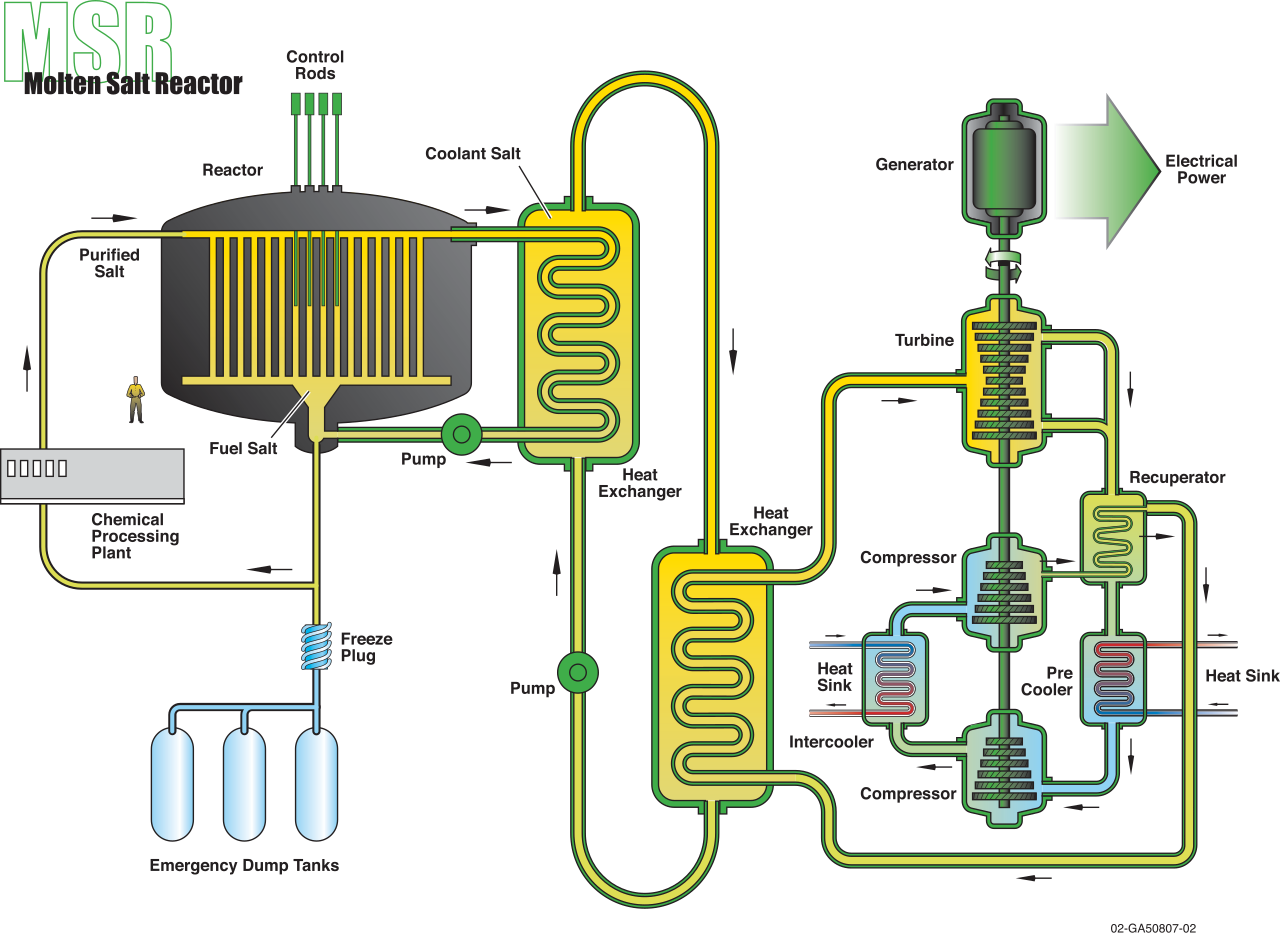
MSR demand is optionality layered on the coolant base, and it is conditional on deployments that have not occurred commercially. The World Nuclear Association's figure that lithium-7 demand could rise to 250 tonnes per year once MSRs commercialize, with tens of tonnes per reactor, is a scenario conditional on a fleet that does not exist and should not be read as a forecast [1]. What is documented is per-reactor inventory: fluoride-salt designs use thousands of kilograms of lithium-7 at 99.95 to 99.995 percent assay for initial fills, plus makeup [4][5][17]. The conditions under which this demand materializes are commercial MSR licensing and deployment at scale, which remain uncertain.
5.3 Fusion breeder blankets: the largest and least certain leg.
Fusion is the largest potential demand and the least certain. Published blanket studies put a 2 GW DEMO water-cooled lithium-lead blanket at roughly 52 tonnes of lithium-6 at 90 percent enrichment (about 26 tonnes of 90-percent lithium-6 per gigawatt of fusion power as total inventory), against a small consumption rate of roughly 112 kilograms of lithium-6 per full-power year per gigawatt [18]. Analyses estimate that a scenario of ten operational plants by 2050 would require over 100 tonnes of lithium-6 by 2035 [11]. These are conditional on fusion plants reaching commercial operation, which has not happened. Molten Salt Solutions has signed framework strategic agreements with the fusion developers Type One Energy and Gauss Fusion, and separately a firmer commercial agreement with Fissionaire to supply lithium-7 for its molten salt reactor; even the firmer agreement precedes any commercial-scale delivery [9][31].
5.4 Defense, tritium production, and minor uses.
Lithium-6 is the feedstock for tritium production, historically for thermonuclear weapons and now also for civil tritium targets, and this defense demand is the reason for its export control [10][22]. Minor uses include neutron detection and research quantities [14]. These markets are small in tonnage but strategically weighty, and in the United States DOE prioritizes lithium-6 for defense-related tritium production [10].
6. Substitution and Thrifting
6.1 Potassium hydroxide and ammonia chemistry for PWRs.
The most credible substitution threat to lithium-7's core market is the replacement of lithium-7 hydroxide with potassium hydroxide for PWR primary coolant pH control, drawing on VVER operating practice where potassium hydroxide (supported by in-core lithium and ammonia-derived hydrogen) is standard [32][33]. EPRI has run a multi-year program on this switch: an initial review in 2002, a further investigation in 2015 finding no known material-compatibility showstopper, and by its own account is roughly halfway through a decade-long research program to inform a fleet switch [33][34]. EPRI estimated the switch could save each reactor roughly $100,000 per year and that existing lithium injection systems could be reused [32]. The gating issues are technical and regulatory: irradiation-assisted stress corrosion cracking of in-core components under potassium chemistry, the need to manage both potassium and residual in-core lithium simultaneously, and the multi-year qualification and licensing burden of any coolant chemistry change in an operating fleet [32][35]. This is a slow threat; it caps the long-run pricing power of lithium-7 in coolant applications without eliminating near-term demand.
6.2 Coolant recovery as thrifting.
The EPRI-demonstrated recovery of roughly 85 percent of cycle lithium-7, combined with in-core generation, is a thrifting mechanism that reduces makeup demand and further limits the volume upside of the coolant market [30].
6.3 Chloride-salt reactors displace the requirement.
A different substitution operates at the reactor-design level. Chloride-salt fast reactors, such as TerraPower's Molten Chloride Fast Reactor, use chloride rather than fluoride salts and therefore do not require lithium-7 at all; they substitute a chlorine-37 enrichment requirement of roughly 97 to 98 percent to avoid chlorine-36 activation and improve neutron economy [19][20][36]. To the extent the advanced-reactor market tilts toward chloride-salt fast designs rather than fluoride-salt thermal designs, the incremental lithium-7 demand from the MSR leg shrinks and is replaced by chlorine-37 demand, a separate isotope chain. This is a structural hedge risk to the MSR-driven lithium-7 thesis.
7. Pricing and Market Structure
Pricing in this chain is opaque. There is no exchange trading of enriched lithium isotopes and no established price reporting agency coverage at the isotope level; the price reporting agencies that cover lithium (Benchmark Mineral Intelligence, Fastmarkets) assess natural battery-grade lithium carbonate, hydroxide, and spodumene, not isotopically enriched material [21][37]. The result is a wide gap between research-quantity catalog pricing (Sigma-Aldrich, American Elements, and similar vendors list gram-scale enriched lithium-6 and lithium-7 at prices that are not representative of bulk contract economics) and undisclosed bulk contract pricing negotiated bilaterally under export-control licensing [38][27]. Customs and trade statistics do not resolve isotopic assay and therefore cannot be used to reconstruct isotope-level volumes or prices [10]. The only public incentive-price anchors are the decade-old DOE and JASON figures of roughly $1,500 to $15,000 per kilogram for high-assay lithium-7, which are too stale to guide investment [16]. Treat all specific enriched-lithium price figures with caution and demand provenance.
8. Key Players
8.1 Public companies.
ASP Isotopes Inc. (NASDAQ:ASPI) is the only listed pure-play with a dedicated lithium enrichment program, conducted through its Quantum Leap Energy subsidiary [6][7]. The lithium program is early-stage and unproven for lithium specifically; the company's demonstrated production track record is in other isotopes (ytterbium-176, silicon-28, carbon-14) [26][6]. ASP Isotopes holds roughly $140.7 million of QLE convertible notes and all of QLE's common equity, with third-party investors holding about $79.1 million of notes, and filed a confidential draft S-1 for a QLE listing in November 2025 [39][40]. TerraPower (private) and Southern Company (NYSE:SO) are relevant on the reactor-demand side through the Molten Chloride Fast Reactor, but that design displaces lithium-7 in favor of chlorine-37, so it is not a lithium-7 demand proxy [36][20]. Centrus Energy (NYSE:LEU) appears as an investor associated with Hexium and is a uranium-enrichment player, not a lithium producer [8].
8.2 Private companies.
Hexium (private), founded October 2023 in Austin by Charlie Jarrott (CEO), Jacob Peterson, and Martin Griswold (CTO), is reviving AVLIS with LLNL under a Technology Commercialization Fund award and CRADA, having launched from stealth in April 2025 with $12 million ($8 million seed co-led by MaC Venture Capital and Refactor, plus $4 million primarily non-dilutive) [8][25]. Molten Salt Solutions (private), Santa Fe, New Mexico, founded by former Los Alamos personnel, closed an oversubscribed $7 million seed round on 31 August 2026 led by Dolby Family Ventures (with Vanedge Capital Partners, Alumni Ventures, Gaingels, True Ventures, and Future Ventures), following a $3 million pre-seed and more than $5 million in grants including a New Mexico Advanced Energy Award, and has signed strategic and commercial agreements with Type One Energy, Gauss Fusion, and Fissionaire [9][31].
8.3 State-owned enterprises and national laboratories.
Rosatom (Russian state-owned), through TVEL and the Novosibirsk Chemical Concentrates Plant, is the incumbent merchant producer of lithium-7 hydroxide and, since December 2025, the developer of a lithium-7 fluoride process [1][3]. China's Shanghai Institute of Applied Physics is the principal Chinese consumer through its thorium MSR program [3]. In the United States, the DOE Isotope Program supports preparation and packaging of lithium isotopes at Y-12, and LLNL, Los Alamos, and Oak Ridge are the relevant national laboratories [41][8]. Necsa, the South African Nuclear Energy Corporation (state-owned), is the site and infrastructure partner for ASP Isotopes/QLE at Pelindaba [28].
9. Geopolitical and Policy Dimensions
9.1 Concentration risk and export control classification.
The concentration of separation capacity in Russia, with China self-supplying, is the central geopolitical fact, and it is the same picture the GAO drew in 2013, now corroborated by 2025 trade-press and WNA sourcing rather than repeated on the strength of the 2013 report alone [4][1][3]. Enriched lithium-6 is export-controlled. Under the US Export Administration Regulations, lithium enriched above natural abundance in lithium-6, and products containing it, is controlled, and a 2018 rule added ECCN 1A231 covering lithium-6 target assemblies specially designed for tritium production [27][42]. Controls flow from the Nuclear Suppliers Group and Wassenaar Arrangement frameworks implemented in national law [43][44].
9.2 The non-proliferation threshold debate.
A 2026 analysis in the Cell Press journal family argues for an international safeguards framework built on explicit lithium-6 enrichment thresholds: natural below 8 percent, low-grade 8 to 40 percent, intermediate 40 to 60 percent, high-grade 60 to 75 percent, and top-grade above 75 percent, with roughly 60 percent presented as a practical ceiling for most commercial fusion and material above 75 percent treated as highly sensitive [10]. A companion preprint argues that lithium enrichment requirements could curb fusion deployment and that reducing the target from 90 to 50 percent lithium-6 would cut the number of enrichment stages from about 80 to about 50, lowering cost [11]. This is an academic proposal, not adopted regulation. If adopted, this would constrain certain high-enrichment fusion blanket designs and would cap what a commercial coproduction facility could produce and to whom it could sell, which propagates directly into the coproduction economics of Section 3 [10][11].
9.3 Resource nationalism, stockpiles, and industrial policy.
US industrial policy instruments touching this chain include the DOE Isotope Program, the Technology Commercialization Fund (the vehicle for the LLNL-Hexium AVLIS award), DOE INFUSE and SBIR awards (Molten Salt Solutions cites NSF SBIR and Los Alamos collaboration), and state-level awards (New Mexico's Advanced Energy Award) [25][9][8]. The DOE Isotope Program's budget justifications explicitly cite supply-chain vulnerability after the Russian invasion of Ukraine as a driver for domestic isotope capacity [45]. There is no US strategic reserve of enriched lithium beyond the residual Y-12 inventory and the 200-kilogram lithium-7 set-aside DOE contemplated [4][22].
9.4 Sanctions exposure. Post-2022 sanctions dynamics are a live but imperfectly documented risk. Russia restricted enriched uranium exports to the United States in 2024, and while no specific Russian enriched-lithium export ban was identified in open sources, the dependence on a single sanctioned-adjacent supplier is precisely the exposure that motivates Western entrants and DOE funding [45][3]. Any escalation touching Rosatom would directly threaten the lithium-7 coolant supply chain.
10. Risk Matrix
| Risk | Likelihood | Impact | Mitigations |
|---|---|---|---|
| Supply concentration / Russian counterparty disruption to lithium-7 coolant supply | High | High | EPRI 85% coolant recovery and in-core generation; DOE Y-12 reserve; qualify Western entrants; potassium hydroxide substitution program |
| Execution failure by Western entrants (lithium not demonstrated at scale) | High | Medium | Diversify across ASPI, Hexium, MSS; treat capacity/efficiency claims as unproven until third-party validated |
| Substitution: KOH/ammonia displaces lithium-7 in PWRs | Medium (long-dated) | High to the lithium-7 coolant thesis | Multi-year qualification and IASCC concerns slow adoption; near-term demand persists |
| Substitution: chloride-salt fast reactors displace MSR lithium-7 demand with chlorine-37 | Medium | Medium to the MSR upside | Fluoride-salt designs still active; chlorine-37 is a separate opportunity |
| Non-proliferation threshold regime caps lithium-6 enrichment/sales | Medium (proposal, not adopted) | High to fusion coproduct economics | Design blankets to ≤60% lithium-6; secure licensing pathway for lithium-6 disposition |
| Coproduct imbalance (unsellable lithium-6 tails or lithium-7 glut) | Medium | Medium to High | Match plant scale to the binding market; secure offtake for both isotopes before financing |
| Pricing opacity / mispriced offtake | High | Medium | Demand provenance on every price; contract on take-or-pay terms |
| Financing / early-stage capital risk (venture and micro-cap) | High | High | Stage capital against demonstrated milestones; watch QLE spin-out terms |
| Permitting and licensing delay (nuclear/export) | High | Medium | Site at existing nuclear infrastructure (Necsa, Y-12-adjacent); early regulator engagement |
| Feedstock | Low | Low | Not a constraint; abundant and cheap |
| Environmental (mercury legacy of COLEX) | Low (for new mercury-free entrants) | Medium | Mercury-free processes (AVLIS, chemical exchange, electrochemical) are the entire Western design premise |
Recommendations
For the public-equity investor.
The honest finding is that clean public-market exposure to the enriched lithium isotope thesis barely exists, and that scarcity is the single most important fact for positioning. The only listed vehicle with a dedicated lithium program is ASP Isotopes (NASDAQ:ASPI), and even there the exposure is diluted: the lithium program is one of many isotope programs, it has not yet demonstrated lithium output, and it is slated to be carved into a separately listed Quantum Leap Energy entity whose terms (the 10 percent perpetual royalty to the parent, the note structure) will determine how much lithium upside accrues to ASPI shareholders versus QLE holders [6][29][39]. An investor buying ASPI today is buying a diversified early-stage isotope enricher with optionality on lithium, not a lithium pure-play. Reactor developers (TerraPower via Southern Company) and enrichment names (Centrus) are dilute proxies that would not move on the lithium isotope thesis specifically; TerraPower's chloride design actively bypasses lithium-7 [36][8]. The genuine pure-plays, Hexium and Molten Salt Solutions, are private and accessible only through venture channels [8][9]. Staged approach: treat ASPI as the only listed toehold and size it as a speculative, execution-dependent position; monitor the QLE S-1 for the actual economics of the lithium carve-out; and watch for any private-to-public transition by Hexium or Molten Salt Solutions as the event that would create a true pure-play. Thresholds that change the thesis: a demonstrated, third-party-verified Western lithium-7 product at coolant assay (bullish confirmation), versus EPRI reaching a licensable potassium hydroxide package or the advanced-reactor market consolidating around chloride-salt fast designs (each bearish for the lithium-7 volume case), and adoption of a lithium-6 enrichment cap near 60 percent (bearish for the fusion coproduct economics).
For the corporate procurement or utility fuel-cycle strategist.
The actionable risk for a utility with PWRs is coolant lithium-7 supply concentration in a single foreign, sanctions-adjacent producer [1][3]. Stage one: exploit the buffers that already exist, namely EPRI-validated coolant recovery (roughly 85 percent) and in-core lithium-7 generation, and confirm participation in EPRI's potassium hydroxide qualification program as a strategic hedge, recognizing it is years from fleet deployment [30][33]. Stage two: diversify procurement by qualifying at least one Western entrant as it demonstrates production, using take-or-pay terms that reflect the pricing opacity of the material [9][6]. Stage three: for any utility or developer pursuing fluoride-salt MSRs, treat the 99.995 percent lithium-7 initial inventory as a long-lead, single-source procurement risk and secure it early; for chloride-salt developers, the equivalent risk shifts to chlorine-37 [5][19]. The benchmark that should change procurement posture: a demonstrated, qualified Western lithium-7 hydroxide product at coolant assay, or EPRI reaching a licensable potassium hydroxide package, either of which would materially reduce the Russian dependence.
Caveats
The supply side, production economics, and pricing of this chain are genuinely opaque, and the report reflects that. No reliable current (2025–2026) bulk contract price for enriched lithium-7 or lithium-6 was identified; the price anchors used are more than a decade old and should not carry the confidence of current market data [16]. Named Chinese lithium-7 enrichment entities are not well documented in open English-language sources; the Chinese role is characterized here as consumption and reported purchase from Russia rather than merchant export, on the strength of WNA and trade-press attribution [1][3]. No specific Russian enriched-lithium export ban was found in open sources; the documented 2024 Russian restriction was on enriched uranium, and the lithium concern is framed as a dependence risk rather than a materialized event [45][3]. The capacity and efficiency claims of ASP Isotopes, Hexium, and Molten Salt Solutions are company assertions and are treated as unproven for lithium until independently validated; none has demonstrated commercial-scale enriched lithium output [6][8][9]. The molten salt reactor and fusion demand figures are conditional scenarios, not forecasts, and depend on deployments that have not occurred commercially [1][11].
References
[1] World Nuclear Association. 2024–2025. "Lithium." Information library. world-nuclear.org.
[2] US Government Accountability Office. 2013. "Managing Critical Isotopes: Stewardship of Lithium-7 Is Needed to Ensure a Stable Supply." GAO-13-716.
[3] World Nuclear News. 2025. "Rosatom develops production process for lithium-7 fluoride." 11 December.
[4] US Government Accountability Office. 2013. GAO-13-716 (full report and highlights).
[5] World Nuclear Association. 2024–2025. "Molten Salt Reactors." Information library.
[6] ASP Isotopes Inc. 2025–2026. Press releases and shareholder communications (GlobeNewswire; ir.aspisotopes.com).
[7] Quantum Leap Energy / ASP Isotopes. 2026. Company descriptions of ASP and Quantum Enrichment technologies (aspisotopes.com).
[8] Hexium. 2025. Launch and funding disclosures (Power Technology; Climate Insider; Crunchbase).
[9] Molten Salt Solutions, Inc. 2026. "Molten Salt Solutions Raises $7 Million…" PR Newswire, 31 August; company site.
[10] "Getting the balance right—Considerations of lithium enrichment for the fusion fuel cycle with a focus on nuclear non-proliferation." 2026. Cell Reports Physical Science / ScienceDirect (S2542435126002801).
[11] "Lithium enrichment threatens to curb fusion deployment." 2026. arXiv:2605.04707.
[12] US Patent 4,600,566, "Method of lithium isotope separation" (abundance data). [13] "Research progress on lithium isotopes separation by chemical exchange with crown ethers." ScienceDirect (S2468025724001791).
[14] "New Trends in Separation Techniques of Lithium Isotopes: A Review of Chemical Separation Methods." 2023. Materials 16(10):3817 (MDPI).
[15] C&EN. 2025. "Nuclear fusion fuel without toxic mercury." March.
[16] ScienceDirect Topics. "Lithium-7 – an overview" (Ault et al. 2012; JASON 2011 price citations).
[17] "Influence of 7Li enrichment on Th-U fuel breeding performance for molten salt reactors." ScienceDirect (S014919701930321X).
[18] Giegerich et al. 2019. "Development of a viable route for lithium-6 supply of DEMO and future fusion power plants." Fusion Engineering and Design (ScienceDirect S092037961930835X).
[19] "The Need of Chloride-37 Enrichment for Molten Salt Fast Reactors." 2024. Preprints.org (202408.0677).
[20] TerraPower. "Benefits of the Molten Chloride Fast Reactor" (terrapower.com); US Department of Energy, "Southern Company Services and TerraPower Build World's Largest Chloride Salt System."
[21] Benchmark Mineral Intelligence. 2026. Lithium price assessment, 12 August (benchmarkminerals.com).
[22] Wikipedia; DOE historical documentation. "COLEX process"; DOE Isotope Program materials on retirement of mercury-based separation.
[23] EurekAlert! 2025. "Producing nuclear fusion fuel is banned in the US for being too toxic…" (Banerjee et al., Chem, 20 March 2025).
[24] C&EN / Fusion Energy Insights. 2025. Coverage of zeta-vanadium oxide electrochemical lithium-6 enrichment.
[25] Lawrence Livermore National Laboratory. 2024. "Revitalized laser technology captures commercialization grant."
[26] ASP Isotopes Inc. 2025. "Completes Commissioning of First Quantum Enrichment Laser System…" GlobeNewswire, 1 April; 2025 production updates.
[27] ECCN listings for lithium-6 (Commerce Control List; eccnfinder.com).
[28] ASP Isotopes Inc. 2026. "Quantum Leap Energy and Necsa Advance Strategic Collaboration…" GlobeNewswire, 23 February; SEC exhibit aspi_ex991.htm.
[29] ASP Isotopes Inc. License and EPC Services Framework Agreements (SEC exhibits aspi_ex995.htm; Law Insider).
[30] ANT International. "Key Emerging Issues and Recent Progress Related to Plant Chemistry" (LCC14, coolant recovery data).
[31] Molten Salt Solutions / Heatmap News; PR Newswire, 24 March 2026. Coverage of Type One Energy, Gauss Fusion, and Fissionaire agreements.
[32] EPRI Journal. 2017. "Conserve, Recover, Replace."
[33] EPRI Journal. "From Lithium to Potassium."
[34] "The effect of potassium hydroxide primary water chemistry on the IASCC behavior of 304 stainless steel." Journal of Nuclear Materials (ScienceDirect S0022311521005468).
[35] EPRI Journal. 2016. VVER primary chemistry review (Sursock).
[36] Gateway for Accelerated Innovation in Nuclear (INL). TerraPower Molten Chloride Reactor Experiment chlorine data.
[37] Fastmarkets. Lithium price methodology and coverage (fastmarkets.com).
[38] Sigma-Aldrich; American Elements; ChemicalBook. Catalog listings for enriched lithium-6 and lithium-7.
[39] StockTitan / ASP Isotopes SEC 8-K. 2026. QLE note structure and spin-out disclosure.
[40] ASP Isotopes Inc. 2026. Letter to Shareholders (GlobeNewswire, 4 August).
[41] US Department of Energy. FY2024 Isotope R&D and Production Congressional Justification (Y-12 lithium packaging).
[42] Federal Register. 2018. ECCN 1A231, tritium production targets (FR-2018-04-05).
[43] US Department of State. "Multilateral Export Control Regimes" (NSG, Wassenaar).
[44] Wassenaar Arrangement. 2021. Dual-Use List.
[45] US Department of Energy. FY2025 Isotope R&D and Production Congressional Justification (supply-chain vulnerability).