Riot Platforms, Inc: History, Current Position, and Future Prospects
Mining turned cash negative on a fully loaded basis in Q2 2026. Riot's 241 MW of AI leases are contracted but not yet delivered or financed.

TL;DR
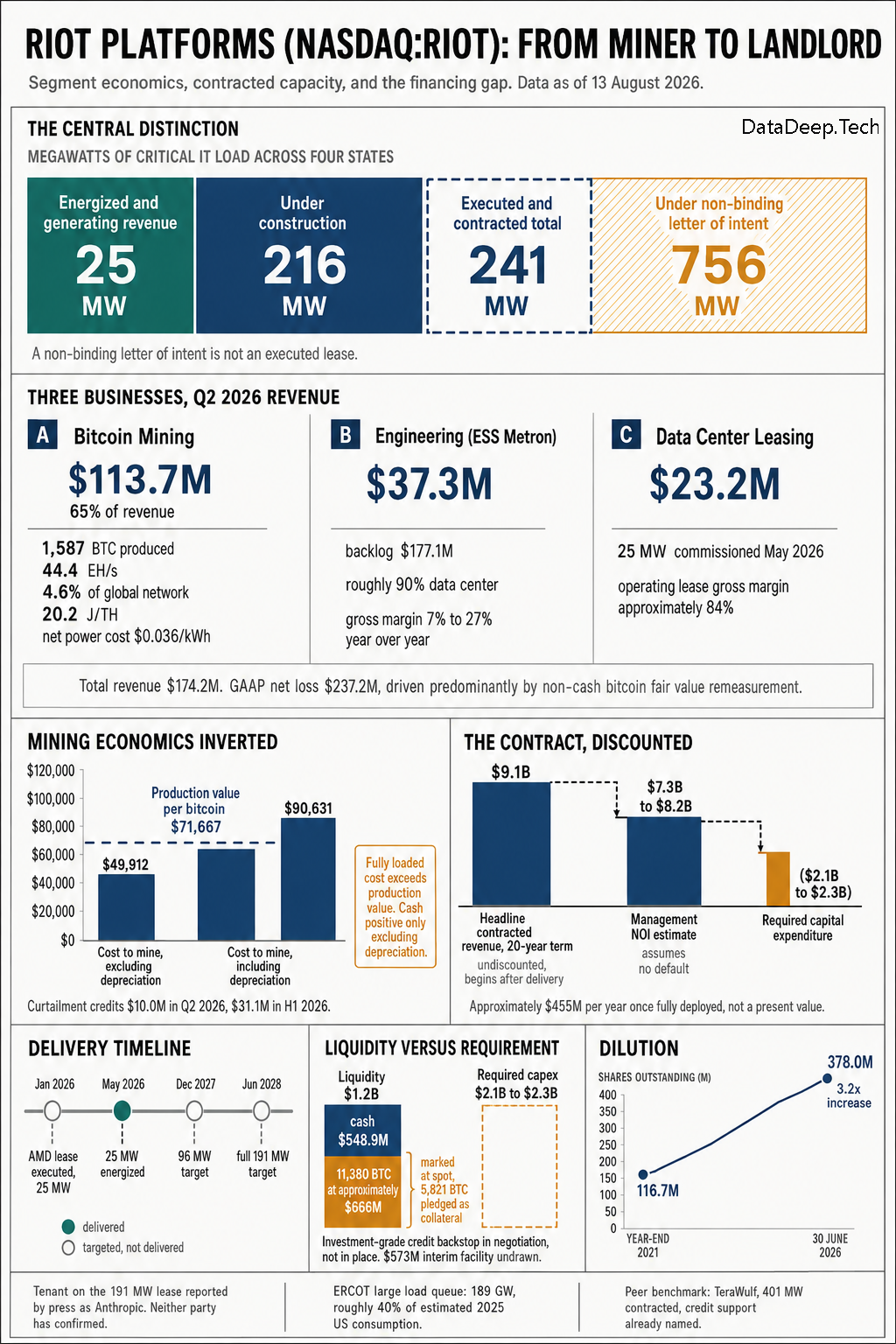
- Riot Platforms is mid-transformation from a pure-play bitcoin miner into a contracted AI data center landlord, and can be analyzed as three distinct businesses; in Q2 2026 it reported $174.2 million total revenue ($113.7 million mining, $37.3 million engineering, $23.2 million data center) and a $237.2 million GAAP net loss driven overwhelmingly by non-cash items, while mining still supplied roughly 65% of revenue [1][2].
- The transition is exists contractually but not yet delivered or financed: Riot has 241 MW of executed critical IT capacity (AMD 50 MW; a "leading frontier AI lab," reported by Bloomberg and independently confirmed by CNBC's David Faber to be Anthropic, 191 MW) representing about $9.8 billion of undiscounted contracted revenue, yet the first 96 MW of the flagship lease is not scheduled to energize until December 2027 and its investment-grade credit backstop is still being finalized [2][4][6][41].
- The core risks are financing and delivery, not demand: the 191 MW build alone implies roughly $2.1–$2.3 billion of capex against about $1.2 billion of liquidity (half of it bitcoin marked at spot); the equity is best understood as a call option on converting undiscounted headline contract values into financed, delivered, credit-backed net operating income [1][2][6].
Key Findings
Riot Platforms is three businesses with three economic structures. The bitcoin mining operation earns volatile, unhedged revenue against a falling commodity price and rising global difficulty; the data center leasing operation earns contracted, long-duration, credit-dependent rent that has barely begun to flow; and the engineering segment earns project margin against a backlog that is now roughly 90% data-center work [1][2]. These carry different capital intensities, risk profiles, and valuation frameworks, and blending them into a single narrative would mislead.
The data cutoff for this report is Riot's Form 10-Q for the quarter ended June 30, 2026 (filed August 10, 2026), the concurrent Q2 2026 earnings materials and 8-K exhibits, and the FY2025 Form 10-K [1][2][3]. This subject moves in weeks, not quarters: the 191 MW lease and the Corsicana campus letter of intent were both disclosed on August 10, 2026, subsequent to the quarter that the same filing reported [6][7].
Three facts most change a reader's prior. First, mining became cash-negative on a fully-loaded basis in Q2 2026: cost to mine including depreciation was $90,631 against a production value of $71,667 per bitcoin, though the fleet stayed cash-positive excluding depreciation ($49,912 cost to mine) [2]. Second, the headline lease values are undiscounted multi-decade sums contingent on capacity that does not yet exist [6]. Third, Riot has funded its pivot substantially by drawing down its bitcoin treasury, which fell from 19,273 BTC in mid-2025 to 11,380 by mid-2026 [1][25].
Details
1. Corporate history and governance evolution
Riot began as Bioptix, Inc., a veterinary and biotechnology diagnostics business. In October 2017 it renamed itself Riot Blockchain, Inc. and redirected into cryptocurrency, with the stock spiking on investor enthusiasm to above $38 per share [10][11]. A February 2018 CNBC investigation flagged postponed annual meetings, insider selling after the name change, dilutive discounted placements to large investors, and a major shareholder selling while others bought; the report precipitated a decline of over 33% [11].
The enforcement record must be stated precisely, because it targeted individuals rather than the operating company. In September 2018 the SEC charged Barry Honig, John O'Rourke (a former Riot chairman and CEO), and 18 other individuals and entities with participation in "classic pump-and-dump schemes" [12]; CNBC reported that the SEC case was unrelated to Riot Blockchain as such, and the specific counts concerned three other issuers [11]. Honig, formerly the largest shareholder at roughly 11.2% in January 2017 [13], agreed in 2019 to settle the SEC's liability claims [11][12]. A separate shareholder class action in the Southern District of Florida named the company, certain officers, and Honig [8][9][14]; the claims against Riot's current directors and officers (including Jason Les, Andrew Kaplan, and Eric So) and against Honig were dismissed in May 2020 [15]. Conflating the individual enforcement with any action against the company would misstate the record.
Under Jason Les, CEO since 2021, Riot built through acquisition. It acquired Whinstone US (the Rockdale, Texas facility) from Northern Data in May 2021 for approximately $651 million ($80 million cash plus 11.8 million shares) [16][17]; the electrical-equipment and engineering business ESS Metron in December 2021 for approximately $50 million ($25 million cash plus up to 715,413 shares) [18][19]; and Kentucky-based Block Mining in 2024 for approximately $92.5 million, adding roughly 60 MW and entering the MISO market [20].
The 2024 Bitfarms episode reflects poorly on capital allocation. Riot made public a hostile bid for Bitfarms Ltd. (NASDAQ/TSX:BITF) in May 2024 at US$2.30 per share (about $950 million equity value), disclosing a 9.25% stake [21]. Bitfarms rejected the offer and adopted a poison pill; Riot withdrew the price but kept buying, reaching nearly 19.9% (90,110,912 shares) [21][23]. A September 2024 settlement capped Riot's stake and seated a Riot-endorsed director [23]. Riot then unwound the position, selling to 14.3% by June 2025 at roughly $0.90 per share, well below cost, having deployed substantial capital at a cyclical top without gaining control [24][25].
In December 2024 activist Starboard Value took a significant position and pressed Riot to convert mining sites to AI/HPC data centers, citing the Core Scientific/CoreWeave model [26][27]. This pressure shaped strategy: on January 21, 2025, Riot halted its planned 600 MW Phase II mining expansion at Corsicana, engaged consultant Altman Solon, and cut its 2025 self-mining hash rate target from 46.7 EH/s to 38.4 EH/s [28][29][30]. Riot also resolved a value-destructive legacy dispute: its Whinstone subsidiary acquired Rhodium's Rockdale assets in April 2025 for $185 million total ($129.9 million cash, $6.1 million deposit return, $49 million in stock), assumed Rhodium's 125 MW, terminated hosting contracts that had produced an approximately $15 million gross loss in FY2024, and dismissed all litigation [31][32][44]; Rhodium confirmed a liquidating plan in December 2025 [33].
The net governance assessment is mixed. Whinstone and Block Mining secured genuinely scarce power that now underpins the pivot, and the Rhodium settlement ended a loss-making contract; but the Bitfarms adventure destroyed capital, and the data center pivot was substantially prompted by an activist rather than initiated by management [21][24][26].
2. Physical asset base and power position
Riot's competitive claim rests on holding energized, interconnected, permitted power at scale in ERCOT. As of 2025–2026 it owned more than 1,100 acres across two Texas campuses with 1.7 GW of approved power combined [22].
The Rockdale campus (via Whinstone) holds roughly 700 MW of developed capacity and hosts both executed data center leases; after the Rhodium acquisition, 100% of Rockdale's power is allocated to Riot [22][31]. All 241 MW of contracted critical IT capacity sits at Rockdale on existing, fully approved interconnection [6][41]. The Corsicana campus in Navarro County holds 1 GW of fully approved ERCOT utility power on Riot-owned land, one of the largest single-site allocations of any miner or data center operator in Texas [22][28]. Riot expanded Corsicana in 2025 (355 acres in May, 238 in July, plus a 67-acre adjacent parcel) to roughly 858 acres [34]. Corsicana currently runs 400 MW of Phase I mining; the halted 600 MW Phase II is now targeted for AI/HPC [28][30].
The gross-to-net distinction is central: Corsicana's 1 GW of gross utility power converts to roughly 756 MW of net critical IT load (a ratio near 0.76), the difference consumed by cooling, conversion losses, and facility overhead [7][22]. The 1 GW is a gross campus figure; the 756 MW is the economically relevant net critical IT figure, and it remains uncommitted capacity under a non-binding letter of intent, not contracted capacity [7]. Riot also runs Kentucky (Block Mining) facilities in MISO, targeting 110 MW for self-mining with expansion optionality toward 300 MW [20][30], and has filed a $400 million construction permit for a new Corsicana data center building (codenamed "Project Ditto," roughly 335,430 square feet) [34].
The power advantage decays. Texas SB6 grandfathers existing interconnections while slowing new large-load entry, raising the scarcity value of Riot's energized positions [49][50][51]; but the advantage is transferable only once, since converting a mining site to a data center consumes the power position and then requires Riot to compete on data center operating competence, where it has limited history.
3. The bitcoin mining business
Mining remains the largest business by revenue but is under structural pressure. In Q2 2026 Riot produced 1,587 bitcoin (17.4 per day), up from 1,426 a year earlier, ending the quarter at 44.4 EH/s of deployed hash rate, about 4.6% of the global network, with 87% utilization (reduced by minor May downtime in Kentucky) [2][25]. Fleet efficiency was approximately 20.2 joules per terahash as of Q1 2026 [38], reflecting MicroBT WhatsMiner M60-series and M66S immersion units (the M66S rated at 18.5 J/TH), procured under a December 2023 agreement for 18 EH/s at $290.5 million (about $16/TH) with options toward 100+ EH/s [35][36].
The economics deteriorated with rising difficulty and the post-2024-halving subsidy. Q2 2026 cost to mine excluding depreciation was $49,912 (69.6% of production value); including miner depreciation it was $90,631 (126.5% of production value), so the fully-loaded fleet lost money, though it remained cash-positive excluding the sunk, non-cash depreciation [2].
Riot's power strategy is the differentiator. Fixed-price power purchase arrangements let it curtail and resell power via ERCOT and MISO demand-response programs [2][3]. Q2 2026 curtailment credits were $10 million ($6,335 per bitcoin mined), cutting net power cost to $0.036 per kWh, among the industry's lowest; first-half 2026 curtailment credits totaled $31.1 million versus $16.1 million a year earlier [2][25]. Q1 2026 total power credits reached $21 million with all-in power costs of $0.030 per kWh [38].
The reported net power cost of $0.036 per kilowatt hour in the second quarter of 2026 is not a tariff and should not be read as one [2]. It is a residual, calculated after power credits are subtracted from gross energy cost, and Riot has not separately disclosed the gross figure in the materials reviewed. The economically meaningful statement is therefore not that Riot buys electricity cheaply, but that it earns enough from selling flexibility back to the grid to offset a substantial share of what it pays for electricity. The first quarter of 2026 illustrates the sensitivity: total power credits of $21.0 million produced an all-in power cost of $0.030 per kilowatt hour, lower than the second quarter figure on higher credits rather than on cheaper power [38]. Credits themselves have grown materially, from $16.1 million in the first half of 2025 to $31.1 million in the first half of 2026 [2][25].
Three distinct mechanisms generate those credits, and they are worth separating because they do not carry equal durability. The first is resale arbitrage under fixed-price power purchase arrangements: when ERCOT settlement prices exceed Riot's contracted price, curtailing the fleet and selling contracted power into the market yields a spread that is booked against power cost [2][3]. This is structurally a long call option on ERCOT power, with mining as the disposition of electricity when the option is out of the money. The second is compensation for participation in demand response programs, which pay interruptible loads for standing reserve capability; Senate Bill 6 creates a competitively procured demand response reliability service that formalizes and may expand this channel [49][50]. The third is avoidance of transmission cost allocated on the basis of consumption during ERCOT's four coincident summer peak intervals, where curtailment during a small number of fifteen-minute windows reduces transmission charges across the following year. No independently verifiable source within the evidence base consulted here establishes the magnitude of Riot's four coincident peak avoidance specifically, and the mechanism is described from general ERCOT market structure rather than from company disclosure. The same limitation applies to interconnection voltage: transmission-level interconnection would avoid distribution charges entirely, but no filing reviewed here states Rockdale's interconnection voltage.
The comparability consequence is direct and constrains the peer assessment. Reporting conventions across the mining cohort are not standardized, and operators variously disclose gross energy cost, cost net of credits, and all-in cost inclusive of transmission and demand charges. A hydroelectric operator outside ERCOT may hold cheaper raw power while reporting a higher headline number, simply because no comparable credit stream exists to net against it. Riot's power position is a real advantage, but an unknown portion of the apparent gap against peers is definitional rather than economic, and claims that Riot holds the lowest power cost in the cohort should be treated as unverified pending normalization of the underlying conventions.
All three mechanisms are contingent on the load being interruptible, which sharpens rather than restates the conversion tension. A tenant operating under an uptime service level agreement cannot be curtailed during a scarcity price spike, cannot be offered as emergency reserve, and cannot be dropped during a coincident peak interval. Conversion of a megawatt from mining to leased data center capacity therefore extinguishes all three revenue streams attached to it simultaneously, not merely the demand response component. The estimated order of magnitude of that loss, roughly $40,000 to $90,000 per megawatt per year, remains well below the contracted lease economics, but the low reported power cost and the conversion strategy are in direct conflict rather than mutual reinforcement, and the reported figure should be expected to deteriorate as conversion proceeds.
This surfaces the strategy's central tension. Curtailment credits are valuable precisely because mining load is interruptible; AI/HPC tenants require near-continuous uptime under SLAs and cannot be curtailed. Every megawatt converted from mining to leased capacity therefore extinguishes the demand-response optionality attached to it. Riot has not disclosed a clean per-megawatt value of the forgone optionality, so precise quantification is not possible from the public record. Directionally, roughly $31 million of H1 2026 credits against about 700 MW of Texas mining load implies on the order of $40,000 to $90,000 per MW per year [2][22], meaningful but an order of magnitude below the $365–$411 million average annual NOI the 191 MW lease is projected to generate [6]. The opportunity cost is dominated by the contracted lease economics if those economics are realized. On the forward path, with difficulty rising and the next halving scheduled for 2028, mining economics will tighten further; no independently verifiable source was identified for the exact bitcoin price at which the fleet turns cash-negative excluding depreciation, but the roughly $49,912 cash cost to mine implies a threshold near that spot level [2], moved by power-credit timing and fleet upgrades.
4. The data center business
This is the analytical core of the thesis, though the smallest business by current revenue at $23.2 million in Q2 2026 ($4.9 million operating lease revenue, $18.3 million tenant fit-out services) [1][2].
The AMD lease: On January 16, 2026, Riot executed its first lease, with Advanced Micro Devices, Inc. (NASDAQ:AMD), for an initial 25 MW of critical IT load at Rockdale on a 10-year term expected to generate approximately $311 million, with three five-year extensions that if fully exercised would reach approximately $1 billion [39][40]. AMD held an expansion option for 75 MW and a right of first refusal on 100 MW (up to 200 MW total) [39][40]. In April 2026 AMD exercised an expansion to 50 MW [41]. The initial 25 MW was fully commissioned in May 2026 and converted to recurring revenue; the 25 MW expansion is under construction (10 MW targeted November 2026, 15 MW May 2027) [2][41]. The Q2 2026 10-Q discloses AMD future base rent of approximately $633 million, and delivered AMD capacity carried operating lease gross margin of roughly 84% [1][2].
The 191 MW frontier AI lab lease: On August 10, 2026, Riot announced a 20-year Data Center Lease and Services Agreement with "one of the world's leading frontier AI labs" for 191 MW of critical IT capacity at Rockdale, a build-to-suit Tier 3 facility running through June 2048 [6]. It is expected to generate approximately $9.1 billion in initial contract revenue, with two five-year extension options raising the potential total to approximately $16.1 billion [6]. Management estimates cumulative NOI of $7.3–$8.2 billion over the base term (an average of $365–$411 million annually) at an illustrative 80%–90% NOI margin [2][6]. Capital expenditure is guided at $11–$12 million per IT MW, implying roughly $2.1–$2.3 billion for the full build [2][6]. Delivery is phased: 96 IT MW by December 2027 and full 191 IT MW by June 2028, using existing approved interconnection [6].
The epistemic status of these figures must be carried explicitly. The $9.1 billion and $16.1 billion are undiscounted sums of future rent that begin only after capacity is constructed and delivered, and assume no default and full performance over 20 to 30 years [6]. The NOI range is a management estimate assuming full on-schedule delivery, no tenant default across two decades, and operating cost assumptions Riot has not fully disclosed [2]. These totals cannot be compared to Riot's current annual revenue: the $9.1 billion accrues over 20 years beginning after 2027 (roughly $455 million per year once fully deployed), against roughly $2.1–$2.3 billion of prerequisite capex [2][6]. Under a plausible 9%–11% discount rate applied to a stream beginning in 2028 and running 20 years, the present value of the contracted rent is below the undiscounted headline, likely one-third to one-half of nominal before netting capital cost; no official present-value figure has been disclosed, and this is an analytical estimate.
On counterparty identity: Bloomberg reported on August 11, 2026 that the tenant is Anthropic, citing "people familiar with the matter, asking not to be identified discussing private information," and CNBC's David Faber independently confirmed the deal [4][5]; Riot's own disclosure describes only "a leading frontier AI lab," and neither Riot nor Anthropic has formally confirmed the identity [6]. The company's characterization and the press attribution are separate evidentiary claims with different standing. As credit assessment depends on identity, any credit judgment is contingent: if the tenant is Anthropic, it is a well-funded but currently unprofitable AI lab dependent on continued capital raising; if it is another party, the assessment could differ.
Credit support and development risk: The credit structure is incomplete. Riot arranged a $573 million interim financing facility through Morgan Stanley to fund initial development costs "while the investment-grade credit backstop is finalized" [2][6]. That backstop, which would underpin long-term project financing and de-risk the 20-year rent stream, is in negotiation, not in place, as of the data cutoff; management asserts negotiations are well advanced with multiple paths to investment-grade-level financing, but that is management's characterization, not a completed fact, and the Morgan Stanley facility had not been drawn as of the Q2 2026 filing [1][2]. Development risk is partially mitigated by vertical integration: ESS Metron manufactures low- and medium-voltage switchgear and power distribution units, among the most constrained long-lead components in the data center supply chain, and Riot increased manufacturing capacity 25% in 2026 [2][18]. Securing this equipment ahead of contract execution is a significant schedule advantage where switchgear and transformer lead times routinely exceed a year. The timeline (96 MW roughly 16 months from signing, full 191 MW in 22 months) is aggressive for Tier 3 but aided by existing interconnection and the AMD precedent (25 MW delivered on time from January signing to May commissioning) [2][6][39].
The Corsicana LOI: The entire Corsicana campus is under a non-binding letter of intent with a single prospective tenant for the full 756 MW of planned net critical IT capacity [7]. Riot has stated a full-site lease could generate more than $1 billion of annual rent once fully deployed, but that is a management estimate, not contracted revenue, and Riot has disclosed no tenant identity, rental rate, credit support, construction budget, or development financing plan [2][7]. A non-binding LOI covering a full campus is a different fact from an executed lease and must not be treated as equivalent.
5. The engineering and equipment segment
The engineering segment (ESS Metron and E4A Solutions) is small relative to the thesis but earns some of the strategic credit it is given. Q2 2026 engineering revenue was $37.3 million, more than triple the $10.6 million a year earlier, with gross margin expanding from roughly 7% to over 27%; backlog was $177.1 million, roughly 90% from the data center sector [1][2][25]. Riot cites $23.8 million in cumulative capex savings since the ESS Metron acquisition [2][18]. The strategic value is supply-chain control, not standalone profit: manufacturing its own switchgear compresses the most constrained long-lead procurement path in Riot's own buildout, and the company holds back manufacturing capacity for internal use [2]. The related-party dynamic matters: as intersegment work grows, a rising share of engineering activity supports Riot's own projects, so reported engineering revenue and margin should be read as partly internal value transfer [1]. The segment is a supporting actor, not a driver of enterprise value.
6. Financial position and funding of the buildout
Capital structure carries modest leverage relative to peers. As of June 30, 2026, total debt was approximately $843 million ($254.6 million current, $588.4 million non-current) [1]. The principal instrument is $594.4 million of 0.75% convertible senior notes due January 2030, issued December 2024, with an initial conversion rate of 67.2767 shares per $1,000 (a conversion price of approximately $14.86 per share); net proceeds of about $579.2 million were used predominantly to buy bitcoin [42][43]. Riot also holds a $200 million credit facility secured by restricted bitcoin (5,821 BTC pledged at June 30, 2026), amended in April 2026 to a fixed rate and extended maturity [1][38]. The $573 million Morgan Stanley interim facility for the 191 MW project was undrawn as of the filing [1].
Dilution is the defining feature of Riot's equity history. Shares outstanding grew from approximately 116.7 million at year-end 2021 to approximately 378 million at June 30, 2026, roughly a 3.2x increase (about +224%); the Q2 2026 10-Q cover reported 375,258,935 shares as of August 7, 2026 [1][3][44]. Growth was driven principally by at-the-market equity programs and acquisition stock: ATM programs raised roughly $298 million (2022), $762 million (2023), over $900 million (2024), and $212.7 million in 2025 under the August 2024 program [3][44][45]. A new $500 million 2025 ATM program was established in December 2025 but undrawn at year-end [45]. Management states it intends to fund the buildout through project-level financing and bitcoin monetization to minimize further common-equity dilution [2].
Liquidity and the financing gap: At June 30, 2026, Riot held over $1.2 billion in liquid assets, comprising 11,380 bitcoin at approximately $666 million (at $58,527 per bitcoin) and $548.9 million in cash ($77.5 million restricted) [1][2]. Roughly half of stated liquidity is a volatile asset marked at spot, and 5,821 of the coins are pledged as collateral [1]. The treasury has been a financing source: Riot sold 3,778 bitcoin for $289.5 million in Q1 2026 [38], and holdings fell from 19,273 BTC in mid-2025 to 18,005 at year-end 2025 to 11,380 by mid-2026 [1][3][25][37]. That drawdown is a financing fact independent of the accounting marks.
The central financing question is stark. The 191 MW build alone implies roughly $2.1–$2.3 billion of capex; the full Corsicana campus would require multiples [6][7]. Against roughly $1.2 billion of liquidity (half volatile) and $843 million of existing debt, the announced buildout is not financeable from current resources and depends on securing project-level, lease-backed financing at scale [1]. Infrastructure-style debt markets will finance a 20-year contracted cash flow only if the tenant obligation is investment-grade or credibly credit-enhanced; until the backstop is in place, the financing is bridged by the Morgan Stanley facility and remains contingent [2][6]. The emergence of contracted, long-duration cash flow should, in principle, lower Riot's cost of capital and open non-recourse project debt distinct from corporate recourse debt; whether that materializes on equity-preserving terms is the single most important financial variable for the equity.
7. Competitive position and the conversion cohort
Riot competes in two reference frames. Within the miner-to-AI conversion cohort, direct comparators are Core Scientific (NASDAQ:CORZ), TeraWulf (NASDAQ:WULF), Cipher Mining (NASDAQ:CIFR), IREN (NASDAQ:IREN), Applied Digital (NASDAQ:APLD), Hut 8 (NASDAQ:HUT), and Bitdeer (NASDAQ:BTDR), along with Galaxy Digital. Against purpose-built developers such as Equinix (NASDAQ:EQIX), Digital Realty (NYSE:DLR), and privately held Vantage, QTS, and Switch, the miners are new entrants without Tier III operating history.
The cohort's advantage rests on holding energized, interconnected power, not on operating competence, and it decays as interconnection queues clear and incumbents secure their own power; SB6 both slows new entrants and locks in the value of existing positions [49][50][51]. The credibility gap with sophisticated tenants is specific: no Tier III operating history, no investment-grade balance sheet, and consequent reliance on credit enhancement, which is why both the TeraWulf and Riot leases with the same reported counterparty hinge on backstops [2][47].
On placement, Riot is a leading cohort member but not the clear leader. TeraWulf disclosed in a Form 8-K dated July 6, 2026 that it had executed a twenty-year lease with Anthropic covering approximately 401 MW of critical IT load at its Hawesville, Kentucky campus, which it expects to produce roughly $19 billion of contracted lease revenue across the initial term and which it states will be supported by investment-grade credit, with initial capacity targeted for the second half of 2027 and full deployment by early 2028 [46][47][48]. TeraWulf also holds multiple Fluidstack leases with Google backstops totaling over 500 MW [47]. Core Scientific pioneered the model with CoreWeave [26]. Measured by contracted megawatts (241 MW executed) and tenant quality, Riot is credibly in the leading group, but it trails TeraWulf on contracted scale and, critically, TeraWulf's leases already carry named investment-grade credit support (Google) while Riot's largest backstop is still being finalized [2][6][47]. On delivered megawatts, Riot's 25 MW of commissioned AMD capacity is a genuine execution proof point several peers lack [2][41]. The honest placement is median-to-leading: ahead on execution discipline and power quality, behind TeraWulf on contracted scale and secured credit enhancement.
8. Demand drivers and market dynamics
The demand backdrop is the scramble for grid-connected power to train and serve frontier AI models. Bitcoin miners control two scarce inputs, permitted land and grid-connected electrical capacity, that would otherwise take years of permitting and transmission upgrades to replicate [52]. Recent comparables underwrite the economics: the TeraWulf 20-year, $19 billion, 401 MW lease and the Riot 20-year, $9.1 billion, 191 MW lease imply broadly similar per-MW annual economics of roughly $2.3–$2.4 million per critical IT MW per year over the base term [6][46][47]. The reported tenant has contracted for capacity across several infrastructure providers, of which the Fluidstack and TeraWulf arrangements are supported within the evidence base consulted here [46][47]; no independently verifiable source was identified for the full roster of that counterparty's other capacity agreements, and the broader claim should be treated as unverified.
That concentration is the key tenant-credit risk. Demand is dominated by a small number of well-capitalized but in several cases unprofitable counterparties. If Anthropic is the Riot tenant, it is not yet profitable and depends on continued capital raising to fund multi-decade obligations [4][5]; underwriting a 20-year rent stream against such a counterparty without external support is riskier than a lease to an investment-grade hyperscaler. This is precisely why the credit backstop matters and why the market underwrites 20-year durations only with credit enhancement [2][47].
On bitcoin dynamics: prices reached a new all-time high in 2025 but softened into 2026 [3][37]. The production value of one bitcoin mined fell from $98,800 in Q2 2025 to $71,667 in Q2 2026, with spot at $58,527 on June 30, 2026, down from $107,174 a year earlier and $87,498 at year-end 2025 [1][2][3][25]. Network hash rate rose roughly 24% year-over-year, raising difficulty and compressing margins even as Riot's own hash rate grew [2]. The 2024 halving cut the block subsidy, the next is scheduled for 2028, and transaction fees remain a small share of miner revenue [3]. These realized outcomes should be distinguished from company projections and forward expectations.
9. Regulatory and grid interconnection landscape
The binding regulatory fact is Texas Senate Bill 6, signed June 20, 2025, overhauling large-load (75 MW and above) interconnection and curtailment in ERCOT [49][50]. SB6 directs the PUCT and ERCOT to develop protocols allowing loads interconnected after December 31, 2025 to be curtailed during firm load-shed events and emergencies, requires such loads to install ERCOT-controllable curtailment equipment, sets a transmission screening study fee of at least $100,000, creates a competitively procured demand-response reliability service, and imposes site-control and cost-contribution requirements; it also requires PUCT/ERCOT approval for behind-the-meter co-location with existing generation after September 1, 2025 [49][50][51].
The competitive implication is double-edged and, on balance, favorable to Riot. SB6's obligations fall most heavily on new large loads interconnecting after year-end 2025, while Riot's Rockdale and Corsicana interconnections are already approved and energized, grandfathering their status and raising the scarcity value of existing positions [22][49][50]. The scale of the pressure is striking: in a PUCT Market Analysis Division presentation dated October 17, 2025, staff placed large load requests in the ERCOT queue at 189 gigawatts, which they characterized as roughly 40 percent of estimated national electricity consumption for 2025, with nearly 69 percent of that total attributable to data centers; the same presentation recorded that the Texas Reliability Entity had raised its assessment of the risk of disorganized large load integration during 2025, moving it from unlikely and moderate to likely and major [52]. The durability of the regulatory bargain permitting large interruptible loads is a genuine political question, and the value of Riot's demand-response revenue depends on that bargain holding; SB6 signals tightening oversight [49][51].
Riot participates in MISO demand-response programs at its Kentucky facilities [20][30]. Local permitting, noise, and water friction have historically attended mining sites; HPC conversion changes the local calculus somewhat, since data centers are quieter and are politically more palatable as economic-development anchors, though cooling water use can raise new concerns. On securities regulation, Riot's frequent material announcements and the 2018 disclosure controversy keep disclosure discipline a live governance issue, though current management's record is cleaner [11][15]. On cryptocurrency regulation, the federal posture has become notably more accommodative, reducing this exposure relative to prior years [3]; it should not be treated at inherited length.
10. Geopolitical and strategic dimensions
The ASIC supply chain is concentrated in a small number of firms of Chinese origin, principally Bitmain and MicroBT, exposing miners to import, tariff, customs, and national-security scrutiny. Riot has partly mitigated this by sourcing MicroBT M60-series and M66S units manufactured in the United States under its long-term agreement [35][36], a genuine if incomplete hedge against customs actions or tariffs raising fleet cost or delaying availability. On the tenant side, semiconductor export controls affect the geographic value of domestic capacity: restrictions on where advanced accelerators (such as those from NVIDIA and AMD) may be deployed increase the value of U.S.-sited, grid-connected capacity for frontier labs that must train domestically, a structural tailwind for Riot's Texas campuses; no independently verifiable source was identified within the evidence base for this specific linkage, and the assessment is analytical inference rather than sourced fact. The emergence of domestic compute as an object of industrial and national-security policy reinforces this. Grid reliability in Texas is a political question, and the durability of the large-flexible-load bargain is the operative geopolitical-adjacent risk [51][52]. The strategic significance of bitcoin mining to U.S. energy and monetary policy is largely rhetorical rather than operative for Riot's day-to-day economics. No memorandum of understanding regarding nuclear or advanced power generation was identified in Riot's disclosures as of the data cutoff [1][3]; any such technology would face the constraint that novel reactor designs have not received NRC design certification or construction permits.
11. Risk matrix
| Risk | Likelihood | Impact | Mitigations |
|---|---|---|---|
| Tenant credit / pending credit backstop for 191 MW lease not finalized | Medium | High | Morgan Stanley $573M interim facility bridges development [2][6]; management asserts investment-grade backstop advanced [2]; AMD diversifies [39] |
| Construction / delivery schedule slip vs. in-service dates (Dec 2027 / Jun 2028) | Medium | High | Existing interconnection [22]; in-house ESS Metron switchgear [2][18]; on-time AMD 25 MW precedent [2][41] |
| Capital availability and dilution to fund ~$2.1–2.3B+ buildout | Medium | High | Project/lease-backed financing sought [2]; bitcoin monetization [38]; $1.2B liquidity [1]; stated intent to avoid common equity [2] |
| Bitcoin price / network difficulty on mining fleet through 2028 halving | High | Medium | Low net power cost ($0.036/kWh) [2]; curtailment credits [2]; fleet upgrades [35][36]; declining share of revenue [1] |
| Loss of demand-response optionality on converted capacity | High | Low–Medium | Optionality value (~$40–90k/MW/yr) small vs. lease NOI [2][6]; mining retained on unconverted capacity [22] |
| Concentration: two tenants represent substantially all contracted revenue | High | High | Corsicana LOI would add a third tenant [7]; AMD and frontier lab are high-quality names [4][39] |
| Interconnection / regulatory change in ERCOT (SB6) | Medium | Medium | Existing interconnections grandfathered [49][50]; SB6 raises scarcity value of energized power [51] |
| Long-lead equipment cost / availability (transformers, switchgear) | Medium | Medium | Vertical integration via ESS Metron [18][19]; advance procurement; 25% manufacturing capacity increase [2] |
| Execution risk: limited Tier III data center operating history | Medium | Medium | AMD delivery track record [2][41]; partner ecosystem; senior data center leadership added (no independently verifiable source identified) |
| Counterparty renegotiation over 20-year term in fast-moving tech sector | Medium | High | Long-term lease with extension options at tenant election [6]; build-to-suit specificity [6] |
| Non-binding Corsicana LOI does not convert to executed lease | Medium | Medium | Substantial disclosed demand [52]; existing 1 GW approved power [22][28]; multiple sites evaluated [28] |
12. Forward scenarios
The following reasons forward from current evidence and states its assumptions; it is not a prediction.
Base case (through 2028): The 191 MW lease's investment-grade credit backstop is finalized in late 2026 or early 2027; project-level financing covers most of the roughly $2.1–$2.3 billion capex at a blended cost of debt around 7%–9%; the first 96 MW energizes on or near December 2027 and full 191 MW by mid-2028 [6]; AMD's 50 MW fully deploys by May 2027 [41]; the Corsicana LOI converts into at least a partial executed lease during 2027 [7]. Bitcoin trades in a $55,000–$85,000 band, keeping the shrinking mining fleet roughly cash-neutral to modestly positive excluding depreciation [2]. Share count grows modestly (under 15%) as project debt substitutes for equity [1][45]. Riot becomes a majority-contracted-revenue company by 2028 with roughly $500 million-plus of stabilized annual data center revenue once Rockdale is fully deployed [6]. Most sensitive variable: the credit backstop; falsified if the backstop fails to close and the Morgan Stanley bridge cannot be refinanced [2].
Upside case: The Corsicana campus is leased in full to a single high-quality tenant, adding up to 756 MW and management's stated $1 billion-plus annual rent potential [7]; credit support is investment-grade; bitcoin appreciates above $100,000, boosting the treasury and mining cash flow and lowering the cost of capital [1]; Riot secures non-recourse infrastructure debt that minimizes dilution. Most sensitive variable: Corsicana lease execution; falsified if the LOI lapses without a binding lease [7].
Downside case: The credit backstop is not secured on acceptable terms [2]; construction slips past contractual in-service dates, triggering penalties or renegotiation [6]; bitcoin falls below $45,000, forcing accelerated treasury liquidation and mining curtailment while depreciation continues [1][2]; Riot returns to the ATM, diluting equity [45]; or the reported frontier-lab tenant's own funding difficulties prompt renegotiation of a 20-year commitment [4]. Most sensitive variable: the joint occurrence of a financing gap and a bitcoin drawdown; avoided if project financing closes before major capex is committed.
Recommendations
For institutional equity investors: Treat Riot as a call option on execution of the data center transition, priced against a still-largest mining business in secular margin decline [1][2]. The equity is underwritten less by current cash flow than by the probability that contracted, undiscounted headline revenue converts into financed, delivered, credit-backed NOI. The single most important near-term catalyst and gating item is finalization of the investment-grade credit backstop on the 191 MW lease [2][6]; do not capitalize the $9.1 billion or $7.3–$8.2 billion NOI figures at face value, and discount them heavily for delivery timing, the roughly $2.1–$2.3 billion of prerequisite capex, and 20-year default risk [6]. Assume continued equity dilution unless project financing demonstrably substitutes for the ATM [44][45]. Turn more constructive if the backstop closes and Corsicana converts to a binding lease [7]; turn negative if bitcoin falls below roughly $45,000 while capex commitments mount without secured project debt.
For prospective data center tenants: Riot's differentiated offering is energized, fully approved ERCOT power at Rockdale and Corsicana [22][28], plus in-house long-lead equipment manufacturing that compresses schedule [18][19], validated by on-time AMD delivery [2][41]. The counterparty risks to weigh are Riot's limited Tier III operating history and sub-investment-grade balance sheet [1]; require robust SLAs, step-in rights, and delivery guarantees, and recognize that Riot's own financing depends on your credit standing, which gives well-capitalized tenants substantial leverage on rate and credit-enhancement structure [2][6].
For credit investors and project lenders: The lease-backed, 20-year cash flow is financeable non-recourse only to the extent the tenant obligation is investment-grade or credibly enhanced [6][47]; underwrite to the credit backstop, not Riot's corporate balance sheet [1], and price construction and delivery risk against the December 2027 in-service date [6]. Existing energized interconnection [22] and advance-procured switchgear [2] de-risk the build relative to greenfield comparables. Distinguish the Morgan Stanley interim facility (development bridge) from permanent takeout financing [2]; the terms of the takeout will reveal the market's true assessment of tenant credit.
For grid operators and Texas policymakers: Riot exemplifies the large-flexible-load integration question SB6 was written to address [49][50]. Its mining load has provided great demand-response value to ERCOT [2], but conversion to non-interruptible AI load removes that flexibility precisely as the large-load queue reaches system-stressing scale (189 GW, roughly 40% of estimated 2025 national consumption) [52][53]. Recognize that HPC conversion turns an interruptible grid asset into a firm-demand liability, and let pricing, curtailment obligations, and interconnection cost-allocation reflect that shift; grandfathering existing interconnections while tightening rules on new loads, as SB6 does, is a defensible but incomplete response [50][51].
Caveats
Several load-bearing facts rest on press reporting rather than company disclosure and are flagged as such. The identity of the 191 MW counterparty as Anthropic comes from Bloomberg (August 11, 2026), citing unnamed people familiar with the matter, with the deal independently confirmed by CNBC's David Faber [4][5]; neither Riot nor Anthropic has formally confirmed the identity, and Riot's filings say only "a leading frontier AI lab" [6]. Credit assessments contingent on that identity are therefore contingent.
Forward-looking figures originating in company presentations and the earnings call, including the $11–$12 million per IT MW capex, the roughly $2.1–$2.3 billion total build cost, the $365–$411 million NOI range, the 80%–90% NOI margin, and the "$1 billion-plus" Corsicana annual rent, are management estimates and projections, not measured or audited quantities, and depend on full on-schedule delivery and no default [2][6][7]. The present-value estimates in Section 4 are the analyst's own and are not disclosed by the company.
Reported GAAP earnings are dominated by non-cash bitcoin fair-value remeasurement; this report isolates operating results using Riot's cost-to-mine metrics (excluding and including depreciation) and its segment revenue, and flags where marks distort the headline loss [1][2]. The precise bitcoin price at which the mining fleet turns cash-negative excluding depreciation could not be independently sourced and is inferred from the disclosed cash cost to mine [2]. The exact fixed interest rate on the amended $200 million bitcoin-backed credit facility was not disclosed in the materials reviewed [1]. Some historical share-count and ATM figures are drawn from Riot's 10-K and annual-report disclosures and, where a single filing line was not directly pinned, from those filings' equity rollforwards; the year-end 2024 outstanding count in particular is an estimate from the weighted-average and cover-page figures [3][44]. Given the pace of disclosure in this subject, all facts are timestamped to the August 13, 2026 report date and are subject to near-term change, particularly the credit backstop status, the Corsicana LOI, and any project-financing terms [6][7].
References
[1] Riot Platforms, Inc. Form 10-Q, quarter ended June 30, 2026. SEC, filed August 10, 2026.
[2] Riot Platforms, Inc. "Q2 2026 Financial Results and Strategic Highlights," press release, Form 8-K Exhibit 99.1, and earnings call transcript, August 10, 2026.
[3] Riot Platforms, Inc. Form 10-K, fiscal year ended December 31, 2025. SEC.
[4] Bloomberg. "Anthropic Strikes $9 Billion Deal With Cloud Computing Firm Riot," August 11, 2026 (deal independently confirmed by CNBC's David Faber).
[5] Data Center Dynamics. "Riot Platforms agrees 191MW, 20-year lease with Anthropic worth $9.1bn – report," August 2026.
[6] Riot Platforms, Inc. Form 8-K Exhibit 99.1 (191 MW Data Center Lease disclosure), August 10, 2026.
[7] Blockspace Media / KBW (Stephen Glagola). "Riot Corsicana 756 MW LOI; Outperform, $35 target," August 2026.
[8] Riot Blockchain securities litigation complaint, U.S. District Court, S.D. Fla., Case 9:18-cv-80225 (Robbins Geller), February 2018.
[9] RTTNews. "Riot Blockchain Faces Class Action Suit," 2018.
[10] Riot Blockchain, Inc. Name change and blockchain redirection announcement, October 2017.
[11] CNBC. "SEC: 'Primary strategist' in $27 million market manipulation case plans to settle," April 26, 2019; and CNBC investigation, February 2018.
[12] U.S. Securities and Exchange Commission. Litigation release and complaint, SEC v. Honig et al., September 7, 2018.
[13] Riot Blockchain, Inc. Form 10-Q, quarter ended June 30, 2018 (Honig ownership disclosure).
[14] Motley Rice LLC. "Amended complaint for Riot Blockchain shareholders alleging pump-and-dump scheme," 2018.
[15] CoinDesk. "US Court Dismisses Lawsuit Over Riot Blockchain's Crypto Pivot," May 4, 2020.
[16] Riot Blockchain, Inc. "Riot to Acquire Whinstone," GlobeNewswire, April 8, 2021.
[17] Riot Blockchain, Inc. Form 8-K (completion of Whinstone acquisition), May 26, 2021.
[18] Riot Blockchain, Inc. "Riot Blockchain Acquires ESS Metron," Form 8-K Exhibit 99.1, December 1, 2021.
[19] MarketScreener. Riot acquired Ferrie Franzmann Industries (ESS Metron), 2021.
[20] PrivSource / Riot Platforms, Inc. Block Mining acquisition disclosure ($92.5 million), 2024.
[21] Riot Platforms, Inc. "Riot Proposes to Acquire Bitfarms for US$2.30 Per Share," Form 8-K Exhibit 99.1, May 28, 2024.
[22] Data Centre Magazine / Riot Platforms. Rockdale and Corsicana land and power disclosures, 2026.
[23] Crypto Briefing. "Riot Platforms and Bitfarms reach settlement agreement," September 23, 2024.
[24] CoinDesk. "Riot Platforms Trims Bitfarms Stake," June 10, 2025.
[25] Riot Platforms, Inc. "Q2 2025 Financial Results," press release, 2025.
[26] CoinDesk / Wall Street Journal. "Activist Investor Starboard Has Built Stake in Riot," December 12, 2024.
[27] Nasdaq. "Riot Platforms Soars as Starboard Value Takes a Stake," 2024.
[28] Riot Platforms, Inc. "Riot Launches Formal Evaluation of AI/HPC Uses for 600 MW at Corsicana," Form 8-K Exhibit 99.1, January 21, 2025.
[29] Blockchain.news. "Riot Platforms Evaluates AI and HPC Integration at Corsicana," 2025.
[30] Riot Platforms, Inc. "January 2025 Production and Operations Updates," 2025.
[31] Riot Platforms, Inc. "Closing of the Acquisition of Rhodium Assets at Rockdale," April 28, 2025.
[32] Riot Platforms, Inc. "Entry into Non-Binding Term Sheet to Acquire Rhodium Assets and Settlement," Form 8-K Exhibit 99.1, March 21, 2025.
[33] ElevenFlo / U.S. Bankruptcy Court, S.D. Tex. Rhodium Encore Chapter 11; liquidating plan confirmed December 19, 2025.
[34] MLQ.ai / Baxtel. Corsicana land expansion and "Project Ditto" permit disclosures, 2025.
[35] Riot Platforms, Inc. "Riot Purchases 18 EH/s from MicroBT," Form 8-K Exhibit 99.3, December 4, 2023.
[36] Blockchain.news. "Riot Bolsters Hash Rate with $97.4M MicroBT Purchase," 2024.
[37] Blockchain.news. "Riot Platforms Reports December 2025 Bitcoin Production," 2026.
[38] Riot Platforms, Inc. "Q1 2026 Financial Results," press release; and Investing.com Q1 2026 summary.
[39] Riot Platforms, Inc. "Fee Simple Acquisition of Land and First Data Center Lease with AMD," January 16, 2026.
[40] Data Centre Magazine. Riot-AMD lease terms, 2026.
[41] Riot Platforms, Inc. Form 8-K Exhibit 99.2 (Q1 2026 presentation, AMD expansion), April 2026.
[42] Riot Platforms, Inc. "Closing of $594.4 Million Convertible Senior Notes Offering," Form 8-K Exhibit 99.1, December 16, 2024.
[43] Riot Platforms, Inc. "Pricing of 0.75% Convertible Senior Notes," Form 8-K Exhibit 99.1, December 9, 2024.
[44] Riot Platforms, Inc. Form 10-K, fiscal year 2024 (ATM program disclosures).
[45] Riot Platforms, Inc. Form 10-K, fiscal year 2025 (2025 ATM program disclosures).
[46] Data Center Dynamics / CoinDesk. "Anthropic signs $19bn, 20-year lease with TeraWulf," July 2026.
[47] TeraWulf Inc. Form 8-K Exhibit 99.1 (Anthropic lease; Fluidstack leases and Google backstops), July 6, 2026, and August/October 2025.
[48] TeraWulf Inc. "Anthropic Lease at Justified Data Campus," press release, July 6, 2026.
[49] Bracewell LLP. "Texas Senate Bill 6 Overhaul of Large Load Interconnection and Grid Access Rules," 2025.
[50] K&L Gates. "Update – Senate Bill 6: Impacting Large Load Development in ERCOT," 2025.
[51] Baker Botts / McGuireWoods. Analyses of Texas SB6 and PUCT Project No. 58317, 2025.
[52] Public Utility Commission of Texas (Market Analysis Division). "SB6 Implementation" presentation, October 17, 2025.
[53] Smith, S.J., Hubbard, A., Newkirk, A., Ganeshalingam, M., Holecek, B., Sartor, D., Mills, M.,
Shehabi, A. 2026. United States Data Center Energy Usage Report: 2025 Update. Lawrence
Berkeley National Laboratory, Berkeley, California. LBNL-2001758.
https://doi.org/10.71468/P1RP4F