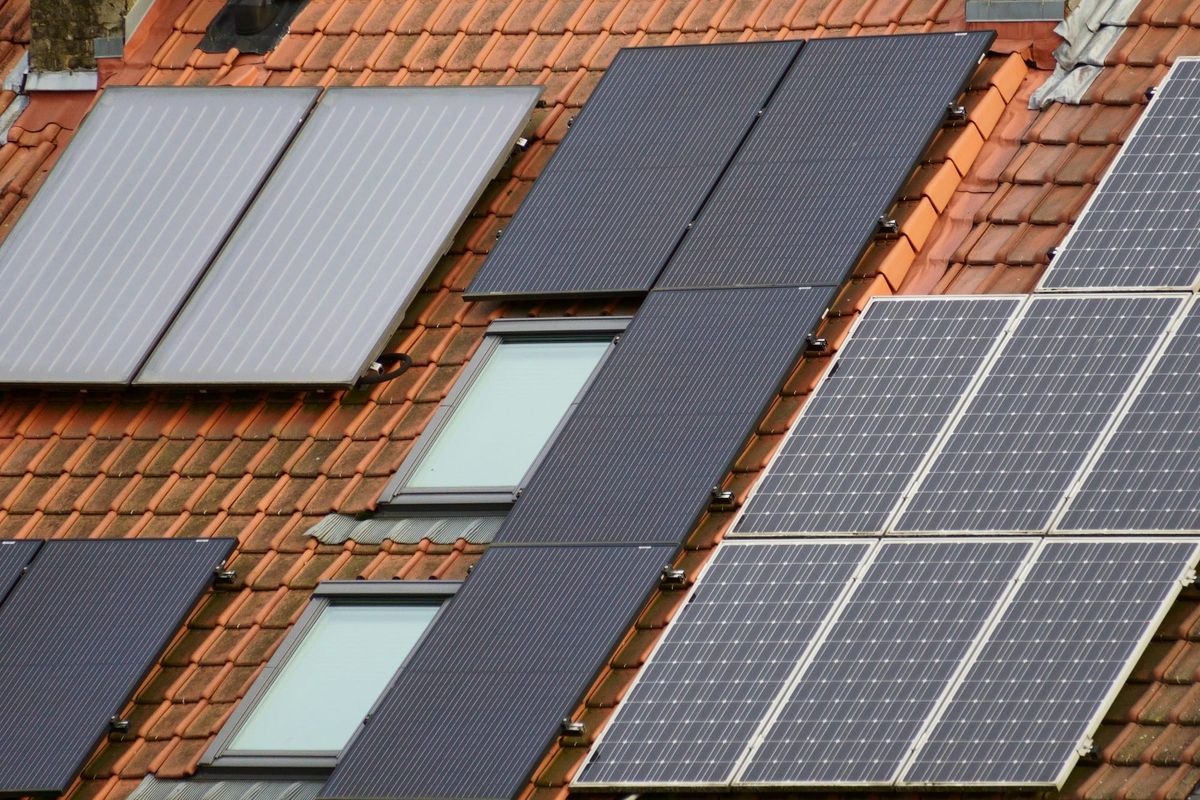
Container Ships as Mobile BESS: How Solar Cargo Roofs and Sodium-Ion Batteries Could Electrify Ports
A 90–100 MWh shipboard BESS paired with solar container roofs could support port charging, shore power, and grid resilience.

Container Ships as Mobile Battery Energy Storage: Rethinking Maritime Batteries, Port Electrification, and Distributed Solar
A Hybrid Architecture for Maritime Solar and Port Electrification
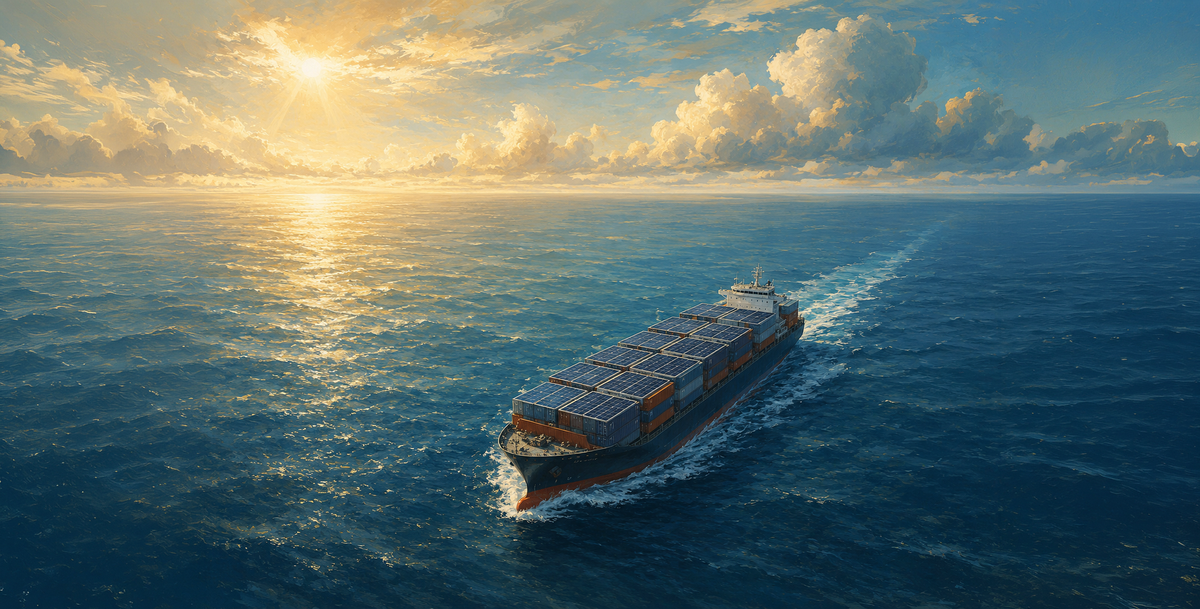
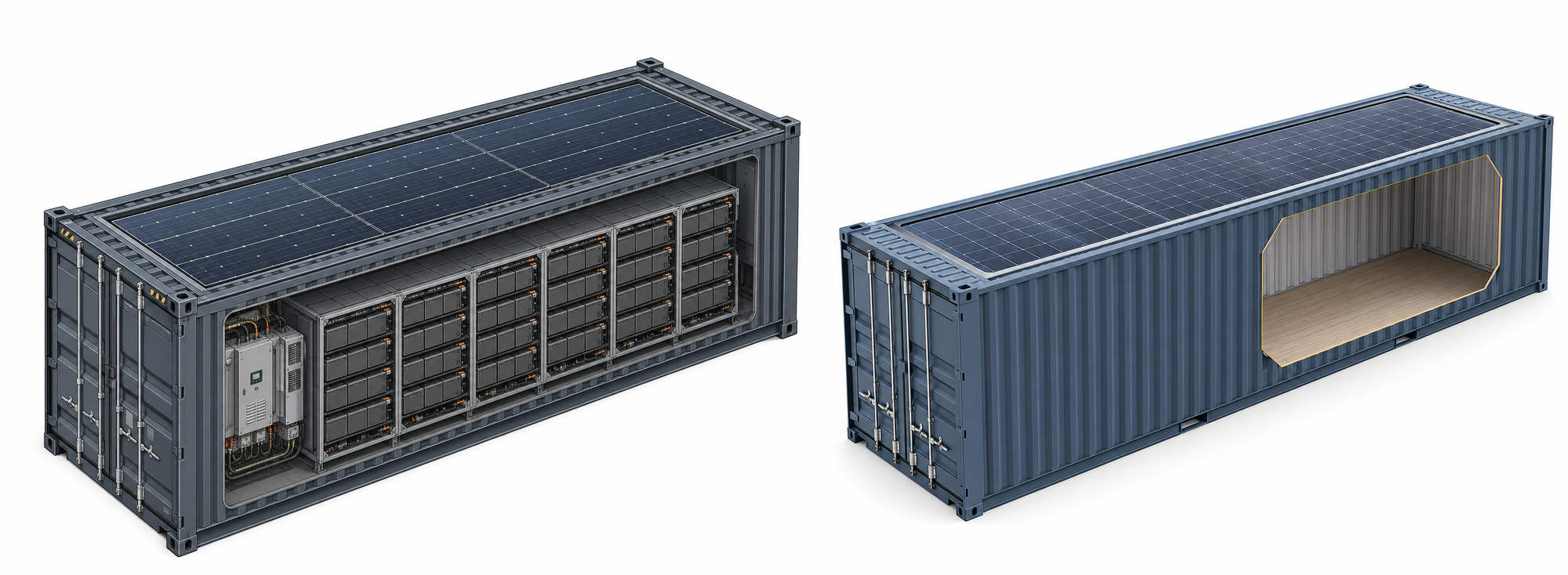
The solar-container concept is not a fleet of battery-filled containers sitting on the top deck of a cargo ship. The weight, vessel-stability implications, and poor ratio between rooftop photovoltaic area and battery capacity make that architecture unnecessarily difficult. A better system separates generation from storage: the roughly 400–550 exposed containers at the top of a fully laden ultra-large container vessel remain ordinary revenue-generating cargo containers but incorporate ruggedized photovoltaic roofs, while approximately 30 dedicated battery containers are placed much lower in the vessel, where their mass can be accommodated more safely. The result is a ship carrying roughly 2–3 MWp of distributed photovoltaic generation and perhaps 90–100 MWh of sodium-ion battery storage without requiring hundreds of top-deck cargo positions to become heavy battery modules.
That distinction changes the economics and the engineering case considerably. The objective is no longer to make each solar container energetically self-sufficient, nor to argue that container-mounted photovoltaics are a superior substitute for fixed solar installations at ports. Instead, the ship becomes a distributed energy platform whose exposed cargo surfaces generate electricity opportunistically and whose concentrated battery storage performs several higher-value functions: absorbing that generation while underway, supporting shipboard auxiliary loads, providing zero- or low-emission power while berthed, buffering high-power port charging loads, and potentially functioning as temporary grid infrastructure when a terminal's electrical connection is constrained.
The technology is a ship-integrated modular battery energy storage system, supported by a distributed photovoltaic skin formed from the exposed container deck.
The Architecture: Solar on Top, Batteries Below
A modern ultra-large container vessel can expose several hundred container roofs to the sky. Depending on stowage configuration, deckhouse geometry, cargo mix, stack heights, and other operational constraints, a conceptual range of roughly 400–550 exposed 40-foot-equivalent positions is reasonable for a vessel in the approximately 24,000-TEU class.
Those containers should not themselves contain large batteries.
A 40-foot container carrying approximately 3 MWh of sodium-ion storage would likely approach several tens of tonnes once cells, structural racks, cooling equipment, power electronics, fire protection, wiring, and reinforcement are included. At contemporary sodium-ion cell energy densities around 175 Wh/kg, the cells alone for a 3 MWh pack would weigh approximately 17 tonnes. The complete containerized system could plausibly approach the upper end of conventional intermodal payload limits.
Placing hundreds of such modules at the highest point of the cargo stacks would be contrary to one of the most basic constraints in ship loading: heavy mass generally belongs lower in the vessel. The upper tiers of large container ships are particularly sensitive to weight because loading substantial mass high above the waterline raises the vessel's center of gravity and can reduce stability margins.
The more sensible design decouples solar collection from battery placement.
The uppermost containers remain normal cargo containers. Their roof structures incorporate approximately 25–30 square meters of ruggedized photovoltaic surface, producing perhaps 5–6 kWp per exposed container under an aggressive but plausible high-efficiency design. Hundreds of those roofs then feed electricity into a protected shipboard collection network.
The batteries sit considerably lower.
If approximately 30 dedicated 40-foot energy containers each provide around 3 MWh of nominal storage, the ship carries approximately 90 MWh of BESS capacity. Thirty-four modules would bring the system slightly above 100 MWh. These containers could be placed deep within appropriate deck stacks or in other locations chosen specifically around naval-architecture, thermal-management, fire-safety, and electrical-distribution requirements.
The resulting configuration is conceptually straightforward: several hundred lightweight solar-generating cargo roofs above, several dozen heavy battery containers below, and an electrical architecture connecting the two.
A Multi-Megawatt Solar Array Hidden in the Cargo Deck
The photovoltaic contribution becomes much more interesting when considered at vessel scale.
One 40-foot roof equipped with perhaps 5–6 kWp of photovoltaics is not a particularly significant generator. Even under favorable conditions it may produce only around 20–30 kWh per day. A 3 MWh battery paired with that single roof would therefore require on the order of months rather than days to recharge completely from solar alone.
This is why the “self-charging battery container” framing breaks down. A 10- to 20-day ocean voyage simply does not provide enough roof area or solar exposure for one container to replenish several megawatt-hours of storage.
Five hundred roofs, however, represent an entirely different energy system.
At approximately 6 kWp per exposed container, 500 containers would collectively provide roughly 3 MWp of photovoltaic capacity. Under favorable portions of a voyage, a system of that scale might generate approximately 12–15 MWh per day. Over a two-week crossing, the aggregate production could reach roughly 170–210 MWh before accounting for weather, shading, salt accumulation, incidence angle, conversion losses, and periods in which parts of the deck are obscured.
The significance of those numbers is not that the ship suddenly becomes solar powered. Marine propulsion remains orders of magnitude more energy intensive. Rather, several megawatts of distributed PV become large enough to participate meaningfully in the vessel's auxiliary electrical system and to replenish a portion of the battery bank during transit.
A 90–100 MWh battery therefore does not need to be charged exclusively by the container roofs. It could leave port already charged from the terrestrial grid, stationary renewable generation, or a terminal microgrid. The maritime PV system then adds energy during the voyage while also potentially offsetting portions of onboard electrical demand.
The solar layer can be understood as an opportunistic energy source feeding a much larger, multi-purpose electrical asset.
The Battery Energy Storage System (BESS) Is the Core Infrastructure
The 90–100 MWh battery bank is where the concept becomes strategically interesting.
At that scale, the ship is carrying an energy-storage system comparable to small utility-scale BESS installations. A 100 MWh bank could theoretically provide 25 MW for four hours, 20 MW for five hours, 10 MW for ten hours, or 5 MW for twenty hours. After allowing for state-of-charge reserves, inverter losses, and battery-management requirements, usable energy would be somewhat lower, but the system would nevertheless be large enough to materially affect both vessel and terminal operations.
That matters because electrified ports increasingly face two related but distinct challenges. The first is acquiring enough energy over the course of a day. The second, and often more difficult, is delivering enormous amounts of power during short operational windows.
Electric terminal tractors, reachstackers, straddle carriers, cranes, reefer banks, shore-power systems, and other port equipment can create concentrated megawatt-scale loads. A terminal may have ample average electricity supply yet still lack enough feeder, transformer, or substation capacity to satisfy simultaneous charging peaks.
A large BESS changes that equation.
Consider a terminal with 30 MW of available utility capacity that periodically experiences 50 MW of electrified-equipment demand. A ship-connected 100 MWh battery capable of delivering 20 MW could bridge that gap for several hours without requiring the utility connection itself to immediately supply the entire 50 MW peak.
The battery is transporting power-delivery capability.
 John D
A Container Ship Could Become Part of the Port Microgrid
The strongest configuration may not require routinely unloading the battery containers at all.
One of the obvious criticisms of mobile BESS is that transporting batteries across an ocean creates costs without necessarily creating value. Every battery container consumes vessel deadweight, requires specialized handling, potentially displaces revenue cargo, adds regulatory complexity, and spends time in transit when it cannot provide stationary grid services at either port.
Those criticisms are valid if the concept is framed as repeatedly moving batteries simply to sell electricity at another location.
They become less so if the BESS is treated as part of the ship itself.
In this version, the approximately 30 battery containers remain aboard during normal operations and are electrically integrated with the vessel. During the voyage, they absorb photovoltaic generation and participate in management of the ship's auxiliary electrical loads. At berth, a bidirectional connection allows the same battery bank to interact with the shore-side electrical system.
The ship effectively becomes a floating BESS that can plug into the terminal.
A vessel carrying approximately 100 MWh could, in principle, provide several megawatts of power for many hours. That could support hotel loads while the ship is docked, reduce the need to operate auxiliary engines, buffer shore-power demand, support equipment charging elsewhere within the terminal, or provide temporary microgrid capacity during electrical disturbances.
This configuration avoids much of the logistical absurdity of repeatedly unloading and reloading dozens of 30-tonne batteries merely because they happen to be containerized. Containerization remains useful for manufacturing, replacement, maintenance, isolation, and modular capacity expansion, but mobility between ship and dock is no longer the central value proposition.
The battery containers become removable modules rather than routine cargo.
When Mobility Does Matter
There are, however, circumstances in which actually removing individual BESS containers could make sense.
If two mature ports both require permanent storage every day of the year, stationary BESS at both locations will almost certainly be more efficient than continually shuttling batteries between them. Fixed storage avoids ocean transport, crane cycles, stowage constraints, and periods of underutilization.
However, not every electrical-infrastructure problem is permanent.
Ports frequently undergo expansion, reconstruction, equipment transitions, and grid upgrades. A terminal may electrify cargo-handling equipment before its permanent substation is completed. A distribution feeder may be constrained for several years while a utility interconnection is pending. A storm or equipment failure may temporarily remove local generation or transmission capacity. Seasonal cargo volumes may create short-duration peaks that do not justify permanent infrastructure sized for the annual maximum. New terminals may begin operations before the surrounding electrical system has caught up.
In these cases, a standardized 3 MWh container capable of megawatt-scale output begins to resemble temporary infrastructure rather than transported energy.
A terminal could receive five modules and rapidly gain approximately 15 MWh of storage. Ten modules provide roughly 30 MWh. Twenty provide around 60 MWh. Individual units could be positioned near charging hubs, temporary reefer installations, terminal construction zones, or emergency microgrids using equipment that ports already possess to move intermodal containers.
This is where the container format itself becomes strategically valuable.
The shipping industry has spent decades building an extraordinarily efficient global logistics system around standardized rectangular modules. Ports already possess cranes, chassis, stacking yards, tracking systems, and operating procedures designed around them. Converting a small portion of that ecosystem into modular energy infrastructure could provide a deployment advantage that purpose-built stationary installations do not possess.
The value is that, when storage needs to be moved, the transportation system already exists.
 John D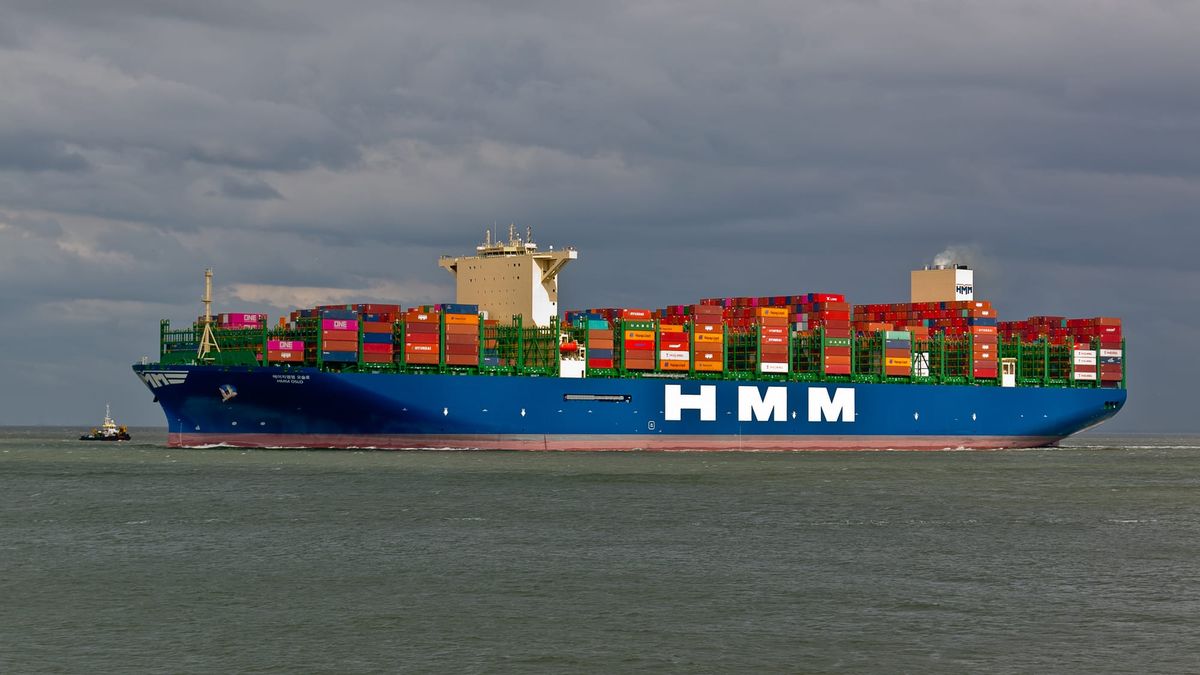
Static Solar Remains the Better Baseline
The photovoltaic component needs equally careful framing.
If a port has available warehouse roofs, parking areas, terminal buildings, nearby land, or canopy structures, fixed solar will usually be the more straightforward way to generate renewable electricity. Stationary arrays can be optimally oriented, cleaned more easily, wired using conventional architectures, maintained without interfering with cargo operations, and designed without the constant vibration and structural abuse associated with ocean shipping.
Container-roof solar complements, rather than competing with those installations.
A port might already possess tens or hundreds of megawatts of stationary renewable generation. The container roofs simply capture energy from a surface that would otherwise contribute nothing while the ship is underway.
The relevant is whether the incremental cost of integrating photovoltaics into exposed container roofs produces enough electricity and operational benefit to justify the added complexity.
The Marine Environment Is an Engineering Penalty, Not a Disqualifier
Salt spray is another legitimate criticism, but it is better understood as a cost and reliability constraint than as a fatal technical objection.
Photovoltaic systems operating at sea would face salt deposition, corrosion, thermal cycling, vibration, container flex, crane impacts, abrasive cleaning, and occasional direct seawater exposure. Electrical connections would require particularly careful sealing, while mixed-metal structures would have to be designed to limit galvanic corrosion.
A practical design might use a recessed photovoltaic cassette protected below the upper structural envelope of the container, with replaceable sacrificial transparent covers, sealed laminates, marine-grade edge seals, drainage channels, corrosion-resistant connectors, and protected electrical penetrations. The system would need to tolerate spreader operations and normal container handling without turning the photovoltaic layer into a fragile piece of equipment.
All of this raises the cost per watt relative to static solar.
That is acceptable only if the electricity is considered an ancillary return from infrastructure that is already moving for other reasons.
 John D
Sodium-Ion Fits the Use Case Particularly Well
The selection of sodium-ion chemistry is also more consequential in this architecture than it might initially appear.
For stationary and quasi-stationary maritime storage, maximum gravimetric energy density is not necessarily the dominant requirement. The vessel already handles enormous masses, and the batteries are deliberately placed low rather than carried as lightweight top-deck cargo. That gives designers greater freedom to prioritize cost, material abundance, thermal behavior, cycle life, and safety over the highest possible watt-hours per kilogram.
Sodium-ion batteries remain heavier than leading lithium-ion chemistries for a given amount of stored energy, but their emerging stationary-storage role makes them a plausible candidate for a system in which energy density is important but not overriding.
The chemistry would still need to satisfy stringent marine fire, isolation, thermal-management, and dangerous-goods requirements. A containerized format could nevertheless help by creating physically separated battery compartments rather than concentrating the full 100 MWh into one monolithic battery room.
Modularity could allow faulty units to be electrically isolated, inspected, replaced, or removed without rebuilding the entire shipboard storage installation.
The Economic Test Is Utilization
The decisive question is how many productive services the BESS can provide over its lifetime.
A stationary battery can potentially earn value every day through renewable-energy shifting, equipment charging, demand management, grid services, resilience, and peak shaving. A shipboard battery spends substantial time at sea, where many of those services disappear.
For maritime BESS to compete, the battery must perform useful work during that period as well.
That means the system becomes more attractive as the number of functions increases.
If the batteries merely sit idle while crossing the ocean, mobility is a liability. If they absorb several megawatts of shipboard solar, reduce auxiliary-generator runtime, smooth onboard electrical loads, provide spinning or contingency reserve, support zero-emission hotel loads at berth, participate in terminal peak shaving, and occasionally provide emergency microgrid capacity, the utilization equation begins to change.
The economic case therefore rests on value stacking across maritime and terrestrial operating modes.
That is more demanding than simply calculating the cost of stored electricity, but it is also where the architecture differentiates itself from conventional stationary storage.
The opportunity is to ask whether the next generation of container ships could carry something increasingly valuable alongside conventional freight: dispatchable electrical capacity.
If that architecture proves economically competitive, the ship would no longer arrive at port solely with goods. It could arrive with a 90–100 MWh energy asset already integrated into its electrical system, capable of serving the vessel, the terminal, and when useful, the surrounding grid.
 John D