
Gamification of Optimisation for Operations Research: Do Human-Computation Games and Learned Solvers Beat Classical Methods?
Foldit and AlphaTensor produce real science, but classical operations-research solvers still win at industrial scale.


The Gamification of Optimisation for Operations Research: A Research Briefing
1. Summary
The phrase "gamification of optimisation for operations research" describes two distinct research programmes that both reframe a hard combinatorial optimisation problem as a game, but they differ in who or what plays the game, and the investment case rests on keeping them separate. In the first programme, human-computation gamification, a scientific search problem is repackaged as a puzzle so that distributed human players supply intuition and pattern recognition; in the second, game-framed machine learning, the problem is cast as a game an artificial agent plays through self-play or search framed as sequential decision-making, and is solved with reinforcement learning. Our central judgement is that both programmes have produced peer-reviewed scientific results, but neither has yet displaced mature classical operations-research methods (exact solvers such as Gurobi, IBM CPLEX and FICO Xpress, and metaheuristics such as Lin-Kernighan-Helsgaun and Google OR-Tools) at industrial scale on the core operations-research problem classes of routing, scheduling, packing, facility location and network design. The investable value today sits with the incumbents that own the compute, the solvers and the platforms, not with the gamification thesis as a standalone category.
The findings are as follows. First, the strongest demonstrated results are narrow and structural: human-computation games have produced real scientific artefacts (a retroviral protease crystal structure, de novo proteins expressed in the laboratory, RNA designs, mapped neurons), and game-framed reinforcement learning has produced real deployed code (faster sorting routines shipped in the LLVM standard C++ library, and matrix-multiplication decompositions that improved on a fifty-year-old bound in one specific setting). Second, the most investment-relevant of these results, reinforcement-learning chip floorplanning, is also the most contested, with a documented reproducibility dispute that a Nature editorial process and independent academic re-evaluation left unresolved on the key question of whether the method beats strong classical baselines. Third, on the canonical operations-research benchmarks, learned solvers are competitive on small instances but are generally matched or beaten by classical exact and heuristic methods at scale, a conclusion supported by the University of Exeter bin-packing work that anchors this brief, in which human-derived heuristics beat a standard evolutionary algorithm but were ultimately outperformed by the simple First Fit and Best Fit heuristics. Fourth, the addressable economics flow through the prescriptive-analytics and decision-intelligence software markets and the accelerator hardware that trains learned solvers, not through the games themselves, which are overwhelmingly grant-funded volunteer platforms with no monetisation path. Fifth, the durable investment signal is that optimisation is being absorbed as a feature into existing decision-intelligence and hyperscaler platforms, which favours incumbents with compute, distribution and solver assets over pure-play gamification or learning-to-optimise startups.
2. Background: Disambiguating the Two Clusters
The term spans two coherent but separate bodies of work, and conflating them produces category errors that matter for capital allocation. The connective tissue is the set of operations-research problem classes that both attack: vehicle routing, scheduling, bin packing, facility location, network design, and molecular and protein design read as combinatorial optimisation. This brief does not treat the topic as generic engagement gamification (points, badges and leaderboards used only to motivate); that thread is addressed only where it bears on the investment view, and, as Section 6 notes, it largely does not, because engagement mechanics are a platform-retention tactic rather than a source of optimisation performance.
2.1 Cluster one: human-computation gamification
The first cluster repackages a hard optimisation problem as a game so that human players supply search, intuition and pattern recognition that algorithms lack. The canonical instances are protein structure and design games (Foldit), RNA design games (Eterna, originally EteRNA), connectomics reconstruction games (Eyewire), and sequence-alignment games (Phylo). The scientific claim is that distributed human play can match or exceed algorithmic search on specific structured problems. Foldit was released to the public in 2008 by the University of Washington's Baker Lab and Center for Game Science. In 2011, Foldit players produced a molecular-replacement model that resolved the crystal structure of the Mason-Pfizer monkey virus retroviral protease, a structure that had resisted determination for years, published in Nature Structural and Molecular Biology. In 2019, Foldit players designed proteins from scratch: of 146 player designs encoded in synthetic genes, 56 were expressed and soluble in Escherichia coli and adopted stable folded structures, representing 20 different folds including one not observed in nature, published in Nature. The Eterna project, anchored at Stanford (Rhiju Das) and Carnegie Mellon, crowdsourced RNA secondary-structure design; its 2014 PNAS paper reported that "a community of 37,000 nonexperts leveraged continuous remote laboratory feedback to learn new design rules" which, "distilled by machine learning into a new automated algorithm EteRNABot, also significantly outperform prior algorithms in a gauntlet of independent tests." Eyewire, launched in December 2012 by Sebastian Seung's laboratory (then MIT, now Princeton), used players to reconstruct retinal neurons; nearly 2,200 Eyewire members traced the pathways underpinning the group's 2014 Nature paper on retinal motion detection (Kim et al.), and per the group's cumulative figures Eyewire had engaged around 350,000 players and traced roughly 6,000 neurons as of March 2025. Phylo, from McGill University, translated multiple-sequence-alignment problems into a tile-matching puzzle.
The University of Exeter work of Nicholas Ross, Edward Keedwell and Dragan Savic is the pivotal bridge from this cluster to operations research, because it applies the human-computation paradigm not to natural science but to a canonical operations-research problem, the two-dimensional bin-packing problem, and extracts reusable heuristics from human play. This body of work anchors the operations-research relevance of the human-computation cluster in this brief and is examined in Section 4.5.
2.2 Cluster two: game-framed machine learning for optimisation
The second cluster casts the optimisation problem itself as a game an agent plays, through single-player self-play or search framed as sequential decision-making, and solves it with reinforcement learning and neural combinatorial optimisation. The canonical instances are DeepMind's AlphaTensor, which reframed the discovery of matrix-multiplication algorithms as a single-player game (TensorGame) and, using an AlphaZero-based agent, found a rank-47 decomposition for multiplying 4x4 matrices in modulo-2 arithmetic, improving on the rank-49 implied by two levels of Strassen's algorithm, published in Nature in 2022; DeepMind's AlphaDev, which framed the search for sorting routines as an assembly-language game and produced sort-3, sort-4 and sort-5 routines integrated into the LLVM libc++ standard C++ library, published in Nature in 2023; and reinforcement-learning chip floorplanning, published by Mirhoseini and Goldie et al. in Nature in 2021, which posed macro placement as a reinforcement-learning problem. The learned-solver literature (Vinyals et al. Pointer Networks, Bello et al., Kool et al. attention models) applies the same framing to routing, scheduling and packing problems central to operations research. This cluster is examined in Sections 4.2 through 4.4.
3. Key Players and Stakeholders
The players that bear on the investment view divide cleanly into those with material revenue-bearing exposure and those whose exposure is research-stage or incidental. The distinction is central: almost none of the entities producing the headline gamification results derive revenue from them.
3.1 Large platform owners
Alphabet (NASDAQ:GOOGL), through Google DeepMind and Google Research, is the single most important actor in the game-framed machine-learning cluster: it produced AlphaTensor, AlphaDev and the reinforcement-learning chip-placement method, and owns OR-Tools, a widely used open-source operations-research toolkit that bundles classical solvers. Its exposure is strategic rather than directly monetised through these artefacts; the value accrues to Alphabet indirectly, through faster internal code, tensor-processing-unit design and cloud differentiation. Microsoft (NASDAQ:MSFT) participates through Azure analytics and optimisation tooling and its research arm, with exposure that is incidental to the specific results discussed here. Both are diversified mega-caps for which optimisation gamification is immaterial to near-term financials.
3.2 Accelerator vendors
NVIDIA (NASDAQ:NVDA) and, secondarily, AMD (NASDAQ:AMD) underwrite the economics of learned optimisation, because reinforcement-learning and neural combinatorial-optimisation methods are compute-intensive to train. The AlphaTensor work benchmarked discovered algorithms on an NVIDIA V100 GPU and a Google tensor processing unit. The investment logic here is indirect: any expansion of learned-optimisation research increases demand for accelerators, and this is the clearest revenue-bearing channel from the second cluster, though it is a small fraction of total accelerator demand, which is dominated by LLM training.
3.3 Commercial mathematical-optimisation vendors
The incumbent solver market is where operations-research optimisation is monetised. Gurobi Optimization (private) is widely regarded as the performance leader in mathematical-programming solvers; third-party estimates place its revenue in the single-digit to low-tens-of-millions range (one tracker reports USD 6.5 million in 2024), which, whether or not precise, frames the entire pure-play optimisation-solver market as small relative to adjacent analytics markets. IBM (NYSE:IBM) owns CPLEX, acquired with ILOG in 2009. FICO (NYSE:FICO) owns the Xpress solver, acquired with Dash Optimization in 2008. Google's OR-Tools is the open-source alternative. These vendors, together with the exact and heuristic methods they embody (branch-and-cut, the Lin-Kernighan-Helsgaun heuristic, genetic algorithms), are the true competitive benchmark against which both gamification clusters must be measured, and they are the incumbents most directly threatened, or not, by learned solvers.
3.4 EDA vendors
Synopsys (NASDAQ:SNPS) and Cadence Design Systems (NASDAQ:CDNS) are the electronic-design-automation incumbents relevant to the chip-floorplanning debate. Both have integrated machine-learning-driven place-and-route capabilities into commercial tools. Their material exposure is that reinforcement-learning placement, if robustly superior, would be absorbed into their tool suites (as it substantially has been) rather than disrupting them; the replication debate around Google's method is therefore of direct commercial relevance to their competitive positioning.
3.5 Academic groups anchoring the field
The University of Washington Baker Lab and Center for Game Science anchor Foldit; Stanford (Das laboratory) and Carnegie Mellon anchor Eterna; Princeton (Seung laboratory) anchors Eyewire; McGill anchors Phylo; and the University of Exeter (Ross, Keedwell, Savic) anchors the bin-packing operations-research bridge. On the learned-solver side, the field traces to Google Brain (Vinyals, Bello) and the University of Amsterdam (Kool), among others. The UC San Diego group of Chung-Kuan Cheng and Andrew Kahng anchors the independent critique of reinforcement-learning chip placement.
4. Technical and Operational Considerations
The differentiated question for an investor is not whether these methods produce publishable results (they do) but whether they beat, match or lose to classical operations-research methods on the problem classes that carry commercial value, and whether the results are independently reproduced or rest on a single group's benchmark.
4.1 Human-computation games: demonstrated results, structural constraints
The human-computation results are real and, in the natural-science domains, sometimes superior to contemporaneous algorithms. The Foldit protease result is a demonstrated, laboratory-verified scientific artefact: players generated a model of sufficient quality for molecular replacement after algorithmic methods, including mr-rosetta, had failed. The Foldit de novo design result is likewise demonstrated: 56 of 146 player-designed proteins expressed and folded stably, a success rate the authors characterised as unprecedented in structural diversity for de novo design. The Eterna finding that human players and the derived EteRNABot outperformed prior RNA-design algorithms is demonstrated in vitro, though it is specific to RNA secondary-structure design and rests substantially on the Das-group experimental pipeline.
The structural constraints are decisive for the investment view. These are volunteer platforms whose performance depends on a small core of expert players: a study of Foldit participation estimated the active playing community "in the region of 200-300 individuals," from which "a small group of approximately 20-30 'core' participants have emerged," even though cumulative registrations exceeded 460,000. Human play does not scale on demand, cannot be summoned for arbitrary problems, and produces solutions at a per-solution cost dominated by volunteer time and platform engineering that no commercial buyer captures. The demonstrated superiority is confined to problems with rich three-dimensional or spatial structure where human perception has an edge; it has not been shown on the abstract, large-scale combinatorial problems that dominate industrial operations research.
4.2 AlphaTensor: what generalised and what did not
AlphaTensor demonstrated that a self-play agent could rediscover known algorithms (Strassen's 2x2, Laderman's 3x3) and improve on standard-arithmetic bounds for over 70 matrix sizes, and it found the first improvement over two-level Strassen for 4x4 matrices in modulo-2 arithmetic. This is a demonstrated result. Its limits are equally important and were established quickly by the mathematics community. The headline 4x4 improvement holds in modulo-2 (binary) arithmetic, not standard arithmetic; DeepMind's own later AlphaEvolve work acknowledged that AlphaTensor "for 4x4 matrices, only found improvements for binary arithmetic." Within days of publication, Manuel Kauers and Jakob Moosbauer, using a conventional computer-aided flip-graph search seeded partly by AlphaTensor's output, reduced the 5x5 modulo-2 case from 96 to 95 multiplications, indicating that the reinforcement-learning approach was not uniquely powerful and that classical search remained competitive. The practical speedups AlphaTensor reported are demonstrated but hardware-specific and modest: the Nature paper describes algorithms that "multiply large matrices 10-20% faster than the commonly used algorithms on the same hardware" (an NVIDIA V100 GPU and a Google TPU v2), and independent reporting places the median gains lower still, around 8.5 percent on the GPU and 10.3 percent on the TPU. The durable contribution is the method (framing algorithm discovery as a game), not a broad displacement of human or classical algorithm design.
4.3 AlphaDev: a strong deployment, narrow in scope
AlphaDev is the strongest deployment claim in the second cluster, and it is well-evidenced. The sort-3, sort-4 and sort-5 fixed-length routines it discovered were reverse-engineered to C++ and integrated into the LLVM libc++ standard sorting library, the first change to those routines in over a decade and the first involving a reinforcement-learning-discovered algorithm, subject to the library maintainers' independent review. Per Google DeepMind, the discovered routines
"led to improvements in the LLVM libc++ sorting library that were up to 70% faster for shorter sequences and about 1.7% faster for sequences exceeding 250,000 elements."
The reading is that this is a shipped, independently vetted result, but on very small fixed-size sorting kernels, and the large-sequence gain is marginal. It is a proof that the method can produce production code, not evidence that it transforms operations-research optimisation.
4.4 Reinforcement-learning chip floorplanning: the contested core
The 2021 Nature paper by Mirhoseini, Goldie et al. claimed that a reinforcement-learning method generated chip floorplans "superior or comparable" to human designs in under six hours, and reported use in designing Google tensor processing units. As chip design is the most commercially consequential application in this brief, its contested status is material. The critique, led by Cheng, Kahng and colleagues at UC San Diego through the open-source MacroPlacement project and their ISPD 2023 paper (arXiv 2302.11014), argued that the Nature paper lacked results on public benchmarks, did not release the proprietary tensor-processing-unit blocks used, and released incomplete code, and that when re-implemented the method did not clearly beat classical methods such as simulated annealing or commercial tools. A separate "Stronger Baselines" study, conducted inside Google, reportedly found that properly tuned simulated annealing outperformed the method. Nature attached an editorial note to the paper, and in September 2024 published an addendum by the authors rather than a correction or retraction; the authors also published a rebuttal ("That Chip Has Sailed," arXiv 2411.10053) defending the work and attributing the failed replications to the absence of pre-training and reduced compute (26 versus 512 experience collectors, 8 versus 16 GPUs). The critics maintain, per their updated assessment, that none of the major concerns were resolved and that the release of a pre-trained model without training data raises data-contamination concerns. The investor-relevant conclusion is that the single most commercially significant result in the game-framed cluster remains disputed on the decisive question of whether it beats strong classical baselines, and that this dispute has run for over three years without clean resolution.
4.5 Learned solvers versus classical operations research
For the core operations-research problem classes, the evidence is that neural combinatorial optimisation is competitive on small instances but does not reliably beat mature classical methods at scale. The seminal architectures (Vinyals et al. Pointer Networks in 2015, Bello et al. reinforcement-learning training in 2016, Kool et al. attention model in 2018) produce high-quality approximate solutions on Euclidean travelling-salesman and vehicle-routing instances up to around 100 nodes but generalise poorly to larger sizes. A critical review (Garmendia, Ceberio and Mendiburu, "Applicability of Neural Combinatorial Optimization: A Critical View," ACM Transactions on Evolutionary Learning and Optimization, 2024) concluded that these methods must be weighed against exact algorithms, heuristics and metaheuristics on performance, computational cost, transferability and reusability, and found their advantages qualified. The most successful hybrids augment rather than replace classical methods: NeuroLKH, for instance, improves the Lin-Kernighan-Helsgaun heuristic rather than supplanting it. On standard benchmarks (TSPLIB, CVRPLIB), specialised solvers such as Concorde for the travelling-salesman problem, the Lin-Kernighan-Helsgaun heuristic, and general solvers Gurobi and CPLEX remain the reference points that learned methods are measured against and usually do not surpass on solution quality at scale.
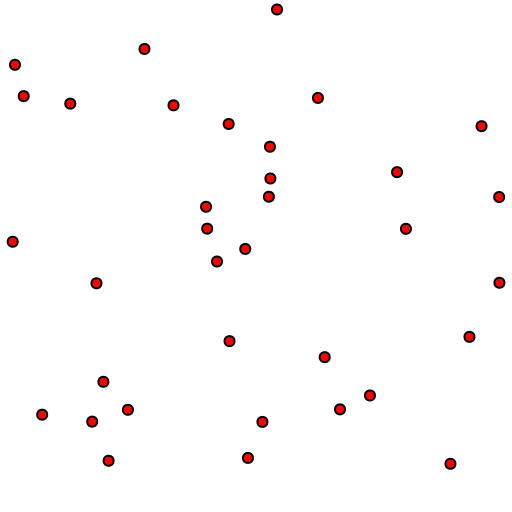
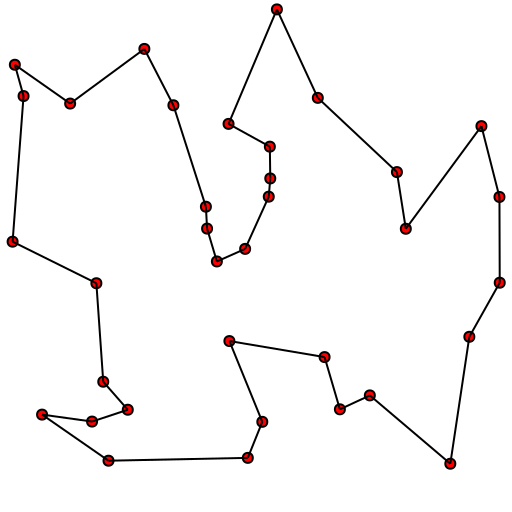
Travelling Salesman Problem - Unsolved and Solved - Photo by Xypron - Public Domain
The Exeter bin-packing work makes the same point from the human-computation side and is worth stating precisely because it is the mandated anchor. Ross, Keedwell and Savic recorded the moves of humans playing a gamified two-dimensional bin-packing problem and used decision-tree regression to extract four human-derived heuristics that replaced the mutation operator in a genetic algorithm. The 2020 result, in the authors' words, was that "the HDHs were shown to outperform the standard EA and were faster to converge than, but ultimately outperformed by, the First Fit and Best Fit heuristics," which "shows that humans can create competitive heuristics through gameplay." The best configuration blended human-derived and standard mutation rather than using pure human-derived mutation: a 99 percent human-derived-heuristic proportion performed best (with 40 percent a close second), while the 100 percent pure-heuristic condition performed worst and was in one case beaten by the standard genetic algorithm. Experiments ran for 200,000 iterations across 30 instances of a 10-bin problem, each repeated 30 times. The 2019 paper found that good human performers augmented algorithm performance while poorer performers could be detrimental, making solution quality dependent on player quality. The thesis conclusion is measured: human-derived heuristics extracted through gamification can enhance an evolutionary algorithm, combining the stochastic search strength of the genetic algorithm with the intuitive problem-solving of the human mind "without the risk of fatigue or limits on the number of function evaluations," but the demonstrated benefit is partial and did not beat the simplest deterministic benchmarks on final solution quality. (No single headline percentage-improvement figure is reported in the 2020 paper, which presents results through per-generation fitness plots rather than one summary number.) For an investor, this is the representative result: gamification and learned heuristics can improve a weak baseline but have not displaced cheap, mature classical heuristics.
5. Economic and Market Dynamics
The economics that matter are not the games, which are grant-funded, but the software and hardware markets into which optimisation is being absorbed, and these figures should be read as vendor-modeled projections attributed to their sources rather than demonstrated outcomes.
The prescriptive-analytics market, the analytics category that includes optimisation, is estimated by multiple market-research firms with wide dispersion, which itself signals definitional looseness. MarketsandMarkets estimated the market at USD 4.9 billion in 2021 growing to USD 14.3 billion by 2026 at a 24.0 percent compound annual growth rate. Market Research Future put it at USD 5.19 billion in 2022 rising to USD 22.30 billion by 2030 at 19.1 percent. Other firms project figures ranging into the tens of billions with compound growth rates from roughly 13 to 28 percent. The dispersion across these modeled estimates is itself the finding: the category is real and growing at a healthy double-digit rate, but its boundaries are drawn inconsistently and the figures should carry low confidence. The adjacent decision-intelligence market, into which optimisation is increasingly bundled, was estimated by Grand View Research at USD 15.22 billion in 2024 growing to USD 36.34 billion by 2030 at 15.4 percent. Gartner has described decision-intelligence platforms as having shifted from niche to a late-stage emerging market and now publishes a Magic Quadrant for the category, a signal that optimisation is being commoditised as a platform feature rather than sold as a standalone game or learned solver.
The cost structures diverge sharply across the two clusters and against the incumbents. Human-computation platforms carry near-zero marginal labour cost (volunteer players) but material fixed costs (engineering, scientific staff, grant administration) and, critically, no revenue model: they are funded by research grants (National Institutes of Health, National Science Foundation, DARPA in Foldit's case; the Engineering and Physical Sciences Research Council for the Exeter work) and produce public-good scientific outputs rather than sellable products. Engagement decay is a structural cost: the active contributor base is small and attrition is high. Learned solvers invert this: near-zero marginal inference cost once trained, but high training cost in scarce accelerator compute and scarce machine-learning talent, and a demonstrated tendency to require retraining or fine-tuning when the problem distribution shifts. Classical solvers, by contrast, have a mature, low-friction licensing model and require no per-problem training, which is precisely why they retain the commercial market. The compute cost of learned solvers relative to the classical methods they aim to displace is, on current evidence, unfavourable for most industrial operations-research problems, because the classical methods are cheap, deterministic and require no GPU.
6. Material Risks
The risks that bear on the investment thesis are, in order of importance to capital allocation, the following.
The primary risk is that gamified and learned approaches do not beat mature classical operations-research methods at industrial scale, and only win on narrow benchmarks. Likelihood is high on current evidence: the neural-combinatorial-optimisation critical literature, the Exeter bin-packing result and the chip-placement dispute all point the same way. Impact is high for any pure-play thesis, because it removes the core value proposition, though low for diversified incumbents. The credible mitigation is to invest in augmentation (learned methods that accelerate classical solvers, such as NeuroLKH-style hybrids) rather than replacement, and to underwrite the incumbents whose solvers are the benchmark.
The second risk is reproducibility and benchmark selection. Likelihood is moderate to high: the chip-placement case is a documented, unresolved instance in which the absence of public benchmarks and shared data prevented clean replication, and single-group benchmarks are common across the learned-solver literature. Impact is high because it directly undermines the evidentiary basis for claimed superiority and, in the chip-design case, touches a commercially central application. Mitigation is to weight independently reproduced results (AlphaDev's LLVM integration, which passed maintainer review) far above single-group claims, and to treat any result lacking public-benchmark validation as unproven.
The third risk is dependence on scarce compute and talent. Likelihood is high and structural: learned optimisation competes for the same accelerators and researchers as large-language-model development, which commands higher returns. Impact is moderate, expressed as cost and talent-retention pressure rather than technical failure. Mitigation for an investor is to recognise that this dependence is itself the strongest revenue-bearing channel, favouring accelerator vendors and the hyperscalers that own the compute.
The fourth risk is engagement and sustainability for human-computation platforms. Likelihood is high: the active contributor base is small (200 to 300 for Foldit), grant-dependent and subject to attrition, and the Exeter work shows that solution quality depends on recruiting good players. This is the point at which engagement gamification (points, leaderboards, narrative) bears on the thesis, and the conclusion is narrow: engagement mechanics are necessary to retain the volunteer labour these platforms depend on, but they are a sustainability tactic, not a source of optimisation advantage, and they do not create an investable asset.
The fifth risk is thin or undefended monetisation. Likelihood is high for pure-play gamification (no evidence of a durable business model) and moderate for learning-to-optimise startups (which face incumbent solvers, open-source OR-Tools, and hyperscaler platform absorption). Impact is high for standalone ventures. Mitigation is to prefer exposure through incumbents with distribution and pricing power over pure-play bets whose moats are unproven.
7. Implications for the Technically Informed Investor
The core implication is that "gamification of optimisation" is a research method that generates real science and occasional deployed code, but the value accrues to entities that already own compute, distribution and solver assets. The direct read is to favour the incumbents: Alphabet and Microsoft as diversified owners of the research and the platforms; NVIDIA and, secondarily, AMD as the revenue-bearing channel for any expansion of learned optimisation; and the solver incumbents (IBM, FICO, private Gurobi) plus the EDA vendors (Synopsys, Cadence) as the parties whose commercial position is confirmed rather than threatened by the current evidence, because learned methods are being absorbed into their tools rather than displacing them.
The forward reasoning, labelled as such and resting on stated assumptions, is as follows. Assuming that (a) classical solvers retain their scale advantage on core operations-research problems, (b) learned methods continue to prove most valuable as accelerants of classical methods rather than replacements, and (c) optimisation continues to be bundled into decision-intelligence platforms, the durable value migrates toward hybrid offerings inside incumbent platforms and away from both pure-play gamification and standalone learning-to-optimise startups. Under these assumptions, a learning-to-optimise startup should demonstrate independently reproduced, public-benchmark superiority on a specific high-value problem class and pair that with a strong distribution channel; absent both, it is likely to be out-competed by open-source OR-Tools, out-priced by incumbents, or absorbed.
The benchmarks that would change this view are concrete. A learned or gamified method would merit re-rating if it demonstrated, on public benchmarks (TSPLIB, CVRPLIB) with independent replication, clear and consistent superiority over Gurobi, CPLEX and the Lin-Kernighan-Helsgaun heuristic at industrial scale, not merely on sub-100-node instances; if the chip-placement method achieved clean, independently reproduced superiority over tuned simulated annealing and commercial EDA tools on shared benchmarks, which would validate a commercially central application and directly affect Synopsys and Cadence; or if a human-computation platform demonstrated a repeatable, low-cost path to solutions on abstract industrial combinatorial problems rather than structured scientific ones. Until one of these thresholds is met, the evidence supports underwriting the incumbents and treating the gamification thesis as a source of optionality embedded in those incumbents rather than as a standalone allocation.

Euclidean Travelling Salesman Problem - Approximation Algorithms
 DeepWiki
References
Bello, Irwan, Hieu Pham, Quoc V. Le, Mohammad Norouzi, and Samy Bengio. 2017. "Neural Combinatorial Optimization with Reinforcement Learning." Workshop paper, International Conference on Learning Representations. arXiv:1611.09940.
Cheng, Chung-Kuan, Andrew B. Kahng, Sayak Kundu, Yucheng Wang, and Zhiang Wang. 2023. "Assessment of Reinforcement Learning for Macro Placement." Proceedings of the International Symposium on Physical Design 2023: 158–166. arXiv:2302.11014.
Cooper, Seth, Firas Khatib, Adrien Treuille, Janos Barbero, Jeehyung Lee, Michael Beenen, Andrew Leaver-Fay, David Baker, Zoran Popović, and Foldit Players. 2010. "Predicting Protein Structures with a Multiplayer Online Game." Nature 466 (7307): 756–760.
Fawzi, Alhussein, Matej Balog, Aja Huang, Thomas Hubert, Bernardino Romera-Paredes, Mohammadamin Barekatain, Alexander Novikov, et al. 2022. "Discovering Faster Matrix Multiplication Algorithms with Reinforcement Learning." Nature 610 (7930): 47–53.
Garmendia, Andoni I., Josu Ceberio, and Alexander Mendiburu. 2024. "Applicability of Neural Combinatorial Optimization: A Critical View." ACM Transactions on Evolutionary Learning and Optimization 4 (1): 1–25.
Goldie, Anna, Azalia Mirhoseini, et al. 2024. "That Chip Has Sailed: A Critique of Unfounded Skepticism Around AI for Chip Design." arXiv:2411.10053.
Grand View Research. 2024. Decision Intelligence Market Size, Share and Trends Analysis Report. San Francisco: Grand View Research.
Kauers, Manuel, and Jakob Moosbauer. 2022. "Flip Graphs for Matrix Multiplication." arXiv:2212.01175.
Khatib, Firas, Frank DiMaio, Foldit Contenders Group, Foldit Void Crushers Group, Seth Cooper, Maciej Kazmierczyk, Miroslaw Gilski, et al. 2011. "Crystal Structure of a Monomeric Retroviral Protease Solved by Protein Folding Game Players." Nature Structural and Molecular Biology 18 (10): 1175–1177.
Kim, Ju Sung, Matthew J. Greene, Aleksandar Zlateski, Kisuk Lee, Mark Richardson, Srinivas C. Turaga, Michael Purcaro, et al. 2014. "Space-Time Wiring Specificity Supports Direction Selectivity in the Retina." Nature 509 (7500): 331–336.
Koepnick, Brian, Jeff Flatten, Tamir Husain, Alex Ford, Daniel-Adriano Silva, Matthew J. Bick, Aaron Bauer, et al. 2019. "De Novo Protein Design by Citizen Scientists." Nature 570 (7761): 390–394.
Koodli, Rohan V., Benjamin Keep, Katherine R. Coppess, Fernando Portela, Eterna Players, and Rhiju Das. 2019. "EternaBrain: Automated RNA Design through Move Sets and Strategies from an Internet-Scale RNA Videogame." PLOS Computational Biology 15 (6): e1007059.
Kool, Wouter, Herke van Hoof, and Max Welling. 2019. "Attention, Learn to Solve Routing Problems!" International Conference on Learning Representations. arXiv:1803.08475.
Lee, Jeehyung, Wipapat Kladwang, Minjae Lee, Daniel Cantu, Martin Azizyan, Hanjoo Kim, Alex Limpaecher, et al. 2014. "RNA Design Rules from a Massive Open Laboratory." Proceedings of the National Academy of Sciences 111 (6): 2122–2127.
Mankowitz, Daniel J., Andrea Michi, Anton Zhernov, Marco Gelmi, Marco Selvi, Cosmin Paduraru, Edouard Leurent, et al. 2023. "Faster Sorting Algorithms Discovered Using Deep Reinforcement Learning." Nature 618 (7964): 257–263.
MarketsandMarkets. 2021. Prescriptive Analytics Market: Global Forecast to 2026. Pune: MarketsandMarkets.
Market Research Future. 2023. Prescriptive Analytics Market Research Report: Forecast to 2030. Pune: Market Research Future.
Mirhoseini, Azalia, Anna Goldie, Mustafa Yazgan, Joe Wenjie Jiang, Ebrahim Songhori, Shen Wang, Young-Joon Lee, et al. 2021. "A Graph Placement Methodology for Fast Chip Design." Nature 594 (7862): 207–212.
Mirhoseini, Azalia, Anna Goldie, et al. 2024. "Addendum: A Graph Placement Methodology for Fast Chip Design." Nature (September).
Ross, Nicholas D. F., Matthew B. Johns, Edward C. Keedwell, and Dragan A. Savic. 2019. "Human-Evolutionary Problem Solving through Gamification of a Bin-Packing Problem." Proceedings of the Genetic and Evolutionary Computation Conference Companion (GECCO '19): 1465–1473. doi:10.1145/3319619.3326871.
Ross, Nicholas, Edward Keedwell, and Dragan Savic. 2020. "Human-Derived Heuristic Enhancement of an Evolutionary Algorithm for the 2D Bin-Packing Problem." In Parallel Problem Solving from Nature – PPSN XVI, Lecture Notes in Computer Science, 413–427. Cham: Springer. doi:10.1007/978-3-030-58115-2_29.
Ross, Nicholas. 2024. "Gamification of Optimisation for Operations Research." PhD thesis, University of Exeter.
Vinyals, Oriol, Meire Fortunato, and Navdeep Jaitly. 2015. "Pointer Networks." Advances in Neural Information Processing Systems 28.
Zarour, Eleyine, Phylo Players, Luis Sarmenta, Mathieu Blanchette, and Jérôme Waldispühl. 2012. "Phylo: A Citizen Science Approach for Improving Multiple Sequence Alignment." PLOS ONE 7 (3): e31362.