Why Gold Mining Stocks Move More Than Gold: Commodity-Price Torque, Operating Leverage, and Gold Beta
Why gold miners can outperform, or underperform, gold as operating leverage, commodity beta, and margin elasticity amplify metal-price moves.

hy Gold Miners Move More Than Gold: The Economics of Commodity-Price Torque
The idea in one sentence
Gold-mining equities are not simply ownership claims on gold in the ground. They are ownership claims on the residual economics of extracting gold. That distinction is why a modest movement in the gold price can produce a much larger movement in a miner's profits, and sometimes, its equity value.
Finance describes different pieces of this phenomenon with different terms: operating leverage, commodity beta, elasticity, operational gearing, leveraged exposure, and, in mining-market shorthand, commodity-price torque. They overlap, but they are not interchangeable.
The empirical foundation is well established. In a study of North American gold miners, Peter Tufano found that the average mining stock moved approximately 2% for each 1% change in gold prices, although exposure varied substantially across firms and through time. Hedging and diversification reduced that exposure, while leverage increased it [1]. Other research has produced lower average betas in different markets and periods. Dirk Baur, for example, found an average gold beta around one for Australian miners over 1980–2010—underscoring an important point: torque is an economic mechanism, not a fixed multiplier [2].
The math behind the terminology
Consider a stylized mine producing gold at an all-in economic cost of $1,500 per ounce while gold trades at $2,000.
Its simplified unit margin is:
Gold price − unit cost = $2,000 − $1,500 = $500
Now suppose gold appreciates 10%, to $2,200. If production and costs are temporarily unchanged, the mine's margin becomes $700.
Gold rose 10%. The unit margin rose 40%.
A 10% decline produces the reverse: at $1,800 gold, the margin contracts from $500 to $300, a 40% decline.
This gives us a useful way to conceptualize commodity-price torque. If P is the commodity price and C is unit cost, then the simplified margin is

Holding cost and production constant, the elasticity of that margin to commodity price is:

There is a revealing alternative interpretation:

The closer a mine sits to its economic breakeven, therefore, the greater its potential commodity-price torque.
This produces a counterintuitive investment insight. A high-cost producer can have more upside sensitivity to gold than a low-cost producer precisely because its starting margin is smaller. Earlier gold-mining research reached a similar conclusion: theoretical gold-price elasticity rises with production costs, while empirical studies have repeatedly found equity exposure to gold greater than one under certain conditions [3][4].
That does not make the high-cost miner the better business. It means quality and torque are different characteristics. A low-cost miner owns resilience; a marginal-cost miner owns something closer to an option.
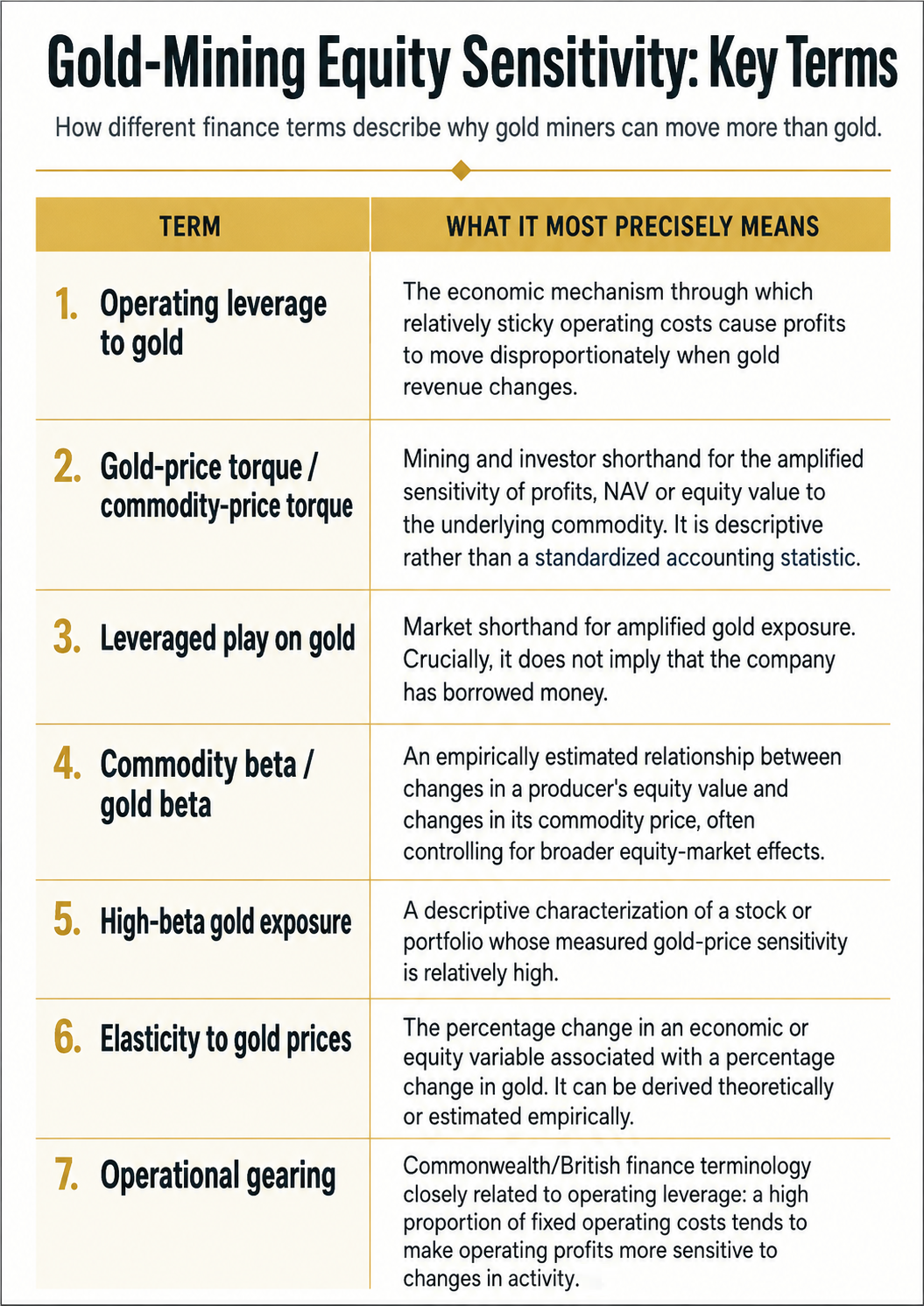
One economic phenomenon, several financial terms
|
Term |
What it most precisely means |
|
Operating leverage to gold |
The economic mechanism through which relatively sticky operating
costs cause profits to move disproportionately when gold revenue changes. |
|
Gold-price torque / commodity-price torque |
Mining and investor shorthand for the amplified sensitivity of
profits, NAV or equity value to the underlying commodity. It is descriptive
rather than a standardized accounting statistic. |
|
Leveraged play on gold |
Market shorthand for amplified gold exposure. Crucially, it does not
imply that the company has borrowed money. |
|
Commodity beta / gold beta |
An empirically estimated relationship between changes in a producer's
equity value and changes in its commodity price, often controlling for
broader equity-market effects. |
|
High-beta gold exposure |
A descriptive characterization of a stock or portfolio whose measured
gold-price sensitivity is relatively high. |
|
Elasticity to gold prices |
The percentage change in an economic or equity variable associated
with a percentage change in gold. It can be derived theoretically or
estimated empirically. |
|
Operational gearing |
Commonwealth/British finance terminology closely related to operating
leverage: a high proportion of fixed operating costs tends to make operating
profits more sensitive to changes in activity [5]. |
The final term deserves a qualification. Traditional operating leverage or operational gearing primarily concerns fixed versus variable costs and the sensitivity of operating profit to sales or output. ACCA, for example, defines operating gearing around the proportion of operating costs that are fixed, noting that high gearing amplifies changes in operating profit [4] [5].
In commodity investing, analysts extend that intuition from volume to price: miners cannot usually increase or decrease their cost base dollar-for-dollar when metal prices change. Calling this "operating leverage to gold" is economically sensible, but commodity-price elasticity is the cleaner term when the variable being shocked is specifically the metal price.
Beta is different again. Tufano's "gold beta" is an observed statistical exposure, not a geological or accounting constant [1]. Later work has shown gold betas can change with hedging, diversification and market conditions [2] [5].
Torque is really a stack of embedded options
The simple margin equation explains only the first layer.
A mine also contains something resembling a portfolio of real options. When commodity prices rise sufficiently, lower-grade ore can become economic; mine plans can change; previously marginal projects may become financeable; production can be expanded; and assets that appeared uneconomic at lower prices can acquire value. Research on gold companies has explicitly examined these real-option characteristics, although evidence on whether gold equities respond asymmetrically to rising versus falling prices is mixed [2][6].
This suggests a more complete framework:
Commodity-price torque = margin leverage + resource optionality + capital-structure leverage − hedging/diversification − price-linked cost leakage.
The last term matters more than simplified models imply.
Costs are not perfectly fixed. Higher commodity prices can eventually produce higher wages, contractor rates, equipment prices, royalties, taxes and competition for scarce mining inputs. Some fiscal regimes are explicitly linked to commodity prices. Newmont's 2026 guidance, for example, disclosed that each $100-per-ounce change in gold was associated with an estimated $505 million pretax revenue-and-cost impact, but it separately identified approximately $6 per ounce of royalty, production-tax and worker-participation effects for every $100 change in gold. Ghana also introduced a sliding gold royalty structure in 2026 [7].
The commodity-price shock does not travel untouched from the gold market to shareholders. Some of it leaks away.
A useful question is:
"Where, along the chain from commodity price to shareholder cash flow, is sensitivity amplified, and where is it absorbed?"
Gold is one of many examples
The same architecture appears throughout natural-resource equities, but the character of the torque changes with the commodity.
Oil and gas provide the mature analogue. Upstream producers naturally possess positive oil-price exposure, but studies show commodity beta is influenced not only by crude prices but also by interest rates, commodity volatility, cost of carry, hedging and expectations of mean reversion [8]. An oil producer is therefore not simply "two-times oil." Its beta is a moving outcome of operating economics and financial-market conditions.
Copper introduces another complication: diversification and by-products. A nominally "copper" miner may sell gold, silver or molybdenum, while a gold miner can generate economically significant copper and silver credits. By-product revenues can materially offset reported gold costs [7][9]. This creates a useful principle: the purer the revenue stream, all else equal, the cleaner the commodity torque. Diversification may improve resilience while simultaneously diluting the investor's intended metal exposure; precisely the relationship Tufano and Baur identify in gold mining [1][2][5].
Uranium demonstrates something closer to threshold torque. The IAEA has documented mines entering care and maintenance when uranium prices do not justify production and becoming candidates for restart once prices exceed mine-specific production costs [9]. Here, a commodity-price increase can do more than improve margin: it can shift an asset from effectively dormant to economically viable. Equity sensitivity around that threshold can therefore resemble an option rather than a stable linear beta.
Lithium provides an even more interesting emerging case. A 2026 peer-reviewed study constructed an index of lithium miners and found that it broadly captured lithium-price movements while exhibiting higher returns and higher volatility than the commodity itself. Intriguingly, the researchers also found miner returns leading lithium-price returns, suggesting that equities can sometimes become part of the price-discovery mechanism rather than merely responding to the commodity [10].
That distinction matters for less mature commodity markets. In gold or crude oil, the commodity market is deep and continuously priced. In emerging materials, such as lithium today, and potentially certain future battery, nuclear-fuel or specialty-metal markets, the listed producer can sometimes be both a leveraged claim on the commodity and an information market for what investors think the commodity will eventually be worth.
 John D
Another mental model is distance from breakeven
The central insight is therefore not simply that "miners move more than metals."
A miner's torque depends on its economic distance from breakeven, the flexibility embedded in its resource base, the purity of its commodity exposure, hedging policy, fiscal regime, debt structure and the speed at which its costs respond to commodity inflation.
That leads to an important distinction for investors.
A high-quality, low-cost producer may have lower commodity-price torque because it already earns substantial margins at today's price. A marginal producer may possess enormous upside elasticity, but also enormous downside elasticity. An undeveloped deposit can have still more theoretical torque because a commodity-price move may determine whether the project exists economically at all.
Gold beta is what the historical data observed.
Gold-price elasticity is what a model says should respond.
Operating leverage is part of why profits respond.
Operational gearing describes the underlying cost structure.
Commodity-price torque is the market's useful shorthand for the entire transmission mechanism.
The deeper lesson is that a mining equity is not leveraged exposure to a piece of metal. It is leveraged exposure to the spread between the value of that metal and the cost, time, uncertainty and capital required to extract it.
That spread (not the commodity alone) is where the torque lives.

References
[1] Tufano, P. (1998). The determinants of stock price exposure: Financial engineering and the gold mining industry. The Journal of Finance, 53(3), 1015–1052. doi:10.1111/0022-1082.00042.
[2] Baur, D. G. (2014). Gold mining companies and the price of gold. Review of Financial Economics, 23(4), 174–181. doi:10.1016/j.rfe.2014.07.001.
[3] Blose, L. E., & Shieh, J. C. P. (1995). The impact of gold price on the value of gold mining stock. Review of Financial Economics, 4(2), 125–139. doi:10.1016/1058-3300(95)90002-0.
[4] O'Connor, F. A., Lucey, B. M., Batten, J. A., & Baur, D. G. (2015). The financial economics of gold—A survey. International Review of Financial Analysis, 41, 186–205. doi:10.1016/j.irfa.2015.07.005.
[5] Association of Chartered Certified Accountants. (n.d.). Selecting sources of finance for business. ACCA Global.
[6] Batten, J. A., Ciner, C., Kosedag, A., & Lucey, B. M. (2017). Is the price of gold to gold mining stocks asymmetric? Economic Modelling, 60, 402–407. doi:10.1016/j.econmod.2016.10.007. [15]
[7] Newmont Corporation. (2026). First quarter 2026 results and 2026 guidance. U.S. Securities and Exchange Commission.
[8] Talbot, E., Artiach, T., & Faff, R. (2013). What drives the commodity price beta of oil industry stocks? Energy Economics, 37, 1–15. doi:10.1016/j.eneco.2013.01.004.
[9] International Atomic Energy Agency. (2018). URAM-2018: Ebb and flow—the economics of uranium mining. IAEA.
[10] Tay, L., Baur, D. G., & Karlsen, J. R. (2026). Charging up on lithium: The metal or the miner? Journal of Commodity Markets, 42, 100554. doi:10.1016/j.jcomm.2026.100554.