Can Mycelium Composites Replace Petroleum Foams and Molded Plastics?
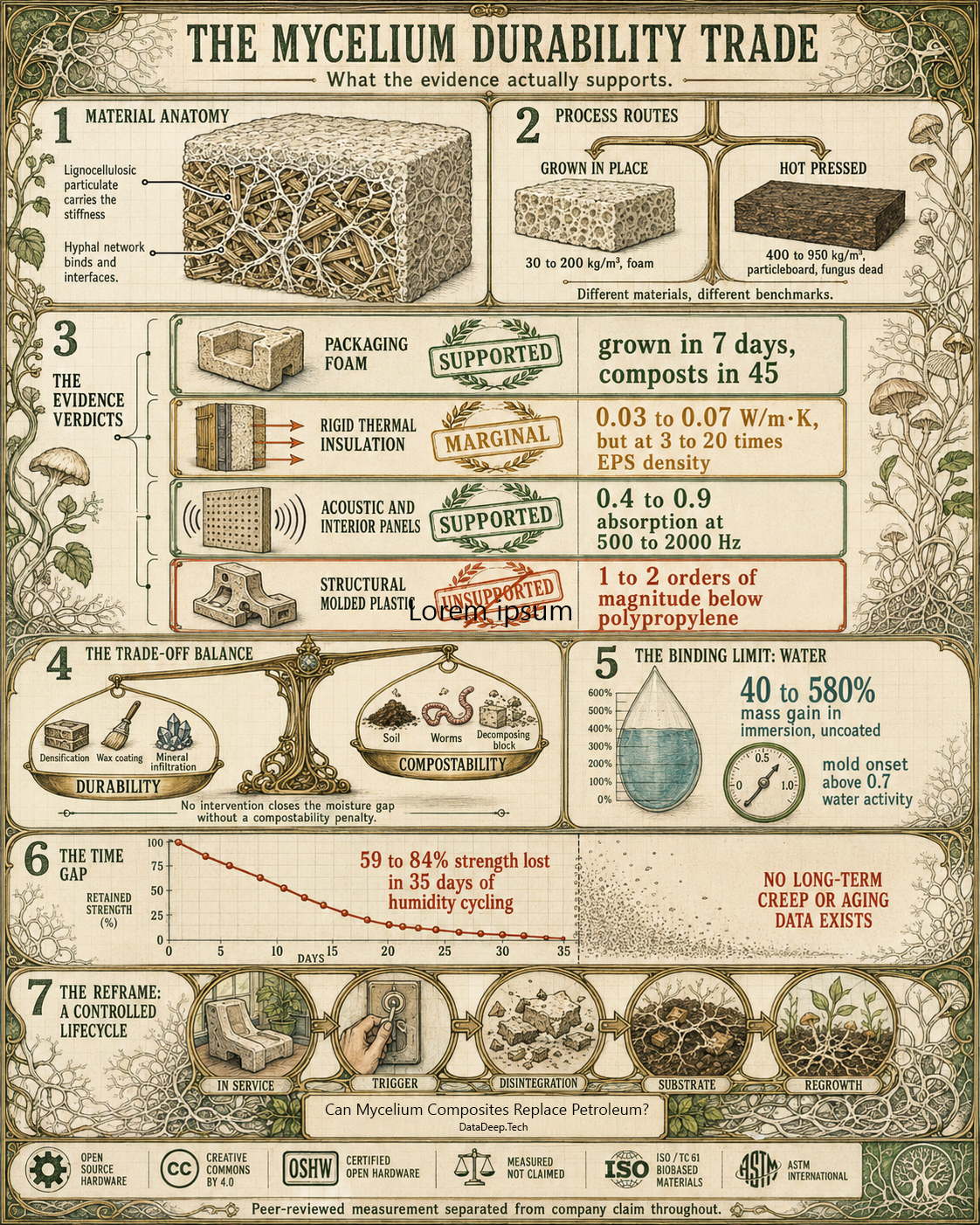
Packaging holds, insulation is marginal, structural plastic fails. Moisture is the binding limit across all four substitution cases.

Engineering Biodurable Mycelium and Myco-Composite Materials as Replacements for Petroleum-Derived Foams and Molded Plastics
1. Summary
Mycelium composites are a real, manufacturable class of two-phase biomaterial in which a lignocellulosic particulate carries most of the load and a fungal hyphal network binds the particles, and the evidence supports their use as a substitute for petroleum foams in exactly one of the four target classes examined here: protective and cushioning packaging foam, where grown-in-place material is already produced at commercial scale by Ecovative and others and meets or exceeds expanded polystyrene on compressive strength [1][2][3]. The substitution case for rigid thermal insulation is marginal but plausible: measured thermal conductivities span roughly 0.03 to 0.07 W/m·K in the better studies, overlapping EPS at 0.03 to 0.04 W/m·K, but the material reaches those values at three to twenty times the density of EPS and remains hygroscopic [4][5][6]. The case for acoustic and interior panels is supported for the specific properties that matter there, namely sound absorption and fire behavior, and is already commercial through Mogu and Biohm [7][8]. The case for structurally loaded, injection-molded rigid plastic parts is unsupported on present evidence: even heat-pressed panels top out at flexural strengths one to two orders of magnitude below injection-molded polypropylene, and the benchmark for pressed material is low-grade particleboard, not engineering plastic [9][10].
The binding property limit across every application is moisture. Uncoated composites absorb 40 to 580 percent of their dry mass in immersion and remain hydrophilic, and the same open, hygroscopic, biologically bound structure that makes the material compostable is what limits its service life [11][12]. This is the field's central and unresolved tension: every intervention that adds durability trades against end-of-life performance, and none has been shown to close the moisture gap without a compostability penalty. Heat pressing roughly doubles density and denatures the fungus, converting a foam into a fungal-bonded particleboard [10][13]. Hydrophobic coatings such as beeswax cut water absorption substantially but add a discrete film whose own degradability governs the product's [14][15]. Mineralization with calcium carbonate has, in the one careful peer-reviewed attempt, reduced strength and surface hydrophobicity rather than improving them, while adding inorganic mass that voids a clean compostability claim [16].
The single most important gap is time. The field has essentially no long-duration creep, sustained-load, or multi-year aging data, and the most rigorous accelerated-weathering study available shows that even hot-pressed, dense material loses 59 to 84 percent of its flexural, tensile, and compressive strength after just 35 days of humidity-and-temperature cycling [17]. For a packaging product with a service life measured in weeks, that is tolerable. For any building or structural product that assumes decades of service, it is disqualifying until demonstrated otherwise. The correct engineering framing is not durability versus compostability but triggered degradation: a material engineered to hold specified properties across a defined, bounded exposure envelope and then to compost on command.
2. Background
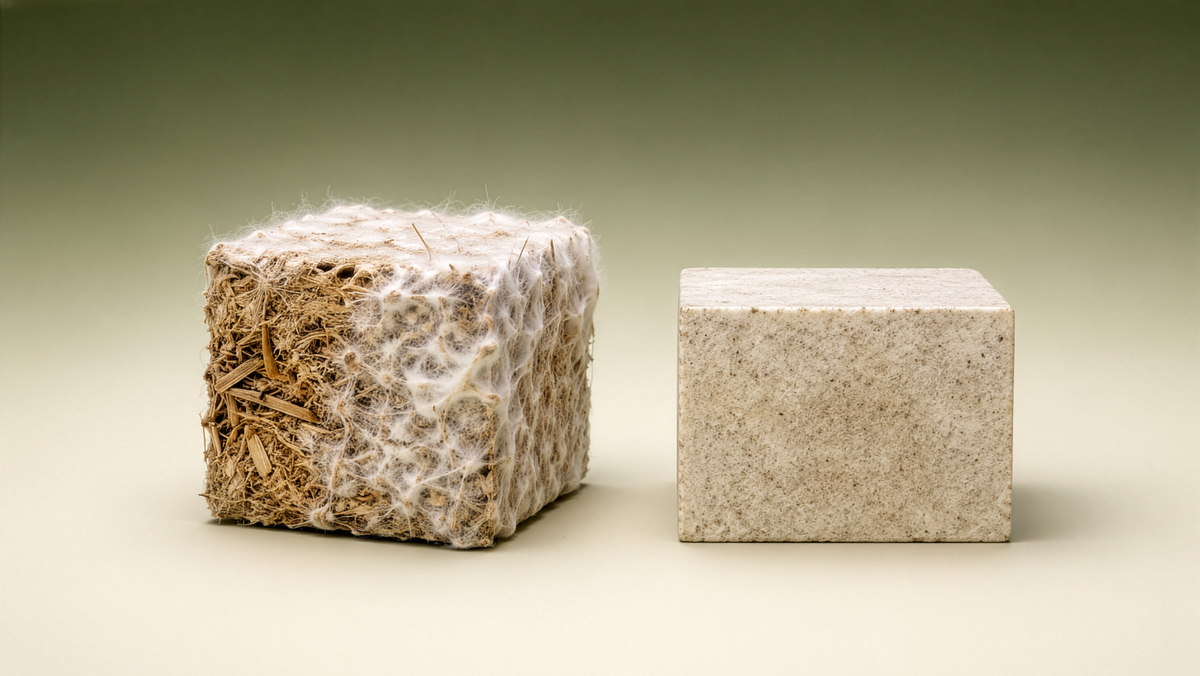
A mycelium composite is a particulate composite. Chopped lignocellulosic feedstock, hemp hurd, straw, sawdust, agricultural residues, provides the bulk and most of the stiffness, and a fungus grown through that feedstock deposits a hyphal network that binds the particles at their contacts and forms a denser skin at air-exposed surfaces [1][18]. The fungal phase is a minority by mass but controls interfacial bonding, surface quality, and water interaction. Fungal cell walls are built from chitin and beta-glucans, with amphipathic hydrophobin proteins concentrated at aerial surfaces; these three components set hyphal strength and the native water repellency of the skin [19][20].
Two process routes yield materials that differ in kind, not degree. Grown-in-place material is left as a low-density foam-like solid, typically 30 to 200 kg/m³, in which the fungus is often killed only by a final drying step and the cellular porosity is preserved [4][21]. Post-pressed material is compacted, usually hot-pressed, to 400 to 950 kg/m³, which denatures the fungus, collapses the porosity, and produces a dense board [10][17]. The first competes with foams; the second competes with particleboard and fiberboard. Conflating them is the most common analytical error in the popular literature and much of the primary literature.
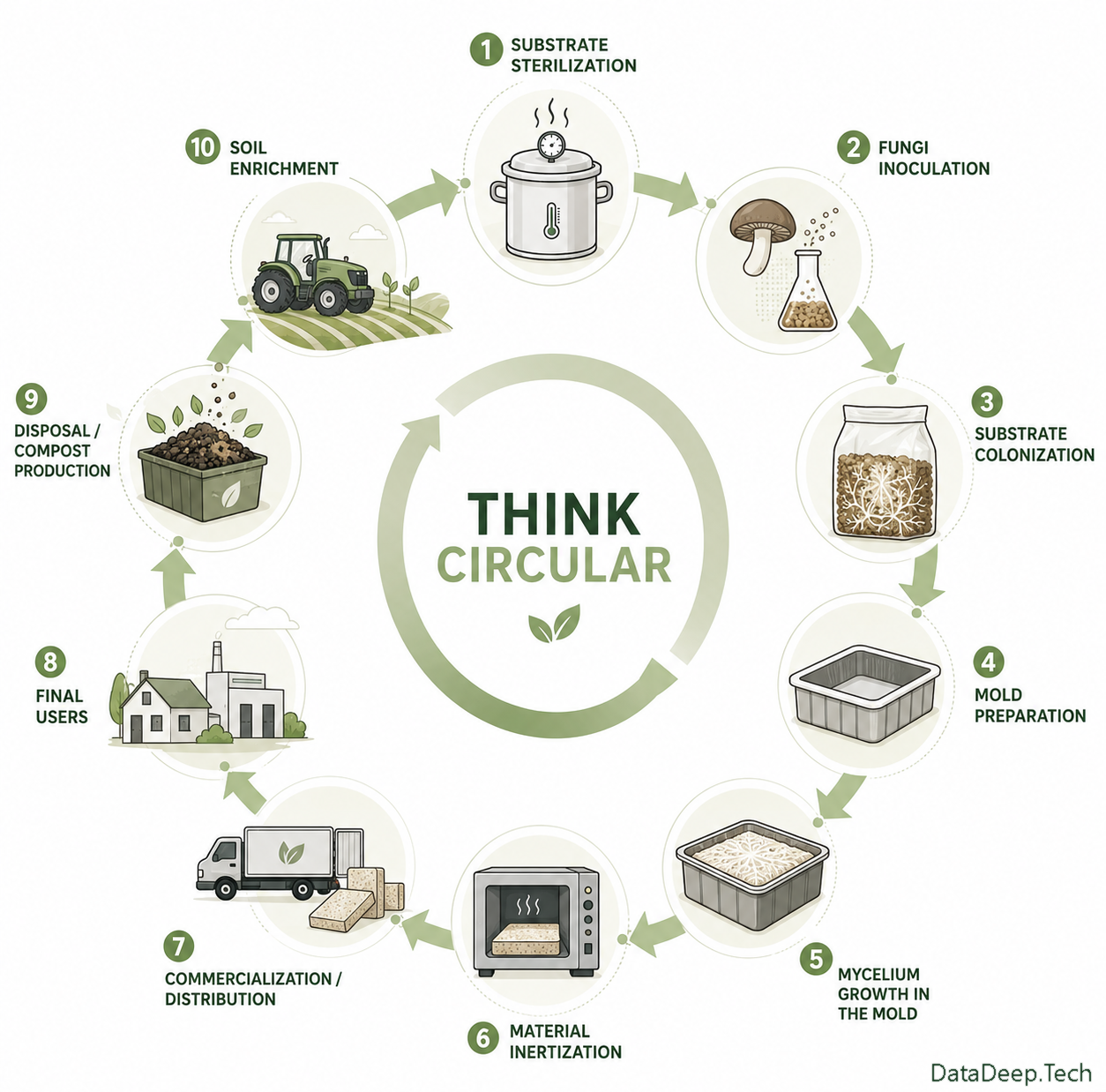
Biodurability must be defined operationally for this analysis to proceed, and it is not the same as inertness. A biodurable mycelium material is one that retains a specified set of properties, compressive strength for cushioning, thermal resistance for insulation, dimensional stability for panels, above defined thresholds over a defined service life under a defined exposure envelope of temperature, humidity, liquid water, and load. Under this definition the design target is not a material that never degrades, which would forfeit the environmental rationale, but a material whose degradation is suppressed within the service envelope and triggered outside it. Every property claim below should be read against that definition.
3. Technical core: the durability design space
3.1 Fungal species and strain selection
The characterized species cluster in the white-rot Basidiomycota, in the orders Agaricales and Polyporales, with the genera Ganoderma, Pleurotus, Trametes, Schizophyllum, and Fomes recurring across the literature [22][23]. A bibliometric review of the field found Pleurotus ostreatus the most-studied species, appearing in 22 of the surveyed documents, followed by Ganoderma lucidum in 20 and Trametes versicolor in 10 [24]. A PRISMA systematic review of 84 selected papers found the same rank order, with P. ostreatus in 41.7 percent of studies and G. lucidum in 27.4 percent [25].
The white-rot versus brown-rot distinction matters for residual substrate mechanics. White-rot fungi can degrade lignin as well as cellulose and hemicellulose, whereas brown-rot fungi preferentially consume the cellulose and leave a modified lignin residue; nearly all composite work uses white-rot species, and the practical implication is that the fungus is consuming the same lignocellulosic skeleton that carries the load, so excessive colonization time reduces substrate mass and can lower properties even as it improves bonding [22][26]. One panel study noted explicitly that longer incubation improved bonding and mechanical properties but caused more wood loss, so a shorter sufficient time is preferred [21].
Cell wall composition bears directly on strength and water uptake. A comparison of strains found that the relatively low chitin content of a P. ostreatus cell wall grown on cellulose and potato dextrose was associated with higher water sensitivity, and that heat pressing of Fomes fomentarius at 100 MPa changed hydrophobicity, tensile strength, and stiffness in line with hyphal compaction, with lignocellulosic substrate yielding higher beta-glucan content and less densely packed structure than glucose-based cultivation [20][27]. Genetic work is proof-of-principle but strikingly large in effect: Appels and colleagues found that deleting the SC3 hydrophobin gene in Schizophyllum commune raised Young's modulus from a wild-type 438 to 913 MPa to 1237 to 2727 MPa and tensile strength from 5.1 to 9.6 MPa to 15.6 to 40.4 MPa, a three- to four-fold gain correlated with increased mycelium density, and introducing a chitin-deacetylase gene raised compressive modulus, showing that cell wall chemistry is a real lever, though not one deployed at production scale [20].
Hyphal morphology governs surface quality. Trametes multicolor produced a soft, smooth, foam-like skin on rapeseed straw while P. ostreatus produced a solid, rough surface on the same substrate, and dense continuous aerial hyphae have been shown to improve wet-state shape retention [19][28]. On the specific question this report is obligated to ask: strain-level and passage-number variation is documented as a real risk, with reviews flagging fungal strain degeneration as a production hazard, but no species selection reported in the peer-reviewed literature has been performed specifically for durability rather than for growth rate, yield, or surface aesthetics [29]. Species are chosen for how fast and how attractively they grow, not for how long the product lasts.
3.2 Substrate engineering
Substrate, not fungus, is the dominant driver of the measured property range, and this allocation is the single most useful design finding in the field. A characterization study varying substrate, species, and processing concluded that substrate type and colonization level determined stiffness and water resistance more than species did, and reviews of thermal conductivity consistently attribute more of the spread to substrate than to the organism [19][4]. A study comparing Ganoderma sessile and Trametes versicolor on green waste, wheat straw, and straw-kapok mixtures found thermal conductivity for green-waste composites roughly 30 percent higher than for wheat-straw composites, a substrate effect that swamps typical species differences [30]. The practical corollary is that design effort spent selecting and conditioning feedstock returns more than effort spent screening fungi.
The feedstock variables that move properties are particle size and aspect ratio, lignin and cellulose fractions, carbon-to-nitrogen ratio, initial moisture, packed density, supplementation, and pretreatment. Higher grain or fiber content raises density and therefore stiffness and strength [1]. Substrates with lower lignin content are generally more favorable to colonization, and most species prefer a mildly acidic pH of 5 to 8 [22]. Supplementation with a soluble carbon source changes the fungal phase measurably: adding D-glucose or dextrose to the growth medium increased elasticity and produced thicker, more porous mycelium [26][19]. Supply and consistency are genuine feasibility inputs rather than market questions: Ecovative's packaging depends on hemp hurd, a decortication byproduct of the fiber-hemp industry, and a 2026 study demonstrated that minimally processed chopped hemp, avoiding the logistically challenging bast-hurd separation, produced composites meeting or exceeding EPS on compressive strength, easing a real bottleneck [3][31].
3.3 Density and hyphal-network control
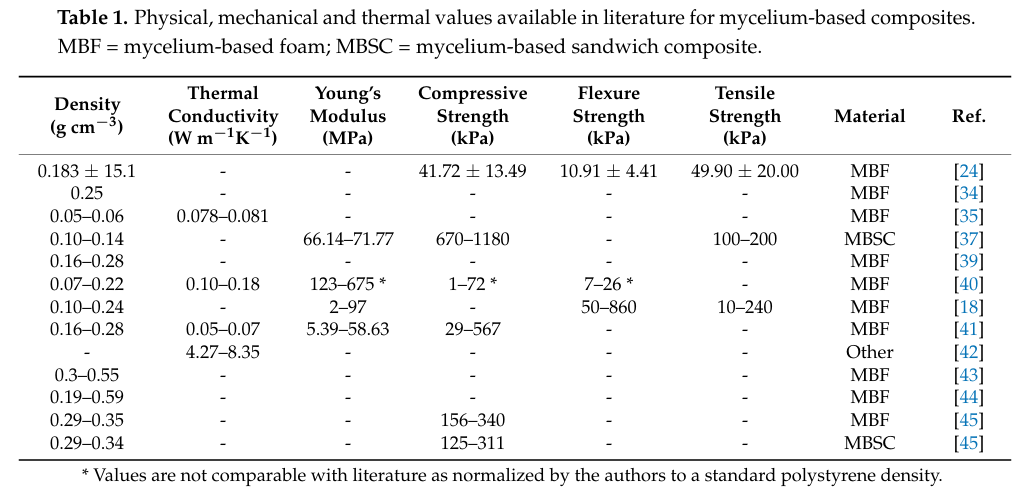
Density is the master variable, and it is set by growth duration, packing pressure, gas exchange and carbon-dioxide accumulation, and the temperature and humidity regime during incubation [1][29]. Grown-in-place foams occupy roughly 30 to 200 kg/m³, overlapping EPS at 10 to 75 kg/m³ but skewing heavier, and hot-pressed boards reach 400 to 950 kg/m³ [4][10][17].
As density dominates, any property comparison across specimens of different density is not a comparison, and this report treats it as such. Reviews repeatedly record that raw compressive strengths ranging from 29 to 567 kPa across the literature reflect substrate and density differences at least as much as material quality, and one compilation reported compressive strengths as different as 1 to 72 kPa for cotton-based Ganoderma versus 490 kPa for red-oak-based Ganoderma, driven substantially by substrate and density [11][32]. The correct treatment is to normalize by density, and the field has begun to do so on Ashby maps [33][34].
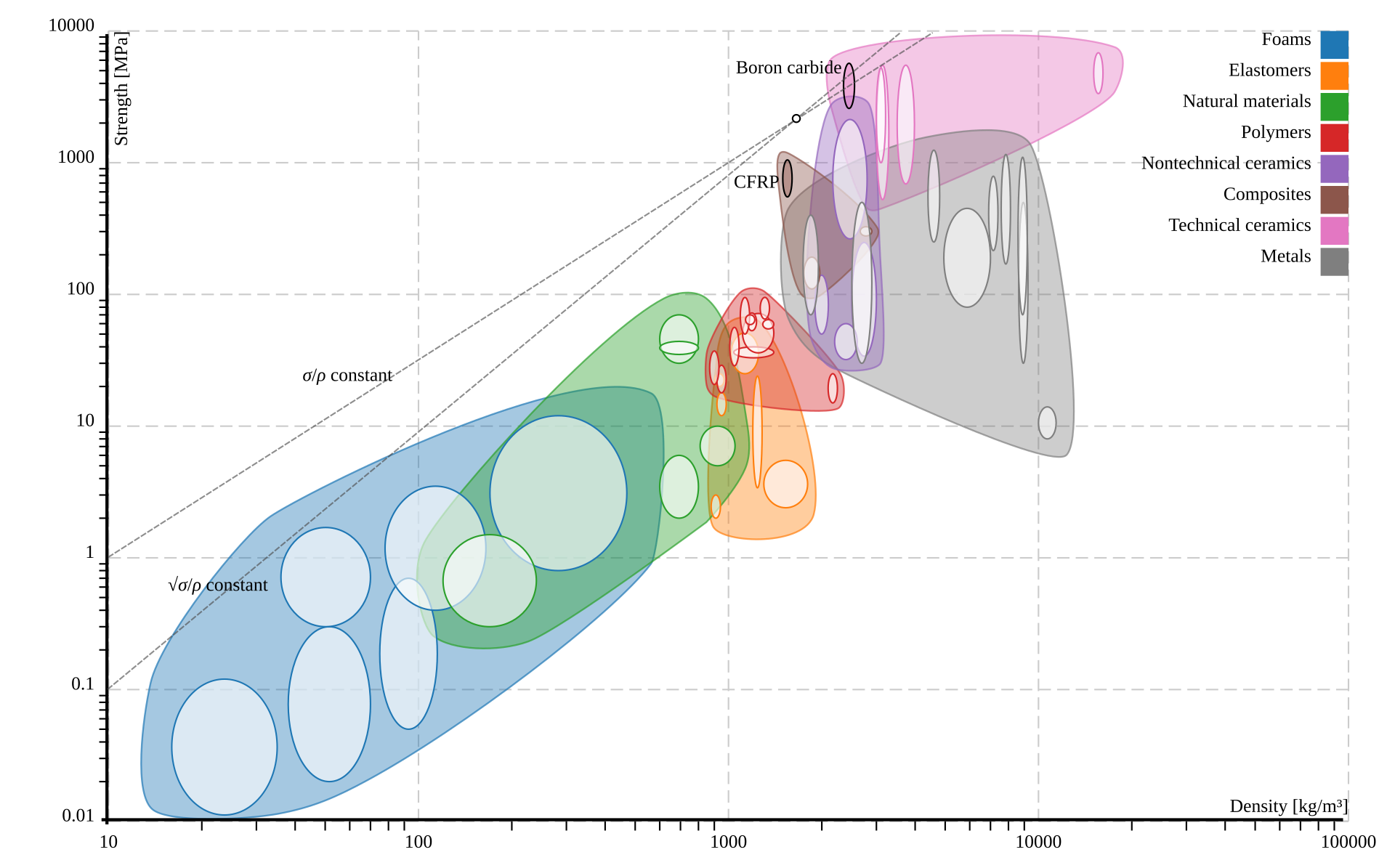
Where the data permit, the property-density relationship follows the scaling expected of open-cell cellular solids. Islam and colleagues reported that "the modulus varies with the square of mycelium density and strength varies with an exponent 3/2," precisely the Gibson-Ashby scaling for open-cell foams [35]. This is analytically important: it means mycelium foams are not anomalous cellular solids, that their weak absolute properties are largely the arithmetic consequence of low density, and that raising properties fundamentally requires raising density, which is why every strengthening route converges on densification and why densification is in tension with the low-density, high-porosity character that gives the material its insulating and cushioning value.
3.4 Heat pressing and densification
Heat pressing is the most effective single strengthening lever and simultaneously the clearest example of the durability-compostability trade. Appels and colleagues found that hot pressing raised tensile strength to 0.24 MPa and flexural strength to 0.87 MPa, improvements of roughly 24-fold and 14.5-fold over as-grown material [13][36]. A study of two Trametes species reported that hot pressing approximately doubled density, from 238 to 480 kg/m³ for one and 270 to 515 kg/m³ for the other, and that the pressed composites outperformed EPS on all mechanical measures while unpressed ones did not, though ductility and toughness deteriorated after densification [10]. Across the literature, hot-pressed tensile strengths run 130 kPa to 1.55 MPa against 10 to 200 kPa uncompressed [10]. Optimized hot pressing of spent mushroom substrate reached a flexural strength of 36.6 MPa, comparable to a wood-panel design standard [37].
Pressing changes the material in kind. It denatures the fungus and terminates biological activity, since the mycelial structure degrades at roughly 225 to 300 °C and pressing temperatures of 120 to 200 °C combined with dwell times kill the organism, foreclosing any subsequent self-repair [10][21]. It collapses the porosity that provides insulation and cushioning. The reframing is that hot-pressed mycelium material is a fungal-bonded particleboard, and its appropriate benchmark is medium-density fiberboard or particleboard, not EPS or polyurethane foam. Against that benchmark it is credible; against injection-molded plastic it is not.
3.5 Moisture behavior
Moisture is the governing weakness. Uncoated composites gain 40 to 580 percent of dry mass in immersion over 48 to 192 hours, driven by hydroxyl-rich cellulose and a hydrophilic mycelial binder [11][12]. A cold-pressed peach-palm composite absorbed 245 percent with 21 percent thickness swell, while hot pressing lowered uptake by reducing porosity [12][21]. At the fiberboard end, EN 317 testing of Ganoderma lucidum boards recorded higher water absorption and thickness swell than adhesive-bonded controls, and a review compiled 24-hour water absorption of 72 to 158 percent and thickness swell of 3.1 to 65 percent across biocomposites [11][38]. Native hydrophobicity from hydrophobins gives water contact angles above 100° on aerial skin and can slow but not prevent uptake; contact angles of 121° to 133° have been measured on mycelium-rich surfaces [19][6].
Sorption isotherms confirm the material equilibrates with ambient humidity: equilibrium moisture rose to about 10 percent at 75 percent relative humidity and to 17 to 32 percent at 90 percent for various species and substrates [39]. Vapor transport should be treated as a design requirement, not a defect. A fully sealed hygroscopic material traps moisture and fails faster in most wall assemblies than a permeable one, which is why Biohm markets its insulation as breathable and moisture-wicking [8]. The design objective for insulation and panels is controlled vapor permeability paired with liquid-water resistance, not an impermeable barrier. Where sources report bare absorption percentages without stating specimen density, immersion duration, or conditioning state, those numbers are not directly comparable, and much of the literature omits precisely those parameters.
3.6 Secondary biological colonization
The resident fungus provides some competitive exclusion. Elsacker's work found the regrown fungus able to outcompete other microorganisms during regrowth, and beeswax-coated composites showed no fungal growth for 36 days against an uncoated reference [14][40]. However, this protection is conditional on dryness. As a hygroscopic material equilibrating above roughly 90 percent relative humidity reaches internal moisture of 17 to 32 percent, it enters the water-activity regime where opportunistic molds proliferate; building-science practice places the mold-growth threshold near a water activity of 0.7 to 0.8, and mycelium composites cross that threshold under sustained high humidity [39]. Improper drying during manufacture is itself flagged as creating conditions for mold growth that compromise integrity over time [41].
The applicable standardized tests are ASTM G21, the 28-day fungal-resistance practice for polymeric materials rated 0 to 4 by visual growth, and its analogues ASTM D3273 for mildew, ASTM C1338 for insulation and facings, and ISO 846 for microbial biodeterioration [42][43]. A verified peer-reviewed dataset applying G21 specifically to mycelium composites and rating live versus heat-killed material side by side was not identified in this research; this is an evidence gap given that living and denatured material should behave differently, live material metabolically defending its territory and killed material offering only a nutrient-rich carbon source. Spore load, allergen exposure, and volatile emissions matter for interior use: Mogu reports a chamber volatile-organic-compound emission of 15 µg/m³ under the Eurofins Indoor Air Comfort 28-day test, and Biohm reports negligible emissions with an A+ rating, but independent allergen and spore-exposure data across products are thin [7][8].
3.7 Wet-dry and freeze-thaw cycling
Hygroscopic swelling and shrinkage drive dimensional instability, warping, and cracking, and improper or uneven drying produces internal stresses and surface cracking [41][44]. One study reported that a mycelium foam-like insulation maintained good functional performance after drying-and-wetting cycles and showed useful moisture-buffering capacity, a comparatively favorable result [45]. This optimism must be read against the strongest cycling dataset available. In the accelerated tropical-weathering study of dense, hot-pressed Ganoderma lucidum composite grown on sawdust and empty fruit bunch, specimens pressed to approximately 954 kg/m³ (from a pre-pressing dried-block density of 120 to 130 kg/m³) and conditioned in a chamber at 27.5 ± 2.5 °C and 75 ± 15 percent relative humidity lost, after 35 days, 59 percent of flexural strength (2.68 to 1.10 MPa), 84 percent of compressive strength (4.44 to 0.71 MPa), and 79 percent of tensile strength (1.55 to 0.32 MPa), with tensile modulus falling 82 percent (647 to 116 MPa), all tested to ASTM D1037 [17]. That protocol did not include liquid immersion or ultraviolet exposure; it was humidity and temperature alone, and the sample size was only three specimens per condition. No published cycling protocol has been applied consistently enough across studies to permit clean comparison, so cycles-to-failure and irreversible-loss-per-cycle figures cannot be compared across the literature, and this inconsistency is itself a reportable finding.
3.8 Bio-based hydrophobic coatings
Coatings are the most-studied moisture defense and the clearest short-term win. Beeswax with coconut oil, dip-coated, cut immersion water absorption to 26.25 percent at 80 percent beeswax content and suppressed fungal growth for 36 days, versus much higher uptake for uncoated references [14]. Chitosan coatings reduced water uptake more than carrageenan or xanthan, and a chitosan-coated composite reached 1.46 MPa compressive strength while an epoxy-resin coating gave the highest flexural strength and lowest water absorption, the epoxy being a petroleum-based exception that voids compostability [46][11]. Candidate bio-based chemistries span waxes, polymerizing drying oils, shellac, chitosan, protein films, hydrophobins, and lignin derivatives.
Two mechanisms operate: penetrating treatments that coat the porous surface and reduce wettability, and discrete films that form a barrier. Grown mycelial and hydrophobin-rich surfaces raise contact angle by native hydrophobicity, while wax and resin films add a distinct layer. The systematic penalties are consistent. A film that blocks liquid water also cuts vapor permeability, risking moisture entrapment in assemblies. Coating durability under abrasion and cycling is largely uncharacterized in the peer-reviewed literature. Every coating imposes an end-of-life penalty proportional to its own recalcitrance: a beeswax or chitosan coating composts with the substrate, whereas an epoxy or synthetic wax does not, so the coating's degradability, not the composite's, becomes the governing end-of-life property. In the weathering study, an oil-based coating produced a statistically significant improvement only in tensile strength after 35 days, not in flexural or compressive strength, indicating coatings retard but do not arrest humidity-driven degradation [17].
3.9 Mineralization and hybrid inorganic approaches
Mineralization is the highest-ceiling and highest-cost intervention, and the peer-reviewed evidence is a cautionary result. The first careful application of a wood-derived calcium-carbonate mineralization protocol to mycelium composites, via in-situ solution exchange, reported that compressive strength declined after mineralization and that surface hydrophobicity fell, with water contact angles reduced by more than 50 percent, contrary to most prior reports on biomass mineralization and attributed to structural damage from the process [16]. Microbially induced calcium-carbonate precipitation using Sporosarcina pasteurii co-cultivated with Ganoderma lucidum, and fungally induced precipitation, have been demonstrated as engineered-living-material routes, and natural reinforcing particles high in calcium carbonate slowed thermal decomposition, but these add inorganic mass and density [47][48]. Silica and calcium-silicate sol-gel routes exist in the patent literature, promising fire and stiffness gains [49].
Quantitatively, the trade is stark: mineralization aims to raise stiffness, water resistance, and fire performance, but the best-controlled peer-reviewed study delivered losses on the first two, and all routes add density and inorganic content. On compostability, a heavily mineralized composite no longer qualifies as cleanly compostable and may fall below the bio-based-content thresholds used in recognized definitions, since added inorganic mineral is neither biodegradable in the composting sense nor bio-based carbon. Mineralization is therefore seen as a route toward a durable building material that has abandoned the compostability rationale, not as a way to have both.
3.10 Mechanical aging and long-term property retention
This is the largest evidence gap in the field, and it must be stated plainly rather than filled with inference. No peer-reviewed source reporting long-term creep or stress-relaxation behavior of mycelium composites under sustained load over months or years was identified in this research. The relevant creep literature covers wood-polymer and plant-fiber composites, not mycelium composites, and cannot be transferred directly because the fungal binder phase has no established long-term constitutive model [50][51]. The longest controlled exposure located is the 35-day weathering study, which is a humidity-temperature aging test, not a sustained-load creep test, and it shows severe strength loss over that short window [17]. One 2026 packaging-oriented study terminated mycelial growth at 35 days and reported no significant strength degradation at 60 days, but 25 additional days is not long-term aging and the specimens were unloaded [52]. Ultraviolet aging is essentially uncharacterized; the weathering study deliberately excluded ultraviolet exposure on the grounds that the material was not intended for direct sunlight [17]. Any application that assumes years of load-bearing service is, at present, extrapolating well beyond the data.
3.11 Repairability and self-repair
The distinctive possibility here is that live, unpressed material can regrow across damage. This has been demonstrated, not merely proposed, in specific systems. Elsacker and colleagues showed that dried pure-mycelium material could be rehydrated and fed to regrow across holes, with aerial hyphae fully overgrowing the wounds and mechanical properties characterized before and after, and that the material survived dry, nutrient-poor storage for up to eight months and could still regenerate, with chlamydospores implicated as the surviving structures [40][53]. A 3D-printed mycelium-hydrogel study measured regrowth at 0.6 to 0.7 mm/day to a maximum healing distance of 2.5 to 3 mm above a 6 percent malt threshold, and reported that fractured specimens healed into stronger and stiffer structures during the growth phase [54]. The critical limitation for durable-product design is that self-repair requires the fungus to be alive, hydrated, and fed, which is incompatible with hot-pressed, denatured, dried product. Conventional repair, patching with fresh inoculated substrate and re-incubation, or adhesive bonding, is available for dead material but has not been characterized for recovery of original properties. Recovery of original mechanical properties has been measured only in living-material studies, and only under active growth conditions, not in service.
3.12 Application-specific service-life design
Protective packaging is the supported case. Design service life is weeks to a few uses, the exposure envelope is dry indoor handling and short transit, and the governing property is compressive cushioning. Grown-in-place, uncoated or lightly skinned foam at 30 to 130 kg/m³ suffices; some hemp-based composites met or exceeded EPS compressive strength without any pressing, and Ecovative's MycoComposite is grown in seven days, composts in 45, is Cradle to Cradle Gold certified and certified 100 percent biobased by the USDA [3][2]. Here the moisture and aging weaknesses are irrelevant because the service life is shorter than the degradation timescale, and no durability intervention is needed. This is the case where the material's compostability is a pure asset.
Rigid thermal insulation is marginal. Design life is decades, the envelope includes humidity cycling and possible liquid water, and the governing properties are thermal resistance and durable dimensional stability. Thermal conductivity of 0.03 to 0.07 W/m·K is competitive, but the material needs controlled vapor permeability, liquid-water resistance from a compostable coating, and freedom from mold at high humidity, and the 35-day weathering data cast doubt on multi-decade stability [4][17]. The supported lever set is a moderate-density grown board with a breathable bio-coating in a vapor-managed assembly, explicitly not a sealed one.
Acoustic and interior panels are supported for their governing properties. Sound absorption coefficients of 0.4 to 0.9 at 500 to 2000 Hz exceed EPS, fire behavior is favorable with high char yield, and Mogu's acoustic material, a roughly 100 kg/m³ product with a flexural strength near 0.05 MPa and compression strength of 10.72 kPa to EN 826, reaches a Euroclass B-s2-d0 fire reaction to EN 13501 with an eco-friendly treatment [5][7][55]. Service life is long but the loads are trivial and the environment is conditioned indoor air, so creep and immersion are non-issues and only interior moisture, mold, and volatile emissions must be managed.
Structurally loaded molded plastic parts are unsupported. Injection-molded polypropylene and ABS deliver tensile and flexural strengths in the tens of megapascals with decades of dimensional stability under load; hot-pressed mycelium board reaches flexural strengths that in optimized cases approach particleboard but sit one to two orders of magnitude below engineering plastic, loses most of its strength under short humidity cycling, and has no creep data [9][17]. No combination of present levers closes that gap. The material is not a candidate for load-bearing molded plastic replacement.
4. Development status and maturity
Demonstrated with published measurements in peer-reviewed literature: the density-property scaling, the substrate-dominance of the property range, the 40 to 580 percent water absorption range, hot-pressing gains, thermal conductivity of 0.03 to 0.07 W/m·K, fire and char behavior, soil-burial disintegration, and the 35-day weathering strength loss are all measured, several across multiple independent groups [1][4][11][17][35]. Thermal conductivity and water absorption ranges are corroborated across many groups; the density-modulus scaling exponents rest on a small number of careful studies; the weathering result rests on a single small-sample study of three specimens per condition [17][35].
Demonstrated at production scale by operating firms with disclosed data: Ecovative reported making over two million pieces of Mushroom Packaging in 2021, with a stated intention to double that figure and a longer-run goal of replacing over a billion pieces of styrofoam, using hemp hurd and mycelium and citing less than one percent of the water of EPS manufacture [2][3]. Mogu and Biohm sell acoustic and insulation panels commercially in Europe [7][8]. These are legitimate evidence of process capability, but the accompanying property numbers are largely company-stated rather than independently measured.
Asserted by companies, patents, or project documentation without independent measurement: Ecovative's patent figures for hydrophobin-skin effects on water absorption, for example 15 percent uptake for standard packaging rising to 55 percent when the skin is removed, are internally consistent process data but not independently verified [56]. Biohm's roughly 75 percent acoustic absorption at 1000 Hz and A+ volatile rating are company claims [8]. Mineralization and silication patents describe processes whose property outcomes are asserted, and the one independent peer-reviewed mineralization test contradicted the optimistic direction [16][49].
Modeled or inferred: multiscale fiber-network models reproduce tensile and compressive behavior, and artificial-neural-network models predict internal bonding and compressive strength from composition, but these are descriptive of existing data rather than predictive of long-term behavior [35]. All statements about multi-year service life are inference, not measurement.
5. Key research groups, institutions, and actors
The most-cited property and review work comes from Mitchell Jones and colleagues at RMIT and the University of Vienna, whose critical review and fire-behavior studies anchor the thermal and mechanical benchmarking [9][57]. Elise Elsacker and collaborators at Vrije Universiteit Brussel and the Hub for Biotechnology in the Built Environment produced the standardized disintegration framework and the self-healing living-material work [40][58]. Groups associated with Utrecht and Eindhoven, through Appels, Wösten, and colleagues, produced the foundational fabrication-factor, hydrophobin, and gene-deletion studies [19][20]. Stefania Akromah and Stephen Eichhorn at Bristol produced the calcium-carbonate mineralization and beeswax-coating studies that provide the most rigorous intervention data [16][15]. Chan, Saeidi, Javadian, Hebel, and Gupta, working across the National University of Singapore and the Future Cities Laboratory, produced the accelerated-weathering study that is the field's most important durability datapoint [17]. On standards, ASTM and CEN provide the wood-panel, foam, fungal-resistance, and composting test methods, though none is written specifically for mycelium composites.
Where a firm's process is the sole source for a claimed property, the dependency should be noted: Ecovative is the primary source for production-scale packaging water-absorption and composting figures, and its patents are the main disclosure of hydrophobin-skin control [56][2]. All named firms, including Ecovative, MycoWorks, Mogu, Biohm, and Grown.bio, are privately held; no publicly traded pure-play exists, which constrains the availability of audited performance data.
6. Path to realization
The open engineering problems are, in order of importance: closing the moisture gap with a compostable rather than synthetic barrier; generating long-duration creep and aging data under load; suppressing secondary mold at service humidity; and controlling batch-to-batch variability inherent to a biological process. Each is tractable in principle, but none is solved.
The standardization gap is severe and is itself a barrier. Studies report bare strength numbers without density, test standard, specimen geometry, loading rate, or conditioning state, which makes cross-study comparison unreliable. The field mixes EN 310/317/319 wood-panel methods, ASTM D1037, ASTM thermal and vapor-permeance methods, ASTM G21, and ISO 20200 and ISO 14855 composting methods without a common reporting convention. A field-specific reporting standard, always pairing every property with density and conditioning, would remove much of the order-of-magnitude spread that is method artifact rather than material difference.
Substrate supply and consistency is a real feasibility input. Hemp hurd is a decortication byproduct whose separation is logistically challenging and potentially cost-prohibitive at scale, which is why the demonstration that minimally processed chopped hemp works is significant for feasibility [31][3]. Agricultural residues are abundant but variable in particle size, lignin fraction, and contamination, and that variability propagates into product variability.
Process economics enters only as a feasibility input, and the binding constraint is time, not energy. Incubation runs days to weeks: Ecovative's packaging grows in roughly seven days, and typical composite growth phases run 15 to 20 days, against the seconds-to-minutes cycle time of injection molding or EPS expansion [2][11]. This growth-limited throughput is the fundamental production constraint and caps how cheaply the material can be made regardless of substrate cost. The offsetting advantages are low process energy and less than one percent of the water of EPS manufacture, plus near-sourcing of substrate [2]. Credible cost figures are scarce and mostly company-stated; Ecovative asserts cost-competitiveness with petroleum foam for packaging, which is plausible for that application and unproven for others.
Realistically, packaging is realized now. Acoustic and interior panels are realized for their governing properties now. Durable insulation is a five-to-ten-year problem contingent on coating and aging work. Structural molded-plastic replacement is not on a credible near-term path with this material system.
7. Material risks and failure modes
In-service moisture failure and secondary colonization is the highest-likelihood, highest-impact technical risk. Likelihood is high for any humid or wetted application given 40 to 580 percent absorption and mold onset above roughly 0.7 to 0.8 water activity; impact is loss of structural integrity and a health-relevant mold problem [11][39]. Mitigation is a compostable hydrophobic coating plus vapor-managed assembly design plus restriction to appropriate applications, but coatings retard rather than arrest the process, as the weathering data show [17][14].
Irreversible property loss under cycling is high-likelihood, high-impact for long-life applications: 59 to 84 percent strength loss in 35 days of humidity cycling means the material cannot be assumed stable in service [17]. Mitigation is densification and coating, which help but do not restore stability, and honest service-life limits.
Absence of long-term creep and aging data beneath applications assuming decades of service is a high-impact risk precisely because it is unquantified; the credible mitigation is to not specify the material for sustained-load structural service until the data exist, and to generate accelerated creep master curves as a research priority [50].
Batch-to-batch variability from biological process control is high-likelihood, moderate-impact, evidenced by high standard deviations in mechanical data and by explicit warnings about strain degeneration [29][17]. Mitigation is tighter strain banking, controlled incubation, and quality-control testing, borrowing good-manufacturing-practice discipline.
Fire performance and regulatory qualification for building applications is moderate risk with a favorable base case: high char yield and low smoke give mycelium composites better fire reaction than XPS in cone-calorimeter tests, and Mogu achieves Euroclass B-s2-d0 with treatment [55][7]. The risk is that full building-code qualification, including structural and durability certification, has not been completed for most products.
Allergen and sensitization exposure is moderate-likelihood, moderate-impact for interior and packaging use; spore load and fungal allergens are plausible concerns and independent exposure data are thin, though vendors report low volatile emissions [7][8]. Mitigation is heat-killing, encapsulation, and exposure testing.
Reputational and regulatory risk of compostability claims that coated or mineralized products cannot substantiate. A composite marketed as home-compostable but finished with a synthetic epoxy or wax coating, or heavily mineralized, may not disintegrate under home or industrial composting conditions and could attract greenwashing scrutiny under tightening labeling regimes. Mitigation is to test every finished formulation, not just the base material, against the actual composting standard claimed, and to restrict compostability claims to formulations that pass.
8. Implications and outlook
For the practitioner deciding whether to pursue this work, the analysis yields a clear allocation of effort. The material is real, it is manufacturable, and it already wins in packaging and interior acoustic and insulation panels, applications whose short service life or benign environment makes the moisture and aging weaknesses irrelevant. Pursue those now. The material is marginal but improvable for durable insulation, where the payoff depends on solving the compostable-barrier and aging problems rather than on any breakthrough in the base composite. Pursue that as a five-to-ten-year research program, not a product. The material is not a substitute for structurally loaded molded plastic, and effort spent chasing that target is likely wasted with this material system.
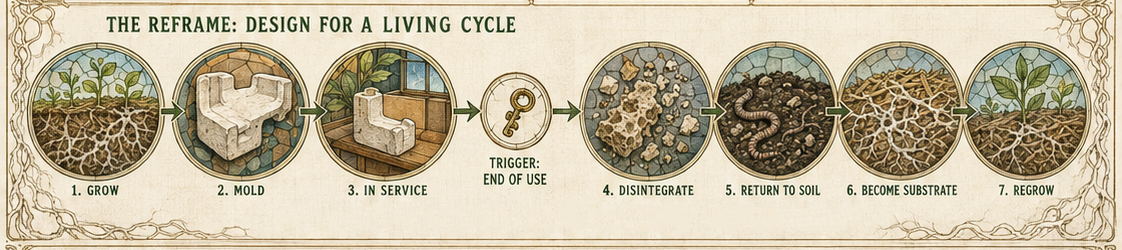
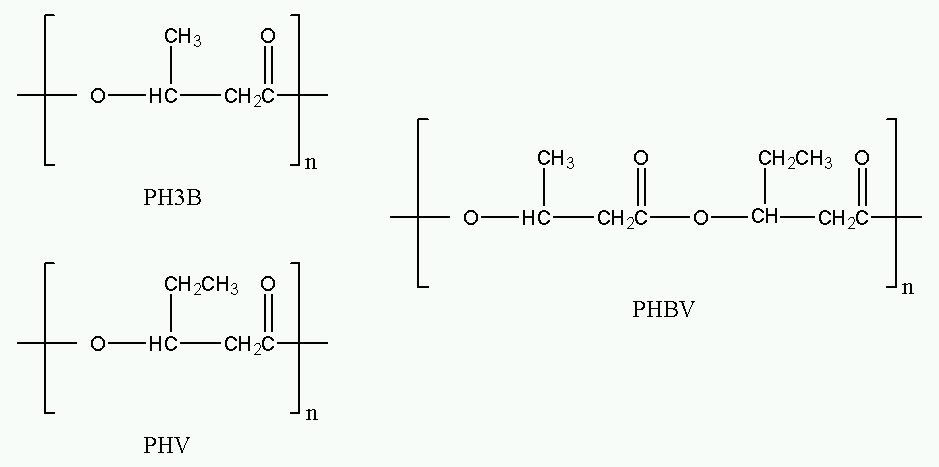
The governing intellectual reframe is that the field has been solving the wrong problem. It has treated moisture sensitivity and biodegradability as defects to be engineered away, when the environmental rationale for the material depends on preserving biodegradability. The productive framing is triggered degradation: a material engineered to hold specified properties within a bounded, defined exposure envelope and to compost reliably outside it. That reframing turns the central tension from a contradiction into a design specification, and it makes the coating and interface the key research object, since a coating that resists water in service but composts on disposal is exactly the trigger the material needs. possibly a thin multilayer: a polar bio-based primer, with a hydrophobic compostable outer layer. Early candidates include polyhydroxyalkanoates (PHA/PHB), or a zein–chitosan–wax barrier.
Open questions that may determine how far beyond packaging this material can credibly go:
Can a fully bio-based coating cut in-service water absorption durably without blocking vapor transport and without surviving the compost that must consume it?
What is the true long-term creep and aging behavior under load, which no one has measured?
Can secondary mold be suppressed at service humidity without biocides that void compostability?
Can the field adopt a reporting standard that always pairs a property with its density and conditioning, so that the next decade of data is comparable in a way the last decade's largely is not?
References
[1] Wang, Sun, and Qin. 2021. "Material Function of Mycelium-Based Bio-Composite: A Review." Frontiers in Materials 8: 737377.
[2] Ecovative. 2022. "Mushroom Packaging is Back, and Growing" and company blog on AirMycelium and production volumes.
[3] Mushroom Packaging (Ecovative). MycoComposite technical documentation and "About" pages.
[4] Wildman, J., Shea, A., Walker, P., and Henk, D. 2025. "Extrinsic and intrinsic determinants of thermal conductivity in mycelium composites." Building Services Engineering Research and Technology.
[5] "Mycelium-Based Thermal Insulation for Domestic Cooling Footprint Reduction: A Review." 2023. Sustainability 15(17): 13217.
[6] George, K., et al. 2025. "Mycelium–coir-based composites for sustainable building insulation." Journal of Materials Chemistry A.
[7] Mogu S.r.l. Acoustic panel material data sheet (EN 826, EN 13501-2, Eurofins Indoor Air Comfort).
[8] Biohm. Mycelium insulation panel technical documentation.
[9] Jones, M., Mautner, A., Luenco, S., Bismarck, A., and John, S. 2020. "Engineered mycelium composite construction materials from fungal biorefineries: A critical review." Materials & Design 187: 108397.
[10] "Material characterization of pressed and unpressed wood–mycelium composites derived from two Trametes species." 2023. Cleaner Engineering and Technology / Sustainable Materials and Technologies.
[11] Girometta, C., et al. 2019. "Physical-Mechanical and Thermodynamic Properties of Mycelium-Based Biocomposites: A Review." Sustainability 11: 281.
[12] "Enzymatic activities and analysis of a mycelium-based composite formation using peach palm (Bactris gasipaes) residues on Lentinula edodes." 2020. Bioresources and Bioprocessing 7.
[13] Appels, F.V.W., et al. 2019. "Fabrication factors influencing mechanical, moisture- and water-related properties of mycelium-based composites." Materials & Design 161: 64–71.
[14] "Effect of beeswax and coconut oil as natural coating agents on morphological, degradation behaviour, and water barrier properties of mycelium-based composite." 2024. Composites Part C.
[15] Akromah, S., Chandarana, N., Acharya, M., and Eichhorn, S.J. 2026. "Understanding and controlling water sensitivity in mycelium composites with beeswax coatings." Materials Today Communications 54: 115589.
[16] Akromah, S., Chandarana, N., and Eichhorn, S.J. 2025. "In Situ Calcium Carbonate Mineralization of Mycelium Composites: Processing Challenges and Physical-Mechanical Property Implications." ACS Omega.
[17] Chan, X.Y., Saeidi, N., Javadian, A., Hebel, D.E., and Gupta, M. 2021. "Mechanical properties of dense mycelium-bound composites under accelerated tropical weathering conditions." Scientific Reports 11: 22112.
[18] Elsacker, E., et al. 2020. "A comprehensive framework for the production of mycelium-based lignocellulosic composites." Science of the Total Environment 725: 138431.
[19] Appels, F.V.W., et al. 2019. "Mechanical, physical and chemical characterisation of mycelium-based composites with different types of lignocellulosic substrates." PLOS ONE 14(7): e0213954.
[20] "A review of recent advances in fungal mycelium based composites." 2024. Discover Materials 4.
[21] "Insight into mycelium-lignocellulosic bio-composites: Foam and sandwich panel processing." 2022. Composites Part A.
[22] Aiduang, W., et al. 2025. "Mycelium-based composites: An updated comprehensive overview." Biotechnology Advances (ScienceDirect S0734975025000035).
[23] Ecovative Design. U.S. Patent 9,914,906. "Process for solid-state cultivation of mycelium on a lignocellulose substrate."
[24] "Fungi in Mycelium-Based Composites: Usage and Recommendations." 2021.
[25] Echeverría-Sáez, F.N., and Villamar-Ayala, C.A. 2026. "Material Selection for Mycelium-Based Composites: A Systematic Review and Opportunities for Chilean Industrial Residues." Designs 10(4): 86.
[26] Haneef, M., et al. 2017. "Advanced materials from fungal mycelium: fabrication and tuning of physical properties." Scientific Reports 7: 41292.
[27] Chen, Y., et al. 2025. "Structural, Mechanical, and Genetic Insights into Heat-Pressed Fomes Fomentarius Mycelium from Solid-State and Liquid Cultivations." Advanced Sustainable Systems.
[28] "Dense and continuous networks of aerial hyphae improve flexibility and shape retention of mycelium composite in the wet state." 2021. Composites Part A 149.
[29] Aiduang, W., et al. 2024. "A Review Delving into the Factors Influencing Mycelium-Based Green Composites (MBCs) Production and Their Properties for Long-Term Sustainability Targets." Biomimetics 9(6): 337.
[30] "Green Waste and Wheat Straw in Mycelium-Bound Composites: A Multi-Parameter Study on Dimensional Stability, Strength, Humidity Response, and Thermal Insulation Properties." 2021.
[31] "Mycelium-Based Composites Using Minimally Processed Industrial Hemp Biomass: Impact of Species and Feedstock Ratio on Mechanical Performance Compared to Polystyrene Packaging." 2026. Polymers 18(3): 400.
[32] "Compressive Resistance of the Mycelium Composite" (compiling Holt et al. 2012 and Travaglini et al. 2013).
[33] "Compressive behaviour of anisotropic mycelium-based composites." 2022. Scientific Reports 12: 6846.
[34] Elahi, et al. 2026. "Experimental Characterization of Mycelium-Based Composites Under Multiple Loading Conditions." Advanced Engineering Materials.
[35] Islam, M.R., Tudryn, G., Bucinell, R., Schadler, L., and Picu, R.C. 2017. "Morphology and mechanics of fungal mycelium." Scientific Reports 7: 13070.
[36] "Morphological and physico-mechanical properties of mycelium biocomposites with natural reinforcement particles." 2021. Construction and Building Materials 313.
[37] Cai, Z., Chen, S., Wen, J., et al. 2026. "Fabrication and performance comparison of mycelium-based composite boards from spent mushroom substrate via dry and wet processing." European Journal of Wood and Wood Products 84: 42.
[38] "Physical and mechanical properties of mycelium-based fiberboards." BioResources.
[39] "Comparison of novel fungal mycelia strains and sustainable growth substrates to produce humidity-resistant biocomposites." 2020. Materials & Design 192.
[40] Elsacker, E., Zhang, M., and Dade-Robertson, M. 2023. "Fungal Engineered Living Materials: The Viability of Pure Mycelium Materials with Self-Healing Functionalities." Advanced Functional Materials 33: 2301875.
[41] "Evaluation of Drying Times in Natural Fiber-Based Mycelium Composites from Empty Fruit Bunches and Kenaf." 2026. Fibers 14(1): 7.
[42] ASTM G21-15(2021)e1. "Standard Practice for Determining Resistance of Synthetic Polymeric Materials to Fungi." ASTM International.
[43] ISO 846:2019. "Plastics — Evaluation of the action of microorganisms." International Organization for Standardization.
[44] "Influence of Drying Temperature in the Oven on Physical, Morphology and Mechanical Properties of Mycelium Composite." 2025. Pertanika Journal of Science and Technology 33(1).
[45] "Physical Properties and Hygrothermal Behavior of Mycelium-Based Composites as Foam-Like Wall Insulation Material." Construction Technologies and Architecture 1: 643.
[46] Sakunwongwiriya, et al. 2024, as reported in Aiduang et al. 2025 comprehensive overview.
[47] "Bending and Compressive Behavior of a Co-cultivated Mycelium-Bacteria Based Composite" (Sporosarcina pasteurii / Ganoderma lucidum MICP).
[48] "Mycelium as a scaffold for biomineralized engineered living materials." 2025.
[49] U.S. Patent 11,293,005. "Process for making mineralized mycelium scaffolding and product made thereby."
[50] "Long-Term Creep Compliance of Wood Polymer Composites: Using Untreated Wood Fibers as a Filler in Recycled and Neat Polypropylene Matrix." 2022. Polymers 14.
[51] "Durability of Plant Fiber Composites for Structural Application: A Brief Review." 2023. Polymers.
[52] "Mechanical and aging performance of natural fiber-reinforced mycelium composites for sustainable packaging." 2026. Scientific Reports.
[53] Hub for Biotechnology in the Built Environment. Summary of Elsacker et al. self-healing functionalities study.
[54] "Three-dimensional Printing of Mycelium Hydrogels into Living Complex Materials." 2022. (arXiv 2203.00976 / Science Advances).
[55] Jones, M., Bhat, T., Kandare, E., et al. 2018. "Thermal Degradation and Fire Properties of Fungal Mycelium and Mycelium-Biomass Composite Materials." Scientific Reports 8: 17583.
[56] Ecovative Design. U.S. Patent 11,920,126. "Bio-manufacturing process."
[57] Jones, M., Bhat, T., Wang, C.H., Moinuddin, K., and John, S. 2017. "Thermal degradation and fire reaction properties of mycelium composites." 21st International Conference on Composite Materials, Xi'an.
[58] Elsacker, E., et al. 2021. "Mycelium Composites and their Biodegradability: An Exploration on the Disintegration of Mycelium-Based Materials in Soil." Construction Technologies and Architecture 1: 652.