Off-Grid Septic Systems in Klamath County, Oregon: Site Evaluation, Branch Selection, and Owner-Installed Cost
The soil picks the system, not the budget. A regulatory-first path from test pit to permitted drainfield on volcanic upland ground.

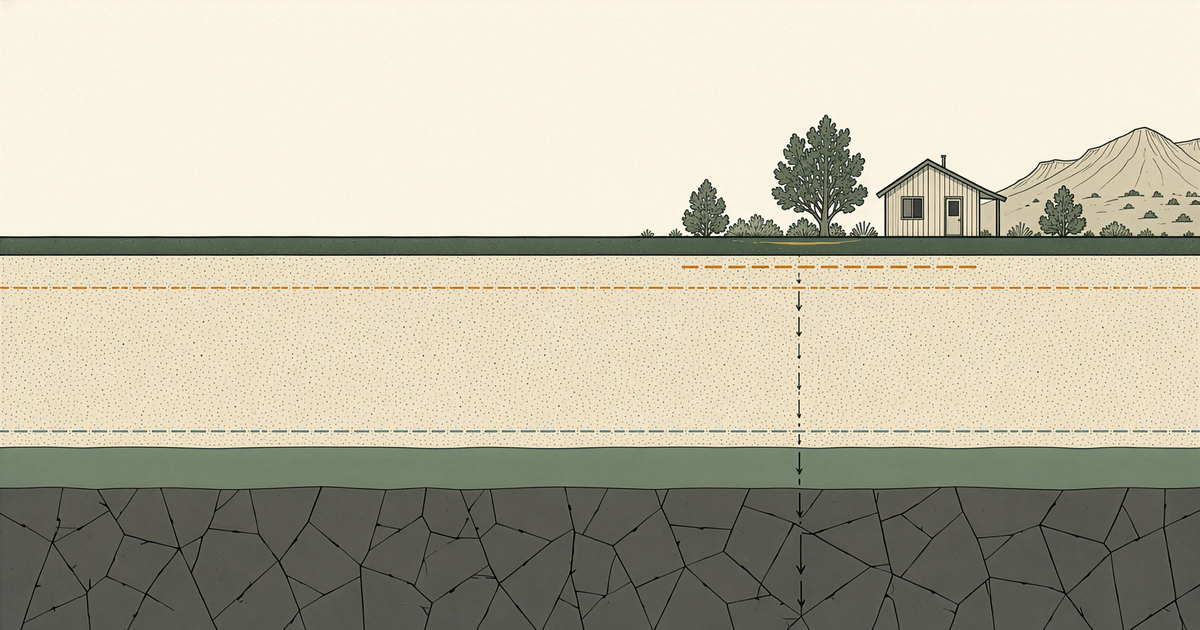
DIY Residential Septic System - Off-Grid Parcel, Bly Mountain (near Bonanza), Klamath County, Oregon
One-line summary: A regulatory-first, cold-climate, off-grid onsite wastewater design framework for a 4-bedroom / 6-occupant dwelling on volcanic upland soils, taking the builder from test-pit data through a decision tree to a permitted, buildable system that favors the zero-power path.
TL;DR
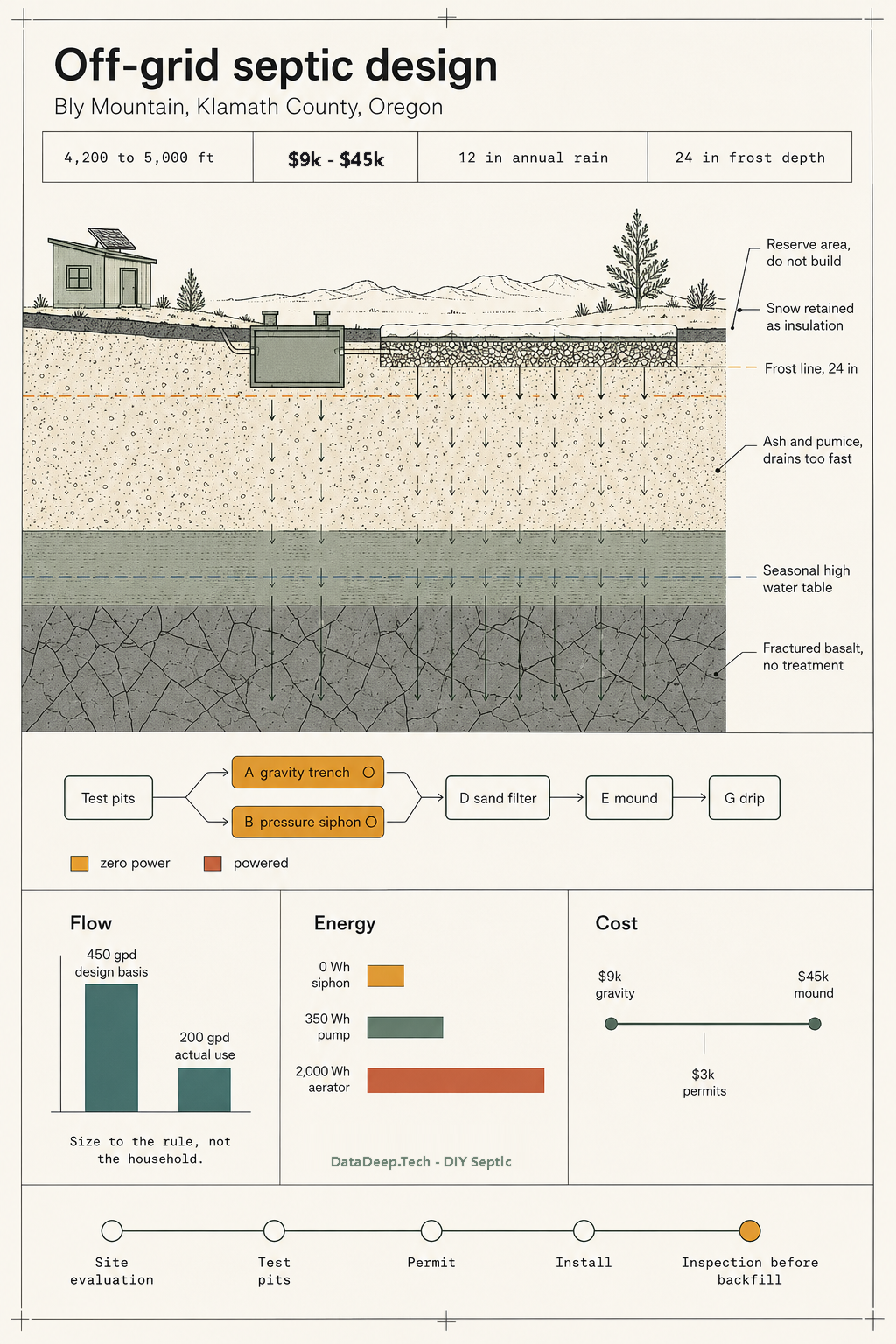
- On the rapidly draining Mazama ash/pumice soils typical of the Bly Mountain uplands (e.g., the Shanahan series), this parcel most likely will NOT qualify for a plain gravity drainfield: Oregon rules require pressure distribution, a sand filter, or a mound whenever rapid-permeability soil sits within 36 in of the surface [REG]. Only the test pits, observed by the county agent, settle this.
- The decisive off-grid move is a gravity-fed automatic dosing siphon: it delivers the pressurized, uniform dosing the soil requires with zero electricity, avoiding the PV/battery burden (~$800–$1,500 for a pump; ~$2,000-$4,000 for an aerobic unit) that otherwise attaches to a powered branch on an off-grid parcel.
- Design to the regulatory basis, not your true flow: a 4-bedroom dwelling is sized at 450 gpd [REG] even though six conserving occupants realistically produce only ~180–230 gpd. Budget roughly $9,000-$16,000 (owner-installed gravity) to $25,000–$45,000+ (mound), plus ~$2,200-$3,600 in permits/fees, and treat the mandatory 100%-reserve replacement area as a day-one constraint on your buildable envelope.
Key Findings
- Klamath County is a DEQ contract county. Onsite wastewater is administered by Klamath County Community Development, Septic/Onsite Division, in coordination with Oregon DEQ under ORS 454.725. DEQ's servicing regional office is in Medford (541-776-6010, by appointment); the DEQ Onsite program for Central/Eastern Oregon is centered in Bend [REG].
- The soil, not the equipment, chooses the system. Effective soil depth, depth to a restrictive layer (duripan/bedrock/cemented ash), the seasonal high water table, and whether rapid-permeability ash/pumice is within 36 in of grade determine which of Branches A–H is even legal. Fractured basalt is the specific hazard; it can give a deceptively fast percolation result while passing effluent to groundwater with essentially no treatment. A fast perc rate is a treatment-failure indicator, not a good outcome.
- Zero power is achievable even where dosing is mandatory, via an automatic dosing siphon (an approved Oregon dosing assembly) that uses gravity fall. This is worth substantial extra effort/cost elsewhere in the system.
- The reserve replacement area doubles your land requirement. It carries the same setbacks as the primary field and frequently constrains siting more than the primary field does.
- Source separation (compost toilet + graywater) does not escape a bad soil site. Oregon requires that the parcel still be capable of a DEQ-approved graywater disposal system, and in most cases a blackwater disposal area must still be installed or reserved. Branch H is a water-conservation/values choice, rarely a cost saver.
Details
1. Site, climate, and user model
1.1 Location & topography [MEAS].
Bly Mountain summit: 1,734 m (5,689 ft), ~42.404° N, −121.437° W, USGS "Sprague River East" quad.
Bly Mountain Pass on OR-140: ~1,547–1,551 m (5,075–5,087 ft). Town of Bonanza: 1,258 m (4,127 ft).
A buildable parcel here most plausibly sits ~1,280–1,550 m (4,200–5,000 ft) on Basin-and-Range upland terrain.
Elevation, aspect, and percent slope must be read off the USGS topo and confirmed with a level on the ground: slope governs whether an at-grade, mound, or drip system is geometrically possible. Oregon allows standard trenches to 30% slope, steep-slope seepage trenches to 45% [REG, OAR 340-071-0220 Table 3 / definitions].
1.2 Climate (Köppen Dsb) - design consequences [MEAS/EST].
Per Weather-US long-term normals for Bonanza (elev. ~1,260 m), with the Sprague River 2 SE station ~3 mi from Bly Mountain as corroboration:
- Annual precipitation ≈ 305 mm (12.01 in) over ~97 rain days, concentrated in the cool season with a pronounced dry summer (the Dsb signature). Snowfall ≈ 973 mm (38.31 in) over ~65 snowfall days; other nearby stations report 29–49 in, so treat snowfall as a range.
- Mean December low −3.9 °C (25 °F) / high 2.9 °C (37.2 °F); mean July high 28.3 °C (82.9 °F) / low 9.5 °C (49.1 °F) [MEAS, Weather-US Bonanza].
- Frost-free period only ~50–70 days; average last frost early June, first frost mid-September [MEAS] - a severe cold-season signal.
- Snow on the ground ~59 days/yr [MEAS] — snow is a valuable insulator over buried components; do not plow it off the field.
- Klamath County building-code frost-depth design value: 610 mm (24 in) below grade [REG, Klamath County Building Division Design Criteria]. Use as the minimum protective-cover benchmark for shallow components.
- Seasonal high groundwater occurs late-winter to spring snowmelt; the site evaluation should observe the profile in that window because redoximorphic features, not standing water, establish the seasonal high water table.
1.3 Geology & soils - plausible cases (screening only) [MEAS — Web Soil Survey + test pits govern].
Retrieve the NRCS Web Soil Survey map units for your exact parcel; the Klamath County survey lists 60+ series.
| Candidate series | Character (USDA Official Series Descriptions) | Onsite implication |
|---|---|---|
| Shanahan | Very deep ashy loamy coarse sand over buried loamy soil; somewhat excessively drained; moderately rapid permeability; pumice-mantled terraces/benches/lava plateaus; slopes 0–45% | Most likely upland case. Coarse ashy texture → rapid permeability → triggers Oregon rapid-permeability rules (pressure distribution and/or added separation) |
| Borobey-type | Ashy over cemented duripan/duric feature ~53–130 cm | Shallow restrictive layer → limits effective soil depth; may force mound/sand filter |
| Dilman / Klamath / Yonna | Floodplain, poorly-to-very-poorly drained ashy/pumiceous alluvium; documented standing water | Disqualifying for a standard system if your parcel is low/wet — mound or relocation needed |
| Mazama ash/pumice over basalt/andesite/tuff/lacustrine | Variable depth to rock | Fractured basalt is the hazard case |
NRCS data is a screening tool only. It does not substitute for the test pits. The two most consequential unknowns are (1) depth to a restrictive layer and (2) whether rapid-permeability ash/pumice sits within 90 cm (36 in) of the surface.
1.4 Household & regulatory basis [REG].
4-bedroom dwelling is the design case. Oregon sizes by bedroom count, not headcount
[REG, OAR 340-071-0220(2)(a), Table 2]: 300 gpd (≤2 BR) + 75 gpd for the third and each succeeding bedroom, minimum 450 gpd.
→ 2 BR = 450 (min); 3 BR = 450 (min);
4 BR = 450 gpd (this project); 5 BR = 525 gpd. Model actual flow separately only as a reality check — you may not shrink the field below the regulatory basis. Intermittent occupancy is a distinct freeze/biomat risk: a system starved of continuous warm flow is the one that freezes.
1.5 Priorities:
legal compliance → public-health protection → capital cost → zero/near-zero power → owner-serviceability (hand tools + rented excavator) → longevity in decades.
2. Regulatory spine
2.1 Governing rules [REG — verify section/version].
OAR ch. 340 Div. 071 (Onsite Wastewater Treatment Systems), Div. 073 (Construction Standards), Div. 053 (Graywater Reuse & Disposal); ORS 447.115–447.124 and OAR 918-770-0050 to -0320 (compost toilets, Building Codes Division / Oregon Plumbing Specialty Code).
Key 071 sections used: -0100 (definitions), -0130 (general standards/water-table prediction), -0140 (fees, Tables 9A–9F), -0150 (site evaluation), -0160 (permits — issued only to the property owner), -0170 (pre-cover inspection), -0175 (certificate of completion), -0220 (standard subsurface + Table 1 setbacks, Tables 2–5 sizing), -0265 (capping fills), -0275 (pressurized distribution), -0290/-0295 (sand filters), -0800 (all tables).
All numeric requirements re-verify before applying.
2.2 Fees are rising [REG].
Per the Oregon DEQ Onsite Wastewater Management Program page, "DEQ Onsite Program fees increase 33%, effective July 1, 2026, as authorized by the Oregon State Legislature and approved by the Environmental Quality Commission." DEQ's Water Quality Fees breakdown gives this as "3% for Onsite fees; PLUS an additional 30% (for a total of 33%) recalibration increase authorized by legislature under POP 120."
Apply this uplift to the Table 9 figures below and confirm current amounts with the county.
2.3 Required sequence & realistic calendar [REG/EST].
- Site Evaluation application + fee ($700 SFR, Table 9A, pre-2026 increase).
- Test pit excavation, observed by the agent; you/your excavator dig; the agent must be present to read the profile. Seasonal window: the profile must be observable; the wet-season observation for seasonal high water table is often required late winter/spring; frozen or saturated ground defeats the reading.
- Site Evaluation Report: specifies approved area, system type/size, special conditions. If rejected, you have 90 days to add test pits at no additional fee.
- Construction-Installation permit application + design submittal + fee.
- Installation (owner or licensed installer).
- ★ MANDATORY PRE-COVER INSPECTION (OAR 340-071-0170) - do not backfill first.
- Certificate of Satisfactory Completion (OAR 340-071-0175).
Frozen-ground blocks test-pit reading, trench excavation, and grade work - plan earthwork for the thaw-to-freeze window (roughly late spring to mid-autumn). The agent may restrict the construction period (OAR 340-071-0130(14)).
2.4 Owner-installer provision [REG].
A construction permit may be issued only to the owner of the real property the system will serve (OAR 340-071-0160(1)). The system must be installed by the owner OR a DEQ-licensed installer using DEQ-approved materials; an owner may lawfully dig and install their own system.
PE/professional design: alternative and engineered systems (pressurized distribution, sand filter, mound, ATT, capping fill) require an alternative-system design and, in practice, a designer/engineer; ATT, sand-filter, and pressurized-distribution systems require the owner to hold a maintenance contract with a certified provider and file annual reports. Pump wiring requires an electrical permit + inspection from the Building Codes Division (OAR 340-071-0275).
2.5 Setbacks - OAR 340-071-0220
Table 1 [REG, feet].
| Feature | From absorption area (incl. reserve) | From tank / treatment units / effluent sewer |
|---|---|---|
| Wells & groundwater supplies | 100 (50 for WRD special-standard wells) | 50 |
| Springs — upgradient / downgradient | 50 / 100 | 50 / 50 |
| Surface public water — year-round / seasonal | 100 / 50 | 50 / 50 |
| Intermittent stream — piped / unpiped | 20 / 50 | 20 / 50 |
| Manmade cuts >30 in intersecting limiting layer | 50 | 25 |
| Downgradient escarpment intersecting limiting layer | 50 | 10 |
| Property lines | 10 | 5 |
| Water lines | 10 | 10 |
| Foundation/building (incl. garage/outbuilding) | 10 | 5 |
| Underground utilities | 10 | — |
The reserve replacement area is mandatory and carries the same setbacks as the primary field - you must fit two full absorption areas plus all setbacks. Size and protect it from day one.
2.6 Water-source interaction [REG].
Well setback: 100 ft from the absorption area, 50 ft from the tank (50 ft absorption for WRD special-standard wells). A pressure transport pipe may be reduced to no less than 25 ft from a well only with Sch-40+ pressure pipe inside a solvent-welded encasement extending ≥50 ft from the well. Check the Oregon Water Resources Department well-log/GWIS database for your and neighboring wells/water rights; a neighbor's well within 100 ft of your candidate field can invalidate it.
Disclose all wells/springs on the plot plan; an undisclosed feature voids the approval.
2.7 Consequences of an unpermitted system (engineering risk, not moralizing) [EST]. Title/sale: an unpermitted system is a marketability defect (Oregon typically requires existing-system evaluation at sale). Lender/insurer: mortgages and hazard insurers commonly refuse or condition on a permitted, functioning system.
Enforcement: DEQ/county can compel correction; ORS 454/468 authorize civil penalties; a variance costs $2,142 [REG, Table 9C]. Retroactive authorization or full replacement to the reserve can exceed the cost of doing it right first. Treat permitting as the cheapest insurance you will buy.
2.8 Adjacent approvals that surprise people [REG]. Plumbing permit for the building drain-waste-vent; building permit / land-use LUCS clearance; floodplain status (avoid low Dilman/Klamath floodplain positions); and a records check (ORMAP parcel number → Oregon Records Management Solution) for a prior site evaluation or failed historic system.
3. Site evaluation — the data that gates everything (field procedure)
Deliverable - Site Evaluation Data Sheet (fill in; feeds the §4 decision tree):
PARCEL: __________  T/R/S/TaxLot: __________  Date: ______  Season: ______
Elevation ____ ft  Aspect ____  Slope across field ____ %  (measured with level)
Test pit #: ___ of ___   Location logic: __________________________
Depth of pit: ____ in   Machine/hand: ____   Shored? Y/N
HORIZON LOG (top→bottom):
  0–__ in: texture ____ structure ____ %coarse frag ____ roots ____ pores ____
  __–__ in: ...
Restrictive layer? type (hardpan/duripan/cemented ash/bedrock) at ____ in
Bedrock character: massive / weathered / FRACTURED  (circle)
Redoximorphic features (mottling/gley/depletion)? depth ____ in → SHWT = ____ in
Water standing in pit? depth ____ in  (NOTE: absence ≠ no SHWT)
Perc test (if required): presoak ___ hr, rate ___ min/in  → FLAG if very fast
Springs/seeps/wet-meadow vegetation on/near field? __________
Effective soil depth (to limiting layer) = ____ in   Soil Group (A/B/C) = ____
- Test pits: number/location per agent; dig below proposed trench depth plus required separation (commonly 1.5–2.5 m / 5–8 ft).
Absolute rule: never enter an unshored pit deeper than shoulder height (see Safety). Read the profile from the surface or a shored/benched pit. - Texture by field ribbon/feel keyed to OAR Table 6 → Group A (sand/loamy sand/sandy loam), B (loam/silt loam/sandy clay loam/clay loam), C (silty clay loam/silty clay/clay/sandy clay) [REG].
- Redoximorphic features establish the seasonal high water table regardless of whether water stands in the pit on the visit day (OAR 340-071-0130(22/23)) [REG].
- Fractured basalt is the specific hazard: it can pass a fast perc test while giving essentially no treatment — exactly why Oregon requires 36 in to rapid-permeability material plus 18 in separation, or pressure distribution, or a sand filter.
4. Design branch tree (selected by §3 results)
                    ┌─────────────────────────────────────┐
                    │ TEST-PIT RESULTS (agent-observed)     │
                    └───────────────┬─────────────────────┘
                                    │
      Effective soil depth ≥30 in AND SHWT ≥ (4 ft below trench)?
                        │ NO                         │ YES
             ┌──────────┴─────────┐                  │
   Shallow soil / bedrock /       │        Rapid/very-rapid perm. within 36 in
   high water table               │        of surface (ashy/pumice/fractured)?
             │                     │              │ YES            │ NO
   ┌─────────┴────────┐            │      ┌────────┴───────┐   ┌───┴────────────┐
   │ BRANCH E: MOUND  │            │      │ Can add 18-in   │   │ BRANCH A:       │
   │ or BRANCH D:     │            │      │ nongravel layer │   │ GRAVITY TRENCH  │
   │ SAND FILTER      │            │      │ OR meet 450 gal/│   │ (cheapest, 0 W) │
   └──────────────────┘            │      │ acre/day?       │   └─────────────────┘
                                   │      │  NO ↓    YES ↓  │
   Steep/irregular terrain? ───────┘      │ BRANCH D  BRANCH B│
        │ YES                             │ SAND      PRESSURE│
   ┌────┴───────────┐                     │ FILTER   (siphon  │
   │ BRANCH G: DRIP │                     │           = 0 W!) │
   │ / steep-slope  │                     └───────────────────┘
   └────────────────┘
   Marginal separation fixable by fill? → BRANCH C (capping fill)
   Need high effluent quality + have power? → BRANCH F (ATT) [off-grid: avoid]
   Want to remove blackwater entirely?     → BRANCH H (compost + graywater)
BRANCH A: Conventional gravity trench.
Qualifies: ≥30 in effective soil depth, permanent water table ≥4 ft below trench bottom, no rapid-perm. layer within 36 in, slope ≤30%, Group A/B soils. The only zero-power option and the cheapest.
Cost: $9,000–$16,000 [EST]. Power: 0 W. Maintenance: filter clean + pump every 3–5 yr. Life: 20–40 yr. Failure signature: biomat overload → ponding/surfacing.
Note: this ashy upland site may not qualify.
BRANCH B: Pressure distribution.
Qualifies: adequate soil depth but uneven-distribution risk, contour laterals, or moderately rapid soils needing uniform dosing; required where rapid/very-rapid perm. is within 36 in and separation <18 in (OAR 340-071-0275). KEY OFF-GRID MOVE: use an automatic dosing siphon instead of an electric pump; a siphon delivers a pressurized dose using only gravity head (~0.6–1.2 m / 2–4 ft of fall, which a sloping upland parcel usually provides), preserving zero electricity.
Cost: $14,000–$24,000 [EST].
Power: 0 W with siphon, ~300–400 Wh/day with a pump (§Energy). Life: 20–30 yr. Failure: siphon fouling, orifice clogging, freeze if laterals don't drain.
BRANCH C: Capping fill / at-grade.
Qualifies: marginal vertical separation correctable by imported fill (OAR 340-071-0265). Shallow trenches ≥12 in into original soil + agent-approved sandy-loam-or-finer fill in lifts. Do NOT compact the infiltrative zone.
Cost: +$3,000–$8,000 over Branch A/B [EST].
BRANCH D: Sand filter (intermittent or recirculating).
Qualifies: rapid soils or inadequate separation requiring polished effluent.
Min medium-sand surface = 360 ft² for a SFR; if design flow >450 gpd, area = flow ÷ 1.25 gpsf (intermittent) [REG, OAR 340-071-0295].
Influent limits ≤300 mg/L BOD5, ≤150 mg/L TSS, ≤25 mg/L O&G [REG]. Media ~ASTM C33 medium sand (effective size ~0.3–0.5 mm, uniformity coefficient <4 - verify OAR 340-071-0100(124)); bed depth ~24 in; pressurized laterals ≤30 in spacing, orifices ≤30 in; ≥3 in underdrain media below laterals. Recirculating variants cut media area but add continuous pumping energy. Cost: $18,000–$35,000 [EST]. Life: 20–30 yr.
BRANCH E: Mound.
Qualifies: shallow soil over bedrock/duripan or high groundwater with no other vertical-separation remedy. Sand fill builds separation above native grade; pressurized absorption bed on top; water table ≥24 in below surface and ≥24 in below the sand base [REG, sand-filter analog].
Sand haul dominates cost.
Cost: $25,000–$45,000+ [EST]. Power: pump usually required (siphon possible with enough fall). Life: 20–30 yr.
BRANCH F: Aerobic treatment unit (ATT) + dispersal.
Qualifies: site needs high-quality effluent.
Continuous aerator ~50–120 W = 1.2–2.9 kWh/day [EST] — disqualifying-to-nearly-disqualifying off-grid; demands a large dedicated PV array + multi-day battery (~$2,000–$4,000 added just for power) plus a mandatory maintenance contract and annual reporting.
Recommendation: avoid on this parcel unless no passive branch qualifies.
BRANCH G: Drip dispersal. Qualifies: steep/irregular terrain, shallow soils, or very-low-rate application over a wide area. Requires filtration, pressure regulation, field flushing, freeze management (drain-back + winterization); usually pumped and controls-heavy.
Cost: $20,000–$38,000 [EST].
BRANCH H: Source separation (compost/urine-diverting toilet + graywater-only disposal).
Largest cost delta and regulatory uncertainty.
- Oregon WILL permit a compost toilet in a dwelling but only where it is NSF/ANSI 41-listed or division-approved, installed under a plumbing permit (OAR 918-770-0080), and the site is limited to areas where a DEQ-approved graywater disposal system can be installed or graywater goes to a public sewer (ORS 447.118).
You cannot use a compost toilet to escape a bad soil site. - Graywater tiers (OAR 340-053): graywater is legally sewage. Tier 1 (general): SFR/duplex, <300 gpd Type 1, subsurface irrigation/compost. Tier 2: treated graywater or up to 1,200 gpd.
Tier 3: individual permit >1,200 gpd. A 6-person graywater (~150–200 gpd) fits Tier 1; untreated graywater is subsurface-only, not stored >24 h, released under ≥2 in of soil/mulch [REG]. - Blackwater still reserved: you generally must still install or reserve an approvable disposal area.
- Cold-climate engineering: batch (rotated bins) beats single-continuous at 6 occupants; ~200–400 L active+curing capacity per person-year; 100 mm (4 in) vent stack.
A passive stack works in summer but an unheated chamber WILL stall below ~13 °C (55 °F) - plan a small fan (1–3 W DC) and/or an insulated/heated chamber inside conditioned space; manage leachate; contain and cure finished material ≥12 months and dispose/bury per local direction; human-derived material carries pathogen/helminth persistence and is not unrestricted compost.
Cost delta: toilets $1,500–$6,000 for 6 people + graywater, but the reserve requirement usually remains - a values/water choice, not a cost play.
Branch comparison matrix [EST/CALC]:
| Branch | Installed cost | Annual op. | Wh/day | Parts | Maint. interval | Owner-serviceable | Freeze vuln. | Life |
|---|---|---|---|---|---|---|---|---|
| A Gravity | $9k–16k | $80–150 | 0 | Low | 3–5 yr pump | High | Low | 20–40 yr |
| B Pressure (siphon) | $14k–24k | $150–300 | 0 | Med | 1 yr + pump | Med | Med | 20–30 yr |
| B Pressure (pump) | $15k–26k | $250–450 | 300–400 | Med-hi | 1 yr contract | Med | Med-hi | 20–30 yr |
| C Capping fill | +$3k–8k | as base | base | Low-med | as base | High | Low-med | 20–30 yr |
| D Sand filter | $18k–35k | $300–600 | 150–500 | High | 1 yr contract | Med | Med-hi | 20–30 yr |
| E Mound | $25k–45k+ | $250–500 | 0–400 | High | 1 yr | Med | Med | 20–30 yr |
| F ATT | $16k–30k | $600–1,200 | 1,200–2,900 | Very high | 1 yr contract | Low | Med | 15–25 yr |
| G Drip | $20k–38k | $400–800 | 200–600 | Very high | 1 yr contract | Low | High | 15–25 yr |
| H Compost + graywater | $1.5k–6k + reserve | $200–500 | 0–70 | Med | Ongoing manual | High | High (stall) | Toilet 10–20 yr |
5. Flow, load & sizing
5.1 Regulatory design flow [REG]: Q_design = 450 gpd (1,703 L/day) for the 4-BR basis (OAR 340-071-0220 Table 2). All field/tank sizing uses this.
5.2 Actual expected flow [CALC]:
| Fixture | Conservation | Conventional |
|---|---|---|
| Toilets (5 flush/person·day × 6) | 1.28 gpf → 38 gpd | 1.6 gpf → 48 gpd |
| Showers (6 × 8 min) | 2.0 gpm → 96 gpd | 2.5 gpm → 120 gpd |
| Lavatory | 12 | 12 |
| Kitchen sink | 15 | 15 |
| Laundry (5 loads/wk) | 18 | 30 |
| Dishwasher | 4 | 6 |
| Total | ~183 gpd (693 L) | ~231 gpd (874 L) |
True flow (~180–230 gpd) is ~40–50% of the 450 gpd basis. In a 1,000-gal tank, retention ≈ 2.2 days at design but ~4.3–5.5 days at actual flow - good treatment.
This gap does not shrink the permitted field.
5.3 Wastewater characterization
[EST - per US EPA Onsite Wastewater Treatment Systems Manual, EPA/625/R-00/008, 2002]: typical residential BOD5 155–286 mg/L; TSS 155–330 mg/L; COD 500–660 mg/L.
A septic tank removes ~30–40% of BOD/TSS. Total N ~40–80 mg/L; the tank removes only ~10–20%, and effluent ammonium nitrifies to nitrate in aerobic soil.
On rapidly draining volcanic soils, nitrate is the contaminant most likely to reach groundwater - the core argument for pressure distribution/sand filtration and for well monitoring. Fecal coliform ~10⁶–10⁸ per 100 mL.
5.4 Drainfield sizing arithmetic [CALC, OAR Table 4 - linear ft per 150 gpd]:
| Effective soil depth | Group A | Group B | Group C |
|---|---|---|---|
| 18–<24 in | 125 | 150 | 175 |
| 24–<36 in | 100 | 125 | 150 |
| 36–<48 in | 75 | 100 | 125 |
| ≥48 in | 50 | 75 | 125 |
Worked example (plausible Shanahan-type Group A, 36–48 in effective depth):
Units = 450 ÷ 150 = 3.0; trench length = 3.0 × 75 = 225
lf (68.6 m) primary + 225 lf reserve = 450
lf committed. Standard trench width ~0.6–0.9 m (2–3 ft), ≥8 ft (2.4 m) undisturbed earth between trenches [REG].
Three 75-ft trenches at ~10 ft centers → primary footprint ≈ 75 ft × ~30 ft (23 × 9 m), doubled for reserve. Group B (36–48 in) = 300
lf; Group C = 375
lf; deeper Group A (≥48 in) = 150 lf - depth pays.
Rapid-permeability trap: if coarse ash/pumice (rapid perm.) is within 36 in of surface, a standard gravity trench is not allowed unless a 340-071-0220(1)(d) exception is met (confining layer + 6-in separation; ≥18-in nongravelly sandy-loam-or-finer layer above water table; or loading ≤450 gal/acre/day).
Otherwise, pressure distribution is mandatory.
5.5 Peak flow / surge [CALC]: a dose tank equalizes surges; for a dosed system, dose ~50–75% of lateral void volume, 10–15×/day; dose-tank liquid capacity ≥ projected daily flow (450 gal) satisfies OAR 340-073-0050.
5.6 Prohibited/problematic inputs [REG/EST]: keep out water-softener regeneration brine (sodium destroys soil structure), RV/holding-tank dumping, cooking grease, "flushable" wipes, disinfectant-heavy cleaning, photo/workshop chemicals, and bulk antibiotics.
Workshop/studio waste (solvents, oils, photo chemicals, plating) must NOT enter the domestic system - manage as hazardous waste.
6. Tank specification & hard exclusions
6.1 Sizing & internals [REG].
Size per the regulatory basis; the practical single-family choice for a 4-BR / 450-gpd dwelling is a 1,000–1,500 gal tank (verify the exact minimum capacity in OAR 340-071-0220(3)(a)/Division 073 with the agent.)
Multi-compartment: first compartment ≥ 2/3 total liquid volume, no inside horizontal dimension <24 in; ≥10% freeboard above the high liquid level; inlet tee invert ≥1 in (pref. 3 in) above outlet tee; 2-in vent space above inlet tee (OAR 340-073-0025).
Effluent filter at the outlet (Polylok PL-68 ≈ $65) in a service riser.
Riser & lid to grade: ≥20 in dia. (cover ≤36 in) or ≥30 in (cover >36 in or tank >3,000 gal); gasketed, secured/weighted, child-proof cover (a 24-in riser+lid kit ≈ $219).
All tanks water-tested watertight after install. Dosing tank (if used): liquid capacity ≥ projected daily flow ≤1,200 gpd; ≥18-in access manhole (OAR 340-073-0050).
6.2 Material comparison (delivered to a remote upland site) [EST/MEAS]:
| Material | Delivered cost, 1,000–1,250 gal | Handling/set | Buoyancy | Structural | Life |
|---|---|---|---|---|---|
| Precast concrete | ~$1,400–2,300 tank; freight + set dominate | ~9,500 lb — needs a large excavator/crane and a passable road | Heavy = best anti-flotation | Best crush/traffic (if H-20 rated) | 40+ yr |
| Rotomolded polyethylene | ~$2,000–2,350 (Norwesco 1,000-gal IAPMO-certified ≈ $2,350; Oregon requires Schedule-40 plumbing kits) | Light (~320 lb) — maneuver with the rented excavator, no crane | Flotation risk — anti-flotation ballast/deadmen required | Adequate if bedded/backfilled per maker; not traffic-rated | 20–30 yr |
| Fiberglass | ~$2,500–4,000 | Light-moderate | Flotation risk | Good, brittle to point loads | 30+ yr |
Remote delivery is a design constraint:
Access-road grade, width, turning radius, and seasonal passability decide which tank can physically arrive. A 9,500-lb concrete tank on a truck+crane cannot reach many Bly Mountain parcels in mud or snow; for a difficult road, a polyethylene tank you can maneuver with the rented excavator is often the only deliverable option. Accept the flotation-management and non-traffic tradeoffs and site it away from vehicle loading.
6.3 HARD EXCLUSIONS [REG/EST].
Do NOT use: IBC totes, water-storage tanks, drums, any container not rated for burial under soil + traffic.
They collapse under lateral earth pressure, buckle/crown-fail under cover load, float, aren't gas-tight, are non-approvable, and make the property uninsurable/untransferable.
Amateur poured-in-place or block-built concrete tanks have no structural rating, crack and leak, fail watertightness, not approvable.
Do not use any tank without a documented structural rating and Oregon/IAPMO approval.
Salvaged tanks can sometimes be reused only with documented approval, a passed watertightness test, sound baffles/risers, and agent acceptance; rarely worth the confined-space cleaning hazard and uncertain integrity for the primary tank.
7. Cold-climate & Dsb-specific engineering
- Frost depth/cover [REG/EST]: design frost depth 24 in (0.6 m); provide ≥0.6 m cover over transport line, distribution components, laterals; 0.75–0.9 m under any drive or plowed area. Add 50–100 mm (2–4 in) rigid XPS board over shallow tank lids/D-box/force main where cover is marginal.
- Why septic usually survives winter - and what breaks it [EST]: continuous warm flow supplies biological/thermal input. Freeze failures concentrate in
(1) intermittently occupied dwellings
(2) shallow/exposed pressure lines that don't drain
(3) the transport line under a plowed/compacted drive
(4) the first hard frost before snow cover establishes.
Design against all four. - Snow is insulation - retain it over the field; never plow the drainfield or reserve. Straw/mulch helps the first winter but kills the grass cover (evapotranspiration/root structure penalty).
- Pressure drain-back [EST]: slope laterals and force main to drain fully between doses; orient orifices down or use shields + weep holes; specify a self-draining configuration - the reason a fully draining dosing siphon is ideal.
- Grade/traffic [REG/EST]: prohibit driving/parking over tank, field, and reserve; mark corners with posts and barriers; compaction is a terminal failure mode. Route snow removal away from the field.
- Vegetation [EST]: plant shallow-rooted grasses/native bunchgrass; do NOT plant trees/shrubs - junipers and other aggressive roots seek the field. In the dry summer the field may be the wettest soil on the property, attracting rodents/wildlife. Inspect for burrows.
- Wildfire [EST]: use metal or intumescent-rated riser lids (not thin exposed plastic), fire-resistant NEMA enclosures for any controls, and inspect above-grade components post-fire.
- Seismic [EST]: Basin-and-Range faulting - the reference event is the September 20, 1993 Klamath Falls sequence (USGS: a magnitude 5.9 shock at 8:28 p.m. and a magnitude 6.0 at 10:45 p.m., epicenter ~42.21° N 122.07° W, depth ~9 km - the strongest Oregon earthquake in more than 50 years, 2 deaths, ~$7.5 million damage). Use flexible rubber-boot connections at tank inlet/outlet and rigid-to-flexible transitions.
8. Off-grid energy integration [CALC/EST]
- Effluent pump (1/2 hp high-head): running ~900–1,100 W; ~8–10 A @ 115 V. Dose ~30 gal at ~50 gpm ≈ 0.6 min/dose; 450 gpd ÷ 30 = 15 doses ≈ ~9 min/day → pump energy ≈ 150 Wh/day.
Timer/controls standby 5–10 W = 120–240 Wh/day (often larger than the pump energy — choose float-only/low-standby controls). Starting surge ~3–6× → inverter ~2,000–3,000 W surge.
Total ≈ 300–400 Wh/day. - Off-grid capital added [EST]: at a Dsb winter ~2 peak-sun-hours, ~290 W extra PV; ~100–150 Ah @ 12 V LiFePO₄ for 2–3 days autonomy; inverter uprate → ~$800–$1,500 (pump/pressure).
- ATT: ~1.5–2.5 kWh/day continuous → ~1.0–1.5 kW dedicated PV + 4–6 kWh battery ≈ $2,000–$4,000 added — this alone justifies avoiding ATT.
- High-water alarm: audible + visual at the dwelling on a separate circuit, plus a battery-backed float alarm that survives an inverter outage.
- Outage/winter-minimum behavior: dose-tank storage before overflow ≈ ~1 day at design, ~2–2.5 days at actual flow. A siphon system has nothing to fail electrically; a pump system needs a manual/gravity bypass or generator inlet, and the household must cut water use.
- Buried pump circuit: direct-burial cable in conduit below frost (≥0.6 m cover), sized for <3% voltage drop, GFCI + equipment ground + surge/lightning protection, NEMA junction box; electrical permit + inspection mandatory.
- Conclusion, plainly: on this property the zero-power branch (gravity, or pressure-by-siphon) is worth substantial extra effort and cost elsewhere.
9. Construction sequence for the owner-installer
Materials takeoff (Branch A, 225 lf, chambers) [CALC/EST]: poly tank (~$2,000–2,350 + freight); PL-68 filter (~$65); 1–2 riser/lid kits (~$219 ea); ~57 Quick4-type chambers (each ≈ 4 lf); OR ~35–45 yd³ washed ¾-in drain rock if not using chambers; 4-in SDR-35/Sch-40 transport pipe; D-box/manifold; flexible boots.
CRITICAL - Oregon chamber sizing credit:
Per DEQ's 2024 Infiltrator authorization memo under OAR 340-071-0135, chambers are authorized wherever a 12-in stone-filled trench is allowed but "Sizing of the disposal field will be the same as for standard trenches. No reduction in the total linear trench length … will be allowed." [REG]. The benefit is eliminating drain-rock haul and filter fabric (big money and labor on a remote site), not a shorter field.
Equipment [MEAS/EST]: mini-excavator rental - national range ~$197–$416/day; Klamath Falls general-excavator average quoted ~$718/day (larger machines), so budget ~$300–$500/day for a 3.5–8 t mini plus transport; rotary/laser level + grade rod (~$40–70/day); hand tamper for bedding only - NO plate compactor on the infiltrative field.
Step sequence with hold points (★ = regulatory hold):
1) layout/stake primary + reserve + tank + setbacks - ★ protect the reserve from all traffic now
2) excavate (stop if soil too wet - smearing)
3) set/level tank on 100 mm ¾-in gravel base, plumb, bed, backfill evenly
4) connect inlet/outlet with flexible boots, install filter + riser
5) transport line at grade on stable bedding; 6) set D-box/manifold level
7) install laterals/chambers to grade
8) ★ MANDATORY PRE-COVER INSPECTION - do not backfill until the agent signs off
9) backfill in correct sequence, crown final grade to shed water away from the field; 10) revegetate, mark corners
11) ★ Certificate of Satisfactory Completion.
Grade tolerance - the #1 owner error [REG/EST]:
Hold gravity trench bottoms level to within roughly ±13 mm over the trench length (verify the agent's spec); pressure laterals level enough for uniform orifice discharge. A sloping trench overloads its low end and fails locally - use the laser, not eyeball.
Smearing/compaction [EST]:
A wet bucket glazes the sidewall/bottom and seals the infiltrative surface; rake/scarify the interface by hand after machine excavation; never excavate when soil is too wet (ribbon test).
Photographic documentation [REG/EST]:
Photograph every phase with a tape in frame; record as-built dimensions from two fixed references so components can be relocated in 20 years; file with permit records.
10. Commissioning, operation, maintenance, monitoring
Commissioning: startup verification; for pumped systems, dose-volume/drawdown test and distribution-uniformity check across laterals; alarm function test.
Operation manual for the household: keep out the §5.6 prohibited inputs; conserve water; spread laundry across the week; a full house of guests loads a system sized for 6 - pace it.
Maintenance schedule:
| Interval | Task | Wear part | Est. cost | Owner/Pro |
|---|---|---|---|---|
| Quarterly (yr 1), then annually | Clean effluent filter | cartridge (rare) | $0–65 | Owner |
| Annually | Field walkover: wet spots, odor, lush/dead stripes, burrows, lid security | — | $0 | Owner |
| Annually | Sludge/scum measure (homemade sludge judge); log | PVC pipe | $10 | Owner |
| Annually (pressure/sand/ATT) | Maintenance-provider service + report | — | $150–400 | Pro (required) |
| 3–5 yr (trigger below) | Pump tank | pumping | $300–600 + remote travel $100–200 | Pro (licensed pumper) |
| Each dose season | Flush laterals, clean orifices | — | $0 | Owner |
| 1–3 yr | Well test: nitrate + coliform | lab test | $30–150 | Owner + lab |
Pumping trigger:
Pump when the scum layer comes within ~6 in of the outlet tee or sludge within ~12 in of the outlet tee (EPA guidance). Oregon reference: pump when solids exceed ~40% of tank volume; typical inspection every 3–5 yr.
Remote pumping logistics: confirm a pumper truck can reach the tank (road grade/width/turning); expect a distance premium (Oregon pumping typically $300–600, ~$0.30/gal average, up to ~$750 in high-cost metros); if the road is impassable when pumping is due, pump early in the dry window.
Groundwater/well protection [REG threshold]:
Baseline nitrate + total-coliform test at commissioning, then periodic, using an accredited lab and clean-catch method.
Action threshold: nitrate-N ≥ 10 mg/L (the EPA enforceable MCL, "10 milligrams per liter or 10 ppm," measured as nitrogen) or any coliform detected → investigate the system and water supply immediately. In rapidly draining volcanic soils this is the primary verification that the system is actually working.
11. Failure modes (nuisance / repairable / EMERGENCY)
| Symptom | Likely cause | Diagnostic / fix | Severity |
|---|---|---|---|
| Sewage backup into dwelling | Full tank/clogged filter; frozen/blocked transport line; field failure | Clean filter; check freeze; if field failed → stop, call agent | EMERGENCY (health) |
| Slow drains — all fixtures | Tank/field overload or filter blinding | Clean filter; check sludge; reduce flow | Repairable |
| Slow drain — one fixture | Fixture/branch clog | Snake the fixture | Nuisance |
| Effluent surfacing/ponding | Biomat clogging, overload, compaction | Reduce flow, rest field; if persistent → terminal, relocate to reserve | EMERGENCY |
| Odor at tank/vent/dwelling | Dry trap, vent issue, tank/lid leak | Fill traps, check vent, reseat gasket | Nuisance→repairable |
| Lush green stripe over lateral | Effluent shallow/near surface | Verify cover/grade; monitor | Repairable |
| Dead/soggy stripe | Overloaded lateral, shallow effluent | Rest; check D-box level | Repairable |
| Root intrusion (juniper) | Roots in laterals | Remove woody plants; hydro-jet; may replace lateral | Repairable |
| Crushed/separated pipe | Vehicle load or settlement | Excavate & replace; enforce no-traffic | Repairable |
| D-box tilt / one lateral floods | Settled/un-level D-box | Re-level on stable base | Repairable |
| Filter blinds repeatedly | Excess solids / tank needs pumping | Pump; keep grease out | Repairable |
| Tank flotation (poly) | High groundwater, no ballast | Add anti-flotation ballast; relocate | Repairable→major |
| Baffle failure / solids to field | Broken tee/baffle | Replace tee; assess field damage | Major |
| Pump/float/control failure | Electrical/mechanical | Multimeter test; replace float/pump; check alarm | Repairable |
| Freeze — line/lateral/pump chamber | Shallow cover, no drain-back, low flow, plowed drive | Thaw carefully; add cover/insulation; fix drain-back; retain snow | Repairable (seasonal) |
| Surge failure (laundry/full house) | Insufficient dose/surge capacity | Spread laundry; add dose capacity | Nuisance |
| Grease accumulation | Kitchen grease | Pump; stop at source | Repairable |
| Softener brine damage | Sodium destroying soil structure | Remove brine discharge | Major |
| Field compaction | Vehicles/livestock on field | Barrier; relocate if infiltration lost | Major |
| Compost toilet stalled (cold) | Chamber <13 °C — cold, wet, ammonia smell, not composting | Heat/insulate, add bulking agent, fan the stack; do not remove until re-composted | Repairable |
Biomat-plugged, compacted, or hydraulically drowned fields are terminal for that field and require relocation to the reserve, which is why the reserve is mandatory and protected from day one.
12. Cost model
Permit & professional fees [REG - 2021 Table 9 values; add the 33% (3%+30%) increase effective 2026-07-01 and the $100 department surcharge]:
| Fee | Amount (pre-2026 increase) |
|---|---|
| Site evaluation, single-family | $700 |
| Site evaluation report review | $659 |
| Construction-install, Type C (standard subsurface) <600 gpd | $1,038 |
| Construction-install, Type D (pressurized, capping fill, ATT) | $1,272 |
| Construction-install, Type E (sand filter, RGF) | $1,566 |
| Pump evaluation | $66 |
| Reinspection | $103 |
| Department surcharge | $100 |
| Variance (if needed) | $2,142 |
Permit subtotal ≈ $2,200–$3,600 [REG], plus for engineered branches a designer/engineer fee (~$1,500–$4,000+) and an annual maintenance contract (~$150–$400/yr) [EST].
Delivered materials to a remote site [EST/MEAS]:
Drain rock & sand are quote-only from Klamath Falls quarries - PNW washed ¾-in drainrock typically ~$25–45/ton (~$35–55/yd³) before haul, and haul is distance-driven and frequently the largest single line item after the tank. Using chambers eliminates most rock haul. Tank (poly, delivered) ~$2,000–2,600; pump generic 1/2-hp $300–600 or premium high-head STEP pump (Orenco PF-series) ~$1,404; filter/riser/D-box/pipe/fittings ~$500–1,200.
Interactive cost comparison of four septic branches against an adjustable capital budget.
Field rehabilitation at end of life is excluded. Relocating to the reserve area is often the largest single future cost and is not quantified in the source figures.
Itemized capital by branch (owner labor = $0) [EST]:
| Branch | Tank | Field materials | Rock/sand haul | Equip. rental | Permits/design | Total |
|---|---|---|---|---|---|---|
| A Gravity (chambers) | $2,300 | $1,800 | ~$0 | $1,500 | $2,400 | ~$8,000–16,000 |
| B Pressure (siphon) | $2,300 | $3,500 | $1,500 | $1,800 | $4,000 | ~$14,000–24,000 |
| D Sand filter | $2,300 | $6,000 | $6,000 | $2,500 | $5,500 | ~$18,000–35,000 |
| E Mound | $2,300 | $7,000 | $12,000+ | $3,000 | $5,500 | ~$25,000–45,000+ |
Owner labor valued separately:
~60–100 h at $25/h ≈ $1,500–2,500, or at $50/h ≈ $3,000–5,000 - what the DIY effort saves versus a full contractor install (comparable systems commonly $15,000–$45,000+ installed).
Twenty-year total cost of ownership [EST]: add pumping every 3–5 yr (~$2,000–3,500 over 20 yr incl. remote travel), filter cleanings (~$0), one pump replacement for powered branches (~$400–1,400), and one field rehabilitation/replacement at end of life (relocate to reserve - often the largest future cost).
The cheapest install is not always the cheapest branch: a pumped/ATT branch's power + maintenance-contract + replacement stream can exceed a more expensive but passive gravity/siphon system over 20 years.
Sensitivity to design flow [CALC]: the 450-gpd minimum floors a 3-BR or 4-BR. Dropping bedrooms does not help. Above 4 BR, each bedroom adds 75 gpd ≈ +37.5 lf (Group A, 36–48 in) of trench.
Conservation fixtures and source separation reduce true load and extend pumping intervals and biomat life but do not shrink the permitted field - their dollar value is longevity and reduced pumping, not a smaller install.
 Science Insights Team
13. Safety
CONFINED SPACE - the rule that saves lives:
Septic tanks, pump chambers, and dose tanks kill through hydrogen sulfide and oxygen displacement.
Never enter, never lean in, and never enter to retrieve someone who has collapsed.
A person "passed out" in a tank is being asphyxiated; the second and third deaths are the would-be rescuers. If someone is down in a tank: do NOT enter - call 911, ventilate from outside, and use a retrieval line only if a harness was pre-rigged.
Rescue requires supplied air and a retrieval harness.

- Excavation: trench/pit collapse is the leading DIY earthwork killer - spoil ≥0.6 m back from the edge, lay back sidewalls or shore, and never enter an unshored pit/trench deeper than shoulder height.
- Utility location: call public locates and map private buried lines (water, power, propane) that no locate service finds on an off-grid parcel.
- Pathogen exposure: glove up, cover wounds, wash thoroughly; discuss tetanus/hepatitis vaccination with a physician.
- Methane/ignition: no open flame or spark near tank openings.
- Heavy equipment & lids: crush hazard during tank set.
An unsecured or deteriorated tank/riser lid is a child-drowning hazard - securing it is a standing maintenance item. - Electrical: wet buried environment - GFCI, proper grounding, permitted/inspected wiring, disconnect before service.
14. Drawings & schematics to produce (free tools)
Produce these in FreeCAD / LibreCAD / Inkscape (plumbing/electrical schematics in KiCad only if a powered branch):
- Annotated site plan — parcel boundary, contours, well/spring, dwelling, primary field, reserve field, tank, all Table-1 setbacks dimensioned, access road.
- Plan + profile for the selected branch - tank invert, transport-line grade, D-box/manifold, lateral layout, and elevations at start/mid/end of every lateral.
- Trench/component cross-sections - trench width/depth, media depth (or chamber), cover depth vs. the 24-in frost line, insulation board where used.
- Hydraulic worksheet - the §5.4 arithmetic filled with your measured Soil Group and effective depth.
- Materials takeoff spreadsheet, construction-sequence checklist with hold points, commissioning checklist, maintenance calendar, inspection log, failure-diagnostic flowchart, cost-model spreadsheet, and a one-page plain-language summary to hand a permitting official or contractor.
Recommendations
Stage 0 - before spending anything.
Pull the NRCS Web Soil Survey map units for your exact parcel, read elevation/aspect/slope off the USGS "Sprague River East"/"Yonna" quads, check the OWRD well-log/GWIS for your and neighboring wells, and search county/ORMAP records for any prior site evaluation.
Confirm the current fee schedule with Klamath County Community Development (add the 33% July-2026 uplift).
Stage 1 - the gating decision.
File the site evaluation ($700 pre-increase) and get the agent to observe test pits in the wet season (late winter/spring) so the seasonal high water table is read correctly.
Do not design or buy anything before this - the pits determine which branch is legal.
Stage 2 - branch selection by the flowchart.
- If ≥30 in effective soil depth, water table ≥4 ft below trench, no rapid-perm. within 36 in, slope ≤30% → build Branch A gravity with chambers (cheapest, zero power).
Benchmark that changes this: rapid-permeability ash/pumice within 36 in, or seasonal water table within 4 ft of the trench. - If rapid perm. within 36 in but soil is otherwise deep → Branch B pressure distribution, and specify a gravity dosing siphon, not a pump, to hold zero power.
Threshold to accept a pump instead: insufficient fall (<~2 ft) between dose tank and field. - If shallow soil over duripan/bedrock or high water table → Branch D sand filter or Branch E mound (accept engineer + maintenance contract).
- Avoid Branch F (ATT) unless no passive branch qualifies - its 1.2–2.9 kWh/day is the single most expensive off-grid line item.
Stage 3 - tank & delivery logistics. Drive the access road as if a delivery truck; if it can't take a 9,500-lb concrete tank on a crane truck, choose a rotomolded poly tank (IAPMO-certified, Schedule-40 kit) with anti-flotation ballast and set it with your rented excavator.
Stage 4 - build in the thaw window, hit grade with a laser, and never backfill before the pre-cover inspection. Protect the reserve from traffic from day one; keep the field un-compacted and un-plowed; retain winter snow as insulation.
Stage 5 - commission and monitor. Baseline nitrate + coliform well test, then every 1–3 yr; any coliform or nitrate-N ≥10 mg/L is your signal the system or well needs immediate attention. Measure sludge annually; pump at the 6-in-scum/12-in-sludge trigger.
Bottom line: the right answer on this parcel is almost certainly a conventional permitted subsurface system; gravity if the soil allows, pressure-by-siphon if the ash forces dosing.
Installed by you under permit, with the reserve area protected. Source separation and ATT are more expensive, perform no better against nitrate here, and carry more regulatory and (for ATT) energy burden.
Caveats
- Every regulatory number here must be re-verified against the current OAR text and the county before you apply it.
Rules are amended quarterly; the edition consulted is effective 2026-01-01, and fees rise 33% on 2026-07-01. Fee amounts in the table are the pre-increase 2021 Table 9 values. - The legally binding design basis (soil group, effective depth, seasonal high water table, approved system type, and setbacks as applied) can come only from the agent-observed site evaluation, not from this document or from NRCS data.
All [MEAS] values are placeholders until your pits are dug. - Klamath-area aggregate/haul pricing is quote-only and is frequently the largest single cost after the tank; the drain-rock and sand figures are regional [EST] anchors, not local quotes. Get direct quotes from a Klamath Falls quarry and a tank supplier including freight to your address.
- Chambers give no trench-length reduction in Oregon - do not size a shorter field expecting a credit.
- Alternative/engineered systems require a professional design and an ongoing maintenance contract; the owner-installer may dig but cannot self-certify these designs.
- Snowfall, precipitation, and frost figures are from the nearest low-elevation stations (Bonanza ~1,260 m); your higher-elevation parcel will be colder and snowier - treat station data as a floor.
Epistemic legend: [REG] regulatory requirement w/ citation + version date (re-verify) · [MEAS] measured/site-specific, to be determined by your evaluation · [CALC] derived, arithmetic shown · [EST] estimated, basis stated. What this document supplies: engineering understanding, design arithmetic, construction method, cost modeling. What only the site evaluation + permitting authority can supply: the legally binding design basis for your specific parcel.
License: Hardware CERN-OHL-S v2 · Documentation CC BY-SA 4.0 Version: 1.0 · Date: 2026-08-18 Rules version consulted: OAR chapter 340, Divisions 071 & 073, edition effective 2026-01-01 (DEQ 29-2025, filed 2025-10-01). Re-verify before applying - these rules are amended quarterly.
Disclaimer: This is community documentation provided as-is; prices are estimates that vary by region and date; regulatory citations must be re-verified against the current OAR text; and the builder is solely responsible for local code compliance, permitting, and safe practice. This document is educational and does not substitute for the site-specific evaluation required by law. Hardware licensed CERN-OHL-S v2; documentation licensed CC BY-SA 4.0.