Room-Temperature Superconductivity in Graphite: Why HOPG Claims Still Fail the Meissner Test
HOPG room-temperature superconductivity claims mapped against the four criteria: no Meissner effect, no neutral replication, no validated result.

The Evidentiary State of Room-Temperature Superconductivity Claims in Highly Oriented Pyrolytic Graphite and Related Graphitic Systems
Summary
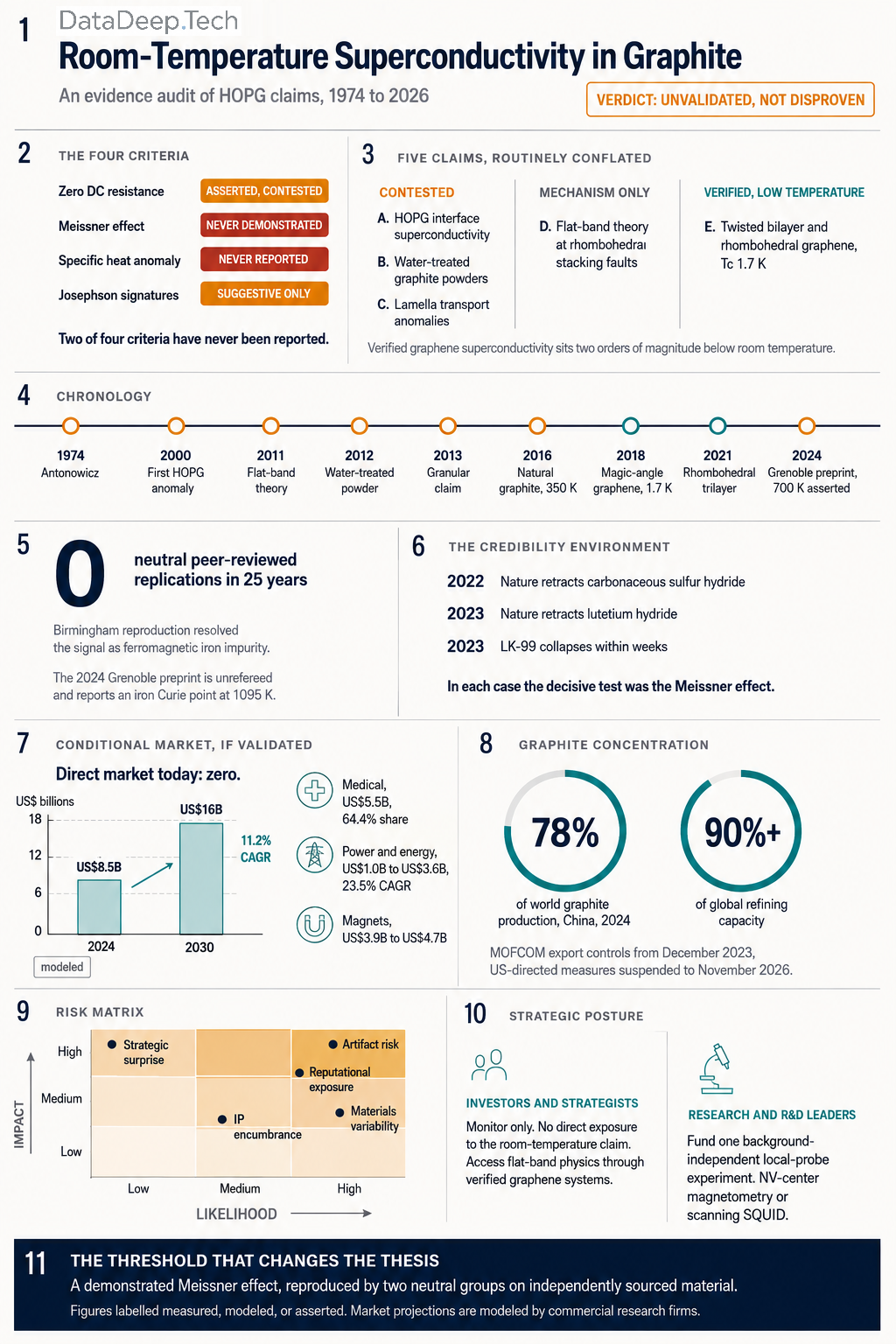
The central finding of this report is unambiguous: as of August 2026, the claim that highly oriented pyrolytic graphite (HOPG) and related graphitic systems host room-temperature, ambient-pressure superconductivity localized at internal interfaces and stacking faults is unvalidated, and no independent group outside the originating research circle has confirmed it in a peer-reviewed venue [1][2][3]. The claim is not obviously false, and it is grounded in a legitimate and now partially verified theoretical mechanism (flat-band superconductivity at rhombohedral stacking faults) [4][5], but the affirmative experimental evidence fails to meet the standard criteria for establishing superconductivity. Two of the four canonical criteria (Meissner flux expulsion and a specific-heat anomaly at the transition) have never been reported for this system in any peer-reviewed source, and proponents themselves concede that the Meissner effect is expected to be immeasurably small given graphite's geometry and dominant diamagnetism [6][7].
For senior technologists, investors, and strategists, the practical implication is that the direct market for this phenomenon is currently zero, and the appropriate posture is structured monitoring rather than capital deployment against the headline claim. The topic nonetheless carries strategic weight for two reasons that are frequently conflated with the headline claim but are analytically distinct: first, closely adjacent physics (superconductivity in twisted and rhombohedral few-layer graphene) is now robustly and independently verified, though only at sub-kelvin temperatures [8][9]; second, the graphite supply chain is a concentrated, geopolitically contested resource irrespective of any superconductivity claim [10][11].
TL;DR:
- The claim is unproven, not disproven. Published HOPG evidence rests on magnetization hysteresis, transport anomalies, and trapped-flux measurements, all of which admit non-superconducting explanations (chiefly ferromagnetic iron impurities and background-subtraction artifacts); zero DC resistance has been asserted, but the Meissner effect and a specific-heat anomaly have never been demonstrated, and no neutral independent group has replicated the effect [1][6][12].
- The credibility environment is hostile and rightly so. The 2022 and 2023 retractions of the Dias/Rochester ambient-superconductivity papers and the 2023 collapse of LK-99 have raised the evidentiary bar; unreplicated ambient-superconductivity claims should be weighted accordingly [13][14][15].
- The adjacent, verified science is where the near-term value sits. Flat-band superconductivity in rhombohedral trilayer and twisted bilayer graphene is independently reproduced, and published in top journals, but occurs at temperatures of order 1.7 K or below and confers no room-temperature capability [8][9].
1. Scientific Background and Claim Taxonomy
1.1 Why graphite is a plausible but non-obvious candidate
Graphite is the most diamagnetic elemental solid short of a superconductor, and it lacks the d- and f-electrons ordinarily associated with high-temperature magnetic or superconducting order, which is precisely why anomalous magnetic and transport signatures in it have drawn four decades of scrutiny and skepticism [16]. The intellectual lineage of the room-temperature claim traces to Kazimierz Antonowicz, who in 1974 reported Josephson-like current-voltage behavior in aluminium-carbon-aluminium sandwiches at room temperature and titled his Nature paper "Possible superconductivity at room temperature" [17]. That result was never independently confirmed and languished for decades. The modern revival began in 2000, when Kopelevich, Esquinazi, and collaborators reported ferromagnetic- and superconducting-like magnetization hysteresis loops in HOPG at and above room temperature in the Journal of Low Temperature Physics, a paper the editors published over referee objections precisely because of the impurity concern [16][18].
 K. ANTONOWICZ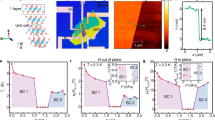
The theoretical case strengthened considerably between 2011 and 2015 with the recognition that rhombohedral (ABC) stacking of graphene layers, and the interfaces between rhombohedral and Bernal (AB) stacked regions, can host topologically protected flat electronic bands [4][5]. Due to the superconducting critical temperature in a flat band scaling linearly with the pairing interaction rather than exponentially (as in conventional BCS theory), flat bands can in principle support far higher transition temperatures than ordinary metals [4][5]. This is the mechanistic core of the Esquinazi-Heikkilä-Volovik proposal and remains the strongest part of the overall argument [19].
1.2 Five distinct claim families
The single most important analytical step in this area is to separate claims that are routinely conflated in popular and even technical discussion.
(a) Granular/interface superconductivity in bulk HOPG. This is the headline claim, associated primarily with Pablo Esquinazi's Division of Superconductivity and Magnetism at Universität Leipzig, together with collaborators T. Scheike, A. Setzer, and W. Böhlmann. It holds that superconducting regions with critical temperatures above room temperature exist at two-dimensional internal interfaces between crystallites of differing stacking order, coupled by Josephson interaction into a granular network. The affirmative evidence is magnetization hysteresis measured for fields normal to the interfaces, reported in Carbon in 2013 [1].
(b) Magnetization anomalies in water-treated graphite powders. Reported by Scheike, Esquinazi and colleagues in Advanced Materials in 2012, this family holds that simple treatment of micrometer-scale graphite powder with pure water (or alkanes such as n-heptane) induces a granular superconducting response above 300 K [20]. Only about one part in 10,000 of the sample responded, and the signal vanished when the powder was pressed into a pellet [12][20].
 Simon Hadlington
(c) Transport anomalies in HOPG lamellae and mesoscopic samples. Ballestar, Barzola-Quiquia, and Esquinazi reported in the New Journal of Physics in 2013 that current-voltage characteristics of transmission-electron-microscope lamellae contacted at the edges of internal interfaces show Josephson-like behavior and reach a zero-resistance state below a current-dependent temperature, inferring critical temperatures above 100 K [21]. Subsequent work reported that the effect vanishes for interface widths below roughly 200 nm [22].
(d) Theoretical flat-band proposals. The rhombohedral surface and stacking-fault superconductivity models of Kopnin, Heikkilä, Volovik, and Esquinazi provide a candidate mechanism [4][5][19]. These are legitimate, peer-reviewed theoretical contributions; they establish plausibility, not existence.
(e) Adjacent but distinct verified results. Two bodies of work provide context but do not constitute evidence for the headline claim. First, twisted bilayer graphene superconductivity at the magic angle (near 1.1 degrees), discovered by Cao, Jarillo-Herrero and colleagues at MIT and published in Nature in 2018 with a critical temperature up to 1.7 K [8], and superconductivity in rhombohedral trilayer graphene, reported by Zhou, Young and colleagues in Nature in 2021 at sub-kelvin temperatures [9]. These are robustly reproduced but occur far below room temperature. Second, verified high-pressure hydride superconductivity (for example H3S and LaH10), which achieves high critical temperatures only under pressures of order 150-200 GPa and is entirely unrelated to carbon [13]. Conflating either with the ambient-temperature graphite claim is a category error.
1.3 Chronology to the present
The claim has progressed from magnetization studies (2000, 2012, 2013) [16][20][1] to transport measurements on lamellae (2013-2014) [21][22] to natural-graphite resistance measurements reporting a step-like transition near 350 K with a roughly 40 K width (Precker et al., New Journal of Physics, 2016) [23], to trapped-flux and magnetic-force-microscopy studies attempting to localize persistent current paths (2022-2023) [24]. In 2023, a Leipzig group published trapped-flux transport measurements described as "verifying" earlier hints (New Journal of Physics 25, 093029) [3]. In 2024, Kopelevich and collaborators published "Global Room-Temperature Superconductivity in Graphite" in Advanced Quantum Technologies [25]. Also in 2024, a group at the Institut Néel in Grenoble (Núñez-Regueiro and colleagues) posted a preprint claiming magnetic-field sorting of superconducting graphite particles with onset critical temperatures reported as high as roughly 700 K and zero resistance to about 500 K [2]. That preprint remains unrefereed as of this writing and, critically, reports its own iron-impurity ferromagnetic signal with a Curie temperature near 1095 K that the authors attribute to metallic iron and must subtract [2]. The trajectory is one of continued publication by a small, mutually connected circle of proponents, without the broadening independent replication that characterizes a validated discovery.
 Anne Helmenstine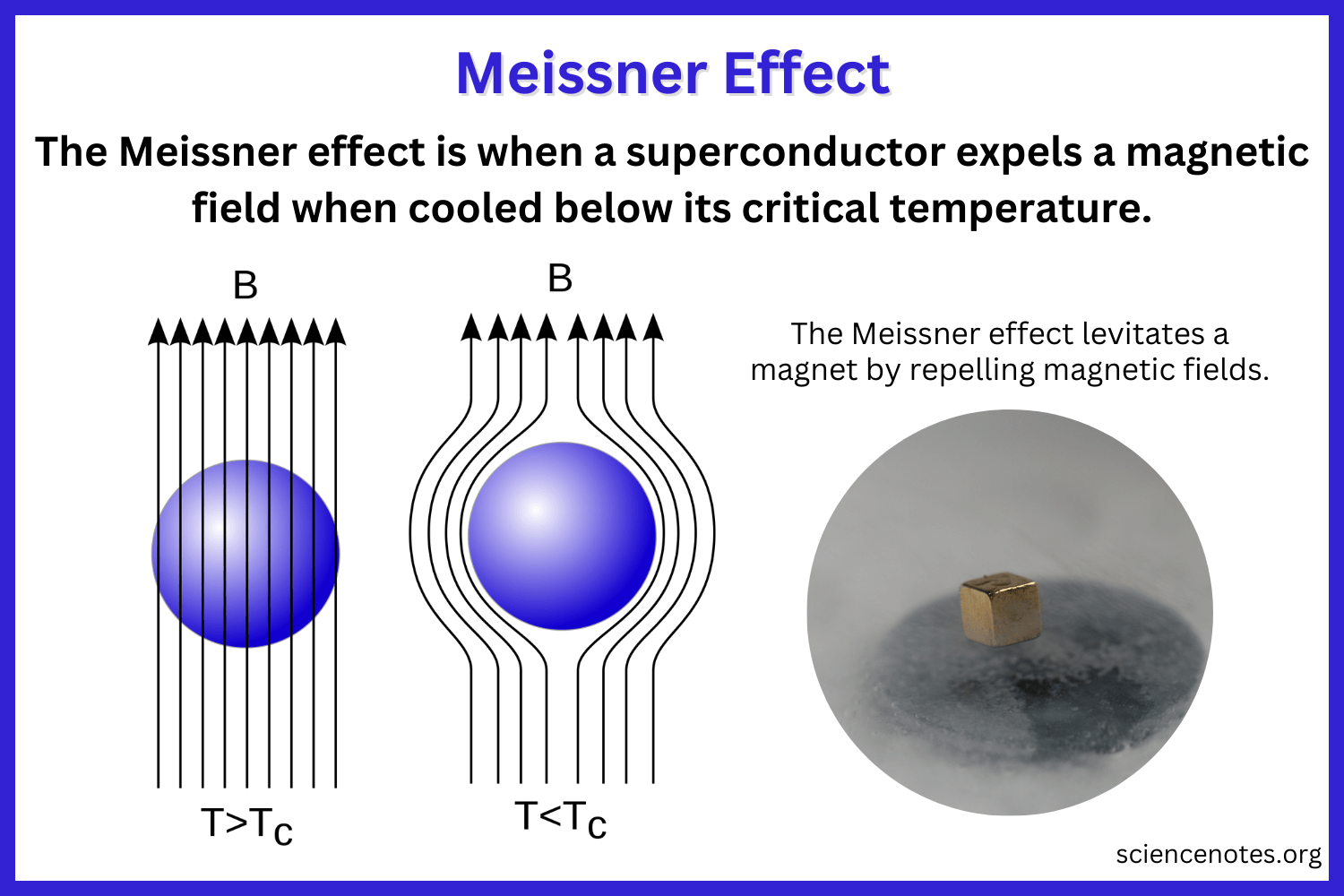
2. Evidence Standards and Gap Analysis
2.1 The accepted criteria
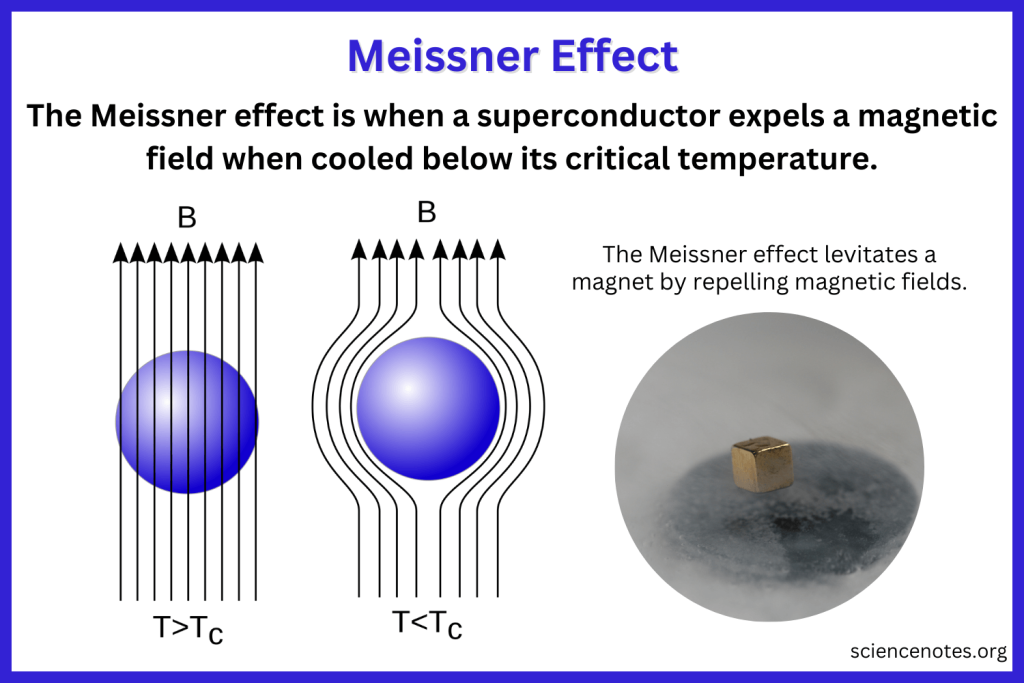
Establishing superconductivity conventionally requires a convergent set of signatures. The two primary criteria are zero DC electrical resistance below a critical temperature, and the Meissner effect, the active expulsion of magnetic flux from the bulk on cooling through the transition, which distinguishes a superconductor from a merely perfect conductor [26]. Supporting criteria include a specific-heat anomaly (a jump at the transition confirming a bulk thermodynamic phase transition), the isotope effect, and Josephson phenomena [26]. No single signature is sufficient; the Meissner effect is generally regarded as the decisive discriminator because it cannot be mimicked by localized magnetic moments or by a resistance artifact [14][27].
2.2 Mapping the HOPG evidence against the criteria
Zero DC resistance: asserted, contested. Transport measurements on lamellae and natural graphite report resistance drops and states interpreted as zero resistance, but these are on filamentary or interfacial paths shunted by a large conducting/semiconducting bulk, not bulk zero resistance, and the "transitions" are step-like anomalies extracted after background subtraction rather than the sharp drops seen in established superconductors [21][23].
Meissner effect: never demonstrated. This is the single most important gap. No peer-reviewed source reports flux expulsion for the graphite-interface claim [6][7]. The Leipzig group explicitly concedes that because of the sample geometry (a demagnetizing factor near one) and the dominant diamagnetism of graphite, a full Meissner state should not be expected to be measurable [3][23]. All magnetic evidence is instead magnetization hysteresis and trapped-flux (persistent-current) measurement, which is qualitatively different from and weaker than flux expulsion [6][24].
Specific-heat anomaly: never reported. Because any superconducting fraction is estimated at a small part of the sample, a bulk thermodynamic measurement such as specific heat cannot resolve it, a point proponents acknowledge [12][19]. The absence is expected under their own model but means a core criterion is simply unavailable.
Isotope effect and Josephson phenomena: the isotope effect has not been established. Josephson-like signatures (the field dependence of an apparent critical current, hysteretic I-V curves) are reported and form part of the affirmative case [21], but Josephson-like I-V behavior is also produced by weak links, contact phenomena, and granular non-superconducting systems, so it is suggestive rather than probative [19].
2.3 Non-superconducting explanations
Several artifacts can produce the reported signatures. First and most important, ferromagnetic impurities, chiefly iron, present at the parts-per-million level, can generate hysteresis loops that resemble superconducting ones after an inappropriate diamagnetic background subtraction [16][28]. The Birmingham group of Elizabeth Blackburn and Ted Forgan reproduced the water-treated-graphite experiment and found that with correct background subtraction the "superconducting" signal became ferromagnetism from impurities [12]. Notably, even the 2024 Grenoble preprint that claims to corroborate the effect reports a ferromagnetic signal with a Curie temperature near 1095 K, which the authors themselves attribute to metallic iron impurities that must be subtracted [2]. Second, measurement-geometry and contact artifacts, percolation effects through inhomogeneous conducting paths, and instrumental background from sample mounts and plastic foils have all been raised as alternatives by careful critics [12]. The proponents' strongest counterargument is the reported two-dimensionality of the signal (that it appears only for fields normal to the interfaces), which they argue is incompatible with simple magnetic anisotropy [1][19]; this is an interesting point but has not persuaded the broader community.


2.4 Replication status
Independent replication is the crux, and the finding is stark. No neutral group outside the Esquinazi/Kopelevich/Núñez-Regueiro circle has published a peer-reviewed confirmation [1][2][12]. The one clear independent reproduction attempt, by Blackburn and Forgan at Birmingham, was a refutation, concluding the signal is a ferromagnetic-impurity artifact; that refutation, however, appeared only in trade-press reporting (Chemistry World) and was not itself formally published [12]. The 2024 Grenoble result is institutionally separate from Leipzig but is a sympathetic, hypothesis-aligned group rather than a skeptical outsider, is unrefereed, and reports no Meissner effect [2]. This is the replication profile of an unvalidated claim, not a discovery in the process of acceptance.
3. Credibility Context
The HOPG claim must be weighted within a field that has been repeatedly burned by ambient-superconductivity claims. Nature retracted the Dias/Rochester carbonaceous sulfur hydride paper in September 2022 over non-standard, user-defined background-subtraction procedures applied to magnetic susceptibility data [29], and retracted the group's March 2023 lutetium hydride paper in November 2023 after eight of eleven co-authors requested withdrawal and Nature found the concerns about the electrical resistance data "credible, substantial and remain unresolved" [13]. In July 2023, the South Korean LK-99 claim of ambient superconductivity went viral and collapsed within weeks, with multiple groups showing that the apparent resistance drop and partial levitation were due to a Cu2S impurity transition and ferromagnetism/diamagnetism rather than superconductivity [15][30].
Two lessons transfer directly to the HOPG case. First, improper background subtraction of magnetic data is the recurring failure mode in false ambient-superconductivity claims, and it is exactly the mechanism critics identify in the graphite work [12][29]. Second, the discriminating test in each debunking was the Meissner effect (or its absence), which is precisely the criterion the graphite claim cannot satisfy [14][15]. The rational prior for any unreplicated ambient-superconductivity claim lacking a demonstrated Meissner effect is now very low, and the graphite claim sits squarely in that category, though it is distinguished from LK-99 and the Dias affair by the absence (to date) of any allegation of misconduct and by the existence of a credible underlying flat-band mechanism.
4. Key Players and Stakeholders
4.1 Proponents
The dominant proponent is Pablo Esquinazi and the Division of Superconductivity and Magnetism at Universität Leipzig, together with long-running collaborators including T. Scheike, J. Barzola-Quiquia, A. Ballestar, C. E. Precker, A. Setzer, and W. Böhlmann [1][21][23]. Yakov Kopelevich (Universidade Estadual de Campinas, Brazil) is the other principal, connected to the original 2000 observation and the 2024 "global room-temperature superconductivity" paper with the Diamantini-Trugenberger-Vinokur theoretical group [16][25]. On the theory side, Tero Heikkilä (Jyväskylä) and Grigory Volovik contributed the flat-band interface model [19]. The Grenoble Institut Néel group (M. Núñez-Regueiro and colleagues) is a more recent, institutionally distinct but hypothesis-aligned entrant [2]. Yasushi Kawashima (Tokai University) is a separate claimant (alkane-graphite) whose results are widely regarded as unconfirmed [12].
4.2 Skeptics and critics
The principal named critics in the literature and reporting are Ted Forgan and Elizabeth Blackburn (Birmingham), who performed the refuting reproduction, and Archie Campbell (Cambridge), who judged the effects "very small and concealed within a large diamagnetic effect" [12]. Jorge Hirsch (UC San Diego), though focused on hydrides, is the field's most prominent methodological critic of magnetic-data handling in superconductivity claims and is relevant by extension [14][27].
 Simon Hadlington
4.3 Material suppliers
The HOPG used in the key studies was nominally ZYA grade from Advanced Ceramics, a lineage that runs Union Carbide to Advanced Ceramics to GE to Momentive Performance Materials (now Momentive Technologies) [31]. Other suppliers include SPI Supplies (which has flagged limited remaining ZYA inventory as of April 2025), MSE Supplies, HQ Graphene, and Tipsnano [31][32]. These are small specialty-materials vendors; HOPG is a niche laboratory and X-ray/neutron-monochromator material, not a bulk commodity [33].
4.4 Incumbents whose positioning would be affected if validated
If (and only if) an ambient superconductor of any practical form were validated, the incumbents disrupted would be low- and high-temperature superconductor manufacturers (for example Bruker, Fujikura, Sumitomo Electric, Furukawa Electric, American Superconductor, and fusion-magnet HTS-tape producers such as MetOx and Faraday Factory Japan) and, separately, the graphite supply chain (Chinese anode producers such as BTR, Shanshan, and Putailai, and Western aspirants) [34][10]. This is conditional and forward-looking; no such disruption is implied by the current evidence.

5. Technical and Operational Considerations
5.1 Sample provenance and variability
The reported effect is exquisitely sample-dependent, which is simultaneously the proponents' explanation for non-reproducibility and the skeptics' basis for suspecting artifact. The claim is that the superconducting response requires a sufficient density of well-defined internal interfaces between Bernal and rhombohedral stacking domains [19][23]. Higher-grade HOPG with the lowest mosaic spread (ZYA grade, 0.4 ± 0.1 degrees) is not uniformly the most active material; the proponents note that certain high-grade SPI samples have a much lower interface density and correspondingly weaker signatures than Advanced Ceramics ZYA [19][31]. This means grade, batch, supplier, mosaic spread, and stacking-fault density all matter, and none is specified tightly enough across the literature to constitute a reproducible protocol. Impurity content is characterized by particle-induced X-ray emission at below 1 ppm magnetic impurities in the key samples [28], but critics contend that even sub-ppm iron, if concentrated at interfaces, suffices to generate the observed magnetic signals [12] [19].
5.2 Measurement and artifact control at the mesoscale
The core measurement challenges are the smallness of the putative superconducting fraction (as low as 0.01 percent in the water-treated powders) [12], the need to subtract a large diamagnetic and a ferromagnetic-impurity background from raw magnetization data [1][28], and the difficulty of contacting individual internal interfaces in TEM lamellae without introducing contact artifacts [21]. A background-independent measurement method is essential and has been the recurring demand of critics [12].
5.3 What a decisive validation experiment would look like
A decisive result would require, at minimum, an unambiguous Meissner effect (direct flux expulsion, not merely a zero-field-cooled/field-cooled magnetization difference) measured on an isolated, structurally characterized sample by a background-independent technique such as a scanning SQUID or nitrogen-vacancy-center magnetometry, ideally correlated spatially with the specific rhombohedral/Bernal interfaces by the same instrument; independent replication by at least two neutral groups on independently sourced material; and a coherent account of the superconducting fraction and geometry. Local-probe magnetometry using nitrogen-vacancy centers, which recently provided the decisive Meissner evidence in the pressurized-nickelate debate, is the most promising route to convert this from a contested to a settled question, in either direction [35].
6. Economic and Market Dynamics
The direct market for the claimed phenomenon is zero, because the phenomenon is unvalidated and, even as claimed, exists only as a microscopic fraction of laboratory samples with no demonstrated bulk current-carrying capacity. This section is therefore explicitly conditional.
Were a practical ambient-temperature, ambient-pressure superconductor to be validated (from any material system, not merely graphite), the addressable markets it would disrupt are large and well-characterized. The overall superconductors market was valued at US$7.8 billion in 2023 and estimated at US$8.5 billion in 2024, and is projected by ResearchAndMarkets to exceed US$16 billion by 2030 at an 11.2 percent CAGR (modeled by a commercial market-research firm, assumptions not independently verified) [34]. Medical applications (MRI and NMR) constituted the largest share at roughly US$5.5 billion (64.4 percent) in 2024, growing at a modeled 7.5 percent CAGR to 2030 [34]. Power and energy applications, the segment an ambient superconductor would most transform, were about US$1 billion in 2024 and are the fastest-growing at a modeled 23.5 percent CAGR to roughly US$3.6 billion by 2030 [34]. The superconducting-magnets subsegment is separately estimated at about US$3.9 billion in 2024, growing at a modeled 3 percent CAGR to about US$4.7 billion by 2030 [36]. These figures describe the existing cryogenic-superconductor market; the economic case for an ambient superconductor is that it would collapse the cooling cost and complexity that currently confine superconductivity to high-value niches, potentially expanding the addressable market by orders of magnitude into bulk power transmission, grid storage, motors, and magnets. That explains the persistent attention, but it is conditional on a validation that has not occurred and, for graphite specifically, would additionally require a leap from a microscopic interfacial fraction to a manufacturable bulk conductor for which no pathway currently exists.
7. Regulatory Landscape
The regulatory landscape specific to this pre-validation laboratory phenomenon is essentially empty. There is no product, no standard, and no safety or approval regime attached to a claimed microscopic effect in laboratory graphite. The only regulatory dimensions that touch the topic are indirect: export controls on graphite as a critical material (addressed in Section 8) and the general research-integrity and publication-standards environment that governs how such claims are vetted, which the retraction history in Section 3 illustrates [13][29]. No dedicated regulatory action is warranted or expected unless and until validation occurs.
8. Geopolitical and Strategic Dimensions
Three genuine strategic threads exist, and they should be kept proportional. First, graphite supply-chain concentration is real and consequential independent of any superconductivity claim. According to the USGS Mineral Commodity Summaries 2025, China produced an estimated 78 percent of world graphite in 2024, and China refines more than 90 percent of the world's graphite into battery-grade spherical graphite and anode material [10][11]. China placed graphite under export-license controls effective December 2023, tightened dual-use restrictions in December 2024, and then suspended the stricter US-directed measures from 9 November 2025 through 27 November 2026 under MOFCOM Announcement No. 72 [10][37]. This concentration means that any future graphite-based technology, superconducting or otherwise, would inherit a supply chain dominated by a single strategic competitor of the United States and its allies.
Second, national research-funding postures toward superconductivity are substantial but are overwhelmingly directed at verified science (fusion-magnet HTS tape, quantum hardware, and grid applications) rather than at the contested graphite claim [34]. Third, the strategic-surprise dimension is the tail scenario that justifies monitoring: a truly low-cost ambient superconductor would be a first-order disruption to energy, defense, and computing, and a state or firm that achieved and concealed it would gain a durable advantage. The rational response to a low-probability, high-impact surprise is inexpensive intelligence and monitoring capacity, not premature capital commitment.
9. Risk Matrix
| Risk | Likelihood | Potential impact | Credible mitigations |
|---|---|---|---|
| Claim proves artifactual (pathological science): the interface-superconductivity signal is ultimately explained by ferromagnetic iron impurities and background-subtraction artifacts | High | High for any party that has committed capital or reputation to the headline claim; low for the broader field | Require a demonstrated Meissner effect and neutral independent replication before assigning any credence; treat all magnetization-hysteresis-only evidence as insufficient |
| Reputational risk to institutions and investors engaging prematurely | Medium-High | High: association with a claim that follows LK-99 and Dias into non-replication carries a lasting credibility cost | Frame any engagement explicitly as monitoring or as adjacent verified-graphene science; avoid public endorsement of the room-temperature claim absent validation |
| Replication and materials-variability risk: even if a real interface effect exists, extreme sample dependence prevents reproducible manufacture | High | Medium-High: a real but uncontrollable effect has little commercial value | Fund protocol standardization and stacking-fault characterization before any device program; treat provenance as a first-order variable |
| IP landscape risk: patents staked on an unvalidated mechanism | Medium | Medium: broad or speculative filings could encumber the adjacent, verified rhombohedral/twisted-graphene field | Monitor filings; concentrate any defensive IP on the verified flat-band graphene systems where the science is settled |
| Opportunity-cost risk of ignoring the area entirely if a real interface effect exists at any temperature | Medium | Medium-High: the flat-band interface mechanism is verified in few-layer graphene, so a bulk analog is not physically absurd | Maintain low-cost monitoring and a modest interface-engineering research option rather than a binary in/out decision |
| Strategic-surprise risk: a competitor validates and conceals a low-cost ambient superconductor | Low | Very high | Sustain intelligence and literature-monitoring capability; participate in the verified-graphene research ecosystem to retain absorptive capacity |
10. Strategic Recommendations
10.1 For deep-tech investors and corporate strategists
The evidence supports a posture of active monitoring with essentially no direct capital exposure to the room-temperature graphite claim, and this recommendation reasons forward from the current evidence rather than from any expectation of imminent validation. Concretely: do not underwrite ventures whose thesis depends on ambient-temperature graphite superconductivity; the claim lacks a Meissner effect, lacks independent replication, and sits in a category (unreplicated ambient superconductivity) with a very low base rate of validation [1][2][12]. Where exposure to flat-band superconductivity is desired, gain it through the verified rhombohedral and twisted-graphene ecosystem and its quantum-hardware and metrology applications, understanding that these operate below a few kelvin and are not room-temperature technologies [8][9]. Treat graphite supply-chain positions on their own robust merits (batteries, anodes, thermal management, export-control dynamics), entirely decoupled from the superconductivity question [10][11]. The threshold that would change this recommendation is specific and binary: a demonstrated Meissner (flux-expulsion) effect on a characterized sample, reproduced by at least two neutral groups on independently sourced material. Until that threshold is met, the correct allocation to the headline claim is monitoring cost only.
10.2 For research directors and industrial R&D leaders
The evidence supports funding a small, well-instrumented replication-and-characterization effort rather than either a full device program or complete disengagement, again reasoning forward from current evidence. The scientifically decisive and relatively inexpensive move is a background-independent local-probe experiment (scanning SQUID or nitrogen-vacancy-center magnetometry) on well-characterized HOPG and natural-graphite samples, designed explicitly to detect or exclude flux expulsion and to correlate any signal spatially with rhombohedral/Bernal interfaces identified by Raman or electron microscopy. This is the same class of experiment that recently resolved the pressurized-nickelate Meissner debate [35]. A neutral group performing this experiment would deliver disproportionate value in either outcome: a positive result would be field-defining, and a clean null would settle a 25-year controversy. Separately, and independently of the room-temperature claim, an interface-engineering research option in rhombohedral-stacking control is justified by the verified low-temperature flat-band superconductivity, and it builds absorptive capacity against the strategic-surprise scenario [8][9]. The benchmark that would justify escalating from characterization to a device program is the same Meissner-plus-replication threshold; the benchmark that would justify winding the effort down is a rigorous, background-independent null result on flux expulsion from a neutral group.
Caveats
This report characterizes the state of evidence, not the truth of the underlying physics, which remains open. Several important sources in this area are arXiv preprints or conference proceedings rather than peer-reviewed journal articles, and this is flagged in the text where it matters (notably the 2024 Grenoble result [2] and the Birmingham refutation, the latter of which exists only as trade-press reporting of an unpublished student reproduction [12]). Market figures in Section 6 are drawn from commercial market-research firms and are modeled projections with undisclosed assumptions; they should be treated as order-of-magnitude context, not precise forecasts [34][36]. The distinction maintained throughout, between demonstrated results, modeled projections, and asserted claims, is the central discipline of the analysis, and readers should resist the common tendency to let the robustly verified low-temperature graphene superconductivity lend borrowed credibility to the unvalidated room-temperature graphite claim. The two are physically related in mechanism but separated by more than two orders of magnitude in temperature and by the entire distance between settled and contested science.
References
- Scheike, T., P. Esquinazi, A. Setzer, and W. Böhlmann. 2013. "Granular Superconductivity at Room Temperature in Bulk Highly Oriented Pyrolytic Graphite Samples." Carbon 59: 140–149.
- Núñez-Regueiro, M., T. Devillers, E. Beaugnon, A. de Marles, T. Crozes, S. Pairis, C. Swale, H. Klein, O. Leynaud, A. Hadj-Azzem, F. Gay, and D. Dufeu. 2024. "Magnetic Field Sorting of Superconducting Graphite Particles with Tc > 400K." arXiv:2410.18020 (preprint, not peer-reviewed).
- Champi, A., C. E. Precker, and P. D. Esquinazi. 2023. "Hints of Granular Superconductivity in Natural Graphite Verified by Trapped Flux Transport Measurements." New Journal of Physics 25: 093029.
- Kopnin, N. B., T. T. Heikkilä, and G. E. Volovik. 2011. "High-Temperature Surface Superconductivity in Topological Flat-Band Systems." Physical Review B 83: 220503(R).
- Muñoz, W. A., L. Covaci, and F. M. Peeters; and Heikkilä, T. T., and G. E. Volovik. 2016. "Flat Bands in Topological Media" and related analyses of stacking faults in rhombohedral graphite. JETP Letters and arXiv:1210.7595, "High-Temperature Surface Superconductivity in Rhombohedral Graphite."
- Ariskina, R., M. Stiller, C. E. Precker, W. Böhlmann, and P. D. Esquinazi. 2022. "On the Localization of Persistent Currents Due to Trapped Magnetic Flux at the Stacking Faults of Graphite at Room Temperature." Materials 15 (10): 3422.
- Esquinazi, P. D., and C. E. Precker. 2023. Discussion of Meissner-state immeasurability in graphite interface superconductivity, in New Journal of Physics 25: 093029.
- Cao, Y., V. Fatemi, S. Fang, K. Watanabe, T. Taniguchi, E. Kaxiras, and P. Jarillo-Herrero. 2018. "Unconventional Superconductivity in Magic-Angle Graphene Superlattices." Nature 556: 43–50.
- Zhou, H., T. Xie, T. Taniguchi, K. Watanabe, and A. F. Young. 2021. "Superconductivity in Rhombohedral Trilayer Graphene." Nature 598: 434–438.
- U.S. Geological Survey. 2025. Mineral Commodity Summaries 2025: Graphite (Natural). Reston, VA: U.S. Geological Survey.
- Observer Research Foundation America. 2025. "China's Critical Mineral Export Controls: Background & Chokepoints." ORF America.
- Extance, Andy. 2013. "New Evidence for Room Temperature Graphite Superconductivity Leaves Experts Unconvinced." Chemistry World, Royal Society of Chemistry.
- Garisto, Dan. 2023. "Nature Retracts Controversial Room-Temperature Superconductor Study." Scientific American / Nature retraction, Nature 615: 244 (retracted November 2023).
- Service, Robert F. 2022. "Breakthrough or Bust? Claim of Room-Temperature Superconductivity Draws Fire." Science (AAAS).
- Padavic-Callaghan, Karmela, et al. 2023. "LK-99 Isn't a Superconductor — How Science Sleuths Solved the Mystery." Nature News (d41586-023-02585-7).
- Kopelevich, Y., P. Esquinazi, J. H. S. Torres, and S. Moehlecke. 2000. "Ferromagnetic- and Superconducting-Like Behavior of Graphite." Journal of Low Temperature Physics 119: 691–702.
- Antonowicz, K. 1974. "Possible Superconductivity at Room Temperature." Nature 247: 358–360.
- Kopelevich, Y., and P. Esquinazi. 2007. "Ferromagnetism and Superconductivity in Carbon-Based Systems." Journal of Low Temperature Physics 146: 629–639.
- Esquinazi, P. 2013. "Invited Review: Graphite and Its Hidden Superconductivity." Papers in Physics 5: 050007.
- Scheike, T., W. Böhlmann, P. Esquinazi, J. Barzola-Quiquia, A. Ballestar, and A. Setzer. 2012. "Can Doping Graphite Trigger Room Temperature Superconductivity? Evidence for Granular High-Temperature Superconductivity in Water-Treated Graphite Powder." Advanced Materials 24 (43): 5826–5831.
- Ballestar, A., J. Barzola-Quiquia, T. Scheike, and P. Esquinazi. 2013. "Josephson-Coupled Superconducting Regions Embedded at the Interfaces of Highly Oriented Pyrolytic Graphite." New Journal of Physics 15: 023024.
- Ballestar, A., J. Barzola-Quiquia, and P. Esquinazi. 2014. "Interface Size Dependence of the Josephson Critical Behaviour in Pyrolytic Graphite TEM Lamellae." arXiv:1401.4959.
- Precker, C. E., P. D. Esquinazi, A. Champi, J. Barzola-Quiquia, M. Zoraghi, S. Muiños-Landin, A. Setzer, W. Böhlmann, D. Spemann, J. Meijer, T. Muenster, O. Baehre, G. Kloess, and H. Beth. 2016. "Identification of a Possible Superconducting Transition Above Room Temperature in Natural Graphite Crystals." New Journal of Physics 18: 113041.
- Stiller, M., P. D. Esquinazi, C. E. Precker, and J. Barzola-Quiquia. 2018. "Local Magnetic Measurements of Permanent Current Paths in a Natural Graphite Crystal." Journal of Low Temperature Physics and related MFM studies, University of Leipzig.
- Kopelevich, Y., J. H. S. Torres, R. R. da Silva, F. Oliveira, M. C. Diamantini, C. A. Trugenberger, and V. M. Vinokur. 2024. "Global Room-Temperature Superconductivity in Graphite." Advanced Quantum Technologies 7: 2300230.
- Tinkham, M. 1996. Introduction to Superconductivity. 2nd ed. New York: McGraw-Hill. (Meissner effect, specific-heat anomaly, and isotope-effect criteria.)
- Hirsch, J. E., and F. Marsiglio. 2022. "Evidence Against Superconductivity in Flux Trapping Experiments on Hydrides Under High Pressure." arXiv:2207.01541.
- Spemann, D., P. Esquinazi, A. Setzer, and W. Böhlmann. 2014. "Trace Element Content and Magnetic Properties of Commercial HOPG Samples Studied by Ion Beam Microscopy and SQUID Magnetometry." AIP Advances 4: 107142.
- Snider, E., N. Dasenbrock-Gammon, R. McBride, M. Debessai, H. Vindana, K. Vencatasamy, K. V. Lawler, A. Salamat, and R. P. Dias. 2022. "Retraction Note: Room-Temperature Superconductivity in a Carbonaceous Sulfur Hydride." Nature 610: 804.
- Kumar, K., N. K. Karn, and V. P. S. Awana. 2023. "Replication and Study of Anomalies in LK-99, the Alleged Ambient-Pressure, Room-Temperature Superconductor." arXiv:2311.03558.
- SPI Supplies. 2025. "HOPG Advanced Ceramics Brand Grade ZYA / ZYB / ZYH" product documentation. West Chester, PA: SPI Supplies / Structure Probe, Inc.
- Momentive Technologies. 2024. "Highly-Oriented Pyrolytic Graphite (HOPG)" product overview.
- Momentive Technologies. 2024. HOPG neutron and X-ray monochromator technical data.
- ResearchAndMarkets. 2025. Superconductors: Materials, Products and Applications Overview 2024 — Global Market to Reach $16 Billion by 2030. Dublin: Research and Markets.
- Xu, X., et al. 2025. "Imaging the Meissner Effect in Pressurized Bilayer Nickelate with Integrated Multi-Parameter Quantum Sensor." National Science Review / PMC12485607.
- ResearchAndMarkets. 2025. Superconducting Magnets Market Size & Forecast to 2030. Dublin: Research and Markets.
- China Ministry of Commerce (MOFCOM). 2025. Announcement No. 72 (9 November 2025), suspending enhanced end-user verification measures for graphite and other dual-use items exported to the United States through 27 November 2026.