Additive Manufacturing of Ferrosilicon: High-Silicon Fe-Si Soft Magnets, Markets, and Strategy
Why Fe-6.5% Si soft magnets are 3D-printed, not rolled: a rigorous review of methods, properties, markets, and supply-chain strategy.

3D Printing High-Silicon Fe-Si Soft Magnets: Methods, Properties, and Markets
1. Summary
1.1 Principal Findings
This report assesses a deliberately bifurcated subject. "Additive manufacturing of ferrosilicon" joins two domains that differ by roughly a century in maturity: a mature, multi-billion-dollar conventional ferrosilicon (FeSi) industry that supplies steelmaking, foundries, magnesium production, and electrical-steel feedstock; and an early-stage research frontier in which iron-silicon (Fe-Si) alloys, particularly high-silicon compositions near Fe-6.5 wt% Si, are processed by additive manufacturing (AM) to make soft-magnetic components. These two subjects are linked by chemistry and by a shared end-market (electrical steel) but are not the same thing, and the report treats them separately throughout.
The central technical finding is that AM is genuinely enabling for high-silicon Fe-Si in a way conventional rolling is not. At silicon contents above approximately 4 to 5 wt%, Fe-Si forms ordered B2 (FeSi) and DO3 (Fe3Si) phases that render the alloy brittle and effectively unrollable into thin sheet by conventional thermomechanical processing [1][2]. The rapid solidification inherent to fusion-based AM, with cooling rates on the order of 10^3 to 10^6 K/s, can suppress the formation of these ordered phases and produce near-fully-dense, crack-controllable parts with strong crystallographic texture [3][4]. Pioneering work by Garibaldi and colleagues established the feasibility of near-full-density Fe-6.9 wt% Si by selective laser melting and demonstrated that annealing at 1,150 degrees C for 1 hour achieves a maximum relative permeability of 24,000 and coercivity of 16 A/m, values that compare favourably with commercial high-silicon laminations [3][5].
The central economic finding is that AM of Fe-Si will not displace conventional electrical steel for mass-produced cores in the foreseeable future. Laser powder bed fusion (LPBF) deposition rates are measured in hundreds of grams per hour, whereas stamping and casting are measured in hundreds of kilograms per hour, a throughput gap of two to three orders of magnitude [6]. The value of AM Fe-Si lies in geometric complexity, thin-wall and site-specific texture control, part-count reduction, and rapid prototyping for high-value, low-volume applications such as aerospace actuators, high-speed and axial-flux motors, and specialised sensors, not in commodity transformer and motor laminations.
The central strategic finding is that the conventional ferrosilicon and electrical-steel value chains are highly concentrated and increasingly contested, and that the United States added silicon to its Final 2025 List of Critical Minerals, published in the Federal Register (90 FR 50494) on 7 November 2025 [7]. China accounted for almost 80% of global silicon-materials production and produced 3,500 thousand metric tons of ferrosilicon (silicon-content basis) of a 75,000 thousand-tonne world total in 2025 [7]. AM of Fe-Si is best understood not as a supply-chain substitute for ferrosilicon, which it is not, but as one of several levers for resilience in the downstream electrical-machine and defense-component base.
1.2 Scope, Definitions, and Method
Ferrosilicon, in industrial parlance, denotes iron-silicon master alloys produced by carbothermic reduction of quartz in submerged-arc furnaces, sold principally in two standard grades of 50% and 75% silicon for use as a steel deoxidiser, cast-iron inoculant, alloying agent, and reducing agent [7][8]. This is a bulk commodity. By contrast, the AM literature concerns dilute iron-silicon alloys, typically 3 to 7 wt% Si, processed from atomized powder into net-shape soft-magnetic parts. The phrase "additive manufacturing of ferrosilicon" is therefore something of a category bridge: the high-silicon electrical-steel compositions of interest to AM sit at the dilute end of the Fe-Si system, far from the 50 to 75% silicon of commodity ferroalloy. The report flags this distinction wherever the two could be conflated.
Method: this analysis synthesizes peer-reviewed metallurgical and AM literature (2016 to 2026), U.S. Geological Survey commodity data, national-laboratory reports from Oak Ridge (ORNL) and the National Renewable Energy Laboratory (NREL), standards-body documentation, and industry and market sources. Quantitative claims are cited to primary sources where possible. Where evidence is single-study, preliminary, or contested, this is stated explicitly.
1.3 Summary of Strategic Implications
For materials scientists and process engineers, the implication is that the field has moved from feasibility demonstration to property optimization and qualification: the open problems are now reproducibility, oxygen control, residual stress and cracking, and the standardization of post-build heat treatment. For defense and industrial-base analysts, the implication is that AM Fe-Si is a niche resilience capability for spare and bespoke electromagnetic components, while the binding supply-chain risks remain upstream in ferroalloy and electrical-steel concentration. For investors and corporate strategists, the implication is that the near-term value pools are in powder supply, AM systems, and high-value end-use components, not in any wholesale substitution of the conventional ferrosilicon or electrical-steel markets, which remain large, cyclical, and energy-cost-driven.
Additive Manufacturing of Ferrosilicon: A Strategic and Technical Analysis
1. Summary
- 1.1 Principal Findings
- 1.2 Scope, Definitions, and Method
- 1.3 Summary of Strategic Implications
2. Background and Technical Context
- 2.1 Ferrosilicon: Composition, Grades, and Conventional Uses
- 2.2 The Metallurgical Problem of High-Silicon Iron-Silicon Alloys
- 2.3 The Case for Additive Manufacturing
- 2.4 Relevant Additive Manufacturing Process Families
3. State of the Technology and Operational Considerations
- 3.1 Feedstock: Powder Production and Atomization
- 3.2 Laser Powder Bed Fusion of High-Silicon Fe-Si
- 3.3 Directed Energy Deposition and Binder Jetting Routes
- 3.4 Defect Formation, Cracking, and Phase Ordering
- 3.5 Microstructure, Magnetic, and Mechanical Properties
- 3.6 Qualification, Repeatability, and Industrial Scale-Up
4. Key Players and Stakeholders
- 4.1 Additive Manufacturing System OEMs
- 4.2 Powder and Feedstock Suppliers
- 4.3 Ferroalloy and Electrical-Steel Producers
- 4.4 Research Institutions, National Laboratories, and Standards Bodies
- 4.5 End-User Industries and Demand Owners
5. Economic and Market Dynamics
- 5.1 The Ferrosilicon Market: Structure, Capacity, and Pricing
- 5.2 Demand Drivers: Electrification, Electric Motors, and Power Electronics
- 5.3 Cost Structure of AM Fe-Si Versus Conventional Manufacturing
- 5.4 Investment Landscape and Publicly Traded Exposure
6. Regulatory and Standards Landscape
- 6.1 Additive Manufacturing Standards: ASTM F42, ISO/TC 261, sector codes
- 6.2 Materials Qualification for Aerospace and Defense
- 6.3 Trade Measures, Tariffs, and Export Controls
- 6.4 Occupational Health and Environmental Compliance for Metal Powders
7. Geopolitical and Strategic Dimensions
- 7.1 Concentration of Ferrosilicon and Ferroalloy Supply
- 7.2 Critical Materials Policy and the Defense Industrial Base
- 7.3 Energy Security and the Electrification Transition
- 7.4 Additive Manufacturing as a Resilience and Onshoring Lever
8. Strategic Recommendations
- 8.1 For Materials Scientists and Process Engineers
- 8.2 For Defense and Industrial-Base Analysts and Policymakers
- 8.3 For Investors and Corporate Strategists
- 8.4 Cross-Cutting Capability and Research Gaps
9. Limitations, Uncertainties, and Contested Evidence
- 9.1 Data Quality and Source Limitations
- 9.2 Open Technical Questions
- 9.3 Forward-Looking Indicators to Monitor
References
2. Background and Technical Context
2.1 Ferrosilicon: Composition, Grades, and Conventional Uses
Ferrosilicon is manufactured by carbothermic reduction of silica (quartz or quartzite) with carbon reductants (coke, coal, wood chips) and an iron source (steel scrap, mill scale, or iron ore) in a submerged-arc furnace at temperatures exceeding 2,000 degrees C [8]. The dominant commercial grades are 75% silicon and 50% silicon, with high-purity variants produced for demanding applications [9]. Energy is the defining cost: electricity accounts for roughly half of a smelter's operating expense, which is why producers cluster around cheap hydroelectric power (Norway, Iceland, Brazil, Paraguay) and curtail output when power prices spike [10].
The uses of ferrosilicon are overwhelmingly metallurgical. The largest is as a deoxidiser and alloying addition in steelmaking, removing dissolved oxygen and imparting strength. A second major use is as an inoculant in cast iron, promoting graphite nucleation and controlling the formation of ductile or grey iron microstructures. A third is as the reducing agent in the Pidgeon process for primary magnesium, in which calcined dolomite is reduced by 75% ferrosilicon under vacuum at about 1,150 degrees C [11][12]. China, which dominates Pidgeon-process magnesium, is therefore both the largest ferrosilicon producer and a large internal consumer. High-purity ferrosilicon, low in aluminium, titanium, and boron, is the feedstock route to silicon additions in grain-oriented and non-oriented electrical steel, which is the conceptual hinge linking the commodity to the AM frontier [9].
2.2 The Metallurgical Problem of High-Silicon Iron-Silicon Alloys
Silicon is the workhorse alloying element of electrical steel because it raises electrical resistivity (suppressing eddy-current loss), increases permeability, and reduces magnetocrystalline anisotropy and magnetostriction. These properties improve monotonically with silicon content and reach an optimum near 6.5 wt% Si, where magnetostriction approaches zero and core loss is minimised [13][14]. Conventional electrical steels are nonetheless limited to about 3 to 3.5 wt% Si.
The reason is metallurgical. Above roughly 4 to 5 wt% silicon, the alloy forms two ordered phases, B2 (FeSi) and DO3 (Fe3Si), whose ordered lattices restrict dislocation slip and make the material hard and brittle [1][2]. This brittleness makes cold rolling to thin gauge impractical: the sheet cracks. The industry has historically addressed this in two ways. The first is to accept the 3.5 wt% ceiling. The second, pioneered commercially by JFE Steel, is to circumvent rolling entirely: JFE's "Super Core" products (JNEX, JNHF, JNRF) are produced by chemical vapour deposition (CVD) siliconizing, in which silicon is diffused into a thin conventional sheet from the surface until a uniform or graded 6.5 wt% profile is reached [15][16]. JFE introduced the first 6.5% Si sheets via this CVD route in 1993 [15]. Super Core is the relevant commercial benchmark against which AM routes to high-silicon Fe-Si should be judged.
2.3 The Case for Additive Manufacturing
Additive manufacturing offers two distinct advantages for high-silicon Fe-Si. The first is metallurgical: fusion-based AM imposes very high cooling rates, on the order of 10^3 to 10^6 K/s, comparable to melt spinning, which can kinetically suppress the B2 and DO3 ordering that embrittles the alloy, allowing dense parts to be built at compositions that cannot be rolled [3][4]. Garibaldi and colleagues demonstrated that even at Fe-6.9 wt% Si, which would ordinarily form ordered phases below 800 degrees C, LPBF can produce near-fully-dense material [3].
The second advantage is geometric. AM builds net-shape parts layer by layer, enabling thin walls, internal channels, slits to interrupt eddy-current paths, and integrated, lamination-free core geometries that conventional stamping and stacking cannot achieve [17][18]. ORNL and NREL have framed this as enabling lightweight, high-efficiency electrical machines: stators and rotors with three-dimensional flux paths, axial-flux topologies, and site-specific grain orientation [17][19]. Crucially, AM also allows crystallographic texture control: by tuning laser energy and scan strategy, a strong <001> fibre or cube texture can be developed along the build direction and retained through annealing, aligning the magnetic easy axis with the working flux [3][20].
The case must be stated with discipline, however. AM does not improve the intrinsic magnetic properties of Fe-Si beyond what the composition allows; it removes a manufacturing constraint and adds geometric freedom. For flat laminations in commodity volumes, conventional rolling and CVD siliconizing remain far cheaper and faster. The AM case is strongest where geometry, integration, or low volume dominate the value calculation.
2.4 Relevant Additive Manufacturing Process Families
Four process families are relevant. Laser powder bed fusion (LPBF, also called selective laser melting, SLM) is the most studied, melting thin layers of powder with a scanned laser; it offers fine feature resolution and texture control but is throughput-limited and prone to solidification cracking in brittle high-silicon compositions [3][21]. Directed energy deposition (DED) blows powder or feeds wire into a melt pool; it offers higher deposition rates and larger parts at coarser resolution and has been used for Fe-6.5 wt% Si toroidal cores and texture studies [22][23]. Binder jetting (BJT) deposits a polymeric binder onto a powder bed to form a "green" part that is then debound and sintered; because densification occurs by solid-state sintering rather than melting, it avoids the rapid-solidification cracking that plagues fusion routes, a significant advantage for brittle Fe-6.5 wt% Si [24][25]. Emerging routes include filament-based material extrusion and bonded-magnet approaches, both of which sinter or consolidate without fusion [26].

3. State of the Technology and Operational Considerations
3.1 Feedstock: Powder Production and Atomization
Powder quality governs printability and magnetic performance. The dominant route for AM-grade Fe-Si powder is gas atomization (including vacuum induction melting gas atomization, VIGA), which produces spherical particles with good flowability and relatively low oxygen content [27]. Water atomization is cheaper but yields higher oxygen (on the order of 1,800 ppm in comparable Fe-Si-based powders) and more irregular particle shapes, degrading high-frequency magnetic performance [28]. Plasma atomization and electrode induction-melting gas atomization (EIGA) offer the cleanest, most spherical powders but at higher cost, and are more associated with reactive metals such as titanium [27].
Oxygen is the critical impurity. Silicon is highly reactive, and oxygen pickup during atomization, storage, and printing forms oxide inclusions and silica films that raise coercivity and core loss and can embrittle the build. Powder chemistry control, including silicon loss by evaporation during melting, is also a known issue: in-situ alloying from blended elemental powders is being explored as a lower-cost alternative to pre-alloyed powder, but commercial pre-alloyed powder currently achieves higher densities (94.2 to 97.7%) than as-blended feedstock (84.7 to 95.1%) [29]. Höganäs markets Fe-6.5 wt% Si powder but notes it is difficult to compact, requiring 1,000 to 2,000 MPa and simple shapes, and is more commonly used uncompacted in insulated soft-magnetic composites [30]. No public per-kilogram price for gas-atomized Fe-6.5 wt% Si AM powder was identified; suppliers quote on request only.
3.2 Laser Powder Bed Fusion of High-Silicon Fe-Si
LPBF is the most mature route for high-silicon Fe-Si and the best-characterised. The foundational results come from Garibaldi and colleagues at the University of Nottingham, who in 2016 demonstrated near-full-density Fe-6.9 wt% Si by SLM with suppressed ordering and a build-direction <001> texture, and in 2018 showed that annealing at 1,150 degrees C for 1 hour produced recrystallized equiaxed grains up to 300 micrometres while retaining the texture, yielding maximum relative permeability of 24,000 and coercivity of 16 A/m [3][5]. That annealing step reduced core loss from 4.3 to 2.2 W/kg at 50 Hz and 1 T [20].
Subsequent work has refined the process window and texture control. Studies report optimal volumetric energy densities in the range of roughly 77 to 140 J/mm3 depending on machine and powder, with scan strategy (single versus double scan, scan angle, thin-wall geometry) controlling whether columnar or equiaxed grains form and how the part responds to annealing [4][20][31]. ORNL work by Haines and colleagues showed that scan strategy determines the annealing response of thin walls, with equiaxed-seeded builds fully recrystallizing at 1,200 degrees C while columnar builds did not [31]. Reported saturation magnetizations for LPBF high-Si Fe-Si reach approximately 1.8 to 1.9 T [29]. Despite these advances, cracking remains a recurring problem at high silicon: one study found carbon segregation and Fe3C at crack boundaries within the ordered B2 plus DO3 regions, implicating both impurity and ordered-phase embrittlement in solidification cracking [4].
3.3 Directed Energy Deposition and Binder Jetting Routes
DED has emerged as a serious alternative, particularly for larger parts and toroidal cores. Sandia National Laboratories researchers (Adamczyk, Kustas, and colleagues) characterised laser-DED Fe-6 wt% Si, reporting that concentric versus cross-hatch tool paths produce markedly different grain structures and that annealing strongly influences core loss [22][23]. A 2026 laser-DED study of Fe-Si reported that annealing at 1,150 degrees C for 2 hours gave the best combination of properties: saturation magnetization of 2.02 T, coercivity of 89 A/m, and elongation of about 30%, while annealing at 700 degrees C for 5 hours caused silicon segregation and brittle precipitates that degraded mechanical properties [2]. Other DED work has deliberately exploited oxide inclusions and abnormal Goss grain growth to cut core loss, reporting a 39.2% reduction in dynamic core loss at 500 Hz and a 71% reduction in coercive field after tailored annealing [32].
Binder jetting is metallurgically attractive precisely because it sidesteps fusion. ORNL researchers (Cramer and colleagues) produced near-fully-dense (about 99% of theoretical density) crack-free Fe-6.5 wt% Si by binder jetting followed by solid-state sintering, reporting ultimate tensile strength of 434 MPa, electrical resistivity of 98 microohm-cm, and saturation magnetization of 1.83 T [24][25]. Because no rapid solidification occurs, cracking is avoided, though the as-sintered material is largely untextured (isotropic), forgoing the texture advantage of fusion routes [24]. Boron additions (around 0.25 wt%) as a sintering aid have been shown to improve permeability and coercivity in binder-jet Fe-Si [33]. The principal limits of binder jetting are sintering shrinkage control, residual porosity, and the loss of crystallographic texture.
3.4 Defect Formation, Cracking, and Phase Ordering
Three coupled phenomena dominate build quality. The first is ordering: the B2 and DO3 phases that the AM cooling rate is meant to suppress can re-form during slow cooling, during the build's repeated thermal cycling, or during post-build heat treatment if cooling is not controlled. DED Fe-6 wt% Si has been observed to retain B2 and DO3 ordered BCC grains in the as-built condition, confirmed by synchrotron and electron diffraction, with coercivity falling from 1.1 to 0.8 Oe after a 1,150 degrees C anneal and slow cool [34]. The second is cracking: brittle ordered regions, residual stress from steep thermal gradients, and impurity segregation (carbon, oxygen) combine to drive solidification and solid-state cracking, especially in fusion routes [4]. The third is residual stress, which in LPBF arises from rapid, spatially non-uniform cooling and can distort thin features.
These are not independent: ordering raises brittleness, which lowers the stress needed to crack, and impurities both promote ordering-adjacent phases (e.g., carbides) and provide crack-initiation sites. The practical consequence is that process windows for crack-free high-Si builds are narrow, and that post-build heat treatment is not optional polish but an integral part of achieving both magnetic and mechanical performance.
3.5 Microstructure, Magnetic, and Mechanical Properties
The achievable property set is now reasonably well mapped, though dispersed across single studies with differing compositions, machines, and measurement conditions, which limits direct comparison. The table below collates representative published results; readers should treat cross-study comparison cautiously given differences in geometry, frequency, and post-processing.
| Route / Composition | Saturation (T) | Coercivity | Max Relative Permeability | Core Loss | Source |
|---|---|---|---|---|---|
| LPBF Fe-6.9Si, annealed 1150 °C | Not stated | 16 A/m | 24,000 | 2.2 W/kg (50 Hz, 1 T) | [3][5][20] |
| Binder jet Fe-6.5Si, sintered | 1.83 | Low (qualitative) | High (qualitative) | Reduced after H₂ anneal | [24][25] |
| Laser-DED Fe-Si, annealed 1150 °C / 2 h | 2.02 | 89 A/m | Not stated | Reduced at 50 Hz | [2] |
| DED Fe-6Si, annealed 1150 °C | ~201 emu/g | 0.8 Oe (~64 A/m) | Not stated | Not stated | [34] |
| LPBF Fe-6.5Si (in-situ vs commercial) | Up to 1.88 | 1159–2414 A/m (as-built) | Not stated | Not stated | [29] |
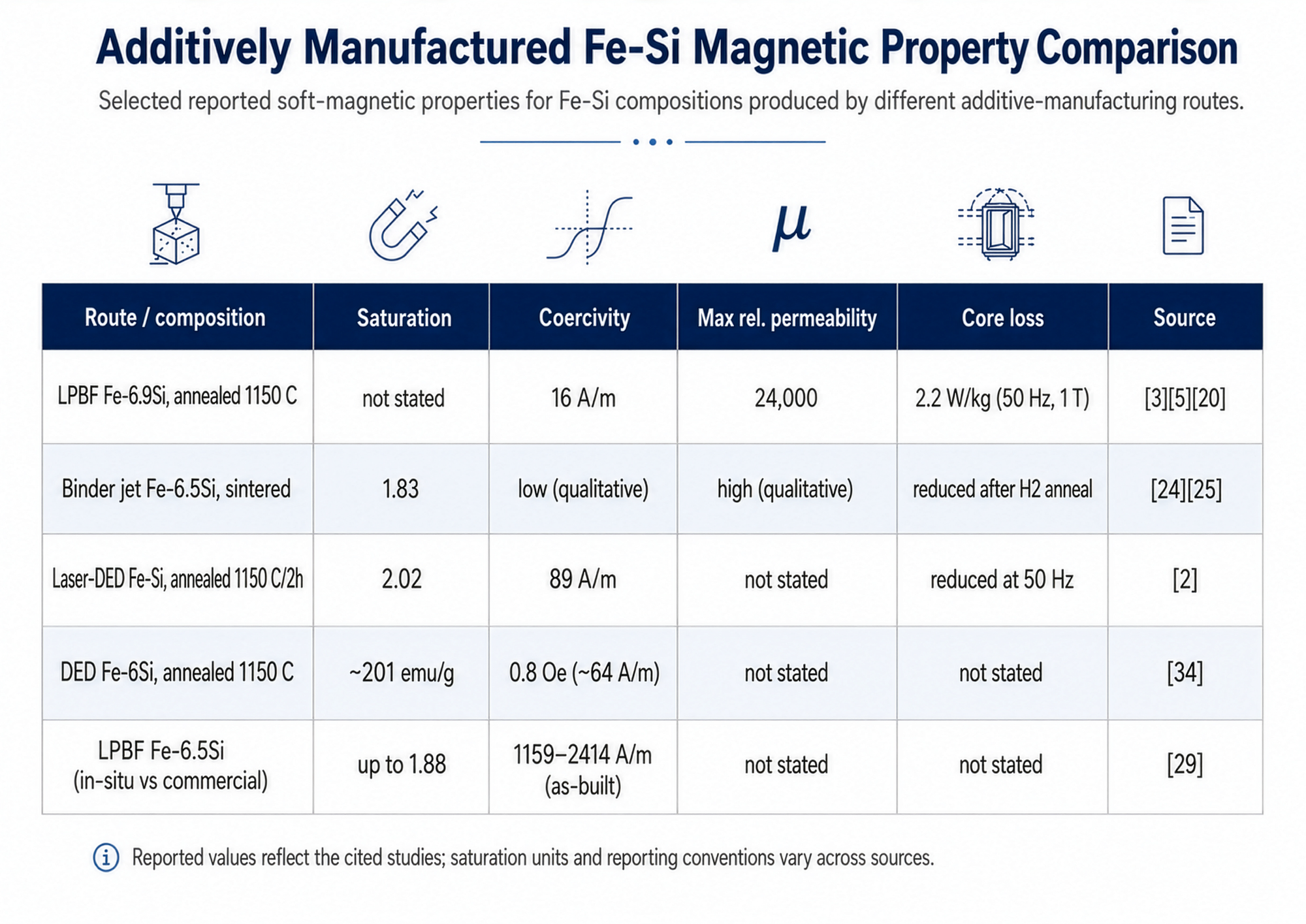
Several patterns are robust across the literature. Annealing consistently improves magnetic performance by relieving stress, growing grains, and reducing dislocation density, while build-direction <001> texture (in fusion routes) aligns the easy axis with flux. Mechanically, high-Si AM parts remain relatively brittle: binder-jet Fe-6.5 wt% Si showed maximum strain of about 2.9% at 434 MPa, consistent with the inherent brittleness of the composition [24]. The decisive caveat is that, by the assessment of the researchers themselves, AM high-Si Fe-Si performance does not yet fully match the best commercial electrical steels, though it is "quite promising" for specific thin-section applications [21].
3.6 Qualification, Repeatability, and Industrial Scale-Up
The barriers to industrialisation are throughput, repeatability, and qualification rather than feasibility. On throughput, LPBF deposits hundreds of grams per hour against hundreds of kilograms per hour for stamping and casting, a two-to-three-order-of-magnitude gap that ORNL identifies as the central impediment to mass adoption [6]. On repeatability, batch-to-batch variation in powder chemistry (oxygen, silicon content), the narrowness of crack-free process windows, and the sensitivity of magnetic properties to heat-treatment schedule all complicate reproducible production. On qualification, soft-magnetic AM parts lack mature, materials-specific standards (Section 6), so adopters must generate bespoke property datasets.
The realistic near-term industrial trajectory is therefore selective: high-value, geometrically complex, low-volume parts (aerospace and defense actuators and sensors, high-speed and axial-flux motor cores, specialised inductors and transformers) where AM's geometric and integration benefits outweigh its cost and throughput penalties. Mass-market motor and transformer laminations will remain the domain of conventional rolled and CVD-siliconized electrical steel.
4. Key Players and Stakeholders
4.1 Additive Manufacturing System OEMs
The metal AM system landscape relevant to Fe-Si has consolidated. Nikon SLM Solutions, formed when Nikon Corporation (Tokyo: 7731) acquired Germany's SLM Solutions for about 622 million euros in a deal completed in September 2023, is a leading LPBF platform supplier whose machines have been used in Fe-Si research [35]. GE Additive relaunched as Colibrium Additive, a GE Aerospace (NYSE: GE) company, in April 2024, retiring the Concept Laser and Arcam EBM brands; it supplies LPBF and electron-beam systems plus powders through its AP&C division [36]. 3D Systems Corporation (NYSE: DDD) and DMG MORI (which offers DED and hybrid LASERTEC systems) are also relevant. Renishaw LPBF machines feature in ORNL's electrical-steel work [19]. These are tool suppliers; none is a ferrosilicon or electrical-steel producer.
4.2 Powder and Feedstock Suppliers
Powder is where the AM Fe-Si and conventional metallurgy worlds most directly touch. Höganäs AB (privately held, Sweden) is the world's largest metal-powder producer and markets both Fe-6.5 wt% Si powder and its Somaloy soft-magnetic composite family, alongside VIGA-atomized AM powders [30][37]. Carpenter Technology Corporation (NYSE: CRS), through its Carpenter Electrification unit, supplies soft-magnetic alloys for AM, including Hiperco 50 (an iron-cobalt alloy) qualified for powder bed fusion [38]. Alleima (Nasdaq Stockholm: ALLEI), the specialty-steel business demerged from Sandvik in 2022, and Colibrium's AP&C are further powder sources. Ferroglobe and Elkem sit upstream as silicon and ferrosilicon producers but are not AM-powder suppliers in the Fe-Si soft-magnetic niche.
4.3 Ferroalloy and Electrical-Steel Producers
The conventional value chain is distinct and far larger. In ferrosilicon and silicon, Ferroglobe PLC (NASDAQ: GSM) is the largest European producer of 50% and 75% ferrosilicon and accounts for about 14% of global silicon-metal capacity [39][9]. Elkem ASA (Oslo Bors: ELK), a subsidiary of China National Bluestar, is Europe's largest ferrosilicon producer [10]. Eramet (Euronext Paris: ERA) is a diversified ferroalloy and mining group. In electrical steel, the dominant integrated producers are Nippon Steel (Tokyo: 5401, which acquired U.S. Steel in 2024), JFE Steel (a subsidiary of JFE Holdings, Tokyo: 5411), POSCO (KRX: 005490; NYSE: PKX), Baowu, Thyssenkrupp, ArcelorMittal, voestalpine, Aperam (Euronext Amsterdam: APAM), and Cleveland-Cliffs Inc. (NYSE: CLF), the sole U.S. producer of grain-oriented electrical steel [40][41]. JFE Steel's CVD Super Core is the principal commercial 6.5% Si benchmark [15].

4.4 Research Institutions, National Laboratories, and Standards Bodies
The research frontier is led by national laboratories and universities. ORNL's Manufacturing Demonstration Facility has been central, spanning LPBF, binder jetting, and big-area AM of soft magnets, often with NREL on electrical-machine integration [17][19][24]. Sandia National Laboratories has driven laser-DED Fe-Si characterisation [23]. The University of Nottingham (Garibaldi, Ashcroft, Hague, Simonelli) produced the foundational LPBF high-Si work [3][5]. Iowa State University and Ames Laboratory (Cui and colleagues) have pursued melt-spun and cost-effective 6.5% Si routes under U.S. Department of Energy funding [42]. Fraunhofer institutes in Germany and NIST in the United States support AM metrology and standards [43]. Standards are developed by ASTM International Committee F42 and ISO Technical Committee 261 (Section 6).
4.5 End-User Industries and Demand Owners
Demand owners for AM Fe-Si components are concentrated in aerospace and defense (actuators, sensors, generators), electric mobility (high-speed and axial-flux traction motors), power electronics and high-frequency magnetics (reactors, inductors, transformers), and renewable energy (wind-turbine generators, which motivated the ORNL/NREL review) [17][19]. These are the same sectors that, in their mass-market segments, drive demand for conventional electrical steel, which is the source of the strategic linkage explored in Section 7.
5. Economic and Market Dynamics
5.1 The Ferrosilicon Market: Structure, Capacity, and Pricing
The conventional ferrosilicon market is large, mature, and cyclical. Estimates of market value vary by source and methodology, clustering in the range of roughly USD 8 billion to USD 13 billion, with multiple market-research firms projecting low-single-digit compound annual growth driven by steel demand [44][45]. These market-sizing figures come from commercial research firms and should be treated as indicative rather than authoritative; the more reliable physical data come from USGS.
According to the USGS, world ferrosilicon production was about 75,000 thousand metric tons (silicon-content basis, as reported in the USGS world production table) in 2025, with China producing 3,500 thousand metric tons, followed by Russia (420 thousand metric tons) and Norway (150 thousand metric tons) [7]. China accounted for almost 80% of total global silicon-materials production [7]. On pricing, the USGS reported the U.S. average price for 75% ferrosilicon at about 140 cents per pound of silicon (estimated) in 2025, up about 3% from 131.96 cents in 2024, having spiked to 312.10 cents in 2022 during the energy crisis before falling back [7]. The market is thus characterised by Chinese dominance, energy-cost sensitivity, and price volatility.
5.2 Demand Drivers: Electrification, Electric Motors, and Power Electronics
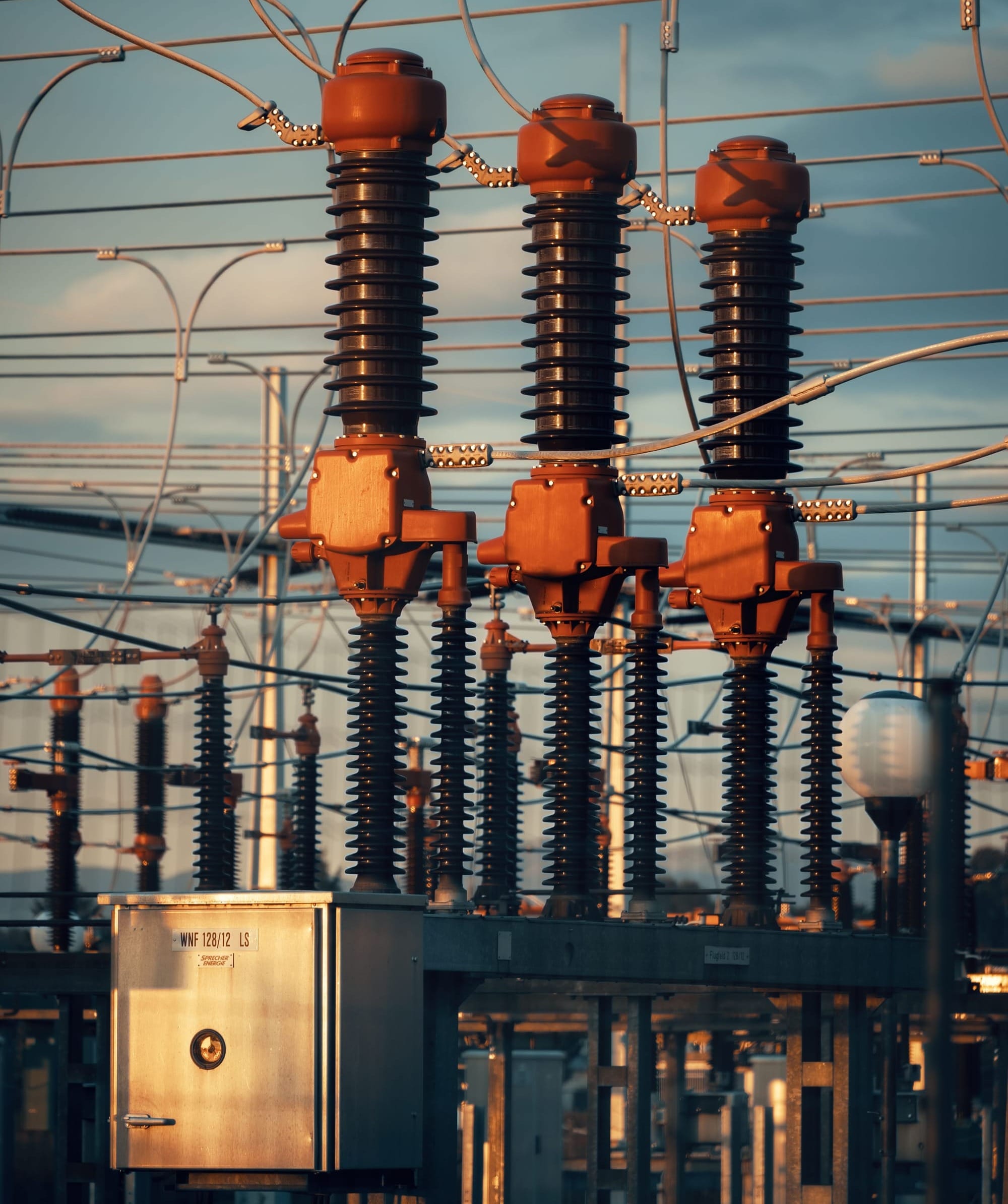
The demand backdrop for the linked electrical-steel market is unusually strong. Transformer lead times have stretched dramatically: per Wood Mackenzie's second-quarter 2025 survey, standard power transformers averaged 128 weeks and generator step-up transformers 144 weeks for delivery, with some specialised orders extending to four years [46]. Demand for generator step-up transformers grew 274% between 2019 and 2025, and substation power transformer demand grew 116% over the same period [46][47]. The drivers are AI data centres, grid modernisation, electric vehicles, and renewable integration. Grain-oriented electrical steel and copper are explicitly cited as binding material constraints, with grain-oriented electrical steel prices roughly doubling since 2020 [47].
This demand surge is the strategic context for AM Fe-Si. It does not make AM cores cost-competitive for transformers (it cannot, at AM throughput), but it intensifies interest in any technology that can ease electrical-machine performance and supply constraints, including high-silicon compositions that AM uniquely enables for complex geometries. The high-frequency, high-efficiency segment, where 6.5% Si excels, is precisely where electrification is pushing.
5.3 Cost Structure of AM Fe-Si Versus Conventional Manufacturing
The cost gap is structural and large. Conventional electrical steel sells at roughly USD 660 to 720 per tonne for non-oriented grades in Asian spot markets, with European non-oriented grades around 1,395 euros per tonne in early 2024 and U.S. prices reported far higher [48][49]. AM, by contrast, carries specific costs measured in pounds or dollars per cubic centimetre: published analyses put electron-beam melting and laser sintering at about 2.39 and 6.18 British pounds per cubic centimetre of material deposited, respectively, with single LPBF systems costing USD 400,000 to 800,000 [50][51]. ORNL's assessment is blunt: increasing laser scan speed is "not the silver bullet required to obtain economically justified mass production with LPBF," and a new scalable architecture is needed for orders-of-magnitude throughput gains [6].
The economic logic is therefore one of niche fit, not commodity substitution. AM reduces material waste (studies cite 35 to 80% material savings versus subtractive routes) and eliminates tooling, which favours low-volume and complex parts, but its flat, high per-unit cost cannot match the declining unit cost of stamping at volume [52]. JFE Super Core's chief drawback is also cost: the only commercially available 6.5% Si thin sheet is described in the peer-reviewed literature as costly and pollution-intensive to produce, which leaves room for alternative high-Si routes in specific applications, though no public Super Core price was identified [53].
5.4 Investment Landscape and Publicly Traded Exposure
Publicly traded exposure splits cleanly between the conventional chain and the AM frontier. Conventional-chain equities include Ferroglobe (NASDAQ: GSM), which reported fourth-quarter 2025 revenue of USD 329.4 million and whose shares had fallen about 28.5% over the prior twelve months amid soft steel and aluminium demand and import competition [54][55]; Elkem (Oslo Bors: ELK); Eramet (Euronext Paris: ERA); Cleveland-Cliffs (NYSE: CLF); Aperam (Euronext Amsterdam: APAM); and the large Asian steelmakers. AM-frontier equities include 3D Systems (NYSE: DDD), Carpenter Technology (NYSE: CRS), and, indirectly, GE Aerospace (NYSE: GE) via Colibrium Additive and Nikon Corporation (Tokyo: 7731) via Nikon SLM Solutions. Höganäs is privately held. For investors, the key analytical point is that no pure-play "AM ferrosilicon" equity exists; exposure is obtained through diversified powder, systems, or specialty-steel names, and the conventional ferrosilicon equities are commodity-cyclical plays largely unconnected to the AM thesis.
6. Regulatory and Standards Landscape
6.1 Additive Manufacturing Standards (ASTM F42, ISO/TC 261, sector codes)
AM standards are developed jointly by ASTM International Committee F42 (organised in 2009) and ISO Technical Committee 261, which since a 2011 cooperative agreement have produced co-branded standards under a partner standards-developing-organisation arrangement, including the foundational ISO/ASTM 52900 terminology standard [56][57]. The standards architecture is tiered: general (terminology, test methods, safety), category (process- or material-specific), and application-specific (aerospace, medical) [58]. The critical gap for this report's subject is that there is no soft-magnetic-specific AM materials standard: existing standards address process control, powder characterisation, and mechanical testing, but not the magnetic-property qualification (core loss, permeability) that electrical-machine adopters require. This forces bespoke qualification.
6.2 Materials Qualification for Aerospace and Defense
Aerospace and defense qualification is the most demanding pathway and the most likely near-term home for AM Fe-Si. Colibrium Additive's work spans FAA certification, military airworthiness, and programmes such as PACER EDGE with the U.S. Air Force Rapid Sustainment Office, which aims to address long lead times for hard-to-source engine components through digital technical data packages and government-owned in-house printing at Tinker Air Force Base [59]. The America Makes institute coordinates much of the U.S. public-private qualification effort. For soft-magnetic parts specifically, qualification will require generating statistically robust magnetic and mechanical datasets, which the absence of a materials standard makes slower and more costly.
6.3 Trade Measures, Tariffs, and Export Controls
Trade policy is active in the conventional chain. In April 2025, the U.S. International Trade Commission determined that the domestic industry was materially injured by ferrosilicon imports from Brazil, Kazakhstan, and Malaysia and issued countervailing and antidumping duty orders [7]. The European Union implemented ferroalloy safeguard measures in November 2025 that, per Ferroglobe, reduced import pressure and supported European market conditions [54]. U.S. Section 232 steel duties and copper tariffs of up to 50% have raised transformer input costs [47]. Standard most-favoured-nation tariffs on ferrosilicon are modest (roughly 1.1 to 5.8% ad valorem depending on grade) [7]. These measures bear on the commodity chain; AM powders and systems face separate, less-developed trade treatment. usgs
6.4 Occupational Health and Environmental Compliance for Metal Powders
Fine metal powders pose combustible-dust and inhalation hazards. Iron-silicon AM powders in the typical 15 to 53 micrometre range, and the finer fractions and condensate generated during printing, require handling under inert atmosphere, grounding, explosion-protected equipment, and respiratory protection consistent with combustible-dust and occupational-exposure frameworks. The reactivity of silicon-bearing powders heightens oxidation and dust-explosion concerns relative to inert powders. Environmentally, the upstream submerged-arc ferrosilicon process is highly energy- and carbon-intensive, and the EU Carbon Border Adjustment Mechanism, though not naming ferrosilicon explicitly, is pushing European steelmakers toward lower-embedded-carbon alloys [10]. (No AM-Fe-Si-specific occupational-health standard was identified; general metal-powder safety practice applies.)
7. Geopolitical and Strategic Dimensions
7.1 Concentration of Ferrosilicon and Ferroalloy Supply
Supply concentration is the defining strategic feature. China produced almost 80% of global silicon materials and 3,500 thousand metric tons of ferrosilicon (silicon-content basis) in 2025; the next-largest producers, Russia (420 thousand metric tons) and Norway (150 thousand metric tons), are far smaller [7]. U.S. ferrosilicon and silicon-metal production occurs at just five facilities, all east of the Mississippi, with combined output withheld as proprietary; the United States imported ferrosilicon principally from Russia (30%, 2021 to 2024 average), Brazil (16%), Canada (13%), and Malaysia (11%) [7]. This concentration mirrors broader ferroalloy and critical-materials dynamics, in which China's dominance of processing has prompted export-control actions across adjacent material classes [60].
7.2 Critical Materials Policy and the Defense Industrial Base
The policy posture shifted materially in 2025. On 7 November 2025, the USGS published the U.S. Final 2025 List of Critical Minerals in the Federal Register (90 FR 50494), which for the first time added silicon (alongside copper, lead, potash, rhenium, and silver) based on an updated methodology [7]. This designation signals heightened policy attention to silicon supply security, of which ferrosilicon is a major component. For the defense industrial base, the relevance of AM Fe-Si is narrow but real: it offers a route to produce bespoke and replacement soft-magnetic components domestically and on demand, reducing dependence on foreign electrical-steel laminations for specialised systems, even though it cannot address commodity ferrosilicon supply.
7.3 Energy Security and the Electrification Transition
Electrification is simultaneously a demand driver and a vulnerability. The transformer and electrical-steel shortages described in Section 5.2 are now gating grid modernisation and data-centre buildout, with roughly 80% of large U.S. power transformers imported and Cleveland-Cliffs the sole domestic grain-oriented electrical steel producer [47]. Ferrosilicon's energy intensity ties it to electricity prices and to the locational advantage of hydropower, which shapes where supply is resilient. High-silicon Fe-Si, whether made by CVD (JFE) or AM, improves high-frequency efficiency and thus matters to the energy productivity of the electrification transition, even where its production volumes remain small.
7.4 Additive Manufacturing as a Resilience and Onshoring Lever
AM's strategic value is as a flexibility and resilience lever, not a volume substitute. Its strengths, namely on-demand production, geometric freedom, part-count reduction, and reduced tooling, make it well suited to spares, bespoke components, and rapid iteration for defense and critical-infrastructure systems. The PACER EDGE model of government-owned in-house printing for hard-to-source parts is the archetype [59]. The honest framing is that AM of Fe-Si can harden the downstream electrical-component base at the margin, but onshoring resilience for the bulk electrical-steel and ferrosilicon supply chains depends on conventional smelting, rolling, and CVD capacity, plus trade and stockpiling policy.
8. Strategic Recommendations
8.1 For Materials Scientists and Process Engineers
Prioritise the unglamorous problems that gate industrialisation: oxygen control across the powder-to-part chain, crack-free process windows for compositions at and above 6.5 wt% Si, and standardised post-build heat-treatment schedules that reliably reproduce both texture and magnetic performance. Favour binder jetting and DED where part size or crack-sensitivity dominates, and reserve LPBF for thin-wall, texture-critical geometries. Benchmark every result against JFE Super Core and the best non-oriented laminations on a like-for-like frequency and induction basis, and report magnetic data with full measurement conditions to enable cross-study comparison. The threshold that should change priorities: demonstrated, reproducible core loss at or below commercial 6.5% Si laminations across multiple builds and machines would move the field from "promising" to "qualifiable."
8.2 For Defense and Industrial-Base Analysts and Policymakers
Treat AM Fe-Si as a targeted resilience capability for bespoke and replacement soft-magnetic components, not as a ferrosilicon supply solution. Fund qualification infrastructure (magnetic-property datasets, materials standards) rather than only hardware, because the binding constraint is qualification, not feasibility. Address the genuine supply risks where they live: the silicon critical-mineral designation, the five-facility domestic ferrosilicon base, and the single domestic grain-oriented electrical steel producer. Concretely, pair any AM investment with conventional electrical-steel capacity support and strategic stockpiling of high-purity ferrosilicon and grain-oriented steel. The indicator to monitor: transformer and electrical-steel lead times; sustained improvement would reduce the urgency of redundant capacity.
8.3 For Investors and Corporate Strategists
The conventional ferrosilicon equities (Ferroglobe, Elkem, Eramet) are energy-cost-driven commodity cyclicals largely unconnected to the AM thesis. Exposure to the AM Fe-Si frontier is best obtained through diversified powder suppliers (Höganäs, privately held; Carpenter Technology), AM systems and powder OEMs (Colibrium via GE Aerospace, Nikon SLM Solutions, 3D Systems), and the electrification-driven electrical-steel names (Cleveland-Cliffs, Nippon Steel, POSCO, Aperam). The asymmetric upside sits in high-value, low-volume end-use applications (aerospace, high-speed motors, power electronics), not in commodity displacement. Watch for credible techno-economic demonstrations of AM cores in qualified aerospace or motor programmes as the trigger to revise exposure.
8.4 Cross-Cutting Capability and Research Gaps
Four gaps cut across audiences. First, there is no soft-magnetic AM materials standard, which slows every qualification. Second, there is no published, peer-reviewed head-to-head cost-per-part comparison of an AM Fe-Si core versus a stamped lamination, leaving economic claims under-evidenced. Third, powder pricing and supply for AM-grade Fe-6.5 wt% Si are opaque, with no public price discovery. Fourth, throughput remains two to three orders of magnitude short of mass production, and the proposed remedies (multilaser, rotary architectures) are projections, not demonstrated capabilities [6]. Closing these gaps, in standards, cost transparency, powder supply, and throughput, would do more to advance the field than further single-sample property demonstrations.
9. Limitations, Uncertainties, and Contested Evidence
9.1 Data Quality and Source Limitations
The evidence base is asymmetric. The conventional ferrosilicon side rests on authoritative USGS data and company filings. The AM Fe-Si side rests on a relatively small set of single-study, single-laboratory results with heterogeneous compositions (Fe-3Si to Fe-6.9Si), machines, and measurement conditions, which makes cross-study comparison hazardous and means many reported property values are not yet independently replicated. Market-sizing figures for ferrosilicon vary widely across commercial research firms and should be read as indicative. Several cost figures (for example, an LPBF energy intensity cited at roughly 1,000 kWh/kg in a non-peer-reviewed analysis) require verification and are not relied upon here.
9.2 Open Technical Questions
Key technical questions remain genuinely open. Can AM reproducibly match or beat the best commercial 6.5% Si laminations on core loss across builds and machines, rather than in single specimens? How fully and durably is B2/DO3 ordering suppressed under realistic build thermal cycles and service temperatures? Can oxygen and silicon-loss be controlled tightly enough for consistent high-frequency performance at scale? Can texture (in fusion routes) and density (in sintering routes) be achieved simultaneously? The honest answer is that the field has demonstrated feasibility and promising single-sample properties but has not yet demonstrated qualifiable, reproducible production.
9.3 Forward-Looking Indicators to Monitor
Monitor: the publication of a soft-magnetic-specific ASTM/ISO AM materials standard; any peer-reviewed techno-economic study giving a defensible AM-versus-stamped cost-per-part figure; demonstrated multilaser or rotary LPBF throughput gains moving deposition from hundreds of grams to kilograms per hour; qualification of an AM Fe-Si component in a named aerospace, defense, or automotive programme; transformer and grain-oriented electrical steel lead times and prices; and policy actions following silicon's 2025 critical-mineral designation. These indicators, more than incremental laboratory property gains, will signal whether AM of high-silicon Fe-Si crosses from research frontier to industrial practice. All forward-looking statements here are conditional on these indicators and are not predictions.
References
- ScienceDirect. 2026. "Evaluation of mechanical and magnetic properties of laser-DED Fe–Si alloy: element segregation and low-frequency AC performance." Journal of Materials Research and Technology (S2238785426003121).
- "Evaluation of mechanical and magnetic properties of laser-DED Fe–Si alloy." 2026. Journal of Materials Research and Technology.
- Garibaldi, M., I. Ashcroft, M. Simonelli, and R. Hague. 2016. "Metallurgy of high-silicon steel parts produced using selective laser melting." Acta Materialia 110: 207–216. doi:10.1016/j.actamat.2016.03.037.
- "Investigation of Soft Magnetic Material Fe-6.5Si Fracture Obtained by Additive Manufacturing." 2022. Materials. PMC9786061.
- Garibaldi, M., I. Ashcroft, J. N. Lemke, M. Simonelli, and R. Hague. 2018. "Effect of annealing on the microstructure and magnetic properties of soft magnetic Fe-Si produced via laser additive manufacturing." Scripta Materialia 142: 121–125.
- Wang, P., G. Robertson, B. T. Gibson, C. M. Fancher, et al. 2024. "Improved Productivity with Multilaser Rotary Powder Bed Fusion Additive Manufacturing." 3D Printing and Additive Manufacturing 11(1): 231–241. doi:10.1089/3dp.2022.0288.
- U.S. Geological Survey. 2026. "Silicon." In Mineral Commodity Summaries 2026, February 2026.
- Hsferroalloy / industry technical guide. "Ferrosilicon Manufacturing Process in Electric Furnace."
- Ferroglobe PLC. "Ferrosilicon" product and business-area pages.
- Mordor Intelligence. 2025. "Ferrosilicon Market Size, Industry Trends and Growth 2025–2031."
- ScienceDirect Topics. "Pidgeon Process: an overview."
- Springer. 2021. "Magnesium Smelting via the Pidgeon Process." doi:10.1007/978-981-16-2171-0_2.
- Garibaldi, M., I. Ashcroft, N. Hillier, S. A. C. Harmon, and R. Hague. 2018. "Relationship between laser energy input, microstructures and magnetic properties of selective laser melted Fe-6.9 wt% Si soft magnets." Materials Characterization 143: 144–151.
- Cui, J. 2018. "Cost Effective 6.5% Silicon Steel Laminate for Electric Machines." U.S. Department of Energy Vehicle Technologies Office Annual Merit Review, Project ID elt091.
- JFE Steel Corporation. "Super Core: Electrical steel sheets for high-frequency application." Product catalogue (F1E-002).
- JFE Steel Corporation. 2020. "JFE Steel Develops JNRF Silicon-gradient Steel Sheet for High-speed Motors." Press release, December 3, 2020.
- Goll, D., et al. 2019. "Additive manufacturing of soft magnetic materials and components." Additive Manufacturing 27: 428–439.
- Tiismus, H., A. Kallaste, M. U. Naseer, T. Vaimann, and A. Rassolkin. "Additive manufacturing of soft magnets for electrical machines: a review." ORNL/NREL technical report (NREL 76839).
- NREL. 2025. "Additive Manufacturing of Soft Magnetic Materials for Electrical Machines." NREL/TP report 90537.
- "Effect of process parameters on the texture evolution of Fe-6.5 wt% Si soft magnetic alloys manufactured via laser powder bed fusion." 2024. Journal of Materials Processing Technology (S0924013624002395).
- Stornelli, G., A. Faba, R. Montanari, et al. "Magnetic performance of FeSi6.5 produced by selective laser melting." (high-silicon SLM characterisation study).
- Tran, J. V., M. P. McKinstry, and N. B. Dahotre. "Additive Manufacturing of Fe-6.5 wt% Si Transformer Steel Toroidal Cores: Process Optimization, Design Aspects, and Performance." Progress in Additive Manufacturing.
- Adamczyk, J. M., S. E. Birchall, E. T. Rothermel, A. B. Kustas, et al. 2024. "Characterization of Fe-6Si Soft Magnetic Alloy Produced by Laser-Directed Energy Deposition Additive Manufacturing." JOM 76. doi:10.1007/s11837-023-06293-5.
- Cramer, C. L., et al. 2019. "Binder jet additive manufacturing method to fabricate near net shape crack-free highly dense Fe-6.5 wt% Si soft magnets." Heliyon 5(11). doi:10.1016/j.heliyon.2019.e02804.
- Oak Ridge National Laboratory. "Binder jet additive manufacturing of Fe-6.5 wt% Si soft magnets." OSTI 1574542.
- "Mechanical and magnetic properties of Fe-6.5% Si parts manufactured by filament-based Material Extrusion." 2025. Additive Manufacturing (S152661252501182X).
- Stanford Advanced Materials. "Gas Atomization vs Water Atomization vs Plasma Atomization: What is the Difference."
- ResearchGate. "Preparation of amorphous Fe-based magnetic powder by water atomization."
- "In-Situ alloying of high-silicon soft magnetic alloy in laser powder bed fusion." 2025. Progress in Additive Manufacturing. doi:10.1007/s40964-025-01463-0.
- Höganäs AB. "Soft Magnetic powder materials" (uncoated powders for electromagnetic applications) product page.
- Haines, M., F. List III, K. Carver, D. Leonard, A. Plotkowski, C. Fancher, R. Dehoff, and S. Babu. "Role of scan strategies and heat treatment on grain structure evolution in Fe-Si soft magnetic alloys made by laser-powder bed fusion." OSTI 1841490.
- "Mitigating core energy losses in Fe-Si alloys fabricated by direct energy deposition through oxide inclusions and abnormal Goss grain growth." 2025. Materials & Design (S0264127525001509).
- "Improving the soft magnetic properties of binder jet printed iron-silicon alloy through boron addition." 2022. Journal of Alloys and Compounds (S0254058422014870).
- "A low coercivity, high Si content, directed energy deposited Fe-6% Si electrical steel." 2025. Journal of Alloys and Compounds (S0925838825034243).
- 3D Printing Journal. "Nikon SLM Solutions: the acquisition of SLM Solutions by Nikon Corporation."
- GE Aerospace. 2024. "GE Additive rebrands as Colibrium Additive." Press release, April 25, 2024.
- Höganäs AB. "Soft Magnetic Composites (Somaloy)" product pages.
- Carpenter Technology / Carpenter Electrification. "Additive Manufacturing of Soft Magnetics."
- Ferroglobe PLC. "Electrometallurgical" business-area page.
- Mordor Intelligence. "Grain Oriented Electrical Steel Market, Size, Share and 2030 Growth Trends Report."
- Fortune Business Insights. "Grain Oriented Electrical Steel Market Size & Report."
- Ouyang, G., C. Macziewski, J. Cui, et al. "Effect of wheel speed on the magnetic and mechanical properties of melt-spun Fe-6.5 wt% Si electrical steel." Heliyon / OSTI 1574542-related, Iowa State University / Ames Laboratory.
- National Institute of Standards and Technology. "Additive Manufacturing Standards and Benchmarks."
- Global Market Insights. "Ferro Silicon Market Size, Share & Forecast Report, 2024–2032."
- Mordor Intelligence. "Ferrosilicon Market" (production volume and capacity data).
- POWER Magazine. 2026. "Transformers in 2026: Shortage, Scramble, or Self-Inflicted Crisis?" (citing Wood Mackenzie Q2 2025 survey).
- IndustrialSage. 2025. "Power Transformer Lead Times Hit Record Highs as U.S. Grid Equipment Shortage Deepens."
- Fastmarkets. 2025. Electrical steel, non-grain-oriented, ex-warehouse Eastern China, price assessment, October 2025.
- Bidoia, L. 2024. "Price of electrical steel sheets in the spotlight for EU buyers." PricePedia, April 15, 2024.
- Baumers, M., P. Dickens, C. Tuck, and R. Hague. 2016. "The cost of additive manufacturing: machine productivity, economies of scale and technology-push." Technological Forecasting and Social Change 102: 193–201.
- Additive Manufacturing Media. "Why Does My 3D-Printed Part Cost So Much?"
- Inside Metal Additive Manufacturing. 2025. "Comparative Insights: Traditional vs. Additive Manufacturing for Electric Motor Design and Performance."
- Lindemann-Geipel, I., T. Mix, et al. 2024. "Potential of powder metallurgical methods to fabricate Fe-6.5 wt% Si soft magnetic components." Powder Metallurgy. doi:10.1177/00325899241247319.
- Ferroglobe PLC. 2026. Fourth-quarter and full-year 2025 financial results, February 18, 2026 (NASDAQ: GSM).
- Stockanalysis.com / Finimize. 2026. "Ferroglobe (GSM) Stock Price and Overview."
- Wohlers Associates. "ASTM ISO Collaboration."
- ISO/TC 261. "Additive manufacturing" committee pages, International Organization for Standardization.
- ASTM F42 / ISO TC 261. "AM Standards Structure and Primer."
- America Makes. "Colibrium Additive: Advancing Metal Additive Manufacturing with End-to-End Innovation."
- International Energy Agency. 2025. "With new export controls on critical minerals, supply concentration risks become reality." IEA Commentary.