Free Open Source Compact Car (FOSCC): Build a Street-Legal DIY Car From Salvage Parts for Under $10,000
Open-hardware plans for a street-legal DIY compact car: salvaged 4-cylinder powertrain on a builder-welded steel frame for under $10,000.

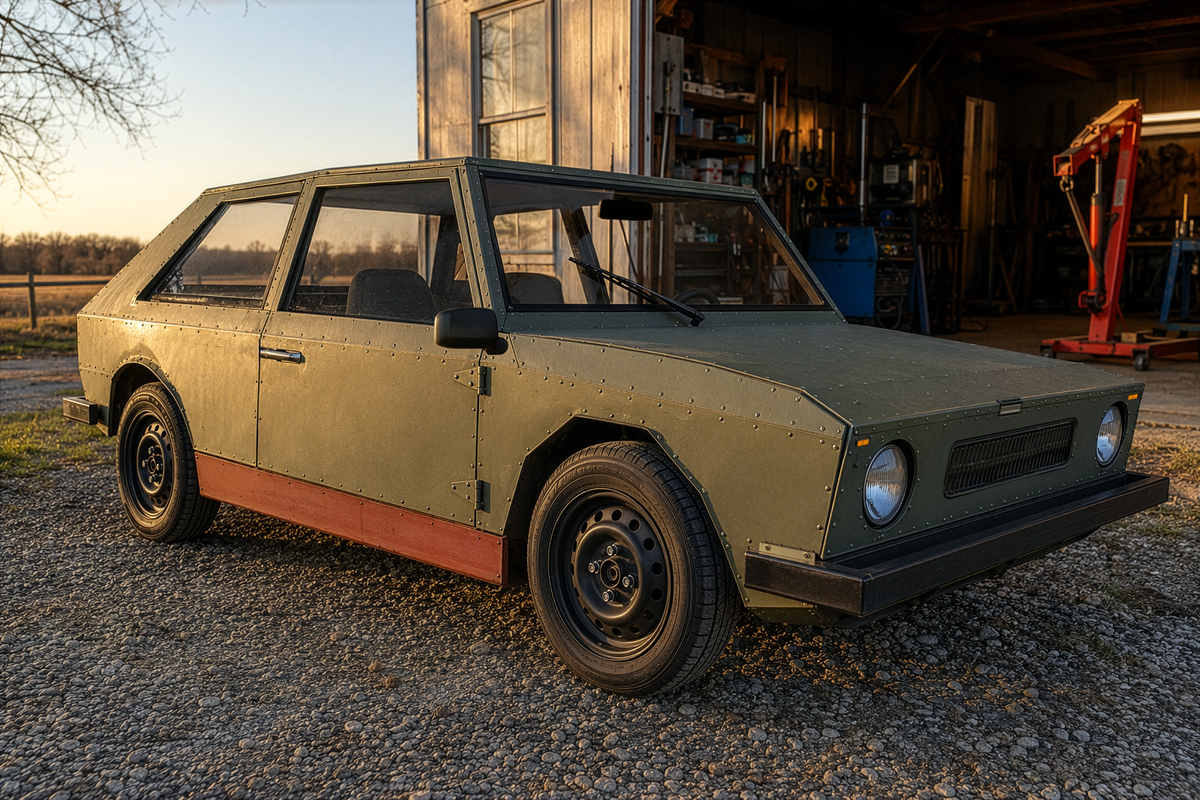
A FOSS / open-hardware DIY compact automobile: salvaged 4-cylinder powertrain on a builder-welded steel frame, buildable for under $10,000.
License: Hardware under CERN-OHL-S v2; documentation under CC BY-SA 4.0. Version: 0.9 (draft for community review) - July 5, 2026.
Maintainers: community project; fork and improve freely.
1. Description
The Free Open Source Compact Car (FOSCC) is a two-seat, front-engine, front-wheel-drive compact automobile built by mating a salvaged compact-car powertrain and suspension "corners" to a simple builder-welded mild-steel ladder/perimeter frame. It is designed to be registered in the United States through self-built / specially-constructed / kit-car pathways, repaired indefinitely with junkyard and hardware-store parts, and built by one person with autobody/metalworking skills for a materials cost under $10,000.
This is community documentation in the tradition of Open Source Ecology, Farm Hack, Appropedia, RepRap, Precious Plastic, and Low-Tech Magazine. It is provided as-is. Prices are estimates that vary by region and date. The builder is solely responsible for local code compliance, structural and electrical safety, and safe fabrication practice
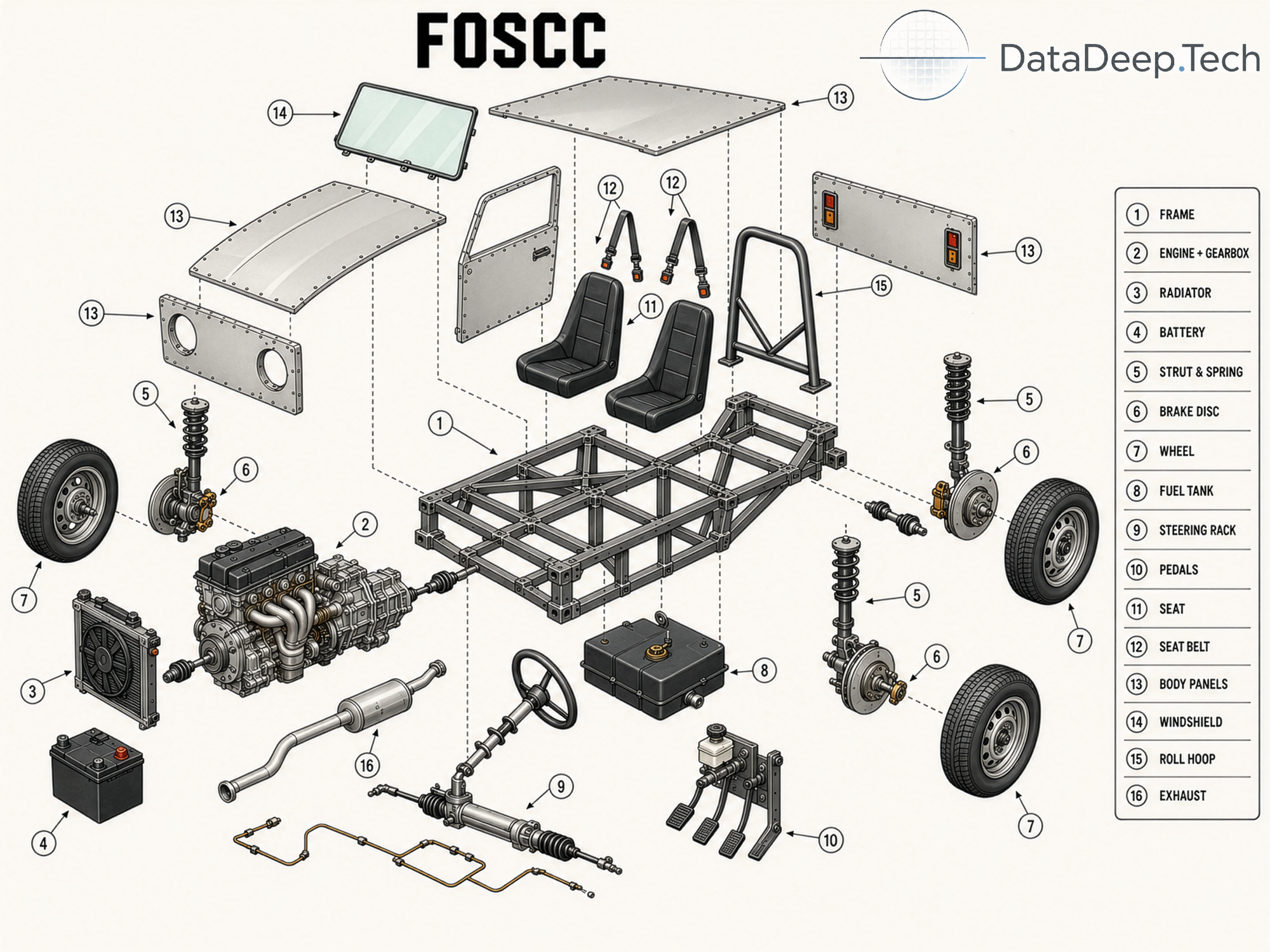
Free Open Source Compact Car - Schematics and Design (FOSCC)
2. At-a-Glance Box
| Item | Value |
|---|---|
| Total estimated cost - cheapest salvage path | ~$4,100 |
| Total estimated cost - upgraded path | ~$8,700 |
| Budget ceiling | $10,000 (design lands under with headroom) |
| Estimated build time | 400–700 hours (roughly 5–9 months of weekends) |
| Difficulty | Advanced (frame welding is safety-critical; wiring and brake plumbing require care) |
| Curb weight target | 700–900 kg (1,540–1,985 lb) |
| Power | 75–130 hp from typical donor engines |
| Key tools | MIG welder, chop saw / angle grinder, drill press, engine hoist, jack stands, hand tools |
| Donor | One or two common compact cars (Civic, Corolla, Fit, Yaris, Focus, Mazda3, Cavalier/Cobalt) |
| Frame material | 50×50×3 mm (2×2×0.120 in) mild steel square tube, ~30–40 m |
3. Abstract / Purpose
What it is. A minimalist, repairable compact car.
The engineering premise: modern cars are technologically over-complex, difficult to repair, and expensive to own. They lock owners out with immobilizers, proprietary diagnostic protocols, glued/bonded structures, and dozens of networked control modules. The FOSCC deliberately strips a car back to the parts a competent home mechanic can understand, buy used, and replace: a cable- or OBD-I-era four-cylinder engine, a manual transaxle, MacPherson struts, a rack-and-pinion, a hydraulic brake circuit, and a 12 V harness with fuses and relays you can trace with a test light.
The problem it solves. New cars in the U.S. have gotten expensive at the entry level: as of mid-2026 the cheapest new car on the market is the Hyundai Venue at $22,150 to start, and per U.S. News (May 2026),
"there's not one new car on the market today with a starting price under $20,000."
The cheapest new compact sedans, the Kia K4 (~$23,535) and Nissan Sentra (~$23,845), start well north of $23,000 (TrueCar, June 2026). A used compact of unknown history is cheaper but comes with the same electronic complexity and no provenance. The FOSCC offers a third path: a vehicle you built, understand completely, and can keep running with junkyard parts.
Who it's for. Off-grid and independent builders; people in the FOSS/open-hardware community; autobody and metalworking technicians; anyone who values repairability over refinement. It assumes access to a standard auto/metal shop's machinery.
Its limits. This is a light, low-speed-capable DIY vehicle. It has no airbags, no crumple-zone crash engineering validated by testing, no ABS, and no electronic stability control. Its occupant protection in a serious crash is far below any modern production car and should be assumed to be comparable to a 1960s–70s vehicle at best. It is best suited to low-traffic secondary roads, rural and off-grid use, and short commutes; not high-speed interstate commuting alongside 2,500 kg SUVs. Read Section 12 (Operation) honestly before deciding to build.
4. Design Rationale & Theory of Operation
4.1 Governing principles
Keep the donor drivetrain intact. The single most important cost-and-complexity decision: retain the donor car's transverse engine + transaxle as a unit, mounted the way the factory mounted it (engine and gearbox bolted together, driving the front wheels through the donor's own CV axles). This eliminates the hardest fabrication problems in any scratch-built car, (bellhousing adapters, custom axle manufacture, driveline angles, and clutch actuation) because those interfaces already exist and are proven. It is why the design is front-engine FWD rather than mid-engine RWD: not because mid-engine is worse dynamically, but because keeping the FWD "power pack" whole saves hundreds of hours and thousands of dollars.
Buy suspension as complete "corners." Rather than design and fabricate double-wishbone geometry (the Locost approach, which requires jigging and analyzing pickup points), the FOSCC reuses the donor's complete MacPherson strut corners: strut/spring assembly, steering knuckle, hub/bearing, brake, and lower control arm. The builder's only job is to fabricate correct mounting points on the frame: a strut top mount (a reinforced plate the donor strut bolts to) and control-arm pivots. This carries over the factory's kinematics for free.
The frame is the only major fabricated structure. Everything else is bought, salvaged, or bolt-on. The frame's job is to (1) hold the four suspension corners in correct geometric relationship under load, (2) carry the powertrain, (3) protect and locate the occupants, and (4) resist torsion so the suspension, instead of the chassis, controls handling.
4.2 Why a ladder/perimeter frame over a pure space frame
A triangulated space frame (Locost/Lotus Seven style) is stiffer per kilogram, but it requires many short tubes cut to compound angles and fitted precisely, requiring high labor hours and skill. A ladder/perimeter frame (two main longitudinal rails with cross-members, plus a welded-up passenger "safety cell" box and integrated roll structure) uses fewer, longer, mostly straight cuts. It is heavier for a given stiffness, but for this vehicle's modest power and speed the extra mass (a few tens of kg) is an acceptable trade for a large reduction in fabrication time and error. The design splits the difference: a ladder base with a partially triangulated central cell and a bolt-in/weld-in roll hoop.
Torsional stiffness target. The recognized rule of thumb from the amateur/kit community is that chassis torsional stiffness should be at least ~10× the vehicle's roll stiffness (spring + anti-roll-bar) so the frame does not become a significant compliance in the suspension. On a Locost-type frame, builders' Finite Element Analysis (FEA) work reports figures in the range of ~2,500–5,000 ft·lbf/degree, one documented double-Y-braced revision reached 2,683 ft·lbf/deg at 174 lb, while the "book" Locost is widely regarded as under-engineered and revised designs (the "Aussie mods," McSorley 442 plans) add a small number of tubes to raise stiffness. The FOSCC targets ≥2,000 ft·lbf/degree (≈2,700 N·m/deg) as a practical minimum for a soft-sprung road car, achieved with the perimeter rails plus a triangulated central tunnel/cell and closed footwell boxes. This is "good enough," not optimal; a builder wanting more should add diagonals in the engine bay and behind the seats, which FEA on similar frames shows give the largest stiffness-per-tube gains (a single scuttle/dash bar can add a large percentage for ~3 lb of steel).
Steel choice. Main rails and safety cell: 50×50×3 mm (2×2 in, 0.120 in wall) mild steel square tube (ASTM A500 Grade B or equivalent; ~36 ksi yield, comparable to the 1018/A500 tube Locost builders use). This is heavier-wall than the 25×25×1.6 mm (1×1 in, 16 ga) tube used in a lightweight Locost, chosen deliberately: it is more forgiving of amateur welds, more crash-tolerant, and readily available at any steel supplier. Secondary structure and gussets: 40×40×2 mm and 3–5 mm plate. Use cold-rolled or de-scaled hot-rolled tube; mill scale must be ground off before welding or welds will be porous and weak; a point Locost builders repeatedly stress.
4.3 Critical parameters and how they were chosen
| Parameter | Target | Rationale |
|---|---|---|
| Wheelbase | 2,300–2,450 mm | Match donor's front/rear track and CV-axle length; long enough for ride, short enough to fit a 20-ft container / trailer |
| Track (front/rear) | Set by donor | Reusing donor control arms/struts fixes track; do not alter it |
| Overall length | 3,800–4,000 mm | Compact footprint; fits container/trailer with margin |
| Overall width | ≤1,700 mm | Compact; container/trailer clearance |
| Overall height | ≤1,450 mm | Low CG; container clearance |
| Curb mass | 700–900 kg | Light for economy and braking; heavier than a Locost due to steel + body + creature comforts |
| Weight distribution | ~60/40 front/rear | Consequence of front FWD power pack; acceptable, matches donor |
| Ride height | 120–150 mm | Retain donor suspension travel; avoid bump-steer changes |
| Power-to-weight | ~90–170 hp/tonne | With 75–130 hp and ~800 kg, brisk but not fast; comparable to the donor economy car |
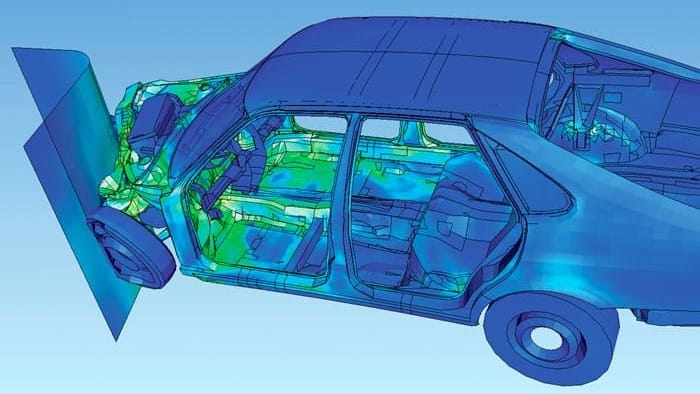
Crash safety: honest limits. No DIY builder can replicate the validated crumple zones, load paths, restraint timing, and airbag systems of a modern car. The FOSCC's frame is designed to (a) not collapse in normal use, (b) provide a rigid occupant cell and roll structure, and (c) locate the seat belts in properly triangulated, load-tested anchorages (see §4.4). That is the ceiling of what this design claims. Treat it as a vintage-equivalent vehicle for crash purposes.
4.4 Belt anchorages: a load-critical detail
Seat-belt anchorage strength is where "good enough" is not acceptable. FMVSS 209 (belt assemblies) and 210 (anchorages) exist because these are life-safety parts. Each anchorage must be welded to frame tube (never to sheet body panels) with reinforcing plate, and use grade 8.8/grade 5 or better 7/16"-20 UNF bolts to the belt-industry standard thread. Anchorages should be angled to the belt geometry and backed with a minimum 40 × 40 × 3 mm plate spreading load into the tube.
5. Specifications & Performance Targets
| Spec | Value |
|---|---|
| Layout | Front transverse engine, FWD, 2-seat |
| Length / width / height | ~3,900 / ~1,680 / ~1,400 mm |
| Wheelbase | ~2,400 mm |
| Curb weight | 700–900 kg |
| Payload | ~200 kg (2 occupants + light cargo) |
| Engine options | Salvaged 4-cyl: Honda D-series (D16, ~1.6 L, D16Y8 127 hp @ 6,600 rpm / D16Z6 125 hp), Honda L-series, Toyota 1NZ-FE (1.5 L, 109 hp @ 6,000 rpm, ~87 kg dry), Tractor Tech Specs Toyota 1ZZ-FE (1.8 L, US-spec 120–130 hp) |
| Transmission | Donor manual transaxle strongly preferred (simpler, no electronic control) |
| Top speed | ~140–160 km/h (87–100 mph) capable but not recommended; geared and intended for ≤110 km/h cruising |
| Fuel economy (est.) | 5–7 L/100 km (34–47 mpg) given light weight and economy engine |
| Frame squareness tolerance | Diagonals equal within ±3 mm; rail-to-rail parallel within ±2 mm |
| Suspension pickup tolerance | Left/right symmetric within ±1.5 mm; strut-top and control-arm points jig-built |
| Expected service life | Indefinite with maintenance; donor engines commonly reach 250,000–500,000 km (Toyota 1NZ-FE/1ZZ-FE and Honda D16 all documented past 300,000 km) Specs Node |
| Duty cycle | Light daily/secondary-road use; not continuous high-speed highway |
6. Bill of Materials
Prices are 2026 U.S. estimates in USD; they vary by region and date. "Salvage alt." lists a realistic free/cheap substitute. Self-service junkyard prices below are drawn from published price lists at regional pull-your-own chains (Carolina Pick-N-Pull, Express Pull-N-Save, Pull-A-Part) and are category prices (the yard charges the same for a Civic part as for any other car); add small refundable core charges and local tax/enviro fees. Entry/gate fee at these yards is typically $2–$3/day.
6.1 Donor and powertrain
| # | Item | Spec/size | Qty | Generic name (or specific + why) | Unit $ | Line $ | Source/notes | Salvage alt. |
|---|---|---|---|---|---|---|---|---|
| 1 | Donor car (whole) | Running/rolling compact, OBD-I or early OBD-II, manual preferred | 1 | Honda Civic (D-series) / Toyota Corolla (1ZZ/1NZ) - ubiquitous, cheap parts | 800 | 800 | Craigslist/FB Marketplace private-party beater ~$1,000–4,000; budget line uses low end | Non-running whole scrap car $200–700 |
| 2 | Engine (if bought separately) | 4-cyl gas, complete w/ accessories | 1 | Donor engine long block + accessories | 350 | 350 | Self-service "engine complete" ~$330–380 (Carolina $379.99; Pull-A-Part $373.75) | Included in #1 |
| 3 | Transaxle | Manual (preferred) | 1 | Donor transaxle | 180 | 180 | Self-service "transaxle" ~$115–220 (Carolina manual $179.99; Pull-A-Part $115) | Included in #1 |
| 4 | CV axles (pair) | Donor | 1 | New aftermarket or reused donor | 120 | 120 | RockAuto new ~$60 ea | Reuse donor axles (free) |
| 5 | Engine management | Open-source ECU | 1 | Speeduino (assembled) or reuse donor OBD-I ECU | 150 | 150 | Assembled Speeduino v0.4 board $199 (speeduino.co.il); v0.4.3c kits ~$130–170; through-hole component kits $73–107 | Reuse donor ECU + harness (free) |
6.2 Frame and fabrication
| # | Item | Spec/size | Qty | Generic | Unit $ | Line $ | Source | Salvage alt. |
|---|---|---|---|---|---|---|---|---|
| 6 | Square tube, main | 50×50×3 mm | ~30 m | Mild steel A500 | ~$5/ft | ~500 | Steel supplier / Metals Depot | Surplus/drop steel yard |
| 7 | Square tube, secondary | 40×40×2 mm | ~15 m | Mild steel | ~$3/ft | ~150 | Steel supplier | Surplus |
| 8 | Plate/gussets | 3–5 mm sheet | ~2 m² | Mild steel plate | — | ~120 | Steel supplier | Salvage plate |
| 9 | Strut top mount plates | 5–6 mm plate, fabricated | 4 | Reinforcement plate | — | (in #8) | — | — |
6.3 Suspension, steering, brakes (carry-over + wear parts)
| # | Item | Spec | Qty | Generic | Unit $ | Line $ | Source | Salvage alt. |
|---|---|---|---|---|---|---|---|---|
| 10 | Strut assemblies (corners) | Strut + spring | 4 | Donor MacPherson strut assy | ~$25 | 100 | Self-service "strut w/ spring" ~$17–37 | Reuse donor (free w/ #1) |
| 11 | Control arms | Lower | 2–4 | Donor control arm | ~$22 | 88 | Self-service ~$19–25 | Reuse donor |
| 12 | Steering rack | Manual preferred | 1 | Donor rack-and-pinion | ~$45 | 45 | Self-service manual rack ~$40 (Carolina $39.99; power ~$70) | Reuse donor |
| 13 | Steering column/U-joints | Donor + U-joint | 1 | Column w/ steering U-joint | 60 | 60 | Donor + Borgeson-type U-joint | Reuse donor column |
| 14 | Brake calipers/wheel cyl | Donor | set | Reused, rebuilt | — | 40 | Rebuild kits | Reuse donor |
| 15 | Brake rotors/drums | New wear | set | Generic | ~$25 ea | 100 | RockAuto | Reuse if within spec |
| 16 | Brake pads/shoes | New wear | set | Generic | — | 60 | RockAuto | — |
| 17 | Brake line | 3/16" steel + fittings | 1 roll | DOT steel brake line, double-flare | 25 | 25 | Parts store | — |
| 18 | Pedal box | Donor or aftermarket | 1 | Donor pedal assembly (reuse) or Wilwood-type pedal box | 60 | 60 | Reuse donor pedals; aftermarket pedal box if needed | Reuse donor (free) |
| 19 | Master cylinder | Donor/new | 1 | Generic | — | (in #18) | — | Reuse donor |
6.4 Fuel, cooling, exhaust
| # | Item | Spec | Qty | Generic | Unit $ | Line $ | Source | Salvage alt. |
|---|---|---|---|---|---|---|---|---|
| 20 | Fuel tank | Donor or steel/poly cell | 1 | Donor fuel tank + sending unit | ~$25 | 25 | Self-service "fuel tank" ~$20–40 | Reuse donor |
| 21 | Fuel pump/lines | EFI in-tank pump + hose | 1 | Donor pump + injection-rated hose | 40 | 40 | Reuse donor pump; new hose | Reuse donor |
| 22 | Radiator | Compact, crossflow | 1 | Donor or universal | ~$45 | 45 | Self-service "radiator" ~$38–52 | Reuse donor |
| 23 | Hoses/clamps/coolant | Silicone or generic | set | Generic | — | 50 | Parts store | — |
| 24 | Electric fan | Donor | 1 | Donor radiator fan | — | 20 | Self-service | Reuse donor |
| 25 | Exhaust tubing + muffler | 2" mild/alum steel + muffler | 1 | Mandrel/DIY bends + universal muffler | 120 | 120 | Summit/parts store | Reuse donor cat-back |
6.5 Electrical
| # | Item | Spec | Qty | Generic | Unit $ | Line $ | Source | Salvage alt. |
|---|---|---|---|---|---|---|---|---|
| 26 | Battery | 12 V, group 24, flooded lead-acid | 1 | Lead-acid automotive battery (e.g., EverStart Value group 24F, 585 CCA) | ~$140 | 140 | Big-box/parts store | Used battery |
| 27 | Alternator | Donor | 1 | Donor alternator | ~$30 | 30 | Self-service ~$22–40 | Reuse donor |
| 28 | Starter | Donor | 1 | Donor starter | ~$25 | 25 | Self-service ~$23–35 | Reuse donor |
| 29 | Wiring/fuse/relay | 12 V harness supplies | 1 | Wire, fuse block, relays, connectors | 120 | 120 | Parts/online | Reuse donor harness (free) |
| 30 | Lighting | DOT headlamps, LED tail/marker | set | DOT sealed-beam or 7" round; LED trailer-style tails | 120 | 120 | Parts store; must be DOT-marked (FMVSS 108) | Reuse donor lamps |
| 31 | Gauges | Speedo, tach, temp, fuel, oil | set | Donor cluster or universal | 60 | 60 | Reuse donor or aftermarket | Reuse donor |
6.6 Body, glazing, seats, restraints, fasteners, consumables
| # | Item | Spec | Qty | Generic | Unit $ | Line $ | Source | Salvage alt. |
|---|---|---|---|---|---|---|---|---|
| 32 | Body panels | 1.5–2 mm aluminum sheet or 18–20 ga steel | ~6 m² | Flat-wrap panels over frame | ~$40/sheet | 240 | Big-box/metal supplier | Salvage panels |
| 33 | Windshield | Laminated DOT AS1 safety glass | 1 | Donor windshield (reuse) | ~$30 | 30 | Self-service "windshield" ~$25–38; polycarbonate NOT legal for windshield FESLER USA | Reuse donor |
| 34 | Side/rear glass | Tempered AS2/AS3 | set | Donor glass or fixed laminated | ~$20 ea | 60 | Self-service | Reuse donor |
| 35 | Seats | Bucket | 2 | Donor bucket seats | ~$35 ea | 70 | Self-service bucket ~$27–45 each (priced individually, no pair discount) | Reuse donor |
| 36 | Seat belts | 3-point, FMVSS 209/302 marked | 2 | New retractable belt (US-made, certified) | ~$45 ea | 90 | Wesco/Seatbelt Solutions | Reuse donor belts if anchorages match |
| 37 | Fasteners | Grade 8.8/grade 5, assorted | lot | M8–M12 8.8; 7/16-20 for belts | — | 80 | Hardware store | — |
| 38 | MIG wire | ER70S-6, 0.030"/0.035" | 2 spools | Welding wire | 30 | 60 | Welding supply | — |
| 39 | Shielding gas | 75/25 Ar/CO₂ | 1–2 fills | MIG gas | 60 | 120 | Welding supply | — |
| 40 | Cutoff/grind discs | 4.5"/9" | lot | Abrasive discs | — | 60 | Big-box | — |
| 41 | Paint/primer | Enamel or 2K | lot | Rattle-can or gun | — | 120 | Big-box | — |
6.7 Cost summary
| Path | Approx. total |
|---|---|
| Cheapest salvage path (one donor providing engine/trans/suspension/brakes/glass/seats/harness/lamps; buy only frame steel, consumables, brake lines, wear parts, belts, battery, body sheet) | ~$4,100 |
| Upgraded path (separately-bought fresh donor engine, Speeduino ECU, new brakes all around, new belts, new lighting, sodium-ion battery, better body finish) | ~$8,700 |
Both land under the $10,000 ceiling. The cheapest path leaves roughly $5,900 of headroom for tools, registration/inspection fees, insurance, and the inevitable replacements.
7. Tools & Equipment
| Tool | Category | Est. cost if buying | Manual fallback |
|---|---|---|---|
| MIG welder (140–220 A) | Should own/borrow | $400–900 | None - welding is mandatory; rent time at a makerspace |
| Auto-darkening welding helmet | Own | $60 | Fixed-shade helmet |
| Angle grinder (4.5") | Own | $40 | Hacksaw + files (much slower) |
| Chop saw / cold saw | Borrow/buy | $120 | Angle grinder with cutoff wheel |
| Drill press | Borrow | $150 | Hand drill + guide |
| Engine hoist (leveler) | Rent | $50/day rent | Chain hoist + gantry |
| Jack + jack stands (4+) | Own | $150 | — (never substitute; see safety) |
| Bench vise | Own | $60 | — |
| Hand tools (metric sockets, wrenches) | Own | $200 | — |
| Torque wrench (1/2") | Own | $50 | — (mandatory for safety-critical bolts) |
| String/tape + stands (alignment) | Own | $20 | — |
| Multimeter / test light | Own | $30 | — |
| Brake bleeder (vacuum or 2-person) | Own | $30 | Two-person pedal method |
| Welding table / flat jig surface | Build | — | Flat concrete + steel plate |
8. Skills & Safety
Required competencies: MIG welding structural steel (you must be able to lay sound, penetrating welds and inspect them); basic vehicle mechanics (engine R&R, brake bleeding, suspension assembly); reading a factory service manual (FSM) for torque specs; basic 12 V automotive wiring; measurement and layout. Autobody/associate's-degree skill level assumed.
Hazards and safe procedures:
- Frame welds (life-critical). Suspension mounts, belt anchorages, and roll structure carry crash and fatigue loads. Grind off all mill scale before welding. Ensure full penetration; do not "sugar-coat" over gaps. Have welds inspected by a certified welder if you are not confident. A failed strut-top weld at speed is fatal.
- Brake system (life-critical). Use DOT steel line and double flares (never single). Torque fittings to spec. Bleed completely; a firm pedal is a go/no-go check. No air, no leaks.
- Fuel system (fire). Use injection-rated hose and proper clamps. No leaks under pressure. Keep the tank vented and grounded. Never weld near a fuel tank with residue.
- Steering (life-critical). Every steering joint must be a proper DOT/OEM U-joint or rod end, double-nutted or safety-wired. A dropped steering shaft = total loss of control.
- Vehicle support (life-critical). Only work under a car on rated jack stands on concrete; never a jack alone, never cinder blocks. Chock wheels.
- Stored energy in springs (life-critical). Use a proper spring compressor on MacPherson struts. A released strut spring can be fatal.
- Hot exhaust / grinding sparks / welding UV. PPE: welding helmet, leather gloves, respirator for grinding/paint, safety glasses, ear protection, fire extinguisher on hand.
 admin
admin
Codes/standards to verify locally:
- State self-built / specially-constructed / assembled-vehicle registration (see §9 and §17).
- FMVSS applicability - see §9.2. Equipment standards (lighting 108, glazing 205, belts 209, brake hose 106) apply to the equipment items regardless.
- State equipment codes (lighting positions, glazing, mirrors, horn, wipers).
- Emissions by engine year - your state may test based on the engine's model year or the assembly year; verify before choosing a donor.
9. Registration & Legality (U.S.)
This is often the hardest part of the build. Verify everything with your own state DMV - rules differ and change.
9.1 The core strategy: build from used parts
There is a decisive federal distinction, stated plainly in NHTSA interpretation letters (e.g., 8902, nht93-6.46/6.47): "if the vehicle is manufactured incorporating a number of previously used parts, particularly involving the chassis and/or drive train, we generally have considered the vehicle to be a used one, and none of the FMVSS that apply to new completed vehicles (as contrasted with those that apply to equipment items) apply to it." By contrast, a vehicle built entirely from new parts is a new motor vehicle that must comply with and be certified to all applicable FMVSS [1].
Design consequence: by using a salvaged engine, transaxle, and suspension, the FOSCC falls on the "used vehicle" side of that line federally, dramatically simplifying legality. It is then governed by state registration and equipment law, not federal new-vehicle certification. (Equipment items, such as lamps, glazing, belts, brake hoses, still must meet their own FMVSS equipment standards.)
9.2 State pathways (research summary)
- California (SPCNS / SB100). Register as a Specially Constructed Vehicle: forms REG 343 (Application) and REG 5036 (Statement of Construction), bills of sale/receipts for major components (engine, frame, transmission, body), DMV vehicle verification, CHP VIN assignment, and a BAR Referee smog inspection. Under SB100 (Cal. Health & Safety Code §44017.4), the DMV "shall annually provide an initial registration to no more than the first 500 vehicles" that qualify, and "the referee shall assign the 1960 model-year to any specially constructed vehicle that does not sufficiently resemble a previously manufactured vehicle." Without an SB100 sequence number, emissions requirements are those for the engine's model year, a strong argument for choosing an older, pre-OBD-II engine. [2]
- Texas (Assembled Vehicle). Governed by the TxDMV Assembled and Reconstructed Vehicle Manual (updated Oct 2025). Requires: eligibility letter from a TxDMV Regional Service Center, Form 130-U, photographs, ownership evidence for motor/body/frame, an ASE Master Technician safety inspection (Form VTR-64), law-enforcement VIN inspection (VTR-68-A) and assigned number (VTR-68-N), certified weight certificate, and (in emissions counties) emissions inspection to the assembly year. Note: as of Jan 1, 2025, the routine non-commercial safety inspection was dropped statewide, but the assembled-vehicle ASE inspection is separate and still required. Vehicles using parts that do not meet an applicable FMVSS (where a standard exists) are ineligible; body/frame may not come from a nonrepairable/junk vehicle.
- Michigan (Assembled Vehicle). Police on-road equipment inspection (Form TR-54), then title application; the state assigns a new VIN ($10 fee) and a Regulatory Monitoring agent performs a final inspection and affixes the VIN sticker; 8–10 week processing; titled by assembly year. Michigan is explicit on two equipment points: per the SOS, "a receipt is required confirming that the installed windshield is U.S. Department of Transportation certified and is laminated glass. A polycarbonate or Plexi-glass windshield isn't acceptable. Also, the parking brake must be mechanical, and not hydraulic." (windshield material is codified at MCL 257.217i) [3]
- Florida (Assembled from Kit / rebuilt). Statement of Builder (HSMV 84490) and title application (HSMV 82040), submitted to a Regional Office; physical inspection; titled by the year assembled. The builder certifies conformity to Florida and Federal Motor Vehicle Safety Standards [4] [5].
- General pattern (most states): proof of ownership for major components (keep every receipt and bill of sale with VINs), a law-enforcement/inspector VIN check and new VIN assignment, an equipment/safety inspection, titling by assembly year (which sets the emissions-year baseline), and insurance. Assembled/kit vehicles are frequently not eligible for temporary registration and may take months.
9.3 Practical takeaways
- Keep meticulous records: dated bills of sale for the donor, engine, transaxle, frame steel, and body, each ideally with VINs/part numbers. This is the single most important non-fabrication task.
- Choose the engine year deliberately. Emissions requirements usually track the engine's model year (or assembly year). An older OBD-I engine can mean a far simpler emissions path, directly reinforcing the repair-first, anti-complexity ethos.
- Equipment must be DOT-legal: DOT-marked headlamps (FMVSS 108), laminated AS1 windshield glass (FMVSS 205), FMVSS 209/302-marked belts, DOT steel brake line. Polycarbonate is legal for many side/rear applications in some states but not for the windshield.
10. Build Instructions
Work in fabrication order. Reference BOM #s. Every torque value comes from the donor's factory service manual (FSM), free FSMs and torque tables are widely available in owner forums for Civic/Corolla-family cars; use donor-specific values, not generic ones, for suspension, hub, and engine fasteners.
Phase 1 - Donor teardown (BOM #1)
- Document everything with photos and labels before disassembly, especially the engine harness and its grounds. Bag and label fasteners by assembly.
- Remove the power pack (engine + transaxle) as a unit with the hoist. Keep engine mounts, wiring, ECU, and sensors together.
- Remove all four suspension corners intact (strut, knuckle, hub, control arm, brake). Keep the steering rack, pedal box, master cylinder, fuel tank/pump, radiator/fan, lamps, seats, belts, glass, and harness.
- Measure and record the donor's track, strut-mount spacing, control-arm pivot spacing, and steering-rack mounting geometry. These become your jig dimensions.
- Go/no-go: power pack turns freely; you have documented suspension geometry.
- Figure 10.1 (photo not included): the stripped power pack on a stand with engine mounts still attached, labeled to show mount faces and axle stub locations.
Phase 2 - Frame jig and welding (BOM #6–9)
- Lay out the frame plan on a flat surface (steel table or flat concrete with a datum line). Build a simple jig from scrap to hold rails and suspension pickups. (Locost builders commonly jig on a sheet of 1" MDF with plywood strips screwed down to locate tubes - a cheap, proven method.)
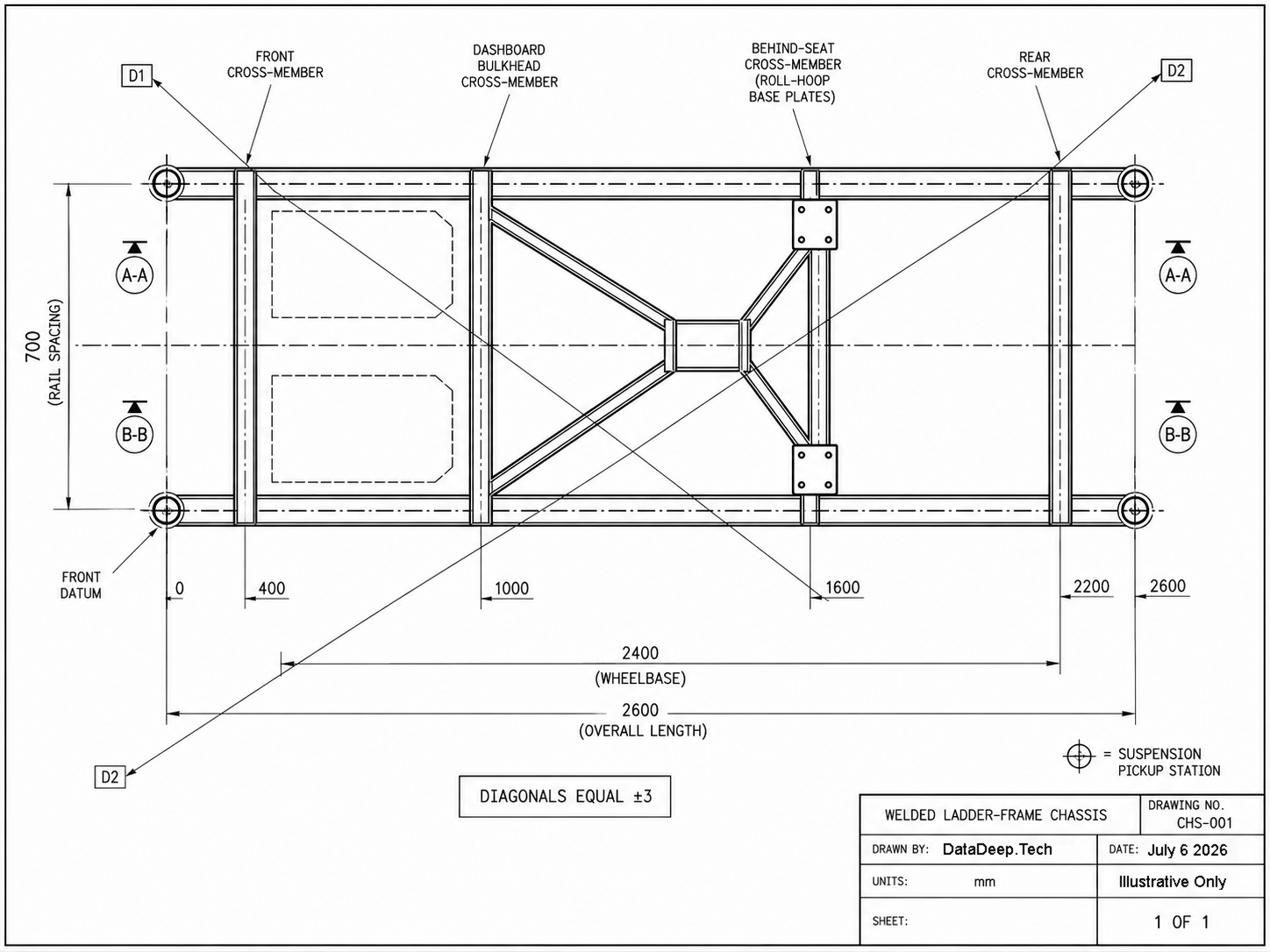
- Cut main rails (50×50×3 mm) and cross-members. De-scale all tube. Tack the perimeter first; check diagonals equal within ±3 mm before fully welding.
- Weld the central tunnel/cell and footwell boxes for torsional stiffness. Add engine-bay and behind-seat diagonals.
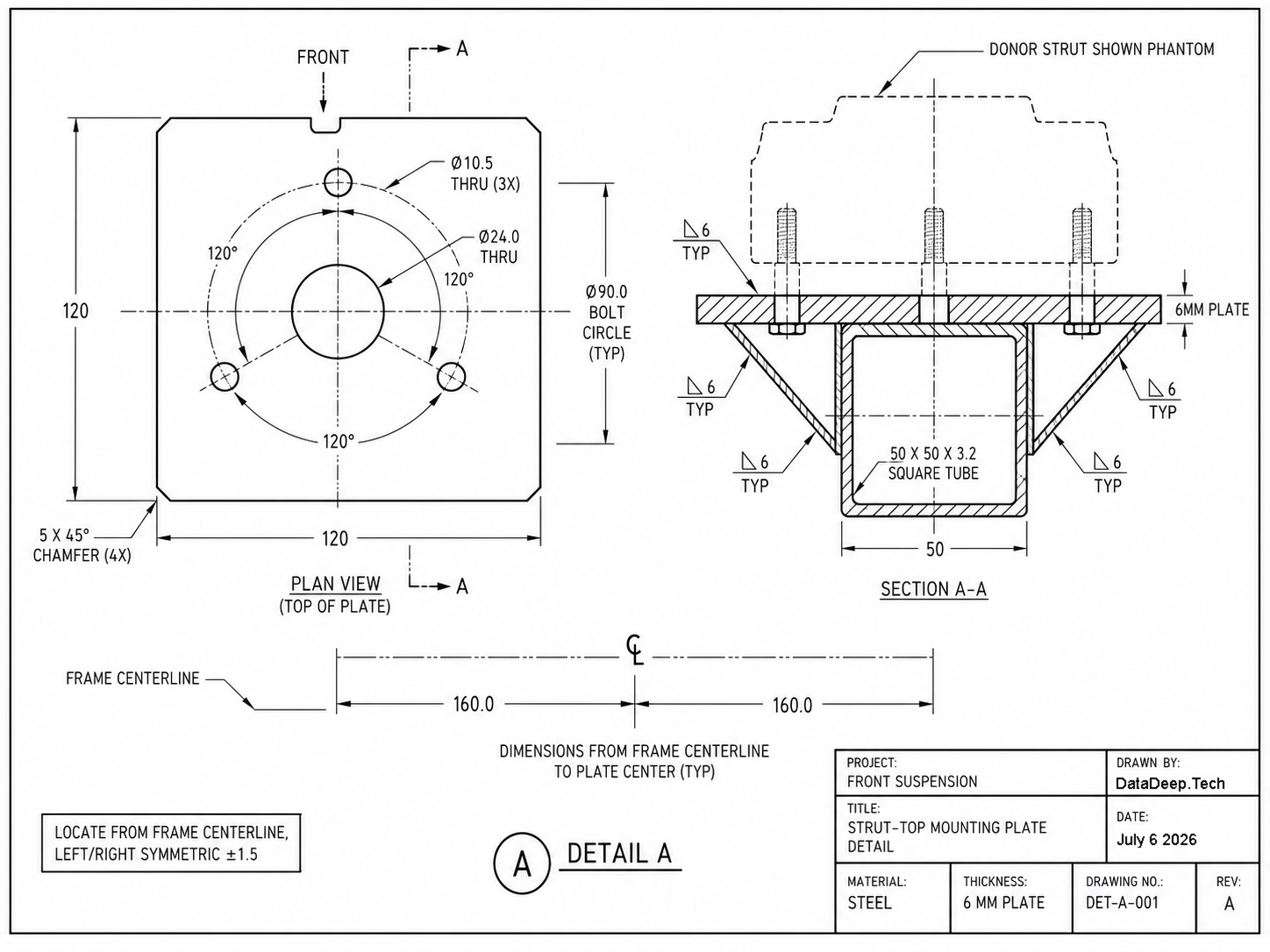
- Fabricate and weld strut-top mount plates and control-arm pivots using the recorded donor dimensions, left/right symmetric within ±1.5 mm. These are life-critical welds.
- Weld roll hoop and belt-anchorage reinforcements (§4.4).
- Go/no-go: frame square (equal diagonals), suspension points symmetric, all structural welds fully penetrated and inspected.
- Figure 10.2 (drawing): frame plan view with rail centerlines, cross-member positions, wheelbase, and diagonal-measurement points dimensioned.
- Figure 10.3 (drawing): strut-top pickup jig detail with plate thickness and bolt pattern.
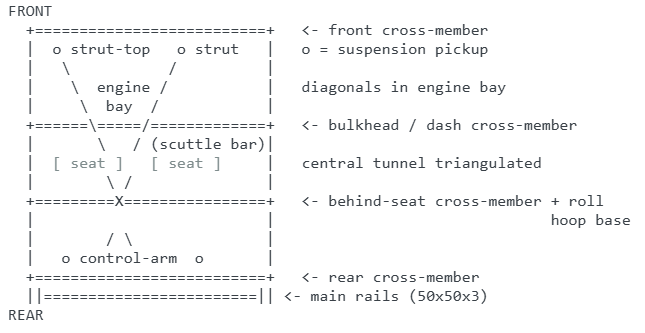
ASCII frame plan (schematic, not to scale):
Phase 3 - Suspension corners (BOM #10–12)
- Bolt the four donor strut corners and control arms to the frame using donor FSM torque values. Install the steering rack; verify tie-rod arcs match suspension travel (check for bump steer by cycling suspension).
- Go/no-go: suspension cycles full travel with no bind, no tire/frame contact; rack centered when wheels straight.
Phase 4 - Powertrain (BOM #1–5)
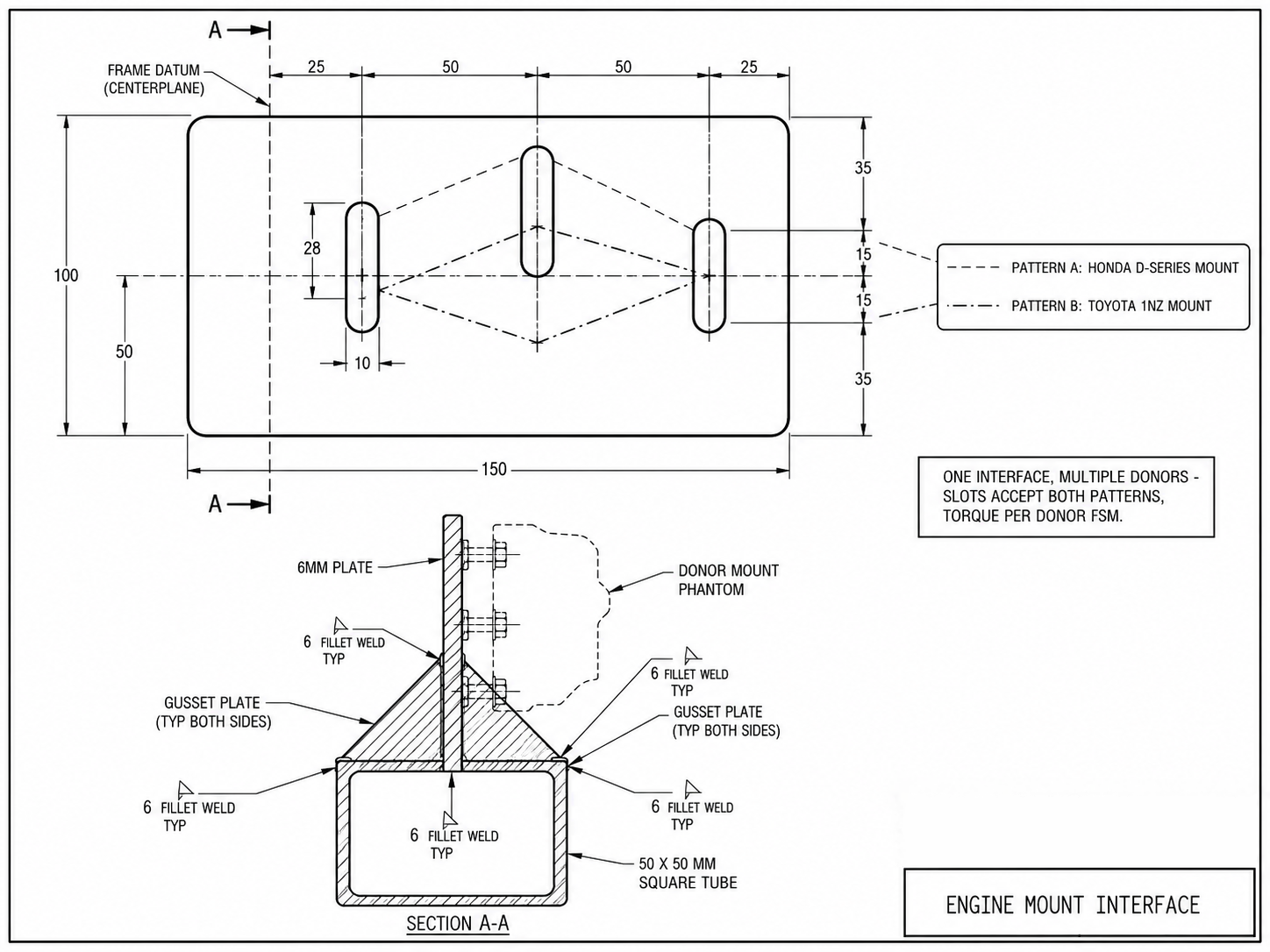
- Fabricate three engine-mount interfaces on the frame matching the donor mount faces (this is the key "standardized mounting interface" that enables engine swaps). Set the power pack on the mounts.
- Install CV axles; confirm plunge and angle at full droop and compression.
- Go/no-go: axles seated, no bind at travel extremes; power pack solidly mounted on three points.
- Figure 10.4 (drawing): engine-mount interface plate showing the standardized bolt pattern common to the supported donor families.
Phase 5 - Steering, brakes, fuel, cooling, exhaust (BOM #13–25)
- Connect steering column to rack via DOT U-joint(s); double-nut/safety-wire every joint.
- Mount pedal box/master cylinder; run 3/16" DOT steel line with double flares to all corners; install rotors/drums, pads/shoes, calipers.
- Mount fuel tank low and protected; run injection-rated hose; ground the tank.
- Mount radiator and fan; route hoses; fill and check.
- Build exhaust from the manifold back; include a muffler; isolate from body with hangers.
- Go/no-go: firm brake pedal after bleed; no fuel/coolant leaks; steering has no free play.
Phase 6 - Electrical (BOM #26–31)
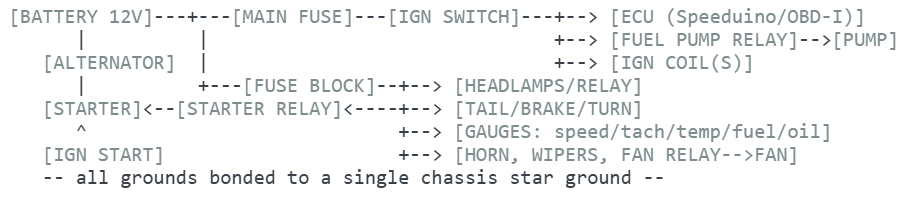
- Mount battery (secured, vented). Wire the 12 V system: charging (alternator → battery), starting (key → starter relay), ignition/EFI (ECU, coil(s), injectors, sensors, fuel pump relay), lighting, gauges. Use a fuse block and relays; label every circuit.
- If reusing the donor OBD-I ECU, retain its harness intact. If using Speeduino, wire per its documentation and the donor sensor set.
- Go/no-go: all lights and gauges function; ECU powers up; fuel pump primes; no shorts (fused bench test first).
- Figure 10.5 (schematic): 12 V wiring block diagram (below).
ASCII 12 V wiring block diagram:
Phase 7 - Body and glazing (BOM #32–34)
- Flat-wrap aluminum or steel body panels over the frame (simple single-curvature bends; rivet or weld). Fit the laminated DOT windshield and side/rear glass.
- Go/no-go: panels secure, no sharp edges, glazing sealed, wiper sweep adequate.
Phase 8 - Final assembly (BOM #35–41)
- Install seats (bolted to frame tube, not sheet) and FMVSS-marked belts to the reinforced anchorages. Mount lamps at legal heights. Paint. Fit mirrors, horn, wipers.
- Go/no-go: belts anchored to spec; all equipment DOT-legal and functional; ready for §11 testing.
11. Testing, Calibration & Validation
Pre-first-start checks: fluids correct; belt anchorage bolts torqued; all suspension/hub bolts torqued to donor FSM spec and paint-marked; fuel system leak-checked; battery secure; fire extinguisher present.
Brakes: bleed all corners; pedal must be firm and hold under steady pressure for 60 seconds with no sink. Roll test at walking pace and confirm straight, even stop. No firm pedal = do not drive.
Steering/suspension: verify no free play, no bind through full lock; recheck all fasteners.
Alignment (string method): set toe with string boxes parallel to the car's centerline and a tape measure; target donor toe spec (typically slight toe-in front). Set camber with a level/plumb and angle gauge to donor spec. Caster is fixed by strut geometry.
Leak checks: run engine to temperature; check fuel, coolant, oil, and exhaust joints.
First-start: prime fuel, verify oil pressure immediately, watch temperature; if using Speeduino, confirm timing with a light and do initial fuel/ignition tuning at idle before any driving.
Low-speed shakedown: empty lot; brake, accelerate, and steer at low speed; recheck every fastener and for leaks afterward; retorque suspension after the first ~50 km.
State inspection prep: assemble receipts/bills of sale, confirm all DOT equipment present and marked, mechanical parking brake functional (required in Michigan and prudent everywhere), and book VIN/safety/emissions inspections per §9.
12. Operation
Correct use: a light, simple, repairable runabout for secondary roads, rural/off-grid transport, and short commutes.
Do: wear the belt always; warm the engine; check fluids and tire pressures weekly; retorque suspension periodically early in the vehicle's life; keep speeds moderate.
Don't: treat it as a modern safety cage (it does not meet modern safety standards); don't commute on high-speed interstates among heavy traffic; don't exceed the ~200kg / 440lb payload; don't ignore any new noise or wander.
Operating envelope: capable of highway speeds mechanically, but crash protection, aerodynamics, and stability are those of a light homebuilt. No airbags, no ABS, no ESC. Braking and handling depend entirely on your fabrication quality. Drive accordingly.
13. Maintenance
| Interval | Task | Consumable/wear part | Est. cost |
|---|---|---|---|
| Weekly | Check oil, coolant, tire pressure, lights | — | $0 |
| First 50 km, then 5,000 km | Retorque suspension/hub/belt bolts | — | $0 |
| 5,000–8,000 km | Engine oil + filter | Oil, filter | $30 |
| 20,000 km | Air/fuel filter, inspect brakes | Filters, pads | $60 |
| 40,000 km (or donor spec) | Timing belt (belt-driven donors like D16), coolant | Timing belt kit, coolant | $120 |
| 60,000 km | Brake fluid flush, spark plugs | Fluid, plugs | $50 |
| As needed | Struts, control-arm bushings, CV axles | Junkyard/new | $20–120 ea |
| Annual | Frame/weld inspection for cracks, corrosion touch-up | Paint | $20 |
Note: chain-driven donors (Toyota 1NZ-FE/1ZZ-FE) avoid the timing-belt interval; belt-driven Honda D-series need periodic belt replacement, a factor when choosing a donor. Also note the 1ZZ-FE's well-documented oil-consumption tendency on early examples; check and top up oil accordingly [6] [7].
14. Troubleshooting
| Symptom | Likely cause | Fix |
|---|---|---|
| No-start, no crank | Dead battery, bad starter relay, ground fault | Check battery/grounds; test relay; check starter (#28) |
| No-start, cranks | No fuel (pump/relay), no spark (ECU/coil), no injection | Confirm pump primes; check ECU power, coil, injector pulse |
| Overheating | Air in coolant, fan not running, low coolant, blocked radiator | Bleed system; test fan/relay; check radiator (#22) |
| Brake pull | Uneven pads, sticking caliper, air in one line | Rebuild/replace caliper; bleed; compare pad wear |
| Wander / poor tracking | Toe/camber off, loose tie-rod, worn bushing | Recheck alignment (§11); inspect steering/suspension joints |
| Charging fault | Alternator, belt, wiring | Test alternator output (#27); check belt and grounds |
| Fuel delivery erratic | Weak pump, clogged filter, bad injector | Test pump pressure; replace filter; clean/replace injectors |
| Vibration | Engine mount, CV axle, wheel balance | Inspect mounts (#11 interface); check axles; balance wheels |
15. Variations, Scaling & Customization
Cheaper minimal version. Single donor for everything; skip finished body panels beyond weatherproofing (aluminum flat wrap + fabric or minimal doors); reuse the donor ECU/harness entirely. This is the ~$4,100 path.
Upgraded version. Fresh separately-sourced engine, Speeduino ECU for full tunability, new brakes and belts all around, better body finish, sodium-ion battery.
Diesel swap (biodiesel capability) - footnote. For off-grid fuel independence, a small IDI or early direct-injection diesel is attractive because it can run biodiesel and, crucially, can be made electronically simple. The VW 1.9 TDI (ALH/1Z) can be converted to a mechanical injection pump ("mTDI") that needs only a fuel line, a throttle cable, and a fuel-cutoff wire, deleting the ECU and immobilizer entirely, which is an expression of the anti-complexity ethos. New bolt-on mechanical pumps for the ALH/1Z engines are sold in the ~$570–850 range (e.g., Hans Auto Parts, injection-pump.com); professionally built hybrid pumps run higher (~$800–1,400). Older VW 1.9 SDI/AAZ and industrial Kubota-style diesels are even simpler (mechanical from the factory). A mechanically-injected VW 1.9 is roughly a ~230 lb (~104 kg) shippable long-block per builders' freight weights; heavier than the gas donors but manageable.
Trade-offs: diesel donors are pricier and harder to find (running TDI cores still fetch $2,000–3,000), swaps need more fabrication, and biodiesel/road-tax rules vary. This is a variation, not the standard build [8] [9] [10] [11].
Sodium-ion battery (forward-looking). As 12 V sodium-ion automotive batteries reach the market, they promise better cold-cranking and cycle life than lead-acid without lithium's fire risk or cost. Treat as an upgrade/variation once affordably available; the standard build uses cheap lead-acid.
 John D
Pickup/ute rear module. Because the rear is a bolt-in/weld-in module, a flatbed or small pickup bed can replace the passenger rear, turning the FOSCC into a light utility vehicle. Keep payload within suspension limits.
Regional adaptations. Choose the most common donor in your region for parts availability (Civic/Corolla in North America; different elsewhere). Verify local registration/emissions before committing to an engine year.
16. Cost Analysis
| Metric | FOSCC (cheapest) | FOSCC (upgraded) | Used compact (unknown history) | New compact |
|---|---|---|---|---|
| Purchase/build cost | ~$4,100 | ~$8,700 | ~$5,000–8,000 | ~$22,150+ (cheapest new car; compact sedans ~$23,500+) |
| Repairability | Total (you built it) | Total | Modern-complex | Modern-complex |
| Provenance | Fully known | Fully known | Unknown | New |
| Crash safety | Vintage-equivalent | Vintage-equivalent | Modern | Modern |
| Build time | 400–700 h | 400–700 h | 0 | 0 |
Interpretation. On dollars alone, a used compact is competitive with the cheapest FOSCC and requires no labor. The FOSCC does not win on pure price against a used car; it wins on repairability, provenance, independence, and the fact that you can maintain it indefinitely with junkyard parts and no dealer tooling or immobilizer headaches. Against a new car (nothing available under $20,000 as of 2026) it is dramatically cheaper. Valuing build labor at even $15/hour makes the FOSCC an economic loss versus a used car; the payoff is non-monetary (skills, autonomy, repairability) plus very low cost-per-mile thereafter (fuel + cheap parts, no financing, minimal depreciation on a vehicle already built from salvage). At ~40 mpg and cheap salvage parts, running cost is dominated by fuel; a builder who reuses one donor for most parts can keep marginal per-mile cost well below that of financing and depreciating a new car.
Build time: 400–700 hours, typically 5–9 months of steady weekend work for a skilled builder; longer for a first-timer.
17. References, Prior Art & Attribution
Prior art and inspiration:
- Ron Champion, Build Your Own Sports Car for as Little as £250 (Haynes) and the Locost / Haynes Roadster community (LocostUSA, locostbuilders) - the closest prior art for donor-parts-on-a-DIY-steel-frame; source of the space-frame tube conventions (25×25 mm/1×1 in tube), the McSorley 442 revised plans, the "Aussie mods," and community torsional-stiffness discussion (~2,500–5,000 ft·lbf/deg, the 10× roll-stiffness rule). North American Locost builders commonly use Toyota Corolla and Mazda Miata donors.
- Open Source Ecology (OSE) Open Source Car concept; OScar project (open-source car, 1999–, long in concept stage); Local Motors Rally Fighter (co-created, CC BY-NC-SA); WikiSpeed (Joe Justice, lean/agile modular vehicle); OSVehicle Tabby / Tabby EVO → Open Motors (modular open platform, CC BY-SA 4.0, chassis assembly claimed in under an hour). These informed the modularity and open-license approach [12].
- Open-source engine management: Speeduino (Arduino-based, open hardware/firmware, 1,000+ documented installs), rusEFI (STM32-based, GPLv3, open), MegaSquirt/MicroSquirt (older, partially open). These enable running a salvaged engine without a locked OEM ECU/immobilizer [13]
- Factory Five, GT40 replicas, and the broader kit-car community - registration precedents under state SPCNS/assembled-vehicle processes.
- mTDI mechanical-diesel conversion community (vwdiesel.net, TDIClub) - the biodiesel/mechanical-pump variation.
Standards to consult: FMVSS 108 (lamps/reflective devices), 205 (glazing), 206 (door retention), 207 (seating), 209 (belt assemblies), 210 (belt anchorages), 106 (brake hoses), 301 (fuel system integrity), 302 (interior flammability); SAE fastener grades and brake-line/flare standards; NHTSA interpretation letters on kit/used/homemade vehicles (8902, nht93-6.46/6.47); your state's specially-constructed/assembled-vehicle statutes and equipment code.
Further reading: donor-specific factory service manuals (free via owner forums); LocostUSA chassis/FEA threads; Speeduino and rusEFI wikis; state DMV assembled-vehicle manuals (e.g., TxDMV Assembled and Reconstructed Vehicle Manual, California VIRPM §7.090 / H&S §44017.4, Michigan BFS-72 and MCL 257.217i, Florida HSMV TL-41/84490).
Recommended free CAD/EDA tools: FreeCAD (3D frame/parts), LibreCAD or QCAD (2D fabrication drawings), KiCad (ECU/wiring schematics), Inkscape (diagrams/harness layouts).
 Jennifer Chu | MIT News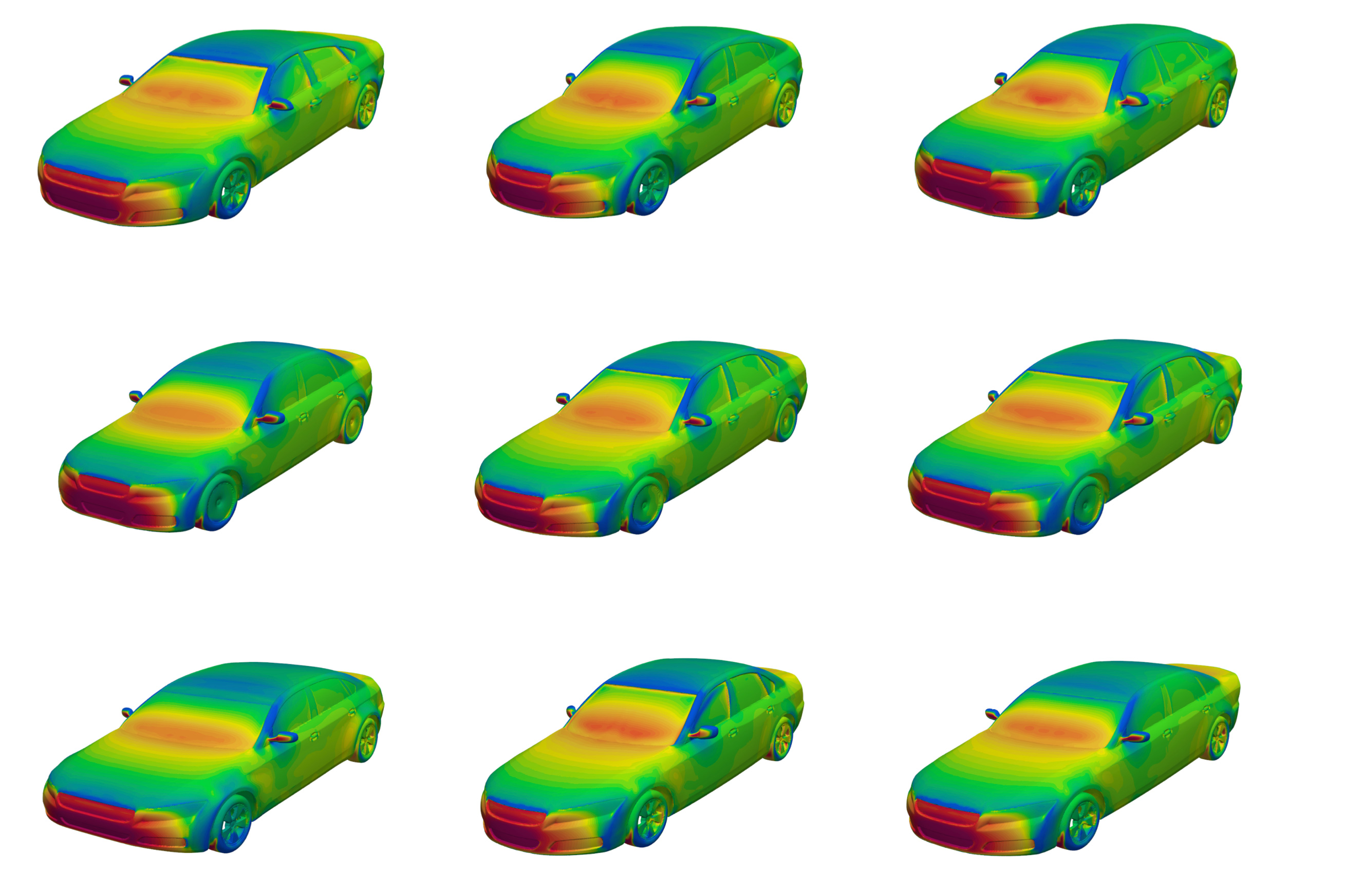
 Mohamedelrefaie
18. License & Contribution
Hardware: CERN Open Hardware Licence v2 - Strongly Reciprocal (CERN-OHL-S v2). You may study, modify, make, and distribute the design and derivatives, provided you pass on the same rights and publish your complete design sources (schematics, drawings, BOM) for any hardware you distribute.
Documentation: CC BY-SA 4.0 - share and adapt with attribution, under the same license.
How to fork/improve/share back: fork the design repository; keep the license notices; document your changes (frame revisions, alternative donors, ECU tunes, registration experiences by state) and publish them so the community benefits. Share your torsional-stiffness measurements, weld inspection results, and crash-relevant improvements especially; those raise the safety floor for everyone.
Recommendations
Stage 0 - Before you cut any steel:
- Call your state DMV/inspector first and confirm the assembled/specially-constructed pathway, required inspections, and emissions-year rule. Threshold to proceed: you have a written or documented path to a title in your state. If your state will not title an assembled vehicle built from used parts, stop - pick a different project or a friendlier state of registration.
- Pick the donor around emissions, not horsepower. If your state tests emissions by engine year, choose the oldest OBD-I engine you can legally register (Honda D-series, early Toyota). If emissions track the assembly year, plan to keep the full OEM emissions hardware (cat, EVAP, O2 sensors) - which argues for reusing the donor ECU rather than a Speeduino.
Stage 1 - Cheapest viable build: one running donor + frame steel + consumables + new brakes/belts/battery. Target ~$4,100. Reuse the donor ECU and harness intact. Prove the concept before spending on upgrades.
Stage 2 - Upgrade only where it buys repairability or safety: Speeduino (tunability + no immobilizer), new belts and brake hardware (life-safety), better body/weatherproofing. Add these only after a successful shakedown.
Stage 3 - Variations: consider the mTDI diesel only if off-grid fuel independence is a real requirement and you accept the added cost, weight, and fabrication; consider sodium-ion 12 V once it is available at a competitive price.
Benchmarks that should change your plan:
- If frame torsional stiffness (measured by the twist-and-dial-indicator method) comes in below ~1,500 ft·lbf/deg, add engine-bay and behind-seat diagonals before driving.
- If the brake pedal is not firm after two full bleeds, do not drive! Find the leak or air.
- If your state's inspection requires FMVSS-new-vehicle compliance (rare, but check), the used-parts strategy has failed for you; reassess before building.
Caveats
- Prices are estimates (2026) and vary widely by region, date, and luck at the junkyard. Self-service prices are category prices; add core charges and local tax/enviro fees. Whole-donor and diesel-core prices are the softest numbers here.
- This is a light homebuilt vehicle with vintage-equivalent crash protection: no airbags, ABS, ESC, or tested crumple zones. Do not represent it as equivalent to a modern car.
- Registration rules differ by state and change - everything in §9 must be verified with your own DMV. Assembled-vehicle titling can take months and may bar temporary registration.
- Structural welds, brakes, steering, fuel, and belt anchorages are life-critical. If you are not confident in a weld or a hydraulic joint, have it inspected. Torque every safety-critical fastener to the donor FSM value.
- Torsional-stiffness figures cited are from the amateur/Locost FEA community and forum discussion, not from a certified test of this specific design; treat the FOSCC targets as engineering goals to verify on your own frame.
- The economics favor a used car on pure dollars. Build this for repairability, independence, skills, and provenance, not to save money versus a used compact.
Community documentation provided as-is; prices are estimates; the builder is responsible for local code compliance and safe practice.

References
[1] California Legislature. (2001, October 14). Senate Bill No. 100: Specially constructed vehicles (Chapter 871). https://www.leginfo.ca.gov/pub/01-02/bill/sen/sb_0051-0100/sb_100_bill_20011014_chaptered.html
[2] Florida Department of Highway Safety and Motor Vehicles. (2023, June 26). Application for a certificate of title for a motor vehicle or motorcycle assembled with a motor vehicle kit (Procedure TL-41). https://www.flhsmv.gov/pdf/proc/tl/tl-41.pdf
[3] Florida Department of Highway Safety and Motor Vehicles. (2024, May). Statement of builder (Form HSMV 84490). https://www.flhsmv.gov/pdf/forms/84490.pdf
[4] Michigan Department of State. (2020, January). Instructions for titling an assembled vehicle (BFS-72). https://www.michigan.gov/sos/-/media/Project/Websites/sos/01lawensn/BFS72__0903_.pdf
[5] National Highway Traffic Safety Administration. (2003, July 25). Interpretation ID 22750.ztv.wpd [Letter to Todd Matsumoto regarding dune buggy kit cars]. https://www.nhtsa.gov/interpretations/22750ztvwpd
[6] MotorReviewer. (n.d.). Toyota 1NZ-FE/FXE 1.5L engine specs, problems, reliability, oil, info. https://www.motorreviewer.com/engine.php?engine_id=170
[7] Wikipedia contributors. (n.d.). Toyota ZZ engine. In Wikipedia. Retrieved July 6, 2026, from https://en.wikipedia.org/wiki/Toyota_ZZ_engine
[8] grsjax. (2008, May 13). TDI to mechanical pump conversion [Online forum discussion]. Zuwharrie BBS. https://bbs.zuwharrie.com/threads/tdi-to-mechanical-pump-conversion.82256/
[9] Hans Auto Parts. (n.d.). Rebuilt diesel injector pumps and new injection pump parts for VW/Volkswagen/Audi cars. https://www.hansautoparts.com/PUMP.aspx
[10] VW diesel swaps. (n.d.). [Online forum discussion]. Pirate 4x4. https://www.pirate4x4.com/threads/vw-diesel-swaps.776335/
[11] VW TDI diesel swap. (n.d.). [Online forum discussion]. Pirate 4x4. https://www.pirate4x4.com/threads/vw-tdi-diesel-swap.960362/
[12] Wikipedia contributors. (n.d.). Open-source car. In Wikipedia. Retrieved July 6, 2026, from https://en.wikipedia.org/wiki/Open-source_car
[13] ericjon262. (2021, April 30). rusEFI? [Online forum discussion]. Real Fiero Tech. https://realfierotech.com/viewtopic.php?t=21818
Additional Resources: