
China's Commercial Space Industry Across LEO, GEO, and Cislunar: Guowang, Qianfan, Reusable Launch, and State-Directed Market Structure
China has filed for nearly 200,000 satellites. Two megaconstellations, zero proven reusable rockets, and a market that isn't quite commercial.

1. Summary
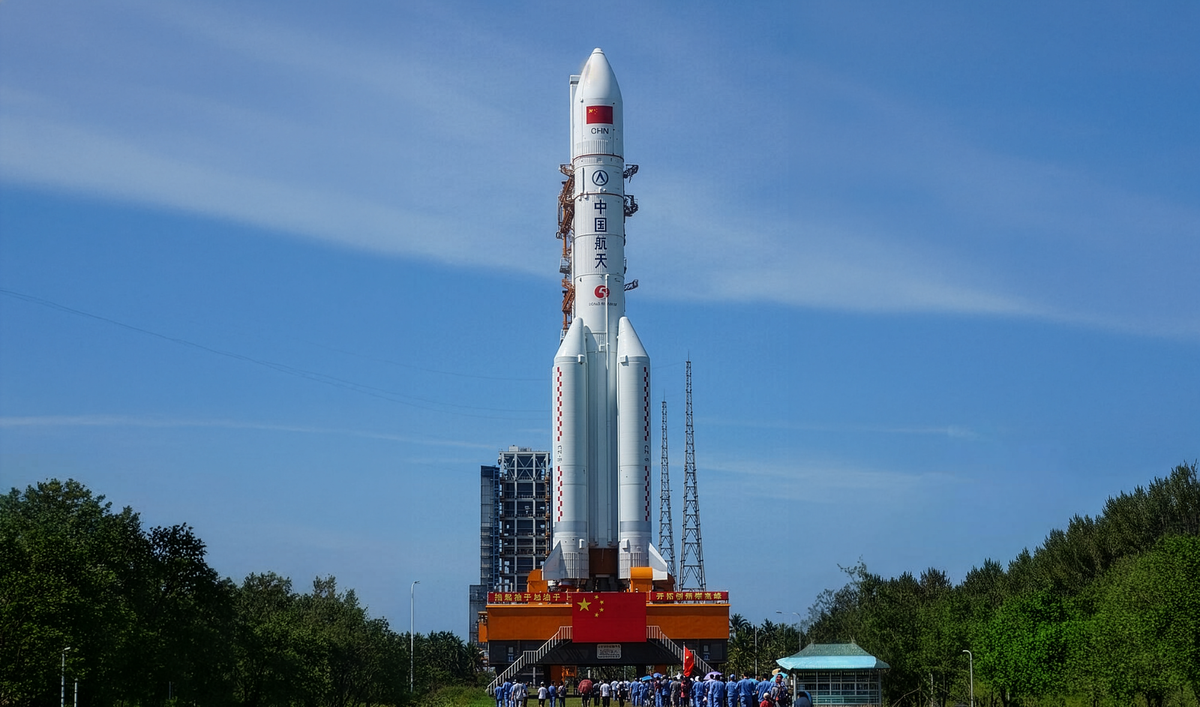
China's commercial space sector has, in roughly a decade, evolved from a policy abstraction into the world's second-largest concentration of private and quasi-private space capital and on-orbit assets, yet it remains a state-guided instrument whose "commercial" character is partial, conditional, and analytically distinct from the Western new-space model [3][4][5]. The catalytic event was the State Council's 2014 "Document 60," which for the first time invited private capital into national civil space infrastructure, a domain previously monopolized by two state-owned primes, the China Aerospace Science and Technology Corporation (中国航天) (CASC) and the China Aerospace Science and Industry Corporation (中国航天科工集团有限公司) (CASIC) [1][3][6]
Across the three operational regimes treated in this report, the maturity gradient is steep. In low Earth orbit (LEO), China is deploying two megaconstellations, the state-owned Guowang (China Satellite Network Group, ~13,000 satellites filed with the ITU) and the Shanghai-backed Qianfan/Spacesail (~14,000–15,000 satellites planned), supported by a maturing private launch sector that in December 2025 achieved its first orbital flight of a reusable methalox vehicle, LandSpace's Zhuque-3, though the first-stage recovery failed [9][10][12]. In geostationary orbit (GEO), the sector is markedly less "commercial": China Satellite Communications Co. (SSE: 601698) operates an effective domestic monopoly built on the state DFH satellite-bus lineage, with limited international footprint [21][22]. In cislunar space, activity is essentially entirely state-led; no genuine Chinese commercial cislunar logistics, relay, or resource-utilization sector yet exists, in contrast to the U.S. and Japanese commercial lunar markets [24][25].
The principal uncertainties are three. First, the gap between filed/announced constellation totals and demonstrated deployment remains very large: by late December 2025 Guowang had reached 136 satellites in orbit and Qianfan 108, against five-figure targets, even as ITU bring-into-use milestones loom [16][18][19]. Second, cadence and cost claims are heavily company-originated and weakly corroborated; reusable-launch reliability remains unproven, with multiple 2024 2026 failures [12][14][15]. Third, the financial architecture is anomalous: loss-making firms are being funded at billion-yuan valuations through state guidance funds and a deliberately liberalized STAR Market listing channel, an industrial-policy mechanism rather than a market discovery one [29][30][31].
The strategic implication is that China is constructing a vertically integrated, state-underwritten space industrial base whose commercial veneer serves dual purposes: attracting private and provincial capital and talent, and providing plausible commercial framing for capabilities with clear military-civil fusion and counterspace relevance [7][8][37]. For investors, incumbents, and policy analysts alike, the central analytical task is to disaggregate true commercial dynamism from state-directed capacity-building, because the two carry very different risk, return, and security profiles.

The Chinese Commercial Space Industry Across LEO, GEO, and Cislunar Space: Capabilities, Market Structure, and Strategic Trajectory
1. Summary
2. Contextual and Historical Background
- 2.1 The Pre-Commercial Baseline and the 2014 Policy Opening
- 2.2 Military-Civil Fusion and State Industrial Planning
- 2.3 The Analytical Significance of “Commercial”
3. Key Players and Stakeholders
- 3.1 The State-Owned Primes and Their Commercial Spin-offs
- 3.2 Private Launch Firms
- 3.3 Satellite Manufacturers and Operators
- 3.4 Financiers
- 3.5 Government and Regulatory Bodies
4. Technical and Operational Considerations Across LEO, GEO, and Cislunar
-
4.1 The Launch Segment
- 4.1.1 LandSpace
- 4.1.2 Space Pioneer
- 4.1.3 Galactic Energy, CAS Space, Orienspace, and iSpace
- 4.1.4 Reusability, Cadence, and Cost
-
4.2 The LEO Constellation Segment
- 4.2.1 Guowang
- 4.2.2 Qianfan / Spacesail
- 4.2.3 Other Operators and Manufacturing Throughput
- 4.3 The GEO Segment
- 4.4 The Cislunar Segment
5. Economic and Market Dynamics
- 5.1 Market Sizing
- 5.2 Funding Flows and the State's Role
- 5.3 IPOs and the STAR Market as Industrial Policy
- 5.4 Cost Structures, Demand Drivers, and Overcapacity Risk
6. Regulatory and Institutional Landscape
- 6.1 Licensing and Launch Authorization
- 6.2 Spectrum and Orbital Filings
- 6.3 Export and Dual-Use Controls
7. Geopolitical and Strategic Dimensions
- 7.1 Competition with U.S. and Allied Programs
- 7.2 ITU Spectrum and Orbital-Slot Contestation
- 7.3 Counterspace and Dual-Use Implications
- 7.4 Supply-Chain and Component Dependencies
- 7.5 Cislunar Strategic Competition
8. Strategic Recommendations
- 8.1 For Institutional Investors and Venture Capitalists
- 8.2 For Defense and Policy Analysts and Corporate Strategists at Incumbent Primes
Caveats
2. Contextual and Historical Background
2.1 The Pre-Commercial Baseline and the 2014 Policy Opening
For most of the space age China's space activity was the exclusive province of monolithic state enterprises. Launch vehicles and satellites originated from CASC and CASIC, the two conglomerates created when the China Aerospace Corporation was split in two, with CASC serving as the primary entity for launch and space technologies [6]. There was, in the words of multiple analysts, no room for private players, because launch was treated as a defense technology, as it is in most states [3].
This changed in November 2014, when the State Council issued Guiding Opinions on Innovating the Investment and Financing Mechanisms in Key Areas and Encouraging Social Investment, universally referenced as "Document 60" [1][3][6]. Section 7.24 explicitly called for private capital to develop, launch, and operate commercial remote-sensing satellites and provide commercial launch services [6]. Analysts describe this as a "watershed moment" that provided the legal and political legitimacy for commercial ventures, even though the regulatory framework remained, in one description, "vague and poorly adapted" until new regulations arrived in 2019 [3]. The opening was deliberately framed by Xi Jinping's leadership as an emulation of the American model, drawing on a talent pool beyond state-funded organizations, and as a means to attract customers wary of working directly with the Chinese government [4].
Document 60 was followed by a dense lattice of supporting policy: the 2015–2025 Medium- and Long-Term Development Plan for National Civil Space Infrastructure, "Made in China 2025," the Belt and Road Space Information Corridor guidance, and successive Five-Year Plans, with the 14th Five-Year Plan (2021–2025) and its 2035 long-range objectives elevating commercial space to a national priority [2][6]. The year 2015 is often referenced as the inaugural year of China's commercial space industry [2].
2.2 Military-Civil Fusion and State Industrial Planning
The commercial sector cannot be understood outside the doctrine of military-civil fusion (junmin ronghe, 军⺠融合 ), elevated to a national strategy under Xi Jinping. The USCC's 2020 and 2025 reporting documents how military-civil fusion ensures that commercial advances flow into national-security applications, and how the commercial space sector is embedded within the broader objectives of the People's Liberation Army (PLA) [7][8]. Talent, technology, and capital move between the state primes and the nominally private firms: most leading private launch founders are alumni of CASC institutes, and State-Owned Enterprises (SOEs) are simultaneously investors in, customers of, and regulatory gatekeepers for private firms [3][7][8].
Industrial planning operates through "guidance planning": the National Development and Reform Commission (NDRC) drafts sectoral plans and the State Council enforces them through ministries, with the Ministry of Industry and Information Technology (MIIT) coordinating since 2008 and SASTIND administering the defense-industrial dimension [6]. In November 2025 the China National Space Administration (CNSA) published an "Action Plan for Promoting the High-Quality and Safe Development of Commercial Space (2025–2027)," a 22-measure blueprint that explicitly seeks to establish commercial space as a pillar of national space architecture rather than an auxiliary, and that names space resource development, on-orbit servicing, space manufacturing, space tourism, and debris removal as new business frontiers [28].
2.3 The Analytical Significance of "Commercial"
A recurring theme in rigorous Western analysis is that the term "commercial" in the Chinese context is a category that bundles genuinely private startups with state spin-offs and SOE subsidiaries. The 2019 IDA evaluation classified Chinese commercial firms into four ownership categories: SOE subsidiaries that sell to government (e.g., Expace); spin-offs from the Chinese Academy of Sciences or other government bodies (e.g., Chang Guang Satellite Technology); startups with no known government funds (e.g., LandSpace, primarily venture-funded); and spin-offs from private companies [6]. Chinese commercial space companies, in the framing of one analyst, "exist because the state decided to create a controlled, complementary commercial sector to serve its broader strategic objectives" [3]. This distinction is the central interpretive key for the remainder of this report.
3. Key Players and Stakeholders
3.1 The State-Owned Primes and Their Commercial Spin-offs
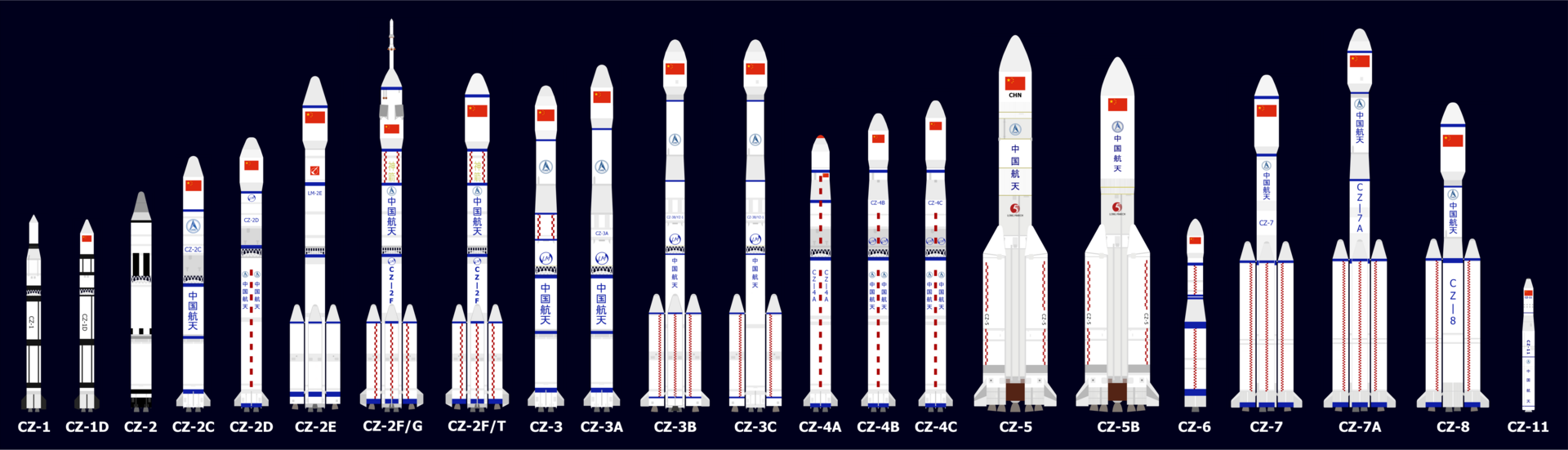
CASC and CASIC remain the gravitational center of the sector, often described as the "national team." CASC develops the Long March family through subsidiaries such as the China Academy of Launch Vehicle Technology (CALT) and the Shanghai Academy of Spaceflight Technology (SAST), and builds satellites through the China Academy of Space Technology (CAST) [5][7]. CASIC operates parallel capabilities. Both leverage commercial activity for spin-on benefits to ballistic-missile and broader defense programs [7][8].
The most analytically important "commercial" entities are SOE spin-offs that retain state ownership while adopting commercial branding. Expace (Wuhan), maker of the Kuaizhou solid rockets, is roughly 70% owned through China Aerospace Sanjiang Group, a wholly owned CASIC subsidiary; its managers openly acknowledge that its capital is essentially public funds, which they do not see as contradicting the "commercial" label [33]. China Rocket (Chinarocket), maker of the Jielong/Smart Dragon solid rockets, is a CALT spin-off [32][33]. CAS Space (Zhongke Aerospace), maker of the Lijian/Kinetica vehicles, was established by the Chinese Academy of Sciences [17][35]. The China Great Wall Industry Corporation (CGWIC) remains the sole authorized commercial provider for international launch services and a facilitator for foreign customers [26].
3.2 Private Launch Firms
The private launch cohort, sometimes called the "Five Little Dragons," comprises LandSpace, Galactic Energy, iSpace (Beijing Interstellar Glory), Space Pioneer (Beijing Tianbing), and CAS Space, with Orienspace and Deep Blue Aerospace as further entrants [37] [38]. These are treated in detail in Section 4. CASC's investment arm, China Aerospace Investment Holdings, funds startups that advance strategic objectives, illustrating the porous boundary between state and private [8].
3.3 Satellite Manufacturers and Operators
Principal players include GalaxySpace (Beijing-headquartered, China's first commercial-space unicorn, with a Nantong "super-factory"), Chang Guang Satellite Technology (the Jilin-1 remote sensing constellation operator, a CAS/Jilin-province spin-off), MinoSpace/Microsat, Spacety, Genesat (the Qianfan manufacturer, a CAS Innovation Academy for Microsatellites and Spacesail joint venture), and Geespace (the Geely automotive group's GeeSAT/Future Navigation constellation) [20][23][40][41]. State manufacturing is anchored by CAST and IAMCAS [19][20].
3.4 Financiers
Capital flows from four overlapping channels: national state guidance funds such as the National Manufacturing Transformation and Upgrading Fund; provincial and municipal governments and their industrial parks; domestic venture capital (Sequoia China, Hillhouse, IDG, Source Code, Matrix Partners China, Shunwei, 5Y Capital); and, historically, some foreign capital [4][8] [31]. Provincial governments are a defining feature: LandSpace received an early RMB 200 million ($30 million) and free land from the city of Huzhou [5].
3.5 Government and Regulatory Bodies
The CNSA (the public face), SASTIND (defense-industrial administration, licensing, registration), MIIT (spectrum and orbital-slot management), the NDRC (macro-planning), the China Securities Regulatory Commission (CSRC) and Shanghai Stock Exchange (capital-market access), and the PLA (end-user and counterspace stakeholder) together constitute the institutional architecture, detailed in Section 6 [6][26][27][30].
4. Technical and Operational Considerations Across LEO, GEO, and Cislunar
4.1 The Launch Segment
4.1.1 LandSpace
LandSpace, founded in 2015 by Zhang Changwu, is the technological frontrunner. Its Zhuque-2 became the world's first methalox rocket to reach orbit on its second flight in July 2023, beating SpaceX and Blue Origin to that specific milestone [11]. Its Zhuque-3, a stainless-steel methalox two-stage vehicle powered by nine Tianque-12A engines, conducted its maiden flight on December 3, 2025, from a LandSpace pad at the Dongfeng Commercial Space Innovation Test Zone within the Jiuquan Satellite Launch Center; per SpaceNews, the vehicle lifted off around 11:02 p.m. Eastern on December 2, successfully placed its expendable second stage in orbit, but lost the first stage during a landing attempt around 390 kilometers downrange in Minqin county, Gansu province, where Xinhua reported "an abnormal combustion" occurred [10][11]. The operational Zhuque-3E is to lift 21,300 kg to LEO expendable, 18,300 kg with downrange recovery, and 12,500 kg with return-to-launch-site recovery; LandSpace targets up to 20 reuses per booster [11]. As SpaceNews noted, the December 2025 flight was China's first attempt at recovery of a stage from an orbital launch, a milestone even in failure [10].
4.1.2 Space Pioneer
Space Pioneer (Beijing Tianbing), founded in 2019 by Kang Yonglai (former LandSpace CTO), reached orbit with the kerolox Tianlong-2 in April 2023 [14]. Its Falcon-9-class Tianlong-3 suffered a notorious accident on June 30, 2024, when a first stage detached from its stand during a static-fire test, lifted off uncontrolled, and crashed and exploded in the mountains near Gongyi, a city of about 800,000 people [13][14]. After more than 120 corrective measures, Tianlong-3 attempted its maiden orbital flight on April 3, 2026, which failed during ascent [15].
4.1.3 Galactic Energy, CAS Space, Orienspace, and iSpace
Galactic Energy operates the Ceres-1 solid rocket (a strong success record of 16 successes in 17 attempts) and is developing the kerolox, eventually reusable Pallas-1 powered by CQ-50 engines [17][39]. CAS Space flies the Lijian-1/Kinetica-1 solid rocket and debuted the Kinetica-2 (Lijian-2) liquid vehicle [17][35]. Orienspace flies the Gravity-1 (Yinli-1), the world's most powerful solid launch vehicle at debut (6,500 kg to LEO), and is developing the reusable Gravity-2 [36]. iSpace made history in 2019 as the first privately funded Chinese firm to reach orbit (Hyperbola-1) but has suffered repeated failures since; it is developing the kerolox, reusable Hyperbola-3 [14][38].
4.1.4 Reusability, Cadence, and Cost
The decisive technical shift is reusability. Both LandSpace's Zhuque-3 and CASC's reusable Long March 12A attempted (and failed) booster recovery in December 2025 [10][38][51]. Cost claims are company-originated: CAS Space stated Kinetica-2 launched at approximately RMB 30,000/kg ($4,350/kg), with reuse potentially halving that, while its solid Lijian-1 ran about RMB 50,000/kg ($6,900/kg); LandSpace targets RMB 20,000/kg (~$2,800/kg) for Zhuque-3 [34][35]. State Long March vehicles cost RMB 70,900/kg for GTO (Long March 3B/E) and RMB 28,200/kg for LEO (Long March 2D), per a LandSpace analyst's study of public contract data published in Aerospace China [34]. These figures should be treated as estimates; cost-per-kilogram is a misleading metric because Chinese launch contracts are bundled with insurance and commissioning [34].
China conducted 93 orbital launches in 2025, a national record, of which the commercial sector completed 50 (54% of the total) and private companies conducted 16 (14 successful), per CNSA data released in January 2026; the 2026 target is approximately 140 [38][51][52]
4.2 The LEO Constellation Segment
4.2.1 Guowang
Guowang ("national network"), operated by China Satellite Network Group (China SatNet), established April 2021, is based on a September 2020 International Telecom Union (ITU) filing for 12,992 satellites [16]. Per SpaceNews, there were 136 satellites in orbit for the planned 13,000-satellite Guowang constellation by late December 2025, deployed in batches of roughly 8–10 on Long March 5B, 6A, 8A, and 12 vehicles, with a near-term target of 400 satellites by 2027 [16][18]. CAST built large and small satellite platforms; the secretive nature of the payloads has prompted comparison to the U.S. Starshield program, with suspected dual-use functions in positioning, imaging, and signals intelligence [16][18]. Guowang must deploy 10% of its constellation by 2029 and 50% by 2032 under ITU rules [41].
4.2.2 Qianfan / Spacesail
Qianfan ("Thousand Sails," formerly G60 Starlink), operated by Shanghai Spacecom Satellite Technology (SSST/Spacesail), backed by the Shanghai municipal government and the Chinese Academy of Sciences, plans over 14,000–15,000 satellites [16][18][42]. It raised RMB 6.7 billion (~$943 million) in Series A funding in February 2024 [42][43]. As of April 2026, 504 satellites had been launched, though deployment lagged plans after a six-month suspension caused by tumbling satellites, upper-stage debris (the first Long March 6A launch generated a cloud suspected to exceed 700 trackable pieces; U.S. Space Command initially reported over 300 pieces), and astronomy interference [16][18][43]. Spacesail's three largest shareholders are Alliance Investment (49.9%), Information Investment (18.7%), and the National Manufacturing Transformation and Upgrading Fund (11.9%) [44]. It reported 2024 revenue of RMB 49,000 against a net loss of RMB 4.9 billion, and a 2025 net loss of about RMB 4 billion on essentially no revenue [44]. It has secured Brazilian regulatory approval (Anatel) through July 2031 and conducted maritime connectivity tests with China Mobile Hong Kong [44].
4.2.3 Other Operators and Manufacturing Throughput
GalaxySpace, China's first commercial-space unicorn (RMB 8 billion valuation at its November 2020 round), operates the Mini-Spider test constellation and a Nantong smart factory producing, by varying claims, 100–150 medium-sized satellites per year up to a stated capacity of 300–500 [40][45]. Chang Guang's Jilin-1 is the world's largest sub-meter commercial remote-sensing constellation, with over 100 satellites in orbit [23]. Geespace (Geely) operates roughly 30 satellites toward a 6,000-satellite IoT/PNT constellation [41][46]. Reported aggregate national satellite-manufacturing capacity exceeds the launch capacity that can loft it: Shanghai alone hosts factories with a potential 970 satellites per year, Zhejiang 870, with the Shanghai Microsatellite center reportedly capable of 300 satellites per month, creating a manufacturing launch imbalance [20][41].
4.3 The GEO Segment
The GEO regime is the least "commercial" and most state-dominated. China Satellite Communications Co. (China Satcom, SSE: 601698), a subsidiary of China Telecommunications Corporation, holds an effective domestic monopoly, accounting for roughly 40% of China's satellite-communication market with a fleet exceeding 30 satellites [21][22]. Its offerings are largely domestic, serving state broadcasters, state telcos, and the PLA, with over 90% of revenue from domestic operations and under 5% international [22]. The DFH (Dongfanghong) bus lineage anchors GEO manufacturing: the mainstream DFH-4 and its DFH-4E enhancement, the high-capacity DFH-5, and the DFH-3 enhanced small platform [21]. High-throughput progress includes ChinaSat-26 (~100 Gbps, China's first such satellite) and the planned ChinaSat-27 (~300 Gbps) [21]. Hong Kong-listed operators APT Satellite (HKEX: 1045) and AsiaSat provide a more internationally oriented but smaller GEO presence; APT Mobile Satcom's APSTAR-6D, a DFH-4E-based high-throughput satellite with ~50 Gbps capacity, was launched in 2020 [21]. The contrast with LEO is instructive: GEO commercial maturity is constrained by an SOE monopoly with limited incentive to innovate until top-level policy pressure forced change [21].
4.4 The Cislunar Segment
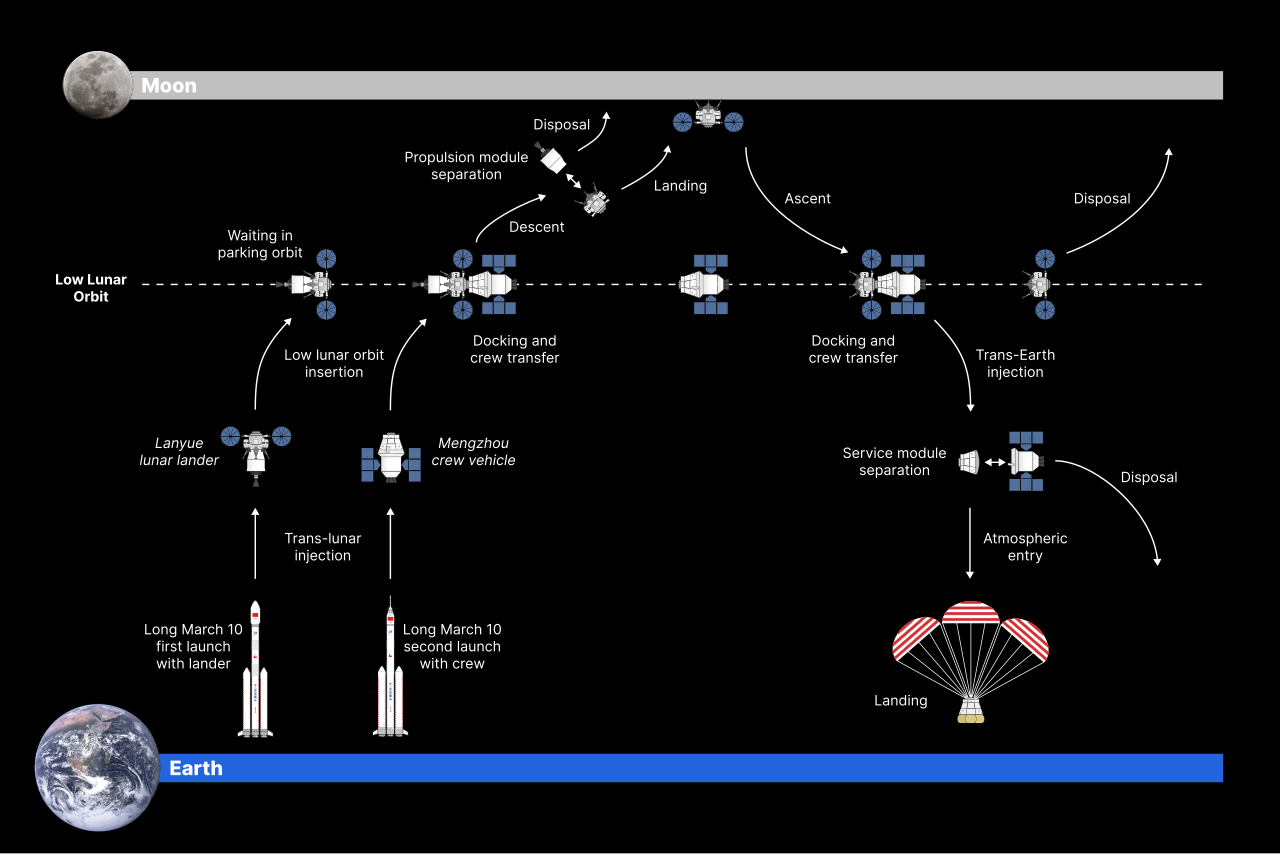
Cislunar activity is, candidly, almost entirely state-led, and any characterization of commercial activity here risks overstatement. The Queqiao relay lineage supports the Chang'e program: Queqiao-1 (2018, Earth-Moon L2 halo orbit) served Chang'e-4; Queqiao-2 (launched March 20, 2024, on a Long March 8 from Wenchang, in a frozen elliptical lunar orbit) supports Chang'e-6,-7, and -8 [24][25]. The Queqiao-2 launch carried the experimental Tiandu-1 (61 kg) and Tiandu 2 (15 kg) CubeSats, developed by the state Deep Space Exploration Laboratory (DSEL), as pathfinders for a planned three-phase Queqiao communications-navigation constellation: v1.0 (~2030), a more extensive v2.0 (proposed, ~2030–2040, satellite counts speculative), and a v3.0 deep-space architecture [24][25][47]. Chang'e-7 (2026) will target the lunar south pole for water ice; Chang'e-8 (~2028, with a CNSA reference to "around 2029") will test in-situ resource utilization; together they are precursors to the International Lunar Research Station (ILRS), whose basic model is targeted for completion around 2035 [25][47][48]. The supplier ecosystem is the state primes (CAST, SAST, DSEL, CALT). There is no Chinese analogue to the U.S. commercial lunar logistics market (Firefly, Intuitive Machines) or Japan's ispace; emerging commercial concepts in resource utilization remain on paper [48].
5. Economic and Market Dynamics
5.1 Market Sizing
Headline market-size figures are state-originated projections with opaque methodology and should be treated with caution. Chinese state media and domestic industry reports put the "commercial space market" at roughly RMB 2.3 trillion (~$314–320 billion) in 2024 and RMB 2.5 2.8 trillion (~$345–387 billion) in 2025 [31][48]. These figures are not corroborated by independent Western market-intelligence firms; some narrower measures put the "commercial space economy" closer to RMB 1 trillion (~$140 billion), illustrating definitional inconsistency [48]. The most authoritative independent China-specific datapoint is Novaspace's estimate of Chinese government space spending at over $19 billion in 2024, second globally behind the United States [48].
5.2 Funding Flows and the State's Role
The "2025 China Commercial Space Innovation Ecosystem Report" recorded 138 financing events in 2024 totaling RMB 20.239 billion (~$2.8 billion), both records; satellite operations (RMB 8.7 billion) and rocket manufacturing (RMB 6.71 billion) drew the largest sums [31]. (A separate Mergermarket M&A-specific figure of $2.17 billion across 24 deals is a different metric and should not be conflated [48].) State-backed investment is reported to have risen to 54% of total capital in 2024 from 20% in 2018, a single-source statistic traceable to "A Profile of China's Commercial Space Sector in 2025" that has not been independently verified [5][48]. Provincial competition is intense: Jiangsu and Nanjing established a RMB 5 billion (~$690 million) advanced-manufacturing fund with a commercial-space focus, and over 20 provinces issued 40 plus supporting policies [31].
5.3 IPOs and the STAR Market as Industrial Policy
The capital-market architecture is the clearest illustration of state direction. In June 2025 the CSRC reactivated the fifth set of STAR Market listing standards for frontier sectors including commercial space, allowing pre-profit firms to list; on December 26, 2025, the Shanghai Stock Exchange created an IPO "fast lane" for reusable-rocket firms, requiring as a prerequisite at least one payload inserted into orbit by a reusable medium-to-large vehicle, an explicit substitution of technical achievement for financial metrics [29][30]. LandSpace, which lost nearly RMB 3.5 billion over three and a half years and generated only RMB 36.4 million in revenue in the first half of 2025, targets an IPO valued at no less than RMB 10 billion [30]. At least 10 commercial space companies, including the five launch "Dragons," entered the IPO pipeline [29][30][37]. One investor's characterization is apt: "The state opened capital markets to provide blood transfusions for companies building infrastructure" [30].
5.4 Cost Structures, Demand Drivers, and Overcapacity Risk
The dominant demand driver is the megaconstellation buildout: Guowang and Qianfan together consumed an estimated 45 launches in 2025 and a projected 70-plus in 2026 [38]. The dominant structural risk is overcapacity: capital is arriving faster than viable projects (around 600 companies, most early-stage), satellite-manufacturing capacity far outstrips launch cadence, and a narrowing competitive track pits many firms against each other for limited domestic contracts [3][20][30]. No Chinese commercial launch firm is profitable [4][35].
6. Regulatory and Institutional Landscape
6.1 Licensing and Launch Authorization
China lacks a comprehensive national space law, governing instead through ministerial regulations of relatively low legal priority: the 2001 Registration Measures and the 2002 Interim Measures on the Administration of Permits for Civil Space Launch Projects [26][27]. SASTIND administers launch licensing and registration through the CNSA; the general project contractor (or, absent one, the spacecraft owner) must apply nine months before launch, submitting debris mitigation and safety materials, and space objects must be registered within 60 days of launch [26][27]. Newer instruments referenced in 2024–2025 include the "Interim Measures for the Management of Civilian Space Launch Project Licenses" and notices on standardizing commercial launch vehicles and microsatellites [50]. Analysts note the framework was originally designed for CASC and remains imperfectly adapted to commercial entities [6].
6.2 Spectrum and Orbital Filings
MIIT manages domestic spectrum and orbital-slot coordination and submits ITU filings. The ITU's first-come-first-served regime and milestone-based bring-into-use rules (10% within roughly two years of the deployment milestone, then 50% and 100% at later thresholds) shape the deployment race [16][41]. In late 2025 a hybrid government-industry body, the Radio Spectrum Development and Technology Innovation Institute (RSDTII), filed for two next generation NGSO constellations (CTC-1 and CTC-2) at 96,714 satellites each, alongside filings from China Mobile and Shanghai Spacecom, bringing aggregate Chinese filings toward nearly 200,000 satellites; these filings confer priority but no authorization and are subject to milestones [49].
6.3 Export and Dual-Use Controls
Chinese firms operate under a tightening Western control environment. Chang Guang Satellite Technology was sanctioned by the U.S. in December 2023 (E.O. 14024) and again in 2025–2026 for providing satellite imagery supporting Iranian and Houthi targeting of U.S. forces [37][53] [54]. U.S. Bureau of Industry and Security Entity List additions in 2025 included additional CAS institutes (the Aerospace Information Research Institute and the National Time Service Center); the U.K. sanctioned MinoSpace in February 2026 over Ukraine-related activity [37][55]. These designations complicate IPO and foreign-investment prospects (Chang Guang terminated a 2024 IPO attempt citing sanctions and losses before restarting in 2026) and reflect the dual-use reality the commercial framing is meant to obscure [37]. Conversely, China placed 28 U.S. aerospace and defense entities on its own export-control and unreliable-entity lists in January 2025 [56].
7. Geopolitical and Strategic Dimensions
7.1 Competition with U.S. and Allied Programs
The strategic frame is a bipolar LEO contest. SpaceX's Starlink reached the milestone of 10,000 satellites operating overhead in December 2025 (with public catalogs showing roughly 9,900 in orbit and about 8,270 operational in early March 2026), far ahead of Guowang and Qianfan; Amazon's Kuiper (~3,200 planned) and the EU's IRIS² (290 satellites, ~€10.6 billion, service ~2029–2030) are smaller [18][57][58]. China's strategic logic is to secure spectrum and orbital priority before Western operators saturate LEO, hence the aggressive ITU filings [49]. The U.S. retains a decisive lead in reusability (per Space.com, SpaceX marked its 600th successful orbital class booster landing on April 19, 2026, versus China's still-unproven recovery attempts) and in scale of private capital [38][59].
7.2 ITU Spectrum and Orbital-Slot Contestation
The near-200,000-satellite Chinese filing is best read as a defensive and pre-emptive claim on finite spectrum and orbital shells rather than a credible deployment plan [49]. It simultaneously raises the regulatory salience of bring-into-use compliance, debris, and coordination disputes, tools that may be turned reciprocally by both Washington and Beijing [41][49].
7.3 Counterspace and Dual-Use Implications
The USCC's 2025 report assesses that China's growing satellite numbers significantly enhance the PLA's ISR and PNT capabilities and provide counterspace options to monitor, target, deny, degrade, or destroy U.S. and allied assets [8]. The Secure World Foundation cautions, however, that public evidence does not confirm a destructive co-orbital ASAT intercept, and that on-orbit technologies may serve intelligence or servicing purposes rather than definitively counterspace ones [8]. The Kharon investigation documents how commercial firms (Chang Guang, MinoSpace, Spacety) have supplied surveillance and launch services into conflict zones (Iran, Russia), illustrating how the commercial sector functions as a deniable extension of state capability [37].
7.4 Supply-Chain and Component Dependencies
China lags in inter-satellite optical links, where it is precluded from using Western suppliers (Mynaric (acquired by Rocket Lab) and Tesat) by the technology decoupling and Made in China 2025 policy, and depends on indigenizing high-throughput components [60]. Cislunar communications dependency on mainland ground stations is a recognized vulnerability the Queqiao constellation is intended to mitigate [25].
7.5 Cislunar Strategic Competition
The ILRS is the principal vehicle for China's lunar geopolitical ambition. Per Xinhua quoting CNSA deputy director Bian Zhigang in April 2025, "a total of 17 countries and international organizations, as well as more than 50 international research institutions have joined the China initiated International Lunar Research Station," a state-originated figure that independent trackers characterize as thinner at the national level (the Secure World Foundation counted 13 countries in September 2024, and the French Institute of International Relations (IFRI) noted only one full cooperation agreement, with Egypt); CNSA has stated it aims to attract 50 countries [48]. Named members include Russia, Venezuela, Belarus, Pakistan, Azerbaijan, South Africa, Egypt, Nicaragua, Thailand, Serbia, Kazakhstan, and Senegal [48]. The ILRS competes directly with the U.S.-led Artemis Accords for international alignment, and the cislunar communications/PNT domain is increasingly contested, with the U.S. Space Force and Defense Innovation Unit also pursuing cislunar awareness and responsive access [24].
8. Strategic Recommendations
8.1 For Institutional Investors and Venture Capitalists
The central recommendation is to price the state-direction premium and discount explicitly. Chinese commercial space valuations are being set by an industrial-policy capital market, not a return-seeking one; the December 2025 STAR Market rule substituting orbital insertion for financial metrics confirms this [29][30]. Investors should: (1) treat reusable-launch timelines as high-variance, given that both leading reusable maiden flights in December 2025 and the Tianlong-3 flight in April 2026 failed recovery or ascent [10][15][38]; (2) recognize sanctions exposure as a binary risk that can terminate IPO and cross-border options overnight, as Chang Guang's experience shows [37]; (3) favor manufacturers and operators over launchers where revenue visibility is marginally better (Spacesail, despite multibillion-yuan losses, has booked international regulatory approvals), while noting all are deeply loss-making [44]; and (4) avoid extrapolating from state-originated market-size figures (RMB 2.3 trillion), instead anchoring to verifiable activity metrics such as payload capacity, launch cadence (93 in 2025) and demonstrated satellite deployment [48][52]. The benchmark that would change this guidance is a demonstrated, reflown reusable booster combined with a profitable launch or constellation operator; until then, the sector is a strategic-capacity bet, not a commercial-return bet.

8.2 For Defense and Policy Analysts and Corporate Strategists at Incumbent Primes
Analysts should treat the LEO megaconstellation buildout as dual-use infrastructure whose civilian framing is a feature, not the substance, given documented military-civil fusion, the Starshield-like opacity of Guowang payloads, and the deniable provision of services to Iran and Russia [8][16][37]. Concrete steps: (1) monitor ITU bring-into-use compliance for Guowang (10% by 2029, 50% by 2032) and Qianfan as the most objective leading indicator of whether five-figure targets are credible, distinguishing filing claims from deployment reality, given that only 136 and 108 satellites respectively were on orbit at the end of 2025 [16][18][41]; (2) track reusability milestones (first successful Chinese orbital booster recovery and reflight) as the pivot point for cost-driven cadence escalation [38][51]; (3) assess the manufacturing-launch imbalance as a near-term bottleneck that constrains deployment regardless of factory capacity [20]; and (4) recognize cislunar competition as state-versus-state, where the ILRS-versus-Artemis alignment contest, not commercial logistics, is the operative dimension [48]. For incumbent primes, the strategic implication is that Chinese cost trajectories in expendable launch are already competitive on a bundled basis (RMB 28,200/kg for Long March 2D LEO), and that the addressable third-country market for Chinese launch, imagery, and broadband (Belt and Road, Brazil, Southeast Asia, Africa) will be contested on price and sovereignty grounds, not on technology alone [34][44][46]. The threshold that would warrant strategic reappraisal is Chinese demonstration of rapid booster reuse at scale, which would compress the cost gap and accelerate constellation deployment from the current lagging pace.
Caveats
This report relies substantially on a mix of high-quality independent sources (USCC, IDA, Secure World Foundation, Novaspace, SpaceNews, IEEE Spectrum, peer-reviewed and think-tank analysis) and on state-originated or company-originated claims that cannot be independently corroborated. The latter category includes: market-size figures (RMB 2.3 trillion), which are projections with opaque methodology; the 54%/20% state-funding-share statistic, which is single-source; cost-per-kilogram and cadence claims, which are company-originated; constellation satellite totals, which reflect ITU filings and corporate ambition rather than committed deployment; and ILRS membership counts, which are state figures that independent trackers assess as thinner at the national level. Cislunar commercial activity is nascent and state dominated; this report has deliberately avoided overstating it. Several quantitative gaps remain: no authoritative public BryceTech or Novaspace figure for China's specific share of global satellites or launch was located, and 2025 funding figures are internally inconsistent across sources. Where Chinese official data, single-source estimates, or forward projections appear, they are flagged as such in the text.
References
- International Institute for Strategic Studies. 2025. “Space: China’s Commercial Space Sector.” Charting China, August.
https://www.iiss.org/charting-china/2025/08/spacechinas-commercial-space-sector/ - Space & Satellite Professionals International. 2024. “China’s Commercial Space Sector: A New Era of Growth and Opportunity.” By Roger (Fuhua) Ni.
https://www.sspi.org/chinas-commercial-space-sector-new-era-growth-and-opportunity - Lyons, Aaron, et al. 2026. “China’s Rocket Deficit.” The Wire China, March 1.
https://www.thewirechina.com/2026/03/01/chinas-rocket-deficit/ - MIT Technology Review. 2021. “China’s Surging Private Space Industry Is Out to Challenge the US.” January 21.
https://www.technologyreview.com/2021/01/21/1016513/china-private-commercial-space-industry-dominance/ - National Bureau of Asian Research. 2023. “Developments in China’s Commercial Space Sector.” Interview with Blaine Curcio.
https://www.nbr.org/publication/developments-in-chinas-commercial-space-sector/ - Institute for Defense Analyses. 2019. Evaluation of China’s Commercial Space Sector. Document D-10873.
https://www.ida.org/-/media/feature/publications/e/ev/evaluation-of-chinas-commercial-space-sector/d-10873.ashx - U.S.-China Economic and Security Review Commission. 2020. China’s Space and Counterspace Capabilities and Activities.
https://www.uscc.gov/sites/default/files/202005/China_Space_and_Counterspace_Activities.pdf - U.S.-China Economic and Security Review Commission. 2025. 2025 Annual Report, Chapter 7: The Final Frontier: China’s Ambitions to Dominate Space.
https://www.uscc.gov/sites/default/files/2025-11/Chapter_7--The_Final_Frontier_Chinas_Ambitions_to_Dominate_Space.pdf - NASASpaceFlight. 2025. “China Pushing for Reusability Milestone with Zhuque-3 Launch and Near-Landing.” December.
https://www.nasaspaceflight.com/2025/12/china-reusability-zhuque-3-launch-landing/ - Jones, Andrew. 2025. “Zhuque-3 Reaches Orbit on Test Flight, First Stage Lost During Landing Attempt.” SpaceNews, December 3.
https://spacenews.com/zhuque-3-reaches-orbit-on-test-flight-first-stage-lost-during-landing-attempt/ - Wikipedia. 2025. “Zhuque-3” and “LandSpace.”
https://en.wikipedia.org/wiki/Zhuque-3 - Space.com. 2025. “China’s 1st Reusable Rocket Explodes in Dramatic Fireball During Landing After Reaching Orbit on Debut Flight.” December.
https://www.space.com/space-exploration/launches-spacecraft/chinas-1st-reusable-rocket-explodes-in-dramatic-fireball-during-landing-after-reaching-orbit-on-debut-flight - Space.com. 2024. “Not-So-Static Fire: Private Chinese Rocket Accidentally Launches During Test.”
https://www.space.com/space-pioneer-tianlong-3-rocket-accidental-launch - Wikipedia. 2024. “Tianlong-3” and “Space Pioneer.”
https://en.wikipedia.org/wiki/Tianlong-3 - China-in-Space (Jack C.). 2026. “Space Pioneer’s Tianlong-3 Fails During Maiden Flight From Jiuquan [Tianlong-3 Y1].” April.
https://www.china-in-space.com/p/space-pioneers-tianlong-3-fails-during - Jones, Andrew. 2025. “China Launches Fourth Group of Guowang Megaconstellation Satellites.” SpaceNews.
https://spacenews.com/china-launches-fourth-group-of-guowang-megaconstellation-satellites/ - China-in-Space (Jack C.). 2025. “Private Sector Space Day.”
https://www.china-in-space.com/p/10th-space-day-attended-by-private - China-in-Space (Jack C.). 2025. “GuoWang Becomes China’s Largest Constellation for Second Time With Wenchang Mission [Long March 8A Y5].” December.
https://www.china-in-space.com/p/guowang-becomes-chinas-largest-constellation - Wikipedia. 2025. “Guowang.”
https://en.wikipedia.org/wiki/Guowang - Jones, Andrew. 2025. “China Ramps Up Satellite Production Capacity Amid Constellation Ambitions.” SpaceNews.
https://spacenews.com/china-ramps-up-satellite-production-capacity-amid-constellation-ambitions/ - Curcio, Blaine. 2024. “Update on the Chinese Satellite Market.” Satellite Markets & Research.
https://www.satellitemarkets.com/news-analysis/update-chinese-satellite-market - Investing.com and DCF Modeling. 2026. “China Satellite Communications Co., Ltd. (SSE: 601698) Stock Data and SWOT Analysis.”
https://www.investing.com/equities/china-satellite-communications - Wikipedia and Chang Guang Satellite Technology Co. 2025. “Jilin-1.”
https://en.wikipedia.org/wiki/Jilin-1 - Jones, Andrew. 2023. “China Wants a Lunar Satellite Constellation to Support Deep Space Missions.” SpaceNews.
https://spacenews.com/china-wants-a-lunar-satellite-constellation-to-support-deep-space-missions/ - The Planetary Society. 2024. “Queqiao-2: China’s Bridge for Lunar Exploration.”
https://www.planetary.org/space-missions/queqiao-2-chinas-bridge-for-lunar-exploration - ANGELS (spacelaws.com). “Space Licensing in China.”
https://spacelaws.com/articles/space-licensing-in-china/ - Lexology. “A General Introduction to Space Law in China.”
https://www.lexology.com/library/detail.aspx?g=57881328-e01f-4eab-8026-8f5e5aa36cbf - Jones, Andrew. 2025. “China Moves to Integrate Commercial Space into Its National Space Development Plan.” SpaceNews, November 28.
https://spacenews.com/china-moves-to-integrate-commercial-space-into-its-national-space-development-plan/ - Global Times. 2025. “Aerospace Companies Set to Get More Capital Market Support as Reusable Rockets Make Headway.” November.
https://www.globaltimes.cn/page/202511/1349327.shtml - HelloChinaTech. 2025. “China’s Rocket IPO Wave: How the STAR Market Turns Capital Into Industrial Policy.”
https://hellochinatech.com/p/china-rocket-ipo-industrial-policy - Futu News / AsianFin. 2025. “China’s Commercial Space Industry Poised for Takeoff in 2025.”
https://news.futunn.com/en/post/61647781/china-s-commercial-space-industry-poised-for-takeoff-in-2025 - Lai, Tianhao, et al. 2025. “Chinese Commercial Rocket Networks Connect Urban Aerospace Agglomerations.” Astropolitics (Taylor & Francis).
https://www.tandfonline.com/doi/full/10.1080/14777622.2025.2569311 - Sénéchal-Perrouault, et al. 2023. “Chinese Commercial Space Launchers: Historical Perspective; Policy Framework.” Space Policy (ScienceDirect).
https://www.sciencedirect.com/science/article/abs/pii/S0265964623000395 - China-in-Space (Jack C.). 2025. “What Is the Cost of a Long March Launch?”
https://www.china-in-space.com/p/what-is-the-cost-of-a-long-march - Yicai Global. 2025. “China’s Commercial Rocket Launchers Close Cost Gap With SpaceX.”
https://www.yicaiglobal.com/news/chinas-commercial-rocket-launch-costs-to-likely-near-those-of-spacex-in-2026 - Wikipedia. 2025. “Orienspace.”
https://en.wikipedia.org/wiki/Orienspace - Kharon. 2026. “China’s Space Mercenaries: How the Commercial Rocket Economy Is Arming Iran and Russia.”
https://www.kharon.com/brief/china-space-military-intelligence-iran-russia-rocket-satellite - KeepTrack. 2026. “China’s Rocket Factory Finds a Second Gear.”
https://keeptrack.space/deep-dive/china-launch-cadence-2025-2026 - Jones, Andrew. 2023. “Chinese Ceres-1 Rocket Reaches Orbit with First Sea Launch.” SpaceNews.
https://spacenews.com/chinese-ceres-1-rocket-reaches-orbit-with-first-sea-launch/ - Solar Daily / Space Daily. 2025. “Rollable Solar Array by GalaxySpace Redefines Satellite Compactness and Power Efficiency.”
https://www.solardaily.com/reports/Rollable_solar_array_by_GalaxySpace_redefines_satellite_compactness_and_power_efficiency_999.html - Rayal, Frank. 2025. “China’s LEO Megaconstellations: Closing the Gap in the Global Space Race.”
https://frankrayal.com/2025/05/19/chinas-leo-megaconstellations-closing-the-gap-in-the-global-space-race/ - Wikipedia. 2026. “Qianfan.”
https://en.wikipedia.org/wiki/Qianfan - Chandran, Nyshka. 2025. “China’s Qianfan Megaconstellation Aims at SpaceX’s Starlink.” IEEE Spectrum.
https://spectrum.ieee.org/satellite-internet - Caixin Global. 2026. “China’s SpaceSail Seeks Fresh Funding to Build Rival to Starlink.” March 11.
https://www.caixinglobal.com/2026-03-11/chinas-spacesail-seeks-fresh-funding-to-build-rival-to-starlink-102421921.html - China Daily. 2025. “Chinese Satellite Enterprises Provide Expanded, Improved Global Services.” January 30.
https://www.chinadaily.com.cn/a/202501/30/WS679ab5dfa310a2ab06ea9bb8.html - Space Daily. 2025. “Chinese Satellite Companies Expand Global Services with Advanced Networks and Constellations.”
https://www.spacedaily.com/reports/Chinese_Satellite_Companies_Expand_Global_Services_with_Advanced_Networks_and_Constellations_999.html - BBC Sky at Night Magazine. 2024. “Queqiao Satellites Enable China to Talk to the Far Side of the Moon.”
https://www.skyatnightmagazine.com/space-missions/queqiao-lunar-constellation - Institute for Defense Analyses; CNSA/Xinhua; Secure World Foundation; IFRI; Novaspace. 2024–2026. People’s Republic of China in Cislunar Space: Activities, Motivations, and Implications (IDA Document 3002255, https://www.ida.org/-/media/feature/publications/p/pe/peoples-republic-of-china-in-cislunar-space-activities-motivations-and-implications/3002255.ashx); CNSA statement by Bian Zhigang reported by Xinhua, April 23–24, 2025; Novaspace Government Space Programs (24th ed., January 2025); and Statista/Euroconsult-EC China government space spend 2024.
- Jones, Andrew. 2026. “China Files ITU Paperwork for Megaconstellations Totaling Nearly 200,000 Satellites.” SpaceNews, January.
https://spacenews.com/china-files-itu-paperwork-for-megaconstellations-totaling-nearly-200000-satellites/ - China-in-Space (Jack C.). 2025. “China Updates Commercial Space Regulation.”
https://www.china-in-space.com/p/china-updates-commercial-space-regulation - China Daily. 2026. “Nation’s Space Program Records Stellar Year of Firsts.” January 9.
https://www.chinadaily.com.cn/a/202601/09/WS69603734a310d6866eb32c62.html - Foust, Jeff. 2026. “SpaceX, China Drive New Record for Orbital Launches in 2025.” SpaceNews, January 3.
https://spacenews.com/spacex-china-drive-new-record-for-orbital-launches-in-2025/ - U.S. Department of State, Office of the Spokesperson. 2026. “Disrupting Iran’s Overseas Military Procurement Networks.” May.
https://www.state.gov/releases/office-of-the-spokesperson/2026/05/disrupting-irans-overseas-military-procurement-networks/ - U.S. Department of the Treasury, Office of Foreign Assets Control. 2026. “Non-Proliferation and Iran-Related Designations and Designations Updates.” May 8.
https://ofac.treasury.gov/recent-actions/20260508_33 - Columbia University Research. 2025. “Developments in Economic Sanctions & Restricted Parties” (BIS Entity List additions, September 12, 2025).
https://research.columbia.edu/developments-economic-sanctions-restricted-parties - DRONELIFE. 2025. “China Expands Export Controls on US Defense Companies.” January 2.
https://dronelife.com/2025/01/02/china-expands-export-controls-on-us-defense-companies/ - Wikipedia and Polytechnique Insights. 2025–2026. “IRIS².”
https://en.wikipedia.org/wiki/IRIS%C2%B2
https://www.polytechnique-insights.com/en/columns/industry/iris2-everything-you-need-to-know-about-this-new-european-constellation/ - Space.com. 2025. “China Launches 8th Batch of Satellites for 13,000-Strong Internet Megaconstellation.”
https://www.space.com/space-exploration/launches-spacecraft/china-launches-8th-batch-satellites-guowang-satnet-internet-megaconstellation-video - Pearlman, Robert Z. 2026. “SpaceX Marks 600th Orbital-Class Rocket Landing.” Space.com, April 20. (Wikipedia, “Falcon 9 booster landings,” accessed May 2026.)
- CircleID. 2022. “Update on China SatNet’s GuoWang Broadband Constellation – Can They Do It?”
https://circleid.com/posts/20220203-update-on-china-satnets-guowang-broadband-constellation-can-they-do-it