How to Extract Aluminum from Lunar Regolith: Electrochemical Routes vs. Hydrochloric Acid Leaching
Electrochemical extraction of aluminum from anorthite and lunar regolith achieves 96% oxygen yield, far exceeding hydrochloric acid leaching.

1. Summary
1.1 Headline findings
The peer-reviewed evidence base reviewed for this report supports a measured but consistent analytical conclusion: electrochemical routes for extracting aluminum from anorthite (CaAl₂Si₂O₈) and from anorthite-rich lunar regolith now demonstrate, at the laboratory and integrated-bench scale, oxygen-removal yields substantially in excess of those achievable through hydrochloric-acid (HCl) leaching alone, while simultaneously coproducing oxygen, silicon, calcium, iron, and titanium of variable purity. Cambridge-style molten-salt electrolysis (the Fray-Farthing-Chen, or FFC-Cambridge, process) has been demonstrated to extract 96 percent of the bound oxygen from regolith simulant in a single integrated cell using a doped tin oxide inert anode at 950 °C [1]. Direct molten oxide electrolysis (MOE), also termed molten regolith electrolysis (MRE) when applied to unbeneficiated silicate feed, has been shown to produce oxygen and a multi-element metal/metalloid pool at current efficiencies of 60 to 100 percent in iron-free silicate melts at approximately 1600 °C, dropping to 30 to 60 percent in iron bearing melts [2]. By contrast, recent HCl-leach plus electrolysis demonstrations reported in 2025 produced bulk aluminum metal of greater than 85 percent purity but with an overall Al₂O₃ to-Al electrolytic conversion of only about 12.1 percent [3], underscoring the yield gap that integrated electrochemical routes are claimed to close.
Three findings shape the rest of the report. First, no electrochemical route is at flight-ready TRL for lunar deployment; the most advanced public demonstrations remain at integrated bench or engineering-breadboard scale, with autonomous lunar-environment demonstration of Blue Origin's Blue Alchemist molten regolith electrolysis system targeted for 2026 [4]. Second, the energy intensity of any lunar aluminum process is governed by reactor heat loss and inert-anode performance rather than by the thermodynamic minimum for Al₂O₃ reduction; reported and modeled values vary from approximately 7 kWh per kg aluminum (a vendor figure for ionic liquid extraction that the present authors flag as unsubstantiated in peer-reviewed form) [5] to roughly 21 kWh per kg of oxygen for MRE in parametric models by Schreiner and colleagues [6], measured against a global Hall-Héroult industry average of approximately 14.1 kWh per kg aluminum on the International Aluminium Institute's 2021 dataset (the 2022 IAI figure stands at approximately 13.2 MWh per tonne, per the European Commission Joint Research Centre's JRC136525 decarbonisation options report) [7]. Third, the strategic value of lunar aluminum is concentrated in cislunar infrastructure (structural alloys, conductors, additive-manufacturing feedstock, and propellant additives), not in return-to-Earth markets, and is bounded by the cost per-kilogram of Earth launch.
1.2 Strategic implications for civil, commercial, and defense space actors
For civil space agencies, the analytical implication is that aluminum should be treated as a coproduct of oxygen extraction, not as a primary target. Every credible electrochemical pathway studied through the 2020s, including those associated with NASA's In-Situ Resource Utilization (ISRU) program, ESA's PROSPECT payload package, and Sino-Russian planning around the International Lunar Research Station (ILRS), prioritizes oxygen because of its dominant mass share in chemical propellants. Aluminum, silicon, and iron-titanium ferroalloys emerge as cathodic byproducts whose downstream refinement remains underspecified in the public literature. Civil agencies should therefore expect the first lunar aluminum to be of metallurgical, not aerospace, grade.
For commercial actors, the implication is that defensible intellectual property and process know how cluster around three loci: inert-anode chemistry at 1500 to 1600 °C (the Allanore-Yin Sadoway chromium-iron alloy line of work [8] and 50:50 iridium-tungsten formulations developed in the Vai-Yurko-Wang-Sadoway 2010 demonstration [9]); reactor containment and joule self-heating architectures (Sibille, Schreiner, and Lunar Resources Inc. [6][10]); and integrated front-end beneficiation that determines whether HCl leaching is required at all. Investors should weight portfolio exposure toward firms holding differentiated anode IP and toward terrestrial decarbonization analogues, particularly the ELYSIS joint venture of Alcoa and Rio Tinto, which is building an industrial-scale inert-anode demonstration plant in Canada planned for operational status by 2027; RUSAL, scaling pilot cells toward commercialization by 2030; and Arctus Aluminium of Iceland, which commissioned a 10 kA inert-anode demonstration cell at Trimet's Essen smelter in August 2024 [11]. Boston Metal's molten oxide electrolysis for iron provides a fourth commercially relevant analogue. Each of these terrestrial deployments amortizes the same inert-anode and molten-salt know-how base on which any large-scale lunar aluminum plant will draw.

For defense and national-security actors, the relevant strategic dimension is that large-scale electrochemical facilities on the lunar surface require sustained multi-hundred-kilowatt to multi megawatt electrical power, and that the infrastructure dual-use profile (power, refining, oxygen, structural metal) overlaps substantially with the logistical footprint of any persistent off-world military or quasi-military presence. The applicable arms-control and export-control regimes (ITAR, EAR, Wassenaar) treat the underlying electrochemistry and inert-anode metallurgy as dual-use; this constrains transatlantic and trans-Pacific technology flows even among Artemis Accords signatories.
1.3 Scope, methodology, and boundary conditions of the analysis
This report synthesizes the peer-reviewed and government-reviewed literature on electrochemical reduction of anorthite and anorthite-rich regolith through May 2026. It covers four electrochemical families: fluoride-based Hall-Héroult-analogue smelting (requiring an alumina extraction step upstream); FFC-Cambridge solid-state electro-deoxidation in molten CaCl₂; molten oxide and molten regolith electrolysis (MOE/MRE) at 1500 to 1700 °C; and ionic liquid mediated low-temperature electrochemistry below 300 °C. It compares each route against HCl leaching as the acid-route baseline. Sources are restricted to peer-reviewed journals, recognized conference proceedings (LPSC, AIAA, ECS, TMS), agency technical reports (NASA NTRS, ESA, IAI, U.S. DOE), and recognized think tank or law-review publications. Where claims rest on press releases or company marketing without peer-reviewed substantiation, this is flagged explicitly.
Two boundary conditions structure the analysis. First, the report is restricted to anorthite-containing feedstocks, including lunar highland regolith (ferroan anorthosite suite) and terrestrial anorthosite (Labrador, Norway, Greenland, Wyoming). Mare regolith and ilmenite rich feeds are addressed only where direct comparison is required. Second, the report addresses only oxide-route chemistry; carbothermal reduction, hydrogen reduction of ilmenite, and vacuum pyrolysis are referenced for context but not analyzed in depth, since they do not yield aluminum metal directly.
Electrochemical High-Yield Extractions of Aluminum from Anorthite-Containing Rock, Including Lunar Regolith: Pathways Beyond Low-Yield Hydrochloric Acid Techniques
1. Summary
- 1.1 Headline findings
- 1.2 Strategic implications for civil, commercial, and defense space actors
- 1.3 Scope, methodology, and boundary conditions of the analysis
2. Contextual Background
- 2.1 The role of aluminum in lunar and cislunar industrialization
- 2.2 Anorthite mineralogy: lunar highlands composition, ferroan anorthosite suites, terrestrial analog deposits
- 2.3 Limitations of hydrochloric acid leaching and other acid-route extractions
- 2.4 The analytical case for electrochemical extraction in resource-constrained, reagent-poor environments
3. Key Players and Stakeholders
- 3.1 National space agencies
- 3.2 Commercial actors in ISRU, lunar mining, and metal extraction
- 3.3 Academic and national lab research programs
- 3.4 Terrestrial aluminum industry incumbents and electrochemistry suppliers
4. Technical and Operational Considerations
- 4.1 Molten salt electrolysis routes
- 4.2 FFC-Cambridge process and direct electro-deoxidation of solid oxide feedstocks
- 4.3 Molten oxide electrolysis (MOE) and molten regolith electrolysis (MRE)
- 4.4 Ionic liquid and low-temperature electrochemical pathways
- 4.5 Energy intensity, current efficiency, electrode degradation
- 4.6 Process integration with oxygen co-production, slag/silicate handling, downstream alloying
- 4.7 Comparative assessment
5. Economic and Market Dynamics
- 5.1 Cost-per-kg framework for lunar aluminum
- 5.2 Competing supply pathways: Earth-launched vs in-situ
- 5.3 Demand drivers
- 5.4 Capital intensity, scaling curves, learning effects
6. Regulatory Landscape
- 6.1 Outer Space Treaty 1967
- 6.2 U.S. Commercial Space Launch Competitiveness Act 2015 and equivalent legislation
- 6.3 Artemis Accords and provisions on resource extraction and safety zones
- 6.4 Hague International Space Resources Governance Working Group and Building Blocks
- 6.5 Export control regimes: ITAR, EAR, Wassenaar
7. Geopolitical and Strategic Dimensions
- 7.1 Lunar south pole vs highland resource picture
- 7.2 Bloc dynamics: Artemis Accords vs ILRS
- 7.3 Supply chain sovereignty and strategic value
- 7.4 Dual-use and security implications
8. Strategic Recommendations
- 8.1 Recommendations for research and technology stakeholders
- 8.2 Recommendations for industrial and investment stakeholders
- 8.3 Recommendations for policy and regulatory stakeholders
9. Conclusion
References
2. Contextual Background
2.1 The role of aluminum in lunar and cislunar industrialization
Aluminum's strategic role in any persistent cislunar architecture rests on four functions. First, as a structural alloy, aluminum and aluminum-silicon eutectic alloys offer high specific stiffness and acceptable radiation tolerance for pressure vessels, habitat structures, and landing pad infrastructure when alloyed appropriately. Second, as an electrical conductor, aluminum offers approximately 60 percent of the conductivity of copper at 30 percent of the mass density, an advantage that compounds in any system whose conductors must be manufactured locally rather than launched; the Blue Alchemist program's stated objective of producing power transmission wire from lunar regolith reflects this calculation [4]. Third, aluminum is a high energy-density propellant additive; aluminized solid and hybrid propellants gain meaningful specific-impulse benefits when oxygen is available locally. Fourth, aluminum powder is a candidate additive-manufacturing feedstock for both selective laser melting and binder-jet construction techniques on the lunar surface, where wire-fed electron-beam additive manufacturing of ferrosilicon and Al-Si alloy stock has been proposed as the integration target for MRE-derived metals [10].
The mass-leverage argument follows directly. SpaceX's publicly stated Starship lunar cargo pricing of 100 million USD per metric ton, or 100,000 USD per kilogram, for 2028 cargo missions sets a near-term Earth-to-lunar-surface delivery benchmark [12]; this is the same order-of magnitude figure used in the Sirk-Sadoway-Sibille 2010 paper [2] but now grounded in commercial pricing rather than an analytical estimate. Even modestly efficient ISRU plants can pay back their landed mass within the lifetime of a single human-occupied outpost at this delivery price, provided the plant operates autonomously. The peer-reviewed literature is, however, divided on the assumed amortization horizon; estimates in recent ESA, NASA, and academic studies range widely depending on whether Starship-class reusable launch achieves stated price targets.
2.2 Anorthite mineralogy: lunar highlands composition, ferroan anorthosite suites, terrestrial analog deposits
The lunar highlands are dominated by ferroan anorthosite, a calcium- and aluminum-rich plagioclase feldspar suite of which anorthite (CaAl₂Si₂O₈) is the end-member. The Lunar Sourcebook, the standard reference work edited by Heiken, Vaniman, and French [13], establishes that anorthosite, while extremely rare on Earth, constitutes the dominant rock type of the lunar highlands and is composed almost entirely of plagioclase feldspar near the anorthite end of the albite-anorthite solid solution. Highland regolith therefore carries weight percentages of Al₂O₃ approaching 25 to 30 percent, far above the global terrestrial crustal average. Per stoichiometric calculation derived from the anorthite molecular formula, one metric ton of pure anorthite contains approximately 193 kg Al, 201 kg Si, 144 kg Ca, and 460 kg O, so any process that fully reduces anorthite yields more oxygen by mass than any other lunar feedstock per unit input.
Terrestrial analog deposits are abundant. The Wyoming Laramie Range anorthosite used by the U.S. Bureau of Mines in the early 1980s for the original HCl-fluoride aluminum extraction studies [14]; the AlSiCal European Horizon 2020 pilot using Norwegian anorthosite [15]; the Greenland Qaqortorsuaq deposit; and the Labrador anorthosite massif of eastern Canada all provide multi billion-ton resource bases averaging 25 to 30 percent Al₂O₃ on which electrochemical pilots can be matured under terrestrial regulatory regimes before lunar flight. The Stillwater Complex in Montana, while better known as a platinum-group-element resource, contains anorthositic horizons that also serve as terrestrial proxies.
Ferroan anorthosite (FAN) suites differ from terrestrial anorthosite in three respects relevant to electrochemistry: they contain higher Fe/Mg ratios in mafic accessory phases; they are essentially anhydrous; and they carry shock-induced microstructures from billions of years of impact processing that alter grain-boundary chemistry and beneficiation behavior [16]. Each of these properties has direct process consequences. Anhydrous feed eliminates the steam generation and hydrolysis side-reactions that complicate terrestrial anorthosite leaching; shock processing reduces the energy required for mechanical activation; and elevated Fe content in associated pyroxene and olivine alters cell efficiency, since Fe²⁺/Fe³⁺ redox cycling parasitically consumes electrons at the anode in molten oxide electrolysis [2].
2.3 Limitations of hydrochloric acid leaching and other acid-route extractions
HCl leaching of anorthite proceeds through the well-characterized reaction CaAl₂Si₂O₈ + 8HCl + 2H₂O → CaCl₂ + 2AlCl₃·6H₂O + 2SiO₂. The reaction is exothermic and, at appropriate temperatures and pressures (approximately 140 °C and 6 bar in the protocols reported by the Missouri University of Science and Technology group in Acta Astronautica in 2025) [3], proceeds in reasonable time scales. Direct HCl leaching alone, however, achieves only partial aluminum recovery; the U.S. Bureau of Mines work in 1982 reported that aluminum extraction from anorthosite using HCl alone reached only modest levels, rising to at least 90 percent only when fluoride compounds (CaF₂, Na₂SiF₆, H₂SiF₆) were added as activators [14]. The Carleton University work on Greenland anorthosite using heated HCl alone reported approximately 94 percent extraction in optimized laboratory conditions [17], illustrating that yield is highly sensitive to particle size, mechanical activation, temperature, acid concentration, and time.
Three limitations make HCl unsuitable as a standalone lunar process. First, reagent supply: chlorine is present on the Moon only in trace quantities in apatite, requiring either Earth-launch resupply of HCl or aggressive chlorine recycling. The Carleton work acknowledges that any lunar HCl process must close the chlorine loop above 99 percent to be viable [17]. Second, corrosion: hot, concentrated HCl is aggressive toward most candidate containment metals and ceramics, requiring glass-lined or fluoropolymer-lined hardware that is mass-expensive to deliver to the lunar surface. Third, waste handling: the calcium and silica residues, while not toxic, must be processed through additional thermal and electrolytic steps to recover useful product, and the SiO₂ produced is amorphous and reactive.
The 2025 Ortega et al. demonstration at Missouri S&T illustrates the integrated yield gap with particular clarity: although HCl leaching and thermal decomposition of AlCl₃·6H₂O to Al₂O₃ were reported as successful in stepwise terms, the overall Al₂O₃-to-Al electrolytic conversion was only approximately 12.1 percent, with bulk metallic spheroids of greater than 85 percent aluminum purity [3]. This is the yield ceiling against which the electrochemical alternatives must be compared. The peer-reviewed literature does not appear to contain a fully optimized end-to-end HCl-route demonstration exceeding 30 percent overall conversion to bulk aluminum metal in lunar-relevant conditions; further work is required to establish whether the acid route can be brought closer to its single-step leaching maximum through process integration.
2.4 The analytical case for electrochemical extraction in resource-constrained, reagent-poor environments
The lunar environment is reagent-poor and energy-abundant in the limit: solar flux is uninterrupted by atmosphere; carbon, water, hydrogen, and chlorine are scarce; and consumables transported from Earth dominate steady-state operating cost. This inversion of terrestrial logistics is the dominant reason electrochemical routes are preferred: the electron, supplied by photovoltaic or nuclear power, is the only practical reducing agent available in unlimited quantity. As Curreri, Ethridge, and colleagues phrased it in the foundational NASA Marshall report, the Moon is rich in mineral resources but is almost devoid of chemical reducing agents, so molten oxide electrolysis is chosen for extraction since the electron is the most practical reducing agent [18]. This formulation captures the analytical case in compact form: electrochemistry is preferred not because it is the most efficient route per kilowatt-hour, but because it minimizes the consumable inventory that must be launched.
3. Key Players and Stakeholders
3.1 National space agencies
NASA's ISRU activities, organized within the Lunar Surface Innovation Initiative, are coordinated through the Space Technology Mission Directorate and have funded MRE/MOE research continuously since the early 2000s at Marshall Space Flight Center and Kennedy Space Center. The 2006 MSFC technical memorandum by Curreri, Ethridge, Hudson, Miller, Grugel, Sen, and Sadoway, NASA/TM-2006-214600 [18], was the first government-reviewed demonstration of molten oxide electrolysis applied to lunar simulant; it was followed by AIAA conference papers in 2009 by Sibille, Sadoway, and collaborators that reported eight-hour batch electrolysis runs at five amperes using iridium inert anodes [19]. NASA's 2023 Tipping Point partnership with Blue Origin, valued at 35 million USD, funds the Blue Alchemist scale-up toward a 2026 simulated lunar environment demonstration [4][20].
ESA's role concentrates on the PROSPECT payload package, led by Open University investigator Mahesh Anand and others, which targets ilmenite reduction at the lunar south pole and aims to extract 50 to 100 grams of oxygen from lunar regolith over a 10-day operational period [21]. ESA also funded the Lomax, Conti, Khan, Bennett, Ganin, and Symes FFC-Cambridge work at the University of Glasgow and the Metalysis spinout [1]. JAXA, CNSA, ISRO, and Roscosmos have published less peer-reviewed ISRU electrochemistry, although CNSA's Chang'e-8 mission, planned for the lunar south pole around 2029, is publicly described as testing in-situ resource utilization for the International Lunar Research Station [22].
3.2 Commercial actors in ISRU, lunar mining, and metal extraction
Blue Origin's Blue Alchemist line is the most publicly developed commercial MRE program; its press materials describe production of iron, silicon, and aluminum from lunar regolith simulant via a molten regolith electrolysis reactor, with the silicon refined to 99.999% purity for radiation-resistant solar cell fabrication [4]. The peer-reviewed literature has not yet absorbed Blue Alchemist's specific process parameters; published claims rest on company press releases and the IEEE Spectrum and Universe Today profiles [4][20]. The completion of the program's Critical Design Review and the stated 2026 autonomous demonstration timeline reflect a TRL trajectory that the present authors assess as plausible at the integrated reactor level, while flagging that no peer-reviewed Blue Origin paper documenting current efficiency, anode lifetime, or energy intensity has yet been identified.
Boston Metal, the MIT spinout from Sadoway, Allanore, and Yurko's work, has commercialized MOE for iron and high-value metals from mining waste at a Brazilian subsidiary [23]; its lunar relevance is indirect but methodologically dominant, since the underlying Cr-Fe inert anode chemistry [8] is the same one that any large-scale lunar MOE plant would require. Lunar Resources Inc. of Houston, founded with the participation of Sadoway, Ignatiev, and Curreri, has filed LPSC abstracts and patents on regolith extraction through molten regolith electrolysis [10]. Helios (Israel) and Metalysis (UK) operate at the upstream-terrestrial end of the same value chain.
3.3 Academic and national lab research programs
The dominant academic loci are the Sadoway group at MIT (now post-emeritus, with continuing publications through former students), the Fray-Schwandt-Chen line at the University of Cambridge (and the spinout Metalysis), the Symes group at the University of Glasgow, the Colorado School of Mines Center for Space Resources, the Politecnico di Milano Department of Aerospace Science and Technologies, and IGCAR in Kalpakkam, India (the Mohandas line of work on FFC-Cambridge in LiCl-KCl-CaCl₂ eutectic melts) [24]. National lab participation includes Marshall Space Flight Center (Curreri, Ethridge, Grugel), Kennedy Space Center (Sibille), and Jet Propulsion Laboratory (Schreiner, now post-MIT) [6][18][19]. Argonne, Oak Ridge, Sandia, and NETL have not been the primary loci for lunar electrochemistry, although terrestrial molten-salt electrochemistry expertise at these facilities is technically transferable.
3.4 Terrestrial aluminum industry incumbents and electrochemistry suppliers
Hall-Héroult operators (Alcoa, Rio Tinto, Norsk Hydro, Rusal, Chalco, Emirates Global Aluminium) collectively operate approximately 250 smelters globally and consume on the order of 14.1 kWh per kg of primary aluminum on the IAI 2021 reported global average, with the 2022 figure standing at approximately 13.2 MWh per tonne as cited in the European Commission JRC decarbonisation options report [7]. Inert-anode developers include the ELYSIS joint venture of Alcoa and Rio Tinto, building an industrial-scale demonstration plant in Canada planned operational by 2027; RUSAL, scaling pilot cells toward commercialization by 2030; and Arctus Aluminium of Iceland, which in cooperation with IceTec and Trimet Aluminium commissioned a 10 kA demonstration cell at Trimet's Essen smelter in August 2024 [11]. SINTEF in Norway has published the most-cited public technical commentary on the energy penalty of inert anodes, noting that inert anodes exhibit higher theoretical energy consumption than carbon anodes at 9.16 kWh per kg Al, since inert anodes cannot use the chemical energy stored in carbon [25]. The implication for any lunar Hall-Héroult-analogue plant is direct: the carbon anode shortcut that has dominated terrestrial smelting for 140 years is unavailable on the Moon, where carbon is scarce, and the inert-anode penalty must be paid in full.

4. Technical and Operational Considerations
4.1 Molten salt electrolysis routes
Fluoride-based electrolysis analogous to the Hall-Héroult process requires alumina (Al₂O₃) as feed dissolved in a cryolite (Na₃AlF₆) bath at approximately 960 °C. Applied to anorthite, this requires an upstream alumina extraction step, since the cryolite bath does not directly dissolve calcium aluminosilicate. Two routes have been proposed: HCl leaching followed by thermal decomposition of AlCl₃·6H₂O to Al₂O₃ (the 2025 Missouri S&T process [3]), or lime-soda sintering followed by aqueous leaching. Neither route is attractive on the Moon because both require multi-step reagent inventories. The fluoride electrolyte itself is also problematic: the lunar surface lacks fluorine other than in trace apatite, requiring either Earth-launched cryolite or a synthetic alternative.
Chloride-based variants substitute molten CaCl₂ or NaCl-CaCl₂ mixtures as the electrolyte at temperatures of 800 to 950 °C. Kadowaki, Katasho, Yasuda, and Nohira demonstrated electrolytic reduction of solid Al₂O₃ to liquid Al in molten CaCl₂ in 2018 [26], providing a published baseline for chloride-route alumina reduction without the cryolite intermediary. The 2025 Missouri S&T LISAP-MSE work, formally named the Lunar In-Situ Aluminum Production through Molten Salt Electrolysis method, integrates HCl leaching, thermal decomposition, and CaCl₂ electrolysis into an end-to-end demonstration, reporting greater than 85 percent aluminum metal purity but only approximately 12.1 percent Al₂O₃-to-Al conversion in the electrolysis step [3].
4.2 FFC-Cambridge process and direct electro-deoxidation of solid oxide feedstocks
The Fray-Farthing-Chen Cambridge process, patented in 1998 at the University of Cambridge by Fray, Chen, and Farthing, electrochemically deoxidizes a solid metal-oxide cathode immersed in molten CaCl₂ (typically with 0.4 to 1 wt% CaO) at temperatures of 850 to 950 °C. Oxygen is stripped from the solid oxide and evolved at the anode, leaving a metallic sponge at the cathode. Schwandt, Hamilton, Fray, and Crawford applied this approach to lunar simulant (JSC-1) and ilmenite pellets in their 2012 paper in Planetary and Space Science, demonstrating that essentially all of the oxygen can be removed from regolith material using a SnO₂ inert anode at 900 °C [27]. The Lomax, Conti, Khan, Bennett, Ganin, and Symes 2020 study in Planetary and Space Science confirmed 96 percent of total oxygen extracted from JSC-2A simulant after 50 hours at 950 °C in molten CaCl₂ using a doped SnO₂ anode (with 1 percent Sb₂O₃ and 0.45 percent CuO), with 75 percent extraction achieved in the first 15 hours [1]. Roughly one third of the total oxygen in the sample was detected in the off-gas; the remaining oxygen is hypothesized to be lost to corrosion of the reactor vessel, a finding that has direct implications for the engineering of integrated oxygen recovery systems. The metallic cathode product is a mixed Fe/Ti/Si alloy with a separable Ca/Al/Si/Mg phase identified by phase mapping. This is the highest oxygen-yield electrochemical demonstration on regolith simulant in the public peer reviewed literature reviewed.
Applicability to anorthite specifically rests on the thermodynamics of CaO, Al₂O₃, SiO₂, and MgO reduction in molten CaCl₂. Available data point toward complete electro-deoxidation being achievable for all four oxide constituents above approximately 900 °C, although the kinetics of CaO and MgO reduction lag those of FeO and TiO₂. The Glasgow group has separately investigated lower-temperature variants in LiCl-KCl-CaCl₂ eutectics, with reduction reported at 550 to 850 °C in various electrolyte compositions [24], although high-yield extraction below 900 °C remains an open research question. Standard FFC-Cambridge working parameters using molten CaCl₂ with 0.4 wt% CaO at 950 °C have been reported to fully reduce every oxide mineral constituting lunar regolith simulants [1][24], although running the process at such a high temperature requires substantial power and promotes the deterioration of materials used in the electrochemical cell.
4.3 Molten oxide electrolysis (MOE) and molten regolith electrolysis (MRE)
Molten oxide electrolysis dissolves the metal-oxide feedstock in its own melt (no supporting salt) at temperatures above the melt's liquidus (approximately 1500 to 1700 °C for lunar regolith compositions). Direct electrolysis evolves oxygen at the anode and produces a multi-element metal pool at the cathode. The Sirk, Sadoway, and Sibille 2010 ECS Transactions paper [2] demonstrated direct electrolysis of molten lunar regolith simulant at 1575 to 1600 °C with iridium wire and plate anodes, scaling from approximately 0.3 cm² to 10 cm² electrode areas. Reported current efficiencies for oxygen evolution were 60 to 100 percent in iron-free oxide melts; iron bearing melts dropped to 30 to 60 percent owing to parasitic Fe²⁺/Fe³⁺ oxidation and increased electronic conductivity [2]. Allanore, Yin, and Sadoway's 2013 Nature paper [8] introduced the Cr₉₀Fe₁₀ alloy inert anode operable at 1565 to 1600 °C, removing the iridium cost barrier and demonstrating macroscopically stable oxygen evolution at currents of 2 to 9 A over 1.5 to 6 hour electrolyses; the anode stability was attributed to formation of a Cr(III)-Al(III) corundum structure solid solution at the surface. The iron mass fraction in the anode alloy was varied between 0 and 30 percent, with the iron-rich limit corresponding to an alloy melting point of approximately 1535 °C [8]. Vai, Yurko, Wang, and Sadoway in 2010 demonstrated 50:50 (wt%) iridium-tungsten alloy anodes as a separate inert-anode pathway, characterizing performance against pure iridium across multiple electrolyte and cathode configurations [9].
Schreiner's 2015 MIT MSc thesis [28] and the subsequent 2016 Advances in Space Research paper with Sibille, Dominguez, and Hoffman [6] developed a parametric sizing model for MRE reactors based on COMSOL multiphysics modeling and a 95 percent current efficiency assumption (conservative relative to the Sirk-Sadoway-Sibille data). The model reported that an MRE reactor can produce on the order of 100 kg of oxygen annually per kilogram of reactor mass, at a specific energy of approximately 21 kWh per kg of oxygen, in the 2000 to 3000 kg annual oxygen production range [6]. The 2019 Sibille-Schreiner follow-up reported that the most effective production plant configuration preliminarily requires approximately 6,776 kg of landed hardware mass to produce 25 metric tons per annum of ferrosilicon alloys from highlands regolith through molten regolith electrolysis [10]. Both figures are model outputs, not measured plant performance, and should be treated as engineering estimates with substantial uncertainty.
MRE applied to highland (anorthite-rich) feed yields a different cathode product mix from mare (basalt-rich) feed. The peer-reviewed literature, however, is divided on the recoverability of aluminum specifically. Sirk and colleagues reported metallic iron and silicon as cathode products [2]; the Schreiner sizing model treats ferrosilicon as the dominant exportable metal product; and the Sibille 2019 advanced concepts paper acknowledges that aluminum extraction from highland MRE feed is of interest but does not report measured aluminum yields at the cathode [19]. This is a recognized gap in the public record. Schreiner has reported that MRE can extract up to 95 percent of the oxygen from lunar regolith, which decreases regolith throughput requirements and reduces reactor mass and power, with post-reactor processing yielding molten iron, silicon, aluminum, titanium, and glassy slag that can be used to produce infrastructure, spare parts, and even solar arrays on the lunar surface [6][10]. The specific quantitative aluminum-extraction efficiency in this product mix, however, remains underspecified in the public peer-reviewed literature, and this estimate remains unresolved.
4.4 Ionic liquid and low-temperature electrochemical pathways
Ionic liquids (ILs) are organic salts liquid below 100 °C with negligible vapor pressure. NASA Kennedy Space Center investigators Paley, Karr, and Curreri pioneered IL-mediated regolith dissolution and electrolysis at temperatures below 300 °C [29]. Six ionic liquids were synthesized and tested for capability to dissolve lunar simulant; preliminary results indicated that over 75 percent of the oxygen from simulant could be harvested as water at 150 °C. Subsequent work by Reiss and colleagues in Planetary and Space Science (2022) using 1-ethyl-3 methylimidazolium hydrogen sulfate ([EMIM][HSO₄]) as electrolyte on EAC-1 simulant showed approximately 30 wt% of the simulant solubilized when at least 6 g of IL per gram of EAC-1 was used [30]. Fraunhofer IST has published a vendor energy claim of approximately 7 kWh per kg aluminum for an ionic-liquid lunar process [5]; the present authors note that this energy intensity figure has not been independently verified in the peer-reviewed literature reviewed, and it should be treated as a process designer's estimate rather than a measured value.
The TRL of IL-mediated lunar electrochemistry is the lowest among the four families reviewed. The peer-reviewed publications report only bench-scale dissolution and small-scale electrolysis; no integrated end-to-end aluminum extraction has been demonstrated in the publicly available literature. Scalability concerns include IL thermal stability under sustained electrochemistry, radiation tolerance, and the question of whether ILs themselves must be launched from Earth, since they cannot currently be synthesized from lunar feedstocks.
4.5 Energy intensity, current efficiency, electrode degradation
The energy intensity comparison frame is set by terrestrial Hall-Héroult, which operates at approximately 14.1 kWh per kg of primary aluminum on the IAI 2021 dataset and approximately 13.2 MWh per tonne on the IAI 2022 dataset cited by the European Commission JRC 2024 decarbonisation report [7], against a theoretical minimum of 6.23 kWh per kg derived from the Gibbs free energy of Al₂O₃ reduction at 960 °C [31]. The terrestrial benchmark is essentially stable; primary aluminium smelting energy intensity is reported by IAI as AC and DC power used for electrolysis by the Hall-Héroult processes per tonne of aluminium production, including rectification and normal smelter auxiliaries up to the point of liquid metal tapping [7].
For lunar electrochemical routes, public energy intensity data are sparse and of variable provenance. Schreiner's parametric MRE model reports approximately 21 kWh per kg of oxygen [6], which, given that anorthite stoichiometrically yields approximately 2.4 kg of oxygen per kg of aluminum, implies a specific energy on the order of approximately 50 kWh per kg of aluminum if aluminum is the value-bearing product, although this allocation is sensitive to coproduct accounting and the actual aluminum fraction recovered at the cathode. The Fraunhofer IST 7 kWh per kg Al figure for ionic-liquid routes [5] is below the Hall-Héroult global average and below the MRE model output; this estimate remains unsupported by independent peer-reviewed measurement and should be treated as preliminary.
Current efficiency ranges are well bounded for MOE: Sirk and colleagues reported that current efficiencies of 60 to 100 percent were measured in the iron-free melt, with reduced efficiencies of 30 to 60 percent observed in the iron-containing melt, due to competing oxidation of Fe²⁺ to Fe³⁺ and increased electronic conductivity [2]. Current efficiency for FFC-Cambridge on regolith is implied to be high by the 96 percent oxygen extraction yield reported by Lomax et al. [1], although galvanostatic current efficiency was not reported as a single headline value. Electrode degradation is the dominant containment-engineering challenge: iridium and 50:50 iridium tungsten alloys [9] are demonstrated but extraordinarily expensive at scale; Cr₉₀Fe₁₀ alloys promise affordable inert anodes but have been validated only over 1.5 to 6 hour runs to date [8]; SnO₂-Sb₂O₃-CuO doped tin oxide anodes [1] are mass-affordable but lose mass through dissolution at the percent level over operating timescales. Containment metallurgy for the cathode side is governed by molten-aluminum-silicon eutectic chemistry and remains an underspecified area in the public lunar literature.
4.6 Process integration with oxygen co-production, slag/silicate handling, downstream alloying
Every electrochemical route reviewed produces oxygen as anode product, although the form factor differs. MRE produces oxygen gas at the anode at high temperatures (above 1500 °C), which must be cooled, dried, and either liquefied or used directly as oxidizer or for life support. FFC-Cambridge in CaCl₂ produces oxygen also at the anode (using SnO₂ or other inert anode) but at lower temperatures (950 °C) and in proximity to the molten salt, which complicates gas handling. Per kg of anorthite, stoichiometric oxygen yield is 460 kg per metric ton of feed, so a plant producing 25 metric tons per annum of ferrosilicon from highland regolith [10] could in principle coproduce on the order of 10 to 20 metric tons per annum of oxygen depending on extraction efficiency and feedstock composition.
Slag and silicate handling is process-dependent. MOE/MRE produces a residual silicate slag (depleted of recoverable metals) that is glassy and can be cast into structural elements or building bricks. FFC-Cambridge leaves a metallic sponge in the CaCl₂ bath; the spent CaCl₂ must be recovered and recycled, and chlorine loss to the cathode pores (the same mechanism that complicates terrestrial calcium electrolysis) is a recognized failure mode requiring careful distillation design. Downstream alloying to produce structural-grade aluminum alloy or Al-Si eutectic casting alloy requires post-electrolysis refining steps (vacuum distillation, zone refining, or fractional crystallization) that are not part of the demonstrated lunar process chain in the public literature.
4.7 Comparative assessment
A comparative summary of the four electrochemical families against HCl leaching as baseline follows. All values are drawn from the peer-reviewed and government-reviewed literature cited; where ranges or competing estimates exist, the report presents both.
HCl leaching baseline: aluminum extraction approximately 50 to 94 percent depending on activator chemistry and particle size [14][17]; operating temperature 100 to 200 °C; energy intensity dominated by heating and acid recovery (no single peer-reviewed lunar figure identified); TRL 4 to 5 for terrestrial pilot, with no lunar demonstration; failure modes including chlorine loss, corrosion, multi-step reagent inventory. Integrated 2025 demonstration achieved approximately 12.1 percent Al₂O₃-to-Al final conversion despite high leaching yield [3].
FFC-Cambridge: 96 percent oxygen extraction from regolith simulant [1]; operating temperature 850 to 950 °C; molten CaCl₂ electrolyte (recyclable); doped SnO₂ or CaTiO₃/CaRuO₃ inert anodes; cathode product is mixed Fe/Ti/Si alloy with separable Ca/Al/Si/Mg phase; TRL approximately 4 for lunar application (integrated bench scale); failure modes including chlorine loss, anode dissolution, alloy product separation.
Molten oxide / molten regolith electrolysis: 60 to 100 percent oxygen-evolution current efficiency in iron-free melts, 30 to 60 percent in iron-bearing melts [2]; operating temperature 1500 to 1700 °C; no supporting electrolyte required; iridium, Ir-W, or Cr-Fe inert anodes; specific energy approximately 21 kWh per kg O₂ in parametric models [6]; TRL approximately 3 to 4 for lunar application, with Blue Alchemist targeting integrated demonstration in simulated lunar environment by 2026 [4]; failure modes including anode oxidation, refractory degradation, joule self-heating instability.
Ionic liquid electrochemistry: approximately 30 wt% simulant solubilization reported [30], greater than 75 percent oxygen-as-water recovery at bench scale [29]; operating temperature below 300 °C; TRL 2 to 3; failure modes including IL degradation, scalability of ionic liquid synthesis, dependence on Earth-launched IL. Vendor energy claim of approximately 7 kWh per kg Al [5] not yet independently verified.
5. Economic and Market Dynamics
5.1 Cost-per-kg framework for lunar aluminum
A defensible cost-per-kilogram framework for in-situ lunar aluminum must account for landed plant capital, electrical power generation and storage, consumables (anode replacement, salt makeup, inert gas), and amortized lifecycle maintenance. The Schreiner 2016 model reports approximately 100 kg of oxygen per year per kilogram of reactor mass [6]; this implies, at stoichiometric ratios for anorthite, on the order of tens of kilograms of aluminum per kg of reactor mass per year, before accounting for power-generation mass. The 2019 Sibille-Schreiner study's 6,776 kg of hardware mass for 25 t/a ferrosilicon production from highlands regolith [10] implies a payback against Earth launch within a single year at the current commercial Starship pricing benchmark of 100,000 USD per kg [12]. The peer-reviewed literature is, however, divided on the appropriate amortization period and on whether oxygen or metal is the primary product against which capex is allocated. The 2019 paper presents its hardware mass figure with explicit "preliminarily requires" language, signaling engineering-design margins that the present authors interpret as plus or minus a factor of two.
5.2 Competing supply pathways: Earth-launched vs in-situ
The competing-supply analysis is dominated by launch cost. At SpaceX's publicly stated 100 million USD per metric ton Starship lunar cargo price target for 2028 operations (equivalent to 100,000 USD per kg) [12], in-situ aluminum production at any reasonable energy intensity is economically attractive once plant landed mass payback is achieved. Whether the publicly stated Starship pricing will hold at scale remains an open question; the analytical case for in-situ aluminum production rests less on near-term cost competition with Earth launch and more on logistical autonomy, surge capacity, and the dual-use coproduction of oxygen and silicon. The peer-reviewed literature has not yet absorbed contemporary commercial launch pricing into formal lunar ISRU cost models in a fully integrated fashion.
5.3 Demand drivers
Lunar demand for aluminum is structurally distinct from terrestrial demand because the market is closed and bounded by physical presence. Structural construction demand scales with habitat and pressure-vessel mass; quantitative estimates of habitat aluminum requirements per pressurized volume have not been published in peer-reviewed form for current Artemis and ILRS architectures, so any habitat-mass figure is a planning estimate rather than a verified value. Electrical conductor demand is dominated by power-transmission wire between solar arrays and habitats; Blue Alchemist's stated focus on aluminum power-transmission wire [4] reflects this calculation. Additive manufacturing feedstock demand depends on the maturity of wire-fed and powder-bed AM technologies on the lunar surface, which remain at TRL 3 to 4. Propellant additive demand for aluminized propellants is significant but technically optional, since liquid oxygen-hydrogen and oxygen-methane chemistries do not require aluminum.
5.4 Capital intensity, scaling curves, learning effects
Terrestrial Hall-Héroult capital intensity is typically reported in industry trade literature as on the order of several thousand USD per annual metric ton of installed capacity, although no peer reviewed source identified gives a single authoritative number; the figure varies with smelter age, location, and integration scope. Lunar capital intensity will be dominated by landed mass cost (capex) rather than plant cost per se; this inverts the terrestrial calculation, in which energy cost dominates lifecycle. Learning effects on lunar electrochemistry remain speculative because no pilot has yet operated. Implications of pilot-scale economics for full-scale ISRU plants are accordingly hedged in this report: the present authors decline to extrapolate from bench-scale demonstrations to plant-scale economics, because the dominant uncertainties (anode lifetime, autonomous operations reliability, dust mitigation, regolith feed handling) have not been characterized at relevant scale in the public literature.
6. Regulatory Landscape
6.1 Outer Space Treaty 1967
The 1967 Treaty on Principles Governing the Activities of States in the Exploration and Use of Outer Space, including the Moon and Other Celestial Bodies, remains the foundational instrument of international space law. Article II provides that "outer space, including the Moon and other celestial bodies, is not subject to national appropriation by claim of sovereignty, by means of use or occupation, or by any other means" [32]. Article I establishes outer space as the province of all mankind, free for exploration and use by all States. The OST has 118 parties as of October 2025. The unresolved question for resource extraction is whether the removal and use of in-situ resources (regolith, metals, volatiles) constitutes appropriation prohibited by Article II or use permitted by Article I. The United States, Luxembourg, the UAE, and Japan have legislated the latter interpretation; other states, including Russia and Brazil, have expressed reservations.
6.2 U.S. Commercial Space Launch Competitiveness Act 2015 and equivalent legislation
The U.S. Commercial Space Launch Competitiveness Act of 2015 (Public Law 114-90, Title IV: Space Resource Exploration and Utilization Act, codified at 51 U.S.C. §§ 51301-51303) explicitly grants U.S. citizens the right to "possess, own, transport, use, and sell" space resources obtained in accordance with applicable law, while disclaiming any U.S. sovereignty claim over celestial bodies [33]. Luxembourg followed in 2017 with the Law of 20 July 2017 on the Exploration and Use of Space Resources, the first European such instrument, declaring in Article 1 that space resources are capable of being appropriated [34]. The UAE enacted Federal Law No. 12 of 2019 on the Regulation of the Space Sector, providing analogous provisions. Japan enacted the Act on Promotion of Business Activities Related to the Exploration and Development of Space Resources in 2021. These four national instruments form the legal core enabling commercial extraction; they do not, however, resolve the international-law ambiguity, and they are not universally recognized among non-spacefaring states.
 John D
6.3 Artemis Accords and provisions on resource extraction and safety zones
The Artemis Accords, opened for signature on 13 October 2020, address space resource utilization in Sections 10 and 11. Section 10 affirms that the extraction and utilization of space resources should be executed in a manner that complies with the Outer Space Treaty and that the extraction of space resources does not inherently constitute national appropriation under Article II of the Outer Space Treaty [35]. Section 11 establishes the safety-zone mechanism, committing signatories to respect reasonable safety zones to avoid harmful interference with operations through prior notification and coordination. As of May 2026, 67 nations have signed the Artemis Accords, with Paraguay becoming the 67th signatory on 7 May 2026 per NASA's official press release [36]. The safety-zone concept is the principal innovation of the Accords on resource extraction; its practical applicability to large-scale commercial resource activity (as opposed to small-scale ISRU demonstrations) has been questioned by Mallowan and colleagues in Space Policy [37], who note that the footprint required for commercial-scale water-ice extraction from permanently shadowed regions would substantially exceed plausible safety zone dimensions.
6.4 Hague International Space Resources Governance Working Group and Building Blocks
The Hague International Space Resources Governance Working Group, established in 2016 under the auspices of Leiden University, adopted by consensus on 12 November 2019 the Building Blocks for the Development of an International Framework on Space Resource Activities [38]. The 20 Building Blocks lay groundwork for a future international framework, addressing scope, international responsibility, registration, attribution of resource rights, safety zones, sharing of benefits, and dispute settlement. The Hague Building Blocks remain non-binding and serve as a soft-law reference point for COPUOS deliberations; they do not constitute treaty law but have influenced both the Artemis Accords and Luxembourg's national legislation.
6.5 Export control regimes (ITAR, EAR, Wassenaar)
Large-scale electrochemical facilities on the lunar surface, and the underlying inert-anode metallurgy and molten-salt process know-how, intersect U.S. International Traffic in Arms Regulations (ITAR) Category XV (spacecraft systems and associated equipment) and Export Administration Regulations (EAR) Commerce Control List categories related to materials processing equipment and electronics. The Wassenaar Arrangement on Export Controls for Conventional Arms and Dual-Use Goods and Technologies includes high-purity refractory metal anode materials and certain molten-salt electrochemistry technologies in its dual-use lists. Terrestrial pilot facilities for inert-anode development face environmental compliance burdens including fluoride emissions reporting (applicable under EPA regulations for Hall-Héroult analogues) and waste salt handling.
7. Geopolitical and Strategic Dimensions
7.1 Lunar south pole vs highland resource picture
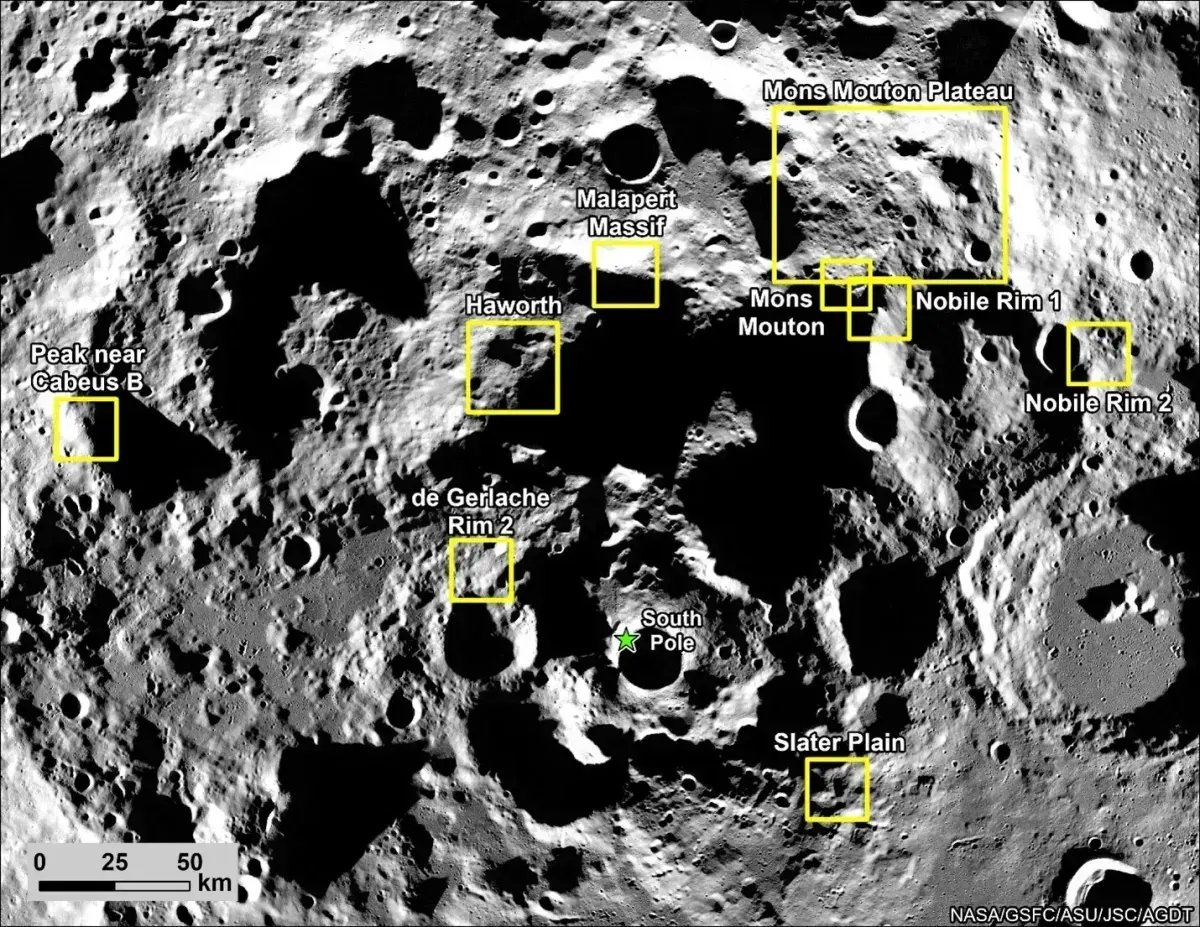
The strategic resource picture at the lunar south pole is dominated by water ice in permanently shadowed regions, with secondary interest in peaks of eternal light for continuous solar power. The Artemis program, the ILRS, ESA's PROSPECT, JAXA, and ISRO all concentrate near-term assets at the south pole. Highland anorthosite resources, however, are not concentrated at the poles; they are abundant across the lunar farside and across the central and northern highlands [13][16]. This creates a strategic asymmetry: the polar locations of greatest political interest are not the locations of greatest aluminum-resource concentration. The peer-reviewed literature is divided on whether near-term lunar industrialization will require highland-resource access or will be confined to polar volatile extraction; the answer turns on whether aluminum production scales aggressively in the 2030s and 2040s. Available data point toward a hybrid architecture in which initial polar deployments source aluminum from local highland regolith of modest Al₂O₃ content, while larger-scale operations migrate to dedicated highland sites.
7.2 Bloc dynamics: Artemis Accords vs ILRS
The Artemis Accords, with 67 signatories as of May 2026 [36], include major spacefaring states (United States, Japan, Canada, United Kingdom, France, Germany, Italy, India, UAE, Brazil) and a long tail of smaller states. The International Lunar Research Station partnership is anchored by China and Russia, with declared participants and partner institutions including Pakistan, Venezuela, Belarus, Azerbaijan, South Africa, Egypt, Thailand, Nicaragua, Senegal, and others, as well as institutional partners in Switzerland [22][39]. The ILRS has not published a normative principles document equivalent to the Artemis Accords; the public ILRS Guide for Partnership released in June 2021 is a programmatic and engineering document. The divergence has implications for electrochemical extraction: Artemis signatories operate under a relatively coherent legal interpretation that resource extraction is permitted; ILRS partners operate under varying national positions, with China and Russia having declined to formally endorse the U.S. Luxembourg interpretation in international fora. In May 2025, CNSA and Roscosmos signed a memorandum on the construction of a power station for the ILRS, scheduled for completion in 2036 [22]; the power-station planning indicates that ILRS-side electrochemical processing infrastructure is being scoped at the multi-decade horizon.
7.3 Supply chain sovereignty and strategic value
The strategic value of off-Earth aluminum is not direct (it will not be returned to Earth in any plausible cislunar economy) but logistical: any sustained presence on the lunar surface, in cislunar orbit, or at Lagrange points benefits from in-situ production of structural metal. Sovereign supply-chain considerations therefore concentrate on which state or commercial actor controls the production capacity. The Artemis bloc's anchor commercial actor in this domain is Blue Origin via Blue Alchemist [4]; the ILRS bloc's anchor is less publicly developed, although Chinese academic publications on MOE applied to lunar simulant have appeared in increasing volume since 2020.
7.4 Dual-use and security implications
Large-scale electrochemical facilities require multi-hundred-kilowatt to multi-megawatt continuous electrical power, multi-ton landed mass, and persistent operational presence. These attributes overlap substantially with the logistical footprint of any persistent quasi-military presence on the lunar surface. The high-purity silicon coproduced by MRE [4] is also a precursor for radiation-hardened electronics; the iron-titanium-aluminum ferroalloy coproduct can be used for structural construction including pressure vessels. The dual-use implication is that any electrochemical extraction plant is, by physical attributes, also a candidate infrastructure node for broader off-Earth industrial and security capabilities. This consideration has not been formally incorporated into Artemis Accords or ILRS legal frameworks.
8. Strategic Recommendations
8.1 Recommendations for research and technology stakeholders
National labs and academic principal investigators should prioritize three areas where the public literature shows the largest gaps. First, anode longevity at integrated process scale: the Cr-Fe inert anode of Allanore-Yin-Sadoway [8] has been validated only over runs of 1.5 to 6 hours; the SnO₂-based anodes of the FFC-Cambridge route [1] over runs up to 50 hours. Sustained operation over thousands of hours under autonomous control is required for credible lunar deployment; this should be a TRL 4 to 5 program priority. The benchmark that would change this recommendation is publication of peer-reviewed data demonstrating greater than 1,000 hours of inert-anode operation at current densities exceeding 0.5 A per cm² with less than 5 percent mass loss.
Second, integrated cathode product separation and refining: the public literature reports cathode products as multi-element alloys (Fe/Ti/Si with a Ca/Al/Si/Mg phase in Lomax et al. [1]; ferrosilicon in Sibille-Schreiner [10]) without specifying downstream refining to structural grade aluminum. Agencies should fund explicit work on post-electrolysis refining (vacuum distillation, fractional crystallization, electrorefining) for the lunar product spectrum. The benchmark that would change this recommendation is publication of a peer-reviewed process flow producing aluminum of at least 99 percent purity from regolith simulant in an integrated end-to-end demonstration.
Third, lower-temperature route maturation: the FFC-Cambridge route at 850 to 950 °C [1] is energetically attractive relative to 1500 to 1700 °C MOE [2]. Lower-temperature variants in LiCl KCl-CaCl₂ eutectics [24] should be matured to integrated bench scale. The benchmark that would change this recommendation is publication of greater than 90 percent oxygen extraction at temperatures below 800 °C in lunar simulant.
8.2 Recommendations for industrial and investment stakeholders
Commercial ISRU firms should structure their development roadmap around three sequenced demonstrations: integrated regolith-to-oxygen at simulated lunar environment scale (Blue Alchemist's stated 2026 milestone is the relevant public benchmark) [4]; integrated regolith-to metal alloy with characterized cathode product separation; and integrated regolith-to-finished aluminum-wire at pilot scale on Earth before lunar flight. Funding stakeholders should weight portfolio exposure toward firms holding differentiated inert-anode IP and reactor-containment know-how, since these are the dominant cost and reliability drivers.
Terrestrial aluminum industry incumbents (Alcoa, Rio Tinto, Norsk Hydro, EGA, Rusal, Chalco) should treat lunar electrochemistry as an extension of their terrestrial decarbonization roadmap rather than as a separable program, since inert-anode and chloride-route technologies have direct terrestrial deployment value. The ELYSIS joint venture's stated 2027 commercial demonstration timeline [11] is the relevant terrestrial reference point. Sovereign wealth funds and VC allocators should benchmark lunar-ISRU equity positions against the maturity of inert anode technology, the demonstrated current efficiency and anode lifetime at integrated scale, and the regulatory clarity of resource-rights frameworks in the relevant jurisdiction.
8.3 Recommendations for policy and regulatory stakeholders
Policy stakeholders should pursue three lines of work. First, the Artemis Accords and ILRS frameworks should be encouraged to converge on a common technical reporting standard for in situ resource extraction, including standardized reporting of mass extracted, energy consumed, and cumulative environmental footprint. This is the kind of soft-law convergence the Hague Building Blocks framework [38] was designed to enable. Second, export control regimes (ITAR, EAR, Wassenaar) should be reviewed to distinguish dual-use inert-anode metallurgy from controlled weapons-related materials processing technology; the current ambiguity discourages transatlantic and trans-Pacific scientific collaboration even among aligned states. Third, terrestrial pilot facilities for lunar electrochemistry should be permitted under streamlined environmental compliance pathways analogous to those for decarbonization pilots, since the technology baseline is materially cleaner than legacy Hall-Héroult.
9. Conclusion
The analytical through-line of the evidence reviewed is that electrochemical extraction of aluminum from anorthite-containing rock, including lunar regolith, has crossed a credibility threshold over the past fifteen years, moving from speculative concept to integrated bench-scale demonstration with documented oxygen-extraction yields of 96 percent (FFC-Cambridge on regolith simulant) [1] and demonstrated current efficiencies of 60 to 100 percent for oxygen evolution in iron-free silicate melts (MOE/MRE) [2]. The yield gap relative to HCl leaching, which in integrated 2025 demonstrations produced only approximately 12.1 percent Al₂O₃-to-Al conversion despite high single-step leaching yields [3], is real and substantial. The technology, however, is not at flight-ready maturity; the dominant unresolved engineering questions are inert-anode longevity, integrated cathode-product refining, and autonomous reliability under lunar surface conditions.
Five open questions structure the next decade of work. First,
Can inert anodes sustain greater than 1,000 hours of operation under representative current densities?
The Cr-Fe and Ir-W lines of work [8][9] indicate the answer is plausibly yes, but the data is not yet here. Second,
Can integrated cathode product separation produce structural-grade aluminum from a multi-element alloy product without prohibitive secondary processing?
The peer-reviewed literature does not yet answer this. Third,
Can MRE be operated at scale autonomously under lunar surface conditions including dust mitigation, thermal cycling, and limited maintenance?
Blue Alchemist's 2026 demonstration [4] is the relevant near-term test point, although the present authors note that the underlying Blue Alchemist data is not yet in the peer-reviewed literature and the demonstration's TRL designation rests on company and NASA Tipping Point classification rather than independent assessment. Fourth,
Can the international legal framework absorb electrochemical resource extraction without bloc-level fragmentation between Artemis and ILRS signatories?
The Hague Building Blocks [38] offer a path; whether it is taken remains a political question. Fifth,
Will launch-cost reductions make Earth-launched aluminum competitive with in-situ production in the 2030s, partially deprioritizing the entire research agenda?
At SpaceX's stated 2028 Starship lunar pricing of 100,000 USD per kg [12], in-situ production retains a clear economic case, but further cost reduction would shift the calculus.
The measured analytical conclusion is that electrochemical aluminum extraction from anorthite-rich rock is technically credible, strategically valuable, and economically defensible at the lunar surface within a 10 to 20 year horizon, provided that the named engineering gaps are closed by sustained agency and commercial investment, and that the international legal framework converges on practical safety-zone and resource-rights provisions. The technology should be developed; the legal framework should be converged; the cost framework should be re-baselined as launch costs evolve.
References
[1] Lomax, Bethany A., Marco Conti, Naail Khan, Nicholas S. Bennett, Alexey Y. Ganin, and Mark D. Symes. 2020. "Proving the Viability of an Electrochemical Process for the Simultaneous Extraction of Oxygen and Production of Metal Alloys from Lunar Regolith." Planetary and Space Science 180: 104748.
[2] Sirk, Aislinn H. C., Donald R. Sadoway, and Laurent Sibille. 2010. "Direct Electrolysis of Molten Lunar Regolith for the Production of Oxygen and Metals on the Moon." ECS Transactions 28 (6): 367-373.
[3] Ortega, Joseph N., Thomas P. Sander, Joshua D. Smith, Fateme Rezaei, David J. Bayless, William Schonberg, Daniel S. Stutts, and Frank D. Han. 2025. "Extraction of Aluminum from Lunar Regolith through Molten Salt Electrolysis." Acta Astronautica 235: 17-28.
[4] Blue Origin. 2025. "Blue Alchemist Hits Major Milestone Toward Permanent and Sustainable Lunar Infrastructure" and "Blue Alchemist Technology Powers Our Lunar Future." Company technology profile and press release series. Kent, WA: Blue Origin.
[5] Fraunhofer Institute for Surface Engineering and Thin Films (IST). 2023. "Closed-Loop Electrochemical Processes for the Extraction of Pure Elements from Lunar Regolith (ELMORE)." Braunschweig: Fraunhofer IST.
[6] Schreiner, Samuel S., Laurent Sibille, Jesus A. Dominguez, and Jeffrey A. Hoffman. 2016. "A Parametric Sizing Model for Molten Regolith Electrolysis Reactors to Produce Oxygen on the Moon." Advances in Space Research 57 (7): 1585-1603.
[7] International Aluminium Institute. 2022. "Primary Aluminium Smelting Energy Intensity Statistics" (2021 data). London: IAI. See also European Commission Joint Research Centre. 2024. Decarbonisation Options for the Aluminium Industry. JRC136525. Luxembourg: Publications Office of the European Union.
[8] Allanore, Antoine, Lan Yin, and Donald R. Sadoway. 2013. "A New Anode Material for Oxygen Evolution in Molten Oxide Electrolysis." Nature 497 (7449): 353-356.
[9] Vai, A. T., James A. Yurko, D. H. Wang, and Donald R. Sadoway. 2010. "Molten Oxide Electrolysis for Lunar Oxygen Generation Using In-Situ Resources." In Proceedings of the TMS 2010 Annual Meeting. Warrendale, PA: The Minerals, Metals and Materials Society.
[10] Sadoway, Donald R., Alex Ignatiev, and Peter A. Curreri. 2019. "Regolith Extraction Through Molten Regolith Electrolysis." Abstract 5012, Lunar ISRU 2019 Workshop. Houston: Lunar and Planetary Institute. See also Sibille, Laurent, Samuel S. Schreiner, and Jesus A. Dominguez. 2019. "Advanced Concepts for Molten Regolith Electrolysis: One-Step Oxygen and Metals Production Anywhere on the Moon." Abstract 5100, Lunar ISRU 2019 Workshop. Houston: Lunar and Planetary Institute.
[11] Peterson, Robert. 2025. "Update on the Development of Inert Anodes for Aluminum Reduction." Light Metal Age, February 2025. San Francisco: Fellom Publications.
[12] Wang, Brian. 2025. "SpaceX Starship Lunar Cargo Missions at $100 Million per Metric Ton." NextBigFuture, citing SpaceX 2028 commercial cargo statements.
[13] Heiken, Grant H., David T. Vaniman, and Bevan M. French, eds. 1991. Lunar Sourcebook: A User's Guide to the Moon. Cambridge: Cambridge University Press.
[14] U.S. Bureau of Mines. 1982. "Aluminum Extraction from Anorthosite by Hydrochloric Acid and Fluoride Leaching." Report of Investigations. Washington, DC: U.S. Department of the Interior.
[15] AlSiCal Project Consortium. 2022. "Thermo-Kinetic Modelling of the Acidic Leaching of Anorthosite: Key Learnings Toward the Conception of a Sustainable Industrial Process." Horizon 2020 European Union Project Output. HAL Archive hal-03713327.
[16] Pernet-Fisher, John F., Katherine H. Joy, Daniel J. P. Martin, and Kerri L. Donaldson Hanna. 2017. "Assessing the Shock State of the Lunar Highlands: Implications for the Petrogenesis and Chronology of Crustal Anorthosites." Scientific Reports 7: 5888.
[17] Bandyayera, Daniel, and Joseph C. Wong, of the Carleton University Department of Earth Sciences. 2022. "A Method for the Extraction of Alumina and Silica from Lunar Regolith Using Hydrochloric Acid." Carleton University Scholaris Repository deposit, Ottawa.
[18] Curreri, Peter A., Edwin C. Ethridge, Sarah L. Hudson, Teresa Y. Miller, Richard N. Grugel, S. Sen, and Donald R. Sadoway. 2006. Process Demonstration for Lunar In Situ Resource Utilization: Molten Oxide Electrolysis. NASA/TM-2006-214600 (MSFC Independent R&D Project No. 5-81). Huntsville, AL: NASA Marshall Space Flight Center.
[19] Sibille, Laurent, Donald R. Sadoway, Prabhat Tripathy, Evan Standish, Aislinn Sirk, Orlando Melendez, Jesus A. Dominguez, Doru M. Stefanescu, Peter A. Curreri, and Sophie M. Poizeau. 2009. "Recent Advances in Scale-Up Development of Molten Regolith Electrolysis for Oxygen Production in Support of a Lunar Base." AIAA Paper 2009-659, 47th AIAA Aerospace Sciences Meeting. Reston, VA: American Institute of Aeronautics and Astronautics.
[20] Williams, Matthew. 2025. "Blue Origin's Blue Alchemist Tech Transforms Moon Dust." IEEE Spectrum, technology coverage feature. New York: Institute of Electrical and Electronics Engineers.
[21] European Space Agency. 2024. "PROSPECT: Searching for Water at the Lunar Poles" and "Team Chosen to Make First Oxygen on the Moon." ESA Science and Exploration Programme Documentation. Noordwijk: ESA ESTEC.
[22] China National Space Administration and State Space Corporation Roscosmos. 2021. "Memorandum of Understanding Regarding Cooperation for the Construction of the International Lunar Research Station." Signed 9 March 2021. See also CNSA-Roscosmos memorandum on ILRS power station, signed May 2025.
[23] Massachusetts Institute of Technology News Office. 2024. "Making Steel with Electricity: MIT Spinout Boston Metal." MIT News, 22 May 2024. Cambridge, MA: MIT.
[24] Meurisse, Aidan, Carsten Schwandt, and collaborators on lower-temperature FFC Cambridge work (citing Sri Maha Vishnu, D., N. Sanil, K. S. Mohandas, and K. Nagarajan, IGCAR). 2022. "Lower Temperature Electrochemical Reduction of Lunar Regolith Simulants in Molten Salts." Planetary and Space Science 211: 105408.
[25] SINTEF Energi (Stiftelsen for industriell og teknisk forskning). 2019. "Is Aluminium Electrolysis Using Inert Anodes a Blind Alley?" SINTEF Blog technical commentary. Trondheim: SINTEF.
[26] Kadowaki, Hideyuki, Yutaro Katasho, Kouji Yasuda, and Toshiyuki Nohira. 2018. "Electrolytic Reduction of Solid Al2O3 to Liquid Al in Molten CaCl2." Journal of the Electrochemical Society 165 (2): D83-D89.
[27] Schwandt, Carsten, James A. Hamilton, Derek J. Fray, and Ian A. Crawford. 2012. "The Production of Oxygen and Metal from Lunar Regolith." Planetary and Space Science 74 (1): 49 56.
[28] Schreiner, Samuel S. 2015. "Molten Regolith Electrolysis Reactor Modeling and Optimization of In-Situ Resource Utilization Systems." S.M. Thesis, Massachusetts Institute of Technology, Cambridge, MA.
[29] Paley, Mark S., Laurel J. Karr, and Peter A. Curreri. 2009. "Oxygen Production from Lunar Regolith Using Ionic Liquids." NASA Technical Reports Server NTRS-20090017882. Huntsville, AL: NASA Marshall Space Flight Center.
[30] Reiss, Philipp, Lukas Schlüter, and collaborators. 2022. "Dissolution and Electrolysis of Lunar Regolith in Ionic Liquids." Planetary and Space Science 219: 105534.
[31] Choate, William T., and John A. S. Green. 2003. U.S. Energy Requirements for Aluminum Production: Historical Perspective, Theoretical Limits, and Current Practices. Report prepared for U.S. Department of Energy Industrial Technologies Program. Washington, DC: U.S. DOE.
[32] United Nations. 1967. Treaty on Principles Governing the Activities of States in the Exploration and Use of Outer Space, including the Moon and Other Celestial Bodies. UN General Assembly Resolution 2222 (XXI), opened for signature 27 January 1967, entered into force 10 October 1967.
[33] United States Congress. 2015. U.S. Commercial Space Launch Competitiveness Act. Public Law 114-90, 114th Congress, Title IV: Space Resource Exploration and Utilization Act. 51 U.S.C. §§ 51301-51303.
[34] Grand Duchy of Luxembourg. 2017. Law of 20 July 2017 on the Exploration and Use of Space Resources. Memorial A No. 674. Luxembourg.
[35] National Aeronautics and Space Administration et al. 2020. The Artemis Accords: Principles for Cooperation in the Civil Exploration and Use of the Moon, Mars, Comets, and Asteroids for Peaceful Purposes. Opened for signature 13 October 2020. Washington, DC: NASA.
[36] U.S. Department of State and NASA. 2026. "Paraguay Signs the Artemis Accords as 67th Nation." Joint press release, 7 May 2026.
[37] Mallowan, Lavinia, Christopher Newman, and Mark Lunday. 2022. "Artemis Accords: Are Safety Zones Practical for Long Term Commercial Lunar Resource Utilisation?" Space Policy 62: 101504.
[38] The Hague International Space Resources Governance Working Group. 2019. Building Blocks for the Development of an International Framework on Space Resource Activities. Adopted 12 November 2019. Leiden: Leiden University Institute of Public Law, International Institute of Air and Space Law.
[39] Secure World Foundation. 2024. "Lunar Space Cooperation Initiatives: Comparison of Artemis Accords and International Lunar Research Station." Washington, DC: Secure World Foundation.
[40] Schlüter, Lukas, and Aidan Cowley. 2020. "Review of Techniques for In-Situ Oxygen Extraction on the Moon." Planetary and Space Science 181: 104753