Bioshelters in 2026: Passive-Solar Food Production Proven at Scale in China, Unproven in the West
Bioshelters promise year-round food at minimal energy. In 2026, passive solar scales to 810,000 ha in China but stays unproven in the West.

Bioshelters with Modern Technology: A 2026 Assessment
TL;DR
- The integrated "bioshelter" (a passive-solar, biologically coupled food-producing structure) remains a demonstrably workable concept at owner/demonstration scale but has essentially no rigorous, peer-reviewed evidence base as an integrated commercial system; the credible quantitative evidence sits entirely in adjacent component literatures (passive-solar greenhouse engineering, climate-battery thermal storage, aquaponics, CEA energy analysis, and ecological wastewater treatment).
- The decisive real-world proof that passive-solar protected horticulture scales is not Western bioshelters but the Chinese solar greenhouse (日光温室): ≈8.1 × 10⁵ hectares installed in 2022 (more than one-third of China's greenhouse area, producing one-third of the nation's vegetable supply), heated by solar gain and north-wall thermal mass alone, while the capital-intensive Western CEA/vertical-farming industry has suffered a wave of insolvencies (AeroFarms, AppHarvest, Bowery, Plenty, and 14 indoor-farming/CEA bankruptcies recorded in 2025).
- Modern technology genuinely improves the envelope and controls (ETFE ~95% transmission and 20–30+ yr life; AI control delivering measurable resource savings in Wageningen's Autonomous Greenhouse Challenge; Eco-Machine wastewater treatment at 97% BOD removal), but year-round high-latitude production still faces an unavoidable energy penalty from supplemental lighting, and the economic case for the fully integrated, semi-closed-loop bioshelter remains unproven.
Key Findings
1. The lineage works technically but never scaled commercially. The New Alchemy Institute (1971–1991) built the Cape Cod Ark (1976; ~1,800 sq ft growing space, 90 ft long) and the Prince Edward Island Ark (1976; 490 m², ~$300,000, opened by Prime Minister Pierre Trudeau). The PEI Ark's passive-solar system provided over 50% of heating requirements. Early demonstrations underperformed on ventilation and overheating, depended on government grants that evaporated, and were never economically self-sustaining. The Institute dissolved in 1991; the Todd lineage pivoted to ecological wastewater treatment (Living Machines / Eco-Machines).
2. Eco-Machines / Living Machines have strong, independently verified treatment performance. US EPA evaluation of demonstration systems at Frederick, MD (40,000 gpd design) and South Burlington, VT (80,000 gpd design) measured BOD5 removal of 97% (effluent 4–5.9 mg/L), TSS removal 97–98%, ammonia removal 94–98%, and total nitrogen removal 75–81%. Phosphorus is the consistent weakness (~45–67% removal). This is the most rigorous quantitative evidence in the entire Todd lineage, and it is for wastewater, not food.
3. Chinese solar greenhouses are the scale proof point. ≈8.1 × 10⁵ ha as of 2022. They produced over 25.3% of China's agricultural products using less than 3% of arable land, which is an economic efficiency surpassing field crops by over 20-fold. Passive design: transparent south roof, opaque insulated north roof, high-thermal-mass north wall, night insulation blankets. Indoor temperatures up to 25°C above outdoor; heated by solar alone even below freezing. The catch: profits per unit area are reportedly 2–3× lower than fully glazed heated greenhouses.
 Kris De Decker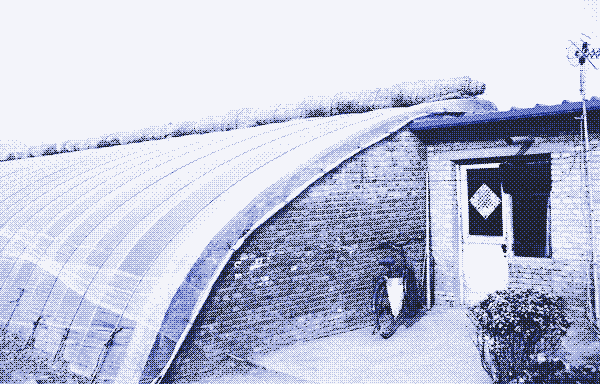
4. The Western CEA/vertical-farm industry is in financial crisis. AeroFarms (Chapter 11 2023, emerged restructured, shut its Virginia facility December 2025), AppHarvest (Chapter 11 2023, liquidated entirely), Bowery Farming (ceased operations November 2024), Plenty (Chapter 11 March 2025), Kalera, Infarm, Smallhold, and 14 indoor-farming/CEA bankruptcies recorded in 2025 (combined historical funding across all failed companies exceeding an estimated $1.37 billion). Core failure mode: energy and capital costs not covered by produce price premiums.
5. Energy is the binding constraint. Vertical-farm lettuce: specific energy consumption 10–18 kWh/kg, energy use intensity 850–1,150 kWh/m²/yr. Lighting is ~65% of vertical-farm power. Conventional greenhouse lettuce ~5.4 kWh/kg vs ~38.8 kWh/kg for indoor agriculture. Supplemental lighting accounts for 10–30% of greenhouse OPEX.
 Ranjot Dhaliwal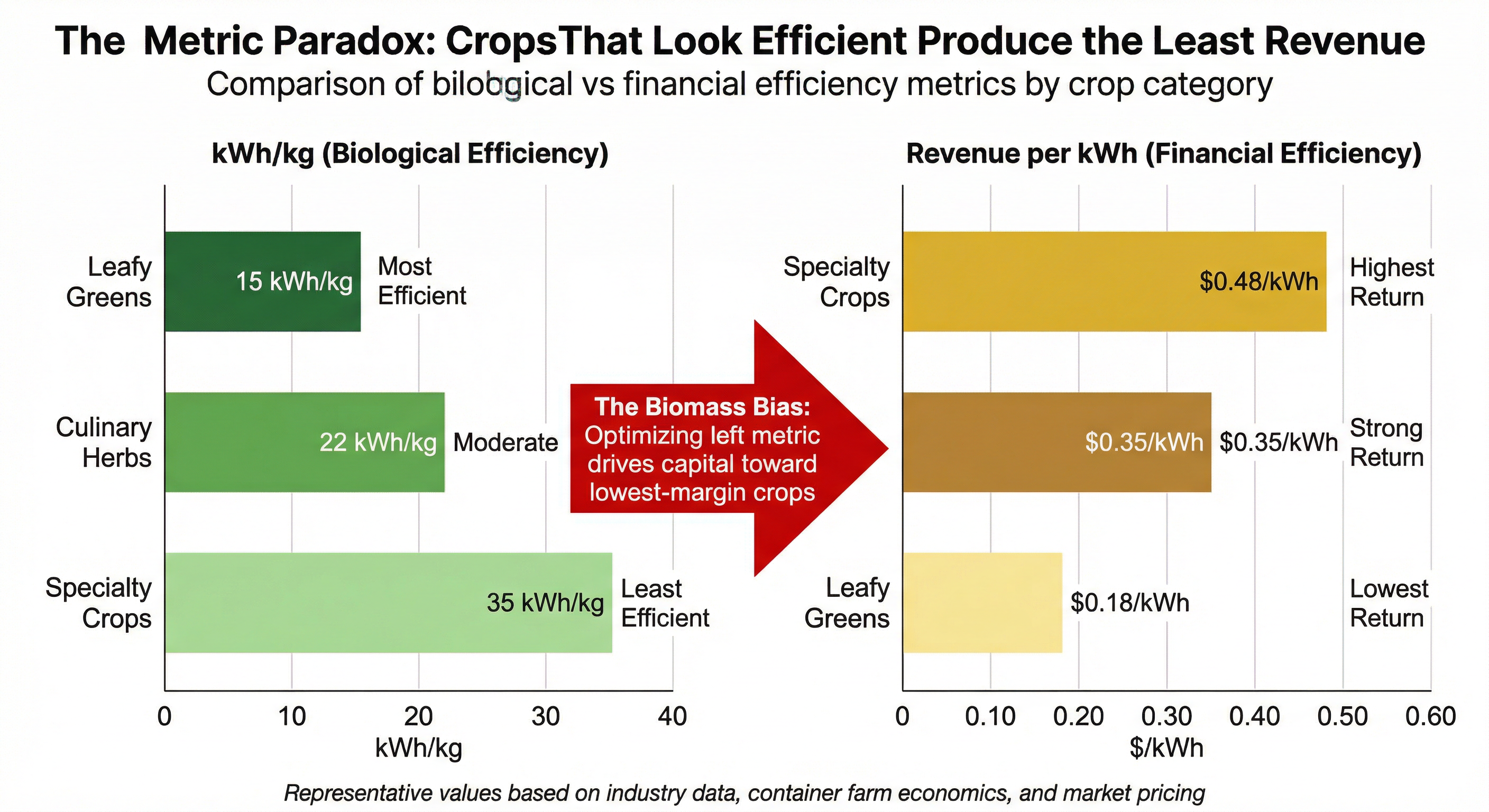
Details
Historical lineage and why it didn't scale
The bioshelter originates with the New Alchemy Institute, founded around 1969–1971 by John Todd, Nancy Jack Todd, and William McLarney on Cape Cod. The concept built from a plastic dome over a wading pool (1971) to the Cape Cod Ark (1976), designed by Yale architects David Bergmark and Ole Hammarlund (Solsearch Architects). Tilapia were raised in double-layered fiberglass (Kalwall) cylinders holding about 700 gallons each, producing two 50-pound harvests per year. The structure used double-glazed fiberglass on the south roof and east-west walls, a white-painted reflective north roof, and fish ponds as thermal mass and water store. Today the interior temperature reportedly hovers near 90°F when sunny and no lower than 40°F at night.
 Elise Hugus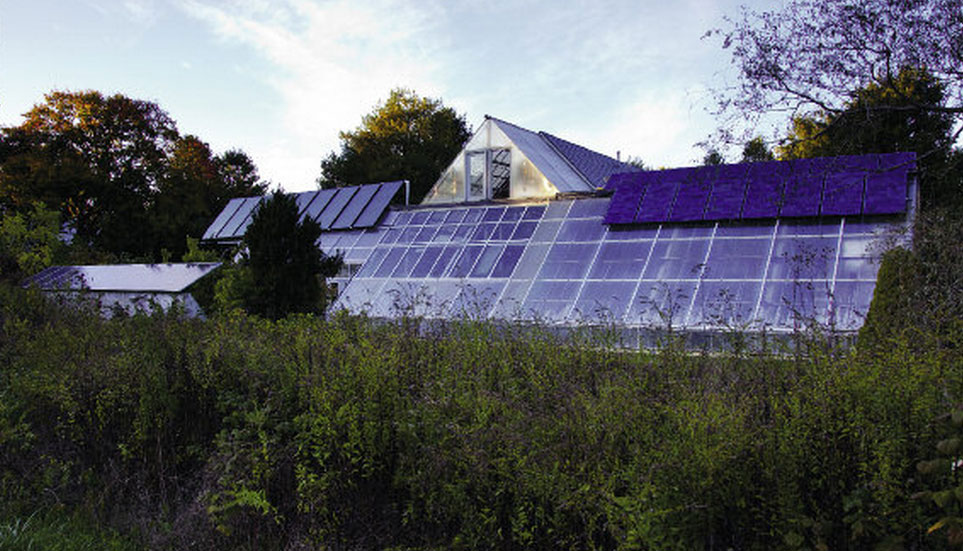
Documented failures: the founders' own account ("From Our Experience: The First Three Years Aboard the Cape Cod Ark," Journal of the New Alchemists 6) noted poor ventilation and summer overheating that killed pond bacteria. The PEI Ark (490 m²; two greenhouses, aquaculture, and a residence; built 1975–76 by Solsearch with New Alchemy) used south/west glass for collection and rocks, concrete and water for storage, plus 36 vertical flat-plate collectors and a wood-stove backup. Its passive system provided over 50% of heating without summer overheating (per the 1979 conference proceedings "Solar energy at the P.E.I. Ark"). Cost exceeded $300,000 (funded by Canada's Ministry of State for Urban Affairs, the Province of PEI, and New Alchemy). It was later converted into a hotel/restaurant and eventually demolished; the New Alchemy Institute dissolved in 1991 due to loss of funding. Archives are maintained by the Green Center (Earle Barnhart and Hilde Maingay) on Cape Cod.
Successor organizations: Ocean Arks International, John Todd Ecological Design (JTED), and Worrell Water Technologies (which acquired the "Living Machine" trademark in 1999–2000). John Todd received the first Buckminster Fuller Challenge prize.
Ecological wastewater treatment (the strongest evidence base)
The US EPA's 2001–2002 evaluation (EPA 832-R-01-004; Fact Sheet EPA 832-F-02-025) provides independently measured field data. At Frederick, MD and South Burlington, VT: BOD5 removal ~97% (effluent 4 and 5.9 mg/L respectively), COD 94%, TSS 97–98%, ammonia 94–98%, total nitrogen 75–81%, and total phosphorus 45–67%. EPA found the systems cost-competitive with conventional treatment up to ~1 million gpd in warm climates (no greenhouse) and ~600,000 gpd where a greenhouse is required. Fecal coliform performance was inconsistent (Burlington effluent averaged ~1,200 MPN/100 mL, indicating disinfection may be required). The foundational peer-reviewed source is Todd and Josephson, "The Design of Living Technologies for Waste Treatment," Ecological Engineering 6 (1996): 109–136, reporting a Vermont AEES treating 300 m³/day (~79,250 gpd) to tertiary standards, including in winter. The Omega Center for Sustainable Living (Rhinebeck, NY) Eco-Machine treats up to 52,000 gallons/day (operator/design figure; no independent peer-reviewed effluent dataset). Phosphorus removal is the consistent limitation across all systems, only ~50% removal, insufficient to meet a 3 mg/L standard.


Building envelope and glazing
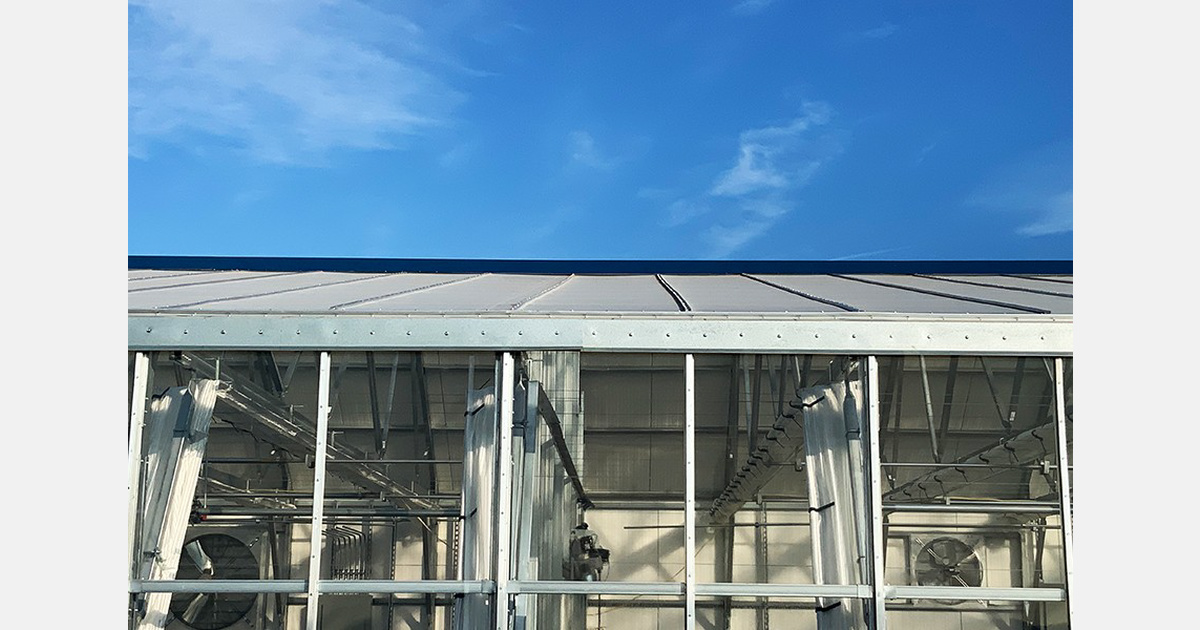
- ETFE film: ~95% light transmission including UV; loses only ~5% transmission over 20 years; documented service life of 30–40+ years; a single layer ~100× lighter than glass. Thin ETFE prices are comparable to double-layer polycarbonate; diffuse/anti-drip coatings add ~30%. Hortidaily
- Polycarbonate: twin/triple-wall is the horticultural workhorse; suffers UV yellowing and transmission decline over time. Ceres
- Aerogel glazing / transparent insulation materials (TIM): Monolithic aerogel glazing achieves center-pane U-values of 0.41–0.66 W/m²K with solar/visual transmittance ~74–78%/71–73% (Duer & Svendsen 1998; Schultz et al.). Cellulose aerogels reach 97–99% visible transmission with thermal conductivity below that of still air (Abraham et al., Nature Energy, 2023). Capillary/honeycomb TIM (Okalux, Arel) reach ~1.36 W/m²K. Aerogel remains expensive and largely pre-commercial for horticulture.

Thermal management
- Climate batteries / GAHT (ground-to-air heat transfer): A master's thesis (Sinke 2022, UNC Greensboro) measured an average COP of 2.38 for a continuously running GAHT. A Chinese earth-air heat exchanger greenhouse study reported a winter average inlet–outlet temperature difference of 9.26°C and a COP of 22.49. EAHE systems can save up to 50% energy versus conventional provision. The vendor Ceres markets its patented GAHT as the leading climate-battery system. Caution: COP definitions vary widely; the "22.49" figure uses a fan-energy-only denominator and is not comparable to a heat-pump COP.
- Phase-change materials (PCM): Common PCMs include CaCl₂·6H₂O, Na₂SO₄·10H₂O, Na₂HPO₄·12H₂O, and paraffins. A modified CaCl₂·6H₂O measured a melting point of 20.6°C and latent heat of 172.7 J/g. PCM north walls satisfied ~35–50% of greenhouse heating needs (Greek studies). Adding 15% PCM to a water tank raised heat storage 70% over water alone. Beyhan et al. achieved energy savings up to 47 kW over 28 days.
- Heat pumps and seasonal/interseasonal storage complement these but add capital and electricity load.
Supplemental lighting and the DLI problem
DLI requirements: low-light crops 5–10, medium 10–15, and high-light/fruiting crops >15 mol/m²/day (high-wire tomato targets are higher). Winter outdoor DLI at northern latitudes falls to 3–5 mol/m²/day; far below fruiting-crop needs. LED efficacy has improved from ~0.9 μmol/J (400 W HPS) to 2.0–2.7 μmol/J (modern LED). Supplemental lighting is 10–30% of greenhouse OPEX; a vegetable greenhouse may spend up to USD $200,000/hectare on supplemental lighting, ~30% of annual farm-gate value.
The fundamental tension: passive solar minimizes energy but limits winter high-latitude yield, while supplemental lighting enables year-round yield but reintroduces the energy/cost burden that bankrupts vertical farms.
Environmental sensing and AI control
Wageningen University's Autonomous Greenhouse Challenge (2018–2025, five editions) is the most rigorous test of AI control. Results: AI algorithms increased production, reduced water and energy use, and improved net profit. Team Automatoes (2020 cherry tomato) achieved the highest net yield with the least resources per kg. A Koidra-led team ("Team Koala") was the only AI team to outperform the Dutch reference growers, providing 27.8% more net profit along with the lowest operating cost (per Automation.com, July 2022), and Koidra reports the team achieved 400 g per head of lettuce, greatly surpassing the 250 g/head target. Team IDEAS won the 2024 edition (dwarf tomato) using nearly double the plant density. The demonstrated benefit is real but bounded (single-digit to ~28% profit optimization in controlled compartments) and distinct from vendor marketing. Signify's GrowWise smart spectrum claims energy savings or growth boost "up to 6%".
 dr. S (Silke) Hemming
Biological subsystems: aquaponics
Coupled vs decoupled: decoupled systems allow independent optimization of fish and plant loops. Yields are claimed up to ~15 kg/m²/yr for leafy greens (industry figure); water use as low as ~3 L/kg lettuce versus ≥30 L/kg in soil (industry/2024 study). The economics are weak: an international survey of 257 commercial producers (Love et al. 2015) found less than one-third profitable. A Spanish FAO-model study produced 62 kg of tilapia and 352 kg of vegetables/fruit with positive accounting profit but negative economic profit once labor was costed. Energy for pumping and temperature control is the main operating-cost driver, and many commercial aquaponics operations have short lifespans.
Scale distinctions
- Western bioshelter: niche, owner-built/demonstration, rarely commercial.
- Chinese solar greenhouse: ≈8.1 × 10⁵ ha (2022), passive, massive scale, lower profit per area than glasshouses but minimal fossil energy.
- CEA/vertical farming: capital-intensive, high energy, financially fragile.
Capital and operating costs
- High-tech Dutch glass (Venlo): conventional glass €150–250/m² (~$165–275/m²); semi-closed conversions exceed €500/m²; LED retrofit adds €25–40/m² (Mordor Intelligence). GrowPro models: €2.5–6.2 million/hectare (€247–282/m² at 1-acre scale).
- Basic commercial glass greenhouse ~$60–120/m²; high-tech smart greenhouse $120–200+/m² (industry).
- Commercial greenhouse all-in: $2–60/ft² (2026 industry estimate).
- Operating: energy is the dominant variable; lighting is 10–30% of OPEX in lit greenhouses and ~65% of power in vertical farms.
Public-company exposure
- Signify (Euronext: LIGHT): world leader in lighting incl. Philips horticulture LED; 2025 sales EUR 5.8 billion.
- Village Farms International (NASDAQ: VFF): regained Nasdaq compliance June 9, 2025; privatized its fresh-produce business in 2025, pivoting toward cannabis.
- Local Bounti (NYSE: LOCL): indoor ag; 2024 sales $38.1M, net loss $119.9M; 2025 debt restructuring cut debt $197M.
- Hydrofarm Holdings (NASDAQ: HYFM): equipment supplier; trading near $0.98, faced delisting risk.
Recommendations
- For a prospective owner-builder/demonstration project: The bioshelter concept is validated at this scale. Prioritize a high-thermal-mass passive envelope (Chinese-solar-greenhouse principles), ETFE or twin/triple-wall polycarbonate glazing, and a GAHT/climate battery (measured COP ~2.4) before any supplemental lighting. Expect food self-sufficiency and amenity value, not profit. Benchmark: if you require year-round fruiting-crop yield at high latitude, model supplemental-lighting energy first; if it exceeds ~10–15 kWh/kg, the passive premise is compromised.
- For a commercial venture: Do NOT pursue an integrated semi-closed-loop bioshelter as a profit center on current evidence. The CEA bankruptcy record is decisive. If pursuing protected horticulture, follow the survivors' playbook (restructured AeroFarms in microgreens, Little Leaf Farms, 80 Acres Farms): right-size facilities, secure off-take agreements before building, choose high-value crops, and minimize energy intensity.
Benchmark to change this recommendation: a peer-reviewed, audited demonstration of an integrated bioshelter achieving positive economic profit (after labor and capital) at >0.5 ha. - For ecological wastewater integration: The Eco-Machine/Living Machine approach is the most credible "living subsystem", adopt it where wastewater-treatment value (not food) justifies it, and budget for separate phosphorus polishing.
- For investors: Adjacent infrastructure (lighting: Signify; established produce: Village Farms) is more durable than pure-play indoor farming. Treat distressed names (Local Bounti, Hydrofarm) as high-risk.
Caveats
- The term "bioshelter" is nearly absent from recent peer-reviewed literature; all integrated-system claims rest on component evidence, not on rigorous study of the integrated whole. This is the central epistemic limitation.
- Many performance numbers are vendor claims (ETFE transmission/life, GrowWise "6%," GAHT marketing) rather than independently measured; these are labeled but should be treated cautiously.
- The dramatic GAHT "COP 22.49" figure uses a fan-energy-only denominator and is not comparable to heat-pump COP.
- Yield and water-use figures for aquaponics frequently come from industry sources and best-case studies; profitability evidence is consistently weak.
- Chinese-solar-greenhouse area and economics derive from a small set of review citations (the ≈8.1 × 10⁵ ha / 2022 figure recurs across Elsevier Solar Energy and Energy papers); these should be regarded as order-of-magnitude.
References
U.S. Environmental Protection Agency. (2002, October). Wastewater technology fact sheet: The Living Machine® (EPA 832-F-02-025). https://19january2017snapshot.epa.gov/www3/npdes/www3/pubs/living_machine.pdf
closedworlds. (n.d.). The Ark for Cape Cod. https://www.closed-worlds.com/the-ark-of-cape-cod
Nair, C. S., Manoharan, R., Nishanth, D., Subramanian, R., Neumann, E., & Jaleel, A. (2025). Recent advancements in aquaponics with special emphasis on its sustainability. Journal of the World Aquaculture Society, 56(1), e13116. https://doi.org/10.1111/jwas.13116

 Miriam Schaffer

 *Correspondence: 2023500014syau.edu.cn; Tel.: +86-13664196881