Discord Spam Bot Protection: 4 Ways to Lock Down Your Server
Spam bots overwhelming your Discord server? Compare four protection options, from custom verification bots to manual vetting.


1. Situation
Discord servers have seen a rising number of automated accounts joining and posting malicious content in public channels. The volume and severity have reached the point where members are openly frustrated with the lack of protection, and the content itself is a real risk to the community's safety and reputation.
This briefing has been specifically tailored for a specific server; but is being published for general awareness and mitigation. The briefing lays out four response options, their tradeoffs, and a recommended path. Two of the steps below cost nothing and can be put in place today, before any purchasing decision.
Disclosure: Option 1 is custom built security bot, and the bot can run on a cheap VPS. I am presenting it next to the alternatives so it can be judged on the merits.
2. How to read the options
The spammers fall into two groups. The large majority are low-sophistication bots that join and immediately post, without reading channels or completing any setup steps. Almost any entry gate stops these. A smaller and growing minority use more capable backends that can solve simple text puzzles and imitate human behavior; these require behavioral detection or a human in the loop to catch reliably.
The single most important property of any solution is whether it stops a new account from posting in the main channels before it is verified. Options 1, 2, and 3 do this. Option 4 reacts after the fact and only catches part of the traffic.
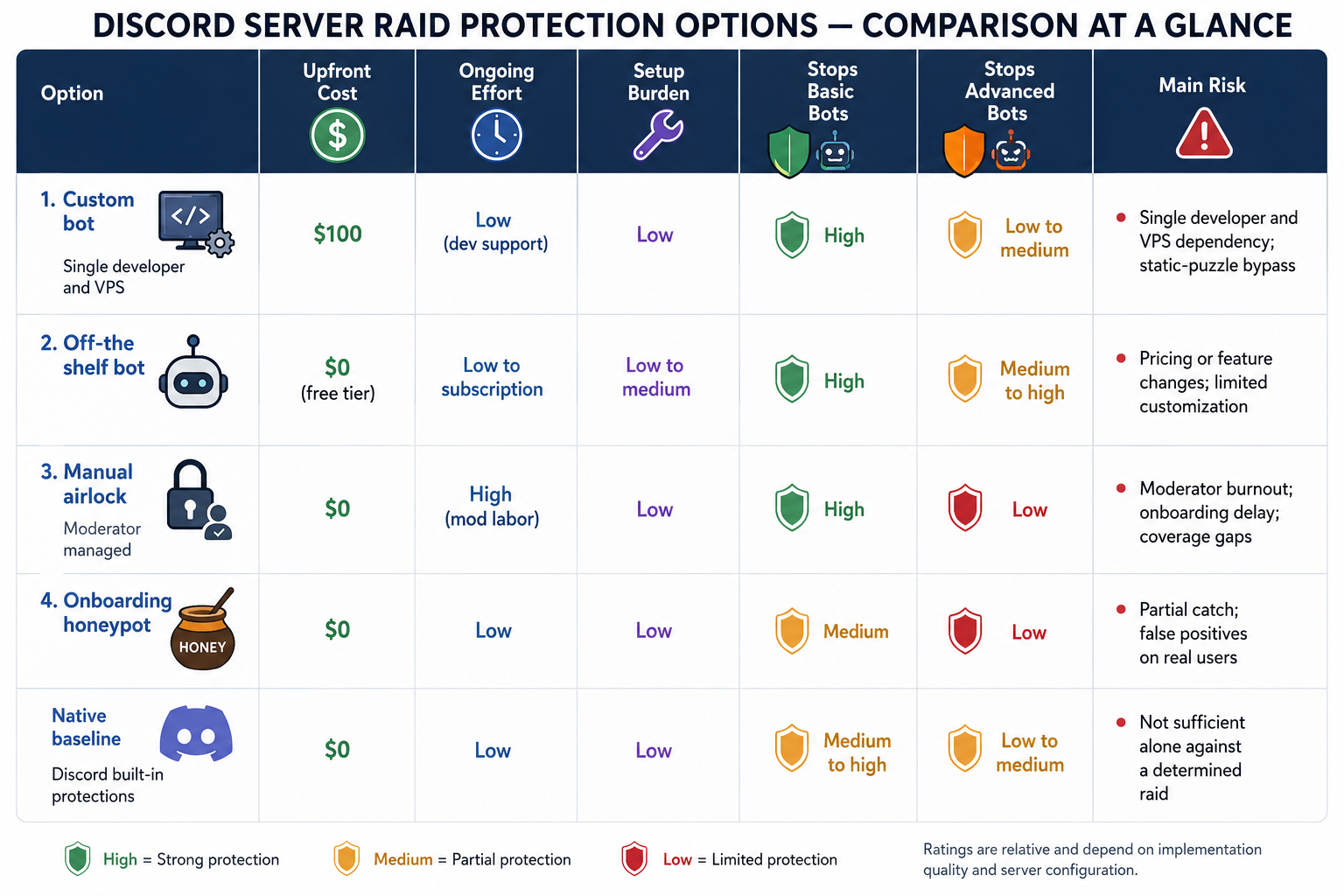
Discord Server Spam Mitigation Options
| Option | Upfront | Ongoing effort | Setup burden | Stops basic bots | Stops advanced bots | Scales | Main risk |
|---|---|---|---|---|---|---|---|
| 1. Custom bot | $100 | Low (dev support) | Low | High | Low to medium | High | Single-developer and VPS dependency; static-puzzle bypass |
| 2. Off-the-shelf bot | $0 (free tier) | Low to subscription | Low to medium | High | Medium | High | Pricing or feature changes; limited customization |
| 3. Manual airlock | $0 | High (mod labor) | Low | High | High | Low | Moderator burnout; onboarding delay; coverage gaps |
| 4. Onboarding honeypot | $0 | Low | Low | Medium | Low | High | Partial catch; false positives on real users |
| Native baseline | $0 | Low | Low | Medium to high | Low to medium | High | Not sufficient alone against a determined raid |
3. The options
Option 1: Custom verification bot
How it works: a custom bot gates new members behind a short verbal logic puzzle (for example, "the hen lays 12 eggs, the fox eats 3 on Tuesday and 2 on Friday, how many are left?"). It runs on a VPS, costs ~$100 upfront with ongoing support included, and needs minimal involvement from you beyond initial setup.
Strengths: low cost, tailored to a homesteading audience that will solve the puzzle easily, full control over behavior, and hands-on support from the developer.
Risks to weigh:
- The puzzle should draw from a randomized pool, not a single fixed question. One static puzzle is defeated permanently the first time an operator records the answer, so it is worth confirming the developer rotates them.
- A puzzle of this kind stops scripted bots but not bots with a language-model backend, which solve grade-school arithmetic trivially. It is strong against the bulk of the problem and weaker against the sophisticated tail.
- The bot needs permissions in the server (assigning the verified role at minimum) and runs on community infrastructure. It is reasonable to ask for least-privilege permissions, a note on what it logs, and a written handover plan in case the developer or host becomes unavailable.
Option 2: Off-the-shelf security bot
How it works: adopt an established verification or anti-raid bot. Several mature options exist, most with a capable free tier and paid upgrades.
Strengths: maintained by dedicated teams, updated against new attack patterns, no dependency on a single individual, and proven at large scale.
Risks: pricing and feature gating can change, customization is limited, and you depend on the vendor's roadmap. In practice the established free tiers handle most of what is needed, so the pricing risk is smaller than it first appears.
Option 3: Manual quarantine / airlock
How it works: new members land in a holding channel and cannot post elsewhere until a moderator clears them. Bots can only spam the airlock, where regular members never see them.
Strengths: no code, no cost, no external dependency, and a human gate is extremely hard for any bot to pass.
Risks: it runs on moderator labor. With 1,300 members and an uptick in joins, that is a real recurring cost, with onboarding delay for legitimate users and coverage gaps across time zones. Effective, but it does not scale on its own.
Option 4: Onboarding honeypot role
How it works: the onboarding flow offers a decoy "spammer" role; bots that auto-select every role flag themselves and are muted automatically.
Strengths: free, native to Discord, and clever against bots that grab all roles by default.
Risks: it is reactive and partial. Many spam bots never touch onboarding and post immediately, so they slip past it entirely. It can also misfire on real users, including non-English speakers who do not understand the label, as you noted. Useful as a cheap add-on, weak as a primary defense.
4. Free baseline (recommended regardless of choice)
Discord's own tools cost nothing and should be switched on now:
- Enable AutoMod to block common spam keywords, mass mentions, and known patterns.
- Turn on rules screening so new members must accept the rules before participating.
- Restrict or filter direct messages from server members.
These do not replace a dedicated gate, but they strip out a large share of low-effort bots for free and complement any option you pick.
5. Recommendation
Layered defense works better than any single control, and the strongest options are not mutually exclusive.
Today, at no cost: switch on the free baseline above, and stand up a temporary manual airlock (Option 3) to keep abhorrent content away from members while you decide on a durable fix.
For the durable layer, the core is a verification gate, which means choosing between Option 1 and Option 2:
- Option 1 is the better fit if you want customization for the homesteading audience, direct control, hands-on support, and a low price, and you are comfortable with the bot running on my infrastructure. If you take it, ask for a randomized puzzle pool, least-privilege permissions, and a written handover plan.
- Option 2 is the better fit if you would rather not depend on a single developer or an external VPS and prefer a maintained product with a public track record, accepting less customization in return.
Both are effective. Given the low cost and the tailored support, Option 1 is a sensible first choice once those three conditions are met, with Option 2 as a solid fallback if you prefer an arms-length vendor. Option 4 can be layered cheaply on top of either, but should not be relied on by itself.