DIY Alpha Radiation Detector: PIN Photodiode Build Under $30
Build a working alpha radiation detector with a decapped PIN photodiode and charge-sensitive amp for under $30. Includes the paper-sheet test.

DIY Alpha-Radiation Detector: PIN Photodiode vs. Zener vs. Transistor/LED Approaches
A buildable, reproducible open-hardware alpha-particle detector using a decapped silicon PIN photodiode and a charge-sensitive preamplifier, with an honest engineering comparison against Zener-diode and LED/transistor alternatives.
TL;DR
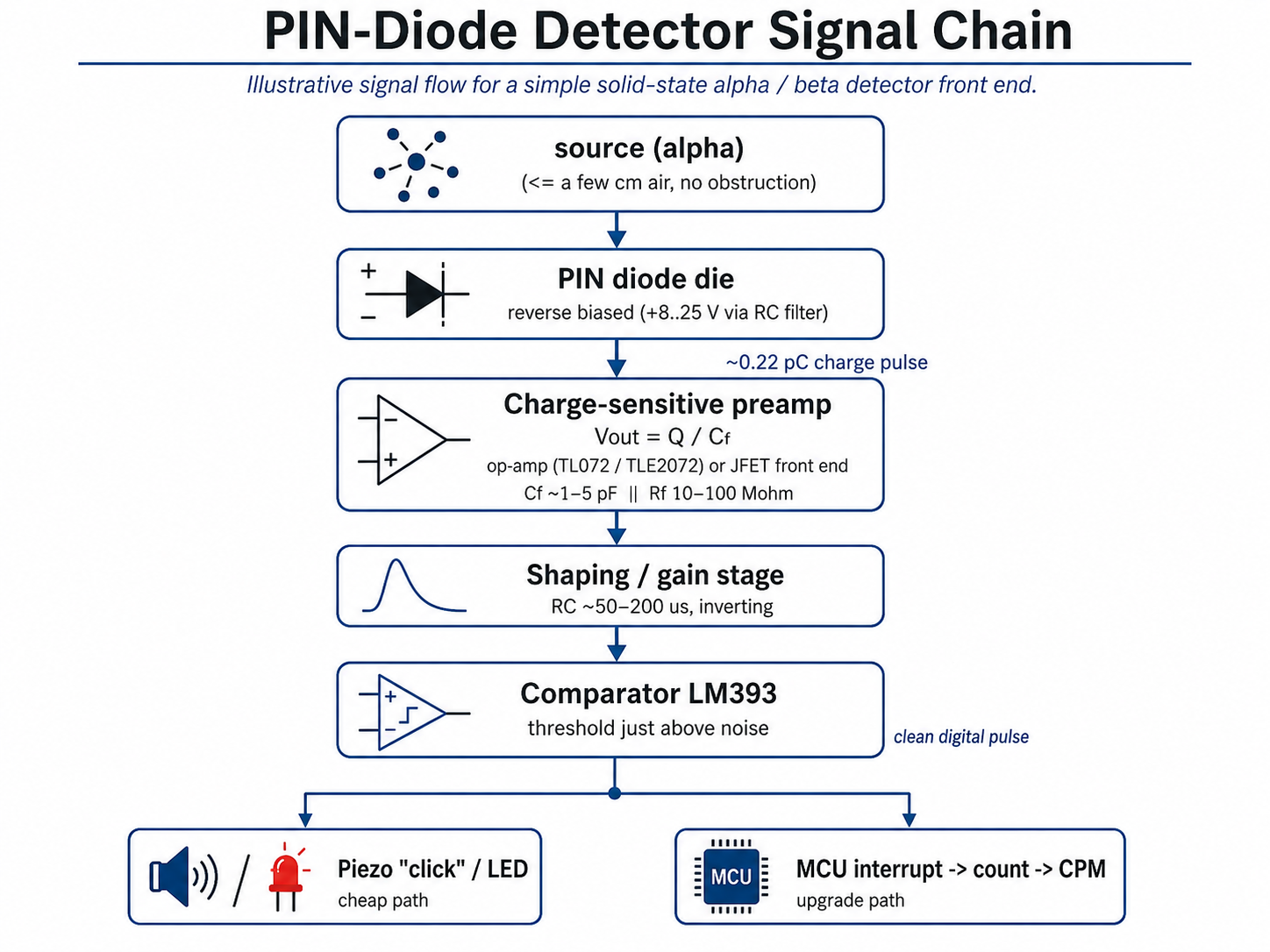
- The best avenue is the PIN photodiode plus a charge-sensitive amplifier. A reverse-biased silicon PIN photodiode (BPW34, or better a metal-can BPX61 with the glass window cracked off) feeding a charge-sensitive preamp, a shaping/gain stage, an LM393 comparator, and a click/counter is the proven, canonical, cheapest path that actually works. The Zener-diode approach is the worst (its avalanche breakdown is itself a noise source), and the LED/transistor ideas are valid only in narrow senses (a decapped transistor junction is a legitimate but lower-grade sensor; a transistor's real job here is amplification; a reverse-biased LED is a curiosity).
- The physics forces one non-negotiable design rule: because a 5.486 MeV americium-241 alpha travels only ~3.5 to 4 cm in air and ~23 microns in silicon, and is stopped by a sheet of paper or the dead skin layer, the detector's silicon die must be physically exposed (decapped) and have a clear air path of at most a couple of centimeters to the source. A fully absorbed 5 MeV alpha deposits ~0.22 picocoulombs of charge (≈1.39 million electron-hole pairs at ~3.6 eV per pair), which a charge-sensitive amp turns into a tens-to-hundreds-of-millivolt pulse.
- Cost and verdict: roughly $18 to $30 for the cheapest viable build, $55 to $90 upgraded, versus several hundred to several thousand USD for a commercial alpha survey meter. Use the single-sheet-of-paper test to prove you are seeing alphas (not beta/gamma). It is a fine point-source detector and teaching/spectrometry instrument, not a calibrated contamination-survey tool.
2. At-a-Glance Box
- Total estimated cost (USD): Cheapest viable path ~$18 to $30; upgraded path (microcontroller counter + die-cast box + USB soundcard spectrometry) ~$55 to $90. Prices are estimates and vary by region and date.
- Estimated build time: 1 weekend (6 to 10 hours), including careful diode decapping and light-tightness testing. (For reference, CERN S'Cool LAB workshops report assembling the comparable kit, including modifying a candy-tin enclosure, in under two hours once parts are in hand; budget more for first-time decapping and debugging.)
- Difficulty: Intermediate. Soldering small components, careful mechanical decapping of a metal-can diode, and patient debugging of a very high-gain, noise-sensitive analog front end.
- Key tools: Fine-tip soldering iron, multimeter, small pliers or Dremel/rotary tool, drill, and ideally borrowed access to an oscilloscope (or a USB soundcard used as a software scope) for first commissioning.
3. Abstract / Purpose
This post explains how to detect alpha radiation at home using cheap silicon junctions. Alpha particles are helium-4 nuclei, typically 4 to 6 MeV from common sources. They have an extremely short range (a few centimeters in air, tens of microns in solids) and cannot penetrate the epoxy or glass packaging of an ordinary diode, or even a sheet of paper. The central engineering consequence is that the detector's silicon die must have a direct, unobstructed line of sight to the source through a few centimeters of air at most. That forces a "decapping" step: the package window must be removed or a windowless die used.
The report evaluates the three approaches in the project title: (a) a reverse-biased PIN photodiode feeding a charge-sensitive amplifier; (b) a Zener diode under fixed reverse bias; and (c) transistor/LED-based junction detectors. It concludes that the PIN photodiode plus charge-sensitive preamp is clearly the best avenue, gives a complete reference circuit, costs, a bill of materials, build steps, validation procedures (including the paper-sheet test), and an honest account of limitations.
Who it is for: an off-grid, repair-first, FOSS-minded builder who wants a working alpha detector for a fraction of the price of a commercial alpha survey meter. What it is not: a calibrated dosimeter or a laboratory alpha spectrometer (though an upgrade path toward spectrometry is described).
4. Design Rationale & Theory of Operation
4.1 The physics that dictates the whole design
Alpha range. A 5.486 MeV alpha from americium-241 has a range of only about 3.5 to 4 cm in air at sea level. (Per Wikipedia's "Americium-241," "The principal α-decay energies are 85% 5.486 MeV, 13% 5.443 MeV, and 2% 5.388 MeV.") In solids the range collapses to tens of microns: roughly 23 to 24 microns in silicon for a 5 MeV alpha. The practical numbers a builder must internalize:
- Range in air (Am-241, 5.486 MeV): ~3.5 to 4 cm.
- Range in silicon (5 MeV): ~23 microns, with the Bragg peak around 22 microns.
- Stopped by: a single sheet of paper, the dead skin layer (~40 microns), or the epoxy/glass window of an ordinary diode.
As opengeiger.de's Bernd Laquai puts it, "There is a rumour saying that a PIN diode counter is not able to detect alpha radiation. Even though this rumour is not correct... [alphas] are absorbed quickly and completely already by foils or sheets of a few mm thickness or even in air." The diode silicon detects alphas easily; the packaging is what blocks them. Remove the window and the alphas get in.
Energy deposition and charge generation. In silicon it takes on average about 3.6 eV to create one electron-hole pair (measured at 3.61 to 3.62 eV for ~5.5 MeV alphas at 300 K, per Phys. Rev. 136, A1756, 1964). A 5 MeV alpha that stops fully in the silicon therefore generates roughly 5,000,000 / 3.6 ≈ 1.39 million electron-hole pairs. The resulting charge is Q = N × e = 1.39e6 × 1.602e-19 C ≈ 0.22 picocoulombs. Independent semiconductor-physics sources put a fully absorbed 5 MeV alpha at around 225 fC (0.225 pC), consistent with this estimate. (opengeiger.de's note that "a 5 MeV alpha particle can produce a charge of 4.5E6 pairs" assumes the full intrinsic bandgap of 1.1 eV per pair rather than the empirical 3.6 eV ionization energy; the 3.6 eV figure is the correct one for charge actually collected, and is the value used throughout the detector literature.)
Why this is hard but doable. 0.22 pC is a tiny charge. Dumped onto a small reverse-biased junction capacitance (a BPW34 at a few volts reverse bias presents on the order of 25 pF; the depletion-region capacitance falls with increasing reverse bias), it produces a step of only tens of millivolts at most, and far less if the charge is shared with amplifier input capacitance. The job of the front-end electronics is to collect that fixed charge cleanly and convert it to a voltage pulse well above the noise floor. Alphas are actually the easy case: because a 5 MeV alpha deposits far more energy than a beta or a gamma interaction in thin silicon, alpha pulses are the largest pulses the detector produces, which is why alpha detectors can run at lower gain and are less sensitive to noise than beta/gamma builds.
Depletion region and reverse bias. A reverse-biased PIN diode forms a depletion region (in a PIN diode, mostly the intrinsic I-layer) that is swept clear of free carriers and has a strong internal electric field. An alpha entering this region creates the electron-hole plasma; the field sweeps electrons and holes apart before they recombine, and the motion induces the signal current. More reverse bias widens the depletion region and lowers junction capacitance (less noise, faster collection), at the cost of slightly more leakage current. For these small diodes, a bias of about 8 to 25 V is typical: the CERN DIY detector runs the BPX61/BPW34 at about 8 V from a 9 V NiMH battery, giving a depletion depth of (50 ± 8) microns; PhysicsOpenLab's BPX61 alpha build runs 25 V reverse bias for a depletion "between 50 and 100 μm." Either comfortably exceeds the ~23 micron alpha range, so essentially all of the alpha energy is collected.
4.2 Why a charge-sensitive amplifier (CSA), not a plain voltage amp
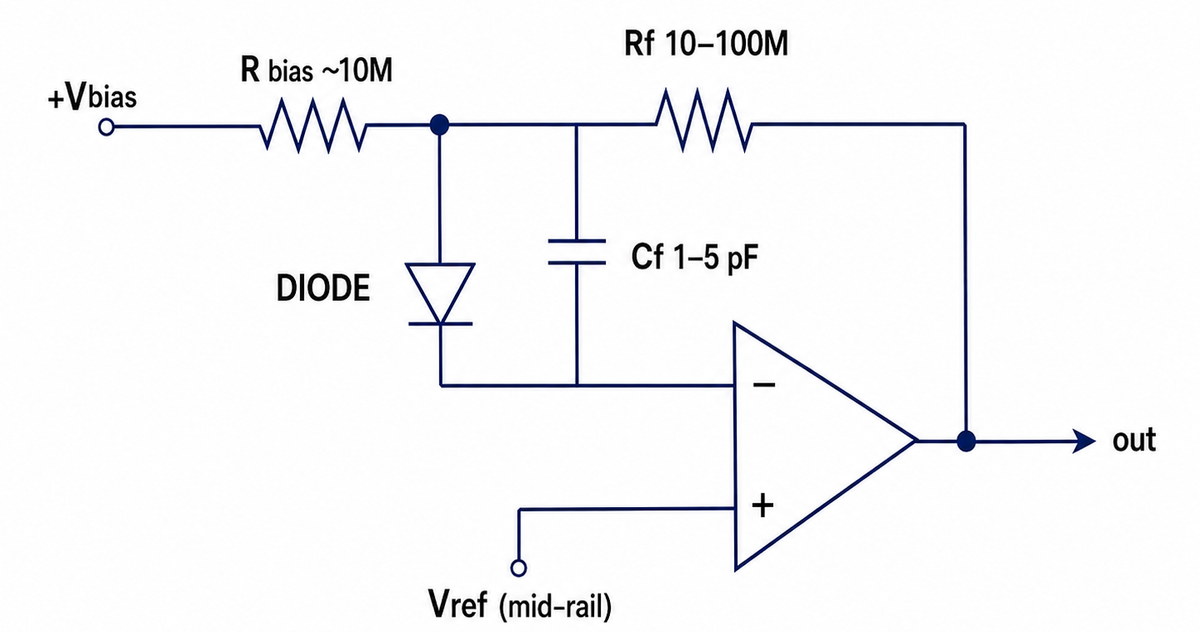
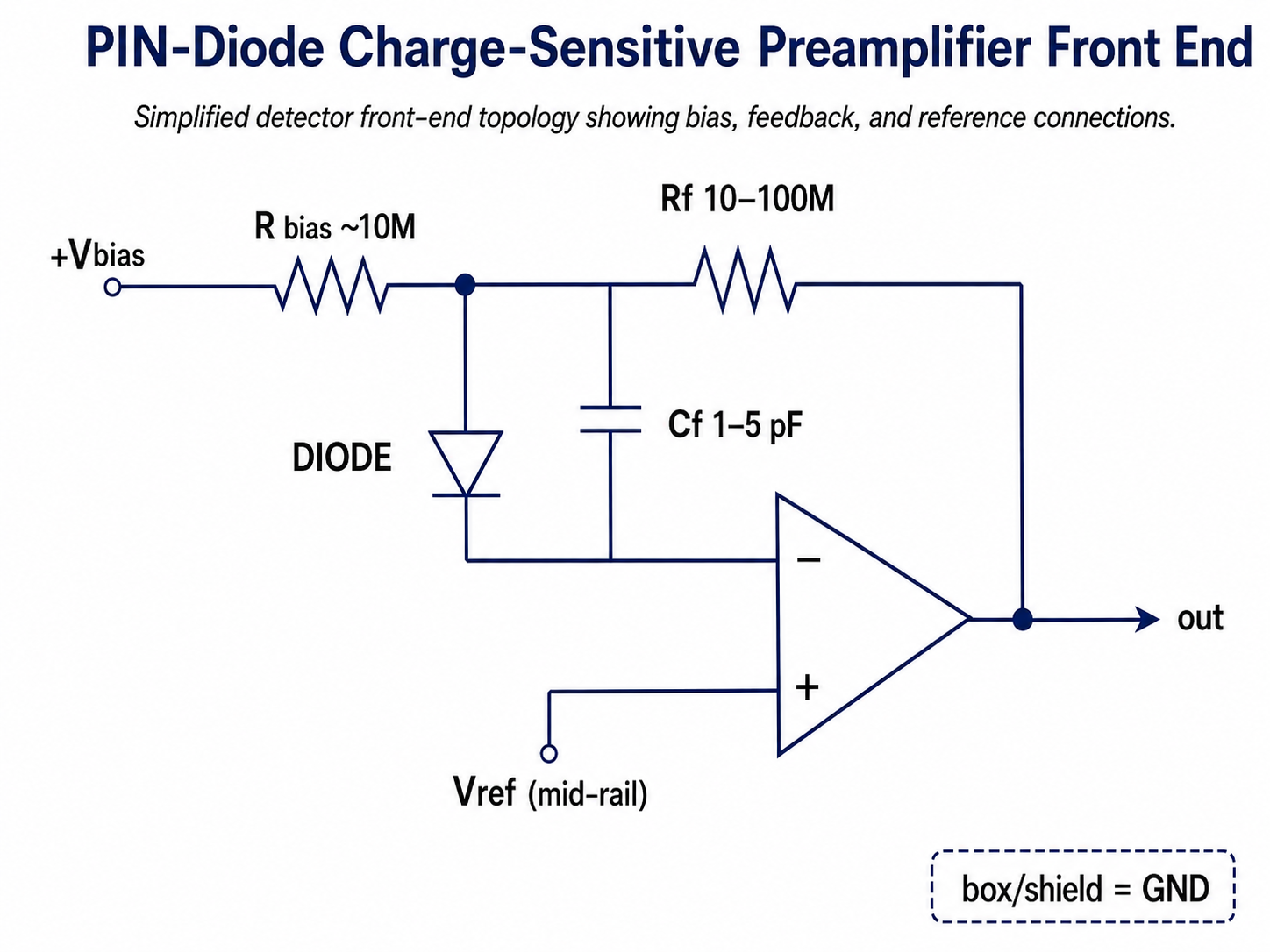
The signal is a fixed quantity of charge, not a fixed voltage. The diode capacitance varies with bias, temperature, and from part to part. If you amplify voltage, your gain depends on that messy capacitance. A charge-sensitive amplifier solves this: an op-amp (or JFET front end) with a small feedback capacitor Cf integrates the charge so the output step is V = Q / Cf, independent of the diode capacitance. With Cf around 1 to 5 pF, a 0.22 pC alpha gives roughly 0.22 pC / 1 pF ≈ 220 mV, a healthy pulse. A large feedback resistor Rf in parallel with Cf (tens to hundreds of megohms) slowly bleeds the charge so the amplifier resets between events; Rf × Cf sets the decay time constant.
Component values from working builds anchor these numbers:
- PhysicsOpenLab's BPX61 alpha detector uses a Cremat CR-110 hybrid charge-sensitive preamplifier "with a feedback capacity of 1.4 pF and a feedback resistance of 100 MΩ, [so] the time constant of the amplifier is 140 μs," with bias and filter resistors "of 10 MΩ."
- The CERN S'Cool LAB DIY Particle Detector (PhysicsOpenLab's reproduction) uses a feedback capacity of 5 pF and a discharge resistance of 40 MΩ for the alpha (BPX61) version (10 MΩ for the BPW34 beta version), giving a shaping time constant of about 200 μs for alpha and 50 μs for beta.
This is the canonical approach in every serious hobbyist and educational design: opengeiger.de (Bernd Laquai's "Stuttgarter Geigerle" and its alpha variant), the CERN S'Cool LAB "DIY Particle Detector" by Oliver Keller, the Theremino radiation sensors, RH Electronics' PIN diode detector, and PhysicsOpenLab's builds. They differ in component choices but share the architecture: reverse-biased silicon junction → charge-sensitive preamp → shaping/gain → discriminator → counter.
4.3 The three candidate approaches, ranked
(a) PIN photodiode + CSA (RECOMMENDED). The BPW34 is a clear-epoxy PIN photodiode with a silicon die of 2.65 × 2.65 mm (≈7 mm²; Vishay's BPW34 datasheet lists a 7.5 mm² radiant-sensitive area) and roughly a 50 micron depletion depth at ~8 V bias. It is cheap (about $1) and globally available. Its weakness for alpha work is the epoxy window: alphas cannot reach the die unless the package is opened, which per the CERN project is "quite difficult [to remove] without destroying the tiny bond wire connecting the anode." The cleaner choice is the BPX61, an electrically near-identical die in a TO-style metal can with a glass window that can be cracked off with small pliers, exposing a bare die that sees alphas directly. This is the proven path. Honest limitations: small active area (~7 mm²) means low geometric efficiency, so the source must be within a couple of centimeters; the bare die is exquisitely sensitive to light and EMI, so a light-tight, shielded metal enclosure is mandatory ("An absolutely light-tight and electromagnetically shielding metal case is mandatory," per the CERN repo).
(b) Zener diode under fixed reverse bias (NOT RECOMMENDED). A Zener can be reverse-biased and will respond to ionizing radiation, but it is a poor detector. Zeners are engineered around their breakdown, and the avalanche/Zener breakdown process is itself a strong, broadband noise source. This is not a fringe claim: Texas Instruments' application brief "Low-Noise Zeners" documents that "the constant switching in and out of avalanche breakdown is what causes the Zener noise," and Analog Devices sells the effect as a feature, building "a low-cost white-noise generator... based on the avalanche noise generated by a zener breakdown phenomenon." Operating near or above breakdown buries the small radiation signal in avalanche noise, giving terrible signal-to-noise. A Zener operated well below breakdown is just a mediocre, heavily-doped, small-depletion-region diode with no advantage over a proper PIN photodiode. There is a genuinely interesting related phenomenon (Geiger-mode/SPAD-like single-particle detection near avalanche), but with the poor SNR and unstable behavior of a junk-box Zener it is a science-fair curiosity, not a reliable alpha detector. Verdict: avoid for alpha detection.
(c) Transistor / LED approaches (PARTIALLY VALID, NICHE). Two distinct ideas hide behind "transistor with voltage spike from the LEDs for activation":
- Decapped transistor as the sensor. The reverse-biased base-collector or base-emitter junction of a decapped transistor is a real, working particle detector. As one hobbyist documents: "I make my own alpha detectors by uncapping transistors and applying the particles directly to the base-emitter junction. This works for older power transistors (2N3055) as well as small signal 2N2222... clamp them by their head... in a drill press and apply a file to the outside while spinning." This is essentially the same physics as the PIN diode, with a smaller, less optimized depletion region. It is a legitimate cheapest-of-the-cheap salvage route. Note a TO-92 plastic 2N3904 is a poor choice (hard to open cleanly); a metal-can device (TO-18 2N2222A) is the practical pick.
- LED as a reverse-biased photodiode/SPAD. A reverse-biased LED can act as a photodiode and, near avalanche, as a crude single-photon avalanche detector (a well-documented undergraduate experiment; one AAPT lab notes an "AND113R LED, which starts to act like an avalanche photodiode at ≈ 26 ± 2V of reverse bias"). The same source is blunt that "these LEDs are not designed for this purpose, so they make rather poor single-photon detectors." Most LEDs also have thick epoxy domes that block alphas unless decapped; some metal-can or windowed LEDs could work. The "voltage spike from the LED" phrasing also matches a real circuit element: in some CSA designs (e.g., the Canberra patent US6587003B2) an LED optically resets the JFET front end ("LED 80 illuminates JFET 70 momentarily, but intensely, causing charge conduction... return[ing] to its original starting condition"). That is a reset trick, not an alpha sensor.
- Transistor as the amplifier. A discrete JFET or low-noise BJT front-end stage is the classic low-noise way to amplify the tiny junction current pulse. A JFET (2N5457, BF862) in front of the op-amp lowers input noise. So a transistor absolutely belongs in the design, as the amplifier, not as the primary alpha sensor.
Ranking: (1) PIN photodiode + CSA, clearly best; (2) decapped metal-can transistor + CSA, a valid salvage variant of the same physics; (3) LED as sensor, a curiosity; Zener as sensor, worst. The rest of this document builds approach (a), with approach (c)-transistor as the noted salvage fallback.
5. Specifications & Performance Targets
These are realistic targets for the recommended build, drawn from the published performance of equivalent designs. Treat them as order-of-magnitude expectations, not guarantees.
- Detector element: one silicon PIN photodiode die, 2.65 × 2.65 mm (≈7 mm²) sensitive area, ~50 micron depletion depth at ~8 V reverse bias.
- Detectable energy range (reference design): about 33 keV to 8 MeV. Per CERN S'Cool LAB / Keller et al. 2019, the detector "measures their energy between 33 keV and 8 MeV," with discrimination between alpha and beta particles "in an energy range of 33 keV to 8 MeV and under ambient air conditions." The minimum detection threshold of 33 keV (±6 keV) is set by electronic noise plus air straggling.
- Alpha energy resolution (if used for crude spectrometry): about 95 keV FWHM in ambient air in the CERN design. Per Keller et al. 2019, "In 1983 Dousse and Rhême showed that this diode, manufactured at the time by Siemens, was capable of performing precise α-spectrometry with a peak resolution of 18 keV full width at half maximum (FWHM) under vacuum conditions." A simple counter build does not need this; resolution matters only for the spectrometer upgrade.
- Pulse characteristics: charge-sensitive output pulses on the order of 50 to 220 mV at the preamp for alphas (depends on Cf and gain; PhysicsOpenLab reports "amplitude of about 50 – 100 mV" for its CERN-style build); pulse widths from tens of microseconds (shaped) up to about 1 ms (CERN audio-bandwidth output for soundcard sampling).
- Count rates: background on bare silicon is very low (the CERN diode detector logged background around 0.06 counts per minute). With an Am-241 source from a smoke detector at 1 to 2 cm, count rates rise dramatically and abruptly once the air gap is short enough for alphas to arrive ("the amplifier suddenly reacts with a massive increase of pulse heights and an increasing counting rate," per opengeiger.de).
- Power: single 9 V battery; current draw on the order of a few milliamps (a comparable 4-diode build drew ~5 mA). Battery operation is strongly preferred; mains supplies inject too much noise into this high-gain front end.
- Dimensions: fits in a tobacco-tin / candy-tin sized metal enclosure (roughly 100 × 60 × 30 mm).
- Duty cycle / service life: continuous; no consumables except the battery. The decapped die is the fragile part and must be protected from light, dust, humidity, and physical contact.
6. Bill of Materials
Prices are estimates in USD and vary by region and date. Generic descriptions are used by default; specific parts are named only where they materially affect the build.
| # | Item | Spec / Size | Qty | Generic Name / Recommended Model | Est. Unit Price | Est. Line Total | Source / Notes | Salvage Alternative |
|---|---|---|---|---|---|---|---|---|
| 1 | Detector diode | TO-style metal-can glass-window PIN photodiode | 1 | BPX61 (window removable for alpha detection; similar die to BPW34) | $4–$9 | $4–$9 | Electronics distributors (e.g., DigiKey) | Decapped metal-can 2N2222A transistor junction used as sensor |
| 2 | Alternative / extra diode | Clear-epoxy PIN photodiode | 1–4 | BPW34 (beta/gamma detection; alpha if window successfully thinned) | $1–$1.50 | $1–$6 | Widely available; LCSC volume pricing lower | Optical mice, IR receivers, salvaged photodiodes |
| 3 | Front-end op amp | Low-noise JFET-input dual op amp | 1 | TL072, TLE2072, or LM358 (higher noise) | $0.40–$1.50 | $0.40–$1.50 | Common distributor stock | Audio equipment circuit boards |
| 4 | Comparator | Open-collector dual comparator | 1 | LM393 | $0.30–$0.60 | $0.30–$0.60 | Comparator companion to LM358 | Salvaged electronics |
| 5 | JFET (optional front end) | N-channel low-noise JFET | 1 | 2N5457 or BF862 | $0.50–$2 | $0.50–$2 | Distributor stock | RF equipment |
| 6 | Feedback capacitor | ~1–5 pF, C0G/NP0 low leakage | 1 | Small ceramic capacitor | $0.10 | $0.10 | Distributor stock | Salvage |
| 7 | Feedback resistor | 10 MΩ–100 MΩ | 1–2 | High-value metal-film resistor | $0.10 | $0.20 | Distributor stock | Salvage |
| 8 | Assorted resistors and capacitors | Bias, shaping, and supply decoupling | ~20 | 1% metal film resistors, ceramics, electrolytics | ~$0.03 | ~$0.60 | Distributor stock | Any scrap PCB |
| 9 | Counter / indicator (cheap path) | 555 timer + piezo or LM393 output | 1 | NE555 + piezo buzzer | $0.50–$1.50 | ~$1.50 | Simple click-counter output | Piezo salvaged from old alarm |
| 10 | Counter / indicator (upgrade) | Microcontroller pulse counter | 1 | Arduino Nano, ATtiny, or clone board | $3–$8 | $3–$8 | Marketplaces and distributors | Broken gadgets |
| 11 | Enclosure | Light-tight conductive box | 1 | Die-cast aluminum enclosure or steel tin | $2–$12 | $2–$12 | Hardware store or household container | Free salvaged candy/tobacco tin |
| 12 | Battery + clip | 9 V battery (NiMH preferred) | 1 | 9 V block battery and clip | $2–$6 | $2–$6 | Common retail item | Salvaged battery clip |
| 13 | Connector / cable | Shielded coax or shielded audio cable | 1 | BNC or shielded 3.5 mm cable | $1–$4 | $1–$4 | Distributor stock | Salvaged shielded cable |
| 14 | Board | Perfboard or small PCB | 1 | Copper perfboard | $1–$3 | $1–$3 | Distributor stock | Salvage |
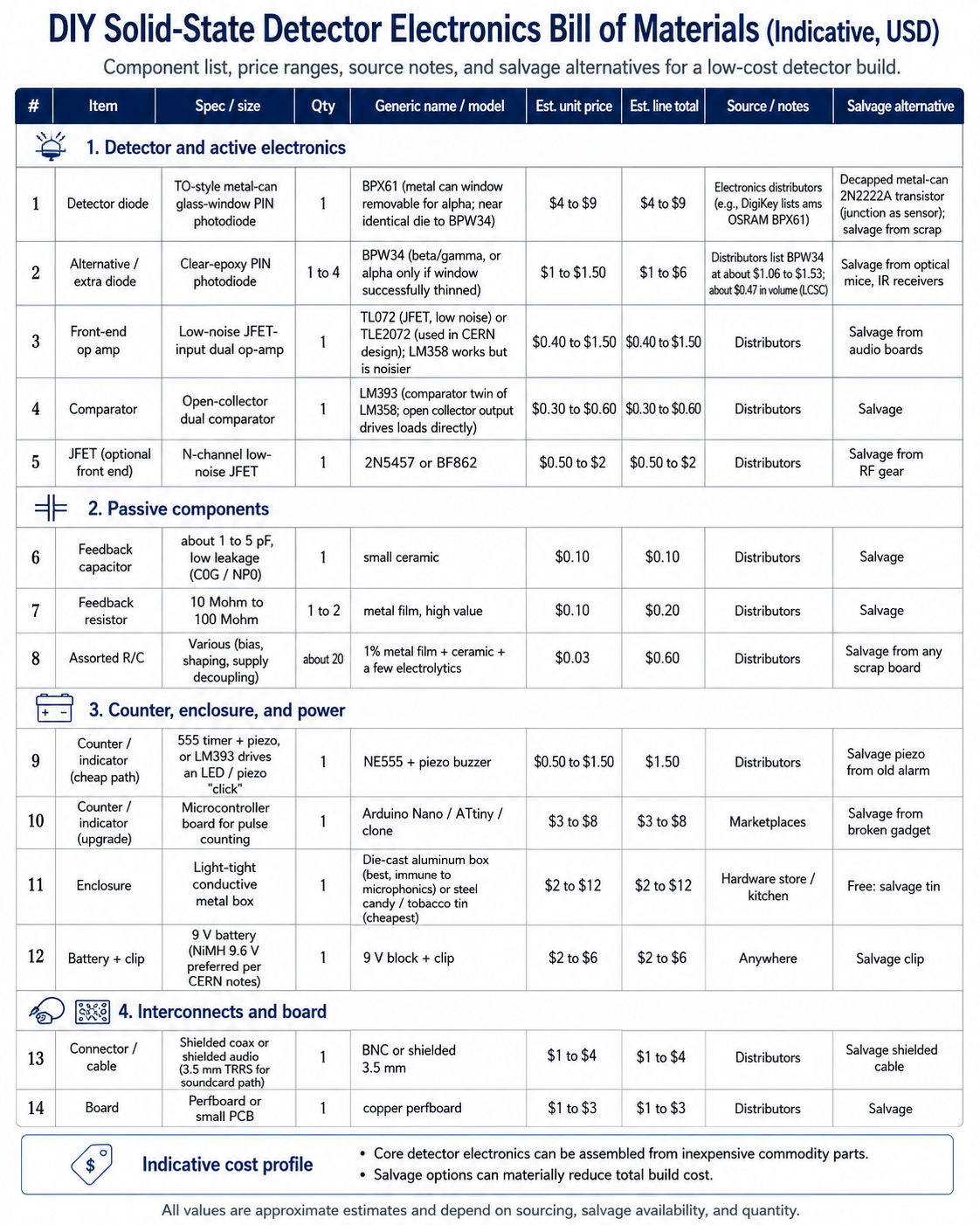
Cost summary.
- Cheapest viable path (salvaged tin box, BPW34 or decapped salvage transistor, TL072/LM358, LM393 + piezo click, no microcontroller, perfboard): roughly $18 to $30.
- Upgrade path (BPX61 metal-can diode, low-noise JFET front end, die-cast aluminum box, shielded cable, Arduino counter, and/or USB soundcard for pulse-height spectrometry): roughly $55 to $90.
7. Tools & Equipment
| Category | Tool | Cost if Bought | Manual / Borrow Fallback |
|---|---|---|---|
| Likely owned | Fine-tip soldering iron + solder | $15–$40 | Borrow one; a butane soldering iron also works |
| Likely owned | Digital multimeter | $10–$30 | Borrow from friend, maker space, or workshop |
| Likely owned | Small pliers, side cutters, files | ~$10 | Borrow basic hand tools |
| Likely owned | Hand drill / drill bits | ~$20 | Use a hand brace and bit |
| Borrow / rent | Oscilloscope (commissioning only) | $300+ | Use a USB sound card with free oscilloscope/MCA software, or a low-cost pocket DSO |
| Borrow / rent | Rotary tool (Dremel) for decapping metal cans | $30–$80 | Hand file (slower but workable, and arguably safer) |
| Buy (cheap) | Solder breadboard / perfboard | $1–$5 | Point-to-point "dead bug" wiring |
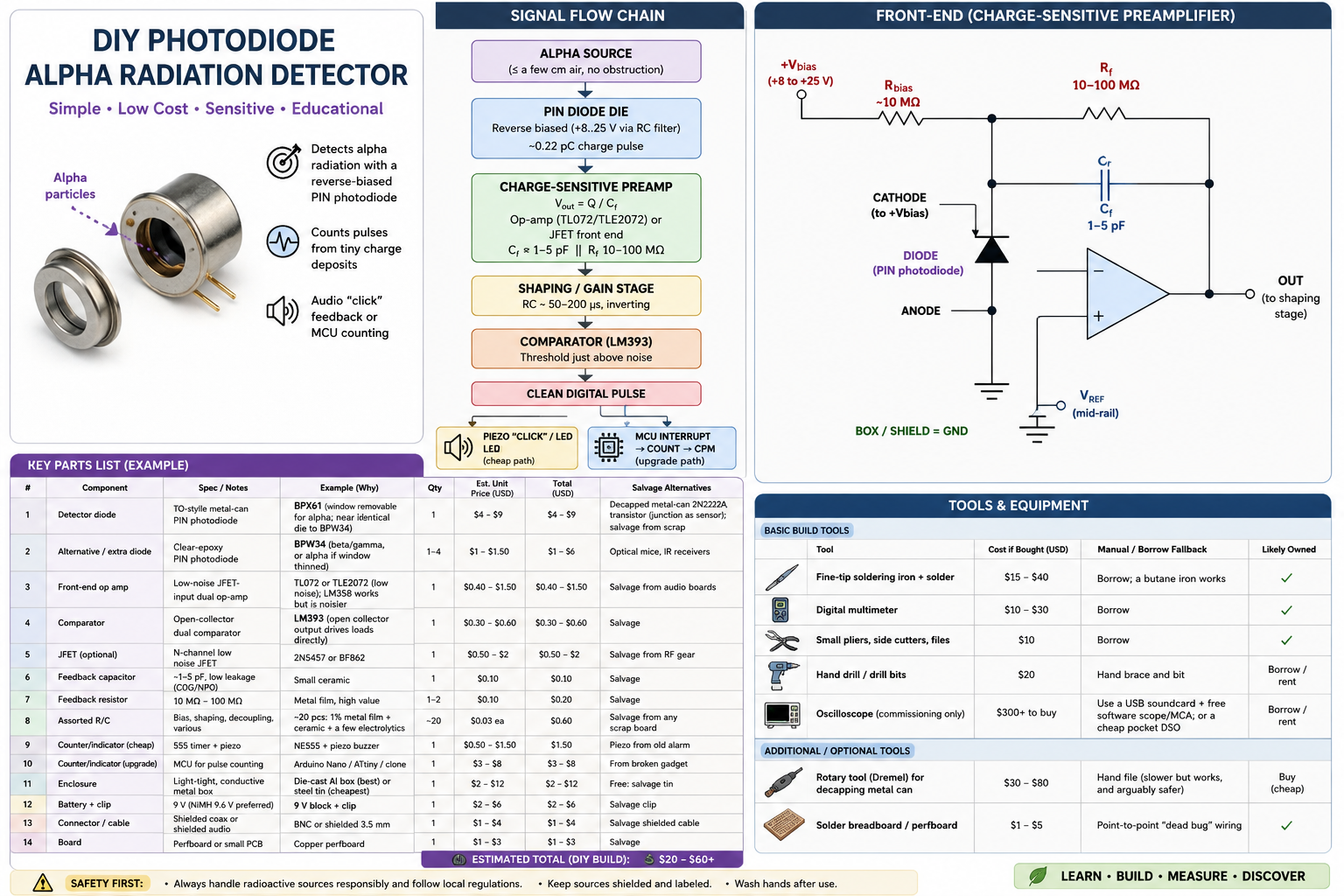
A power tool is useful only for decapping; a hand file is a fully adequate manual fallback and is in some ways safer (more control, less chance of flinging glass).
8. Skills & Safety
Required competencies: through-hole soldering of small parts; reading a schematic; using a multimeter to check bias voltages and continuity; patience for analog debugging of a microvolt-to-millivolt, high-gain front end; careful mechanical work to open a diode package without destroying the die.
Radiation safety / ALARA (read this twice). Alpha emitters are the classic example of a hazard that is trivial outside the body and serious inside it. An intact external alpha source at a few centimeters is a low external hazard, because alphas are stopped by air and the dead skin layer. The real danger is contamination: if the source material is inhaled or ingested, those same alphas deposit all their energy in living tissue at close range. Therefore:
- Keep any source intact. Never grind, file, dissolve, scratch, heat, or otherwise disturb a radioactive source. This applies especially to the Am-241 foil in a smoke detector and to thoriated welding electrodes (grinding thoriated tungsten produces inhalable thorium dust, which is the main documented hazard of those electrodes; in electrode form the tungsten itself absorbs most of the alpha emission).
- Wash hands after handling any source. Do not eat, drink, or smoke at the bench. Do not use radioactive antique glass or ceramics for food or drink (uranium can leach, especially with acidic contents).
- Apply ALARA: minimize time, maximize distance, keep sources stored and labeled, and keep the smallest activity that does the job.
- Smoke-detector Am-241: it is the classic hobbyist alpha source. Per the ATSDR Toxicological Profile for Americium, "A typical household smoke detector contains 0.9 microcuries (µCi)... or 33,000 Bq of 241Am" (Wikipedia's "Americium-241" instead cites "1 microcurie/37 kBq" / 0.29 µg per new detector; both figures appear in the literature). The source is sealed in a thin gold/silver foil (the NRC notes the gold cover is only ~0.002 to 0.003 mm thick) and must stay that way. Removing it from the detector, and disturbing the foil, may be illegal in your jurisdiction and voids the smoke detector (a life-safety device). In the US the device is sold under an NRC exemption (10 CFR 30.15(a)(7) and 32.27, "ionization chamber smoke detectors containing not more than 1 microcurie of americium-241 per detector in the form of a foil"); the exemption covers the intact device, not extraction and redistribution of the source. Check local rules before doing anything beyond pointing your detector at an intact, mounted source. Honestly, the lower-risk testing route is uranium glass, an old thoriated lantern mantle, or a thoriated TIG electrode kept intact, not opening a smoke detector.
Other hazards.
- Decapping with acid is dangerous: do not. Hot concentrated/fuming nitric acid is the industrial way to dissolve epoxy packages (heated to 75 to 80 °C in jet-etch equipment). It is severe: corrosive, produces toxic NOx fumes, and is unsuitable for a home bench. This document recommends the mechanical metal-can route instead. If you ignore this and use acid anyway, that is outside the scope of safe practice here.
- Eye hazard during decapping. Cracking a glass diode window flings glass shards. Wear eye protection; crack the window pointing down into a bin (the CERN wiki tip: "keep the diode upside down above a trash can during this procedure such that the glass pieces fall immediately down and away from the silicon chip").
- Soldering: burns, fumes; ventilate, use a stand.
- Stored energy: this is a low-voltage battery circuit; the main "stored energy" caution applies only if you add a high-voltage bias supply, which this design avoids.
- Mains: none if you run on a battery, as recommended.
Codes/standards to check locally: national radiation-source regulations (US: NRC 10 CFR Parts 30/31/32; in agreement states, the state program; elsewhere the national equivalent), rules on possession and disposal of radioactive consumer products, and electrical/e-waste disposal rules. The builder is responsible for compliance.
9. Build Instructions
References are to BOM item numbers.
Phase A: Prepare the detector diode.
- Choose your sensor. Cheapest-safe-and-works for alpha: a metal-can glass-window PIN photodiode (BOM 1, BPX61). For beta/gamma only, or as a learning build, the clear-epoxy BPW34 (BOM 2) needs no decapping but will not see alphas.
- Decap the metal can. Hold the diode upside down (window facing the bin). With small pliers, cut four small dents into the rim of the metal can; this cracks the glass window. Tap gently to drop the glass out. Go/no-go check: the bare silicon die is visible and the thin bond wire from the anode pin to the die top is INTACT. If the bond wire tears, the diode is dead; start over. (Mechanical-decap alternative: clamp a metal-can transistor by the head and file the top off while spinning, then use its reverse-biased junction as the sensor.)
- Handle the bare die only by the leads from now on. Do not touch the die surface.
Phase B: Charge-sensitive preamplifier. 4. Wire the diode reverse-biased: cathode to the positive bias (about +8 to +25 V from the battery rail through a high-value bias resistor of ~10 MΩ and an RC filter to keep the bias quiet), anode to the amplifier summing node (inverting input of the op-amp, BOM 3, or the gate of the JFET front end, BOM 5). 5. Build the CSA: op-amp inverting integrator with feedback capacitor Cf (BOM 6, ~1 to 5 pF) in parallel with feedback resistor Rf (BOM 7, 10 to 100 MΩ). Worked examples: Cf = 5 pF with Rf = 40 MΩ (CERN alpha build, ~200 µs constant) or Cf = 1.4 pF with Rf = 100 MΩ (PhysicsOpenLab/Cremat, 140 µs). Critical: keep this node tiny and clean. Stray capacitance and leakage here directly degrade noise. Short leads, clean flux, consider a guard ring or Teflon standoff for the summing node. 6. Add the second gain/shaping stage (second op-amp in the dual package): an inverting amp with an RC that rounds the pulse and sets the shaping time constant. Reference designs use ~200 µs for alpha, ~50 µs for beta. A low-pass output filter rounds the pulse so a slow ADC or soundcard can capture it.
Phase C: Discriminator and counter. 7. Feed the shaped pulse to the comparator (BOM 4, LM393). Set the threshold with a trimmer just above the noise band so noise does not trigger counts but real pulses do. 8. Cheap path: the comparator output drives a piezo (BOM 9) for an audible "click" per event, or triggers a 555 monostable to stretch the pulse for an LED blink. Upgrade path: feed the comparator's clean digital pulse to a microcontroller interrupt pin (BOM 10) and count edges; compute counts per minute in firmware (standard approach: attach an interrupt to pin 2/3 on an Arduino UNO, increment a counter, sum over a rolling window to display CPM).
Phase D: Light-tight, EMI-shielded enclosure. 9. Mount the board in the metal box (BOM 11). The bare die MUST be in total darkness: any light leak swamps it (it is, after all, a photodiode). Tin or aluminum also acts as a Faraday cage against EMI. Connect the box to circuit ground. A die-cast aluminum box additionally resists "microphonic" effects from vibration. 10. Bring the source close to the die through the inside of the box, or build a small lidded sample chamber so a sample can be placed 1 to 2 cm from the die with no light entering. Run the signal/power out through a feedthrough that does not admit light (a grommeted hole with a shielded cable, BOM 13). Go/no-go check: in a lit room with bias on and no source, the count rate must be at or near background. A high count rate in the light means a light leak.
10. Drawings & Schematics
Recommended free tools: KiCad (schematic + PCB), FreeCAD or LibreCAD (enclosure drawings), Inkscape (figure art).
11. Testing, Calibration & Validation
- Pre-power checks. With a multimeter, verify supply polarity, that the diode is reverse-biased (cathode positive), and that there are no solder bridges at the high-impedance summing node.
- Light-tightness test. Bias on, no source, lid closed, in a bright room. The count/click rate must drop to background. If it stays high, you have a light leak or the lid is not sealed. Fix before proceeding. (A bare photodiode in light produces a continuous high rate, an unmistakable symptom.)
- Noise floor and threshold. With an oscilloscope (or USB-soundcard software scope) on the preamp output, observe the noise band. Set the comparator threshold just above it. Too low gives constant counts; too high gives zero counts.
- Background rate. Closed, no source: log counts for several minutes. Expect a very low background on bare silicon (the CERN diode detector recorded an average background rate of 0.06 cpm; larger-area or multi-diode builds see a few cpm from gamma background).
- Functional test with a source. Place an intact alpha source (uranium glass, thoriated mantle/electrode, or a mounted smoke-detector Am-241) 1 to 2 cm from the die. The rate should jump sharply. If it does not, shorten the air gap; remember alphas die at ~3.5 to 4 cm in air.
- The paper-sheet test (the key alpha validation). With a source giving a strong count rate, slide a single sheet of paper (or a few extra cm of air) between source and die. If the rate collapses to background, you were detecting alphas (paper stops alphas but not beta/gamma). If the rate barely changes, you are seeing beta/gamma, not alpha. This simple test is how you prove alpha detection rather than assuming it. clectronics
- Optional energy calibration (spectrometer upgrade). Feed the analog pulse to a USB soundcard and use multichannel-analyzer software (e.g., the Theremino MCA tooling, or the CERN DIY detector's recording software/web app) to histogram pulse heights; calibrate against the known Am-241 5.486 MeV line.
12. Operation
- Operate on battery for lowest noise. Keep the lid closed; the die must stay dark during use.
- Bring samples close (1 to 2 cm) and keep the path clear. Dust, condensation, or a smear over the die attenuates alphas.
- Do's: keep sources intact; wash hands; log background regularly; use the paper test to confirm alpha vs beta/gamma.
- Don'ts: do not open or grind sources; do not run from a noisy mains adapter; do not touch the bare die; do not expect quantitative dose readings (this is a counter, not a calibrated dosimeter).
- Operating envelope: indoor, room temperature, dry. The bare die dislikes humidity and temperature swings (leakage current and noise rise with temperature).
13. Maintenance
| Interval | Task | Consumable / Wear Part | Estimated Cost |
|---|---|---|---|
| Each use | Confirm light-tightness and background count rate | None | $0 |
| Each use | Check battery voltage | 9 V battery | $2–$6 when depleted |
| Monthly | Inspect detector die for dust or condensation; reseal enclosure if needed | None | $0 |
| As needed | Re-set comparator threshold to compensate for component aging | None | $0 |
| Yearly | Re-verify operation using the paper-sheet test and a known source | None | $0 |
| On failure | Replace decapped detector diode if bond wire fails or the die becomes contaminated | 1 detector diode | $1–$9 |
14. Troubleshooting
| Symptom | Likely Cause | Fix |
|---|---|---|
| Constant high count rate |
Light leak onto bare die; Threshold below noise floor; EMI pickup |
Seal enclosure; raise threshold; ground the enclosure; shorten summing-node leads. |
| Zero counts even with strong source |
No bias voltage; Dead diode (snapped bond wire); Threshold too high; Source too far away |
Verify reverse bias with a multimeter; inspect bond wire; lower threshold; move source to within 1–2 cm of the detector. |
| Erratic, bursty counts |
EMI; Poor grounding; Microphonics (vibration); Unstable power source |
Improve grounding and shielding; use a die-cast metal enclosure; operate from battery power; mechanically secure the board. |
| Counts occur but paper test does not reduce them | Detector is seeing beta or gamma radiation rather than alpha particles | Confirm the detector window has actually been removed and verify the source is an alpha emitter positioned at very short range. |
| Rate drifts with temperature | Diode leakage current increases as temperature rises | Allow the detector to thermally stabilize; reduce bias slightly if needed; recognize this as a known limitation of the design. |
| Hum or oscillation on preamp output |
High-gain instability; Poor layout; Long signal leads; Parasitic capacitance |
Decouple power supplies; keep the feedback node compact; add a small compensation capacitor; use a tight PCB layout. Theremino notes warn that poorly laid-out high-gain front ends can "auto-swing." |
15. Variations, Scaling & Customization
- Cheaper / salvage: use a decapped metal-can transistor (2N2222A) junction as the sensor; salvage the op-amp, box, and cable.
- Larger active area: parallel several BPW34 diodes (as the opengeiger and CERN beta builds do, e.g., four diodes) for more sensitivity to weak sources, at the cost of more capacitance and noise; for alpha you would need each die exposed, which is harder, so arrays are more practical for beta/gamma.
- Indicator options: simple piezo "click" (cheapest), LED blink, or a microcontroller computing and displaying CPM with optional data logging.
- Regional adaptation: substitute locally available jellybean op-amps (LM358 is everywhere but noisier; TL072 is a good low-noise JFET-input compromise; TLE2072 if you can get it).
- Upgrade to a spectrometer: because the charge-sensitive output amplitude is proportional to deposited energy, feeding the analog pulse to a soundcard + multichannel-analyzer software turns the counter into a crude alpha spectrometer (the CERN design reaches ~95 keV FWHM in air; the same diode family reached 18 keV FWHM under vacuum, per Dousse and Rhême 1983). A small vacuum or low-pressure chamber sharpens alpha peaks by reducing air straggling.
16. Cost Analysis
- This build: ~$18 to $30 (cheapest) or ~$55 to $90 (upgraded). Build time ~6 to 10 hours.
- Nearest commercial equivalent: a dedicated alpha (or alpha/beta) scintillation survey instrument uses a ZnS(Ag) probe plus a ratemeter. Commercial alpha probes and survey meters from established makers (e.g., Ludlum Model 43-90/43-147, Mirion/Canberra SA-100, Fluke Biomedical ASM-990) run from several hundred to several thousand USD for probe + meter. A research-grade silicon Alpha-PIPS detector is better still: per Mirion's selection guide, a 450 mm² PIPS achieves "Values <= 16 keV (FWHM)" with "Absolute efficiency of up to 40%," but such detectors are far more expensive than this build. A bare PIN-diode detector kit/PCB (e.g., the open-source CERN design via Kitspace) is a few tens of dollars.
- Payback / cost-per-use: if your alternative is buying a commercial alpha survey meter, the DIY build saves on the order of hundreds to thousands of USD; the "payback" is immediate after the first use. The honest caveat is performance: a commercial ZnS(Ag) survey probe has far larger area (100 to 200 cm² vs ~0.07 cm² here) and is calibrated, so for surface-contamination surveying it is vastly more capable. The DIY unit is a point-source detector / teaching / crude-spectrometry instrument, not a survey tool.
17. References, Prior Art & Attribution
- Keller, O.; Benoit, M.; Müller, A.; Schmeling, S. "Smartphone and Tablet-Based Sensing of Environmental Radioactivity: Mobile Low-Cost Measurements for Monitoring, Citizen Science, and Educational Purposes." Sensors 2019, 19(19), 4264. DOI: 10.3390/s19194264. (Peer-reviewed basis of the CERN S'Cool LAB DIY Particle Detector; source of the 33 keV to 8 MeV range, 95 keV in-air FWHM, 33 ± 6 keV threshold, (50 ± 8) µm depletion at ~8 V, and the Dousse & Rhême 1983 18 keV vacuum result.)
- Keller, O., et al. "DIY Particle Detector" open-hardware repository. github.com/ozel/DIY_particle_detector (CERN OHL; BPX61 alpha-spectrometer and BPW34 electron-detector variants; assembly wiki with decapping instructions; 2.65 × 2.65 mm die; TLE2072 front end and component values in the hardware files). GitHub
- CERN S'Cool LAB. "DIY Particle Detector." scoollab.web.cern.ch/diy-particle-detector.
- Laquai, B. "Detection of Alpha Radiation with a PIN Diode Counter." opengeiger.de/Alphastrahlung_en.pdf, 2012. (Decapping a TO-5 photodiode with a Dremel; Am-241 smoke-detector and thoriated-mantle tests; source within ~4 cm.)
- Laquai, B. "Traditional versus PIN Diode Geiger Counter." opengeiger.de/Geigerzaehler_en.pdf, 2012. (The "Stuttgarter Geigerle" lineage.)
- PhysicsOpenLab. "CERN DIY Particle Detector," "Alpha Detector with BPX61 Photodiode," "PIN Diode Radiation Detector," "Si-PIN Photodiode β Detector," "Alpha Activity Measures," "Alpha Particles Range & Bragg Curve." physicsopenlab.org. (Circuit details: TLE2072, Cf = 5 pF, Rf = 40 MΩ / 10 MΩ, ~200 µs / 50 µs shaping, 8 V bias; Cremat CR-110, 1.4 pF, 100 MΩ, 140 µs, 25 V bias; 50 to 100 mV pulses.)
- Theremino Project. "Sensors of radioactivity." theremino.com/en/hardware/inputs/radioactivity-sensors. (PIN diode + charge amp, MCA via soundcard; layout/auto-oscillation cautions.)
- Hackaday. "Use A Cheap PIN Diode As A Geiger Counter" (2014); "A Trio Of Photodiodes Make A Radiation Detector" (2021); "Germanium Vision" (decapped-transistor sensors). hackaday.com / hackaday.io.
- Spalding, G., et al. "Introducing students to single photon detection with a reverse-biased LED in avalanche mode," and associated AAPT/ALPhA lab materials (LED as SPAD at ≈26 ± 2 V reverse bias). advlabs.aapt.org.
- Texas Instruments, "Low-Noise Zeners" (SLVAG25); Analog Devices, "Building a Low-Cost White-Noise Generator." (Zener/avalanche breakdown as a broadband noise source, i.e., why Zeners are poor detectors.)
- Klein, C.A., and Phys. Rev. 131, 134 (1963) and Phys. Rev. 136, A1756 (1964): electron-hole pair generation energy in silicon for alphas (ε ≈ 3.61 to 3.62 eV); arXiv detector-physics notes confirming ~3.6 eV per pair and ~23 µm 5 MeV alpha range / 22 µm Bragg peak in silicon.
- Canberra Industries, US Patent 6,587,003 B2, "Charge sensitive preamplifier with pulsed source reset" (LED optical reset of a JFET front end; transistor reset circuits).
- U.S. NRC, 10 CFR Parts 30/31/32 (byproduct material; smoke-detector Am-241 exemption, 10 CFR 30.15(a)(7) and 32.27); NRC "License-Exempt Consumer Product Uses of Radioactive Material." nrc.gov / ecfr.gov.
- ATSDR/CDC, "Americium Public Health Statement" (0.9 µCi / ~33 kBq per typical smoke detector); Wikipedia, "Americium-241" (5.486 MeV 85% branch; 1 µCi/37 kBq alternative figure; foil construction); NRC HPS "Can my smoke detector be leaking radiation?" (gold cover ~0.002 to 0.003 mm).
- ORAU Museum of Radiation and Radioactivity: "Vaseline and Uranium Glass," "Thorium Containing Welding Rod"; ESAB and Energy Institute notes on thoriated-tungsten (grinding-dust hazard). orau.org.
- Mirion, "Considerations for Choosing an Alpha Spectroscopy PIPS Detector" (≤16 keV FWHM at 450 mm², up to 40% absolute efficiency); Ludlum (43-90, 43-147) and Fluke Biomedical (ASM-990) product pages for commercial alpha-probe comparison.
- Knoll, G.F. Radiation Detection and Measurement (Wiley) — standard reference for semiconductor detectors, charge-sensitive preamps, and silicon detector physics.
18. License & Contribution
Hardware design: CERN-OHL-S v2 (strongly reciprocal: share modified hardware designs under the same license). Documentation: CC BY-SA 4.0 (share and adapt with attribution, share-alike). To contribute: fork the design files, keep the license notices, document your changes (especially diode type, op-amp, Cf/Rf, shaping constants, bias voltage, and measured background/threshold), publish your schematic and BOM, and share results back, ideally with oscilloscope traces and a paper-sheet-test log so others can reproduce your performance. Credit the prior art above, especially the opengeiger.de and CERN S'Cool LAB lineages on which this design rests. Note that the upstream CERN DIY Particle Detector is released under the older CERN-OHL v1.2; if you base a derivative directly on its files, observe that license's terms in addition to this document's.
Disclaimer: This is community documentation provided as-is; prices are estimates and the builder is responsible for local code compliance and safe practice.
License: Hardware: CERN-OHL-S v2. Documentation: CC BY-SA 4.0. Version: 1.0, 6 June 2026.
 John D