Kratos Defense, After the CCA Loss: Funded Backlog, Dilution, and the Affordable Mass Thesis
Kratos grew revenue 18.5% to $1.35B in FY2025 yet posted a 1.9% operating margin and negative free cash flow. A skeptical look at the growth thesis.

Kratos Defense & Security Solutions (NASDAQ: KTOS): Origins, Operating Position, and Forward Prospects
1. Summary
Kratos Defense & Security Solutions (NASDAQ: KTOS) has successfully repositioned itself from a debt-laden, organically shrinking rollup of communications and government-services businesses into a fast-growing, product-centric supplier of attritable air vehicles, small turbine propulsion, hypersonic flight-test infrastructure, solid rocket motors, satellite ground software, and microwave electronics; however, that top-line transformation has not yet converted into GAAP earnings power, and the equity trades at a valuation that prices in years of flawless execution not yet demonstrated [1][4][49].
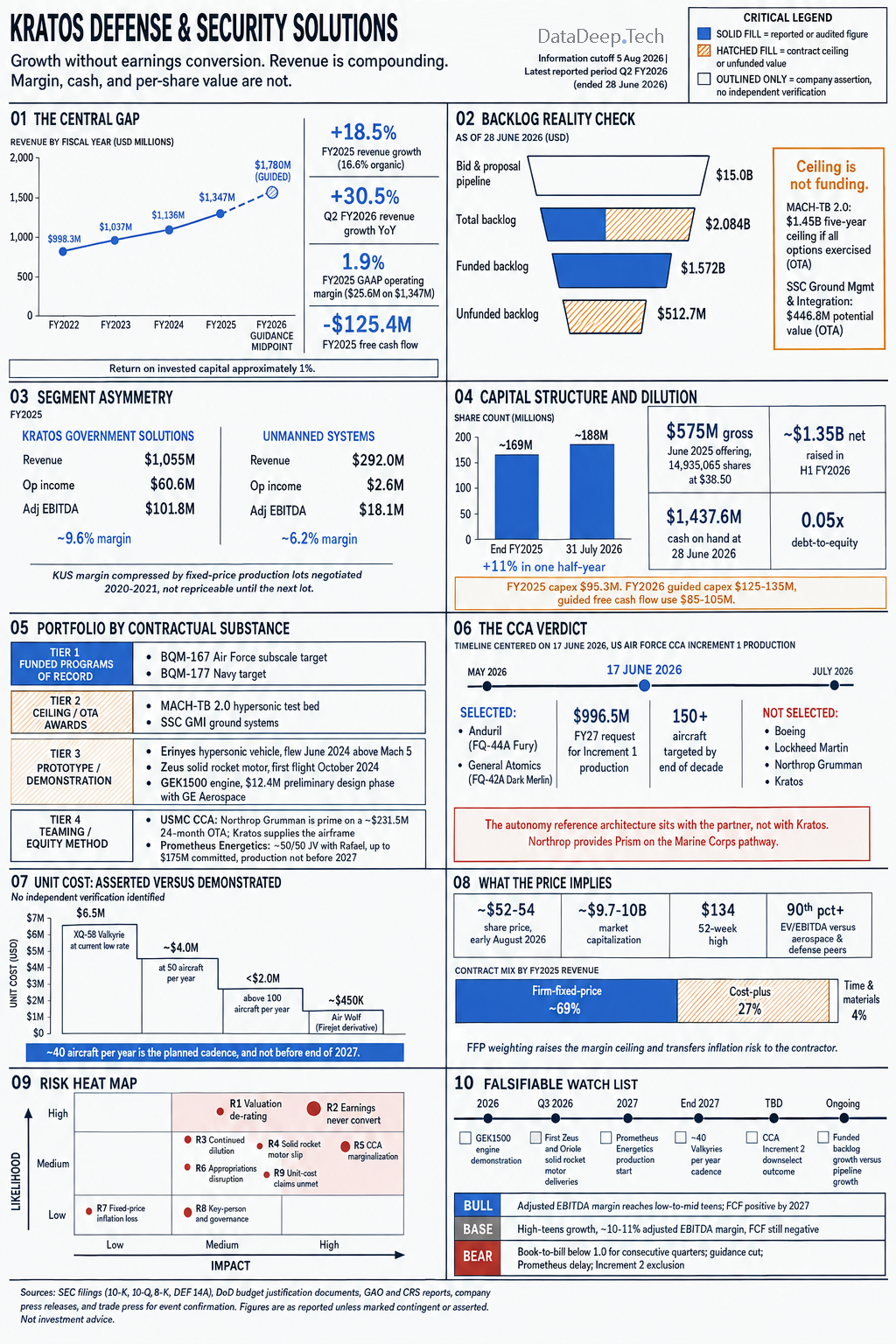
The central findings are as follows. First, revenue growth is real and accelerating: full-year 2025 revenue reached $1.347 billion, up 18.5 percent (16.6 percent organic), and the second quarter of fiscal 2026 reached $458.8 million, up 30.5 percent year over year [1][4]. Second, that growth has been accompanied by margin compression, negative free cash flow, and substantial share issuance, so per-share economics have lagged the headline: full-year 2025 GAAP operating income was only $25.6 million (roughly a 1.9 percent operating margin), free cash flow was a use of $125.4 million, and the share count rose from roughly 169 million to roughly 188 million during the first half of 2026 following an equity raise that the company's June 30, 2025 release described as "raising $575,000,000 in gross proceeds, at a public offering price of $38.50 per share, for a total of 14,935,065 shares," with net proceeds of approximately $556 million [1][4][36]. Third, the forward thesis rests heavily on programs that are early, contingent, or accounted for off-balance-sheet: the flagship Collaborative Combat Aircraft (CCA) production opportunity for the U.S. Air Force was lost to Anduril and General Atomics, the Marine Corps pathway runs through Northrop Grumman (NYSE: NOC) as prime, the Prometheus solid rocket motor venture will not produce until 2027 and is equity-method, and the largest announced awards are contract ceilings rather than obligated funding [4][16][22][25]. Fourth, the company's most consequential cost and performance claims, particularly Valkyrie unit cost at rate and the economics of merchant solid rocket motor production, are management assertions.
 Charlotte Bailey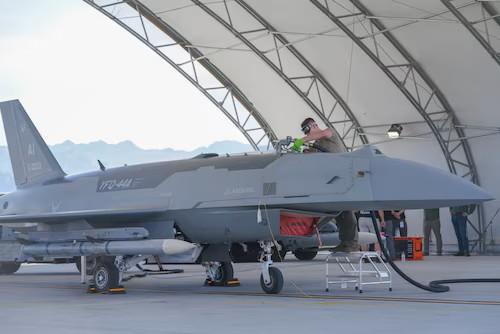
The load-bearing uncertainties are whether adjusted EBITDA margins can expand as promised while capital expenditure remains elevated; whether the hypersonics and solid rocket motor franchises convert ceiling awards into obligated, margin-accretive revenue; and whether the company's exclusion from Air Force CCA production is a durable competitive verdict or an artifact of a specific source-selection.
The information cutoff for this research is August 5, 2026; the most recent reported financial period available was the second quarter of fiscal 2026 (quarter ended June 28, 2026), reported August 4, 2026, and the most recent audited full year was fiscal 2025 (ended December 28, 2025) [1][4].
Kratos Defense: Growth Without Earnings Conversion in Attritable Air, Hypersonics, and Solid Rocket Motors
1. Summary
2. Corporate History and Strategic Evolution
- 2.1 Origins in wireless infrastructure and the pivot to defense
- 2.2 Governance history: the stock-option backdating episode
- 2.3 The acquisition-led rollup and the leverage peak
- 2.4 Deleveraging, divestiture, and repositioning around affordable mass
3. Contextual and Technical Background
- 3.1 The doctrinal shift to affordable mass and cost-per-effect
- 3.2 The physics and economics of expendable and attritable airframes
- 3.3 Small turbine propulsion, solid rocket motors, and hypersonic test infrastructure
- 3.4 Satellite ground systems, microwave electronics, and C5ISR
4. Business Segments, Program Portfolio, and Contract Structure
- 4.1 Segment composition, revenue, and margin
- 4.2 Contract vehicle mix and its margin implications
- 4.3 Backlog: ceiling, funded, and total
- 4.4 Program-by-program status: funded, prototype, and teaming
5. Key Players and Stakeholders
- 5.1 Customers and program offices
- 5.2 Competitors
- 5.3 Partners and joint ventures, characterized by substance
- 5.4 Launch services and the Rocket Lab relationship under MACH-TB 2.0
- 5.5 Vertical integration and supplier base
- 5.6 Management, board, ownership, and insider activity
6. Technical and Operational Considerations
- 6.1 Demonstrated versus claimed performance
- 6.2 Unit cost claims: structural versus contractual advantage
- 6.3 Manufacturing scale-up, capital intensity, and workforce
- 6.4 Qualification and test-pathway risk
- 6.5 Autonomy, command and control, and integration
7. Economic and Market Dynamics
- 7.1 Multi-year financial history and the earnings-conversion gap
- 7.2 Capital structure, dilution, and the shift from debt to equity
- 7.3 Addressable market, built from budget structure
- 7.4 Valuation: what the price implies
8. Regulatory and Programmatic Landscape
- 8.1 Export control and foreign military sales
- 8.2 Appropriations mechanics and continuing-resolution exposure
- 8.3 Government contracting compliance
9. Geopolitical and Strategic Dimensions
- 9.1 Magazine depth, cost exchange, and surge capacity
- 9.2 Allied demand and industrial-base policy
10. Risk Matrix
11. Forward Outlook and Falsifiable Indicators
12. Strategic Recommendations
- 12.1 For institutional investors and capital allocators
- 12.2 For corporate strategists at primes, partners, and potential acquirers
- 12.3 For government program offices and acquisition policymakers
- 12.4 For suppliers and technologists evaluating engagement
13. References
2. Corporate History and Strategic Evolution
2.1 Origins in wireless infrastructure and the pivot to defense
The company was incorporated in New York in 1994, commenced operations in 1995, and reincorporated in Delaware in 1998, operating as Wireless Facilities, Inc. (formerly NASDAQ: WFII), a builder and manager of commercial wireless communications infrastructure [8]. Eric DeMarco, previously president and chief operating officer of the Titan Corporation (acquired by L3 Harris in 2005 for 2.65B), joined as president and COO in November 2003 and became chief executive officer in April 2004 [41]. On September 12, 2007, the company changed its name to Kratos Defense & Security Solutions, marking a deliberate exit from the commercial telecom services business and a reorientation toward national security work [8]. The severity of the transition, and of the financial distress that accompanied it, is captured by the 1-for-10 reverse stock split executed on September 10, 2009, when the pre-split closing price was $0.84 [8].
2.2 Governance history: the stock-option backdating episode
The early Kratos record contains a material governance and financial-reporting failure that bears on the reliability weight a skeptical reader should assign to management's forward representations. In 2004, while still Wireless Facilities, the company filed a fiscal 2003 Form 10-K/A restating results, including an approximately $11 million adjustment for tax contingencies and additional adjustments totaling approximately $30 million over a three-year period [6]. Beginning in the summer of 2006, current management initiated an "Equity Award Review" of historical stock-option granting practices covering more than 14,000 grants from two months before the November 1999 IPO through December 2006; previously filed reports were superseded and were not to be relied upon [6]. Separately, the company discovered a theft by its former stock-option administrator of options and stock valued in excess of $6.3 million; the individual pled guilty and was sentenced to 46 months in prison, and on April 1, 2008, the SEC notified Kratos that it had completed its investigation and did not intend to recommend enforcement action against the company itself [7]. The episode is now nearly two decades old and the responsible personnel are long gone, but it establishes that this management team assumed control amid a restatement and a securities-fraud environment, which is context for evaluating its later use of aggressive non-GAAP presentation.
2.3 The acquisition-led rollup and the leverage peak
From 2010 through roughly 2014, Kratos pursued a debt-financed acquisition rollup that assembled its government-services and electronics footprint. Signature transactions included Herley Industries (microwave electronics) for approximately $270 million and Integral Systems (satellite ground systems) at an enterprise value of approximately $266 million in 2011, and Composite Engineering, Inc. (the aerial-target airframe business that would later become the unmanned systems core) for approximately $155 million [10][11]. The strategy failed on its own financial terms: EBITDA margins fell from 13.1 percent in 2011 to 8.6 percent in 2014, EBITDA add-backs ballooned to 26 percent of management EBITDA versus 3 percent in 2012, and net leverage spiked from 5.2x in 2012 to 8.5x in 2014 [9]. The business was, in this period, in sustained organic decline, and short-side analysis characterized management's adjusted metrics as containing "dubious" add-backs used to hit guidance [9]. This is the second strand of evidence bearing on the credibility of current non-GAAP framing.
2.4 Deleveraging, divestiture, and repositioning around affordable mass
The corrective phase came through divestiture. In June 2015 Kratos sold the U.S. and U.K. operations of its Electronic Products division to Ultra Electronics for $265 million, applying the bulk of proceeds to debt reduction [9][10]. The company subsequently narrowed toward two reportable segments, Unmanned Systems (KUS) and Kratos Government Solutions (KGS), and rebuilt around a thesis that predates its current popularity: low-cost, high-rate, "attritable" systems designed to be fielded in mass and tolerate losses. The strategic bet, articulated repeatedly by DeMarco, is to make internally funded investments in facilities, tooling, and products ahead of government commitment, and to avoid dividends and buybacks in favor of reinvestment [1]. That model is the direct antecedent of the current capital-intensity and dilution profile: the same philosophy that now funds Valkyrie production lots and hypersonic facilities ahead of contract is a continuation, not a departure, from the acquisition-era habit of front-running demand, with the funding source shifted from debt to equity.
 Airbus
3. Contextual and Technical Background
3.1 The doctrinal shift to affordable mass and cost-per-effect
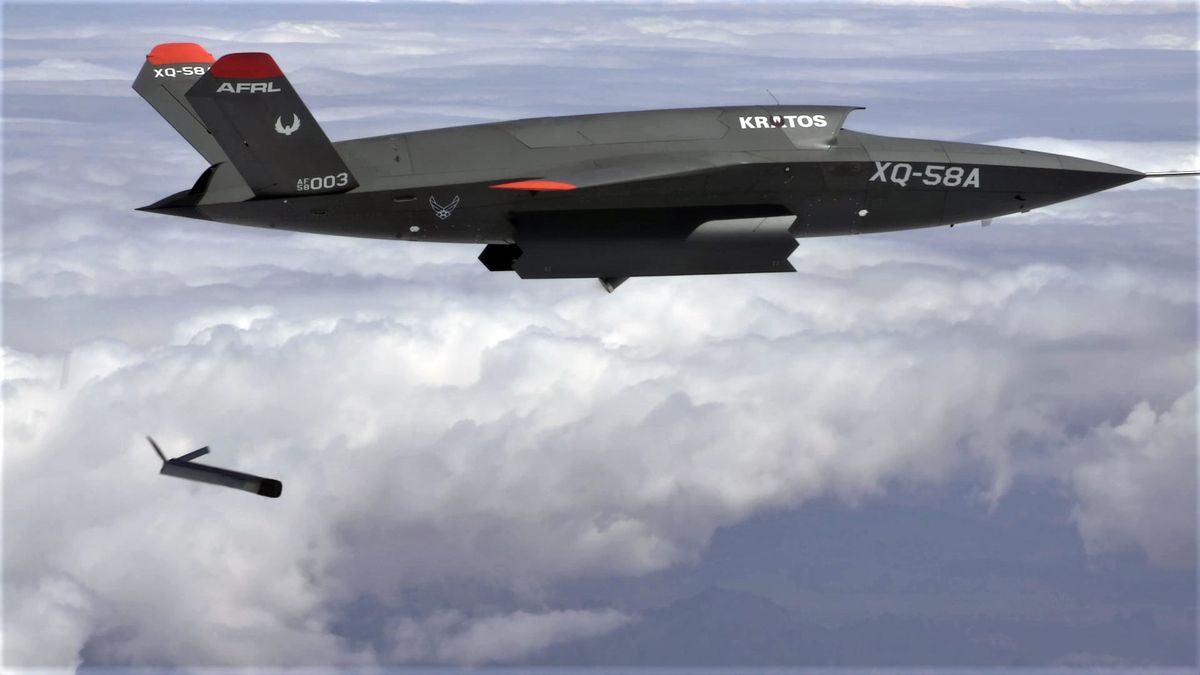
Kratos's addressable opportunity is a function of a doctrinal shift within the U.S. Department of War toward affordable mass: fielding large numbers of low-cost, autonomous or semi-autonomous air vehicles to complement a shrinking inventory of exquisite, expensive crewed platforms, and measuring capability in terms of cost-per-effect and cost-exchange ratio rather than platform performance alone [1][12]. The Collaborative Combat Aircraft concept, in which uncrewed "loyal wingmen" team with crewed fifth- and sixth-generation fighters, is the doctrinal centerpiece; the Air Force has publicly targeted a unit cost of roughly one-third of an F-35A, implying figures near $30 million per aircraft, and stated it has beaten that target on Increment 1 [16][17]. This environment structurally favors non-traditional entrants with production philosophies oriented to rate and cost rather than to bespoke performance.
3.2 The physics and economics of expendable and attritable airframes
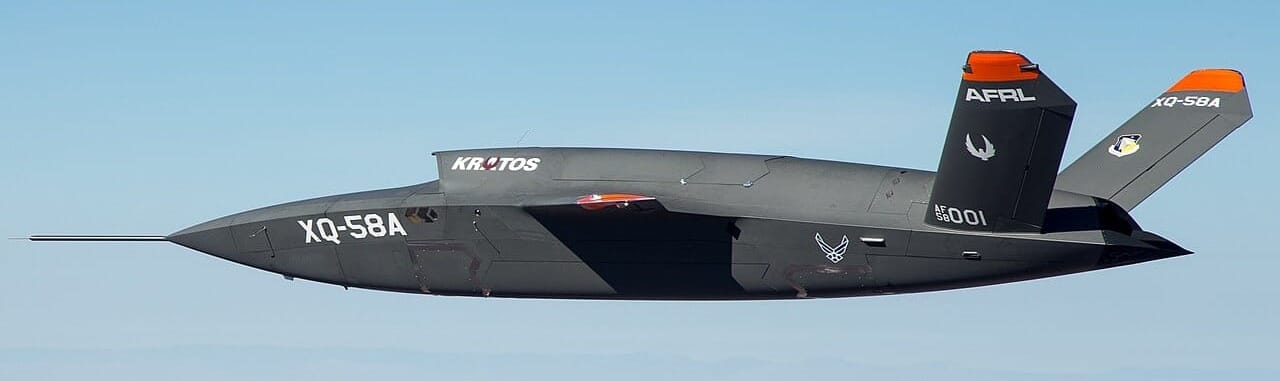
The engineering constraint that governs Kratos's target and tactical-drone lines is that unit cost at rate, not peak performance, is the design objective. The BQM-167 and its derivatives are built from carbon-fiber and epoxy composites, rail-launched with a jettisoned rocket-assisted take-off booster, and recovered by parachute for refurbishment and reuse; the BQM-167 can represent air targets maneuvering at up to 9 g at speeds up to Mach 0.91 and altitudes between 50 and 50,000 feet [31]. The same composite-airframe, rail-launch, parachute-recovery philosophy underlies the XQ-58 Valkyrie, which trades runway independence and low cost against the payload and endurance of a bespoke platform [48]. What actually drives unit cost at rate in these airframes is the combination of low-cost materials and tooling, minimization of non-recurring engineering per copy, tolerance for limited service life, and the amortization of fixed production overhead across volume; the last of these is why Kratos's quoted Valkyrie unit costs fall so steeply with rate (see Section 6).
3.3 Small turbine propulsion, solid rocket motors, and hypersonic test infrastructure
Kratos's propulsion lines span small turbojets and turbofans for drones and missiles (the Turbine Technologies division, and the GE Aerospace-partnered GEK family), solid rocket motors (the internally developed Zeus and Oriole motors and the Prometheus merchant venture), and hypersonic flight-test vehicles (Erinyes) [19][22][25][27]. The engineering challenge in small turbines is that neither scaling a large engine down nor scaling a small turbojet up is straightforward: tolerances, materials, and thermal management do not scale linearly, and achieving turbofan fuel efficiency in a turbojet-sized envelope is the specific problem the GE Aerospace partnership addresses [21]. In solid rocket motors, the governing constraints are the energetics supply chain (ammonium perchlorate, binders, and castable propellant), the qualification burden (each motor must be qualified to a specific application through extensive static-fire and flight test), and environmental permitting for energetics handling; these are the barriers that have kept the merchant market a duopoly (see Sections 5 and 6) [43][44]. In hypersonics, the binding constraint on U.S. progress has been test cadence rather than design, which is precisely the gap the MACH-TB program is intended to fill [25][26].
3.4 Satellite ground systems, microwave electronics, and C5ISR
The Space, Training and Cyber business within KGS centers on OpenSpace, which the company describes as the first commercially available, fully orchestrated, software-defined satellite ground system, using containerized and virtualized functions (SpectralNet signal digitization, virtualized "quantum" components, and the OpenSpace platform) to replace purpose-built hardware [28][29]. This is the highest-margin, longest-duration, and most defensible part of the portfolio in structural terms, because software-defined ground infrastructure carries recurring economics and switching costs that hardware production does not. The microwave electronics business supplies components for missiles, radar, and air-defense systems, and is being expanded through the Orbit Technologies acquisition (see Section 4) [42].
4. Business Segments, Program Portfolio, and Contract Structure
4.1 Segment composition, revenue, and margin
Kratos reports two segments. Kratos Government Solutions is the larger, generating full-year 2025 revenue of $1.05 billion (up 19.3 percent organically), operating income of $60.6 million, and adjusted EBITDA of $101.8 million, an adjusted EBITDA margin of roughly 9.6 percent [1]. Within KGS, the fastest-growing lines in 2025 were Defense and Rocket Support (organic growth of 56.3 percent for the year), Microwave Products (17.1 percent), and Space, Training and Cyber (13.6 percent) [1]. Unmanned Systems generated full-year 2025 revenue of $292.0 million (7.9 percent organic growth), but only $2.6 million of operating income and $18.1 million of adjusted EBITDA, a roughly 6.2 percent margin depressed by material and subcontractor cost increases on multi-year fixed-price production contracts negotiated in 2020 and 2021 that the company cannot renegotiate until the next production lot [1][2]. The margin asymmetry between the two segments is analytically important: the drone business that dominates the investment narrative is the thinner-margin, more capital-intensive of the two, while the less-glamorous government-solutions segment carries the profitability.
In the second quarter of fiscal 2026, this pattern intensified. Consolidated revenue was $458.8 million, but KGS supplied $379.7 million of it (revenue boosted by the Nomad and Orbit acquisitions on top of 22.0 percent organic growth), while KUS contributed $79.1 million with only $1.2 million of segment operating income [4]. The consolidated result was a GAAP operating loss of $1.6 million against $4.4 million of net income, with adjusted EBITDA of $38.2 million; the divergence between the operating loss and positive adjusted EBITDA reflects $16.3 million of non-cash stock compensation, $12.5 million of amortization, and $13.6 million of company-funded R&D in the quarter [4].
4.2 Contract vehicle mix and its margin implications
Kratos disclosed that cost-plus-fee and time-and-materials contracts represented approximately 27 percent and 4 percent, respectively, of 2025 revenue, implying that firm-fixed-price work constituted roughly 69 percent of revenue [3]. This mix is analytically double-edged. Firm-fixed-price contracts offer a higher margin ceiling and reward production efficiency, which suits an affordable-mass producer that believes in its cost structure; but they transfer inflation and execution risk to the contractor, which is exactly the mechanism that compressed KUS margins on the 2020-2021 Valkyrie production lots [2]. The heavy FFP weighting means Kratos bears the downside of its own aggressive unit-cost commitments, and it is the reason a reader should treat quoted "affordable" unit prices as commitments with real balance-sheet consequences rather than as costless marketing.
4.3 Backlog: ceiling, funded, and total
Discipline about backlog definitions is essential for this company because trade press routinely reports indefinite-delivery ceiling values and multi-year "if all options are exercised" figures as if they were awards. At fiscal year-end 2025 (December 28, 2025), total backlog was $1.57 billion, of which funded backlog was $1.23 billion and unfunded backlog was $341 million [1]. By the end of the second quarter of fiscal 2026 (June 28, 2026), total backlog had risen to $2.08 billion, of which $1.57 billion was funded and $512.7 million unfunded, and the bid-and-proposal pipeline had reached $15 billion [4]. The pipeline figure in particular is a qualified-opportunity estimate, not a contractual entitlement, and should carry essentially no weight in a conservative valuation. The gap between the $15 billion pipeline and the $1.572 billion of funded backlog is the single most important quantification in this report: the overwhelming majority of the "opportunity" cited in promotional coverage is unfunded.
4.4 Program-by-program status: funded, prototype, and teaming
The portfolio can be sorted by contractual substance. Genuine, funded programs of record with recurring procurement include the BQM-167 Air Force subscale aerial target, which performs nearly all U.S. Air Force subscale target missions, and the BQM-177 Navy subsonic target [30][31][32]. The MACH-TB 2.0 hypersonic test-bed award, announced January 6, 2025, is an Other Transaction Agreement under which, per the company's release, "The total value of this award, if all options are exercised over the five-year period, is $1.45B," with Kratos prime for Task Area 1 systems engineering, integration and testing, and which CEO Eric DeMarco called "the largest contract award in our company's history"; the ceiling figure is not obligated funding, and the practical revenue depends on task orders actually issued [25][26]. The Space Systems Command Ground Management and Integration award announced April 8, 2026, is similarly an OTA with a total potential value of $446.8 million contingent on option exercise [28].
Prototype, demonstration, and early-development efforts subject to non-continuation include the Erinyes hypersonic flight vehicle, the Zeus and Oriole solid rocket motors (120 on order with deliveries beginning in the third quarter of 2026), and the GEK1500 engine, which is in a $12.4 million preliminary-design phase under a joint Air Force contract with GE Aerospace [4][19][27]. Teaming arrangements and off-balance-sheet ventures with no obligated Kratos funding line include the Marine Corps MUX TACAIR CCA effort, where Northrop Grumman is the sole prime contractor under an approximately $231.5 million, 24-month OTA and Kratos supplies the Valkyrie airframe as a subcontractor, and the Prometheus Energetics solid rocket motor joint venture with Rafael, which is accounted for by the equity method and will not begin production until 2027 [14][22]. Quantifying the split: of the roughly $2 billion in total backlog, the funded portion is $1.572 billion, but the multi-billion-dollar figures that dominate headlines (the $1.45 billion MACH-TB ceiling, the $446.8 million space ceiling, the $15.0 billion pipeline) are predominantly ceiling or pipeline values rather than obligated funding [4][25][28].
5. Key Players and Stakeholders
5.1 Customers and program offices
Kratos's revenue is concentrated in U.S. government customers across the Air Force (aerial targets via the Air Force Life Cycle Management Center; CCA-adjacent work), the Navy and Naval Air Systems Command (BQM-177; Valkyrie testing), the Marine Corps (MUX TACAIR / PAACK-P), the Space Force's Space Systems Command (OpenSpace ground systems, the GMI award, and Evolved Strategic SATCOM), the Office of the Under Secretary of Defense for Research and Engineering's Test Resource Management Center (MACH-TB), and the Missile Defense Agency (Erinyes) [4][14][25][28][30]. This breadth of program offices provides some diversification, but the forward thesis is disproportionately exposed to a handful of new-start lines (hypersonics, drones, solid rocket motors) whose appropriations are more discretionary and more vulnerable to continuing-resolution disruption than the mature target-drone base.
5.2 Competitors
In collaborative and attritable combat aircraft, Kratos competes against both venture-funded entrants and traditional primes. The U.S. Air Force awarded CCA Increment 1 production contracts to Anduril (privately held; FQ-44A Fury) and General Atomics Aeronautical Systems (privately held; FQ-42A Dark Merlin) on June 17, 2026, an award the service's portfolio acquisition executive Col. Timothy Helfrich said came four months ahead of schedule and represented a fresh source selection rather than an extension of the 2024 prototyping contracts, with the service planning to field at least 150 CCAs combined by the end of the decade; the two firms beat Boeing (NYSE: BA), Lockheed Martin (NYSE: LMT), and Northrop Grumman, and Kratos was not a finalist [16][17]. In aerial targets, Kratos is effectively the incumbent monopolist for U.S. jet subscale targets [31]. In small turbine propulsion, it partners with GE Aerospace (NYSE: GE) rather than competing head-to-head, a relationship that both de-risks and caps the value it can capture [19][21]. In solid rocket motors, the incumbents are Northrop Grumman and L3Harris Technologies (NYSE: LHX, which owns Aerojet Rocketdyne), with Nammo (privately held, Norway) as a secondary source and a wave of new entrants including Anduril (which acquired Adranos), X-Bow Systems, and Ursa Major; per the 2017 Government Accountability Office finding, the domestic industry "consolidated from six U.S. manufacturers to two U.S. manufacturers" since 1995 (Aerojet Rocketdyne, now L3Harris, and Orbital ATK, acquired by Northrop Grumman in 2018), and is now re-diversifying under demand pressure [43][44][45]. In satellite ground systems, Kratos's OpenSpace competes against both legacy ground-system integrators and cloud-native newcomers, though its installed base in military SATCOM command-and-control is a meaningful moat [28][29].
5.3 Partners and joint ventures, characterized by substance
The three most consequential relationships differ markedly in financial substance. The GE Aerospace partnership is a teaming agreement and MOU structure, formalized in 2024-2026, under which the two firms co-develop the GEK800 and GEK1500 engines; Kratos captures design and production participation but shares the value with a far larger partner [19][21]. The Northrop Grumman relationship on Marine Corps CCA is one in which Northrop, not Kratos, holds the prime contract and provides the Prism autonomy software and mission systems, with Kratos as airframe supplier; this is strategically validating for the Valkyrie but places Kratos in the subordinate contractual position and cedes control of the autonomy reference architecture [13][14]. The Prometheus Energetics venture with Rafael Advanced Defense Systems (privately held, Israel) is an approximately 50/50 joint venture with up to $175 million of combined committed capital, headquartered on a roughly 500-acre site near Crane, Indiana, that broke ground in February 2026 and is projected to begin production in 2027, dependent on Rafael's technology transfer and certification; Kratos accounts for it under the equity method, recognizing 50 percent of net income and free cash flow rather than consolidating it [22][23][24]. The Airbus (Euronext: AIR) partnership to offer a Valkyrie variant with an Airbus mission system to the German Air Force is an announced international pathway of as-yet-unproven contractual substance [52].
5.4 Launch services and the Rocket Lab relationship under MACH-TB 2.0
Rocket Lab Corporation (NASDAQ: RKLB) joined the Kratos-led subcontractor team for MACH-TB 2.0 Task Area 1 in January 2025, supplying full-scale launch services against the systems engineering, integration, and testing scope for which Kratos holds the prime role [54][25]. The relationship has since produced the clearest publicly verifiable evidence that the program's $1.45 billion ceiling is converting into issued work rather than remaining a headline figure. In April 2025 Kratos awarded Rocket Lab the first full-scale flight test under MACH-TB 2.0, for launch from Launch Complex 2 at Wallops Island, Virginia, no earlier than the first quarter of 2026 [55]. On March 18, 2026, Rocket Lab announced a $190 million block buy of twenty hypersonic test flights over four years under Task Area 1, which the company described as the largest launch agreement in its history and which lifted its total launch and space systems backlog above $2 billion [56]. At an implied approximately $9.5 million per flight, the award commits on the order of thirteen percent of the MACH-TB 2.0 ceiling to launch services with a single subcontractor [56][59].
The analytical significance for Kratos cuts in two directions, and the promotional literature reports only the favorable one. Favorably, the block buy is a task order actually issued against an indefinite-delivery vehicle, which is the specific conversion event this report identifies as the load-bearing question for the hypersonics franchise, and it establishes that Kratos is exercising integrator authority in selecting and contracting performers. Unfavorably, the $190 million is Rocket Lab's revenue, not Kratos's margin: Kratos retains the integration and mission planning scope and whatever fee attaches to orchestrating subcontracted launch services, and no public disclosure was identified specifying the margin Kratos retains on flow-through launch content. Subcontract-heavy program revenue of this type is ordinarily dilutive to segment margin percentage even as it grows reported revenue dollars, which is consistent with the pattern documented in Section 7 whereby Kratos's revenue growth has consistently outpaced its earnings conversion.
 Mike Wall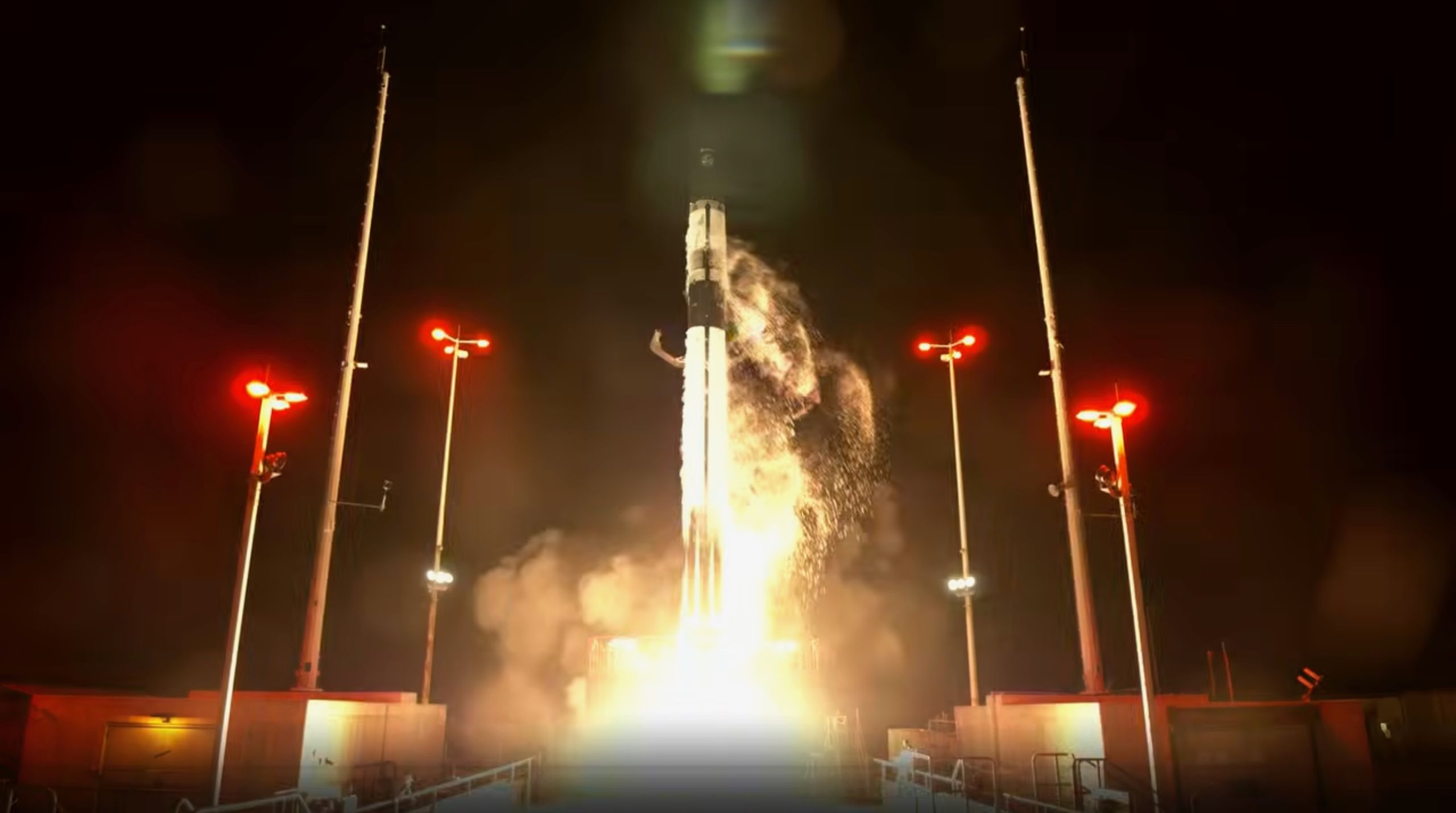
The technical complementarity is significant rather than nominal. HASTE, the Hypersonic Accelerator Suborbital Test Electron, is a suborbital derivative of the Electron launch vehicle retaining its carbon composite structures and additively manufactured Rutherford engines, with a modified upper kick stage, payload capacity to approximately 700 kilograms, and the ability to deploy air-breathing, glide, and ballistic payloads at velocities above 7.5 kilometers per second [58][55]. As the binding constraint on U.S. hypersonic development has been test cadence rather than vehicle design, a commercially operated launcher with demonstrated turnaround (three MACH-TB flights delivered from 2023, including two within twenty-one days) addresses the precise bottleneck the program exists to relieve [55]. The division of labor leaves Kratos supplying subscale vehicles, its own Erinyes flight vehicle, its Zeus and Oriole solid rocket motors, and the integration function, while Rocket Lab supplies full-scale, high-energy trajectories that Kratos does not currently field. Demonstrated activity under the arrangement includes a February 25, 2026 HASTE mission carrying the Hypersonix DART AE payload, and a classified "Curveball" mission that scrubbed from its June 11, 2026 window at Wallops and held for subsequent attempts [57][60]. Rocket Lab states a one hundred percent HASTE mission success rate to date.
Rocket Lab has been widening its direct defense access in parallel, including eligibility under the U.S. Air Force Enterprise-Wide Agile Acquisition Contract and inclusion in the United Kingdom Ministry of Defence hypersonic framework, and trade reporting in early August 2026 described a separate Air Force award to Rocket Lab for hypersonic vehicles, a report resting on limited secondary sourcing and not confirmed against contract records here [55][61]. Reasoning forward from this evidence, a subcontractor accumulating sufficient direct customer relationships could compete for the integrator role at a future recompete, or bypass it. That is an inference about incentive structure, not an established plan, and the observable indicator would be whether TRMC continues to route full-scale launch procurement through the Task Area 1 prime or begins contracting launch services directly.
5.5 Vertical integration and supplier base
Kratos's claim to vertical integration is true in airframes (composite manufacturing inherited from Composite Engineering) and partial in propulsion (internal turbine design combined with GE Aerospace manufacturing scale-up) [21][31]. In solid rocket motors and energetics, vertical integration is prospective rather than actual, contingent on Prometheus reaching production and on Rafael's technology transfer [22]. The Orbit Technologies acquisition and the Norden Millimeter asset purchase extend the microwave and satellite-communications supply base [1][42].

5.6 Management, board, ownership, and insider activity
Eric DeMarco, age 61, has been CEO since April 2004, an unusually long tenure that provides continuity but also means the current strategy is inseparable from a single executive; the board is chaired by William Hoglund [40][41]. The compensation committee set DeMarco's 2025 base salary at $1,000,000, at the 75th percentile of CEO peers [40]. Ownership is overwhelmingly institutional (roughly 82 percent), with The Vanguard Group holding about 9.3 percent, BlackRock (NYSE: BLK) about 8.6 percent, and ARK Investment Management about 6.1 percent; DeMarco held roughly 0.6 percent, or 749,320 shares as of early January 2026 [38][39]. Insider selling has been material: DeMarco sold 200,000 shares on January 6, 2026 for approximately $18 million, and insiders collectively sold roughly $48 million more than they bought over the trailing twelve months [39]. Heavy insider selling into a richly valued stock is a signal a skeptical reader should weigh, though it is common among founders and long-tenured executives diversifying concentrated holdings.


6. Technical and Operational Considerations
6.1 Demonstrated versus claimed performance
The Valkyrie is genuinely flight-proven: it first flew March 5, 2019, has flown with F-22 and F-35 aircraft, and completed Marine Corps PAACK-P test flights beginning October 3, 2023 [12][47]. The Erinyes hypersonic vehicle flew for the first time in June 2024 and exceeded Mach 5 on that flight for a Missile Defense Agency experiment, and the Zeus solid rocket motor flew for the first time in October 2024; these are demonstrated events, not renderings [27]. By contrast, the GEK1500 engine is in preliminary design with demonstration planned for 2026, and Prometheus solid rocket motor production is a 2027 projection contingent on technology transfer; these should be read as planned, not achieved [19][22].
6.2 Unit cost claims: structural versus contractual advantage
The single most-cited and least-verified set of claims concerns Valkyrie unit cost. Management has quoted a current unit price of approximately $6.5 million at low-rate production, roughly $4 million at an annual rate of 50 aircraft, and below $2 million at rates above 100 aircraft; the smaller Firejet-derived Air Wolf has been quoted at approximately $450,000 [47][48]. No independently verifiable source confirms these figures at the stated rates, because the stated rates have not been achieved: the company plans to reach approximately 40 Valkyries annually only by the end of 2027 [1][47]. The analytical distinction that matters is how much of the cost advantage is structural (composite tooling, minimal per-copy non-recurring engineering, tolerance for limited life) versus contractual or accounting (development largely funded by the Air Force Research Laboratory and other government customers, non-recurring engineering treated as customer-funded, and unit prices quoted at rates not yet demonstrated). The evidence suggests the advantage is real but overstated in its cleanest form: a design-and-tooling advantage exists, but the headline sub-$2 million figure is a modeled projection at a rate the company will not reach for years, and the government has borne much of the development cost. This is precisely the epistemic hazard the reader should hold in mind for every "affordable" claim in the portfolio.
6.3 Manufacturing scale-up, capital intensity, and workforce
The scale-up thesis is capital-hungry. Full-year 2025 capital expenditure was $95.3 million and drove free cash flow to a use of $125.4 million; fiscal 2026 guidance calls for capital expenditure of $125 million to $135 million and free cash flow use of $85 million to $105 million [1][4]. The 2026 capital plan itemizes an advanced manufacturing facility for hypersonics and engines, a payload integration facility for MACH-TB, a BladeWorks turbofan facility, expanded microwave facilities in Israel and the U.S., a secure space-and-satellite build-out, and the second Valkyrie production lot of 12 aircraft [1]. The empirical concern is that the incremental revenue this capital is intended to produce has not yet materialized at margins that justify the outlay: three consecutive years of negative free cash flow are being funded by equity issuance rather than by the cash generation of the programs themselves. The qualification timelines (particularly for solid rocket motors and new engines) and the specialized-workforce constraints in energetics and hypersonics are additional gating factors that the capital plan alone cannot resolve.
6.4 Qualification and test-pathway risk
The solid rocket motor entry carries the highest qualification risk in the portfolio. Each motor design must be qualified to its application through static-fire and flight testing, the energetics supply chain is constrained, and environmental permitting for a new energetics campus is demanding; Prometheus must complete construction, receive and certify Rafael's technology transfer, and qualify its motors before 2027 production is meaningful [22][24]. For new engine development, the GEK family must complete altitude testing and demonstration before production economics are knowable [21]. In both cases, the market has arguably priced success that remains contingent on test events that have not occurred.
6.5 Autonomy, command and control, and integration
A structurally important limitation is that Kratos does not control the autonomy reference architecture for its most prominent CCA pathway. On the Marine Corps effort, Northrop Grumman provides the Prism autonomy software and mission systems; Kratos supplies the airframe [13][14]. This matters because the Air Force has deliberately separated the CCA airframe and mission-autonomy competitions to allow rapid software iteration, and the enduring value and margin in collaborative aircraft may accrue disproportionately to the autonomy and mission-systems provider rather than to the airframe manufacturer [17]. Kratos is, on current evidence, positioned as a low-cost airframe and propulsion supplier rather than as the systems integrator that captures the autonomy value.
7. Economic and Market Dynamics
7.1 Multi-year financial history and the earnings-conversion gap
The multi-year record substantiates the report's central finding that revenue growth has outrun earnings conversion. Revenue rose from $747.7 million in 2020 to $898.3 million in 2022, $1.037 billion in 2023, $1.136 billion in 2024, and $1.347 billion in 2025 [1][34][35]. Over the same window, the company posted GAAP net losses of $36.9 million in 2022 and $8.9 million in 2023 before returning to modest net income of $16.3 million in 2024 and $22.0 million in 2025 [34]. Operating margin has compressed structurally over the longer arc, from roughly 5.3 percent in 2019 to the low-single-digits since, standing at roughly 1.9 percent for full-year 2025 and negative in the second quarter of fiscal 2026 on a GAAP operating basis [33][1][4]. Return on invested capital is negligible: recent figures place ROIC near 1 percent, consistent with a company investing far ahead of returns [50]. The persistent gap between program-win headlines and earnings is therefore not an artifact of one quarter; it is a multi-year structural feature driven by mix (thin-margin drone production), FFP inflation exposure, elevated R&D and stock compensation, and capital intensity.
7.2 Capital structure, dilution, and the shift from debt to equity
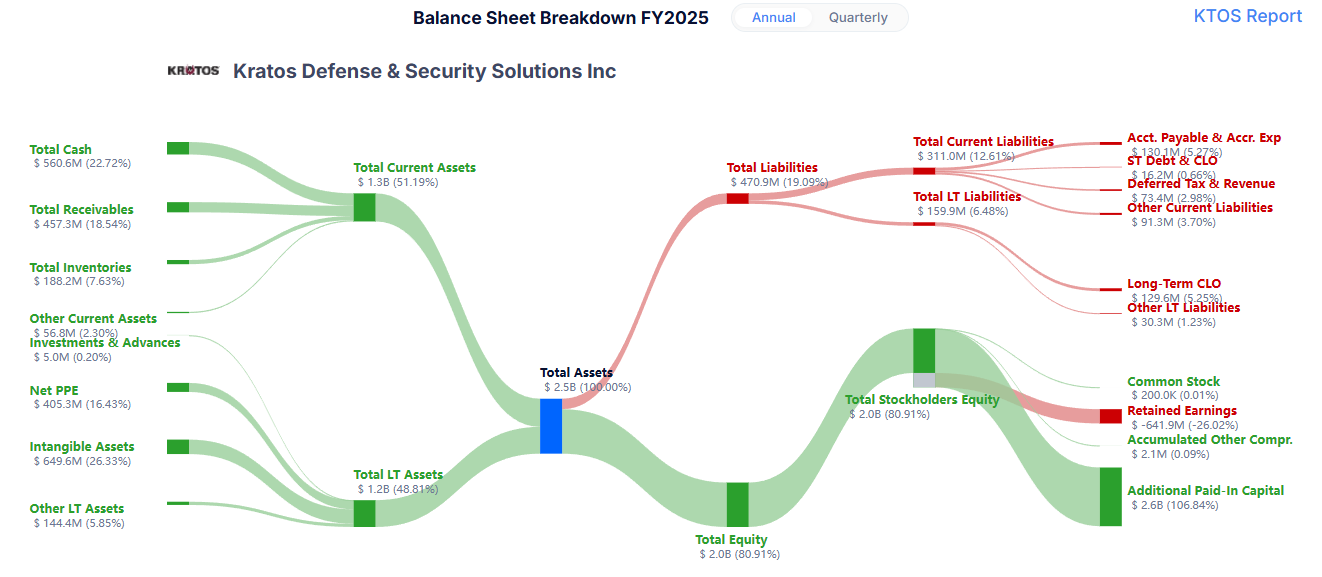
Kratos has deliberately shifted its financing from the debt that nearly sank it in 2014 to equity. In June 2025 it completed a public offering of 14,935,065 shares at $38.50, raising $575 million gross (approximately $556 million net) [36]. During the first half of fiscal 2026 the company raised approximately $1.35 billion net through common stock issuance, lifting cash to $1,437.6 million as of June 28, 2026 and reducing net debt to a modest level, with a debt-to-equity ratio around 0.05 [4][50]. The consequence is a share count that rose from roughly 169 million at the end of 2025 to roughly 188 million by July 31, 2026, diluting existing holders by more than 10 percent in a single half-year [4][50]. Management's explicit position is that investors should focus on enterprise value and EBITDA growth rather than per-share metrics, which is a coherent argument for a scale-up but also a convenient reframing that de-emphasizes the dilution [51]. The fortress balance sheet (over $1.4 billion of cash, minimal debt) is a strength that removes solvency risk and funds the capital plan without new borrowing; the cost is ownership dilution and the implicit obligation to eventually generate returns on a much larger equity base.
7.3 Addressable market, built from budget structure
Sizing the addressable market from budget documents rather than vendor studies yields a more sober picture than promotional coverage implies. The aerial-target franchise is a stable, modest program of record: Air Force budget justifications fund production of roughly 20 subscale targets per year plus boosters in recent requests, a mature line measured in the low tens of millions annually [30]. The hypersonic test-bed opportunity is bounded by the MACH-TB appropriation and by the number of task orders actually issued against the $1.45 billion ceiling, not by the ceiling itself [25]. The solid rocket motor opportunity is truly large in aggregate (Aerojet alone delivers on the order of 100,000 motors of various types annually from a single facility), and the Department has signaled willingness to invest directly in capacity, which supports the demand case for a new merchant entrant; but Kratos's realized share depends entirely on Prometheus reaching qualified production [43]. The CCA production market is large; the Air Force's fiscal 2027 budget requests $996.5 million to begin Increment 1 production plus $150 million of advance procurement for fiscal 2028, and the service intends to field about 1,000 combat-capable CCAs over time, but that Increment 1 production is now closed to Kratos [16]. Vendor-supplied market studies citing multi-billion-dollar hypersonics or drone total addressable markets should be treated as advocacy, not evidence.
7.4 Valuation: what the price implies
Rather than issue a price target, the analytically useful exercise is to read what the market price implies about required future execution. As of early August 2026, KTOS traded in roughly the $52 to $54 range for a market capitalization of approximately $9.7 billion to $10 billion, against 2025 revenue of $1.347 billion and adjusted EBITDA of $119.9 million [4][50]. On trailing metrics that implies an EV/EBITDA multiple near or above the 90th percentile for the aerospace and defense industry and a P/E in the several-hundreds, per GuruFocus and other data providers [49][50]. The stock had also fallen substantially from its 52-week high (a range extending to $134), indicating that even after a correction the equity discounts years of high-teens to low-twenties revenue growth with the promised 100-basis-point-per-year adjusted EBITDA margin expansion actually delivered [4][50]. In plain terms: the price does not require Kratos to win every program, but it does require the company to convert its pipeline into funded, margin-accretive revenue at a pace and profitability it has not yet demonstrated, and to do so while free cash flow remains negative.
 John D
8. Regulatory and Programmatic Landscape
8.1 Export control and foreign military sales
The international thesis (a German Valkyrie variant with Airbus, Orbit's global customer base, Rafael technology transfer) is materially constrained by U.S. export control (ITAR) and foreign military sales mechanics, and, in the Orbit and Prometheus cases, by the reciprocal constraint of a non-Israeli company acquiring or partnering with an Israeli national-security firm, which required specific regulatory clearance [42]. These constraints are governed largely by general precedent and are treated briefly here because they are not unique to Kratos; the main company-specific point is that the Rafael technology transfer underpinning Prometheus is itself an export-control-sensitive event whose timing gates the venture's production start [22].
8.2 Appropriations mechanics and continuing-resolution exposure
The most material near-term programmatic risk is appropriations timing. Management explicitly attributed a first-quarter-2026 revenue and EBITDA trough to an extended federal government shutdown in the fourth quarter of fiscal 2025 that delayed short-turn contract awards and higher-margin software and data sales, and stated that the resolution of the shutdown, the continuing resolution, the fiscal 2026 NDAA, and the fiscal 2026 defense appropriations bill (bringing total national-security-related approved spending to approximately $1 trillion) had improved the environment [1]. New-start programs, which are disproportionately where Kratos's growth lies, are the most vulnerable to continuing-resolution restrictions on new-start funding, so the company's forward case is structurally more CR-sensitive than that of a prime with a mature program base.
8.3 Government contracting compliance
Given the 2004-2008 restatement and stock-option history, and the heavy FFP mix, government-contracting compliance (cost accounting standards, progress-payment and inventory treatment, and the reliability of percentage-of-completion estimates) is a standing exposure, though no current material compliance finding was identified in the open record.
9. Geopolitical and Strategic Dimensions
9.1 Magazine depth, cost exchange, and surge capacity
Kratos's strategic relevance is a direct function of the peer-conflict logic in which magazine depth and cost-exchange ratios are critical. Attritable aircraft and low-cost munitions improve the cost-exchange ratio against a peer adversary, and additional solid rocket motor capacity addresses a documented munitions-production bottleneck; the domestic SRM base contracted from six suppliers to two between 1995 and 2017 per the GAO and Govini findings, creating exactly the fragility that a new merchant entrant is meant to relieve [44][45]. These are structural drivers rooted in an enduring Indo-Pacific threat assessment, not cyclical ones.
9.2 Allied demand and industrial-base policy
Allied and partner demand is credible in direction but unproven in contracted substance: the Airbus German-variant pathway, Orbit's European and Pacific customer base, and Rafael's Israeli demand are announced pathways, and the strategic value of non-traditional capacity in constrained sectors (energetics, small turbines, hypersonic test) is precisely what industrial-base policy now seeks to cultivate through second-sourcing [42][45][52]. The distinction the reader should hold is that the structural driver (the state's desire to diversify a fragile industrial base) is durable and favorable to Kratos, while the specific realization (which allied contracts actually fund) remains cyclical and contingent.
10. Risk Matrix
Likelihood is defined on a three-point scale: "Low" denotes a risk judged unlikely to materialize within the stated horizon (roughly under 25 percent), "Medium" a plausible risk (roughly 25 to 55 percent), and "High" a more-likely-than-not risk (above 55 percent). Impact is defined relative to Kratos's equity value and strategic position: "Low" denotes a manageable effect on earnings or valuation, "Medium" a material effect capable of moving the equity by a low-double-digit percentage or impairing a segment, and "High" a severe effect capable of impairing the core thesis or a large fraction of equity value. Analyst confidence reflects the quality and independence of the evidence underlying each assessment.
| ID | Risk description | Likelihood | Impact | Time horizon | Leading indicators | Credible mitigations | Confidence |
|---|---|---|---|---|---|---|---|
| R1 | Valuation de-rating: multiple compresses toward defense-sector norms as growth or margin disappoints | High | High | 0-24 months | Missed quarterly organic-growth or adjusted-EBITDA-margin targets; guidance cuts; further decline from 52-week high | Deliver promised ~100 bps/yr EBITDA margin expansion; convert pipeline to funded backlog | High |
| R2 | Earnings never convert: revenue grows but GAAP operating margin and free cash flow stay weak | High | High | 0-36 months | Continued negative FCF; flat operating margin; rising stock-comp and R&D as percent of revenue | Rate-driven overhead absorption; higher-margin space/software mix; end of below-cost legacy FFP lots | High |
| R3 | Continued dilution: further equity raises to fund capex erode per-share value | Medium | Medium | 0-24 months | New S-3 takedowns; ATM usage; share count rising faster than EBITDA | Reach self-funding FCF; deploy $1.4B cash before issuing | High |
| R4 | Solid rocket motor entry fails or slips: Prometheus misses 2027 production or qualification | Medium | Medium | 12-36 months | Delayed Rafael tech transfer; permitting/construction slippage; failed static-fire/qualification | Rafael combat-proven processes; 50/50 risk-share; DoD demand pull | Medium |
| R5 | CCA marginalization: Kratos remains an airframe subcontractor, not autonomy integrator; loses Increment 2 | Medium | High | 0-36 months | Increment 2 downselect excludes Valkyrie; Northrop captures value; Air Force favors incumbents | Marine Corps program-of-record traction; sole-source tactical-drone positions; export variants | Medium |
| R6 | Appropriations/CR disruption: prolonged CR or flat topline delays new-start funding | Medium | Medium | 0-18 months | New CR; shutdown recurrence; delayed task orders against OTAs | Diversified program offices; funded backlog cushion; mature target-drone base | High |
| R7 | FFP inflation losses: fixed-price production lots absorb cost growth without recovery | Medium | Low | 0-24 months | KUS margin compression; disclosed EACs/charges; shekel FX drag on Israeli operations | Renegotiate at next lot; index future contracts; supplier diversification | High |
| R8 | Key-person/governance: dependence on DeMarco; legacy of restatement and aggressive non-GAAP | Low | Medium | 0-36 months | Succession events; auditor or SEC action; widening GAAP-vs-adjusted gap | Board oversight; long tenure; deep bench | Medium |
| R9 | Unit-cost claims unmet: Valkyrie fails to reach quoted sub-$2M cost at rate | Medium | Medium | 12-48 months | Production stays below 40/yr; unit price stays near $6.5M; customer balks at cost | Design maturity; GE engine cost-down; volume from multiple customers | Medium |
The three risks that most govern the forward case are R1/R2 (the intertwined valuation and earnings-conversion risks) and R5 (CCA marginalization). On R1 and R2, the causal chain is that a several-hundred-times P/E and an EV/EBITDA multiple near the top of the industry can only be sustained if Kratos both grows at the promised high-teens-to-low-twenties organic rate and expands adjusted EBITDA margin by roughly 100 basis points per year, while eventually turning free cash flow positive; any sustained shortfall in either the growth or the margin variable removes the justification for the multiple, and because the multiple is so extended, the downside is asymmetric [1][4][49]. On R5, the strategic question is whether Kratos is building an enduring franchise or a commodity-airframe business: the Air Force's decision to run separate airframe and autonomy competitions, and its selection of Anduril and General Atomics over Kratos for Increment 1 production, are evidence that the highest-value position (mission autonomy and systems integration) may be captured by others, leaving Kratos as a price-competitive airframe and propulsion supplier whose margins are structurally capped [16][17].
11. Forward Outlook and Falsifiable Indicators
Reasoning forward from current evidence requires stating assumptions explicitly. The base assumptions are that the U.S. defense topline holds near the approximately $1 trillion national-security level enacted for fiscal 2026, that no prolonged continuing resolution recurs, and that Kratos executes its stated capital plan without major qualification failures [1].
Under a bull scenario, the preconditions are that hypersonics and solid rocket motors convert ceiling awards into obligated, margin-accretive task orders; that Prometheus reaches qualified production on schedule in 2027; that the space/software mix lifts consolidated adjusted EBITDA margin as guided; and that Valkyrie reaches meaningful production for the Marine Corps and export customers. The confirming indicators would be adjusted EBITDA margin crossing into the low-to-mid teens, free cash flow turning positive by 2027, funded backlog growing faster than total backlog, and a definitized Valkyrie production contract with a disclosed delivery schedule [1][4].
Under a base scenario, revenue continues to grow in the high teens but margins expand only slowly, free cash flow remains negative into 2027 as capital expenditure stays elevated, and the equity de-rates toward a still-premium but lower multiple as the market marks the timeline to profitability. The confirming indicators would be organic growth in the 15-to-23 percent range with adjusted EBITDA margin near 10-to-11 percent and continued (if narrowing) free cash flow use, in line with fiscal 2026 guidance of $1.75-$1.81 billion revenue and $173-$176 million adjusted EBITDA [4].
Under a bear scenario, the preconditions are a continuing-resolution or topline disruption, a Prometheus qualification slip, exclusion from CCA Increment 2, and persistent FFP margin drag. The confirming indicators would be a book-to-bill falling below 1.0 for consecutive quarters, a guidance cut, a disclosed Prometheus delay, an Increment 2 downselect excluding the Valkyrie, and a widening gap between adjusted EBITDA and GAAP operating income [2][4][16].
The specific, checkable near-term milestones a reader should monitor are: whether the GEK1500 completes its planned 2026 demonstration [21]; the cadence at which Kratos issues further task orders against the remaining MACH-TB 2.0 ceiling; whether Kratos discloses MACH-TB-attributable revenue and margin separately from Defense and Rocket Support in aggregate; and whether the twenty-flight manifest sustains a rate consistent with completion inside the stated four-year window, whether Zeus and Oriole solid rocket motor deliveries actually begin in the third quarter of 2026 as stated [1]; whether Kratos reaches its stated cadence of approximately 40 Valkyries annually by the end of 2027 [1]; whether the roughly $1 billion sole-source hypersonic opportunity management hopes to receive materializes as an obligated award [1]; the outcome of CCA Increment 2 downselects [18]; the Prometheus production start in 2027 [22]; and the quarterly trajectory of funded backlog versus the bid-and-proposal pipeline [4].
 Matt Swayne
12. Strategic Recommendations
12.1 For institutional investors and capital allocators
Treat KTOS as a high-multiple, execution-dependent growth equity rather than a defense-sector value or income holding, and size positions accordingly. The evidence supports a constructive view on the business's strategic relevance and a skeptical view on the entry valuation: the equity discounts years of flawless conversion of unfunded pipeline into funded, margin-accretive revenue. The recommendation is to require confirmation of earnings conversion before adding aggressively: specifically, evidence that adjusted EBITDA margin is expanding on the guided trajectory and that free cash flow is on a credible path to positive by 2027. This recommendation would reverse toward more constructive if the company demonstrates two or more consecutive quarters of margin expansion with a definitized Valkyrie production award, or reverse toward outright caution if free cash flow use widens or a guidance cut confirms the earnings-conversion risk (R2). Weight enterprise-value-and-EBITDA framing as management urges, but do not ignore the more than 10 percent half-year dilution when doing so [4][50].
12.2 For corporate strategists at primes, partners, and potential acquirers
For a prime contractor, the strategic read is that Kratos is most valuable as a low-cost airframe and propulsion supplier and as a satellite-ground-software asset, and that the autonomy and systems-integration value in collaborative aircraft is capturable by the partner rather than by Kratos, as the Northrop Grumman Marine Corps arrangement demonstrates [13][14]. A potential acquirer should recognize that the fortress balance sheet (over $1.4 billion cash, minimal debt) and the roughly $9.7-$10 billion market capitalization make a straightforward takeover expensive and unlikely at present, but that the OpenSpace software franchise and the microwave/Orbit electronics base would be the highest-value pieces in a break-up or carve-out thesis [4][28][42]. The condition that would make an acquisition attractive is a sustained equity de-rating that brings the multiple toward defense-sector norms while the strategic assets remain intact; the condition that would obstruct it is the current premium plus the national-security review burden on any transaction touching the Israeli assets.
12.3 For government program offices and acquisition policymakers
The public interest supports cultivating Kratos as a second source in constrained sectors (solid rocket motors, small turbines, hypersonic test cadence), because the industrial-base fragility the company addresses is documented [44][45]. The recommendation is to structure awards to reward demonstrated qualification and rate rather than to reward ceiling announcements, and to provide the stable, multi-year demand signals that CSIS and others have identified as prerequisites for new-entrant SRM capacity to mature [45]. Program offices should also weigh the FFP-inflation lesson from Kratos's 2020-2021 Valkyrie lots: fixed-price structures that ignore inflation risk can distress a supplier the government needs [2]. This posture would change if a qualification failure or delivery shortfall demonstrated that the non-traditional capacity is not materializing.
12.4 For suppliers and technologists evaluating engagement
Suppliers of energetics, precision components, composites, and test services should view Kratos as a growing but capital-constrained customer whose demand is significant, but whose margins are thin and whose payment cadence is tied to lumpy government funding. The recommendation is to engage on the specific high-growth lines (hypersonics, engines, microwave electronics) where funded backlog is expanding, while pricing in appropriation-timing risk and the company's FFP-driven pressure to push cost onto the supply chain [1][2]. Technologists in autonomy and mission systems should note that the reference-architecture value on Kratos's flagship CCA pathway sits with Northrop Grumman, which shapes where an autonomy supplier's leverage lies [13]. The engagement calculus would improve materially if Prometheus reaches production and the hypersonics franchise converts its ceilings to obligated task orders, and would worsen under a prolonged appropriations disruption.

13. References
- Kratos Defense & Security Solutions. 2026. "Kratos Reports Fourth Quarter and Full Year 2025 Financial Results." Press release, February 23. San Diego, CA.
- Kratos Defense & Security Solutions. 2025. "Kratos Reports Third Quarter 2025 Financial Results." Press release, November 4. San Diego, CA.
- Kratos Defense & Security Solutions. 2026. Annual Report (Form 10-K) for fiscal year ended December 28, 2025. U.S. Securities and Exchange Commission.
- Kratos Defense & Security Solutions. 2026. "Kratos Reports Second Quarter 2026 Financial Results" and Quarterly Report (Form 10-Q) for the period ended June 28, 2026. Press release and SEC filing, August 4.
- Benzinga. 2026. "Kratos Defense Posts Double Beat in Q2, Business Momentum Expected to Accelerate." August 4.
- Kratos Defense & Security Solutions. 2008. Registration Statement (Form S-4/A). U.S. Securities and Exchange Commission.
- Kratos Defense & Security Solutions. 2008-2009. Current and Quarterly Reports (Forms 8-K and 10-Q). U.S. Securities and Exchange Commission.
- Kratos Defense & Security Solutions. 2010. Prospectus Supplement (Form 424B5). U.S. Securities and Exchange Commission.
- Seeking Alpha. 2015. "Kratos: Screaming Short, Valued At 20x Forward EBITDA Despite 9 Years Of Organic Declines."
- Mergr. "Kratos Defense & Security Solutions M&A Summary and Business Overview."
- Kratos Defense & Security Solutions. 2011. Current Report (Form 8-K), Acquisition of Integral Systems. U.S. Securities and Exchange Commission.
- Aerospace Global News. "Kratos XQ-58A Valkyrie to be 1st US Marines CCA."
- USNI News. 2026. "Northrop Grumman to Advance Kratos XQ-58 Valkyrie Drone for Marine Corps 'Loyal Wingman' Program." January 12.
- Kavout. 2026. "Is Kratos's Valkyrie Program a Game-Changer for Defense Investors."
- Airforce Technology. "Collaborative Combat Aircraft (CCA), US."
- Breaking Defense. 2026. "Air Force picks General Atomics, Anduril to build first CCA drone wingmen." June; and Military Times, "Air Force FY27 budget request for CCA Increment 1 production." April 30.
- DefenseScoop. 2026. "Air Force picks Anduril, General Atomics to build first operational CCA drones." June 17; and Air & Space Forces Magazine coverage of the June 17, 2026 award.
- Breaking Defense. 2025. "CCA Round 2: Air Force picks 9 vendors for next batch of drone wingmen." December.
- GE Aerospace and Kratos Defense & Security Solutions. 2026. "GE Aerospace and Kratos Win U.S. Air Force Award to Design Engine for Expendable Collaborative Combat Aircraft." Press release, February 23.
- GE Aerospace. 2025. "GE Aerospace and Kratos Expand Small Engine Portfolio." Press release.
- Breaking Defense. 2025. "GE, Kratos broaden engine partnership, targeting 'lower end' CCA." June.
- Kratos Defense & Security Solutions and RAFAEL Advanced Defense Systems. 2025. "Kratos & RAFAEL Establish Prometheus Energetics Joint Venture." Press release, February 26.
- Breaking Defense. 2025. "Rafael, Kratos team to produce solid rocket motors as Prometheus Energetics." February.
- Prometheus Energetics. 2026. "Prometheus Energetics Breaks Ground on New Solid Rocket Motor Manufacturing Campus in Indiana." Press release (PRNewswire), February 20.
- Kratos Defense & Security Solutions. 2025. "Kratos Receives $1.45B MACH-TB 2.0 Contract Award." Press release (GlobeNewswire), January 6.
- Breaking Defense. 2025. "Kratos wins firm's largest-ever $1.5 billion award for DoD hypersonic testbed." January.
- The Aviationist. 2025. "Kratos Signs $1.5 Billion Deal for DoD Low-Cost Hypersonic Testbed" and related coverage of Erinyes and Zeus.
- Kratos Defense & Security Solutions. 2026. "Kratos Receives $446.8 Million Space Systems Command Contract for Resilient Missile Warning and Missile Tracking Ground Management & Integration (GMI)." Press release (GlobeNewswire), April 8.
- Kratos Defense & Security Solutions. 2025. "Kratos Awarded $25 Million Task Order for U.S. Space Force's Evolved Strategic SATCOM." Press release (GlobeNewswire), June 11.
- Congressional Research Service. "The Air Force Life Cycle Management Center's Aerial Targets" (IF12738); and Air & Space Forces Magazine, "BQM-167 Subscale Aerial Target."
- Air & Space Forces Magazine. "BQM-167 Subscale Aerial Target."
- Wikipedia. "Kratos BQM-177" and "Composite Engineering BQM-167 Skeeter."
- Macrotrends. "Kratos Defense & Security Solutions Operating Margin 2010-2025."
- Yahoo Finance. "Kratos Defense & Security Solutions, Inc. (KTOS) Income Statement."
- Kratos Defense & Security Solutions. 2021. Current Report (Form 8-K), Fourth Quarter and Fiscal 2020 Results. U.S. Securities and Exchange Commission.
- Kratos Defense & Security Solutions. 2025. "Kratos Announces Completion of Public Offering of $575 Million of Common Stock at $38.50 Per Share." Press release, June 30.
- Investing.com. 2025. "Kratos Defense & Security announces $500 million equity offering" (citing Stifel).
- Yahoo Finance / Simply Wall St. 2025. "Kratos Defense & Security Solutions ownership analysis."
- GuruFocus. 2026. "Eric M DeMarco - Net Worth and Insider Trading."
- Fintool. "Eric DeMarco - Chief Executive Officer and President, KTOS Executive Profile & Compensation" (drawing on Kratos DEF 14A proxy statement).
- Kratos Defense & Security Solutions. "Eric DeMarco" leadership biography.
- Kratos Defense & Security Solutions. 2025. "Kratos to Acquire Israel-Based Orbit Technologies Ltd for $356.3 Million." Press release, November 4; and Via Satellite coverage.
- Flight Global. 2024. "US manufacturers ramp solid rocket motor production amid surging munitions demand."
- Breaking Defense. 2026. "With the boom for solid rocket motors for missiles, a perilous crunch in the supply chain" (citing Govini and GAO). January.
- Quilty Space. "The Dawn of Solid Rocket Motor Diversification"; and U.S. Government Accountability Office. 2017. Report on solid rocket motor industrial base.
- MarketsandMarkets. "Solid Rocket Motors Market Report."
- The War Zone. "Marine XQ-58 Valkyries Will Be Electronic Warfare Platforms For F-35s."
- Asia Times. 2024. "US Valkyrie drone swarms taking clearer, cheaper shape."
- GuruFocus. 2026. "Kratos Defense & Security Solutions EV-to-EBITDA."
- StockAnalysis.com. 2026. "Kratos Defense & Security Solutions (KTOS) Statistics & Valuation."
- Simply Wall St. 2026. "Kratos Defense & Security Solutions (Nasdaq:KTOS) Stock Analysis."
- Airforce Technology. "USAF selects Anduril and General Atomics as CCA vendors" and coverage of Airbus-Kratos German CCA variant.
- U.S. Federal Trade Commission. "Petition of Northrop Grumman to Reopen and Set Aside Decision and Order" (Dkt. No. C-4652), on solid rocket motor market structure.
- Rocket Lab USA. 2025. "Rocket Lab Selected by Kratos to Deliver Hypersonic Test Launches for DoD with HASTE Rocket." Press release (BusinessWire), January 7.
- Rocket Lab USA. 2025. "Rocket Lab Awarded New HASTE Launch Contract for the DOD by Kratos." Press release (BusinessWire), April 23.
- Rocket Lab Corporation. 2026. "Rocket Lab Secures $190M Contract for 20x HASTE Launches, Cements Hypersonics Leadership with Department of War Partnership." Press release (GlobeNewswire), March 18.
- SpaceNews. 2026. "Rocket Lab wins $190 million Pentagon deal for hypersonic test flights." March 18.
- Rocket Lab Corporation. "HASTE" product page and mission archive, including "HASTE A La Vista" mission record.
- The Motley Fool. 2026. "U.S. Air Force Taps Rocket Lab to Sell It 12 Hypersonic Missiles for $266 Million." August 2.
- Tech Times. 2026. "Rocket Lab HASTE Curveball Scrubs From Virginia: Backup Window Opens Tonight." June 11.
- CompositesWorld. 2025. "Rocket Lab awarded HASTE launch contract for U.S. DOD." May.