Molten Regolith Electrolysis: The Cathode Metals the Moon Makes, and in What Order
With lunar cargo near $100,000/kg, every gram of regolith-made iron or silicon counts. Here's what the cathode produces, and in what order.

TL;DR
- The cathode in molten regolith electrolysis yields metals in a thermodynamically fixed sequence, iron first (theoretical minimum ~0.91 V for FeO), then silicon and titanium (co-reducing), then the refractory electropositive metals aluminum, magnesium, and calcium; but the as-deposited product is a MIXED multi-metal alloy, not pure metals, and obtaining application-grade iron, solar-grade silicon, or structural aluminum requires substantial downstream refining that remains largely undemonstrated at scale.
- Demonstrated laboratory results (MIT/NASA: iron + silicon co-deposition at ~1600 °C, 8-hour batches at 5 A with iridium anodes) are small; the headline performance claims, such as Blue Origin's >99.999% solar-grade silicon and Lunar Resources' LR-1 reactor processing 25 kg of simulant over 36 hours (24 hours of electrolysis) at NASA Kennedy in late 2024, are program reports at roughly TRL 6, not independently peer-reviewed production data.
- The economic case rests on co-product value stacking (oxygen + iron + silicon + aluminum from one reactor) against launch costs that are falling fast but remain extraordinarily high for early Starship lunar cargo. The binding engineering constraint is the inert-anode degradation problem (oxygen at 1600 °C is extremely corrosive), which conditions the entire process even though the products of interest are cathodic.
The Cathodic Half: Metallic Products of Molten Lunar Regolith Electrolysis (MRE)
Key Findings
- The reduction sequence is governed by oxide stability (Ellingham ordering). The order in which cations are reduced at the cathode follows the relative Gibbs free energies of formation of the constituent oxides. The accepted ordering of increasing decomposition potential (i.e., increasing difficulty of reduction) is FeO < SiO₂ ≈ TiO₂ < Al₂O₃ ≈ MgO < CaO. FeO is the least stable major oxide and is reduced first at the lowest applied potential; CaO is the most stable and is reduced last/hardest.
- Iron is the most accessible cathode product. Iron oxide decomposition has a theoretical minimum voltage of ~0.91 V at ~1823 K (Wiencke et al. 2018), and a standard decomposition potential of ~0.825 V at 1800 K (Sadoway group). Iron deposits as a liquid metal pool at the cell bottom and can in principle be tapped first, before significant silicon co-deposition.
- Silicon and titanium co-reduce, complicating separation. Because SiO₂ and TiO₂ have very close decomposition potentials at MRE temperatures, titanium and silicon tend to deposit together as an alloy; pure titanium is essentially unobtainable without prior removal of silica. This is the central practical problem: raw cathode product is a mixed alloy (Fe–Si, Fe–Si–Ti, Ca–Si–Al–Mg) rather than separated pure metals.
- Process is "frozen-wall" / Joule-heated at ~1600 °C. The molten oxide bath is itself the electrolyte (no supporting salt), made conductive by melting to ~1600 °C; the corrosive melt is contained by a frozen layer of solidified regolith ("cold wall") on cooled reactor walls, analogous to Hall–Héroult aluminum cells. The molten metal pool acts as the cathode.
- The inert anode is the binding materials problem. Oxygen evolution at 1600 °C destroys most candidate anode materials. MIT/NASA work used iridium anodes; Allanore, Yin, and Sadoway's 2013 Nature paper identified chromium-based alloys that form a protective conductive oxide film. Anode durability conditions the entire process economics even though it is on the oxygen side.
- Energy budgets are substantial. Modeled MRE systems require tens of kWh per kg of product; iron production by molten oxide electrolysis is estimated by Allanore (2015) at ~3,700 kWh per tonne of iron in an optimized practical process. The 354-hour lunar day/night cycle forces either large energy storage or nuclear power for continuous operation.
- Competing processes give different products. Solid-state FFC-Cambridge (Metalysis) operates at ~900–950 °C and produces solid metal alloys plus near-complete (~96%) oxygen recovery; carbothermal reduction yields Fe–TiC cermets and requires carbon; hydrogen reduction of ilmenite yields iron + TiO₂ + water (oxygen) but is limited by ilmenite content. MRE is distinguished by producing molten metals and the broadest range of metal products directly.
- Players span government, commercial, and academic. NASA ISRU/MMPACT, ESA/ESRIC; commercial developers Blue Origin (Blue Alchemist), Lunar Resources Inc., Metalysis, Boston Metal (terrestrial analogue); academic leaders MIT (Sadoway, Allanore) and Colorado School of Mines (Cannon).
Details
The cathodic reduction sequence and decomposition potentials
Molten regolith electrolysis (MRE), also called molten oxide electrolysis (MOE) applied to regolith, melts lunar soil to ~1600 °C so that the oxide melt itself becomes a liquid electrolyte. Applying a voltage drives metal cations to the cathode (reduced to metals/metalloids) and oxygen anions to the anode (oxidized to O₂ gas). No supporting electrolyte or consumable reagent is required, only regolith and electricity.
Which cation reduces, and in what order, is set by thermodynamics: the relative stability of the constituent oxides as captured by Ellingham diagrams (Gibbs free energy of formation vs. temperature). The ordering of decomposition potential is FeO < SiO₂ ≈ TiO₂ < Al₂O₃ ≈ MgO < CaO. A Blue Origin–associated MRE patent (US 11,624,119) states the cell potential "increases in the order Fe < Si, Ti < Mg, Al < Ca," grouping Si–Ti and Mg–Al as near-equal pairs.
Quantified values are best established for iron: Wiencke et al. (2018, Journal of Applied Electrochemistry 48:115–126) report a theoretical minimum decomposition voltage of 0.91 V for iron oxide in a molten oxide composition at ~1823 K; the Sadoway group gives a standard decomposition potential of ~0.825 V at 1800 K. A clean, peer-reviewed table of decomposition voltages for SiO₂, TiO₂, Al₂O₃, MgO, and CaO at MRE temperatures (~1850 K) is not readily available in the open literature; values circulating for SiO₂ (~0.16 V) and TiO₂ (~1.9 V) are from non-MRE conditions (carbothermic reduction and the FFC molten-salt process at ~900 °C, respectively) and should NOT be applied to MRE. This is a genuine data gap, the strongest candidate primary source is Schreiner's MIT thesis (2015/2016), which contains the coupled electrochemical-thermodynamic model. Low confidence on exact non-iron voltages.
Principal cathode products by accessibility
(a) Iron and ferrous phases (from FeO). Iron is the easiest product: lowest decomposition potential, deposits as liquid metal. MIT/NASA experiments (Sirk, Sadoway, Sibille 2010, ECS Transactions) confirmed concomitant production of iron and silicon at the cathode while oxygen evolved at the anode. Iron oxide reduction proceeds stepwise Fe₂O₃ → Fe₃O₄ → FeO → Fe.
(b) Silicon and ferrosilicon (from SiO₂). Silicon co-deposits with iron, giving ferrosilicon initially. Blue Origin states its Blue Alchemist process "purifies silicon to more than 99.999%" (5N, "five-nines"), the level required for efficient solar cells, using only sunlight and reactor silicon.
(c) Titanium-bearing phases (from TiO₂). Important in ilmenite-rich (FeTiO₃) mare feedstocks. Titanium co-reduces with silicon; pure Ti is essentially unobtainable without first removing silica.
(d) Refractory/electropositive metals Al, Mg, Ca (from Al₂O₃, MgO, CaO). These require the highest potentials and are hardest to isolate. Colorado School of Mines (Kevin Cannon, MAGMA project, $2M NASA LuSTR grant with industry partner Lunar Resources) targets aluminum extraction and refinement into high-purity wire for additive manufacturing. CaO is the most stable; at high voltages it can be co-reduced, which lowers current efficiency.
The mixed-alloy problem and separation strategies
The defining honest caveat: raw cathode product is a multi-metal alloy. The Metalysis/FFC work on regolith (Lomax et al. 2019/2020) recovered three alloy categories: an Al/Fe alloy (often with Si); an Fe/Si alloy (sometimes with Ti and/or Al); and a Ca/Si/Al alloy (sometimes with Mg). Management strategies:
- Staged/sequential electrolysis exploiting distinct decomposition potentials: tap iron first at low voltage, then raise voltage to deposit silicon, etc.
- Temperature and feedstock control.
- Downstream refining (melt-refining, zone refining for silicon).
The Colorado School of Mines LAMPP concept notes that a sequential process "can deliver silicon, magnesium, titanium, and aluminum with a grade close to the metallurgical" grade.
Feedstock dependence: highland vs. mare
Lunar regolith composition varies strongly by terrane:
- Highland (anorthositic) regolith: high Al₂O₃ and CaO (plagioclase feldspar), low FeO (<10 wt%) and TiO₂. Apollo 16 is the type site. Favorable for aluminum/calcium; lower iron yield.
- Mare (basaltic) regolith: higher FeO (>10 wt%, ~12–18 wt% in some basalts), MgO, and TiO₂. "High-Ti" mare basalts have TiO₂ >6 wt%; "low-Ti" 1–6 wt%. Rich in ilmenite (FeTiO₃) — favorable for iron and titanium. Pure ilmenite is ~47.4 wt% FeO and ~52.6 wt% TiO₂.
- Silicon (~20 wt% as element) is abundant in all lunar materials. Oxygen is ~40 wt% of regolith.
Schreiner et al. (2016, Acta Astronautica / Advances in Space Research) found a ~1-tonne MRE plant could produce ~10 tonnes O₂/year from highland regolith; cathode metal yield and current efficiency depend on ilmenite/anorthite content. Mare regolith current efficiency can drop near ~2200 K when MgO begins to electrolyze.
Electrochemistry and reactor design
Cell operates at ~1600 °C (some sources cite 1600–1800 °C; Lunar Resources reports heating to 1700 °C). The molten oxide is conductive; iron oxide content strongly raises conductivity and lowers decomposition voltage. Above ~7 wt% FeOx, the anodic current is limited by reaction kinetics (high Faradaic yield, electronic conduction <10% at 3 V), giving anodic current efficiency near 100% (Metallurgical and Materials Transactions B, 2019). Below that, electronic conduction (from Fe²⁺/Fe³⁺ multiple valence) wastes current. Schreiner's cold-walled MOE reactor simulations recovered 0.15–0.375 kg O₂ per kg of regolith across a wide range of conditions.
Reactor configuration: Joule-heated ("self-heating") cells where electrolytic current generates enough heat to maintain the melt, contained within a frozen regolith shell. Molten metal pool cathode at the bottom; product tapping and slag removal are key engineering challenges (CSM LAMPP tested SiC+BN composite refractories; molybdenum is also used).
The inert anode degradation problem
Oxygen evolution at 1600 °C is extremely corrosive. NASA/MIT MRE used iridium anodes (demonstrated 8-hour batches at 5 A). Allanore, Yin, and Sadoway (2013, Nature) identified a chromium-based alloy anode that forms a protective, electronically conductive Cr(III)–Al oxide film in the corundum structure, with limited consumption observed over a 5-hour period; a breakthrough for terrestrial MOE steelmaking. Lunar Resources claims a proprietary anode technology that "eliminates anode degradation" and enables an order-of-magnitude more production. Newer work uses yttria-stabilized zirconia hollow anodes with a platinum current collector to address O₂ separation (NASA NTRS 2025).
Energy budgets and power
- Iron by MOE: ~2,600 kWh/tonne Fe theoretical minimum (enthalpy); Allanore (2015, J. Electrochem. Soc. 162(1):E13–E22) states verbatim that "the electricity consumption for a practical, optimized process is therefore likely to be of the order of 3700 kWh.tFe⁻¹" (assuming ~90% selectivity and 60% furnace efficiency).
- Schreiner MRE system models: a 400 kg, 14 kW system produces 1,000 kg O₂/year from highland regolith; a 1,593 kg, 56.5 kW system produces 10,000 kg O₂/year.
- For comparison, hydrogen reduction of ilmenite: ~24.3 kWh per kg of liquid oxygen for 10 wt% ilmenite regolith.
- The 354-hour lunar day/night cycle forces large thermal/energy storage or nuclear fission power for continuous high-temperature operation. Thermal management of a 1600 °C reactor in vacuum is a major design driver.
Process comparison (cathode products and quality)
| Process | Temperature | Cathode / Metal Product | Oxygen Output | Maturity |
|---|---|---|---|---|
| MRE / MOE (Molten Regolith Electrolysis / Molten Oxide Electrolysis) | ~1600 °C | Molten Fe, Si, Fe-Si, Al, Mg, Ca alloys (broadest product range) | O₂ produced at inert anode | TRL ~6 (program claims) |
| FFC-Cambridge (Metalysis) | ~900–950 °C | Solid metal alloys (Al/Fe, Fe/Si ± Ti, Ca/Si/Al) | Up to 96% oxygen recovery | Lab proof-of-concept |
| Carbothermal Reduction | >1600 °C | Fe + TiC cermet; requires carbon feedstock (potentially recycled) | Via CO → CO₂ processing | TRL 5–6 |
| Vacuum Pyrolysis | ~1200–2000 °C | Gaseous metals and suboxides, later condensed into useful products | O₂ by-product possible | Low TRL |
| H₂ Reduction of Ilmenite | ~1000 °C | Metallic iron + TiO₂ | Via water electrolysis | TRL 5–6 (mare deposits only) |
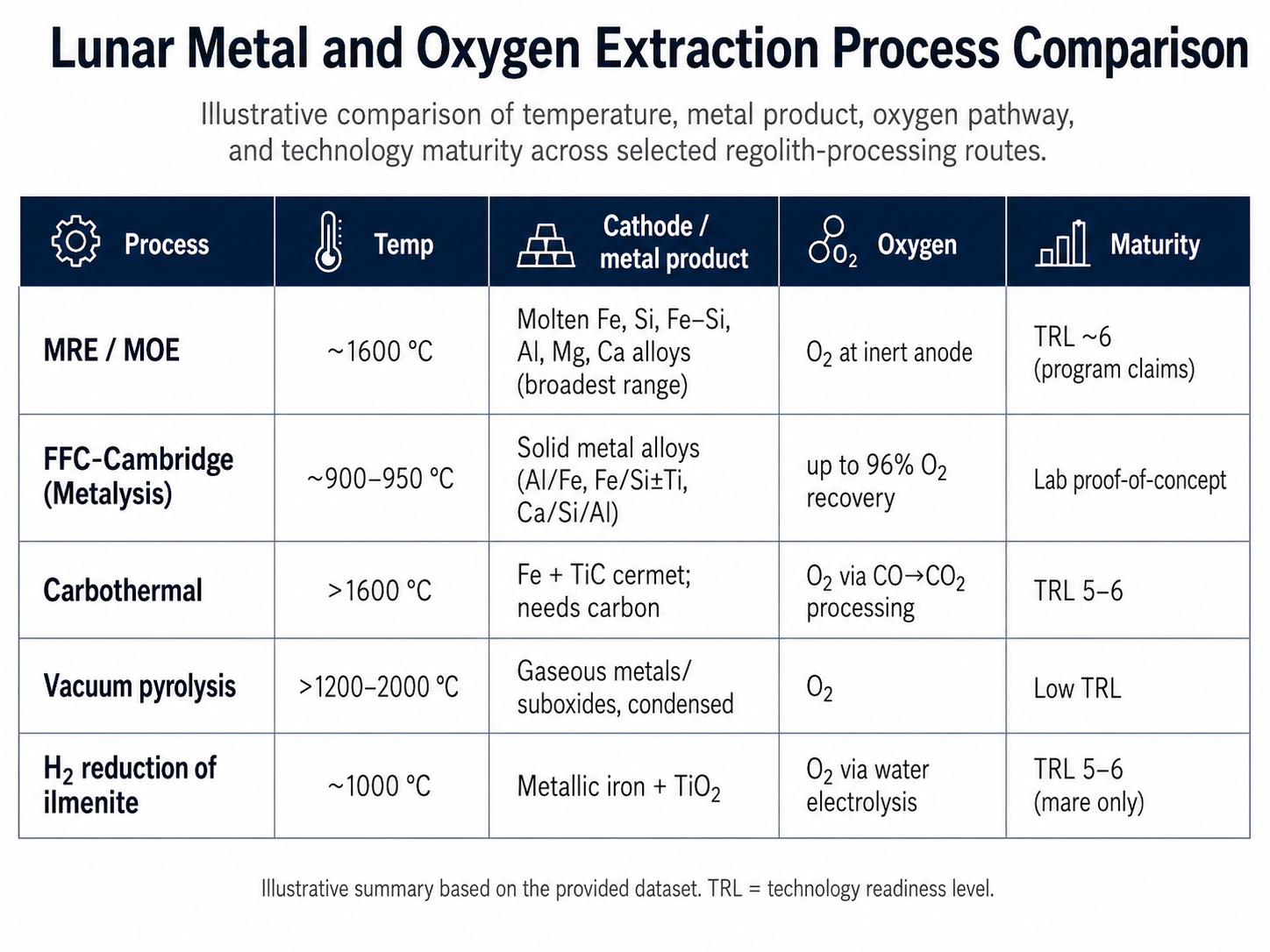
FFC produces solid (not molten) alloys at much lower temperature and avoids the 1600 °C containment problem, but reduction is slow and salt management is required. MRE uniquely produces molten metal directly and the broadest metal slate, at the cost of the highest temperature and the inert-anode problem.
Key players and stakeholders
Government/intergovernmental:
- NASA ISRU programs and the Lunar Surface Innovation Initiative (LSII); MMPACT (Moon to Mars Planetary Autonomous Construction Technology) at Marshall Space Flight Center and focuses on construction materials including metals and melted regolith; demonstration missions planned mid-/late-2020s.
- ESA and ESRIC (European Space Resources Innovation Centre, Luxembourg, established November 2020; joint Luxembourg Space Agency/LIST/ESA initiative). ESRIC partners with Airbus (ROXY oxygen/metals system) and supported the Metalysis/Glasgow FFC work.
Commercial developers:
- Blue Origin - Blue Alchemist MRE solar-cell program. NASA awarded Blue Origin $34.7M in its July 24, 2023 Tipping Point selections (the largest of the awards), to advance Blue Alchemist toward a simulated-lunar-environment demonstration. Blue Origin claims to produce end-to-end solar cells, transmission wire, and cover glass; it has completed a Critical Design Review, with integrated MRE-plus-purification environmental testing scheduled 2026.
- Lunar Resources, Inc. (Houston, founded 2019). Proprietary MRE for O₂, Fe, Si, Al, Mg; SIRE (Silicon and Iron Extraction) project. Its LR-1 reactor "operated for over 36 hours, including 24 hours of electrolysis, and processed 25 kg" of highland simulant heated to ~1700 °C at NASA Kennedy in late 2024, with measured oxygen matching theoretical (NASA Kennedy, Dec. 5, 2024; LPSC 2025 abstract #2737, Hinkel). NASA's Dr. Annie Meier stated, "This is the first time NASA has produced molecular oxygen using this process." Federal obligations ~$10.5M; investors include NSF, NASA, and DoD/National Security Innovation Capital.
- Metalysis (UK) - FFC-Cambridge commercial metal/alloy producer; lunar work with ESA and the University of Glasgow.
- Boston Metal (MIT spinout, Woburn MA; founded ~2012 as Boston Electrometallurgical by Sadoway, Allanore, and James Yurko) - terrestrial MOE for green steel; school-bus-sized modular cells at ~1600 °C; Brazilian subsidiary recovers high-value metals. The most direct terrestrial analogue and technology-transfer pathway.
Academic/research:
- MIT - Donald Sadoway and Antoine Allanore; foundational MOE work (Nature 2013; ECS Transactions 2010 with Sibille; J. Electrochem. Soc. 2011, e.g. Wang, Gmitter & Sadoway 158:E51–E54 and Kim, Paramore, Allanore & Sadoway 158:E101–E105).
- Colorado School of Mines - Space Resources Program/Center for Space Resources (since the 1990s); Kevin Cannon (MAGMA aluminum project); LAMPP Big Idea concept.
- University of Glasgow (Lomax, Symes); University of Central Florida MRE reactor.
Economics
- Launch cost displacement: cost to land mass on the Moon is frequently cited at ~$1,000,000/kg today (Colorado School of Mines; older Sadoway papers cite ~$100,000/kg historically and ~$20,000/kg from LEO to surface). SpaceX's official figure for early Starship lunar cargo is "$100 million per metric ton" ($100,000/kg), with flights no earlier than 2028; aspirational long-run marginal costs are far lower but unproven. Every kg of oxygen or metal made in situ displaces an equivalent launched kg.
- Co-product value stacking is the core economic argument: a single MRE reactor yields oxygen (life support, propellant oxidizer), iron/steel (structure), silicon (solar cells, semiconductors), and aluminum (wire, structure). Oxygen is ~40 wt% of regolith and is the highest-volume product; metals are the higher-value-per-kg co-products.
- Demand pathways: surface construction (MMPACT landing pads, habitats); in-situ photovoltaics and power transmission (Blue Alchemist); propellant (LOX) and life support.
- Capital intensity/throughput: Schreiner-class plants are sub-tonne to few-tonne hardware producing single-digit to tens of tonnes of product/year; scaling to industrial throughput is unproven. Blue Origin projects Blue Alchemist could make lunar landings up to 60% cheaper and cut fuel-cell/battery mass up to 70% via lunar refueling (developer projection).
Regulatory
- Outer Space Treaty (1967): Article II bars national appropriation of celestial bodies "by claim of sovereignty, by means of use or occupation, or by any other means." The status of extracted resources (as opposed to territory) is not directly addressed; ratified by 117 states as of 2025.
- US Commercial Space Launch Competitiveness Act (2015) (Space Resource Exploration and Utilization Act, 51 U.S.C. §51303): grants US citizens rights to possess, own, transport, use, and sell space resources obtained, while disclaiming sovereignty.
- Luxembourg (Law of 20 July 2017): space resources "are capable of being appropriated." UAE and Japan (Space Resources Act) have enacted similar laws.
- Artemis Accords (2020): Section 10 affirms that the extraction of space resources does not inherently constitute national appropriation under OST Article II; introduces "safety zones" for deconfliction. Non-binding; 50+ signatories by 2025–2026 (Britannica cites 61 by January 2026).
- Moon Agreement (1979): declares the Moon the "common heritage of mankind"; not ratified by the major spacefaring nations (US, Russia, China, Luxembourg, Japan), limiting its force.
- Open issues: interoperability standards, safety-zone scope, benefit-sharing.
Geopolitical
The field is bifurcating into a US-led Artemis ecosystem (50+ signatories) and the China–Russia International Lunar Research Station (ILRS), announced 2021, with construction targeted from ~2031–2035 and a basic facility by ~2035. A lunar power-station memorandum was signed in May 2025 (completion targeted ~2036), and the ILRS has a growing roster of Global South partners (Russia, Venezuela, Belarus, Pakistan, Azerbaijan, South Africa, Egypt, Nicaragua, Thailand, Serbia, Kazakhstan, Senegal, etc.). China's Chang'e-8 (~2028–2029) will test ISRU for the ILRS. In-situ metals and silicon are strategically significant: they underpin supply-chain sovereignty and an industrially self-sustaining cislunar base, reducing dependence on Earth launch. The capacity to manufacture structures, wire, and solar cells from local regolith is a strategic differentiator in this competition.
Recommendations
- Treat iron as the near-term anchor product and oxygen as the economic co-product; treat solar-grade silicon and structural aluminum as higher-risk, longer-horizon products. Iron has the lowest decomposition voltage, deposits as a tappable liquid, and is the most defensible first product. Benchmark to change this view: independent (non-developer) demonstration of >99.999% silicon at >1 kg scale would justify reprioritizing silicon.
- Fund the inert-anode problem as the critical path. Anode durability at 1600 °C in O₂ governs the entire process. Stage gate: a continuously operating anode (>1,000 h) at >5 A in regolith melt before committing to a flight reactor. Track Boston Metal's terrestrial chromium-alloy anode lifetimes (their published demonstration was a 5-hour period) as a leading indicator.
- Demand staged-electrolysis separation data, not just bulk extraction data. The mixed-alloy problem is the under-reported risk. Require developers to report as-deposited alloy compositions AND post-refining grades against application specs (e.g., solar-grade Si, structural Al).
- Match feedstock to product: highland sites for Al/Ca/Si; mare/ilmenite-rich sites for Fe/Ti. Co-locate MRE with the intended product demand.
- Plan power for the 354-hour night. Continuous 1600 °C operation favors fission surface power (e.g., NASA Fission Surface Power) over solar-plus-storage for industrial throughput; benchmark: kWh storage mass vs. reactor mass crossover.
- Monitor the regulatory/geopolitical split. Track Artemis vs. ILRS resource-rights divergence; a contested safety-zone precedent or a new multilateral treaty would change the investment calculus.
Caveats
- Maturity gap: Demonstrated lab results (MIT/NASA iron+silicon co-deposition; 8-hour, 5 A iridium-anode batches; Lunar Resources' 25 kg / 36-hour run with 24 h electrolysis) are real but small-scale. Headline figures from Blue Origin (>99.999% Si, up to 60% cheaper landings) and Lunar Resources ("eliminates anode degradation," order-of-magnitude production) Schreiner's plant numbers are modeled projections.
- Decomposition-voltage data: Only iron's value (~0.91 V at 1823 K; ~0.825 V at 1800 K) is well-sourced for MRE conditions. Non-iron oxide decomposition voltages at ~1600 °C are not cleanly tabulated in the open literature; circulating SiO₂/TiO₂ values are from non-MRE systems and were excluded.
- Temperature range: Sources cite 1600 °C to 1800 °C; "1600 °C" is the most common operating figure (Lunar Resources reports 1700 °C).
- Launch cost figures vary by an order of magnitude or more depending on vehicle and assumptions; treat break-even analyses as scenario-dependent.
- Oxygen vs. metals framing: Most MRE literature is oxygen-centric (NASA's driving interest); cathode-metal product quality is comparatively under-characterized, which is itself a finding.
- Citation note: Allanore, Yin & Sadoway 2013 is Nature 497:353–356 (doi:10.1038/nature12134); the pp. 324–325 reference is the companion commentary by D. Fray (doi:10.1038/nature12102), not the primary research article.
 John D
Verified source inventory (for Chicago author-date assembly)
Peer-reviewed / primary:
- Allanore, Antoine, Lan Yin, and Donald R. Sadoway. 2013. "A New Anode Material for Oxygen Evolution in Molten Oxide Electrolysis." Nature 497 (7449): 353–356. doi:10.1038/nature12134.
- Fray, Derek J. 2013. "Metallurgy: Iron Production Electrified." Nature 497 (7449): 324–325. doi:10.1038/nature12102.
- Allanore, Antoine. 2015. "Features and Challenges of Molten Oxide Electrolytes for Metal Extraction." Journal of the Electrochemical Society 162 (1): E13–E22. doi:10.1149/2.0451501jes.
- Wang, Dihua, Andrew J. Gmitter, and Donald R. Sadoway. 2011. "Production of Oxygen Gas and Liquid Metal by Electrochemical Decomposition of Molten Iron Oxide." Journal of the Electrochemical Society 158: E51–E54.
- Kim, Hojong, James Paramore, Antoine Allanore, and Donald R. Sadoway. 2011. "Electrolysis of Molten Iron Oxide with an Iridium Anode: The Role of Electrolyte Basicity." Journal of the Electrochemical Society 158: E101–E105.
- Wiencke, Jan, Hervé Lavelaine, Pierre-Jean Panteix, Carine Petitjean, and Christophe Rapin. 2018. "Electrolysis of Iron in a Molten Oxide Electrolyte." Journal of Applied Electrochemistry 48 (1): 115–126. doi:10.1007/s10800-017-1143-5.
- Sirk, Aislinn H. C., Donald R. Sadoway, and Laurent Sibille. 2010. "Direct Electrolysis of Molten Lunar Regolith for the Production of Oxygen and Metals on the Moon." ECS Transactions 28 (6): 367–373.
- Sibille, Laurent, Donald R. Sadoway, Aislinn Sirk, et al. 2009. "Recent Advances in Scale-up Development of Molten Regolith Electrolysis for Oxygen Production in Support of a Lunar Base." 47th AIAA Aerospace Sciences Meeting, AIAA 2009-0659.
- Schreiner, Samuel S., Laurent Sibille, Jesus A. Dominguez, and Jeffrey A. Hoffman. 2016. "A Parametric Sizing Model for Molten Regolith Electrolysis Reactors to Produce Oxygen on the Moon." Advances in Space Research. doi:10.1016/j.asr.2016.01.006.
- Schreiner, Samuel S. 2015. "Molten Regolith Electrolysis Reactor Modeling and Optimization of In-Situ Resource Utilization Systems." S.M. thesis, MIT (DSpace handle 1721.1/98589).
- Lomax, Bethany A., Melchiorre Conti, Nader Khan, Nick S. Bennett, Alexey Y. Ganin, and Mark D. Symes. 2020. "Proving the Viability of an Electrochemical Process for the Simultaneous Extraction of Oxygen and Production of Metal Alloys from Lunar Regolith." Planetary and Space Science 180. doi:10.1016/j.pss.2019.104748.
- Wiencke et al. companion: "The Impact of Iron Oxide Concentration on the Performance of Molten Oxide Electrolytes for the Production of Liquid Iron Metal." 2019. Metallurgical and Materials Transactions B. doi:10.1007/s11663-019-01737-3.
- Balasubramaniam, R., U. Hegde, and S. Gokoglu. 2010. "The Reduction of Lunar Regolith by Carbothermal Processing Using Methane." (ScienceDirect, S0301751610000815).
- Haskin, Larry, and Paul Warren. 1991. "Lunar Chemistry." Chapter 8 in Lunar Sourcebook. Lunar and Planetary Institute.
Government / intergovernmental / patents:
15. Sirk, Sadoway, Sibille. "Direct Electrolysis of Molten Lunar Regolith…" NASA NTRS 20110008535.
16. "Improving Molten Regolith Electrolysis with Zirconia-Based Hollow Anode Technology." NASA NTRS 20250004626 (also Acta Astronautica, S0094576525003807).
17. "System Modeling of a Lunar Molten Regolith Electrolysis Plant." NASA NTRS 20240012420.
18. MMPACT overview papers: NASA NTRS 20205007535, 20220013715, 20230008890; AIAA 2021-4072.
19. Sanders, G., and J. Kleinhenz. 2025. "Progress Review of NASA Lunar ISRU Development: 2019 to 2025." NASA NTRS 20250003730.
20. US Patent 11,624,119. "Centrifugal Molten Electrolysis Reactor for Oxygen, Volatiles, and Metals Extraction from Extraterrestrial Regolith."
21. Congressional Research Service. R48144. "Space Resource Extraction: Overview and Issues for Congress." congress.gov.
22. US Commercial Space Launch Competitiveness Act 2015, 51 U.S.C. §51303.
23. Luxembourg. Law of 20 July 2017 on the Exploration and Use of Space Resources (UNOOSA contribution document).
Institutional / industry:
24. Blue Origin. 2023. "Blue Alchemist Technology Powers Our Lunar Future." blueorigin.com (Feb 2023).
25. Blue Origin. "Blue Origin Awarded NASA Partnership…" ($34.7M Tipping Point, July 2023).
26. Lunar Resources / NASA Kennedy. 2024. "NASA Kennedy Breathes Life into Moon Soil Testing." nasa.gov (Dec 5, 2024); LPSC 2025 abstract #2737 (Hinkel). 27. Colorado School of Mines Newsroom. "Mines Researchers Get $2M from NASA to Advance Technology for Extracting Aluminum from Lunar Soil" (MAGMA, Cannon).
28. Colorado School of Mines. 2023. "Lunar Alloy Metal Production Plant (LAMPP)." NASA BIG Idea Challenge technical paper.
29. ESA. 2019. "Oxygen and Metal from Lunar Regolith." esa.int.
30. ESRIC (Luxembourg Space Agency / LIST). Institutional pages and Airbus ROXY MoU (Oct 2021).
31. MIT News. 2024. "Making Steel with Electricity" (Boston Metal). news.mit.edu. 32. Artemis Accords (2020); International Lunar Research Station Guide for Partnership (CNSA, 2021).
33. SpaceX. "Moon" (spacex.com/humanspaceflight/moon): "$100 million per metric ton."