Nancy Grace Roman Space Telescope Technical Briefing: 2.4m Optics, 300-Megapixel Focal Plane, 20 Petabytes
What Roman has demonstrated, what remains modeled, and why out-year funding is the dominant risk.

The Nancy Grace Roman Space Telescope: A Technical and Feasibility Briefing
Update: Nancy Grace Telescope has since launched successfully on August 30, 2026, aboard a SpaceX Falcon Heavy, and is currently in-transit to Sun-Earth L2 as planned.
1. Summary
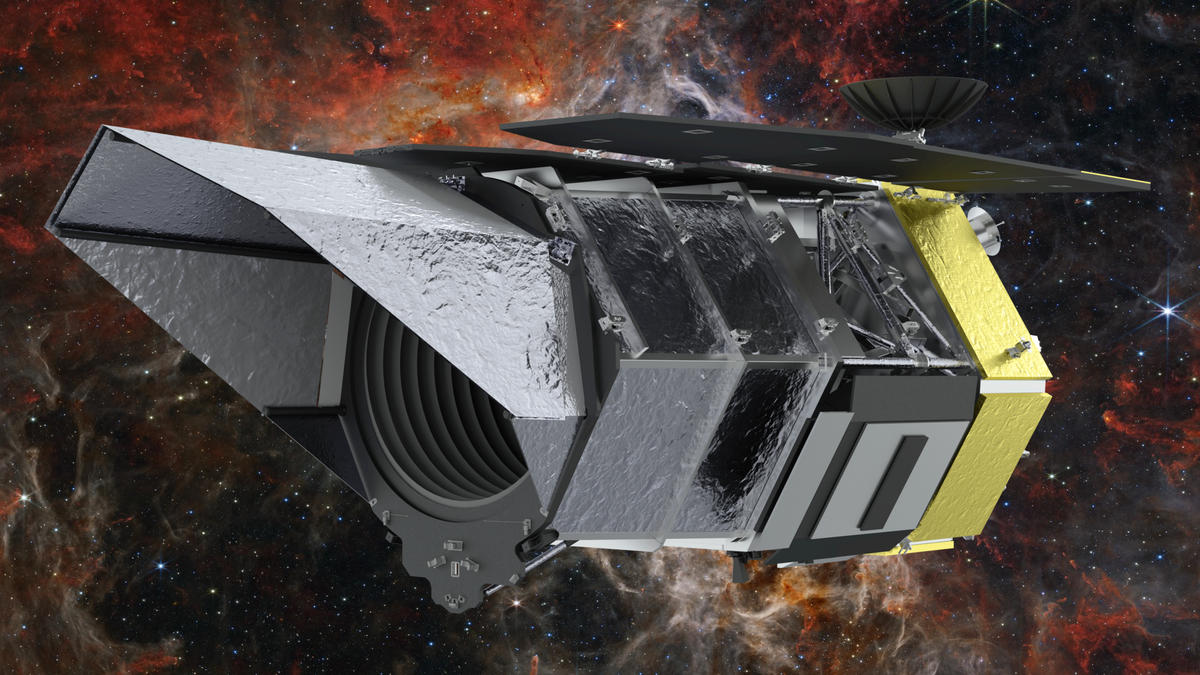
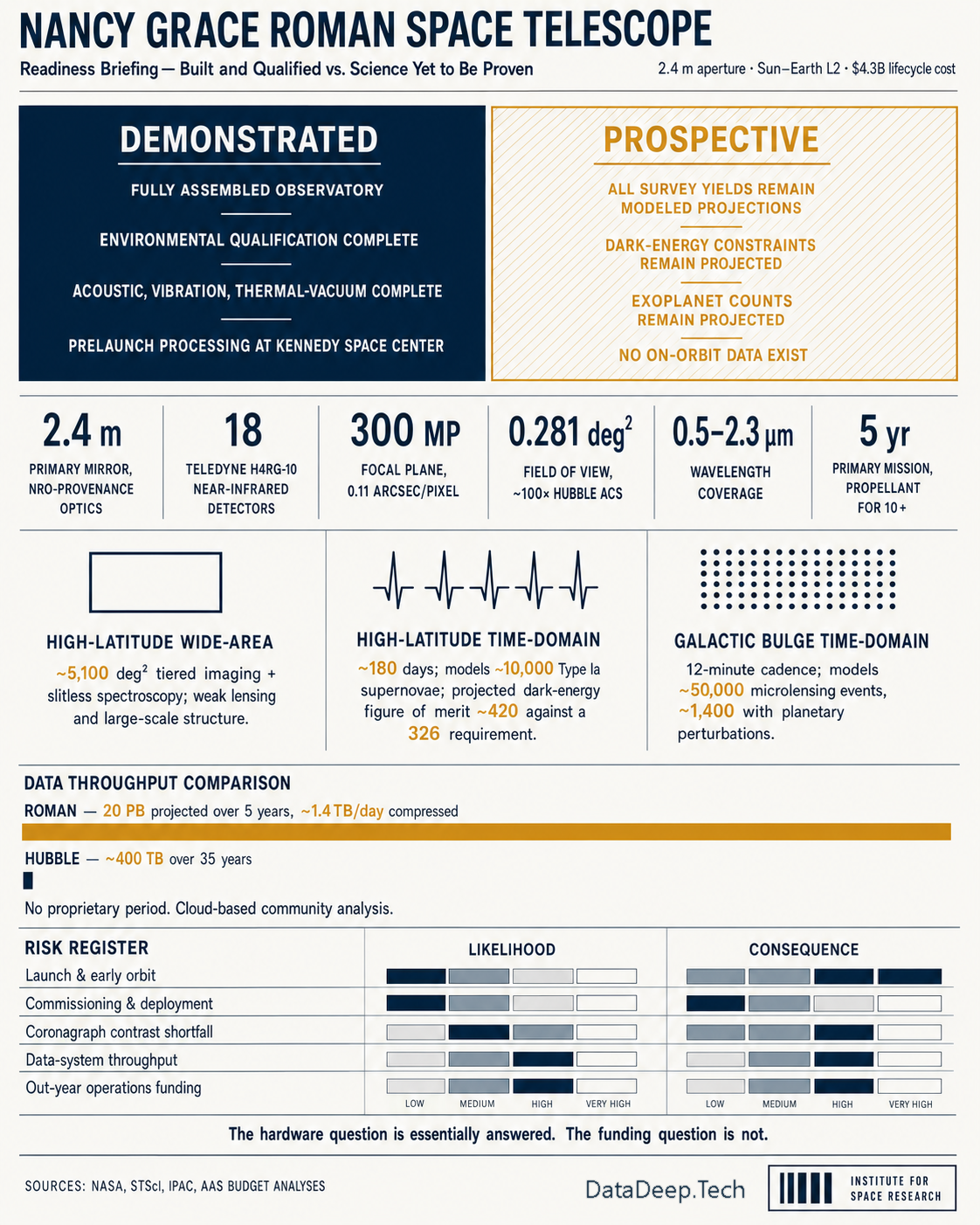
The Nancy Grace Roman Space Telescope is a fully assembled, environmentally qualified 2.4-meter wide-field near-infrared flagship in prelaunch processing at Kennedy Space Center, targeting launch no earlier than August 30, 2026, on a SpaceX Falcon Heavy, with a mandated launch-readiness date no later than May 2027. The central analytical distinction this briefing enforces is between hardware maturity, which is high and demonstrated, and science yield, which is entirely prospective: the observatory has passed acoustic, vibration, and thermal-vacuum qualification, but no on-orbit data yet exist. Roman's differentiated capability is not aperture (identical to Hubble) but etendue: an 18-detector, roughly 300-megapixel focal plane delivers a field of view about 100 times larger than Hubble's imaging cameras at comparable resolution, converting Hubble-class imaging into a statistical survey instrument. NASA and STScI project that the mission will generate 20 petabytes (20,000 terabytes) over its five-year primary mission, against the roughly 400 terabytes Hubble has delivered across 35 years, shifting cosmology and exoplanet demographics toward a survey-first, community-analysis paradigm. The mission's hardest problems are now integration-scale rather than component-scale: weak-lensing shape calibration across a very large detector mosaic, petabyte-class data processing and archiving, and coordination of finite survey time across competing cosmology and exoplanet goals. The dominant residual risk is not technical but programmatic: the FY2026 request proposed to cut Roman's development funding to $156.6 million (with a leaked draft calling for outright cancellation) before Congress restored it to $300 million, and the out-year operations and Guest Investigator funding on which all science return depends remains exposed to the same annual budget instability. The Coronagraph Instrument is explicitly a technology demonstrator; its ground-measured contrast is a true achievement, but its on-orbit performance goals are unproven, and a shortfall degrades a demonstration objective rather than the core mission.
2. Background
Roman originates as the top-ranked large space mission of the 2010 astrophysics decadal survey, "New Worlds, New Horizons in Astronomy and Astrophysics" (Astro2010), which prioritized a Wide-Field Infrared Survey Telescope (WFIRST) above the Explorer program augmentation, LISA, and the International X-ray Observatory in the large space category. The decadal's science charge, dark energy, the demographics of planetary systems via microlensing, and broad infrared astrophysics, remains the mission's charge today. The original WFIRST Design Reference Mission 1 (2011–2012) was a 1.3-meter unobstructed telescope. In January 2011 the National Reconnaissance Office informed NASA of two surplus 2.4-meter optical telescope assemblies, built for a reconnaissance program and never flown; the donation was accepted in 2011 and publicly announced on June 4, 2012.
The NRO donation is best understood as a technical-heritage and political-momentum event rather than a strategic dimension. The 2.4-meter mirror doubled the aperture of the baseline WFIRST design, quadrupling light-gathering power and, through the assembly's shorter focal length, enabling the wide field that defines the mission. What the donation did not do was provide a complete instrument: the assemblies arrived without detectors, electronics, or spacecraft, all of which NASA funded and integrated, and the larger optics required a larger launch vehicle and camera. Contemporaneous estimates of the net cost effect ranged from roughly $250 million of savings to a $100–250 million increase, so the donation is not accurately characterized as a straightforward cost reduction. The mission became a formal NASA project in February 2016, was renamed in May 2020 for Nancy Grace Roman, NASA's first Chief of Astronomy, and was confirmed at Key Decision Point-C in 2020.
3. Technical Core: Observatory Architecture and Survey Concept of Operations
3.1 The Optical Telescope Assembly and its heritage
The Optical Telescope Assembly is a 2.4-meter, f/7.9 three-mirror anastigmat built around the NRO-provenance primary mirror, with nine additional mirrors, supporting structure, and electronics. The primary mirror was reworked by L3Harris Technologies (NYSE:LHX) in Rochester, New York. The short focal length relative to Hubble, whose Wide Field Camera 3 operates near f/24, is the physical origin of Roman's wide field: the same aperture and comparable resolution are spread across a far larger focal surface. The assembly retains an actuated (steerable) secondary mirror, a feature of its reconnaissance heritage, giving the observatory an active optical adjustment capability beyond Hubble's fixed optics.
3.2 The Wide Field Instrument
The Wide Field Instrument is the primary science payload and the source of the mission's differentiated capability. Its focal plane is a 6-by-3 mosaic of 18 Teledyne (NYSE:TDY) H4RG-10 HgCdTe near-infrared detectors, each 4096-by-4096 pixels (4088-by-4088 usable after reference pixels), for over 300 million active pixels at a plate scale of 0.11 arcseconds per pixel, comparable to Hubble's WFC3/IR. The active field of view is 0.281 square degrees, described by mission and archive documentation as roughly 100 times the area of Hubble's ACS or JWST's NIRCam, and about 200 times that of WFC3/IR. The instrument is sensitive from approximately 0.5 to 2.3 microns, with the detectors' intrinsic long-wavelength cutoff near 2.5 microns but the optical elements effectively setting the red edge near 2.3 microns. The WFI carries eight or more filters, including the very wide F146 (0.92–2.00 microns) used for microlensing, plus two dispersive elements, a grism (G150, resolution roughly 460, 1.00–1.93 microns) and a prism (P127, resolution roughly 80–180, 0.75–1.80 microns) for slitless spectroscopy. The instrument delivers diffraction-limited imaging in all but the shortest-wavelength filter, and the observatory can slew and settle on an adjacent field in about 60 seconds using reaction wheels, a cadence advantage over gas-thruster-slewed missions. The WFI completed vibration, acoustic, and two thermal-vacuum tests and was delivered to Goddard in summer 2024; integration and test were led by BAE Systems in Boulder, Colorado.
The engineering significance of this architecture is that resolution is set by the mirror while survey speed is set by the detector array. Roman measures a comparable number of galaxy shapes per unit observing time to the ground-based Vera C. Rubin Observatory, but with the sharp, stable point-spread function of a space platform, which is the property that matters most for weak-lensing systematics control.
3.3 The Coronagraph Instrument as a technology demonstrator
The Coronagraph Instrument is explicitly designated a technology demonstration, not a core-mission instrument. It is the first space-based coronagraph to carry two deformable mirrors (48-by-48 actuators each) with active, high-order wavefront sensing and control, using the electric-field-conjugation algorithm with a ground-in-the-loop architecture for the computationally expensive control steps. Its purpose is to raise the technology readiness level of the components (deformable mirrors, photon-counting detectors, coronagraph masks, low-order wavefront sensors) needed for a future flagship capable of directly imaging Earth-like planets, identified with the Habitable Worlds Observatory.
The distinction between demonstrated ground performance and on-orbit goals is critical. Per Cady et al. 2025 (JATIS 11(2), 021408), during flight-instrument thermal-vacuum testing
"CGI achieved better than 5×10⁻⁸ total raw contrast with two independent coronagraph architectures covering 3–9 and 6–20 λ/D between them and a 360° dark hole on each,"
and the authors note
"The contrast limits appear to be driven by the time available for testing and do not appear to represent a floor."
The instrument's stated on-orbit goal is a raw contrast of order 10⁻⁸ or better in the 3–9 λ/D region, which is roughly an order of magnitude short of the roughly 10⁻¹⁰ contrast required to image true Earth analogs, a gap the mission and the HWO technology community state explicitly. Deformable mirrors for the program were assessed around technology readiness level 4 in HWO planning documents. The Coronagraph will operate through a Community Participation Program with a baseline allocation of roughly 2,200 hours in the first 18 months, and there is no exclusive-use period for its data.
3.4 Operating orbit
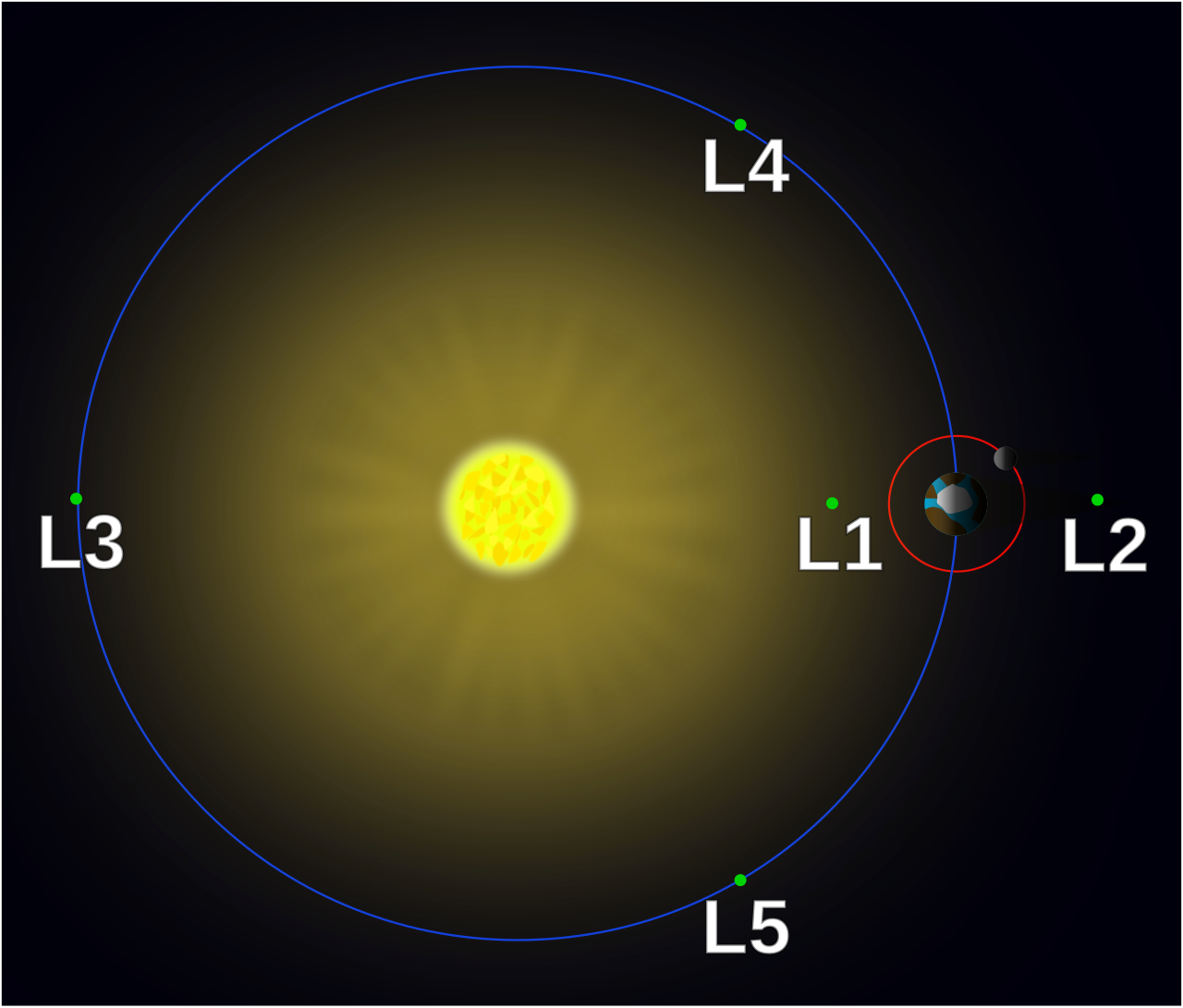
Roman will operate in a halo orbit around the Sun-Earth L2 point, about 1.5 million kilometers from Earth, the same broad regime as JWST and Euclid. L2 provides a thermally stable environment with the Sun, Earth, and Moon on one side, favorable for the passive cooling and pointing stability that wide-field near-infrared survey work requires. Transit to L2 and commissioning follow launch, with science operations beginning after roughly 90 days of commissioning.
3.5 The core community surveys and the observing/data model
Roman's five-year primary mission is organized around three Core Community Surveys, defined through community committees and the Roman Observations Time Allocation Committee, which together are anticipated to consume the majority of primary-mission observing time; at least 25 percent of the primary mission is reserved for competitively selected General Astrophysics Surveys, including an early-definition Galactic Plane Survey.
The High-Latitude Wide-Area Survey is the weak-lensing and large-scale-structure workhorse. Its imaging component is designed to cover on the order of 1,700 to 2,400 square degrees in four near-infrared bands (F106, F129, F158, F184) with a slitless spectroscopic component; current documentation describes a multi-tiered design covering roughly 5,100 square degrees when the single-filter wide tier is included, about 12 percent of the sky. Mission forecasts model that weak lensing over a roughly 2,000-square-degree high-latitude survey could improve precision on matter clustering by up to an order of magnitude over current measurements, with a modeled galaxy shape density of roughly 35 galaxies per square arcminute in the best single band. These are design objectives and forecasts, not measurements.
The High-Latitude Time-Domain Survey is allocated roughly six months of observing time (about 180 days) spread over the mission and is designed to detect on the order of 10,000 Type Ia supernovae, most at redshift 0.5 to beyond 2, to constrain the dark-energy equation of state. A catalog-level simulation of the committee-recommended strategy (Kessler et al. 2025) models a sample of roughly 10,000 Roman supernovae combined with roughly 4,400 from Rubin, yielding a dark-energy figure of merit of approximately 420, described as "well above the NASA mission requirement of 326, with the caveat that SN Ia model training systematics have not been included."
The Galactic Bulge Time-Domain Survey is the first space-based microlensing exoplanet census, monitoring roughly 1.7 to 2 square degrees of the bulge at 12-minute cadence during six roughly 72-day seasons (three early, three late in the mission). Its design objective is to measure cold and free-floating exoplanet demographics in a mass-separation regime complementary to Kepler and TESS. Per Johnson et al. 2020, the survey "will observe ∼50,000 microlensing events, of which roughly 1400 are predicted to show planetary perturbations" down to roughly Mars mass; pixel-level simulations model an additional roughly 60,000 to 200,000 transiting planets, and free-floating-planet yield estimates range from hundreds to roughly a thousand depending on the assumed mass function. NASA and STScI communicate an aggregate figure of order 100,000 exoplanets across microlensing and transit detections. Every one of these numbers is a modeled projection contingent on final survey design and the true (unknown) planet mass function.
The data and observing model is a defining feature. All WFI data are public with no proprietary period and are processed as they arrive; the Science Operations Center at STScI runs the RomanCal calibration pipeline (built on JWST heritage) to produce prompt products, deeper mosaics, and source catalogs, while the Science Support Center at IPAC handles slitless spectroscopy extraction and the Galactic Bulge microlensing processing. All products are distributed through the Mikulski Archive for Space Telescopes, with cloud-based analysis via the Roman Research Nexus on Amazon Web Services (NASDAQ:AMZN). Per STScI, once fully operational Roman "will return approximately 1.4 terabytes of compressed data per day" and "will ultimately generate 20 petabytes of data" in its first five years; NASA's Goddard characterizes the rate as "over 500 times more data back to Earth than Hubble" each day, making local download impractical and forcing a shift to in-place, cloud-based community analysis funded through a Guest/General Investigator program.
The integration-level difficulty concentrates in four places. First, data rate and downlink: the very high WFI data volume must be moved over the Ka-band link (documented around 290 Mbit/s) and processed on a cadence that keeps prompt products flowing within days. Second, the scale of science data processing and archiving at petabyte class, NASA's first such astrophysics mission, which is why the ground system moved into development only after a dedicated critical design review. Third, weak-lensing shape calibration across the 18-detector mosaic, where field-dependent point-spread-function variation, detector-level effects such as the brighter-fatter effect, and wavefront error must be controlled to the sub-percent level that cosmic-shear cosmology demands. Fourth, the coordination of finite survey time across competing cosmology and exoplanet goals, a zero-sum allocation problem the community committee process is designed to manage.
4. Development Status and Maturity
The flight observatory is fully assembled and has completed environmental qualification. NASA joined the two major observatory segments in late 2025, and construction was declared complete on November 25, 2025. The observatory underwent acoustic, vibration (launch simulation), and thermal-vacuum testing at Goddard, and the primary mirror and instruments passed their qualification campaigns. Roman arrived at Kennedy Space Center on June 21, 2026, via NASA's Pegasus barge and the port of Baltimore, and as of July 2026 is in prelaunch processing in the Payload Hazardous Servicing Facility: rotated vertical, powered up for system checkouts, with solar-array, thermal-blanket, and propellant-tank testing underway ahead of loading roughly 290 gallons (about 1,100 liters) of hydrazine and encapsulation in the Falcon Heavy fairing. This is a high, demonstrated state of hardware readiness.
Hardware readiness must be held entirely separate from science yield. No on-orbit data exist. Every performance figure in Section 3, dark-energy figure of merit, weak-lensing precision, supernova counts, microlensing yields, is a modeled projection, and the mission's own documentation frames them as design objectives and forecasts. On-orbit performance will not be known until after commissioning.
For the Coronagraph, the demonstrated result is the ground-measured contrast (better than 5×10⁻⁸ raw contrast in flight-instrument thermal-vacuum testing), which is a genuine achievement for a space-qualified instrument. Its on-orbit contrast goal (order 10⁻⁸ or better in the 3–9 λ/D region) is an objective, not a demonstrated capability, and space-environment stability, thermal drift, and pointing jitter can degrade contrast relative to ground testbeds. Because the Coronagraph is a technology demonstrator, this uncertainty is appropriate to its role.
5. Key Programs, Institutions, and Actors
NASA's Goddard Space Flight Center manages the mission and hosts the Mission Operations Center. The Jet Propulsion Laboratory developed and manages the Coronagraph Instrument and supports WFI detector characterization through its Precision Projector Laboratory. The Space Telescope Science Institute hosts the Science Operations Center, planning and scheduling observations, running the calibration pipeline, and operating the MAST archive; Caltech/IPAC hosts the Science Support Center, responsible for slitless spectroscopy and Galactic Bulge microlensing processing.
The primary industrial contributors are Teledyne Scientific & Imaging (NYSE:TDY), which supplies the H4RG-10 near-infrared detectors; L3Harris Technologies (NYSE:LHX), which reworked the primary mirror and contributed optical elements; and BAE Systems (parent BAE Systems plc), which built and tested the Wide Field Instrument in Boulder. SpaceX provides the Falcon Heavy launch under NASA's Launch Services Program.
As scientific context, two peer facilities are complementary rather than competitive. ESA's Euclid, a 1.2-meter mission launched July 1, 2023, and in nominal survey operations since February 2024, is wider and shallower and lacks a supernova program; Roman is deeper, sharper, and narrower in area, and adds supernova cosmology. The NSF–DOE Vera C. Rubin Observatory, an 8.4-meter ground-based telescope that unveiled first-look images on June 23, 2025 and is entering its ten-year Legacy Survey of Space and Time, provides the wide-area optical photometry that complements Roman's space-based near-infrared imaging; the highest-value cosmology is expected to come from cross-calibration among Roman, Rubin, and Euclid rather than any one alone. JWST is complementary in the opposite sense: it observes deep and narrow where Roman observes wide, and Roman is expected to feed target lists to JWST.
6. Path to Realization
Because the observatory is built and qualified, the remaining path is launch, transit to L2, in-orbit commissioning and instrument checkout (roughly 90 days), and the ramp to survey operations, followed by a five-year primary mission and the community observing program. The credible lifecycle cost is $4.3 billion, reflecting a $382 million pandemic-driven replan added in 2021 to a prior $3.93 billion commitment; NASA characterizes the mission as currently under budget and ahead of schedule. The launch vehicle is the Falcon Heavy from Launch Complex 39A, with launch targeted no earlier than August 30, 2026 and a mandated no-later-than date of May 2027. The primary mission is five years, and onboard propellant (hydrazine) is stated to support ten or more years, making a five-year extension feasible in principle subject to funding.
The dominant open dependency is not engineering but funding. Per the American Astronomical Society's FY2026 budget analysis (June 2025), "Exoplanet Exploration Funding is reduced to $156.6 million for the Nancy Grace Roman Telescope, compared to the $376.5 million it was projected to get in FY26 in the FY25 budget request," and a leaked draft reportedly called for outright cancellation; the broader request proposed cutting NASA's Science Mission Directorate by roughly 47 percent and the Astrophysics Division to $523.1 million. Congress rejected these cuts: the FY2026 CJS minibus (H.R. 6938, enacted January 2026) provided $300 million for Roman, roughly $7.25 billion for the Science Mission Directorate, and roughly $1.595 billion for Astrophysics, with explicit anti-impoundment language requiring NASA to spend no less than the allocated amounts. The FY2027 request again proposed deep astrophysics cuts (Astrophysics to roughly $552 million, a 65 percent reduction from the FY2026 enacted level) while funding Roman itself at $166.8 million to preserve launch and begin the prime mission. Critically for science yield, the FY2027 request funds General Investigator awards for only the first mission year and defers dedicated Roman science-return (exoplanet) funding to FY2028, and NASA plans to consolidate seven separate Guest Observer/Investigator programs into one within a sharply reduced Astrophysics Research budget. The Roman Cycle 1 General Investigator call had proposals due March 17, 2026.
 John D
7. Material Risks and Failure Modes
The material risks are technical and programmatic, and the analysis weights them accordingly. Launch and early-orbit failure is the classic low-likelihood, high-consequence risk: a Falcon Heavy failure or a transit anomaly would be catastrophic and unrecoverable, but Falcon Heavy is a flight-proven vehicle and this class of risk is irreducible for any single-launch flagship. Mitigation is confined to standard launch-vehicle qualification and the mandated schedule margin to May 2027.
Commissioning and deployment anomalies are a moderate concern. Unlike JWST, Roman does not require a complex multi-stage unfolding of its primary mirror, which materially lowers deployment risk; the principal deployables are the solar-array sun shield and standard appendages, and the instruments must reach thermal equilibrium and focus. The probability of a mission-ending deployment failure is lower than JWST's was, but instrument cooldown, focus, and wavefront-control commissioning still carry non-trivial risk of partial capability loss or schedule slip.
The Coronagraph falling short of its contrast goals is a plausible but correctly bounded risk. As it is a technology demonstrator with performance goals rather than requirements, a contrast shortfall degrades a demonstration objective and reduces the pathfinding value for HWO, but does not compromise the core dark-energy and exoplanet-demographics mission carried by the WFI. This risk should be framed as affecting an option, not the mission.
Science-data-system and archive throughput at petabyte scale is a concerning integration risk. A ground system that cannot keep pace with the WFI data rate would delay prompt products and throttle community science even with a perfectly functioning observatory. This is mitigated by JWST pipeline heritage, a cloud-based architecture, a dedicated critical design review, and pre-launch community testing via the Research Nexus, but it remains unproven at full operational volume.
Out-year operations and Guest Investigator funding instability is, in this assessment, the most probable threat to realized science value. The mission has faced cancellation or deep-cut proposals repeatedly, including across the first Trump administration and again in the FY2026 and FY2027 requests, and its scientific return depends on a sustained operations and GI budget that the observatory itself does not guarantee. A built and launched observatory starved of operations and data-analysis funding would still return data, but the community's ability to convert 20 petabytes into science would be materially curtailed. Congressional support has been consistent and bipartisan, and anti-impoundment language in the FY2026 enacted bill is a meaningful mitigation, but the annual-appropriations exposure is structural and recurring.
8. Implications and Outlook
Roman's core meaning for the field is the maturation of statistical, survey-first astrophysics as a space-based enterprise. In cosmology, Roman is designed to deliver a quantitatively improved dark-energy constraint by combining three probes (weak lensing, galaxy clustering with spectroscopy, and Type Ia supernovae) with the systematics control that only a stable space platform provides; the modeled figure of merit of exceeds the mission requirement, though the achieved value will depend on systematics not fully captured in current simulations. The most powerful cosmological results will likely come not from Roman alone but from joint analysis with Rubin's optical photometry and Euclid's wider-area near-infrared survey, using Roman's deep, sharp imaging to calibrate systematics and the wider surveys for statistical reach.
In exoplanet science, the Galactic Bulge Time-Domain Survey is set to deliver the first space-based microlensing census, populating the cold, wide-orbit, and free-floating regime that transit (Kepler, TESS) and radial-velocity methods cannot reach, and completing the demographic picture begun by Kepler. Combined with a modeled tens-of-thousands transiting-planet bycatch, Roman should roughly reorder the known exoplanet population by mass and separation, though the precise yields hinge on the true planet mass function it is being built to measure.
The observing paradigm itself is a structural shift: no proprietary period, prompt public products, and cloud-based community analysis make Roman a shared infrastructure rather than a PI instrument, with the Guest Investigator program as the mechanism that converts data into published science. The Coronagraph, finally, is best read as a pathfinder: its value lies less in the planets it may image than in retiring the technical and operational risk of active, space-based high-contrast imaging ahead of the Habitable Worlds Observatory.
The open questions that will decide the outcome are three. Technically, will on-orbit weak-lensing shape calibration across the detector mosaic reach the sub-percent systematics floor the cosmology requires, and will the coronagraph's contrast survive the transition from testbed to L2? Operationally, can the petabyte-scale ground system sustain prompt products at full volume? Programmatically, most decisively, will the out-year operations and Guest Investigator budgets be sustained across annual appropriations cycles that have repeatedly targeted the mission? The hardware question is essentially answered; the science-yield question is entirely ahead.
 John D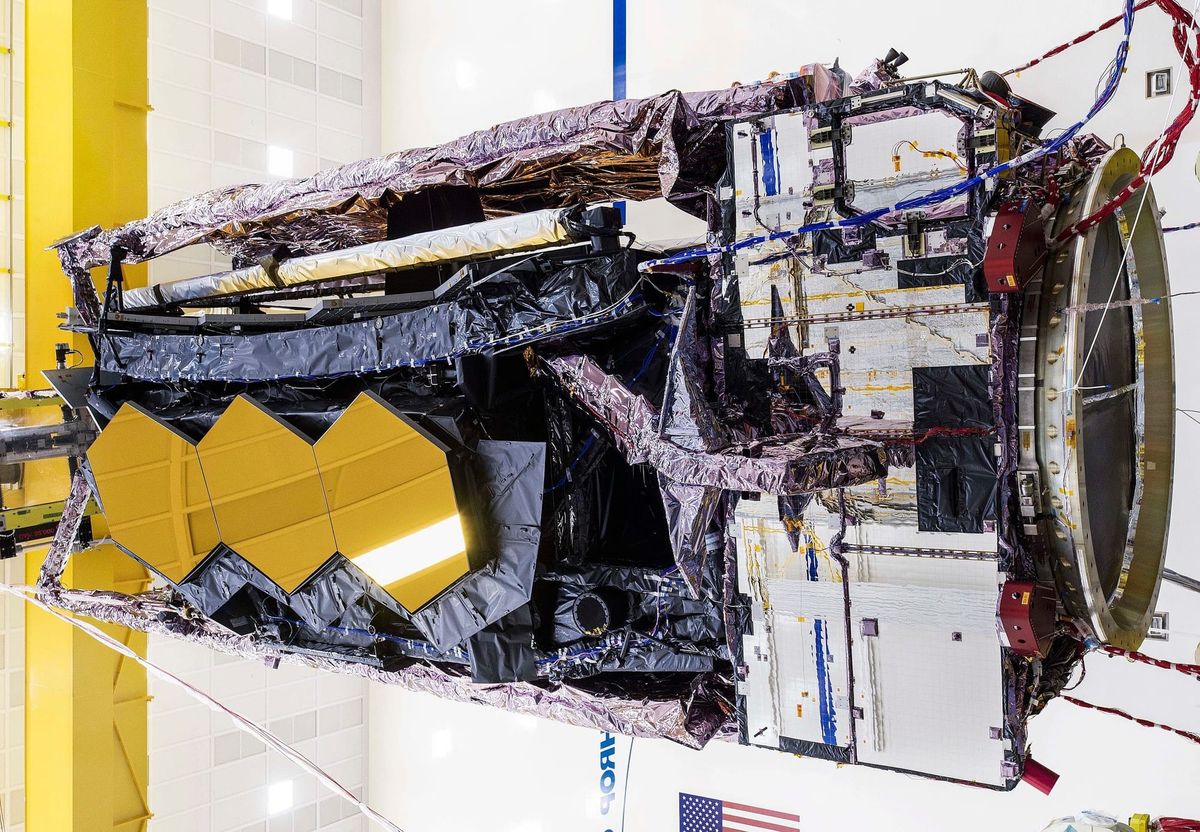
References
[1] NASA Science, "Building Roman." science.nasa.gov.
[2] NASA Science, "NASA's Roman Launch Preparations Proceed," July 9, 2026.
[3] NASA Science, "Roman Launch Countdown" and "NASA's Next Generation Telescope Arrives in Florida," June 21, 2026.
[4] STScI, Roman User Documentation, "The Wide Field Instrument" and "Description of the WFI."
[5] STScI, MAST Archive, "Roman Space Telescope."
[6] Cady et al. 2025, "High-order wavefront sensing and control for the Roman Coronagraph Instrument (CGI): architecture and measured performance," JATIS 11(2), 021408 (arXiv:2507.23738).
[7] arXiv 2103.01980, "The Nancy Grace Roman Space Telescope Coronagraph Instrument (CGI) Technology Demonstration."
[8] Astronomy & Astrophysics, "Extended linearity in the high-order wavefront sensor for the Roman Coronagraph," 2025.
[9] arXiv 2607.02773, "The Habitable Worlds Observatory Technology Development Plan."
[10] NASA JPL, "The Roman Coronagraph Instrument."
[11] NASA Science, "Core Community Surveys" and "High-Latitude Time-Domain Survey: Technical."
[12] STScI, "Surveys and Programs."
[13] Penny et al. 2019, "Predictions of the Nancy Grace Roman Space Telescope Galactic Exoplanet Survey. I."
[14] Johnson et al. 2020, AJ, doi:10.3847/1538-3881/aba75b, free-floating planet detection rates.
[15] IOPscience, "Transiting Exoplanet Yields for the Roman Galactic Bulge Time Domain Survey."
[16] Wikipedia, "2012 National Reconnaissance Office space telescope donation to NASA"; Planetary Society, "NRO gives NASA two hand-me-down telescopes."
[17] NASA, "NASA Confirms Roman Mission's Flight Design in Milestone Review" (lifecycle cost $4.3 billion).
[18] National Academies, "New Worlds, New Horizons in Astronomy and Astrophysics" (2010).
[19] Kessler et al. 2025, "Cosmology Constraints from Type Ia Supernova Simulations of the Roman HLTDS Strategy," ApJ (arXiv:2506.04402).
[20] Roman @ IPAC / NASA GSFC, Project Infrastructure Teams; weak-lensing precision forecast.
[21] Oxford Academic MNRAS, "synthetic Roman Space Telescope High-Latitude Imaging Survey."
[22] STScI, "High-Latitude Wide-Area Survey," Roman User Documentation.
[23] Caltech/IPAC, "Ground System for NASA's Roman Space Telescope Moves into Development" (20 petabytes); NASA Goddard ground-system infographic.
[24] STScI, "Roman Space Telescope Science Platform Will Open New Frontiers in Space Science" (news-2026-401).
[25] STScI, "The Roman Science Operations Center Data Management System."
[26] National Academies, "Cosmological Complementarity of Roman & Euclid" (Eisenstein).
[27] ESA / Laureijs et al., "Euclid mission: status after launch and early operations," SPIE 2024.
[28] Rubin Observatory, "First Look," June 23, 2025; NOIRLab December 2025 update.
[29] The Planetary Society, "You just saved NASA's budget" (FY2026 enacted figures, Jan. 2026).
[30] American Astronomical Society, FY26 (June 2025) and FY27 (April 2026) President's Budget Request analyses.
[31] Astronomy.com, "Congress passes NASA budget, rejects Trump cuts," January 2026; Space.com, FY2026 appropriations coverage.
[32] STScI, "Roman: Delivering Data That Unlocks Discovery."
[33] Discover Magazine, "Roman Space Telescope Arrives in Florida," June 2026.
[34] arXiv 2202.09475, "Euclid-Roman joint microlensing survey."
[35] Scientific American, "Set for launch in September, NASA's Roman Space Telescope," 2026.