
Skydweller in 2026: Credible but Unproven After Losing Its Only Aircraft, With a 192-Hour Record, a Roughly One-Hour Energy Shortfall, and a 2027 Replacement
Skydweller’s 192-hour flight ended about an hour of sunlight short. Battery reserve, not structure, gates its 2027 return and any Navy buy.


Skydweller Aero: From Solar Impulse 2 to Uncrewed Maritime Patrol, Program Status, and the Case for Perpetual-Flight Aircraft
1. Summary
Skydweller has demonstrated that while a large solar-electric aircraft can fly an eight-day, multi-sensor maritime patrol profile, it has yet to have demonstrated that the profile can be sustained for weeks, and the May 2026 loss shows why. The company's only airframe, the converted Solar Impulse 2 (N247PF), flew for 192 hours and 14 minutes from April 26, 2026, supported the U.S. Navy's FLEX 26 exercise with a synthetic aperture radar and an electro-optical/infrared turret, and was then ditched in the Gulf of Mexico on May 4 after turbulence during the return transit exhausted its batteries [1]. The National Transportation Safety Board (NTSB) is conducting a Class 4 investigation that issues no preliminary report, so the cause currently rests on the company's own account [2].
Our position is that the record supports a credible but unproven path to operational multi-week patrol, and that the path now runs almost entirely through two things the public record does not yet show: a replacement aircraft and the money to finish it.
Four findings: First, the demonstrated envelope is narrow: one airframe, a maximum of eight days, at subtropical latitude in spring, against a developer claim of 90 days or more [3]. Second, a first-order energy model calibrated to the airframe's published solar harvest implies the aircraft fell short by only a few kilowatt-hours, roughly one hour of sunlight after a dawn ditching, which identifies dawn battery reserve, not structure, as the decisive variable. Third, the same model suggests a Solar Impulse 2-class battery cannot close the energy balance in a Caribbean December, and that no plausible load closes it at the latitude of the Strait of Hormuz in winter, so perpetual-flight claims are latitude- and season-specific. Fourth, disclosed government contract value totals about $20.6 million against roughly $40 million of disclosed equity and a EUR 30 million loan, with no program of record identified.
For investors, Skydweller is an option value on a 2027 replacement first flight, a multi-week flight, and a funded follow-on contract; failure to show those within roughly 18 months would place it on the same path as earlier abandoned solar long-endurance programs.
2. Background
2.1 A crewed record aircraft repurposed.
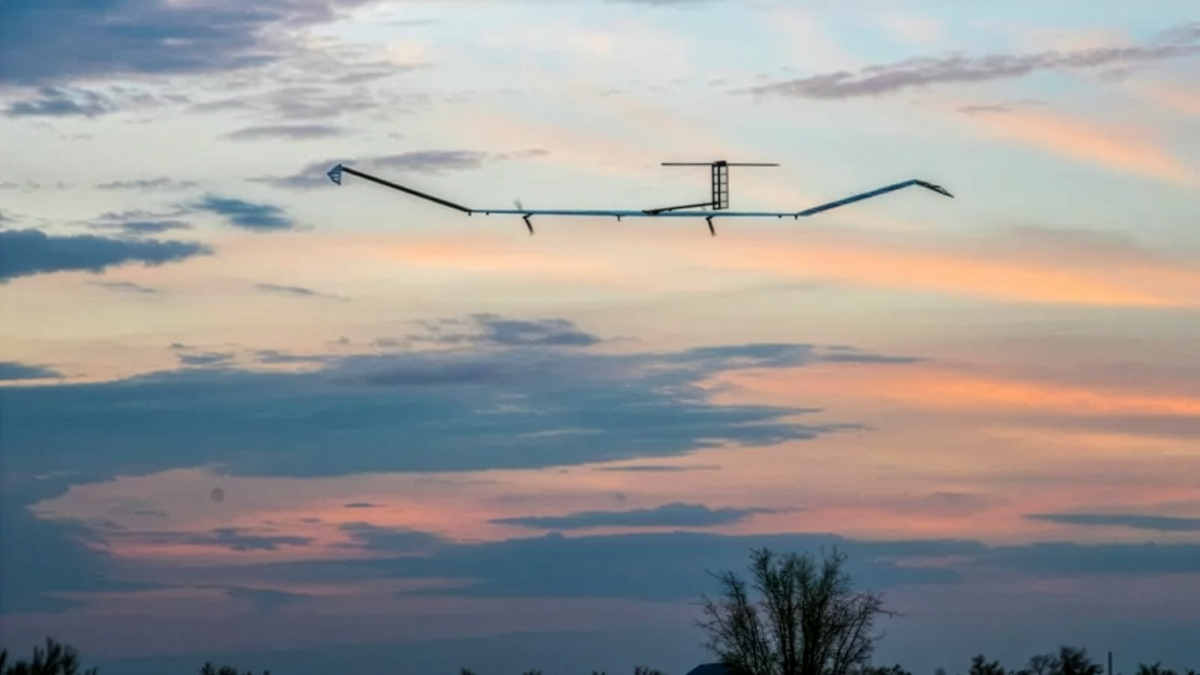
Solar Impulse 2 first flew in June 2014 and was built to carry one pilot around the world on solar power, which it did in 2015 and 2016 in 17 stages and 23 flying days [4][5]. Its 17,248 monocrystalline cells cover 269.5 square meters, and its four nacelles hold 633 kilograms of lithium-polymer cells at 260 watt-hours per kilogram, about 164.6 kilowatt-hours of nominal storage [6][7]. A 2015 interview with the project's chief executive gave a smaller array figure of 250 square meters and 45 kilowatts peak, an inconsistency in the published specifications that this briefing resolves by using the 269.5 square meter figure and the project's stated harvest of up to 340 kilowatt-hours per day [7][6].
2.2 Conversion and the uncrewed record.
Skydweller bought the aircraft and its associated intellectual property in 2019 [8]. It first flew as Skydweller in November 2020 and first flew autonomously in February 2023 [9]; Janes reported that these flights at Albacete, Spain, carried a safety pilot and that the aircraft flew autonomously from takeoff to landing [10]. The first fully uncrewed flight followed at Stennis International Airport, Mississippi, in April 2024 [3]. The FAA registry lists N247PF as a 2014-built aircraft holding an experimental research-and-development airworthiness certificate issued in July 2024 [11]; no primary source fixing the reported January 2024 relocation date was identified. Endurance then rose in three steps: flights of 16 and 22.5 hours in September 2024, at altitudes the company put as high as 33,000 feet [12][13]; a 73-hour flight in July 2025 that the Naval Air Warfare Center Aircraft Division (NAWCAD) said demonstrated the feasibility of a positive energy balance [14]; and the 192-hour FLEX 26 flight [1]. The company's own figure for the July 2025 flight is 74 hours and 3 minutes, within a campaign of 222 hours and 46 minutes over 20 days [15].
2.3 The base rate for the class.
Large solar aircraft have a poor survival record, and the failures cluster around weather and low-altitude dynamics. NASA's Helios broke up near Kauai in 2003; the mishap board attributed the loss to an inability to predict the aircraft's sensitivity to turbulence after configuration changes [16]. Google's Solara 50 was destroyed in May 2015 after control problems in a thermal updraft, and Facebook / Meta's Aquila suffered a structural failure on its first flight in 2016 [17]; Google closed its Titan drone unit in January 2017 and Facebook disbanded Aquila in June 2018 [18]. Airbus's (EPA:AIR) Zephyr crashed in 2022 after 64 days when it met storm turbulence while descending, and its successor was ditched in the Indian Ocean in April 2025 after a record 67 days [19]. Skydweller's loss differs in kind, since the airframe survived the turbulence, but it shares the category's central failure mode: the troposphere consumes more than the design budgeted.
 John D
3. Key Players
3.1 Skydweller.
Skydweller Aero Inc. describes itself as a U.S. company backed by venture and private capital, headquartered in Oklahoma City with engineering offices in the United States and Spain and flight operations at Stennis [20]. It was founded in 2017 by Robert Miller, who remains chief executive, and John Parkes [21]; Thomas Nielsen was promoted to chief operating officer in September 2026 [22]. The structure is transatlantic: government contracts flow to Skydweller US Inc. [23], while the European Investment Bank describes the borrower Skydweller SL as a Spanish small business whose loan funds work in Spain and pre-serial production in Italy [24]. That split is a modest advantage for allied sales and a modest complication for U.S. sole-source procurement, if required.
3.2 Listed companies with exposure.
Leonardo (BIT:LDO) co-led the Series A [25] and, through its Edinburgh-based Leonardo UK unit, builds the AN/ZPY-8 (Osprey multi-mode) radar that flew in FLEX 26 [26][1]. Palantir invested in the same round and partnered to supply its Foundry platform [25][27]; in April 2026 it also partnered with Ondas (NASDAQ:ONDS) and its World View unit on a competing stratospheric intelligence platform [28]. The FLEX 26 turret was a Teledyne FLIR (NYSE:TDY) 380X HDc, an upgraded variant of the Star SAFIRE 380-HDc, which the manufacturer lists at 65 pounds and 225 watts [1][29]. Nokia (HEL:NOKIA), through Nokia Federal Solutions, is Skydweller's partner on airborne 5G demonstrations [30][31]. Northrop Grumman (NYSE:NOC) builds the MQ-4C Triton, Skydweller's most direct conventional substitute [32], and in October 2026 flew Skydweller's VECTA flight-control actuators on the first flight of its YFQ-48A Talon Blue collaborative combat aircraft [20]. None of these relationships is significant to any of these companies' results; a minority stake in a company with $40 million of disclosed equity, or a handful of sensors and actuators, does not move a large-cap defense or software income statement.
3.3 Competitors and substitutes.
Two stratospheric solar aircraft and one small solar aircraft compete most directly for the persistence mission. Airbus's AALTO subsidiary flies Zephyr, a 75-kilogram aircraft with a 25-meter span that reached 67 days in 2025 [33]. BAE Systems (LON:BA.) PHASA-35 holds a NASA contract on behalf of the Air Force Research Laboratory worth up to $10 million for missions from July 2025 to April 2030 in coordination with U.S. Southern Command, including integration of an X-band synthetic aperture radar [34][35]. Privately held Kraus Hamdani builds a small solar-electric aircraft that trade reporting credits with a 75-hour, 35-minute flight and an Air Forces Central contract ceiling of $270 million announced in April 2026 [36]. Stratospheric balloons are now inside a listed company: Ondas completed its purchase of World View on April 1, 2026, for about $140 million in stock and cash [37][38]. Conventional substitutes are the Triton, with 24-plus hours of endurance [32]; General Atomics' privately held MQ-9B SeaGuardian at 30-plus hours [39]; and Boeing's (NYSE:BA) P-8A. Space-based radar is the fastest-moving substitute: ICEYE had about 70 synthetic aperture radar satellites in orbit by March 2026 and was scaling to roughly one satellite per week [40], and an investor-research profile reports revisit under two hours at mid-latitudes [41].
 John D
4. Technical and Operational Considerations
4.1 What has been demonstrated and what is claimed.
The verified record is one airframe, a longest flight of 192 hours, and roughly 220 hours of flying in one 20-day campaign [1][15]. Payloads actually flown include the AN/ZPY-8 radar with track generation, the FLIR turret, an automatic identification system receiver, and beyond-line-of-sight data links that fed Navy networks [1]. Against that, the company claims endurance of 90 days or more and altitude up to 45,000 feet [3], payload up to 800 pounds with 2 kilowatts of average and more than 100 kilowatts of peak power [15], and more than 200 kilowatt-hours of storage [42]. No flight has approached the endurance claim, the highest reported operating altitude is 33,000 feet [13], and no payload mass for FLEX 26 has been disclosed. Basic specifications also conflict: trade press gives a mass of 5,620 pounds [43], while the company's 2025 release says under 5,000 pounds [15]; and against the company's 800-pound payload figure, the chief executive described a 360-kilogram payload in a 2025 interview [15][44].
4.2 A first-order energy balance.
Perpetual solar flight requires two conditions each day: the array must harvest more than the aircraft consumes, and the battery must carry the aircraft through every hour when array output is below load, with reserve left at dawn. We modeled both conditions with stated assumptions: the published 269.5 square meter array on a horizontal wing; a clear-sky irradiance model at 6 kilometers altitude, scaled so that the Gulf of Mexico in early May yields the project's published 340 kilowatt-hours per day; a constant electrical load of 10 kilowatts for propulsion, avionics, and payload, bracketed at 8 and 12 kilowatts; 95 percent discharge efficiency; and 85 percent usable depth of discharge. No published cruise-power figure for Skydweller was identified. The 10-kilowatt central case is our inference from the flight record: with a 164.6 kilowatt-hour pack, a load much above 11 kilowatts could not have survived the subtropical nights of FLEX 26 even in calm air.
The model implies that at 22 degrees north in early May the array falls below a 10-kilowatt load for about 13 hours a day, requiring about 128 kilowatt-hours from the battery, against 140 kilowatt-hours usable from a Solar Impulse 2-class pack. That leaves a dawn reserve near 12 kilowatt-hours, about 70 minutes of flight. Daily harvest of 340 kilowatt-hours exceeds the 240 kilowatt-hour demand by about 40 percent, so in this case the battery, not the array, binds. The picture changes with season and latitude. At 15 degrees north in December, harvest falls to about 247 kilowatt-hours, essentially equal to demand before charging losses, and the overnight requirement rises to about 146 kilowatt-hours, more than the older pack can supply. At 26.5 degrees north in December, the latitude of the Strait of Hormuz that the chief executive has named as a candidate mission [45], harvest of about 189 kilowatt-hours is below demand even at an 8-kilowatt load, so the aircraft would lose energy every clear day. At 40 degrees north in December, harvest is roughly half of demand. The company's claimed 200-kilowatt-hour pack [42] would raise the early-May dawn reserve to roughly 42 kilowatt-hours and close the Caribbean winter night with about 24 to spare, but it does not change the daily-harvest deficit at higher latitudes. These are modeled figures for clear skies; cloud cover lowers harvest further, and altitude is an additional energy store, since descending 5,000 meters releases up to about 35 kilowatt-hours of potential energy from a 2,550-kilogram aircraft.
4.3 The May 2026 loss as the central case.
After FLEX 26 ended on April 30, the aircraft waited out a cold front, loitered south of Cuba for about a day and a half, began the return on May 3, and overnight met vertical air movement producing climb and descent rates more than ten times normal; holding altitude consumed energy faster than planned, and the aircraft was ditched under control northwest of Cancún around 6:30 a.m. on May 4 and sank [1]. The chief executive told Forbes that every system was healthy except battery charge, that schedule pressure had prevented installation of a full set of new batteries, and that with new batteries the aircraft might have survived [45]. Aviation Week reported that the Solar Impulse Foundation also attributed the loss to battery exhaustion after poor weather [46]. The NTSB's notification records the accident at 11:28 UTC near 22 degrees north, 87 degrees west, classifies the investigation as Class 4, states that no preliminary report will be issued, and notes that investigators did not travel to the scene [2]; press accounts describing NTSB preliminary findings are therefore inaccurate. Debris later washed ashore in Cameron Parish, Louisiana, and the NTSB confirmed in late June that it came from N247PF [47].
Our model adds a quantitative reading. Sunrise at the NTSB coordinates on May 4 was about 11:15 UTC, so the ditching came roughly 13 minutes after sunrise, with the sun about 2 degrees above the horizon. At a 10-kilowatt load, the array would not have matched consumption until the sun reached about 14 degrees, roughly 67 minutes after sunrise. The energy needed to bridge the remaining interval is about 4 kilowatt-hours, between 2 and 6 kilowatt-hours across the 8- to 12-kilowatt range, or 1 to 3 percent of nominal pack capacity. A weather penalty of 50 percent above normal load for eight hours would consume about 40 kilowatt-hours, several times the modeled clear-air dawn reserve. On this reading, which depends on our load assumption and ignores any minimum reserve the operators held back for a controlled ditching, the aircraft was lost to a single-digit-percent energy shortfall. That is consistent with the company's claim that a fresh battery set might have changed the outcome, and it is also the clearest evidence that the design margin was thin.
4.4 Medium altitude against the stratosphere.
Skydweller's concept trades weather exposure for payload. A heavy airframe carries radar-class sensors that stratospheric aircraft such as the 75-kilogram Zephyr cannot [33], and it survived turbulence that has destroyed lighter designs. The cost is that it lives in the weather: the chief executive has described a "death zone" for these aircraft between 5,000 and 30,000 feet [48], which is where it operated. Altitude also limits sensor reach. By our geometric radar-horizon arithmetic, a sensor at 50,000 feet sees about 275 nautical miles to the horizon, against about 195 at 25,000 feet and 150 at 15,000 feet, so a high-altitude radar covers two to three times the area at the horizon, though small-boat detection range is usually set by radar power rather than geometry. Speed constrains repositioning: at its claimed 100-knot maximum [43], a 1,000-nautical-mile transit takes at least ten hours in still air, which perpetual station-keeping can amortize but a weather avoidance maneuver cannot.
4.5 Airframe, autonomy, and supplements.
The aircraft that flew FLEX 26 was a 2014 airframe designed for a pilot, carrying weight and structure an uncrewed design does not need [11][45]. The company said in 2023 that its next aircraft would drop the cockpit fuselage and adopt newer solar cells [10], and in June 2026 that the replacement adds more efficient motors, better cells, new propellers, better batteries, and possibly onboard weather radar [45]. Autonomy appears to be the program's most mature element: the company reports triple redundancy moving to quadruple [44], positive control through the final phase of the loss [1], and now supplies flight-control actuators that flew on Northrop Grumman's collaborative combat aircraft [20]. The Defense Innovation Unit contract targeted hydrogen fuel cells, lightweight hydrogen storage, and advanced battery modules [49], which would directly address the dawn-reserve problem, but no flight of a fuel-cell supplement has been reported.

5. Economic and Market Dynamics
5.1 Cost of persistent coverage.
Skydweller has disclosed neither a unit price nor an operating cost; its public cost claims are that operation will be 10 to 100 times cheaper than conventional aircraft [50] and that maintenance costs approach those of small general aviation aircraft [42]. The comparison set is better documented. The Department of Defense's fiscal 2026 reimbursable rate for an MQ-4C Triton flight hour is $11,028 for defense users and for a P-8A is $8,609 [51]; these are marginal rates that exclude acquisition. They are also volatile, since the Triton rate was $26,575 two years earlier [52]. At the fiscal 2026 rate, one continuous Triton orbit costs about $97 million a year in marginal flying cost alone, before a program acquisition cost the Government Accountability Office put at $513 million per aircraft, in fiscal 2024 base-year dollars, after the planned buy fell from 70 to 27 [53]. By forward reasoning, suppose a Skydweller orbit needs three aircraft (one on station, one transiting or in maintenance, one spare) and costs $1,500 an hour to operate including ground crew and satellite links; operating cost would be about $13 million a year, leaving over $80 million a year of headroom for capital charges before matching Triton's marginal hour. The cost case is therefore robust to almost any plausible airframe price. What it is not robust to is availability: if weather or season forces the aircraft off station, the operator must still pay for a conventional backup, and the coverage per orbit is likely smaller than Triton's.
5.2 Contracts against capital. Disclosed government awards are small. A NAWCAD research award to Skydweller US worth $5.12 million was made in May 2021 [23]. A Defense Innovation Unit award of $14 million in April 2022 is documented only in the company's announcement [54]; a corresponding federal record was not located for this briefing. An Office of Naval Research award for next-generation electric propulsion, reported in the press as a Navy award, is confirmed at up to $1.4 million, awarded in December 2025 with about $1.1 million obligated [55]. The value of a Navy small-business research Phase I award with Nokia Federal running from November 2025 to November 2026 [31], the U.S. Air Force airborne-network award announced in January 2026 [30], and work under the Defense Department's Operational Energy Prototyping Fund and the MARLINS task order for Southern Command [15] are undisclosed. A technology demonstration with Southern Command and Africa Command is documented by Africa Command's 2022 release [56]; the company's history page labels it a Joint Comparative Technology Demonstration [21], whereas the Defense Department program is named Joint Capability Technology Demonstration, and press references to a "Joint Concept" demonstration match neither. Disclosed contract value therefore sums to about $20.6 million.
On the capital side, the Series A totaled $40 million, including an $8 million extension in 2021, co-led by Leonardo, Marlinspike Capital, and Advection Growth Capital, with Palantir participating [25] and Intesa Sanpaolo's (BIT:ISP) Neva fund joining [57]. The European Investment Bank signed a EUR 30 million venture loan in November 2023 for a project costed at EUR 114 million [58][24]. An aggregator reports total funding of $48 million [59]. In 2023 the chief executive valued investment to date at about EUR 253 million [60], a figure the disclosed sources do not come close to explaining. The company also reports a 2020 research contract from Spain's Ministry of Science and Innovation [21]; the reported involvement of Spain's CDTI and ENISA, and of Airbus Ventures and DCVC as investors, could not be confirmed from a primary record and is not relied on here. Burn is undisclosed. As an illustration only, the company reported almost 100 engineers in 2021 [21]; at a fully loaded $175,000 each, that is about $17.5 million a year in labor before flight operations and hardware, which implies the disclosed capital would have been largely consumed by 2026 unless undisclosed funding exists. No new financing round has been announced since the loss.
5.3 From demonstration to program of record.
The funding pattern is the classic demonstration ladder. The company describes the 2025 campaign as the first of two milestones under its Operational Energy Prototyping Fund project, the second being a military utility assessment in the Southern Command area [15]; whether FLEX 26 satisfied that milestone has not been stated, and the Navy's FLEX 26 release does not name Skydweller [61]. That release also describes further experimental operations later in 2026 from Comalapa, El Salvador [61], a window Skydweller cannot fill without an aircraft. No program-of-record budget line for a solar maritime patrol aircraft was identified in this review.
5.4 Addressable market.
No independent market sizing for solar-electric maritime patrol was identified, and vendor or consultancy figures are excluded here. The observable price points are modest: up to $10 million over five years for PHASA-35 missions [34], a contract ceiling of up to $270 million for small solar aircraft in the Central Command theater [36], and about $140 million for World View's entire balloon business [38]. By forward reasoning, the realistic near-term market is a handful of continuous orbits for Southern Command, Navy maritime domain awareness gaps, and communications relay, worth on the order of tens of millions of dollars a year if bought as a service. That can sustain a focused company; it does not yet support a production-scale aircraft business.
6. Material Risks
6.1 Energy margin against weather.
This is the decisive risk. Our model suggests the older battery left a dawn reserve of about an hour at the most favorable latitude and season, and that the margin disappears in winter at 15 degrees north. Likelihood of another energy-limited loss on the current design margin is high; impact is loss of an airframe and, more damaging, of customer confidence. Credible mitigations exist and are mostly known engineering: a larger and newer battery, higher-efficiency cells, onboard weather radar, hydrogen supplementation, and concept-of-operations rules that hold a fixed dawn reserve and restrict latitude by season. Each adds mass or cost, which is why the replacement's actual specification matters more than any claim.
6.2 No flying airframe.
The program has had no aircraft since May 4, 2026, and the stated return to flight is June to December 2027 [45]. The production narrative has shifted repeatedly: in 2023 two aircraft were described as under construction at Leonardo in Italy [10], and the chief executive targeted a commercial launch in early 2025 [60]; in October 2024 the company hoped to start another aircraft the following year [48]; and in January 2025 the next two were to be assembled at Stennis [62]. Given that history, schedule slip beyond the 18-month window is more likely than not. The impact is erosion of the Navy and Southern Command relationships the company built through 2025 and 2026; the main mitigation is the company's statement that the replacement's upgrades use technology already available rather than new development [45].
6.3 Funding runway.
With undisclosed burn, no announced post-loss round, and contracts that disclose about $20.6 million in total, the probability that financing rather than engineering sets the schedule is material, and the impact of a shortfall would be a stalled replacement. Mitigations include strategic capital from existing holders such as Leonardo, European debt, and diversification revenue such as the actuator business now flying on Northrop Grumman's collaborative combat aircraft [20].
6.4 Demonstration-to-procurement transition and airspace. Every disclosed award is research, prototyping, or small-business innovation money. Absent a program of record or a service contract, the company remains dependent on discretionary experimentation budgets; the likelihood that this persists through 2027 is high, and its impact is revenue confined to demonstrations. Airspace compounds this: N247PF flew on an experimental research certificate under a certificate of authorization [11][2], and its domestic test flying relied on NASA Stennis restricted airspace [63]. FLEX 26 showed coordinated transit through foreign air defense identification zones [1], and the chief executive says the aircraft holds European, FAA, and NAVAIR airworthiness approvals [42], but a 72-meter-span, 100-knot aircraft operating at mid-altitudes outside segregated airspace remains a regulatory frontier. The practical mitigation is a service model flown over international waters, which FLEX 26 already exercised.
6.5 Substitution.
Satellite radar revisit is shortening quickly [40][41], conventional uncrewed aircraft already offer 24- to 30-plus-hour endurance with mature logistics [32][39], the Defense Department is funding cheaper small solar aircraft [36], and balloon persistence has been consolidated into a listed defense supplier [37]. The likelihood that buyers meet the "unblinking eye" requirement with layered alternatives rather than a new aircraft class is moderate to high; Skydweller's mitigation is payload power and mass that none of the light platforms can carry.
6.6 Supplier dependence.
Battery cells and solar cells are commodity-adjacent, but the specific high-specific-energy cells the aircraft needs come from a small supplier base; the original pack used Kokam lithium-polymer cells [4]. The replacement pack's sourcing is undisclosed. This is a lower-order risk, relevant mainly to schedule.
7. Implications for the Technically Informed Investor
There is no clean public-market expression of the Skydweller thesis. Leonardo, Palantir, Teledyne, Nokia, and Northrop Grumman each have small ties, and Palantir's parallel partnership with Ondas and World View suggests even close partners are hedging across persistence platforms [28]. The listed names whose results are more sensitive to the persistent-ISR category are the substitutes: Ondas through World View, and to a lesser degree Airbus and BAE Systems through their stratospheric programs, none of which is a pure play either. For a private-market investor, any participation should be priced as an option on a replacement aircraft rather than as a stake in a proven product.
The observable milestones are well defined. In rough order of evidentiary weight, the thesis strengthens with a disclosed financing round or strategic investment, the replacement's first flight on or before December 2027, a flight beyond eight days that publishes its battery reserve at dawn, a multi-week flight in a Northern Hemisphere winter, and a follow-on contract structured as a service or production buy rather than a demonstration. It weakens with an NTSB final report that identifies factors beyond weather and battery age, slippage of the replacement into 2028, a down round or asset sale, or Southern Command selecting balloons, small solar aircraft, or satellite radar for the same orbits.
For the broader category, Skydweller's outcome matters more than its size suggests. To our knowledge it is the only program to have flown a heavy, radar-class payload on solar power for more than a week in an operational exercise. If the replacement flies and holds a winter orbit, the evidence would support a durable niche for heavy medium-altitude solar aircraft beside lighter stratospheric platforms. If it does not, the record would suggest that perpetual flight is viable only above the weather with small payloads, and the category's center of gravity would shift toward Zephyr-class aircraft, balloons, and satellites.
References
[1] Skydweller Aero. 2026. "Skydweller Aero's Historic Achievement, and the Aircraft Loss That Followed." Company news release, May 12, 2026. https://www.skydweller.aero/news/skydweller-aeros-historic-achievement-and-the-aircraft-loss-that-followed/
[2] National Transportation Safety Board. 2026. "Aviation Investigation Notification: DCA26LA196, Skydweller S L Solar Impulse SI2, N247PF." CAROL database, accessed October 2026. https://data.ntsb.gov/carol-repgen/api/Aviation/ReportMain/GenerateNewestReport/202937/pdf
[3] Skydweller Aero. 2024. "Skydweller Aero Completes World's First Successful Unmanned/Uncrewed Flight of Large Scale Solar-Powered Aircraft in the United States." Press release published by Airframer, April 4, 2024. https://www.airframer.com/news/release/91061
[4] Airport Technology. n.d. "Solar Impulse 2 (HB-SIB) Solar Airplane." https://www.airport-technology.com/projects/solar-impulse-2-hb-sib-solar-airplane/
[5] Agence France-Presse. 2026. "Historic Swiss Solar-Powered Plane Crashes into Sea." Published by Free Malaysia Today, May 14, 2026. https://www.freemalaysiatoday.com/category/world/2026/05/14/historic-swiss-solar-powered-plane-crashes-into-sea
[6] Minor Metals Trade Association. 2016. "Solar Impulse 2: Fossil Fuel Free Flying." https://mmta.co.uk/solar-impulse-2-fossil-fuel-free-flying/
[7] pv magazine. 2015. "Round-the-World Solar Flight Taxiing Towards Take Off." https://www.pv-magazine.com/round-the-world-solar-flight-taxiing-towards-take-off
[8] 405 Magazine. n.d. "Aerospace Innovator of the Year: Skydweller." https://www.405magazine.com/?p=23479
[9] Aerospace Testing International. 2024. "Skydweller Drone Completes First Uncrewed Flight Test Campaign." December 19, 2024. https://www.aerospacetestinginternational.com/news/skydweller-drone-completes-first-uncrewed-flight-test-campaign.html
[10] Janes. 2023. "Skydweller UAV Conducting Autonomous Flights in Advance of Experimental Operations." Janes Defence News, April 2023. https://www.janes.com/defence-intelligence-insights/defence-news/air/skydweller-uav-conducting-autonomous-flights-in-advance-of-experimental-operations
[11] Federal Aviation Administration. 2026. "N-Number Inquiry Results: N247PF." FAA Aircraft Registry, accessed October 2026. https://registry.faa.gov/aircraftinquiry/Search/NNumberResult?NNumberTxt=247PF
[12] Skydweller Aero. 2024. "Skydweller Aero Successfully Completes Initial Uncrewed Flight Test Campaign." Press release published by Airframer, October 1, 2024. https://www.airframer.com/news/release/93141
[13] Defence Industry Europe. 2025. "Skydweller Aero Advances Autonomous Solar Aircraft Testing for Operational Deployment in 2025." https://defence-industry.eu/skydweller-aero-advances-autonomous-solar-aircraft-testing-for-operational-deployment-in-2025/
[14] Naval Air Warfare Center Aircraft Division. 2025. "Navy Demonstrates Multi-Day Solar UAS Flight." NAVAIR News, July 29, 2025. https://www.navair.navy.mil/news/Navy-demonstrates-multi-day-solar-UAS-flight/Tue-07292025-1554
[15] Skydweller Aero. 2025. "Skydweller Aero Successfully Demonstrates Perpetual Flight." Company press release, September 4, 2025. https://www.skydweller.aero/news/skydweller-aero-successfully-demonstrates-perpetual-flight/
[16] NASA. 2004. "NASA Releases Helios Prototype Aircraft Mishap Report." News release HQ 04-283. https://www.nasa.gov/news-release/nasa-dryden-flight-research-center-news-room-news-releases-nasa-releases-helios-prototype-aircraft-mishap-report/
[17] Bloomberg. 2016. "Facebook Experimental Drone Accident Subject of Safety Probe." Republished by Data Center Knowledge, November 21, 2016. https://www.datacenterknowledge.com/hyperscalers/facebook-experimental-drone-accident-subject-of-safety-probe
[18] SiliconANGLE. 2018. "Facebook Formally Disbands Its Little-Known Drone Development Division." June 26, 2018. https://siliconangle.com/blog/2018/06/26/facebook-formally-disbands-little-known-drone-development-division/
[19] Marks, Paul. 2025. "AALTO Maintains 2026 Target for Commercial Operations, Despite Aircraft Loss." Aerospace America, May 6, 2025. https://aerospaceamerica.aiaa.org/aalto-maintains-2026-target-for-commercial-operations-despite-aircraft-loss/
[20] Skydweller Aero. 2026. "Skydweller Aero's Primary Flight Control Actuators Take Flight with Collaborative Combat Aircraft." Company press release, October 6, 2026. https://www.skydweller.aero/news/skydweller-aeros-primary-flight-control-actuators-take-flight-with-collaborative-combat-aircraft/
[21] Skydweller Aero. n.d. "About: History." Company website, accessed October 2026. https://skydweller.aero/?p=84
[22] Skydweller Aero. 2026. "News." Company website news index, accessed October 21, 2026. https://www.skydweller.aero/news/
[23] SAM.gov. 2021. "Award Notice N6833521C0343: Broad Agency Announcement, NAWCAD WOLF ASI Division, Awardee Skydweller US Inc." Award date May 10, 2021, as archived by SAM Daily, May 26, 2021. https://samdaily.us/archive/2021/05-May/26-May-2021/FBO-06010430.htm
[24] European Investment Bank. 2023. "SKYDWELLER (IEU TI)." Project 20220902, signed November 14, 2023. https://www.eib.org/en/projects/all/20220902
[25] Global Venturing. 2021. "Corporates Swoop In for Skydweller's $40m Series A." September 13, 2021. https://globalventuring.com/corporate/corporates-swoop-in-for-skydweller/
[26] Military & Aerospace Electronics. 2019. "Northrop Grumman Picked to Upgrade Leonardo Surface-Search Radar Aboard Navy MQ-8C Unmanned Helicopters." December 10, 2019. https://www.militaryaerospace.com/sensors/article/14073363/radar-unmanned-surface-search
[27] Edwards, Jane. 2021. "Solar-Powered Aircraft Maker Skydweller Announces Series A Funding Round, Partnership With Palantir." ExecutiveBiz, September 2021. https://executivebiz.com/2021/09/skydweller-announces-series-a-funding-round-partnership-with-palantir
[28] Ondas Inc. 2026. "Palantir Partners with Ondas and World View to Advance Next Generation Multi-Domain Intelligence Platform." Company news index, accessed October 2026. https://www.ondas.com/news/categories/press-release/page/2
[29] Teledyne FLIR. n.d. "Star SAFIRE 380-HDc." Product page, accessed October 2026. https://flir.com/products/star-safire-380-hdc
[30] Skydweller Aero. 2026. "USAF Contracts Skydweller Aero, Nokia Federal, Tangram Flex for Rapid-Deployment Airborne Network." Company press release, January 14, 2026. https://www.skydweller.aero/news/usaf-awards-skydweller-nokia-federal-contract-for-airborne-5g-network/
[31] IoT Insider. 2025. "Skydweller Aero and Nokia Federal Solutions Awarded U.S. Navy SBIR Contract for Airborne 5G Hub." October 2025. https://www.iotinsider.com/?p=21823
[32] U.S. Navy. 2021. "MQ-4C Triton." Fact file, last updated September 28, 2021. https://www.navy.mil/Resources/Fact-Files/Display-FactFiles/Article/2160569/mq-4c-triton/
[33] Advanced Television. 2026. "AALTO Targets Australia for Zephyr's Next Operating Site." February 16, 2026. https://www.advanced-television.com/2026/02/16/aalto-targets-australia-for-zephyrs-next-operating-site/
[34] American Institute of Aeronautics and Astronautics. 2025. "BAE's PHASA-35 HAPS Secures Multiyear AFRL Surveillance Contract." Summary of Aviation Week reporting, December 19, 2025. https://aiaa.org/2025/12/19/baes-phasa-35-haps-secures-multiyear-afrl-surveillance-contract/
[35] GovContractFinder. 2025. "Phasa-35 High-Altitude Long Endurance (HALE) Platform, NASA Ames Contract 80ARC025D0006." Justification posted December 17, 2025. https://govcontractfinder.com/contracts/phasa-35-high-altitude-long-endurance-hale-platform-80ARC025D0006
[36] MigFlug. 2026. "$270 Million for Drones That Fly for 75 Hours Straight." April 12, 2026. https://migflug.com/jetflights/270-million-for-drones-that-fly-for-75-hours-straight/
[37] Ondas Inc. 2026. "Ondas Completes Acquisition of World View Enterprises, Establishing a Persistent, AI-Enabled Multi-Domain ISR Platform Across Stratosphere, Air, and Ground." Exhibit 99.1 to SEC filing, April 1, 2026. https://ir.ondas.com/all-sec-filings/content/0001213900-26-038053/ea028432601ex99-1.htm
[38] MarketScreener. 2026. "Ondas Inc. Completed the Acquisition of World View Enterprises, Inc." April 2026. https://in.marketscreener.com/news/ondas-inc-completed-the-acquisition-of-world-view-enterprises-inc-ce7e51ddd18cf024
[39] General Atomics Aeronautical Systems. 2023. "MQ-9B SeaGuardian: Persistent Maritime Domain Awareness." Datasheet, February 2023. https://www.ga-asi.com/images/products/aircraft_systems/pdf/mq9b-seaguardian-datasheet-feb2023.pdf
[40] Cranny-Evans, Sam. 2026. "ICEYE Deploys 70th Satellite in Recent Launch, Including Sovereign Fleets for Poland and Portugal." Calibre Defence, March 31, 2026. https://www.calibredefence.co.uk/iceye-deploys-70th-satellite-in-recent-launch-including-sovereign-fleets-for-poland-and-portugal/
[41] Sacra. 2026. "ICEYE." Company profile, accessed October 2026. https://sacra.com/c/iceye/
[42] Forisha, Jon. 2026. "Robert Miller on Transforming Solar Aircraft into Military-Grade Assets." RADICL DIB Innovators podcast episode summary, May 1, 2026. https://radicl.com/resources/robert-miller-transforming-solar-aircraft
[43] The Defense Post. 2025. "Skydweller Solar Drone Completes Endurance Flight in US Navy Test." July 31, 2025. https://thedefensepost.com/2025/07/31/us-skydweller-solar-drone/
[44] Button, Keith. 2025. "Building Toward (Almost) Perpetual Flight." Aerospace America, 2025. https://aerospaceamerica.aiaa.org/features/building-toward-almost-perpetual-flight/
[45] Hambling, David. 2026. "Skydweller Solar Aircraft Project Lives On After Loss Of Prototype." Forbes, June 4, 2026. https://www.forbes.com/sites/davidhambling/2026/06/04/skydweller-solar-aircraft-project-lives-on-after-loss-of-prototype/
[46] Warwick, Graham. 2026. "Skydweller UAS Crash Attributed To Turbulent Weather." Aviation Week, May 13, 2026. https://aviationweek.com/aerospace/advanced-air-mobility/skydweller-uas-crash-attributed-turbulent-weather
[47] KPLC. 2026. "Debris from Historic Solar-Powered Aircraft Washed Ashore in Cameron Parish, NTSB Says." June 30, 2026. https://www.kplctv.com/2026/06/30/debris-historic-solar-powered-aircraft-washed-ashore-cameron-parish-ntsb-says/
[48] Hambling, David. 2024. "U.S. Navy Eternal Drone Signals the Dawn of Practical Solar Flight." Forbes, October 9, 2024. https://www.forbes.com/sites/davidhambling/2024/10/09/us-navy-eternal-drone-could-signal-the-dawn-of-solar-flight/
[49] Potomac Officers Club. 2022. "DIU Awards Skydweller Contract to Develop Long-Endurance, Solar-Powered Drone." April 2022. https://www.potomacofficersclub.com/diu-awards-skydweller-contract-to-develop-long-endurance-solar-powered-drone/
[50] CompositesWorld. 2024. "Skydweller Aero Conducts Solar-Powered Carbon Fiber Aircraft Flight." April 2024. https://compositesworld.com/news/skydweller-aero-conducts-solar-powered-carbon-fiber-aircraft-flight
[51] Office of the Under Secretary of Defense (Comptroller). 2025. "FY 2026 Reimbursable Rates: Fixed Wing and Helicopter (Tabs B and C)." Effective October 1, 2025. https://comptroller.war.gov/Portals/45/documents/rates/fy2026/2026_b_c.pdf
[52] Office of the Under Secretary of Defense (Comptroller). 2023. "FY 2024 Reimbursable Rates: Fixed Wing and Helicopter (Tabs B and C)." Effective October 1, 2023. https://comptroller.war.gov/Portals/45/documents/rates/fy2024/2024_b_c.pdf
[53] Shepherd, Abby. 2024. "MQ-4C Costs Rise by 117%, Final Version Estimated at $618 Million per Unit." Inside Defense, July 9, 2024. https://insidedefense.com/daily-news/mq-4c-costs-rise-117-final-version-estimated-618-million-unit
[54] Skydweller Aero. 2022. "Defense Innovation Unit Awards Skydweller Aero Inc. Contract for Extreme-Endurance Solar Aircraft Systems." Press release published by Airframer, April 4, 2022. https://www.airframer.com/news/release/83039
[55] HigherGov. 2026. "Definitive Contract N0001426C1501: Next Generation Electric Propulsion for All-Electric Aircraft, Office of Naval Research, Awardee Skydweller US." Last modified February 20, 2026. https://www.highergov.com/contract/N0001426C1501
[56] U.S. Africa Command Public Affairs. 2022. "U.S. Africa Command, International Partners Unite in Support of Autonomous Solar-Powered Aircraft." June 23, 2022. https://www.globalsecurity.org/military/library/news/2022/06/mil-220623-africom01.htm
[57] Skydweller Aero. 2021. "Neva Sgr, Intesa Sanpaolo Group's Venture Capital Fund, Invests in Skydweller Aero Inc." Press release published by Airframer, September 28, 2021. https://www.airframer.com/news/release/80673
[58] European Investment Bank. 2023. "InvestEU: EIB and Skydweller Sign EUR 30 Million Loan Agreement to Expand Solar-Powered Autonomous Aircraft Programme." Press release 2023-425. https://www.eib.org/en/press/all/2023-425-investeu-supports-eib-and-skydweller-eur30-million-loan-agreement-to-expand-solar-powered-autonomous-aircraft-programme
[59] CB Insights. 2026. "Skydweller Aero: Financials." Accessed October 2026. https://www.cbinsights.com/company/skydweller-aero/financials
[60] Invest in Spain (ICEX). 2023. "EIB Finances Skydweller Autonomous Aircraft Development in Spain." https://www.investinspain.org/en/news/2023/skydweller
[61] Archer, Paul. 2026. "U.S. Naval Forces Southern Command/U.S. 4th Fleet Completes FLEX in Key West." U.S. Navy, May 4, 2026. https://www.navy.mil/Press-Office/News-Stories/display-news/Article/4476496/us-naval-forces-southern-commandus-4th-fleet-completes-flex-in-key-west/
[62] Jennings, Gareth. 2025. "Skydweller to Grow 'Geoplane' Opportunities in EMEA Region." Janes, January 2025, as excerpted by Skydweller Aero. https://www.skydweller.aero/news/janes-skydweller-to-grow-in-emea/
[63] NASA Stennis Communications. 2024. "NASA Stennis Takes Key Step in Expanding Its Range Operations Work." October 23, 2024. https://www.nasa.gov/?p=746007