Boiling Liquid CO2 as a Turbine Working Fluid: Can It Replace Steam?
CO2's 31°C critical point makes condensing CO2 turbines feasible only with cold sinks. Why sCO2 Brayton (10 MWe STEP Demo) leads the field.

Can Liquid CO2 Replace Steam in Power Turbines? The 31°C Limit on CO2 Cycles
Summary
The phase-change "boiling liquid CO2" cycle (a condensing/transcritical CO2 Rankine architecture) is thermodynamically sound, however demonstrated only at kilowatt-to-low-megawatt scale; it is not the configuration attracting most capital or hardware [1][2]. The overwhelming majority of demonstrated hardware, public funding, and peer-reviewed study in the CO2-as-working-fluid field sits in two adjacent families: the single-phase supercritical CO2 (sCO2) closed Brayton cycle and the direct-fired oxy-combustion (Allam-Fetvedt) cycle [3][4]. This report treats the condensing/transcritical CO2 Rankine cycle as primary subject, but situates it honestly: the physics that makes a condensing CO2 cycle attractive for low-grade heat (low pump work, good thermal match) are the same physics that make it fragile in warm climates, because CO2's critical temperature is only 31 degrees Celsius [5][6].
Three findings dominate. First, condensing CO2 Rankine cycles have attracted far less hardware and funding than sCO2 Brayton and oxy-combustion because their natural niche (low-grade heat below roughly 250 degrees Celsius) is small in unit value, crowded by mature organic Rankine cycle (ORC) technology, and physically constrained by the heat-rejection problem; the highest-value CO2-cycle opportunities (high-temperature nuclear, CSP, fossil with capture) favor single-phase Brayton or oxy-combustion [2][6][7]. Second, the most consequential 2024-2025 milestones were single-phase: the 10 MWe STEP Demo in San Antonio reached full operational speed of 27,000 rpm at a 500 degrees Celsius turbine inlet temperature and 250 bar, generating approximately 4 MWe of net grid-synchronized power, and China's CNNC Chaotan One brought a commercial pair of 15 MWe sCO2 waste-heat units online at the Shougang Shuicheng steel plant [8][9][10]. Third, the marquee oxy-combustion program, NET Power's Project Permian, suffered a cost escalation to 2 billion dollars and a slip to no earlier than 2029, and the company took a technology impairment in Q3 2025, a cautionary signal for first-of-a-kind CO2-cycle economics [11][12][13].
For investors: the near-term, lower-risk exposure is sCO2 Brayton waste-heat recovery and the turbomachinery/heat-exchanger supply chain, not pure-play condensing CO2 Rankine. For engineers and policymakers: condensing CO2 cycles merit targeted R&D only where a genuinely cold heat sink exists (deep seawater, cold geothermal, cold weather industrial sites); elsewhere, sCO2 Brayton or conventional steam remains superior.
Boiling Liquid CO2 as a Turbine Working Fluid: An Assessment of Phase-Change CO2 Power Cycles in the Broader CO2-as-Working-Fluid Landscape
Summary
1. Scope, Cycle Taxonomy, and Governing Physics
- 1.1 Terminology and the primary subject of this report
- 1.2 Cycle taxonomy
- 1.3 Governing physics: critical point, triple point, and their consequences
2. Thermodynamic Fundamentals and Comparative Cycle Performance
- 2.1 Efficiency comparison at matched turbine inlet temperature
- 2.2 Condensing and transcritical CO2 Rankine performance specifically
- 2.3 Water consumption, footprint, and transient behavior
3. Materials, Corrosion, and Component Engineering
- 3.1 Corrosion mechanisms
- 3.2 Alloy selection and what is solved versus open
- 3.3 Heat exchangers and turbomachinery near the critical point
4. The Heat-Rejection Constraint: The Crux of the Condensing CO2 Case
5. Application Domains: Where Phase-Change CO2 Genuinely Fits
- 5.1 Waste-heat recovery: low-to-medium grade
- 5.2 Concentrated solar power: CSP
- 5.3 Nuclear, including Generation IV and SMRs
- 5.4 Geothermal and low-grade/OTEC
- 5.5 Fossil generation with carbon capture
6. Key Players, Stakeholders, Programs, and Milestones
- 6.1 NET Power and the Allam-Fetvedt oxy-combustion cycle
- 6.2 STEP Demo: the indirect sCO2 Brayton flagship
- 6.3 Echogen Power Systems
- 6.4 Research institutions and OEMs
- 6.5 China: CNNC Chaotan One
7. Economic and Market Dynamics
- 7.1 The absence of measured cost data
- 7.2 Capital cost
- 7.3 Heat exchangers as cost driver
- 7.4 LCOE: mixed and application-dependent
- 7.5 The role of 45Q for oxy-combustion variants
8. Regulatory Landscape
9. Geopolitical and Strategic Dimensions
10. Structured Risk Matrix
11. Strategic Recommendations
- 11.1 For investors and corporate strategists
- 11.2 For power-generation engineers, utilities, and national-laboratory and policy decision-makers
References
1. Scope, Cycle Taxonomy, and Governing Physics
1.1 Terminology and the primary subject of this report
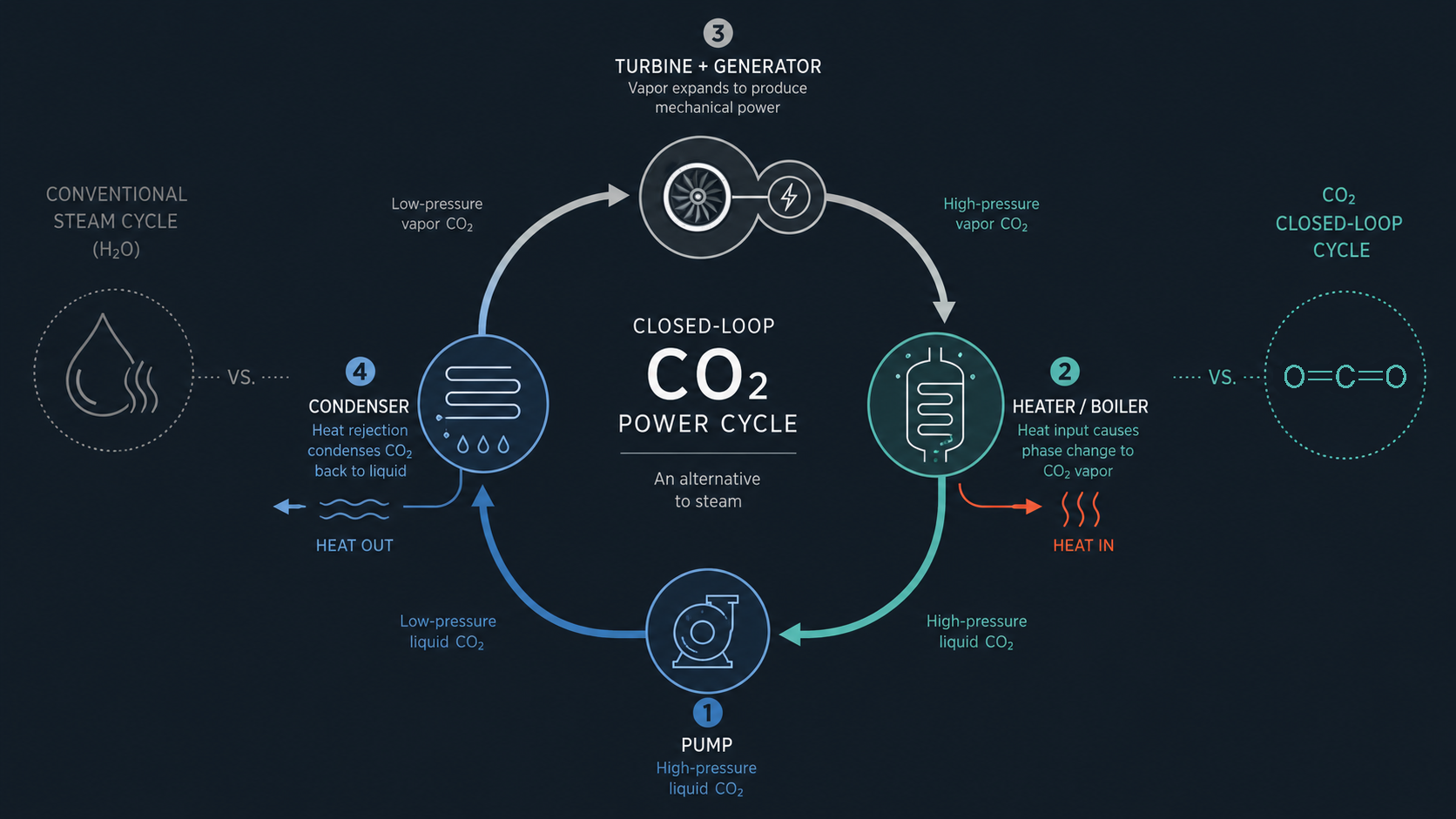
"Boiling liquid CO2 as a turbine working fluid" most precisely denotes a phase-change power cycle: liquid CO2 is pumped, boiled (or pseudo-boiled across the pseudocritical region) to vapor or supercritical fluid, expanded through a turbine, and then condensed back to liquid against a heat sink. This is a CO2 Rankine architecture [1]. It is thermodynamically distinct from the sCO2 Brayton cycle, in which the fluid remains single-phase above the critical point and never condenses [3]. Both differ again from direct-fired oxy-combustion cycles, which use a CO2 working fluid but inject combustion products into the loop [4].
This report treats the condensing/transcritical CO2 Rankine cycle (the literal "boiling CO2" case) as primary subject, while giving the surrounding sCO2 Brayton and oxy-combustion families the proportionate coverage their larger evidence base demands.
1.2 Cycle taxonomy
(a) sCO2 closed Brayton cycles, including recuperated and recompression variants. The fluid is compressed near but above the critical point, heated indirectly, expanded, cooled, and recompressed, always remaining single-phase. The recompression Brayton cycle (RCBC) is the canonical high-efficiency configuration [3][7]. This family carries the preponderance of demonstrated hardware.
(b) Transcritical CO2 cycles. The fluid is pumped as a liquid (subcritical), heated above the critical pressure, expanded, and partially or fully condensed. These straddle the saturation dome on the low-pressure side and the supercritical region on the high-pressure side [1][14].
(c) Condensing CO2 Rankine cycles, the literal "boiling liquid CO2" case, in which the working fluid is fully condensed to liquid before pumping. These require a heat sink cold enough to condense CO2 (below 31 degrees Celsius at the corresponding saturation pressure), which is the central engineering constraint [1][6].
(d) Direct-fired oxy-combustion CO2 cycles, such as the Allam-Fetvedt cycle, in which natural gas or syngas is burned in oxygen within a recycled CO2 stream; the combustion products (CO2 and water) join the working fluid, water is condensed out, and a stream of pipeline-ready CO2 is exported for sequestration or use [4][15].
1.3 Governing physics: critical point, triple point, and their consequences
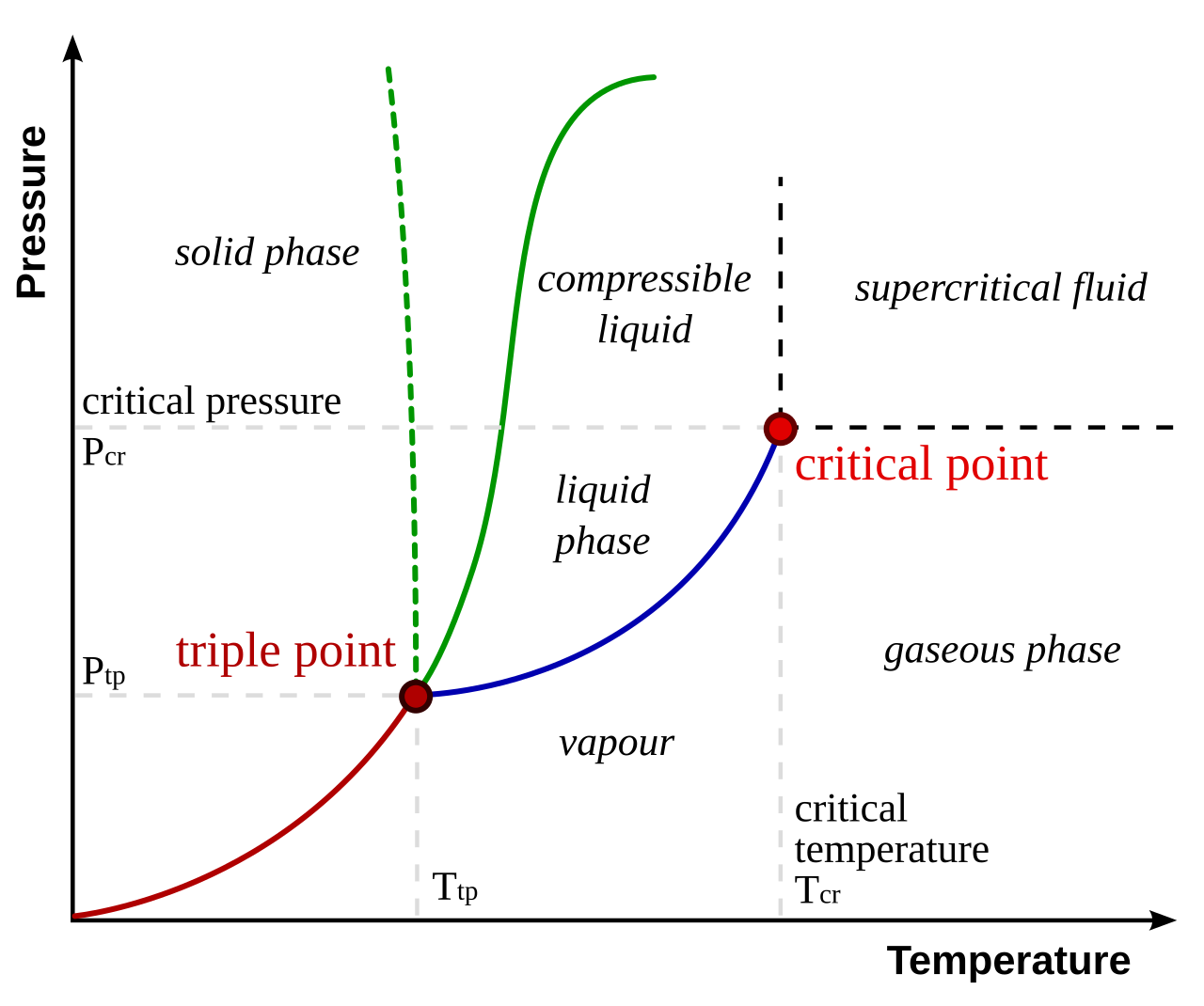
The CO2 critical point, from the Span and Wagner reference equation of state, is a critical temperature of 304.1 K (30.9 degrees Celsius) and a critical pressure of 7.3 MPa, with a critical density of 467.6 kg per cubic meter [16][17]. The triple point is 216.592 K (minus 56.5 degrees Celsius) at 0.51MPa [16]. These values are corroborated by Duschek et al. experimental determinations (304.1282 plus or minus 0.015 K; 7.3 plus or minus 0.003 MPa) [18].
Three consequences follow directly and shape the entire assessment:
First, liquid CO2 cannot exist at atmospheric pressure. Below the triple-point pressure of about 0.518 MPa, CO2 sublimes directly between solid and vapor [16]. Any condensing CO2 cycle must therefore remain pressurized throughout, typically at or above roughly 5-7 MPa on the low-pressure side. There is no low-pressure condenser analog to a steam plant's near-vacuum condenser; the entire loop is a pressure vessel.
Second, the low critical temperature of 31 degrees Celsius imposes a demanding heat-rejection and condensing constraint. To condense CO2, the heat sink must be colder than the saturation temperature, which is at most 31 degrees Celsius (and lower at lower pressure). In warm ambient conditions, condensation is difficult or impossible without refrigeration or a naturally cold sink [5][6]. This is the single most important honest limitation of the "boiling CO2" concept and is treated in detail in Section 4.
Third, the high specific heat and near-incompressibility of CO2 near the critical point are simultaneously the source of the cycle's appeal (low compression/pump work, high density, compact turbomachinery) and the source of its sensitivity (small temperature changes near the critical point cause large density swings, complicating compressor and condenser design) [5][19].
2. Thermodynamic Fundamentals and Comparative Cycle Performance
2.1 Efficiency comparison at matched turbine inlet temperature
The headline claim for CO2 cycles is higher efficiency than steam at comparable turbine inlet temperature, plus dramatic size reduction. The evidence supports the size claim robustly and the efficiency claim conditionally.
Modeled performance. For high-temperature applications, sCO2 recompression Brayton cycles are modeled to reach or modestly exceed advanced steam. A patent-stage modeling claim places sCO2 Brayton above 55 percent at very high turbine inlet temperatures, against roughly 40 percent for advanced steam apparatus and a 34 percent average for installed steam Rankine; these are modeled figures, not measured [20]. More rigorous DOE/NETL-referenced modeling comparing sCO2 to steam at matched coal-plant conditions (turbine inlet 593 degrees Celsius/24.1 MPa and 730 degrees Celsius/27.6 MPa) found a direct sCO2 cycle achieving roughly 45-50 percent thermal efficiency with a plant-cost reduction of about 18 percent versus a conventional Rankine reference; these are modeled [21]. A separate peer-reviewed coal study found sCO2 exceeding steam by 3-4 percentage points at cycle level (2-3 points at plant level), modeled [22].
Measured. Field-demonstrated net efficiency for indirect sCO2 cycles remains far less proven. The STEP Demo's simple-cycle phase produced over 8 MW of gross shaft power and approximately 4 MWe net at 500 degrees Celsius turbine inlet, with the 50 percent efficiency target reserved for the not-yet-completed 715 degrees Celsius recompression phase [8][23]. No public source provides a measured net efficiency for a utility-scale sCO2 plant matching the modeled 50 percent.
Benchmark for steam. Modern ultra-supercritical steam plants reach about 47 percent net at roughly 30 MPa and 600-620 degrees Celsius; advanced ultra-supercritical concepts at 700-720 degrees Celsius and about 35 MPa target roughly 50 percent (47 percent HHV, about 50 percent LHV) [24][25]. These are the numbers any CO2 cycle must beat to justify displacement.
Net assessment: At matched high turbine inlet temperature, modeled sCO2 efficiency is comparable to or slightly above advanced steam, but the field-demonstrated advantage is not yet established. The honest position is that sCO2's proven advantages are compactness and potential capital/operational flexibility, not a large, demonstrated efficiency lead.
2.2 Condensing and transcritical CO2 Rankine performance specifically
For the phase-change "boiling CO2" case, the relevant regime is low-grade heat. Modeled transcritical CO2 Rankine cycle efficiencies are modest, reflecting low source temperatures: in the single digits to low twenties of percent. Representative figures: a low-grade transcritical analysis found thermodynamic efficiency gains of 2.7 to 8.2 percentage points across configurations [26]; a CO2/R290 zeotropic split cycle reached 20.44 percent net at small scale [27]; a transcritical CO2 Rankine with a cold (12 degrees Celsius water) sink modeled 26.3 percent at about 5.2 MWe [14].
Measured hardware for condensing/transcritical CO2 Rankine is small. Experimental engine-waste-heat rigs have demonstrated single-digit kilowatt outputs: about 2.42 kW at 7.7 percent thermal efficiency, and a preheater-plus-regenerator configuration reaching about 3.47 kW at 7.8 percent [28][29]. A small-scale solar transcritical CO2 Rankine test rig was built at about 12 kW thermal capacity [30]. These are laboratory-scale.
The volumetric power-density and turbomachinery-size advantage is the most robustly supported claim across the family. SwRI and partners describe sCO2 turbomachinery as roughly one-tenth the size of equivalent steam turbomachinery; the STEP turbine rotor weighs about 210 lbs at a power density near 160 kW/kg, closer to rocket-engine turbopumps than to ground power turbines [23][31]. Because condensing CO2 cycles use a liquid pump rather than a compressor, pump work is much smaller than Brayton compression work, an efficiency advantage specific to the phase-change architecture at low source temperatures [1].
2.3 Water consumption, footprint, and transient behavior
CO2 cycles can be dry-cooled, eliminating the large evaporative water consumption of steam plants, an advantage in arid regions [19][31]. Footprint is smaller owing to compact turbomachinery and printed-circuit heat exchangers (PCHEs) [31]. Transient response is generally favorable: the high-density working fluid and compact components allow rapid load following, though near-critical operation introduces control complexity that the STEP team addressed by reducing compressor speed for stability and managing dry gas seals [23][31].
3. Materials, Corrosion, and Component Engineering
3.1 Corrosion mechanisms
Two degradation mechanisms dominate in CO2 environments, both distinct from steam-cycle concerns. First, high-temperature oxidation: CO2 dissociates to provide an oxygen partial pressure sufficient to oxidize iron and chromium, growing chromia (or alumina) scales [32]. Second, carburization: carbon from CO2 permeates the oxide and diffuses into the alloy matrix, forming chromium carbides, sensitizing the steel, and increasing susceptibility to stress-corrosion cracking. Carburization has been observed on ferritic-martensitic steels at temperatures as low as 550 degrees Celsius [33].
A separate, lower-temperature mechanism is relevant specifically to condensing/transcritical cycles and to impure loops: carbonic acid formation when water and CO2 coexist in liquid or condensing regions, which drives aqueous corrosion. Oxygen impurities (notably in direct-fired oxy-combustion loops, which run impure CO2 with residual O2 and water) accelerate both oxidation and aqueous attack. Laboratory studies have exposed candidate alloys to impure sCO2 (initially 3.6 percent O2 and 5.3 percent H2O at 200 bar, 650-750 degrees Celsius) to characterize these effects [34].
3.2 Alloy selection and what is solved versus open
Evidence indicates a workable, if expensive, materials pathway at high temperature. Multi-thousand-hour exposures show that chromia-forming austenitic steels (316NG) and Fe-Ni and Ni-base alloys (800H, 625) form continuous, protective, nanometer-scale Cr2O3 layers following near-cubic kinetics out to 3000 hours [35]. At temperatures above about 750 degrees Celsius, alumina-forming nickel-base alloys (e.g., alloy 214) show superior carburization resistance, while chromia-formers (alloy 600, 690) show carburization at the oxide/metal interface [32]. The STEP Demo notably qualified the largest installation of Inconel 725 piping and a 740H heater coil (over 1600 welds), and advanced ultra-supercritical steam programs have matured Inconel 740H for 700 degrees Celsius service [23][24].
Considered relatively solved on demonstrated hardware: short-to-medium-duration (hundreds to low thousands of hours) compatibility of chromia-forming alloys at 500-600 degrees Celsius; turbine dry gas sealing (STEP identified the need to supply warm gas to seals whenever pressurized); compressor operation with liquid CO2 ingestion [23][35]. Open research questions: long-duration (tens of thousands of hours) carburization and breakaway-oxidation behavior at 700+ degrees Celsius; impurity-driven corrosion in direct-fired loops; cost-effective alternatives to expensive nickel superalloys [32][33].
3.3 Heat exchangers and turbomachinery near the critical point
Printed-circuit heat exchangers (diffusion-bonded, chemically etched microchannel units) are the enabling recuperator technology; the STEP Demo deployed what its team described as the largest PCHE built [23]. Recuperators are also the cost driver: NETL modeling finds they constitute over 50 percent of sCO2 power-block cost [36]. Compressor and pump behavior near the critical point is a recognized challenge because CO2 density changes steeply there; designers maintain compressor inlet conditions slightly above the critical point (typically 32-35 degrees Celsius) to avoid unintended two-phase operation, and dedicated facilities (e.g., Korea's SCO2PE compressor rig) study near-critical compression [6][37].
4. The Heat-Rejection Constraint: The Crux of the Condensing CO2 Case
The warm-ambient heat-rejection penalty is the decisive technical issue for any condensing CO2 cycle and deserves direct treatment.
Because CO2's critical temperature is 31 degrees Celsius, condensation requires a sink colder than the corresponding saturation temperature. In hot or arid climates, this is often unachievable without active refrigeration, which consumes the very power the cycle produces. The literature is explicit: the transcritical CO2 Rankine cycle is generally usable only when ambient temperature is below the critical temperature of CO2; a relatively low condensation temperature is required, and it may be difficult to condense CO2 if ambient temperature is high [6].
For sCO2 Brayton cycles, the same physics appears as off-design degradation rather than outright infeasibility: as ambient temperature rises, the compressor inlet condition shifts away from the critical point, compressor work rises, and net output falls [38]. CSP and dry-cooled studies show that compressor inlet temperature is the dominant off-design lever; raising compressor inlet temperature by 13 degrees Celsius can reduce thermal-storage effectiveness materially [38]. The standard mitigations are: locating the cooler outlet at 32-35 degrees Celsius; dry cooling with compressor speed control; and, for cold-climate or cold-sink sites, exploiting the naturally low sink [6][37][39].
Mitigations specific to the condensing case. Three approaches recur in the literature, all with penalties. First, cold natural sinks: deep seawater Ocean Thermal Energy Conversion (OTEC), cold groundwater, or ground-cooled condensers, which can boost net output by roughly 30 percent versus a conventional condenser in one ground-cooled study [40]. Second, CO2-based zeotropic mixtures (CO2 blended with R290, R134a, R32, or hydrocarbons) that raise the effective critical temperature and broaden the condensation window, at the cost of reintroducing flammability or global-warming-potential concerns and added complexity [27][41]. Third, ejector-based self-condensing configurations that recover expansion work to assist condensation [2]. The need for these workarounds is precisely why pure-CO2 condensing Rankine cycles have struggled to find broad application: the unmodified concept is climate-limited.
5. Application Domains: Where Phase-Change CO2 Genuinely Fits
5.1 Waste-heat recovery (low-to-medium grade)
This is the most natural home for transcritical/condensing CO2 Rankine cycles and the domain with the most experimental hardware, albeit small. CO2's good heat-transfer properties and gliding pseudo-boiling give a strong thermal match to a cooling exhaust stream, and the liquid pump keeps parasitic work low [1][26]. However, the competition is fierce: organic Rankine cycles are mature and commercial for sub-240 degrees Celsius heat, and sCO2 Brayton variants compete for higher-grade waste heat [26]. Echogen Power Systems commercialized sCO2 Rankine-type waste-heat systems (a Siemens Energy/TC Energy compressor-station pilot was contracted to lift station efficiency by about 10 percent) [42], and KEPCO/KAIST developed a 2 MW sCO2 waste-heat system in Korea [43]. China's Chaotan One (two 15 MWe units) is a commercial waste-heat sCO2 plant at a steel mill [10]. The phase-change variant is competitive specifically where the heat sink is cold and the source is low-grade.

5.2 Concentrated solar power (CSP)
CSP favors single-phase sCO2 Brayton, not condensing CO2. High receiver temperatures (650-700+ degrees Celsius) suit Brayton; a comparison found sCO2 net thermal efficiency of 32.9 percent versus 28.2 percent for steam in a solar application [6]. The catch is that CSP sites are typically hot and arid, exactly where condensing CO2 is hardest, reinforcing the Brayton (not Rankine) choice for solar [38].
5.3 Nuclear, including Generation IV and SMRs
Nuclear is a leading target for sCO2 Brayton: compact turbomachinery, dry-cooling compatibility for flexible siting, and good match to sodium-cooled and high-temperature reactor outlet temperatures [37][39]. Sandia, Argonne, KAIST/KAERI (the SCIEL loop), and CNNC's Nuclear Power Institute (which developed Chaotan One and is pursuing molten-salt-plus-sCO2) are all active [37][43][44]. This is single-phase Brayton territory; condensing CO2 has no particular nuclear advantage.
5.4 Geothermal and low-grade/OTEC
Geothermal and ocean-thermal (OTEC) are the domains where a condensing CO2 cycle is comparatively most practical, because both can supply a genuinely cold sink (cold deep seawater for OTEC; cool ground or reinjection water for geothermal). OTEC is intrinsically low-efficiency (single-digit percent, given a roughly 20 degrees Celsius surface-to-deep temperature difference), and the literature largely favors ammonia or CO2-based zeotropic mixtures over pure CO2 to manage the condensation temperature [45][46]. A ground-cooled condenser can lift transcritical CO2 Rankine output by about 30 percent [40]. These are the niches where "boiling CO2" is genuinely interesting, but they are small markets.
5.5 Fossil generation with carbon capture
This is the domain of direct-fired oxy-combustion (Allam-Fetvedt), not condensing Rankine. The cycle inherently produces a pipeline-ready CO2 stream, making capture intrinsic rather than bolted-on [4][15]. This is the single largest commercial bet in the CO2-cycle field (Section 6).
6. Key Players, Stakeholders, Programs, and Milestones
6.1 NET Power and the Allam-Fetvedt oxy-combustion cycle
NET Power Inc. (NYSE: NPWR) is the central commercial actor in direct-fired CO2 cycles. The Allam-Fetvedt cycle technology is owned by 8 Rivers Capital and licensed to NET Power for natural gas [4][15].
The 50 MWth (about 25 MWe) La Porte, Texas demonstration plant achieved first fire of its Toshiba-built commercial-scale combustor in May 2018, and synchronized to the ERCOT grid in November 2021 (first power on November 16, 2021) [4][15][47]. The facility has logged over 1,500-1,600 hours of operation across campaigns, including a Q4 2024 Baker Hughes Phase 1 campaign exceeding 140 hours with a 30-hour continuous run [11][12]. Toshiba Energy Systems and Solutions supplied the combustor and turbine [48]; Baker Hughes (NASDAQ: BKR) holds responsibility under a 2022 joint-development agreement for the sCO2 turboexpander, main compressor, and high-pressure pump for the first commercial unit [49].
 Vers0Adm1n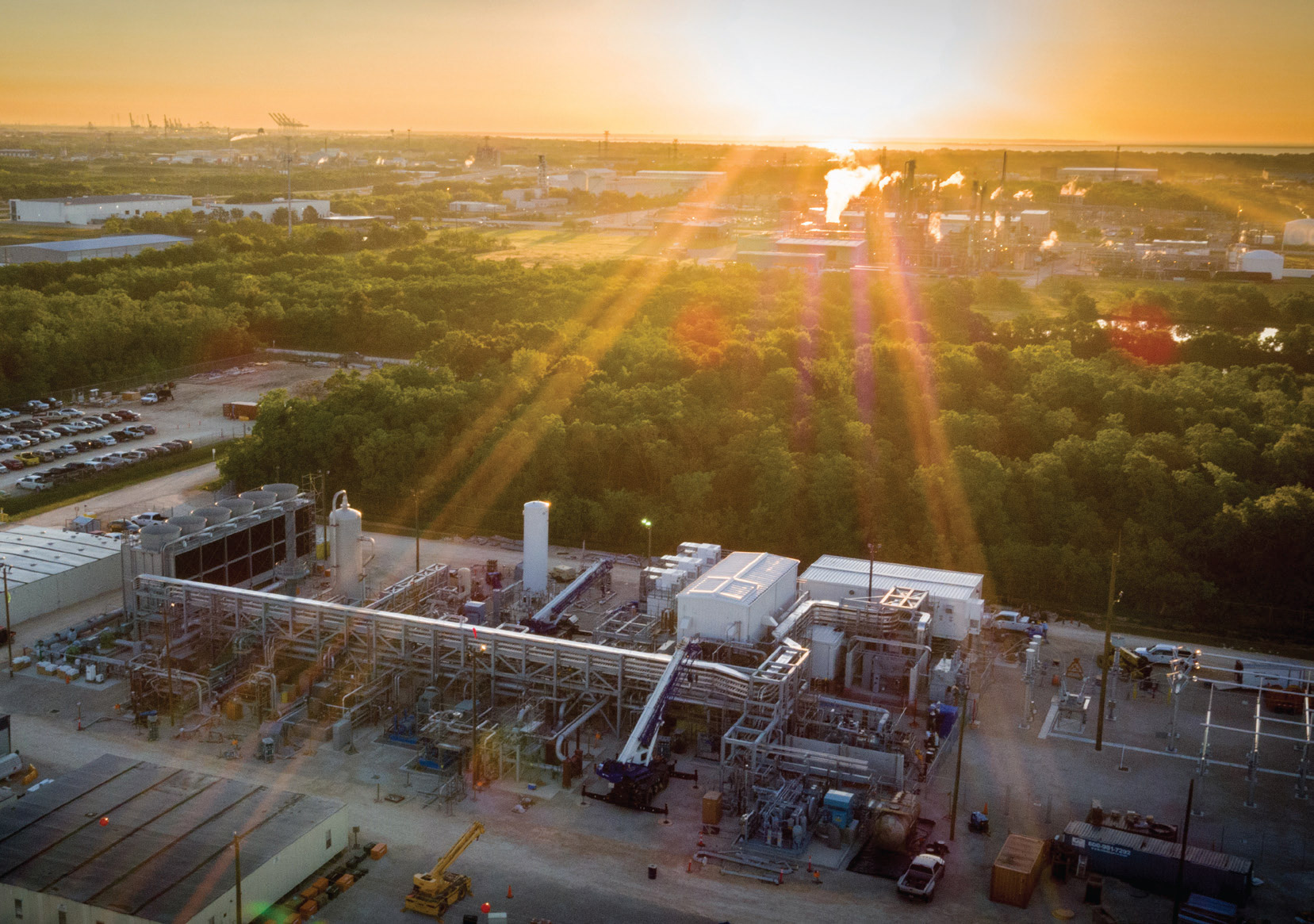
Projected versus delivered. NET Power's projected net efficiency for natural gas is up to ~59 percent LHV [15][50], with projected capital cost of 900-1,200 dollars per kW and projected LCOE of approximately 21-40 dollars per MWh [47][51]. For coal, 8 Rivers documents quote both a 51 percent net LHV headline target and a more detailed 43.3-44.5 percent LHV modeled range, a discrepancy worth noting [15][52]. POWER Magazine
Project Permian / Serial Number 1. NET Power's first utility-scale project (about 300 MWe gross, near Midland-Odessa, Texas) has deteriorated sharply. Cost estimates rose from an initial 750-950 million dollars (2022) to about 1 billion dollars (late 2023) to ~2 billion dollars (March 2025), and the start date slipped from 2026 to no earlier than 2029 [13]. The March 10, 2025 disclosure cut the share price 31.46 percent in one day (closing at 4.75 dollars from 6.93 dollars), and triggered a securities class action [11]. In Q3 2025, NET Power took a non-cash impairment on its oxy-combustion technology, stating that its market analysis identified slower-than-anticipated acceptance and that value engineering on Project Permian did not reach economic competitiveness in the current market; it pivoted toward post-combustion capture on conventional gas turbines (a letter of intent with Entropy Inc.), while resizing the Permian site as a clean-firm-power hub up to 1 GW [12]. This is the most important cautionary datapoint in the entire CO2-cycle field: first-of-a-kind oxy-combustion economics have proven far harder than projected.
6.2 STEP Demo: the indirect sCO2 Brayton flagship
The 10 MWe Supercritical Transformational Electric Power (STEP) Demo at Southwest Research Institute in San Antonio is the largest indirect-fired sCO2 pilot in the world, a roughly 169 million dollar project (of which 116 million dollars was federal funding) led by GTI Energy with SwRI, GE Vernova (NYSE: GEV), and DOE/NETL [8][9][53]. Milestones: mechanical completion October 2023; integrated turbine operation to 18,000 rpm January 2024; first electricity May 2024 at full 27,000 rpm; simple-cycle maximum September-October 2024 at 500 degrees Celsius turbine inlet and 250 bar, generating over 8 MW gross shaft power and approximately 4 MWe net synchronized to the grid [8][9][23][31]. The next phase reconfigures to recompression Brayton at up to 715 degrees Celsius targeting a pathway to over 50 percent efficiency [9][54]. The project qualified several world-first components (largest PCHE, largest turbine stop and control valves, largest Inconel 725 piping installation) [23].
6.3 Echogen Power Systems
Echogen (Akron, Ohio; private) is the principal US sCO2 waste-heat-recovery developer and has pivoted toward sCO2-based pumped thermal energy storage (PTES) and high-temperature heat pumps [55][56]. It received a 3 million dollar DOE award to develop a 500 kW CO2 high-temperature heat pump, signed a PTES partnership with Westinghouse, and its Echogen Rankine Cycle technology underpinned a Siemens Energy waste-heat pilot for TC Energy [42][56][57]. Echogen exemplifies a strategic migration from pure power generation toward storage and industrial heat where sCO2 economics are more favorable.
6.4 Research institutions and OEMs
Active national laboratories and institutes include Sandia National Laboratories (Brayton loops), Argonne National Laboratory (cycle optimization), NETL (materials, cost correlations, techno-economics), and Korea's KAIST/KAERI (SCIEL integral loop, SCO2PE compressor rig) [36][37][39]. OEMs and industrials include GE Vernova, Baker Hughes, Toshiba, Doosan (Korea), Hanwha Power Systems (sCO2 and gas-turbine combined cycle work with NETL), Heatric/Meggitt (the PCHE manufacturer that built NET Power's recuperators), and Lummus Technology (recuperative heat exchangers for NET Power) [49][58][59]. GTI Energy is the STEP prime contractor [9].
6.5 China: CNNC Chaotan One
China National Nuclear Corporation's Chaotan One (also "Super Carbon No. 1") at the Shougang Shuicheng steel plant in Liupanshui, Guizhou, is the world's first commercial-scale sCO2 waste-heat power plant: two 15 MWe units that began commercial operation in late 2025 [10][44]. CNNC's Nuclear Power Institute developed the technology; per chief scientist and chief designer Huang Yanping, compared with conventional sintering waste-heat steam generation Chaotan One increased power-generation efficiency by over 85 percent, net power generation by over 50 percent, and reduced floor space by 50 percent [10][60]. CNNC separately launched a molten-salt-storage-plus-sCO2 demonstration in 2024 targeting 2028 [44]. This is a single-phase sCO2 Brayton (waste-heat) deployment, and it places China ahead in commercial sCO2 deployment, even as the US leads in indirect-fired pilot scale (STEP) and oxy-combustion (NET Power).
7. Economic and Market Dynamics
7.1 The absence of measured cost data
A central honest finding: there is essentially no measured ($/kW or LCOE) cost data for CO2 power cycles in the public literature. Only performance milestones are hardware-measured; all cost and LCOE figures are modeled or developer claims.
7.2 Capital cost
The DOE/SETO target for sCO2 power blocks is 900 dollars per kWe at 50 percent efficiency, 715 degrees Celsius, air-cooled, with NETL studies suggesting a 50-100 MWe block could approach this [61]. However, peer-reviewed benchmarking is less optimistic: one CSP study modeled a partial-cooling sCO2 power block at 1,720 dollars per kW versus 1,055 dollars per kW for steam, with sCO2 more expensive partly due to Inconel material costs [62]. The authoritative public cost dataset is the NETL component cost correlations (Weiland, Lance, Pidaparti, 2019), built from vendor quotes spanning 5-750 MWe, with turbine cost uncertainty of +30/-25 percent [36]. NET Power's 900-1,200 dollars per kW is not yet validated at commercial scale [47], and Project Permian's escalation to 2 billion dollars for about 300 MWe (roughly 5,700-6,700 dollars per kW for a first-of-a-kind unit) illustrates the gap between projection and first-of-a-kind reality [13].
7.3 Heat exchangers as cost driver
Recuperators/PCHEs are the dominant power-block cost: over 50 percent per NETL [36]. PCHE unit cost exceeds 0.10 dollars per watt (about 100 dollars per kW-thermal) for stainless steel rated to about 550 degrees Celsius, against under 0.05 dollars per watt for conventional heat exchangers, with nickel superalloys raising cost further (MIT estimate) [63]. The PCHE manufacturer Heatric cautions that $/kWt comparisons are misleading because cost scales logarithmically with size, and cites an EPRI view that recuperator cost should fall to about 25 dollars per kW-thermal to enable commercialization [64].
7.4 LCOE: mixed and application-dependent
Modeled LCOE results do not show a uniform CO2-cycle advantage. For direct-fired sCO2 natural gas, NETL modeled LCOE 13-17 percent higher than NGCC with capture, driven by air-separation-unit and power-block capital (recuperators over 50 percent of block cost) [65]. For CSP, modeled sCO2 LCOE is at least 9 percent higher than a steam reference [66]. For coal, results split: one study found sCO2 LCOE of 60.56 dollars per MWh, 1.32% lower than steam [67]; another found efficiency gains of 3-4 points but limited COE benefit because capital cost rose with turbine inlet temperature [22]. For waste-heat recovery, a Sandia analysis found a solarized sCO2 Brayton could deliver 10-20 percent lower levelized cost than steam waste-heat systems, primarily from smaller components [68]. The pattern: CO2 cycles win on LCOE mainly in waste-heat and some coal cases (where compactness is key) and lose where an expensive air-separation unit or high-temperature alloys dominate.
7.5 The role of 45Q for oxy-combustion variants
For direct-fired capture cycles, the US Section 45Q tax credit is decisive to economics. Under the 2022 Inflation Reduction Act, the credit reached 85 dollars per tonne for industrial/power CCS with geological storage (60 dollars per tonne for enhanced oil recovery) when prevailing-wage requirements are met; direct air capture reached up to 180 dollars per tonne [69][70]. The 2025 One Big Beautiful Bill Act standardized the credit at parity (up to 85 dollars per tonne for industrial/power, 180 dollars for DAC) regardless of end use, preserved transferability, but accelerated the construction-start deadline and barred claims by specified foreign entities (China, Iran, North Korea, Russia) [71][72]. The base values inflation-adjust; the IRS published a 2026 base figure of 29.28 dollars per tonne under 45Q(a)(1) before the enhanced multiplier [73]. Crucially, even with 45Q, NET Power concluded in 2025 that Project Permian was not economically competitive, underscoring that policy support alone has not closed the first-of-a-kind cost gap [12].
8. Regulatory Landscape
There is no CO2-turbine-specific regulatory regime, and this section is therefore deliberately brief. Policy operates indirectly through three channels. First, carbon pricing and capture incentives, principally Section 45Q in the US (Section 7.5), which drive oxy-combustion economics [69][71]. Second, emissions standards and clean-electricity tax credits (45Y/48E) that shape the competitive context for all low-carbon generation [72]. Third, captured-CO2 handling rules: EPA Class VI injection-well permitting, Subpart RR or ISO 27916 measurement-and-verification for sequestration, and pipeline safety regulation for CO2 transport [70][74]. For condensing/transcritical CO2 Rankine cycles without capture, the regulatory burden is essentially that of any pressurized industrial power system (pressure-vessel codes, standard environmental permitting); CO2's non-flammability and low toxicity at the relevant concentrations make it regulatorily simpler than hydrocarbon working fluids, though occupational hazard risk from pressurized inventories requires standard industrial-gas safety controls [1].
9. Geopolitical and Strategic Dimensions
This dimension is largely subsumed by general clean energy geopolitics and is treated proportionately.
The distribution of advanced CO2-cycle capacity is concentrated in four countries. The United States leads in indirect-fired pilot scale (STEP) and in oxy-combustion intellectual property (8 Rivers/NET Power), backed by deep national-laboratory materials and turbomachinery work [9][15][36]. China leads in commercial sCO2 waste-heat deployment (CNNC Chaotan One, 30 MWe) and has a state-backed pipeline linking nuclear, steel, and storage applications [10][44]. South Korea has sustained institutional programs (KAIST/KAERI loops, KEPCO 2 MW system, Doosan and Hanwha OEM activity) [43][58]. Japan contributes core turbomachinery (Toshiba's combustor and turbine for NET Power) [48].
The CO2-specific supply-chain consideration is high-temperature alloys: nickel superalloys (Inconel 740H, 725, alloy 625/214) and the diffusion-bonded PCHE manufacturing base [23][32][63]. These are the same materials contested across aerospace and advanced steam, so CO2 cycles inherit, rather than create, a strategic dependency on nickel and on a small number of PCHE fabricators (e.g., Heatric/Meggitt) [59][64]. A nation seeking sovereign CO2-cycle capability needs nickel-alloy melting/forging and diffusion-bonding capacity, both concentrated and capital-intensive. The strategic stakes are highest for the oxy-combustion variant, because it couples power generation to carbon-management infrastructure and to air-separation-unit supply, making it a potential pillar of a decarbonized, dispatchable, capture-ready fleet, if the economics can be solved.
10. Structured Risk Matrix
The following risks are assessed for the CO2-cycle field, with emphasis on the condensing/phase-change case where it differs from the Brayton/oxy-combustion mainstream.
Technical: heat-rejection/condensing constraint (condensing cycles). Likelihood: high in warm climates; intrinsic. Impact: high (can render the cycle infeasible or uneconomic). Mitigations: site selection for cold sinks (OTEC, geothermal, cold climates); CO2 zeotropic mixtures; ejector self-condensing; or choose Brayton instead [2][6][40]. This is the defining risk of the "boiling CO2" concept.
Technical: materials/corrosion (oxidation, carburization, carbonic-acid corrosion). Likelihood: moderate. Impact: moderate-to-high at 700+ degrees Celsius and in impure loops. Mitigations: chromia/alumina-forming alloy selection, impurity control (O2 and H2O limits); proven short-duration; open question is multi-decade durability [32][33][35].
Technical: turbomachinery reliability and near-critical compression/pumping. Likelihood: moderate. Impact: moderate. Mitigations: maintain inlet 32-35 degrees Celsius above critical point; dry gas seal warm-gas supply; demonstrated at STEP and La Porte at pilot scale [23][37].
Scale-up and cost. Likelihood: high (demonstrated by Project Permian). Impact: high. Mitigations: modular standardized designs; learning-curve cost reduction; heat-exchanger cost reduction toward EPRI's 25 dollars per kW-thermal target [13][64].
Market and substitution. Likelihood: high for condensing CO2 specifically. Impact: high. Competition: mature ORC for low-grade heat; ultra-supercritical steam for high-temperature baseload; lithium-ion batteries and other storage for flexibility; sCO2 Brayton for the high-value CO2-cycle niches [25][26]. Condensing CO2's addressable market is narrow.
Policy-dependence (oxy-combustion variants). Likelihood: moderate-to-high. Impact: high. The economics of capture cycles hinge on 45Q levels, construction-deadline timing, and foreign-entity restrictions; the 2025 OBBBA accelerated deadlines, raising execution risk. Mitigation: diversify revenue (CO2, argon, nitrogen co-products; enhanced oil recovery) and pursue post-combustion fallbacks, as NET Power has [12][71].

11. Strategic Recommendations
11.1 For investors and corporate strategists
The capital, hardware, and near-term returns sit in single-phase sCO2 Brayton (waste-heat recovery, nuclear, CSP) and, more speculatively, oxy-combustion. Prefer the picks-and-shovels layer: PCHE/diffusion-bonding fabricators, nickel-superalloy supply, and turbomachinery OEMs (GE Vernova, Baker Hughes, Doosan, Hanwha) that benefit regardless of which cycle architecture wins.
Treat oxy-combustion as high-risk, milestone-gated. NET Power's 2025 cost escalation, impairment, and strategic pivot are a clear signal that first-of-a-kind Allam-cycle economics remain unproven [12][13]. Condition further commitment on a financeable, value-engineered Project Permian FID and on 45Q durability; the benchmark that would change this view is a contracted utility-scale unit at or below roughly 1,500 dollars per kW with bankable performance guarantees.
For condensing CO2 Rankine specifically, the credible commercial cases are geothermal with cool reinjection, cold-climate industrial waste heat, and (longer-term) OTEC. Absent a naturally cold heat sink, the heat-rejection penalty makes pure-CO2 condensing cycles uncompetitive with ORC [6][45].
11.2 For power-generation engineers, utilities, and national-laboratory and policy decision-makers
Match architecture to heat source and sink, explicitly. Use sCO2 Brayton for high-temperature sources (nuclear, CSP, high-grade waste heat) and dry-cooling-constrained sites; reserve condensing/transcritical CO2 Rankine for low-grade sources paired with genuinely cold sinks; default to steam where it already wins (large baseload with ample cooling water). The decision threshold is the available sink temperature relative to 31 degrees Celsius [6][38].
Prioritize the two binding R&D gaps. First, long-duration (tens of thousands of hours) high-temperature corrosion and carburization data at 700+ degrees Celsius, including impure direct-fired environments [32][33][34]. Second, heat-exchanger cost reduction; recuperators exceed 50 percent of power-block cost, and reaching the EPRI-cited 25 dollars per kW-thermal would do more for CO2-cycle competitiveness than incremental efficiency gains [36][64]. For condensing cycles specifically, fund pilot-scale OTEC/geothermal CO2 Rankine demonstrations and CO2-mixture working-fluid validation, which are under-studied relative to Brayton [40][45].
Design policy for execution risk, not just emissions. The 2025 acceleration of 45Q construction deadlines raises the chance that capture-dependent CO2 cycles stall before deployment [71]. Stable, durable, technology-neutral capture incentives and predictable Class VI permitting timelines would de-risk the oxy-combustion pathway more effectively than higher headline credit values that projects cannot reach in time.
References
- Wieland, C., et al. "Comparison of Conventional and CO2 Power Generation Cycles for Waste Heat Recovery." 5th International Symposium on Supercritical CO2 Power Cycles, 2016. sco2symposium.com.
- Sun, et al. "Thermodynamic, Economic Analysis and Multi-Objective Optimization of an Improved Self-Condensing Transcritical CO2 Rankine Cycle with Two-Stage Ejector." Energy Conversion and Management, 2024. ScienceDirect.
- U.S. Department of Energy. "Supercritical Carbon Dioxide Brayton Cycle." Quadrennial Technology Review, 2015. energy.gov.
- "Allam Power Cycle." Wikipedia (citing 8 Rivers / NET Power technical documentation), accessed 2026.
- "Understanding sCO2 Cycle Efficiency Through Simulation." Technical commentary, LinkedIn, accessed 2026.
- International Centre for Sustainable Carbon (ICSC). "What Are Supercritical CO2 Power Cycles?" sustainable-carbon.org, accessed 2026.
- "System Design and Application of Supercritical and Transcritical CO2 Power Cycles: A Review." Frontiers in Energy Research 9 (2021): 723875.
- Southwest Research Institute. "STEP Demo Supercritical CO2 Pilot Plant" press releases (Jan., May, Oct. 2024). swri.org.
- GTI Energy. "STEP Demo Pilot Achieves Phase 1 Testing Milestone." gti.energy, Oct. 2024.
- China National Nuclear Corporation. "World's First Commercial Supercritical Carbon Dioxide Power Generator Begins Operation." en.cnnc.com.cn, Dec. 2025; Interesting Engineering, 2025.
- Business-news-today. "Why NET Power Faces a Class Action Lawsuit Over Project Permian Cost." 2025.
- NET Power Inc. "Net Power Reports Third Quarter 2025 Results and Provides Business Update." Business Wire, Nov. 13, 2025.
- E&E News by POLITICO. "Net Power Delays Low-Emission Texas Gas Plant as Costs Climb." Mar. 2025; Rigzone, Mar. 13, 2025.
- Wieland, C., et al. "Transcritical CO2-Rankine Cycle Performance." 5th International Symposium on Supercritical CO2 Power Cycles, 2016 (paper 125).
- Allam, R., Fetvedt, J., et al. "Demonstration of the Allam Cycle." Energy Procedia (GHGT-13), 2017. ScienceDirect.
- Span, R., and W. Wagner. "A New Equation of State for Carbon Dioxide Covering the Fluid Region from the Triple-Point Temperature to 1100 K at Pressures up to 800 MPa." Journal of Physical and Chemical Reference Data 25, no. 6 (1996): 1509-1596.
- "Reference Correlation of the Thermal Conductivity of Carbon Dioxide from the Triple Point to 1100 K and up to 200 MPa." Journal of Physical and Chemical Reference Data, PMC4824315.
- Duschek, W., et al., as cited in "Accurate Density Measurements of CO2 at the Vicinity of the Critical Point by a Single-Sinker Densimeter." Journal of Chemical Thermodynamics, 2025.
- "Optimized Operation of Recompression sCO2 Brayton Cycle Based on Adjustable Recompression Fraction under Variable Conditions." Energy, 2021. ScienceDirect.
- "Turbine and Brayton Cycle Including Same." US Patent 11,015,463 (modeled efficiency claims).
- "Comparison of Supercritical CO2 Power Cycles to Steam Rankine Cycles in Coal-Fired Applications." ResearchGate / sCO2 symposium proceedings.
- "Techno-Economic Analysis of Supercritical Carbon Dioxide Cycle Integrated with Coal-Fired Power Plant." Energy Conversion and Management, 2021. ScienceDirect.
- Moore, J., et al. "The STEP 10 MWe sCO2 Pilot Installation and Commissioning." 8th International Supercritical CO2 Power Cycles Symposium, 2024 (paper 74). sco2symposium.com.
- "Steam Generator for Advanced Ultra Supercritical Power Plants 700C to 760C." ResearchGate; U.S. A-USC consortium materials.
- Tumanovskii, A. G., et al. "Review of the Coal-Fired, Over-Supercritical and Ultra-Supercritical Steam Power Plants." Thermal Engineering 64 (2017): 83-96.
- "Analysis of the Thermodynamic Performance of Transcritical CO2 Power Cycle Configurations for Low Grade Waste Heat Recovery." Energy Reports, 2022. ScienceDirect.
- Liu, J., et al. "Performances of Transcritical Power Cycles with CO2-Based Mixtures for the Waste Heat Recovery of ICE." Entropy 23, no. 11 (2021): 1551.
- Shi, L., et al. "Experimental Investigation of a CO2-Based Transcritical Rankine Cycle (CTRC) for Exhaust Gas Recovery." Energy, 2018. ScienceDirect.
- "Experimental Comparison Between Four CO2-Based Transcritical Rankine Cycle (CTRC) Systems for Engine Waste Heat Recovery." Energy Conversion and Management, 2017. ScienceDirect.
- Lee, et al. "Experimental Study on a Small-Scale Transcritical CO2 Rankine Cycle for Solar Thermal Applications." International Journal of Energy Research, 2023.
- Southwest Research Institute. "Supercritical Transformational Electric Power Pilot Plant." swri.org, accessed 2026.
- "Corrosion Behaviors of Heat-Resisting Alloys in High Temperature Carbon Dioxide." Crystals / PMC8879538, 2022.
- "Identified Corrosion and Erosion Mechanisms in sCO2 Brayton Cycles." OSTI 1155017, U.S. DOE.
- Kung, S. C., et al. "Oxidation and Carburization of Alloys Exposed to Impure Supercritical CO2." NACE CORROSION 2017, paper NACE-2017-9006.
- "Compatibility of Different Commercial Alloys in High-Temperature, Supercritical Carbon Dioxide." Materials / PMC9267550.
- Weiland, N. T., B. W. Lance, and S. Pidaparti. "sCO2 Power Cycle Component Cost Correlations from DOE Data Spanning Multiple Scales and Applications." ASME Turbo Expo GT2019-90493, NETL, 2019.
- "Review of Supercritical CO2 Technologies and Systems for Power Generation." Applied Thermal Engineering, 2020. ScienceDirect.
- "Off-Design and Annual Performance Analysis of Supercritical Carbon Dioxide Cycle with Thermal Storage for CSP Application." Applied Energy, 2020. ScienceDirect.
- Moullec, et al. "Dry-Cooled Supercritical CO2 Power for Advanced Nuclear Reactors." ASME GT2014-25079.
- "CO2-Based Transcritical Rankine Cycle Coupled with a Ground-Cooled Condenser." City Research Online, openaccess.city.ac.uk.
- "Performance Improvement of Ocean Thermal Energy Conversion Organic Rankine Cycle under Temperature Glide Effect." Energy, 2022. ScienceDirect.
- "Siemens' Echogen Tech Uses sCO2 to Convert Waste Heat into Power." Gas To Power Journal, 2022.
- KAIST / KEPCO. "Development of a 2MW sCO2 Power System for Waste Heat Recovery at KEPCO." European sCO2 Conference Proceedings, 2025. pure.kaist.ac.kr.
- China Daily / Xinhua. "Major CO2 Power Generator Starts Operations." global.chinadaily.com.cn, Dec. 23, 2025.
- "Thermodynamic Optimization of Rankine Cycle Using CO2-Based Binary Zeotropic Mixture for Ocean Thermal Energy Conversion." Applied Thermal Engineering, 2020. ScienceDirect.
- "Ocean Thermal Energy Conversion." Wikipedia, accessed 2026.
- POWER Magazine. "Breakthrough: NET Power's Allam Cycle Test Facility Delivers First Power to ERCOT Grid." powermag.com, 2021.
- Toshiba Energy Systems & Solutions. "Toshiba Successfully Achieves First Fire of 50MWth Commercial-Scale Combustor at the NET Power Demonstration Plant." toshiba-energy.com, June 2018.
- "Turbocharging Decarbonization: How Baker Hughes' Supercritical CO2 Turboexpanders Power NET Power's Zero-Emission Vision." GlobalSpec, 2022; NET Power SEC Form 8-K filings, 2023-2024.
- "NET Power's CO2 Cycle: The Breakthrough That CCS Needs." Modern Power Systems, accessed 2026.
- POWER Magazine. "NET Power Consolidates Business to Gear Up for Allam Cycle Power Plant Deployment." powermag.com.
- 8 Rivers Capital. "Allam Cycle Zero Emission Coal Power" (Direct-Fired Supercritical Carbon Dioxide Power Plant System). NETL report 89243319CFE000015, 2019.
- National Energy Technology Laboratory. "STEP Demo" project page and 24UTSR status update (Moore, 2024). netl.doe.gov.
- POWER Magazine. "Breakthrough for sCO2 Power Cycle as STEP Demo Completes Phase 1 of 10-MW Project." powermag.com, 2024.
- Echogen Power Systems. "Technology" and "Energy Storage." echogen.com, accessed 2026.
- "Echogen Power Systems to Develop 500kW CO2 High-Temperature Heat Pump with $3M U.S. DOE Award." Natural Refrigerants, 2024.
- "Supercritical CO2: An Expanding Range of Potential Applications." Modern Power Systems, accessed 2026.
- Wygant, K. (Hanwha Power Systems). "Advanced Gas Turbine and sCO2 Combined Cycle Power System." NETL FE0031619 kickoff, 2018.
- Shiferaw, D., J. Montero Carrero, and R. Le Pierres (Heatric/Meggitt). "Economic Analysis of sCO2 Cycles with PCHE Recuperator Design Optimisation." 5th International sCO2 Power Cycles Symposium, 2016 (paper 053).
- Xinhua / CGTN. "Power Generation Milestone: World's First Commercial Supercritical CO2 Power Generator Begins Operation in China." news.cgtn.com, Dec. 2025.
- Vijaykumar, R. (NREL). "Supercritical CO2 Brayton Cycle Development Overview." 2020 SETO Peer Review, U.S. DOE. energy.gov.
- "Benchmarking Supercritical Carbon Dioxide Cycles Against Steam Rankine Cycles for Concentrated Solar Power." Peer-reviewed (hosted Academia.edu).
- MIT Applied Science & Engineering. "Printed-Circuit Heat Exchanger (PCHE)." ase.mit.edu, accessed 2026.
- Shiferaw, D., et al. (Heatric/Meggitt), and Qian Zhu (IEA Clean Coal Centre report CCC/280, "Power Generation from Coal Using Supercritical CO2 Cycle"). usea.org.
- Pidaparti, S., C. White, E. Liese, and N. Weiland (NETL). "Performance and Cost Potential for Direct-Fired Supercritical CO2 Natural Gas Power Plants." OSTI 1993561, Mar. 2023.
- "Cost Benefit Analysis of Supercritical CO2 Cycles in Next-Generation Solar Thermal Power Plants." Renewable Energy, 2025. ScienceDirect.
- Xu, J., et al. "Economic Comparison Between sCO2 Power Cycle and Water-Steam Rankine Cycle." Energy Conversion and Management 238 (2021): 114150.
- Turchi, C., et al. (Sandia/NREL). "Technoeconomic Analysis of Alternative Solarized s-CO2 Brayton Cycle Configurations." Journal of Solar Energy Engineering, 2016. sandia.gov.
- U.S. Energy Information Administration. "Tax Credits Drive Carbon Capture Deployment in Our Annual Energy Outlook." eia.gov, 2025.
- Congressional Research Service. "The Section 45Q Tax Credit for Carbon Sequestration." IF11455, congress.gov.
- Carbon Capture Coalition. "The One Big Beautiful Bill Act of 2025" fact sheet. carboncapturecoalition.org, 2025; Payne Institute, Colorado School of Mines, "Keeping Up with Carbon," 2025.
- CSIS. "45V or 45Q? How Tax Credits Will Influence Low-Carbon Hydrogen's Development." csis.org.
- Tax Notes. "IRC Section 45Q (Tax Credit for Carbon Oxide Sequestration)" (IRS Notice 2026-29, inflation adjustment). taxnotes.com.
- 26 U.S. Code § 45Q. Legal Information Institute, Cornell Law School. law.cornell.edu.