Aldrin Cyclers Explained: How Earth–Mars Transfer Orbits Could Become Interplanetary Shipping Lanes
Aldrin cyclers could turn Mars travel into recurring logistics routes, using reusable deep-space habitats and timed transfer craft.

Cyclers in Interplanetary Space: How Recurring Transfer Orbits Could Become the Shipping Lanes of the Solar System
Interplanetary cyclers are one of the more useful concepts for thinking about space transportation as infrastructure rather than as isolated missions. A cycler is best understood as a recurring orbital pathway, transportation route, or logistics architecture, rather than a single spacecraft's route. A dedicated cycler vehicle may travel along that pathway, but the trajectory itself is the underlying “lane.”
Reader Question 1:
Each cycler is more akin to a travelling lane rather than a single ship, right? Could I have multiple ships travelling the aldrin cycler?
Our Answer:
Yes, a cycler is more like a recurring travel lane or scheduled route than a single one-time ship path.
However, “the cycler” can mean several things at once: the orbital trajectory, the large spacecraft placed on that trajectory, or the broader transportation system built around it. Multiple spacecraft could theoretically use compatible cycler trajectories or rendezvous with a cycler vehicle, but they cannot casually “merge” onto it like cars entering a highway. They need precise launch timing, matching orbital phasing, adequate delta-v, navigation accuracy, and rendezvous capability.
What Is an Interplanetary Cycler?
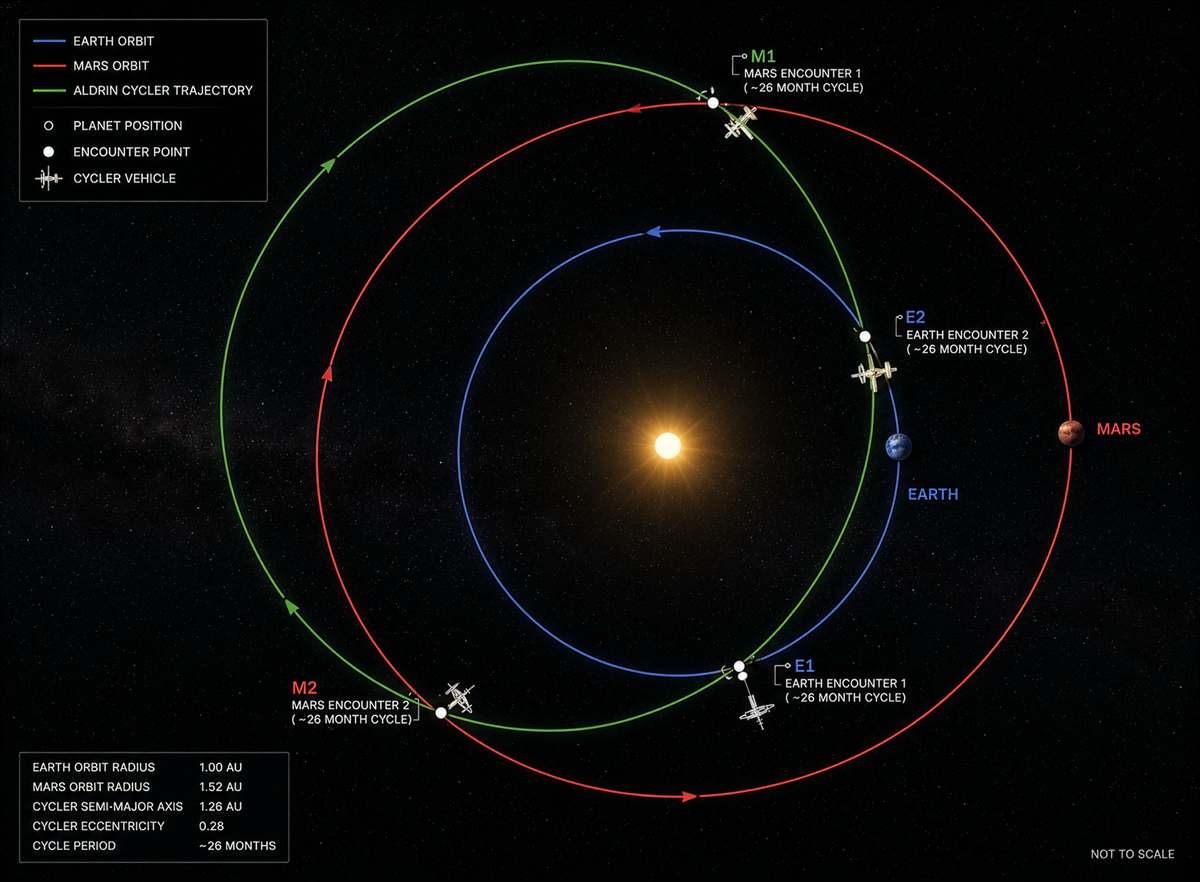
A cycler is a trajectory through space that repeatedly passes near two or more planetary bodies. In an Earth–Mars context, the goal is to create a path around the Sun that periodically encounters Earth and Mars. The object on that path is not parked between the planets. It is continuously moving in heliocentric orbit, meaning it is orbiting the Sun rather than orbiting Earth or Mars.
A standard mission to Mars is usually designed as a one-time transfer. A spacecraft departs Earth, travels through interplanetary space, and arrives at Mars. A cycler architecture changes the logic. Instead of treating each journey as a fully independent expedition, the system establishes a recurring route. A large habitat, cargo platform, or transport vehicle can remain on that route and repeatedly pass near Earth and Mars over time.
Several terms are useful here:
A transfer orbit is a path used to move from one celestial body or orbit to another.
A planetary encounter is a close approach to a planet.
A synodic period is the time it takes for two bodies, such as Earth and Mars, to return to roughly the same relative alignment.
Earth–Mars opportunities are strongly shaped by this cycle, which is why Mars launch periods are commonly discussed as recurring roughly every 26 months. NASA’s JPL educational material explains the basic Earth–Mars launch-window logic using Mars’ 687-day solar orbit and the geometry of transfer timing.
A rendezvous is the process of matching position and velocity with another spacecraft. Delta-v is the change in velocity a spacecraft must produce through propulsion. A flyby is a close pass by a planetary body, often using gravity to bend or adjust the spacecraft’s trajectory. Phasing refers to being at the right place at the right time in orbit.
A normal Mars mission is like chartering a vehicle for one trip. A cycler is more like establishing a recurring train route, shipping lane, or scheduled ferry path. The cycler vehicle is the train or ferry that keeps moving along the route. Smaller spacecraft act like taxis, carrying crew and cargo between the planets, orbital stations, and the moving cycler.
The Aldrin Cycler
The Aldrin cycler is one of the best-known Earth–Mars cycler concepts. Buzz Aldrin helped develop it, alongside later technical work on Earth–Mars cycling trajectories. Academic work has described the Aldrin cycler as a fundamental Earth–Mars cycler orbit, and other studies have examined families of cycler trajectories that could connect the two planets on repeating schedules.
In plain terms, the concept is to place a large transport vehicle, station, or habitat onto a trajectory that repeatedly passes near Earth and Mars. That large vehicle would not land on either planet. Instead, smaller taxi spacecraft would handle the difficult local operations: launching from Earth, rendezvousing with the cycler, departing near Mars, entering Mars orbit, or descending to the surface.
This matters because the large interplanetary habitat could be reused. It could carry heavy radiation shielding, life-support equipment, repair systems, communications equipment, supplies, larger habitable volume, and perhaps artificial-gravity systems. Those elements are expensive and difficult to launch. If they can remain in space and keep cycling between planetary neighborhoods, they become infrastructure rather than disposable mission hardware.
No operational Aldrin cycler currently exists. It is a proposed transportation architecture and orbital mechanics concept, not an active Mars transit system. As a model for future interplanetary logistics, it is important because it shifts the discussion from “How do we send one crew to Mars?” toward “How do we build a repeatable route between worlds?”
Is a Cycler a Ship, a Route, or Both?
The confusion comes from the word itself. “Cycler” can refer to three related things.
The cycler trajectory is the mathematical orbital path that repeatedly encounters planetary neighborhoods. This is the “route” or “lane.”
The cycler vehicle is the spacecraft, habitat, station, or transport platform placed onto that trajectory. This is the “train” or “ferry.”
The cycler system is the full logistics architecture: launch vehicles, crew taxis, cargo vehicles, propellant depots, staging stations, navigation systems, docking systems, Mars orbit infrastructure, surface landers, and mission-control procedures.
So, yes: a cycler is more like a recurring travel lane, schedule, or route than a single ship in the ordinary sense. But a specific spacecraft can also be assigned to that route and then informally called “the cycler.”
The important limitation is that space lanes are not physical lanes. They are orbital solutions. A spacecraft can only use them if it launches at the correct time and has the required energy to match the trajectory. Spacecraft cannot merge onto a cycler the way trucks enter a highway. They must solve a high-speed three-dimensional rendezvous problem in deep space or near a planetary flyby.
Could Multiple Ships Travel the Aldrin Cycler?
In principle, yes. Multiple ships could participate in an Aldrin-style cycler architecture in several ways.
First, multiple independent cycler vehicles could be placed onto the same or related Earth–Mars cycling trajectories. A mature system might have several large habitats phased apart so that useful transfer opportunities occur more often.
Second, smaller taxi craft could rendezvous with a large cycler vehicle during Earth or Mars flyby windows. These vehicles would carry crew, cargo, replacement parts, propellant, or emergency supplies to and from the moving cycler.
Third, cargo ships could be launched on compatible trajectories to meet the cycler, pre-position supplies, or arrive near the same planetary encounter. Tankers, maintenance craft, backup vehicles, and logistics modules could all be designed around the repeating schedule.
Fourth, over time, an interplanetary logistics network could include multiple related cycler routes. Some might be optimized for crew transfer, some for cargo, some for fuel, and some for slower but cheaper logistics movement.
The constraints are severe. Launch windows are limited by orbital mechanics. Rendezvous with a fast-moving cycler requires precise timing. Planetary flybys may involve high relative velocities. Passenger transfer vehicles may require substantial delta-v. Safety margins would need to be carefully designed because missing the cycler could be catastrophic. If many vehicles operate near the same encounter window, traffic management becomes a real problem.
Multiple spacecraft can share a cycler architecture, but they do not share it the way cars share a highway. They share it the way spacecraft share a precisely timed orbital schedule.
Why Cyclers Matter for Interplanetary Logistics
Cyclers matter because long-term space settlement is not only a propulsion problem. It is a logistics problem. A one-time expedition can tolerate inefficiency if the mission is rare. A settlement, research base, mining operation, or permanent Mars presence cannot. It needs regular movement of people, spare parts, medicine, electronics, food, tools, replacement systems, scientific equipment, and emergency supplies.
Technical literature on Earth–Mars cyclers often frames them as a way to provide recurring crew transfer between Earth and Mars using a station or habitat that remains in a repeating orbit. One study on sustainable human Mars exploration describes a cycler orbit as a trajectory that repeats every integer multiple of the Earth–Mars synodic period and encounters the two planets on a precise schedule, allowing a station to be injected into that orbit for repeated crew transfer.
The infrastructure logic is similar to railroads, container ships, and airline hubs. The first route is expensive. The value appears when traffic becomes regular. A reusable deep-space habitat could reduce the need to launch a full interplanetary living module for every mission. A standardized route could improve planning, training, insurance, maintenance, and cargo scheduling. Supplies could be staged ahead of crew missions. Surface bases and orbital stations could organize around predictable arrivals.
Cyclers are the backbone infrastructure for a future interplanetary transport network.
Cyclers as Interplanetary Transport Hubs
A mature Earth–Mars cycler system might operate through several linked nodes.
Near Earth, crew and cargo would launch to an orbital staging station. A taxi vehicle would depart from that station and intercept the cycler during the correct encounter window. Cargo pods, spare parts, propellant, water, food, scientific equipment, and passengers could be loaded before the cycler continues outward.
During cruise, the cycler vehicle would provide the deep-space functions that small taxis are poorly suited to provide: living space, radiation protection, power, communications, medical capability, exercise systems, repair tools, and long-duration life support.
Near Mars, a Mars taxi or descent vehicle would separate from the cycler and carry passengers or cargo into Mars orbit or to the surface. The cycler itself would not stop. It would continue along its solar orbit until the next encounter cycle.
Between encounters, the cycler could be serviced, refueled, inspected, resupplied, or met by other craft. Additional cyclers could be phased to create more frequent service. Over time, the architecture starts to resemble a hub-and-spoke network: Earth orbit, cycler route, Mars orbit, surface bases, depots, and cargo nodes.
The analogy to shipping lanes is useful, but imperfect. Ocean lanes are geographic corridors through water. Cycler lanes are recurring geometries in orbital mechanics. The “route” exists because the planets and spacecraft meet at the right times and velocities.
Advantages of Cycler Architectures
The main advantage is reuse. The largest and most expensive deep-space systems do not need to be discarded after one mission. A cycler habitat could be improved, repaired, and upgraded across multiple cycles.
A second advantage is mass efficiency. The large cruise habitat does not need to land on Mars or return to Earth’s surface. Local taxi vehicles can be specialized for ascent, descent, rendezvous, and orbital transfer, while the cycler specializes in long-duration transit.
A third advantage is radiation protection. Heavy shielding is difficult to justify on a disposable spacecraft, but a permanent or semi-permanent cycler habitat could justify more mass if it serves many missions.
A fourth advantage is operational regularity. Repeating routes allow standardized procedures. Crews can train for known rendezvous profiles. Logistics teams can plan around expected encounter windows. Cargo can be pre-positioned.
A fifth advantage is scalability. One cycler is not a full transport economy, but it can become a node in one. Additional cyclers, depots, tugs, and stations can be added as traffic increases.
Limitations and Risks
Cyclers are not magic shortcuts. They do not remove the need for rockets, propulsion, life support, landing systems, or careful mission design. They also require high upfront investment. A cycler vehicle would be a major infrastructure project, not a small spacecraft.
Orbital design is complex. Studies on establishing Earth–Mars cycler trajectories note the challenge of inserting spacecraft into these repeating paths and comparing the delta-v requirements of different cycler cases.
Cycler trajectories can also require station-keeping because real solar-system dynamics include perturbations such as gravity from other bodies and solar radiation pressure. Research on Earth–Mars cyclers for sustainable Mars exploration notes that perturbations can degrade the orbit and require station-keeping maneuvers.
Rendezvous is another major challenge. The cycler does not wait. If a taxi vehicle launches late, underperforms, or fails to match the required trajectory, the transfer may be lost. High-speed flyby windows compress operational timelines.
There are also long-duration spacecraft risks: radiation, micrometeoroids, life-support reliability, maintenance fatigue, spare-parts shortages, communication delays, and emergency rescue limitations. A cycler that is underused could become stranded capital: impressive infrastructure without enough traffic to justify its maintenance.
For one-off exploration missions, simpler architectures may be more practical. Cyclers become more compelling when there is repeated traffic between planetary destinations.
Cyclers and Future Solar System Infrastructure
Cyclers would not exist in isolation. They would likely connect with lunar staging nodes, Mars orbital stations, propellant depots, reusable landers, cargo tugs, solar electric propulsion vehicles, nuclear electric propulsion systems, asteroid logistics, in-space manufacturing, communications relays, and maintenance facilities.
The broader trend is toward space logistics rather than single-mission spacecraft. Recent work on interplanetary supply chains emphasizes that sustained Mars operations require logistics architecture, depots, reusable transportation, and resilient supply planning rather than direct launches alone. In that context, cyclers could become one component of a larger network: not the entire solution, but a recurring backbone route for crew and cargo movement.
Plain-Language Answer
So, to restate the question: “Each cycler is more akin to a travelling lane rather than a single ship, right? Could I have multiple ships travelling the Aldrin cycler?”
Yes, the cycler trajectory is like a recurring interplanetary lane or schedule. A cycler spacecraft is a vehicle assigned to that lane. Multiple ships could participate in the same cycler architecture by following similar trajectories, rendezvousing with the main cycler vehicle, operating as taxis, carrying cargo, serving as backups, or supporting maintenance. However, this requires precise orbital timing and is not like vehicles casually sharing a road. It is more like synchronized spacecraft operations around a repeating transportation route.
Conclusion
Cyclers do not make Mars easy. They do not eliminate propulsion requirements, launch windows, docking challenges, radiation exposure, or the need for reliable life support. Their value is repetition. They turn interplanetary travel from isolated expeditions into a candidate logistics system.
For early Mars missions, a cycler may be too expensive or complex. For sustained Mars settlement, recurring cargo flow, regular crew rotation, and long-term interplanetary infrastructure, the logic becomes stronger. A cycler is not just a ship. It is a schedule, a route, a habitat, a transfer architecture, and potentially a hub in a future solar-system logistics network.
Jet Propulsion Laboratory. (2025, September 25). Let’s go to Mars! Calculating launch windows. NASA/JPL Edu. https://www.jpl.nasa.gov/edu/resources/lesson-plan/lets-go-to-mars-calculating-launch-windows/
Morimoto, M., Yamakawa, H., & Uesugi, K. (2004). On the Earth-Mars cycler trajectory. 35th COSPAR Scientific Assembly. https://ui.adsabs.harvard.edu/abs/2004cosp...35.1977M/abstract
Pelle, S., Gargioli, E., Berga, M., Pisacreta, J., Viola, N., Dalla Sega, A., & Pagone, M. (2019). Earth-Mars cyclers for a sustainable human exploration of Mars. Acta Astronautica, 154, 286–294. https://doi.org/10.1016/j.actaastro.2018.04.034
Rogers, B. A., Hughes, K. M., Longuski, J. M., & Aldrin, B. (2012). Preliminary analysis of establishing cycler trajectories between Earth and Mars via V∞ leveraging. AIAA/AAS Astrodynamics Specialist Conference, Minneapolis, MN. https://doi.org/10.2514/6.2012-4746