China's Reusable Rocket Race: Closing the Orbital Launch Gap with SpaceX by 2027
China recovered a Long March booster at sea, trailing only SpaceX and Blue Origin. Economical reuse is the gap that remains.

Technological Trajectory, Commercial and State Actors, Economic and Strategic Implications, and the Outlook for Closing the Reusability Gap
Note:
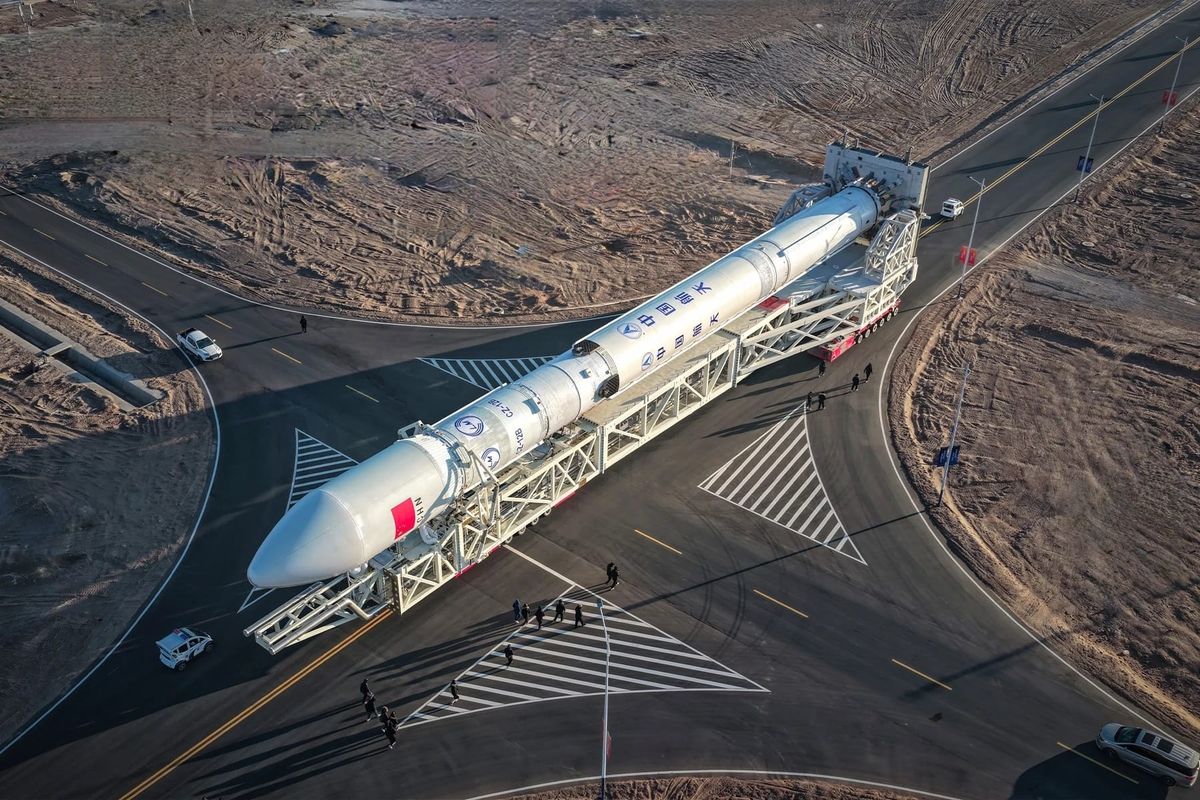
This report's principal judgment held that China stood one to two flight attempts from recovering an orbital-class first stage. That event has now occurred. On July 10, 2026, the China Aerospace Science and Technology Corporation (CASC) recovered the first stage of the Long March 10B using a sea platform equipped with a net capture system, making China the second nation after the United States, (alongside SpaceX and Blue Origin) to recover an orbital-class booster. The vehicle belongs to the crewed-lunar Long March 10 family discussed in Section 3.1; it can carry at least 16 tonnes to low Earth orbit and was built by China Academy of Launch Vehicle Technology.
1. Summary
1.1 Principal Judgment
China has moved, over roughly the last eighteen months, from possessing no demonstrated orbital-class reusable launch capability to standing within one to two flight attempts of recovering and reflying a first stage. On December 2 to 3, 2025, the private firm LandSpace launched its stainless-steel, methane-fueled Zhuque-3 vehicle, delivered its upper stage to orbit, and attempted China's first orbital-class propulsive landing of a first stage. The booster reached its downrange landing zone but was lost to an anomalous combustion event during the landing burn [1]. The assessment offered here is that this outcome, a successful orbital insertion paired with a failed but near-miss recovery, is best read as a normal and expected step on a development curve that SpaceX traversed a decade earlier, not as evidence of a fundamental barrier. The central judgment of this report is that China is likely to demonstrate recovery and reflight of an orbital-class booster within the 2026 to 2027 window, with moderate confidence, but that the transition from a single demonstrated recovery to routine, economically meaningful reuse will take substantially longer and remains the more demanding challenge.
1.2 Supporting Findings
The field is unusually crowded. At least six Chinese vehicles, spanning one state-affiliated and several private developers, are credibly within a year or two of attempting orbital-class recovery: LandSpace's Zhuque-3, Space Pioneer's Tianlong-3, the Shanghai Academy of Spaceflight Technology's Long March 12A, iSpace's Hyperbola-3, Galactic Energy's Pallas-1, and Orienspace's Gravity-2, with CAS Space's Kinetica-2 and a Long March 10-derived state vehicle close behind [4][6][12][13]. This breadth reflects a deliberate state strategy of fostering parallel competition rather than a single national champion.
Reusability in China is driven less by an abstract pursuit of efficiency than by a concrete and urgent demand signal: the deployment of two and possibly three planned mega-constellations, each exceeding 10,000 satellites, against International Telecommunication Union (ITU) milestone deadlines that require partial deployment within fixed windows [15][16][28]. China conducted a record of roughly 93 orbital launches in 2025, yet this cadence remains far below what full constellation deployment requires, and far below SpaceX's 165 Falcon 9 missions in the same year [30]. The arithmetic of constellation deployment, not marketing, is the engine behind Chinese reusability.
Cost claims should be treated with caution. Chinese developers have advertised target prices in the range of roughly 2,800 to 4,350 United States dollars per kilogram to low Earth orbit, figures that are presented as competitive with Falcon 9 but that rest on undemonstrated reuse counts, opaque accounting, and pervasive state support [16][17]. Demonstrated reuse, refurbishment cost, and turnaround time, the variables that actually determine launch economics, remain unproven for every Chinese vehicle as of mid-2026.
1.3 Strategic Implications
The strategic significance of Chinese reusability extends well beyond commercial launch pricing. Reusable boosters are an enabling technology for the rapid build-out of dual-use low Earth orbit infrastructure, including communications, remote sensing, and missile-tracking architectures, and they sit squarely within China's military-civil fusion framework [24][29]. United States export-control policy, principally the International Traffic in Arms Regulations (ITAR), has had the second-order effect of accelerating an indigenous and increasingly export-capable Chinese supply chain [32]. Analysts cited by industry press estimate that China could supply a large share of planned non-Western constellation launches over the remainder of the decade, which would extend Beijing's influence over orbital and spectrum resources [32].
1.4 Headline Recommendations
For institutional investors, the prudent posture is selective and stage-aware exposure that distinguishes between firms with demonstrated propulsion and recovery progress and those trading on announcement. For government policymakers in the United States and allied states, the priority is to treat the closing of the reusability gap as a plausible near-term reality, to reassess export-control settings that may be counterproductive, and to invest in the launch cadence and constellation programs that preserve a margin of advantage. These recommendations are developed in Section 9.
2. Background and Context
2.1 The State Heritage of Chinese Launch
China's launch sector originated as an extension of its ballistic missile program, and that lineage continues to shape its institutions. The Long March (Chang Zheng) family of expendable launch vehicles has been developed and operated primarily by the China Aerospace Science and Technology Corporation (CASC), a state-owned enterprise that remains the backbone of national spaceflight. For decades the Chinese model was characterized by vertically integrated state ownership, expendable hardware, and a launch cadence calibrated to national civil and military requirements rather than to commercial market demand. This structure produced reliable access to space but offered few of the incentives toward cost reduction and high flight rate that later drove reusability elsewhere.
The dual-use character of this heritage is not incidental. The organizations, personnel, and production base that build civil launch vehicles overlap substantially with those supporting strategic missile forces, a feature that the United States Department of Defense has repeatedly identified in its annual assessments of Chinese military power [29]. This overlap is central to understanding why reusable launch is treated in Beijing as a matter of national capability rather than purely commercial opportunity.
2.2 The Commercial Opening After 2014
A structural inflection occurred in 2014 and 2015, when central policy guidance opened space activity to private capital and encouraged the formation of commercial launch and satellite firms. This policy shift produced the first generation of Chinese "NewSpace" companies, including LandSpace, iSpace (Interstellar Glory), Galactic Energy, and Space Pioneer (Beijing Tianbing), most founded between 2015 and 2019. These firms were permitted, and indeed encouraged, to pursue liquid-propellant and ultimately reusable vehicles, drawing on talent and in some cases technology that diffused from the state sector. War on the Rocks and other strategic-affairs outlets have characterized this emergence as a deliberate state experiment in harnessing private dynamism while retaining ultimate direction [22].
It is important not to overstate the privateness of these private firms. The Chinese commercial space sector operates within a system of state guidance funds, subnational government support, and procurement expectations tied to national constellation programs. The boundary between commercial and state activity is more permeable than the equivalent boundary in the United States or Europe, a point developed in Sections 5 and 6 [21][24].
2.3 The Global Shift Toward Reusability
The motivating backdrop for all Chinese activity is the transformation of global launch economics achieved by SpaceX. The repeated recovery and reflight of Falcon 9 first stages, beginning operationally in the late 2010s, compressed launch prices, raised achievable cadence, and made very large constellations such as Starlink economically conceivable. By 2025 SpaceX alone flew 165 Falcon 9 missions, a figure exceeding the rest of the world combined and roughly one launch every two days [30]. This performance reset global expectations for what a launch enterprise must achieve to be competitive.
For China, the Starlink precedent carried a double significance. It demonstrated that reusable launch was an engineering problem with a known solution rather than a speculative ambition, and it created a strategic imperative, because a Western-controlled, rapidly deployed broadband mega-constellation was perceived in Beijing as both a commercial and a security challenge. The Chinese response, sovereign mega-constellations deployed at scale, in turn made domestic reusable launch close to a necessity, because the launch cadence required to deploy and sustain tens of thousands of satellites cannot be met economically with expendable vehicles [14][15]. Reusability in China is therefore best understood as a derived demand, pulled into being by constellation policy, rather than as an independent commercial project.
3. Key Players and Stakeholders
3.1 The State Enterprises: CASC and CASIC
The China Aerospace Science and Technology Corporation remains the dominant force in Chinese spaceflight and the developer of the principal next-generation reusable state vehicles. Two CASC programs are central. The first is the Long March 10 family, a new-generation human-rated launcher whose baseline variant is intended to carry Chinese astronauts to the Moon before 2030, and whose derivatives are being designed for first-stage recovery [7][10]. CASC conducted static fire tests of a Long March 10-series vehicle in August and September 2025 and, according to People's Daily, completed streamlined post-test engine maintenance and inspection, which the state outlet framed as progress toward reuse [7]. A reusable Long March 10-derived rocket is reported as targeting a first test flight in the first half of 2026 [6]. The Long March 10 recovery concept reportedly relies on a rocket-and-ground coordinated approach using tethering structures on the vehicle and a ground-based net-type recovery device, a solution distinct from the deploy-legs-and-land approach used by Falcon 9 [7]. The second CASC program is the Long March 9, a super heavy-lift vehicle now being designed for full reusability with sea recovery, including grid-fin-guided first-stage descent and a propulsive vertical landing of the second stage; this vehicle is a 2030s prospect rather than a near-term capability [7].
A distinct and important state-affiliated effort is the Long March 12A, developed under the Shanghai Academy of Spaceflight Technology (SAST), which sits within the CASC system. The Long March 12A is a methane-fueled, partially reusable vehicle widely reported to be among the vehicles closest to an orbital reuse attempt, alongside the private Tianlong-3 [4]. The China Aerospace Science and Industry Corporation (CASIC), the second large state aerospace conglomerate, has historically focused on solid-propellant vehicles (the Kuaizhou family) and on its own constellation concepts; its role in liquid reusable launch is less prominent than CASC's, and available reporting points to CASIC being a secondary rather than leading actor in propulsive recovery as of mid-2026. This distinction matters: when commentary refers to China's reusable launch effort, the cutting edge is found in CASC and SAST programs and in the private cohort, not uniformly across all state conglomerates.
3.2 The Commercial NewSpace Cohort
The private sector is where much of the visible flight-test activity has occurred, and it is very competitive. LandSpace, founded in 2015, is the most advanced by the key measure of having attempted an orbital-class recovery. Its Zhuque-3 is China's first large stainless-steel methalox rocket, with a reported expendable payload to low Earth orbit near 21,000 kilograms, falling to roughly 18,300 kilograms when the first stage is recovered downrange, powered by nine TQ-12 engines on the first stage and a TQ-15 on the upper stage, with a stated booster reuse target of at least twenty flights [1][2]. The reuse target is a design intention and is undemonstrated. LandSpace's December 2025 flight reached orbit and attempted recovery, losing the booster during the landing burn [1].
Space Pioneer (Beijing Tianbing) is developing the Tianlong-3, a roughly 72-meter, kerolox, partially reusable medium-lift vehicle with a reported capacity of 17 to 18 tonnes to low Earth orbit, explicitly positioned as a Falcon 9 analog and as a workhorse for constellation deployment [4][5]. In September 2025 the company conducted a static fire of the first stage, with nine engines firing for about 35 seconds and producing close to 1,100 tonnes of combined thrust, an event the firm described as a major qualification step ahead of a first launch [5]. The company's credibility is complicated by a June 2024 incident in which a Tianlong-3 first stage unintentionally lifted off during a ground test and crashed, a safety event that underscores the risks of the test campaign.
The remaining private cohort is closely bunched. iSpace has conducted vertical takeoff and vertical landing hop tests with its Hyperbola-2 demonstrator and is developing the larger Hyperbola-3, with reported low-altitude landing accuracy at the meter level and a sea-recovery concept supported by a dedicated drone ship and a refurbishment facility at the Wenchang commercial site [9][13]. Galactic Energy completed a first-stage power-system test of its kerolox Pallas-1 in November 2025; the vehicle is rated near 7 tonnes to low Earth orbit and designed for at least 25 uses, again a target rather than a demonstrated figure, and the firm raised approximately 336 million United States dollars in a financing round tied to its reusable and solid-rocket programs [12]. Orienspace is developing the larger kerolox Gravity-2, with a reported capacity above 21 tonnes to low Earth orbit, while CAS Space, an entity affiliated with the Chinese Academy of Sciences, flew its Kinetica-2 (Lijian-2) for the first time in March 2026 and has publicly outlined a path to recovering and reusing the vehicle by 2028 [13]. Deep Blue Aerospace conducted a notable high-altitude (kilometer-class) vertical recovery test of its Nebula-1 in September 2024 that met most but not all of its objectives, with the vehicle reaching its target before an engine-shutdown anomaly caused a crash landing [11].
3.3 Financiers, Guidance Funds, and Capital Markets
The capital structure behind these firms is a defining feature of the Chinese model. Reporting indicates that annual investment in the Chinese commercial space sector reached on the order of 2.8 billion United States dollars (about 20.2 billion yuan) across roughly 138 financing events in 2024, described as records for the sector, with state-backed capital accounting for an estimated 54 percent of the total, up sharply from about 20 percent in 2018 [21]. These figures derive from a single ecosystem report and should be treated as indicative rather than authoritative, but the direction of travel, rising absolute investment and a rising state share, is corroborated across multiple analyses [21][22].
Capital markets are now becoming an exit and funding channel. LandSpace received approval to pursue an initial public offering on Shanghai's STAR Market in early 2026, targeting proceeds reported at roughly 7.5 billion yuan (about 1.1 billion United States dollars) and a valuation near 1 billion United States dollars, despite very limited revenue, a juxtaposition that signals the state's willingness to use public equity markets to capitalize strategic launch capacity ahead of profitability [33]. Space Pioneer, CAS Space, and Galactic Energy have also moved toward public listings [33]. The presence of subnational guidance funds, with regions such as Beijing's Haidian District and Shanghai reported to be marshaling very large pools of capital for space clusters, further blurs the line between commercial and state finance [21].
3.4 Customers and the Demand Side
The decisive customers are the state-directed mega-constellation operators. China SatNet (China Satellite Network Group), a state-owned enterprise established in 2021, operates the Guowang ("national network") program; Shanghai Yuanxin (Spacesail) operates the Qianfan ("Thousand Sails") constellation; and Hongqing Technology is associated with the Honghu-3 constellation [16]. These operators, together with national civil and military requirements, constitute the anchor demand that gives reusable launch its economic rationale in China. The relationship is symbiotic and state-mediated: constellation operators need cadence and low cost, launch firms need committed manifests, and the state coordinates both through planning instruments and funding. This contrasts with the more market-driven, anchor-tenant model in the United States, and it has implications, examined in Section 5, for how launch demand will actually be allocated among the many competing vehicles.
4. Technical and Operational Considerations
4.1 Engine Architectures: Methalox Versus Kerolox
The choice of propellant is the single most consequential architectural decision for a reusable first stage, because it strongly conditions engine reusability, refurbishment burden, and turnaround time. Two camps are visible in the Chinese field. The first pursues liquid oxygen and methane (methalox), the propellant combination SpaceX selected for Starship and that most new Western entrants favor for reuse. Methane burns cleanly, leaves little coking or soot in the engine, and supports the rapid inspection and reflight that make reuse economical. LandSpace's Zhuque-3 (TQ-12 and TQ-15 engines) and the state-developed Long March 12A are methalox vehicles [1][4]. The Long March 12A is associated with the YF-209 methalox engine, which open sources describe as producing on the order of 735 kilonewtons of thrust at sea level and as designed for reuse on the order of thirty cycles with restart capability; these are design specifications and manufacturer-aligned claims, not independently verified service figures.
The second camp continues with liquid oxygen and kerosene (kerolox), which offers higher density and leverages China's deep heritage with the YF-100 engine family. Space Pioneer's Tianlong-3, Galactic Energy's Pallas-1, Orienspace's Gravity-2, and CAS Space's Kinetica-2 are kerolox vehicles [5][12][13]. The state's reusable ambitions also run through kerolox: the YF-100K, an uprated YF-100 variant, powers the first stages of the Long March 10, which uses twenty-one such engines across its core and two boosters at liftoff, and a reusable variant designated YF-100N is reported to be in development. The kerolox path is lower-risk in the near term because it builds on proven hardware, but kerosene combustion deposits residues that complicate rapid reuse, which is why the methalox vehicles, if matured, may hold a long-run reuse-economics advantage. The evidence does not yet permit a confident ranking, because no Chinese engine of either type has demonstrated repeated orbital-class reflight.
4.2 The Vertical Takeoff and Vertical Landing Flight-Test Record
Propulsive landing is learned incrementally, through hop tests of rising altitude before an orbital recovery is attempted, and the Chinese record now spans the full ladder. At the low-altitude rung, iSpace conducted hop tests with its Hyperbola-2 demonstrator reaching roughly 178 meters and reported landing accuracy at the meter level, validating guidance, throttling, and landing-leg deployment [9]. At the higher rung, Deep Blue Aerospace flew its Nebula-1 to approximately the kilometer scale in September 2024 in what was described as China's first high-altitude vertical recovery test of an orbital-class rocket; the vehicle met most of its stated objectives and reportedly achieved sub-meter targeting before an engine-shutdown anomaly during the final phase caused it to fall and explode [11]. This pattern, most objectives met but the terminal landing not completed, recurs across the Chinese campaign and is characteristic of the regime where the hardest problems (relight reliability, terminal guidance, and shutdown sequencing) concentrate.
The decisive event to date is LandSpace's December 2025 Zhuque-3 flight, which moved beyond hop testing to a full orbital launch with a downrange first-stage landing attempt. The upper stage reached its intended orbit, and the first stage flew its reentry and landing burn to a pad roughly 390 kilometers downrange before an anomalous combustion event during the landing burn destroyed it within meters of the target [1][31]. The analytically important point is that the booster demonstrated the full sequence of boostback, reentry, and terminal guidance to the correct location, leaving terminal propulsion as the proximate failure. This is consistent with a program one or two iterations away from routine successful recoveries, although overconfidence is unwarranted, because terminal-phase reliability is precisely where reusable programs historically stall.
4.3 Grid Fins, Landing Legs, and Recovery Operations
The aerodynamic and mechanical subsystems required for recovery are maturing in parallel. Grid fins for steering during descent and deployable landing legs have been demonstrated on Chinese hop-test vehicles, and the state Long March 9 concept explicitly incorporates grid-fin-guided descent [7]. Notably, China is not converging on a single recovery architecture. LandSpace and most private firms pursue the Falcon 9-style approach of legs and a propulsive landing on a pad or ship. The state Long March 10 family is reported to favor a ground-coordinated net-and-tether capture rather than legged landing [7]. iSpace is investing in sea-based recovery, having reportedly launched a dedicated landing drone ship and opened a first-stage refurbishment facility at Wenchang [13]. This diversity of approaches is a hedge at the national level, increasing the probability that at least one architecture matures, while raising aggregate development cost.
Recovery operations, as distinct from the landing event, are where reuse economics are ultimately won or lost, and here the evidence base is thin. Refurbishment time, the number of components requiring replacement between flights, inspection regimes, and the labor intensity of turnaround are not publicly quantified for any Chinese vehicle, because none has yet reflown an orbital-class stage. The construction of refurbishment infrastructure at Wenchang and the emphasis on rapid pad reset cycles indicate that operators understand the importance of turnaround, but intent should not be mistaken for demonstrated throughput [13][19].
4.4 The Engineering Gap to Routine Reuse
Synthesizing the technical picture, China has closed most of the gap to technically successful recoveries and retains a wider gap to routine, economical reuse. The first gap, single recovery, is narrow and has recently been achieved, though further success is needed to prove reliability [1][6]. The second gap is broader and comprises several distinct problems: demonstrating that a recovered stage can be inspected and reflown without refurbishment costs that erase the savings; proving engine life across many cycles rather than the single-cycle reuse targets currently advertised; achieving turnaround times measured in days or weeks rather than months; and doing all of this at a flight rate high enough to amortize fixed costs. Western experience with SpaceX indicates that several years separate a first recovery from economically meaningful reuse, and there is no strong evidence that China will compress that interval dramatically, although its parallel-program approach and state funding could shorten it relative to a single-firm effort. The peer-reviewed and technical literature on reusable-vehicle guidance and landing control, including Chinese-authored work, indicates active and sophisticated domestic research on the precise terminal-guidance problems that the flight tests are now exposing [3], which supports a judgment of genuine and deepening competence rather than superficial imitation. Confidence in a first recovery within two years is moderate; confidence in routine reuse within two years is low.
 John D
5. Economic and Market Dynamics
5.1 The Demand Driver: Mega-Constellations and Required Cadence
The economic case for Chinese reusability rests on the gap between planned constellation size and current launch capacity. China has filed for, and begun deploying, sovereign mega-constellations of unprecedented scale. The Guowang program associated with China SatNet was filed with the ITU around 2020 for nearly 13,000 satellites across two sub-constellations, and the Shanghai-backed Qianfan and a third Honghu-3 system add further large tranches, with the three headline systems each exceeding 10,000 satellites [15][16]. In late December 2025, Chinese entities filed ITU paperwork for additional constellations totaling close to 200,000 satellites, including two filings of roughly 96,700 satellites each [16]. The 200k figure should be interpreted with care: available reporting and the assessment offered here treat it primarily as a spectrum-priority and option-preserving maneuver under ITU first-come rules rather than as a literal deployment plan, and it should not be read as a credible near-term manifest [16].
Deployment progress remains modest against these targets. By late 2025, Guowang had placed on the order of 100 to 113 satellites in orbit and Qianfan a broadly comparable number, with each Guowang mission lofting only eight to ten relatively large satellites [14]. This is the heart of the economic problem. To deploy and then continually replenish constellations numbering in the thousands, China requires a sustained launch cadence and a per-satellite delivery cost far below what expendable Long March vehicles can provide. Industry analysis indicates that Guowang deployment alone could consume a substantial share of the national launch manifest, and that meeting the schedule would require dozens of dedicated launches per year from constellation-optimized vehicles [14]. China's record of roughly 93 orbital launches across all purposes in 2025 illustrates the shortfall: even a record national cadence is an order of magnitude short of what full constellation build-out, sustained over years, implies [30]. Reusability is the only credible path to closing that gap at acceptable cost, which is why the state is funding multiple programs in parallel.
5.2 Cost Economics and Per-Kilogram Targets
Chinese developers have advertised aggressive cost targets. LandSpace has cited a Zhuque-3 target on the order of 20,000 yuan per kilogram, approximately 2,800 United States dollars, to low Earth orbit, and CAS Space has referenced figures near 30,000 yuan per kilogram, approximately 4,350 United States dollars, for an early Kinetica-2 flight, with the expectation that recovery would reduce costs further, potentially toward half of current levels [16][17]. Trade-press analysis suggests that Chinese commercial launch costs could approach those of Falcon 9, frequently benchmarked near 3,000 United States dollars per kilogram, during 2026 [17][18]. Taken at face value, these figures would place the leading Chinese vehicles in the same broad cost band as the established Western incumbent.
These targets warrant substantial skepticism for several reasons, and the analysis here treats them as low-confidence marketing-aligned figures rather than validated unit economics. First, every advertised price assumes successful, repeated reuse that no Chinese vehicle has demonstrated; a price predicated on twenty reflights is meaningless until reflight is shown to be achievable at low refurbishment cost. Second, Chinese cost accounting is opaque and is shaped by subsidized inputs, including state-supported facilities, guidance-fund capital, and below-market financing, which means a quoted price may not reflect the fully loaded economic cost [21]. Third, the relevant figure for constellation deployment is not headline price per kilogram but fully amortized cost per satellite delivered, including integration, dispenser, and insurance, where data are absent. The defensible conclusion is that China is plausibly on a trajectory toward cost competitiveness with Falcon 9 on a marginal basis. Separately, the comparison class is itself moving, because SpaceX's Starship aims at a step-change in cost that, if realized, would reopen a gap that Chinese reusable medium-lift vehicles are only now closing against Falcon 9 [2].
5.3 Capital Formation and the Coming Shakeout
The Chinese commercial launch sector is capital intensive and, at present, structurally unprofitable. LandSpace, the most advanced private developer, reported only on the order of 5 million United States dollars of revenue in the first half of 2025 even as it pursued a public listing valuing it near 1 billion United States dollars, a gap that is sustainable only because the state and capital markets are willing to fund strategic capacity ahead of returns [33]. Funding has nonetheless been ample by the sector's historical standards, with cumulative raises in the hundreds of millions of United States dollars for the leading firms and a sector-wide total in the billions, an increasing share of it state-linked [12][21][33].
The current configuration, with at least six to eight credible developers pursuing overlapping medium-lift reusable vehicles, is unlikely to persist. The anchor demand, although large, is state-allocated, and the state has both the incentive and the instruments to consolidate around the most successful one to three vehicles once recovery and reuse are demonstrated. The likely path, on the evidence, is a competitive winnowing in which firms that fail to demonstrate propulsion maturity and recovery on schedule lose access to constellation manifests and follow-on funding, while winners are scaled rapidly through procurement and public equity. For investors and partners, this implies high dispersion of outcomes: the sector in aggregate is strategically supported, but individual firms face real failure risk, and the distribution of returns will be highly skewed toward the few vehicles that achieve demonstrated, economical reuse first.
6. Regulatory and Industrial-Policy Landscape
6.1 Industrial Policy and State Planning Instruments
The Chinese state treats commercial space, and reusable launch within it, as a strategic emerging industry to be cultivated through directed policy rather than left to the market. Commercial space was elevated in central economic planning beginning with the December 2023 Central Economic Work Conference and was named in the 2024 government work report as a new engine of economic growth, language repeated and reinforced in the 2025 report and in the recommendations feeding the 15th Five-Year Plan covering 2026 to 2030 [35]. The China National Space Administration has issued an action plan for the high-quality and safe development of commercial space spanning 2025 to 2027, signaling sustained top-level attention [35]. This planning architecture is consequential because it converts political priority into concrete instruments: guidance funds, subsidized manufacturing upgrades, loan discounts, insurance subsidies, and procurement expectations tied to national constellations [21][35]. The practical effect is that reusable-launch developers operate with a degree of demand visibility and downside protection that few Western commercial entrants enjoy, while also operating under correspondingly greater state direction.
The structure also creates a distinctive risk profile. Because the sector is shaped by industrial policy rather than purely by market selection, capital may be allocated to politically favored or regionally sponsored firms rather than to the most technically capable, and overcapacity is a live possibility as multiple provinces and conglomerates back competing vehicles [21][22]. The state's coordinating role cuts both ways: it can accelerate the leaders and sustain the sector through the unprofitable development phase, but it can also prolong the survival of weaker programs and delay the consolidation that would concentrate resources on the most promising architectures.
6.2 Launch Site Capacity
Physical launch infrastructure is a binding constraint on cadence, and China has moved deliberately to expand it. The most important development is the Hainan International Commercial Aerospace Launch Center near Wenchang, China's first purpose-built commercial spaceport, whose first two pads became operational and supported a growing manifest through 2025 [19]. Reporting indicates that the first phase comprises a pad tailored to the Long March 8 series with a rapid reset cycle and a second multi-vehicle pad for medium-lift liquid rockets, with each pad designed to accommodate up to roughly sixteen launches per year [19][20]. A second phase, breaking ground in early 2025, adds two further liquid-rocket pads intended to be operational by the end of 2026, after which the site's annual capacity is projected to exceed sixty missions [20]. These projections are state and operator figures and should be treated as planning targets rather than demonstrated throughput, but the direction is clear and the construction is ongoing.
Launch-site expansion is tightly coupled to reusability in two ways. First, reusable vehicles require recovery and refurbishment infrastructure co-located with or near the launch site, which is why firms such as iSpace are building refurbishment facilities and recovery vessels at Wenchang [13]. Second, the economic value of reuse is realized only at high flight rate, which requires pad availability and rapid reset, the very capabilities the Hainan site is being engineered to provide [19]. The coastal location at Wenchang also enables downrange and sea recovery and supports launch azimuths to a range of inclinations, advantages relative to China's older inland sites.
6.3 Spectrum and Orbital Filings
The regulatory contest that most directly shapes Chinese launch demand is the international competition for spectrum and orbital slots administered through the ITU. Under the milestone-based regime adopted at the 2019 World Radiocommunication Conference, operators of non-geostationary systems must deploy defined fractions of a constellation within fixed windows, reported as 10 percent within two years of the end of the bring-into-use period, 50 percent within five years, and full deployment within seven years, replacing an earlier regime that allowed spectrum to be reserved by launching a single satellite [28]. These milestones convert spectrum filings into binding launch-cadence obligations, and they are a primary reason China must develop the capacity to launch large numbers of satellites quickly. The peer-reviewed literature on constellation registration notes persistent compliance and transparency challenges in how large constellations are registered and brought into use, which complicates verification of who actually controls which orbital and spectrum resources [34].
China's filing behavior should be read in this strategic light. The 2020 Guowang filings and the late-2025 filings approaching 200,000 satellites function partly as defensive moves to secure priority and preserve options against earlier Western filings, including Starlink [16][34]. Whether China can convert filed rights into deployed systems depends directly on launch cadence and therefore on reusability. The filings thus create a self-reinforcing dynamic: they generate the deployment obligations that justify the reusable-launch investment, which in turn determines whether the filed rights can be retained.
6.4 Licensing, Oversight, and Safety
Domestic licensing and oversight of launch remain firmly under state control, exercised through national authorities and the military-linked institutions that manage launch ranges and airspace. The commercial opening has not transferred fundamental regulatory authority to a market regulator on the model of the United States Federal Aviation Administration; rather, commercial activity proceeds within boundaries set by the state and its security apparatus. Safety governance has been tested by the development campaign, most visibly by the June 2024 incident in which a Space Pioneer Tianlong-3 first stage lifted off unintentionally during a ground test and crashed near a populated area, an event that drew attention to the hazards of conducting high-energy tests within China's geography and to the maturity of test-safety practices in the commercial cohort. The episode did not halt the sector, but it illustrates a regulatory environment still adapting to the pace and risk of commercial reusable-rocket development.
7. Geopolitical and Strategic Dimensions
7.1 Dual-Use Considerations and Military-Civil Fusion
Reusable launch is not a narrowly commercial technology, and in the Chinese context it is embedded in an explicit policy of military-civil fusion that treats civilian industrial capability and military capability as a single integrated base. United States government assessments characterize China's commercial space sector as a driver of innovation that simultaneously advances military space objectives, including the rapid build-out of resilient low Earth orbit communications, intelligence, surveillance, and reconnaissance architectures [29]. The same low-cost, high-cadence launch capability that deploys a civil broadband constellation can deploy a proliferated military sensing or tracking layer, and the boosters, engines, guidance systems, and recovery technologies are common to both. CSIS analysis frames the private-sector push on reusability as accelerating the deployment of dual-use space infrastructure rather than as a purely economic development [23][24][25].
The technological adjacencies are direct. Precision propulsive landing requires advances in terminal guidance, throttleable engines, and autonomous control that are technically related to capabilities relevant in the missile domain, and the institutional overlap between civil launch and strategic forces in China is long-standing [29]. This does not imply that every commercial firm is a military program, and the analysis here cautions against collapsing the distinction, but it does mean that the maturation of reusable launch in China should be assessed as a contribution to comprehensive national power, not solely as commercial competition [8].
7.2 Export Controls and the ITAR Dynamic
A central and somewhat counterintuitive strategic dimension concerns the effect of United States export controls. Since the transfer of commercial satellite jurisdiction to the State Department under ITAR in the late 1990s, restrictions on United States-origin content have shaped the global launch and satellite market in ways that, on balance, appear to have accelerated rather than slowed Chinese capability [32]. By making it difficult to fly United States-content satellites on Chinese vehicles and by complicating cooperation, ITAR incentivized the build-out of an indigenous Chinese supply chain that is now increasingly capable and export-oriented [32]. Trade and policy analysis argues that this regime is progressively ceding portions of the commercial launch market to non-United States providers, including China and Europe, and industry estimates cited in that analysis suggest China could supply a large share of launches for announced non-Western low Earth orbit constellations over the remainder of the decade [32].
The strategic implication is that export-control settings designed to deny capability may, in the launch domain, be producing a more self-sufficient and competitive Chinese industry while reducing United States visibility into and leverage over third-country space programs. This is a contested interpretation, and proponents of the controls argue they have slowed Chinese access to specific critical technologies and protected sensitive United States know-how. The evidence does not permit a definitive verdict, but the weight of the launch-market analysis points to significant unintended second-order effects that policymakers may weigh against the controls' intended benefits [32].
7.3 International Competition and the Contest for Orbit
The competitive dynamic with established providers operates on two levels. At the level of launch services, Chinese reusable medium-lift vehicles are positioned to compete on price for commercial payloads, particularly in markets where price sensitivity outweighs concerns about reliability, geopolitics, or supply security. At the level of orbital and spectrum resources, the contest is more strategic: the ITU first-come framework means that the actor that deploys at scale fastest secures durable advantages in slots and frequencies, and China's very large filings are explicit bids for that priority [16][34]. The aggregate picture for 2025, in which the United States and China together accounted for the large majority of global orbital launches and SpaceX alone flew more missions than the rest of the world combined, shows a bifurcating launch order in which two actors dominate and most others are increasingly dependent on one of them [30].
China's competitive position is strengthened by its willingness to bundle launch and satellite capability with state financing and diplomatic relationships, an offer that is attractive to states seeking sovereign space capability without Western conditions. This extends the contest from pure commercial competition into the domain of influence and alignment, with implications for which states' systems populate low Earth orbit and, on whose terms [22],[24].
7.4 Space Access, Resilience, and Deterrence
Reusable launch contributes to strategic capability, and indirectly to deterrence dynamics. A state that can launch frequently and cheaply can reconstitute degraded constellations quickly, complicating an adversary's calculus about the value of attacking space assets, because rapid replacement reduces the payoff of counterspace action. The Secure World Foundation's open-source assessment documents China's systematic development of a full spectrum of counterspace capabilities alongside its build-out of space infrastructure, indicating that Beijing is investing in both the offensive and the resilience sides of the space-security ledger [27]. Independent analysis from CSET similarly tracks the rapid expansion of China's on-orbit presence and launch capacity as components of comprehensive space power [26].
The deterrence implication runs in two directions and should not be overstated. Cheap, responsive launch enhances China's ability to sustain and reconstitute its own space-enabled military capabilities, and it supports the kind of proliferated architectures that are inherently more survivable. At the same time, the diffusion of low-cost launch and proliferated constellations globally tends to make the orbital environment more crowded, more contested, and potentially less stable, raising the salience of debris, spectrum interference, and crisis-management challenges. The net effect on strategic stability is indeterminate on current evidence, and this report flags it as an area of uncertainty rather than asserting a confident conclusion [27].
8. Risk Assessment
8.1 Approach
| Horizon | Category | Risk | Likelihood | Impact | Leading Indicators |
|---|---|---|---|---|---|
| Short term (1–3 years) | Technical | Repeated failure to complete terminal landing and achieve the first successful recovery. | Moderate | High | Outcome of the next Zhuque-3, Tianlong-3, and Long March 12A landing attempts; recurrence of landing-burn or engine-shutdown anomalies. |
| Short term (1–3 years) | Financial | Funding strain at individual firms despite broader sector support; pre-revenue listings underperform. | Moderate | Moderate | LandSpace STAR Market listing outcome; follow-on fundraising terms; revenue disclosures. |
| Short term (1–3 years) | Regulatory | Test-safety incident triggers tighter oversight and slows test cadence. | Low to Moderate | Moderate | Further uncontrolled test events; new licensing or range-safety rules. |
| Short term (1–3 years) | Adoption | Constellation manifests concentrate on expendable vehicles, delaying demand for reusable launch systems. | Moderate | Moderate | Share of Guowang and Qianfan launches flown on reusable vehicles. |
| Medium term (3–7 years) | Technical | Recovery is achieved, but reuse remains uneconomical because of high refurbishment requirements or limited engine life. | Moderate to High | High | Demonstrated reflight count per booster; turnaround time; engine cycle-life disclosures. |
| Medium term (3–7 years) | Financial | Sector consolidation strands capital in unsuccessful launch programs. | Moderate to High | Moderate to High | Withdrawal of guidance-fund support; mergers, restructuring, or exit of weaker firms. |
| Medium term (3–7 years) | Regulatory | ITU milestone deadlines are missed, jeopardizing spectrum rights. | Moderate | High | Deployment percentages measured against applicable bring-into-use windows. |
| Medium term (3–7 years) | Adoption | Reusable launch cadence remains insufficient to meet constellation deployment schedules. | Moderate | High | Annual number of satellites deployed versus constellation filing obligations. |
| Long term (7+ years) | Technical | Technology gap reopens as Western fully reusable heavy-lift vehicles reset the launch-cost frontier. | Moderate | High | Operational status and cost performance of Starship-class systems versus Chinese heavy reusable launch vehicles. |
| Long term (7+ years) | Financial | Overcapacity and price competition erode returns across surviving launch firms. | Moderate | Moderate | Launch-price trends; utilization rates of expanded launch-pad and production capacity. |
| Long term (7+ years) | Regulatory / Strategic | Export-control and orbital-governance frictions escalate. | Moderate | Moderate to High | Changes to ITAR posture; ITU disputes; counterspace developments. |
| Long term (7+ years) | Adoption | Constellations underperform commercially, weakening the demand base that justifies reusable launch investment. | Low to Moderate | High | Subscriber growth and revenue performance of Guowang and Qianfan. |
8.3 Narrative Synthesis and Interdependencies
The dominant near-term risk is technical and is concentrated in the terminal landing phase. The December 2025 Zhuque-3 outcome, orbit achieved and booster lost during the landing burn, is the archetype: the difficulty is no longer reaching the landing zone but completing the final propulsive sequence reliably [1]. Due to multiple vehicles attempting this milestone in close succession, the probability that at least one Chinese developer demonstrates a first recovery within the short-term horizon is moderate to high, even though the probability for any single firm on any single attempt is lower [6]. A first recovery is therefore likely; the more demanding and more uncertain question is the medium-term transition to economical reuse.
The most important interdependency is that technical, financial, and adoption risks are coupled through the state-allocated demand structure. If recovery slips, the firms most exposed are those that raised capital and pursued listings on the expectation of near-term reuse revenue, which converts a technical delay into a financial-distress and consolidation event [21][33]. If recovery succeeds but reuse proves uneconomical, the adoption risk materializes as constellation operators continue to rely on expendable or low-reuse vehicles, the cadence required by ITU milestones is not met, and filed spectrum rights are placed at risk, transmitting a technical shortfall into a regulatory and strategic loss [28][34]. Conversely, an early and clean demonstration of economical reuse would relax all four risk categories simultaneously, unlocking manifests, validating valuations, and securing spectrum, which is why the first demonstrated reflight at low refurbishment cost is the single highest-information event to watch.
The long-term risks are dominated by a moving competitive frontier. Chinese medium-lift reusables are closing the gap against Falcon 9, but the relevant benchmark may shift to fully reusable heavy-lift systems, against which China's equivalent (a reusable Long March 9) is a 2030s prospect [2][7]. The risk for China is therefore not only failing to catch the present frontier but having the frontier move again before it arrives. The leading indicators that best discriminate among these futures are concrete and observable: the outcome of the next several landing attempts, the first disclosed booster reflight and its turnaround time and refurbishment scope, the share of constellation launches actually flown on reusable vehicles, and deployment percentages measured against ITU milestone windows.
9. Strategic Recommendations
9.1 For Institutional Investors
Treat the first demonstrated, low-refurbishment booster reflight, not the first recovery and not announced cost targets, as the threshold event that converts the sector from speculative to investable. Until a Chinese firm reflies a recovered orbital-class stage and discloses turnaround time and refurbishment scope, advertised per-kilogram prices near 2,800 to 4,350 United States dollars should be modeled as marketing aspirations rather than achieved economics, and valuations that capitalize them should be discounted accordingly [16][17][33]. Position for high outcome dispersion: the state-allocated demand structure makes a few winners likely and many losers probable, so concentrated exposure to a single name carries failure risk that the sector's strategic backing does not offset at the firm level [21][22].
Differentiate on demonstrated propulsion and recovery progress rather than on narrative. The most informative diligence signals are static-fire duration and engine count actually fired, hop-test altitude and landing accuracy, and the specific failure mode of any landing attempt, because a vehicle that reaches its landing zone and fails on terminal propulsion is closer to success than one that has not flown [1][6][11]. For investors accessing the sector through public markets, recognize that STAR Market listings are being used to capitalize strategic capacity ahead of profitability, which means liquidity and policy support may sustain valuations independent of fundamentals, a dynamic that can persist longer than fundamentals alone would justify but that also concentrates policy risk [33]. For those restricted from direct exposure to Chinese issuers, the more accessible expression of the thesis is in the second-order beneficiaries and competitors, including Western launch and satellite firms whose competitive position is directly affected by the pace at which China closes the gap.
9.2 For Government Policymakers in the United States and Allied States
Plan on the assumption that China demonstrates orbital-class reusability within the near-term horizon and achieves at least partial economical reuse within the medium term, because the evidence supports treating this as a likely rather than a speculative outcome [1][6]. The central policy task is to preserve a margin of advantage rather than to deny an outcome that is no longer deniable. This argues for sustaining and increasing allied launch cadence and for ensuring that allied constellation programs are resourced to deploy on schedule, since the strategic contest is increasingly about who deploys and reconstitutes at scale fastest, a contest the present launch order shows two actors dominating [30].
Reassess export-control settings in the launch and satellite domain against their demonstrated second-order effects. The available analysis indicates that ITAR-driven restrictions have contributed to building a self-sufficient and export-capable Chinese supply chain while reducing United States insight into third-country programs, an outcome contrary to the controls' intent [32]. A calibrated review that distinguishes critical technologies, which should remain tightly held, from content whose restriction mainly cedes market share and visibility, would better serve strategic objectives; this recommendation is offered with acknowledgment that the evidence on export-control effects is contested and that any loosening carries its own risks [32]. In parallel, invest in space-domain awareness, debris mitigation, and orbital-governance diplomacy, because the diffusion of low-cost launch and proliferated constellations raises congestion and crisis-stability risks regardless of which state leads [27][34]. Finally, treat the dual-use character of Chinese reusable launch as a planning assumption for force design and resilience, prioritizing proliferated and reconstitutable allied architectures over small numbers of high-value assets [24][29].
9.3 For Commercial-Sector Executives and Allied-Industry Strategists
Launch-service providers and satellite operators outside China should plan for a medium-term environment in which Chinese reusable medium-lift capacity exerts downward pressure on commercial launch prices in price-sensitive and non-aligned markets [17][18][32]. Competing on headline price alone is unlikely to be viable against state-supported entrants; differentiation should instead emphasize reliability records, schedule assurance, supply-chain security, regulatory compatibility, and the geopolitical acceptability that many customers require, attributes that Chinese providers cannot easily replicate for Western and allied buyers. Where appropriate, pursue cost reduction through reuse and manufacturing scale aggressively, because the cost frontier is moving and the protection afforded by incumbency will erode if Chinese reuse matures on the trajectory this report considers likely.
Satellite and constellation operators should monitor the same leading indicators the risk section identifies, particularly the first disclosed Chinese booster reflight and the share of Chinese constellation launches flown on reusable vehicles, and should treat those events as triggers to revisit capacity, pricing, and supplier assumptions [6][14]. Allied-industry strategists advising governments should press for resourcing decisions that are robust to a faster-than-expected Chinese timeline, since the cost of preparing for an earlier arrival is modest relative to the cost of being surprised by it. Across all three audiences, the unifying recommendation is to anchor decisions to demonstrated milestones rather than to claims, while building in enough lead time that a credible Chinese reuse demonstration does not require a scramble.
References
1. SpaceNews. 2025. "Zhuque-3 Reaches Orbit on Test Flight, First Stage Lost during Landing Attempt." SpaceNews, December 3.
2. Scientific American. 2025. "China's Explosive Zhuque-3 Test Previews the Global Race for Reusable Rockets." Scientific American, December.
3. Song, Zhengyu, Qiaoyan Cai, Pengxin Han, Cong Wang, Hao Pan, Guangchun Zhang, and Xujin Li. 2021. "Review of Guidance and Control Technologies for Reusable Launch Vehicles." Acta Aeronautica et Astronautica Sinica 42 (11): article 25050.
4. Aviation Week Network. 2025. "Space Pioneer Advances Tianlong-3 with Nine-Engine Test." Aviation Week Network, September.
5. New Space Economy. 2025. "Space Pioneer Conducts Successful Test of Tianlong-3 Reusable Rocket First Stage." New Space Economy, September 17.
6. SpaceNews. 2026. "China to Debut Reusable Long March 10-Derived Rocket in First Half of 2026." SpaceNews, January.
7. People's Daily Online. 2026. "China's Long March-10 Passes Key Tests, Paving Way for Future Rocket Reuses." People's Daily Online, February 14.
8. Defense One. 2025. "China Is Working on Reusable Rockets, and a Strategic Leap in Space Power." Defense One, August.
9. South China Morning Post. 2023. "China's First Full-Scale Reusable Rocket Test Fuels iSpace Hyperbola-3 Ambitions." South China Morning Post, November.
10. RAND Corporation. 2025. "China Is Going to the Moon by 2030: Here's What's Known about the Mission, and Why It Matters." RAND Commentary, November.
11. SpaceNews. 2024. "Deep Blue Aerospace Hop Test Suffers Anomaly Moments before Landing." SpaceNews, September.
12. SpaceNews. 2025. "Galactic Energy Secures $336 Million, Nears Debut of New Reusable and Solid Rockets." SpaceNews.
13. China in Space. 2025. "OrienSpace, iSpace Reusable Rockets Inch Forward as 2025 Debuts Slip Away." China in Space, December.
14. SpaceNews. 2025. "China Launches Fourth Group of Guowang Megaconstellation Satellites." SpaceNews.
15. SpaceNews. 2021. "China Is Developing Plans for a 13,000-Satellite Communications Megaconstellation." SpaceNews, April.
16. SpaceNews. 2026. "China Files ITU Paperwork for Megaconstellations Totaling Nearly 200,000 Satellites." SpaceNews, January.
17. South China Morning Post. 2025. "Is China's Commercial Rocket Now Cheaper than Elon Musk's SpaceX Falcon 9?" South China Morning Post.
18. Yicai Global. 2026. "China's Commercial Rocket Launch Costs to Likely Near Those of SpaceX in 2026." Yicai Global.
19. People's Daily Online. 2026. "Spaceport's Milestone a Major Boost for Hainan Space Industry." People's Daily Online, January 27.
20. Global Times. 2025. "Hainan's Commercial Space Launch Site Phase II Breaks Ground, with Two Liquid Rocket Launch Pads Planned." Global Times, January 26.
21. Asia Pacific Foundation of Canada. 2025. "How Subnational Government Support Is Helping China Build Its Version of Starlink." Asia Pacific Foundation of Canada.
22. War on the Rocks. 2025. "Eastern Stars Rising: The Rise of China's Commercial Space Industry." War on the Rocks.
23. Center for Strategic and International Studies. 2025. Space Threat Assessment 2025. Washington, DC: CSIS Aerospace Security Project.
24. Center for Strategic and International Studies. 2025. Strategic Trajectories: Assessing China's Space Rise and the Risks to U.S. Leadership. Washington, DC: CSIS.
25. Center for Strategic and International Studies. 2026. "A Match Made under Heaven: The Emerging Role of China's Private Sector in Space." Trustee China Hand. CSIS, April.
26. Center for Security and Emerging Technology. 2025. China's Space Progress Report. Washington, DC: Georgetown University, Center for Security and Emerging Technology.
27. Secure World Foundation. 2025. Global Counterspace Capabilities: An Open Source Assessment. Broomfield, CO: Secure World Foundation, April.
28. International Telecommunication Union. 2020. "ITU Members Agree to New Milestones for Non-Geostationary Satellite Deployment." ITU News, January.
29. U.S. Department of Defense. 2024. Military and Security Developments Involving the People's Republic of China 2024. Washington, DC: Office of the Secretary of Defense, December.
30. SpaceNews. 2026. "SpaceX, China Drive New Record for Orbital Launches in 2025." SpaceNews, January.
31. NASASpaceFlight. 2025. "China Pushing for Reusability Milestone with Zhuque-3 Launch and Near-Landing." NASASpaceFlight.com, December.
32. New Space Economy. 2026. "The ITAR Trap: How U.S. Export Control Law Is Ceding the Commercial Launch Market to China and Europe." New Space Economy, March 31.
33. Caixin Global. 2026. "LandSpace Wins Nod for $1 Billion IPO amid China's Space Ambitions." Caixin Global, January 3.
34. Liu, H., Q. Sun, and S. Han. 2024. "The Compliance Issues with Regard to the Registration Procedure of Satellite Constellations." Space: Science & Technology 4: article 0117.
35. SpaceNews. 2025. "China Highlights Commercial Space Sector in Government Work Report." SpaceNews.