
Displacement Cosmology: The Intra-Singular Information Model
A speculative cosmology model proposing our universe as a black hole interior shaped by spacetime displacement and information flow.

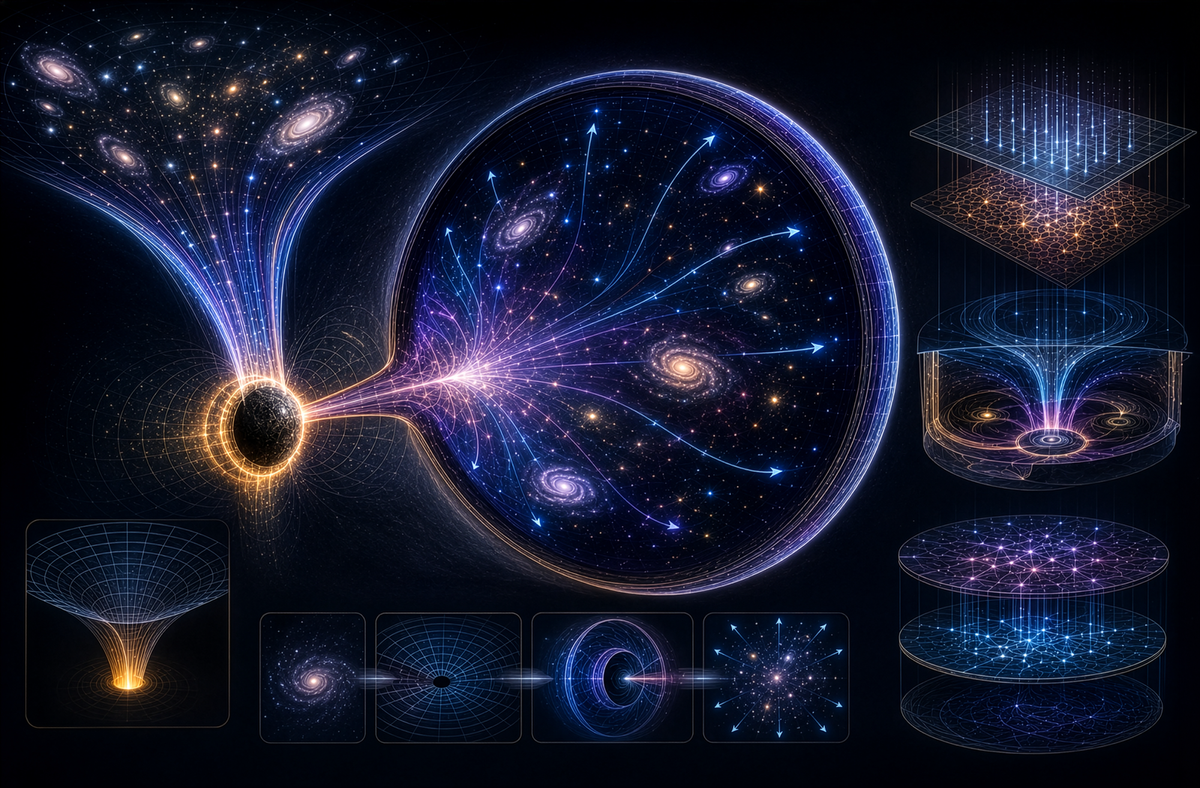
Independent Researcher
21 May 2026
Displacement Cosmology: The Intra-Singular Information Model
Original Theory and Content Written By Johnny (J4K, JohnnyXwing241)
Abstract
Modern cosmology continues to face unresolved questions concerning the origins of spacetime expansion, the nature of dark matter and dark energy, and the apparent informational structure of the universe. This paper proposes a speculative theoretical framework titled Displacement Cosmology, which suggests that the observable universe may exist within the interior geometry of a black hole formed in a higher-order parent universe. Within this model, cosmological expansion is interpreted not as expansion into empty space, but as the internal displacement of spacetime caused by incoming mass-energy and informational content crossing the parent event horizon. Drawing conceptually from holographic gravity, black hole thermodynamics, and interior cosmology theories, this framework attempts to unify several major cosmological problems under a single geometric interpretation while remaining consistent with relativistic principles. Although speculative and presently unverified, the model proposes several observational directions and philosophical implications relevant to future cosmological study.
Introduction
The standard cosmological model successfully explains many observable properties of the universe, including cosmic microwave background radiation, galactic redshifts, and large-scale structure formation. However, several major theoretical issues remain unresolved. These include the physical nature of dark matter and dark energy, the apparent fine-tuning of universal constants, and the informational paradoxes associated with black holes.
Recent developments in theoretical physics have increasingly linked gravity, spacetime geometry, and information theory. The holographic principle, first proposed through the work of Gerard ’t Hooft and later expanded by Leonard Susskind, suggests that the information contained within a volume of spacetime may be encoded on its boundary surface. Similarly, research in black hole cosmology has explored whether black hole interiors may generate independent cosmological regions or “baby universes.”
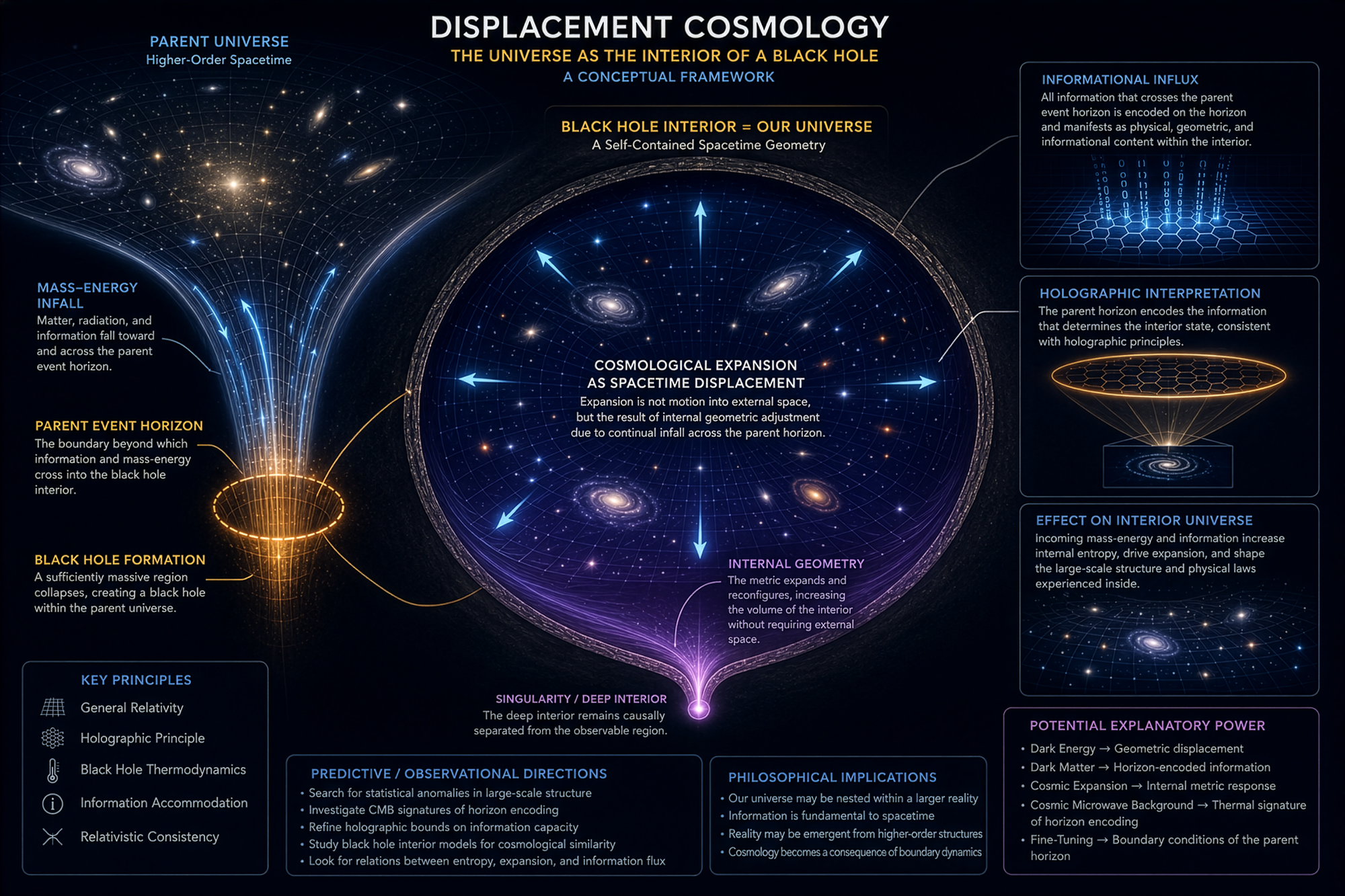
Displacement Cosmology extends these discussions by proposing that the observable universe itself may be interpreted as the interior geometry of a black hole embedded within a higher-order parent universe. Rather than treating cosmological expansion as movement into an external vacuum, the framework proposes that expansion results from the internal metric displacement required to accommodate incoming information and mass-energy crossing the parent event horizon.
The purpose of this paper is not to claim definitive proof of this model, but rather to present a coherent speculative framework that unifies several cosmological phenomena under a single geometric and informational interpretation.
Outline of the Framework
The framework is based upon three central postulates:
- The observable universe exists within the interior geometry of a black hole formed in a parent universe.
- Cosmological expansion is caused by internal metric displacement driven by the inflow of mass-energy and informational content through the parent event horizon.
- The apparent infinitude of the universe is a topological effect caused by curved spacetime geometry within a finite but unbounded system.
These postulates collectively form the basis of the proposed cosmological structure.
Body
Black Hole Interior Cosmology
The concept that universes may emerge from black hole interiors has appeared in several theoretical discussions within modern cosmology. Nikodem Popławski proposed models in which black holes may generate expanding internal universes through gravitational torsion effects. Similarly, holographic cosmology research has explored relationships between higher-dimensional gravitational systems and observable cosmological dynamics.
Within Displacement Cosmology, the observable universe is treated as the interior spacetime of a black hole located within a larger parent universe. The event horizon of the parent black hole functions as both a gravitational boundary and an informational transfer surface. Because observers inside the system cannot directly access the exterior geometry, the universe appears self-contained and effectively infinite despite remaining finite in total structure.
This interpretation attempts to explain why the density of the observable universe approaches conditions mathematically similar to those associated with Schwarzschild-scale gravitational boundaries.
Expansion as Informational Displacement
In the standard cosmological model, expansion is generally described through metric expansion of spacetime itself. Displacement Cosmology proposes an alternative interpretation: spacetime expands internally because the system must continuously accommodate additional incoming mass-energy and informational content crossing the parent event horizon. Conceptually, the expansion rate may be represented as proportional to the rate of incoming mass-energy:
In this interpretation, expansion is not random or externally driven, but rather emerges as a geometric necessity of maintaining internal consistency within a dynamically growing informational manifol
This proposal also offers a speculative reinterpretation of dark energy. Instead of viewing dark energy as a constant vacuum energy field, the accelerated expansion of the universe may reflect increasing accretion rates within the parent black hole system.
Dark Matter and External Gravitational Influence
The framework further proposes that some effects currently attributed to dark matter may result from higher-order gravitational influences originating outside the observable universe.
Galactic rotation curves and gravitational lensing observations currently suggest the presence of unseen mass. Standard cosmology attributes these effects to nonbaryonic dark matter particles. Displacement Cosmology instead explores whether large-scale frame-dragging or curvature effects from the parent universe could manifest internally as additional gravitational influence.
This interpretation remains highly speculative and presently lacks sufficient mathematical modeling. Any viable version of this hypothesis would need to reproduce observed galactic lensing distributions and structure formation patterns currently explained by dark matter simulations.
Informational Inheritance and the Origin of Life
One of the more philosophical implications of the framework concerns informational persistence across cosmological generations. Through the holographic principle, information may not be destroyed during gravitational collapse, but rather encoded on horizon boundaries.
Under this interpretation, some informational structures from a parent cosmological system could theoretically survive into a daughter universe through highly transformed or encoded states. This does not imply direct biological transfer, but rather the possibility that preconditions favorable to complexity and life may be inherited rather than emerging entirely independently.
This section of the framework remains the most speculative and currently possesses no direct experimental support.
Observational Possibilities
Although highly theoretical, the framework suggests several observational avenues for future study.
First, cosmologists may continue investigating why the observable universe approaches density conditions similar to those associated with black hole formation thresholds.
Second, large-scale anisotropies within the cosmic microwave background, including the so-called “Axis of Evil,” may potentially indicate preferred rotational structure consistent with parent black hole angular momentum.
Third, future gravitational wave observations could search for anomalous echoes or refractive effects potentially associated with internal horizon geometry.
At present, none of these observations confirm the framework, though they may provide future opportunities for falsifiability.
Conclusion
Displacement Cosmology proposes that the observable universe may be understood as the interior geometry of a black hole embedded within a higher-order cosmological system. Within this framework, cosmological expansion emerges from internal metric displacement driven by informational and mass-energy inflow across the parent event horizon. By combining concepts from holographic gravity, black hole thermodynamics, and cosmological interior models, the theory attempts to provide a unified interpretation of expansion, dark energy, and informational persistence.
The framework remains speculative and incomplete, particularly in its mathematical development. However, it offers a coherent conceptual structure capable of generating testable predictions and philosophical implications relevant to modern cosmological debate.
Final Thoughts
The history of cosmology demonstrates that scientific understanding evolves through increasingly abstract interpretations of reality. Concepts once considered impossible—including curved spacetime, quantum uncertainty, and black hole thermodynamics—eventually became central to modern physics.
Displacement Cosmology should therefore not be viewed as a replacement for established cosmological science, but rather as an exploratory framework intended to encourage further investigation into the relationships between gravity, geometry, information, and the large-scale structure of reality.
Whether ultimately correct or incorrect, the framework attempts to approach cosmology not as isolated phenomena requiring separate explanations, but as a connected informational system governed by underlying geometric principles.
Author and Publication Disclaimer
The foundational concepts, theoretical mechanisms, philosophical interpretations, and core cosmological ideas presented in this manuscript were independently developed by the author, Johnny (J4K, JohnnyXwing241).
These concepts originated through personal theoretical exploration and were not generated by artificial intelligence systems.
Artificial intelligence tools and language models were utilized solely for the following purposes:
• Expanding preliminary written material into formal academic structure
• Improving clarity, grammar, and scholarly tone
• Assisting with organization and formatting
• Identifying and locating relevant peer-reviewed literature and related scientific sources
• Refining wording for readability and publication presentation
No core theoretical principles, original cosmological mechanisms, or foundational hypotheses were generated by AI systems. All major conceptual contributions—including the informational displacement model of expansion, intra-singular cosmology interpretation, and parent-universe accretion framework—originated from the author.
Publication and Licensing Agreement
The author, Johnny (J4K, JohnnyXwing241), affirms original conceptual authorship of Displacement Cosmology: The Intra-Singular Information Model and grants permission for the manuscript to be published, archived, reproduced, and distributed digitally by “DataDeep.Tech” for educational, discussion, and non-fraudulent publication purposes.
This permission does not transfer authorship, intellectual ownership, or original attribution of the work. Any republication, quotation, or distribution of this manuscript must preserve attribution to the original author.
Recommended attribution format:
Johnny (J4K, JohnnyXwing241). Displacement Cosmology: The Intra-Singular Information Model. Independent unpublished theoretical manuscript, 2026.
 John D
 John D
 John D
Works Cited
Apostolopoulos, Pantelis S., George Siopsis, and Nikolaos Tetradis. “Cosmology from an Anti-de Sitter Schwarzschild Black Hole via Holography.” Physical Review Letters, vol. 102, no. 15, 2009.
Banks, Tom, and Willy Fischler. “Holographic Cosmology.” arXiv preprint, hep-th/0405200, 2004.
Bekenstein, Jacob D. “Black Holes and Entropy.” Physical Review D, vol. 7, no. 8, 1973, pp. 2333–2346.
Hawking, Stephen W. “Particle Creation by Black Holes.” Communications in Mathematical Physics, vol. 43, no. 3, 1975, pp. 199–220.
Popławski, Nikodem J. “Universe in a Black Hole with Spin and Torsion.” Astrophysics and Space Science, vol. 361, no. 4, 2016.
Sahu, Abhisek, and Mark Van Raamsdonk. “Holographic Black Hole Cosmologies.” Journal of High Energy Physics, vol. 2025, no. 5, 2025.
Susskind, Leonard. “The World as a Hologram.” Journal of Mathematical Physics, vol. 36, no. 11, 1995, pp. 6377–6396.
’t Hooft, Gerard. “Dimensional Reduction in Quantum Gravity.” arXiv preprint, gr-qc/9310026, 1993.