Vacuum-Splitting Warp Geometry: A Zero-Integral Toy Model for Exotic Stress-Energy Compensation
A speculative vacuum-splitting warp drive model exploring zero-integral stress-energy, negative energy limits, and QEI constraints.

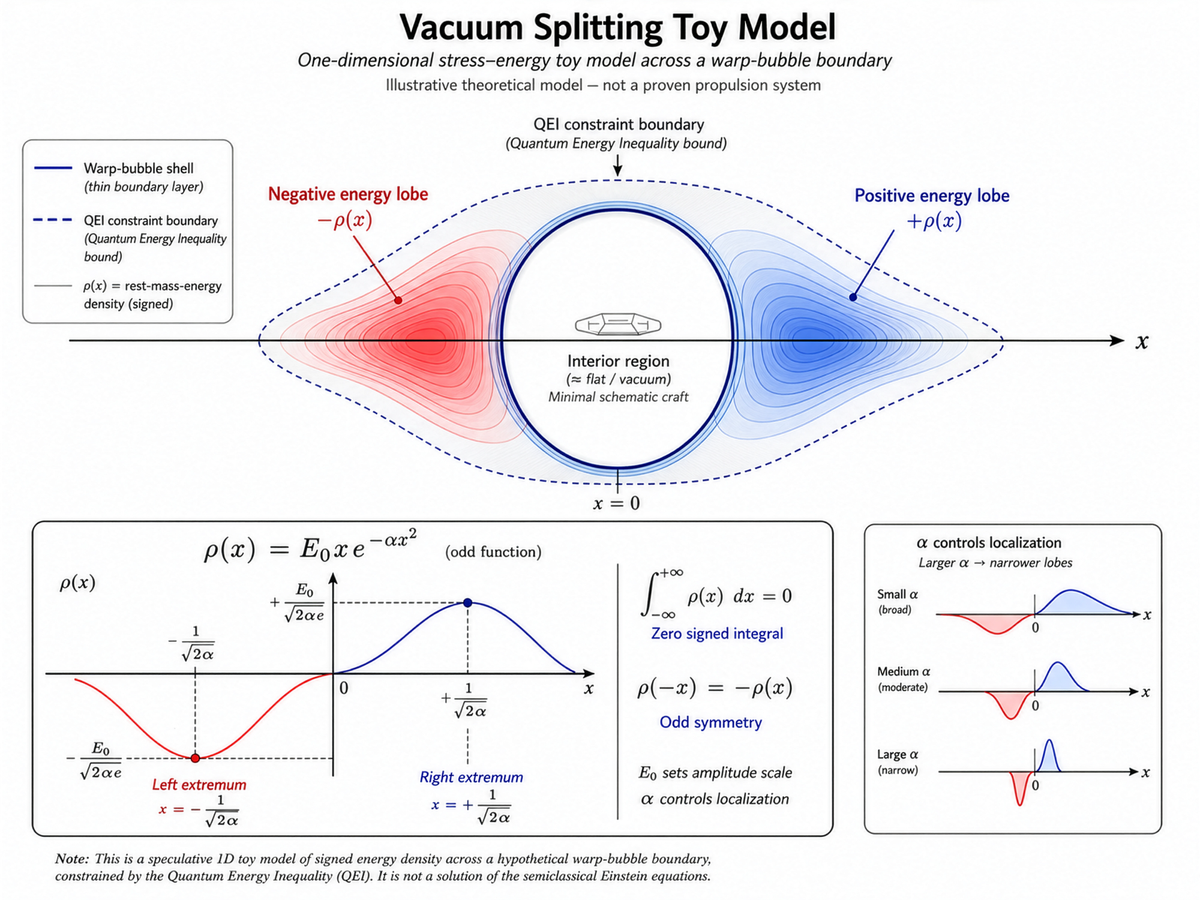
This proposal explores whether a localized positive/negative energy-density split could model a zero-net exotic stress-energy shell for warp-drive geometries. The model does not claim to bypass quantum energy inequalities, rather it frames the stabilization problem mathematically.
Historically, warp-drive physics has been limited by the requirement for exotic stress-energy. Alcubierre’s original 1994 metric demonstrated that general relativity permits a spacetime geometry resembling a “warp bubble,” but the associated stress-energy tensor requires negative energy density and violates classical energy conditions. Later work by Pfenning, Ford, Roman, Van Den Broeck, White, Bobrick, Martire, Lentz, and others has explored whether these requirements can be reduced, reformulated, or replaced by positive-energy geometries, but no known model presently provides a practical engineering route to superluminal propulsion.
This proposal examines a narrower question: whether a zero-integral positive/negative energy-density distribution can serve as a toy model for a locally compensated warp-shell source. Rather than treating negative energy as an isolated resource, the model represents the exotic component as one side of a balanced stress-energy dipole.
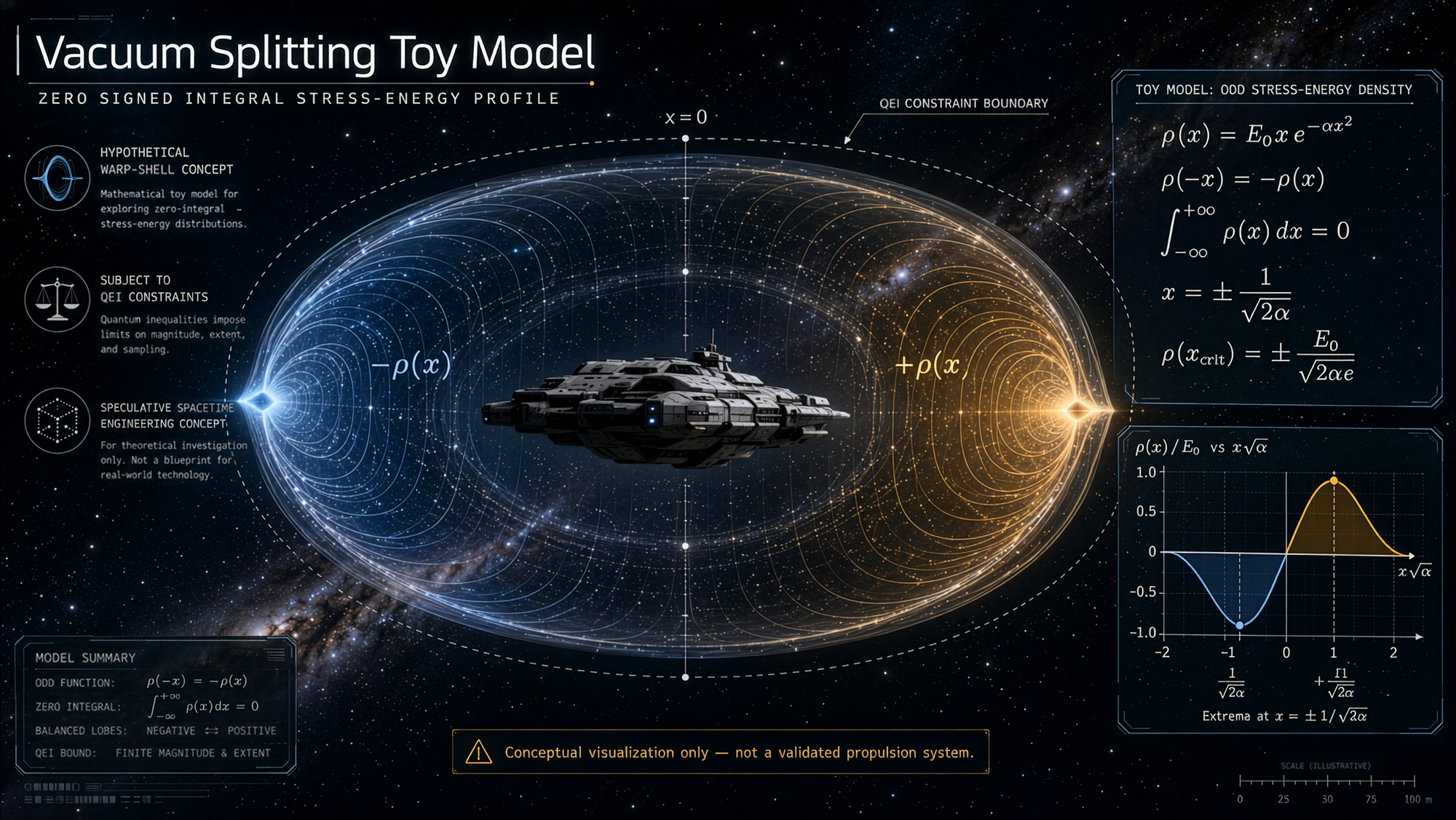
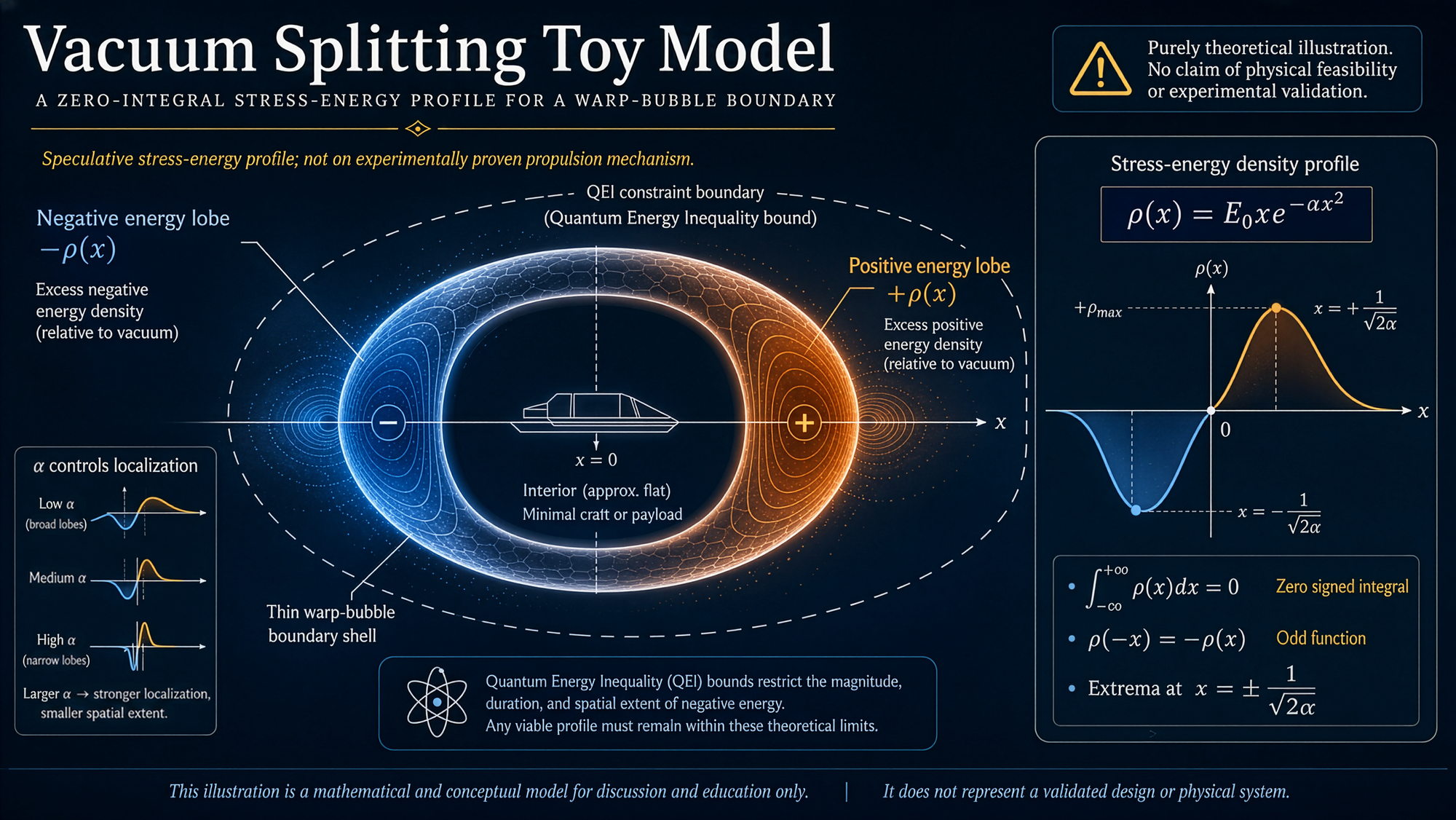
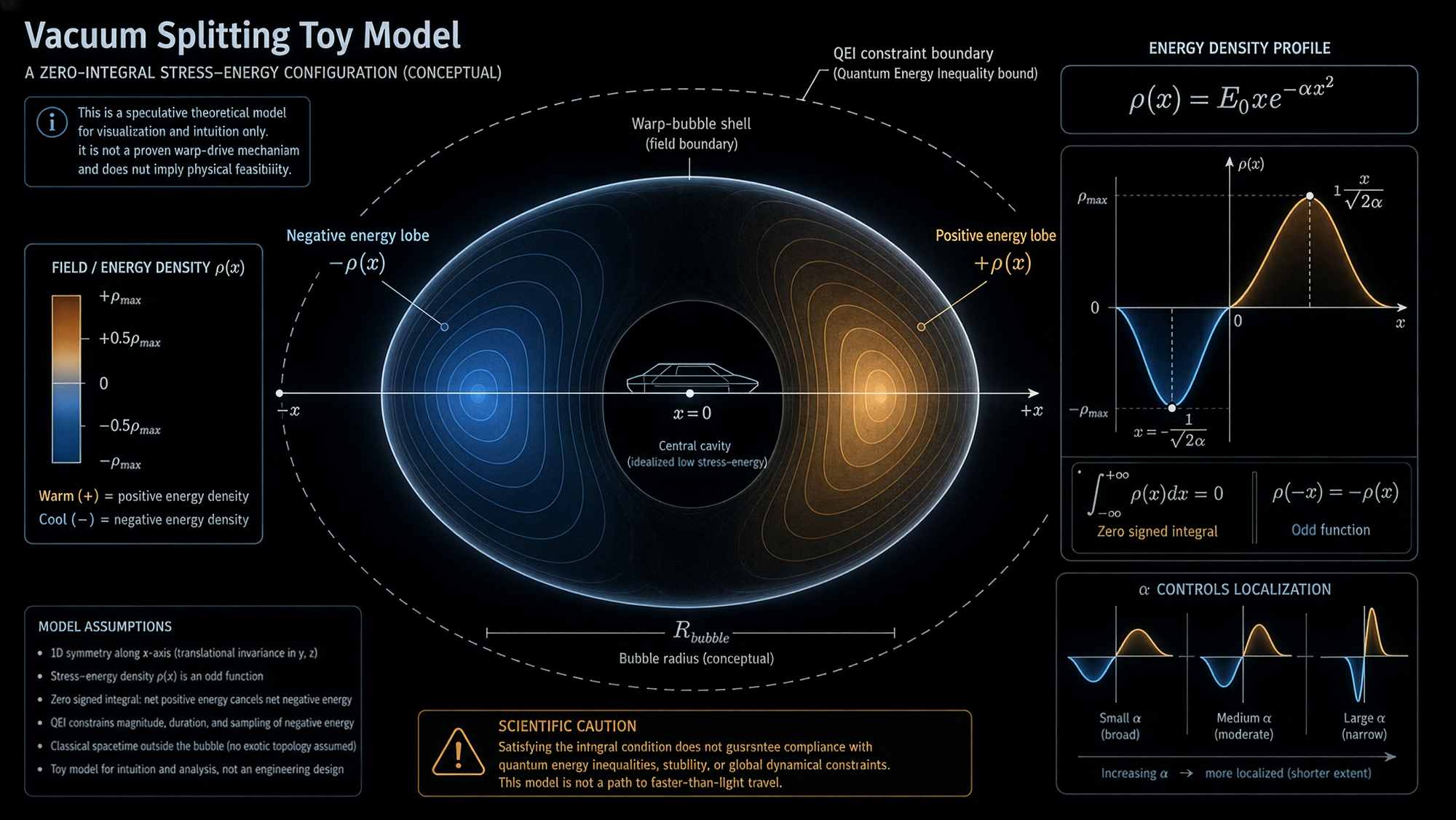
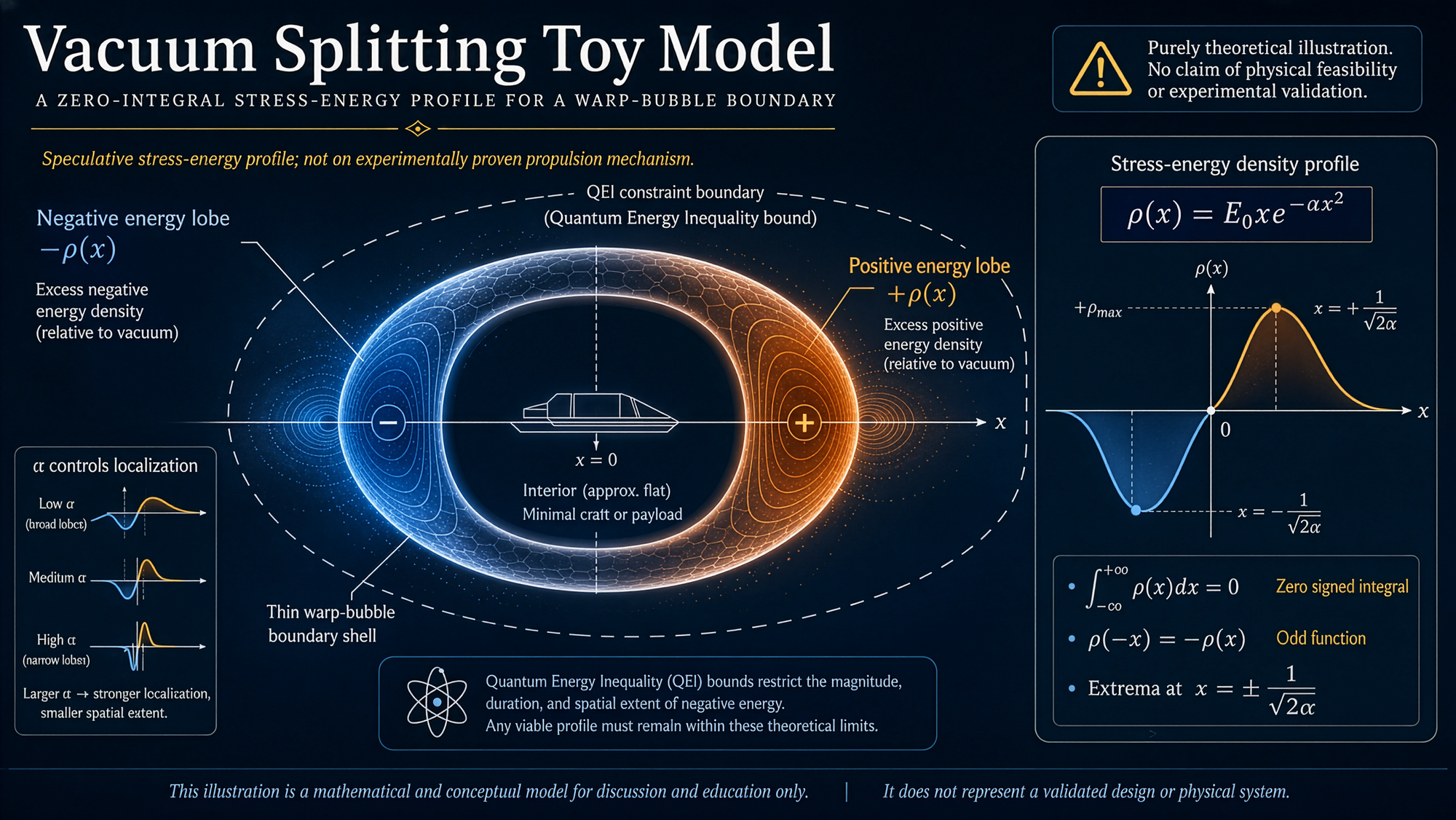
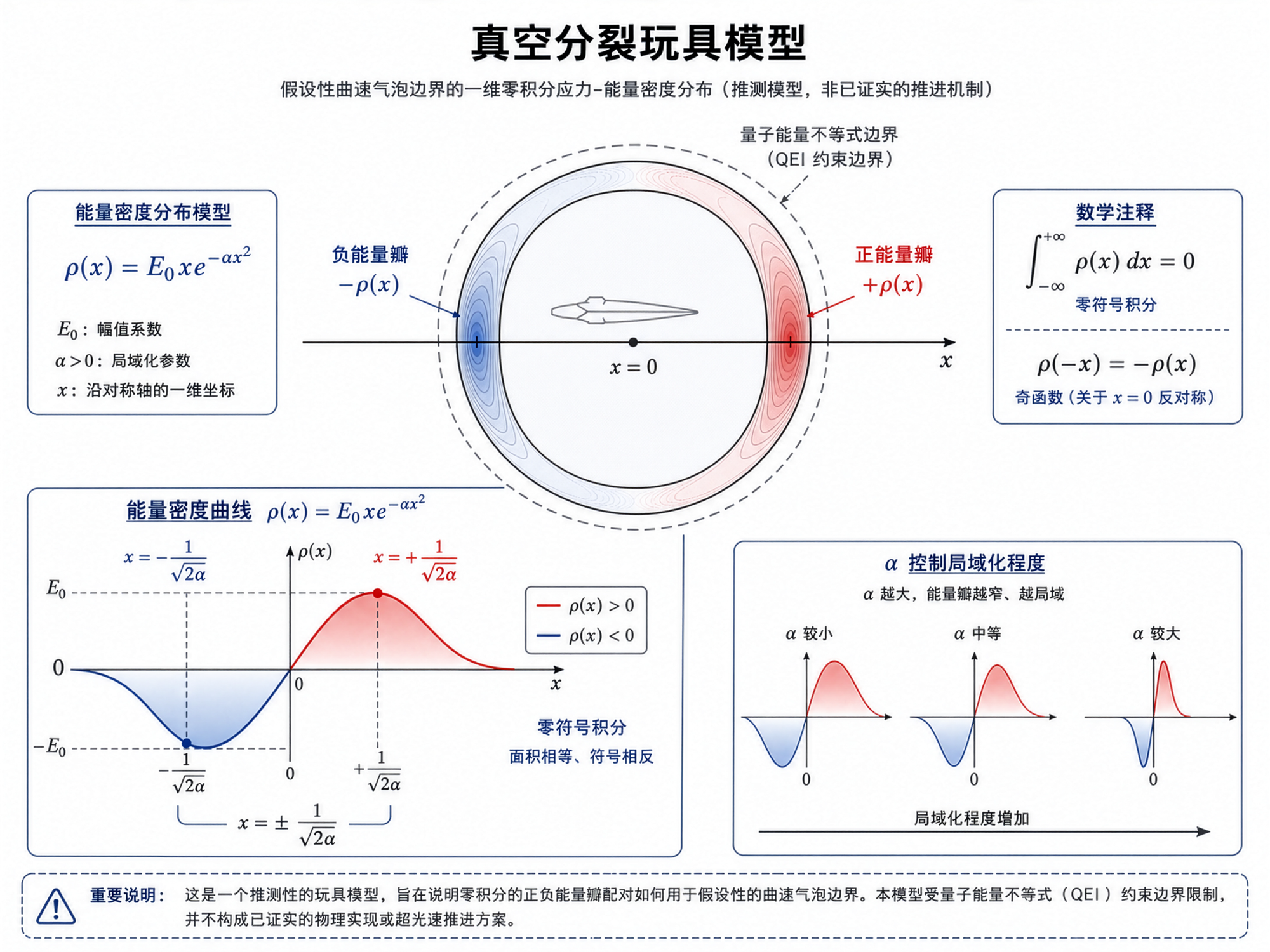
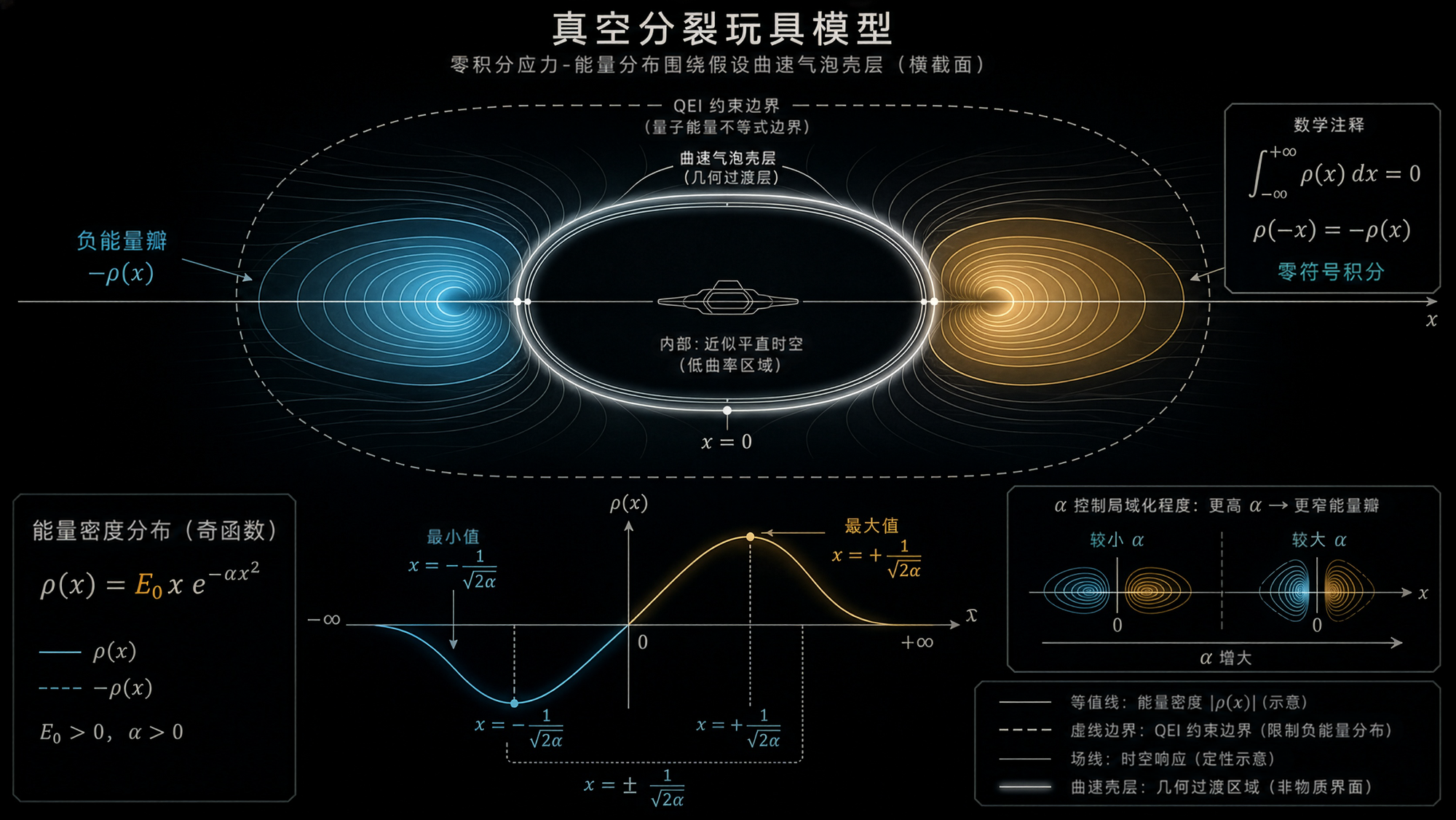
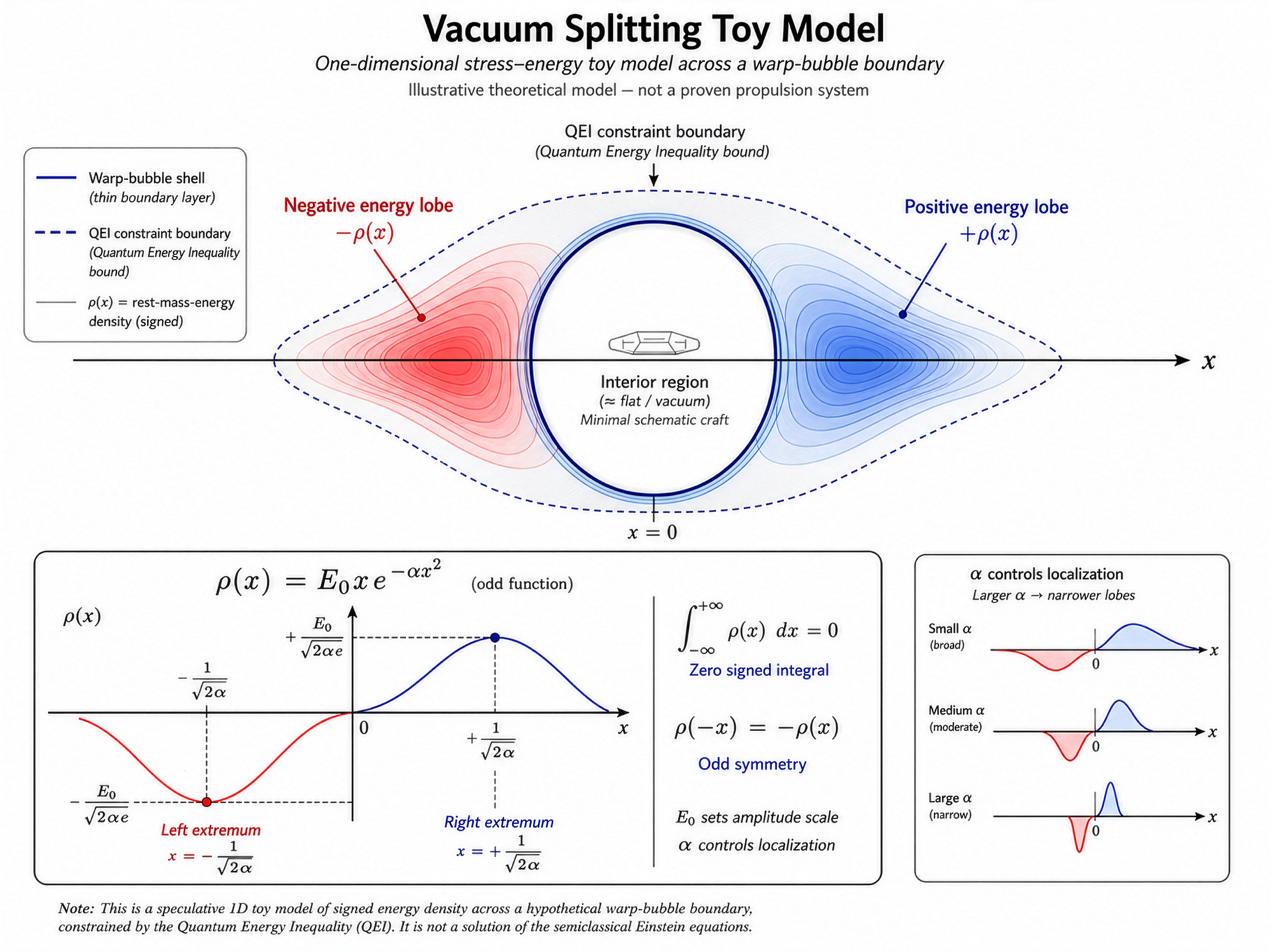
Define a one-dimensional localized energy-density profile across the warp-shell boundary:
where E0 is an amplitude coefficient, xxx is the spatial coordinate across the shell boundary, and α > 0 controls localization.
Because this function is odd,
it's integral over a symmetric domain vanishes:
This creates a mathematically clean positive/negative energy split: one lobe carries positive energy density, while the opposite lobe carries negative energy density. The extrema occur at:
with peak magnitude:
The model therefore describes a localized energy-density dipole with zero signed integral. However, this does not automatically make the configuration physically allowable. Quantum energy inequalities constrain negative energy locally, not merely globally. A physically viable version of the model would need to show that the negative-energy region satisfies QEI bounds along all relevant observer worldlines, that the compensating positive-energy region satisfies quantum-interest-like overcompensation requirements, and that the full stress-energy tensor obeys conservation:
The key stability question is whether α can remain finite. If QEI constraints force the positive and negative regions into near-coincident cancellation, the distribution may collapse into a microscopic vacuum fluctuation with no macroscopic geometric effect. If α remains finite, the next challenge is to identify a physically realizable quantum state capable of producing the required stress-energy profile.
Questions for Researchers:
- Can an odd, zero-integral stress-energy density profile be embedded into a full conserved Tμν?
- Would such a profile satisfy known QEIs under realistic sampling functions?
- Does quantum interest require the positive lobe to exceed the negative lobe, breaking the clean +50/−50 symmetry?
- Can this distribution source any useful warp-like metric, or does it merely cancel gravitationally?
- What happens under semiclassical backreaction?
- Does the model survive perturbation analysis, or do vacuum fluctuations destroy the separation?
A zero-integral vacuum-splitting profile may be useful as a toy model for studying compensated exotic stress-energy distributions, but it does not by itself evade quantum energy inequalities or prove that macroscopic negative energy can be stabilized.
 John D
 John D