How Fog Computing Powers Remote Agricultural IoT, Smart Farms, and Automated Indoor Farming
Fog computing helps remote farms process sensor data locally, reduce cloud dependence, and maintain resilient IoT automation.

Fog Computing for Remote Agricultural IoT: How Edge Intelligence Makes Smart Farms More Resilient
Summary
Modern agriculture is becoming increasingly dependent on connected systems: soil sensors, weather stations, irrigation controllers, livestock collars, machine-vision cameras, autonomous vehicles, drones, cold-chain monitors, and farm-management software. Yet many farms, ranches, aquaculture sites, and remote food-production facilities operate in environments where connectivity is weak, power is intermittent, and field assets are spread across large distances. A cloud-only IoT architecture is often poorly matched to these realities. If every decision requires a round trip to a distant data center, then irrigation, livestock alerts, greenhouse controls, or storage monitoring can become fragile when broadband, cellular service, or satellite backhaul degrades.
Fog computing addresses this gap by distributing processing, storage, analytics, and decision-making closer to the field. NIST describes fog computing as a distributed, federated model that decentralizes applications, management, and data analytics into the network itself, especially for IoT environments where cloud-only models are insufficient. In agricultural terms, fog computing places an intermediate intelligence layer between field devices and the cloud: ruggedized gateways, local servers, mesh nodes, LoRaWAN gateways, private wireless nodes, solar-powered compute boxes, and local AI inference systems.
The distinction matters. Cloud computing centralizes storage, analytics, model training, fleet management, and enterprise integration in remote data centers. Edge computing places computation directly on or near individual devices, such as a smart sensor, irrigation controller, camera, or drone. Fog computing sits between these two layers, coordinating local and regional compute resources across a farm, ranch, greenhouse, irrigation district, or rural operating area. It is not a replacement for the cloud. It is a practical extension of the cloud into operating environments where latency, bandwidth, resilience, and autonomy matter.
Fog Computing for Remote Agricultural IoT: Edge Intelligence for Farms, Ranches, and Distributed Food Systems
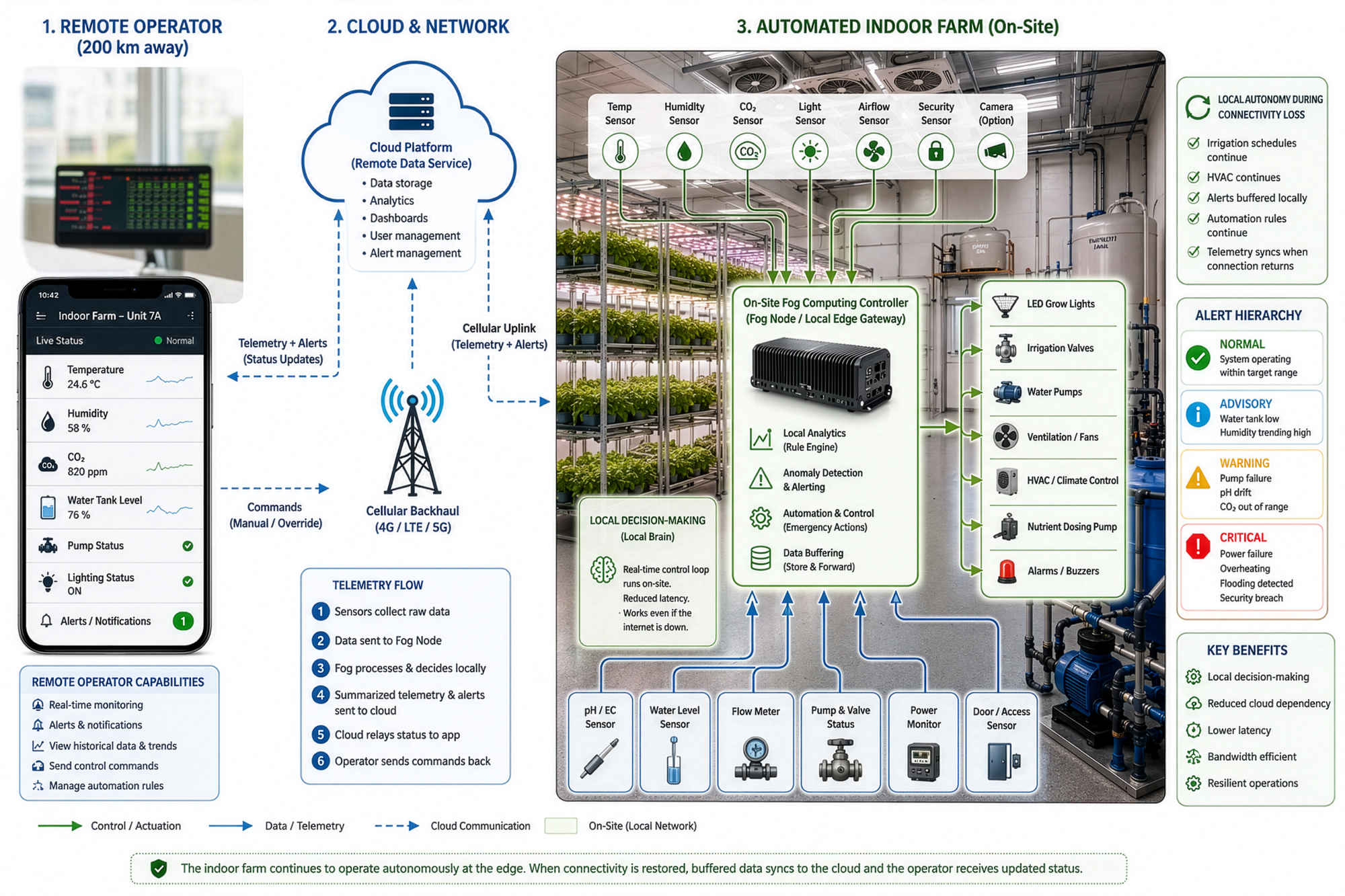
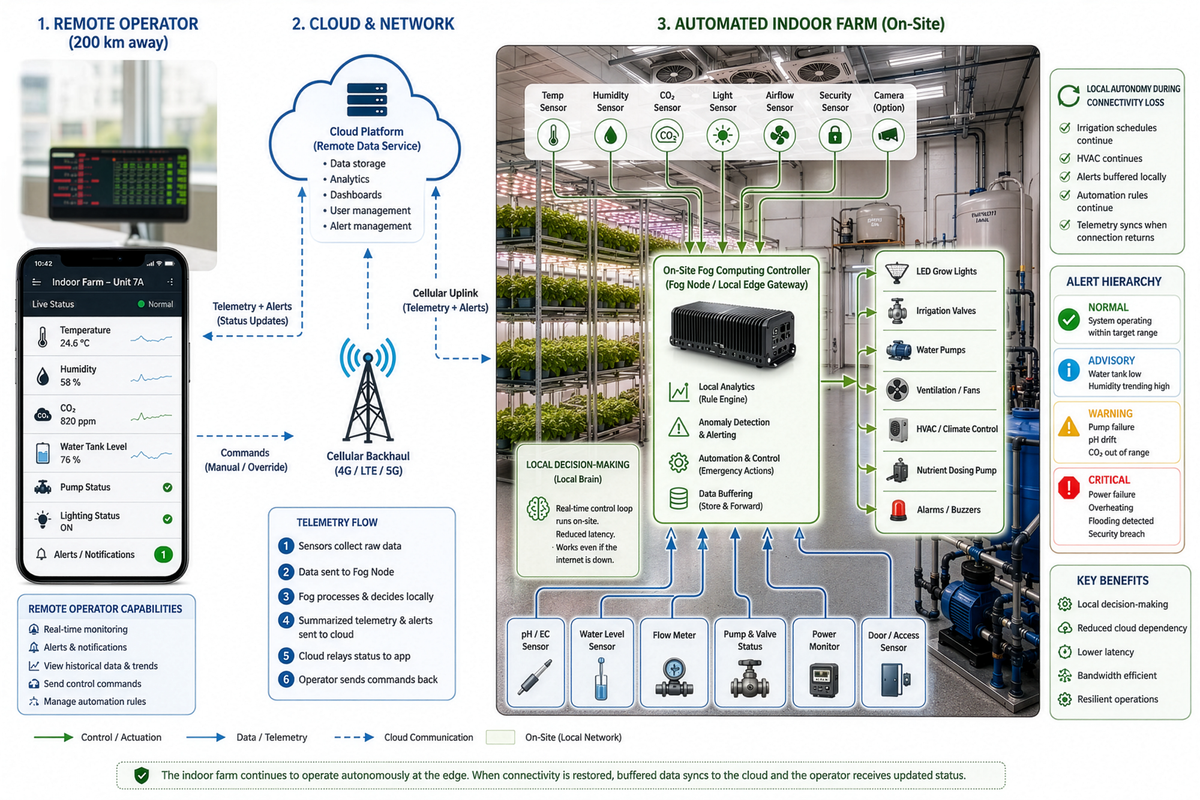
Scenario: Remote Monitoring of an Automated Indoor Farm 200 km Away
To make the concept more concrete, imagine an individual who owns or operates a small automated indoor farm located in a rural building, warehouse, greenhouse annex, or converted outbuilding roughly 200 km from where they live. The farm grows leafy greens, herbs, mushrooms, microgreens, or other controlled-environment crops. The owner is not physically present every day, so the site needs to operate with a high degree of autonomy while still giving the owner real-time visibility through a phone app.
In a conventional cloud-only setup, every sensor reading might be sent directly from the farm to a cloud server, and every decision might depend on that cloud connection. If the internet connection weakens, the app may stop updating, and the automation system may lose access to remote instructions. That is not ideal for an indoor farm, because environmental drift can become expensive quickly. A failed fan, blocked irrigation line, nutrient imbalance, overheating grow room, or humidity spike could damage the crop before the operator has time to drive 200 km to inspect the site.
A fog-computing architecture changes the logic. Instead of treating the remote farm as a passive collection of sensors, the farm has a local intelligence layer on-site. Sensors throughout the facility monitor temperature, humidity, CO₂, water level, pH, electrical conductivity, light cycles, pump status, airflow, door access, camera feeds, power status, and equipment health. These devices connect to a local fog node, such as a ruggedized gateway, small industrial computer, or farm-level edge server located inside the facility.
That local fog node acts as the farm’s on-site supervisor. It continuously collects telemetry from the indoor farm and decides what matters. Routine data is logged locally. Minor fluctuations are corrected automatically. For example, if humidity rises above the target range, the fog node can activate ventilation or a dehumidifier. If reservoir levels drop, it can trigger a pump or send an early refill warning. If the room gets too hot, it can adjust fans, reduce lighting intensity, or issue an urgent alert. These actions do not require the owner’s phone to be online, and they do not require a cloud server to approve every decision.
The farm would still use cellular connectivity for remote access. The fog node would upload telemetry through a cellular router or modem to a cloud service, which then updates the owner’s phone app. The app could show current status in plain terms: room temperature, humidity, CO₂ level, lighting status, irrigation cycle, water tank level, nutrient status, camera snapshots, power status, and any active warnings. The owner could be 200 km away and still see whether the farm is operating normally.
The key advantage is that the system does not need to upload every raw data point in real time. The fog node can filter and summarize the data first. Instead of sending thousands of individual sensor readings every hour, it can send useful summaries: “Zone 1 stable,” “Reservoir at 62%,” “Humidity trending high,” “Pump 2 completed irrigation cycle,” or “Temperature exceeded threshold for 4 minutes but returned to normal.” This reduces cellular bandwidth use and makes the phone app easier to interpret.
For urgent events, the system can escalate immediately. If the power goes out, the backup battery activates, or the temperature rises beyond a safe limit, the owner receives a real-time push notification or SMS alert. If a camera detects water on the floor, abnormal plant stress, or equipment failure, the system can mark that event as high priority. The owner does not need to watch a dashboard all day. The fog layer performs situation monitoring locally and only interrupts the user when the situation requires attention.
A practical alert hierarchy might look like this:
| Alert Level | Example | System Response |
|---|---|---|
| Normal | Temperature, humidity, and lighting are within range | Log data locally and update app periodically |
| Advisory | Water tank is getting low or humidity is trending upward | Send low-priority app notification |
| Warning | Pump cycle failed, pH is drifting, or CO2 is outside target range | Send priority alert and attempt local correction |
| Critical | Power failure, overheating, flooding, fire alarm, or security breach | Send urgent phone alert, SMS backup, and activate emergency rules |
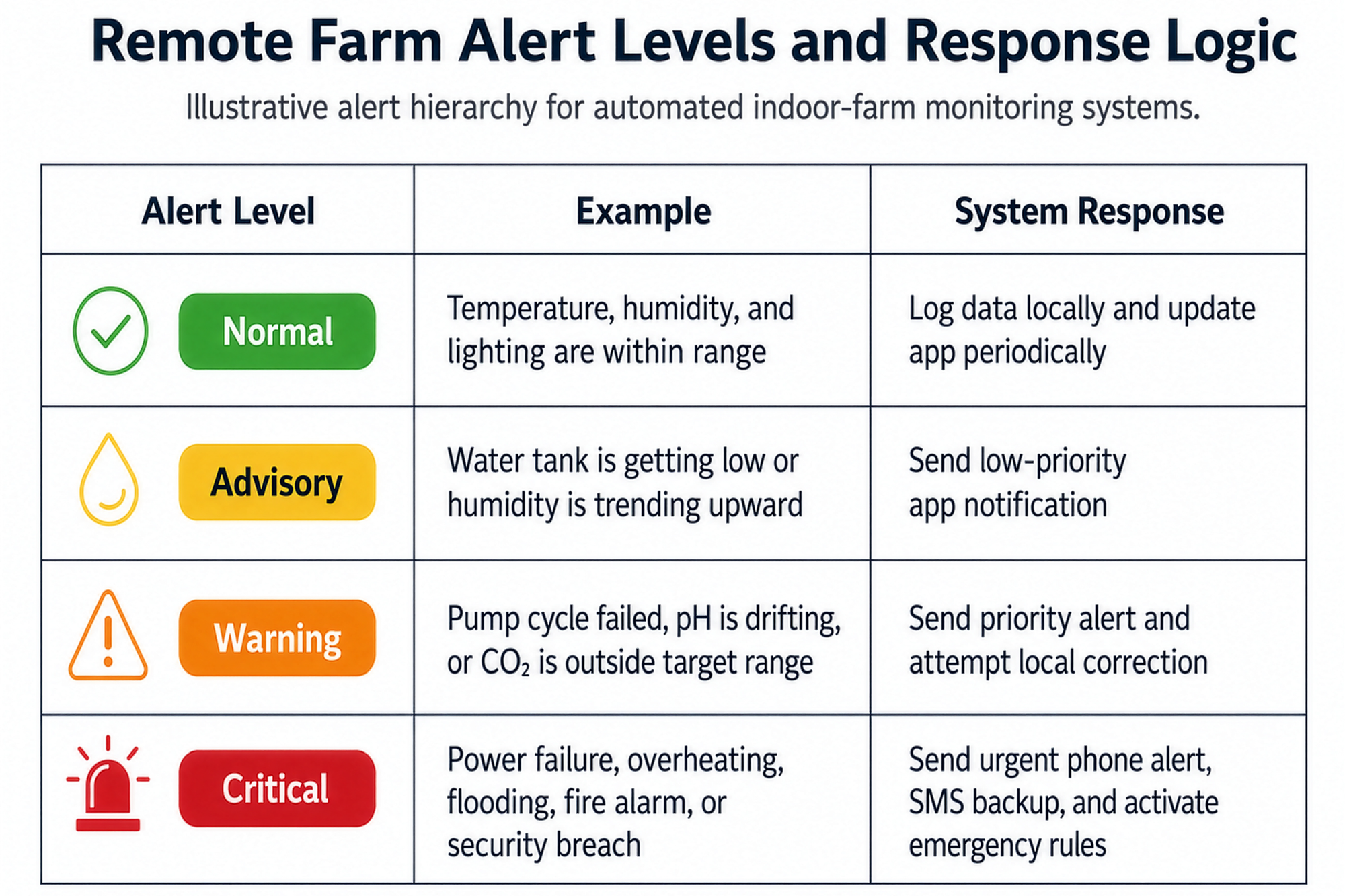
This makes the system more useful than a simple remote camera or dashboard. The farm is not merely reporting what is happening; it is interpreting conditions and taking local action. The owner’s phone becomes a command and awareness interface, while the fog node remains the operational brain on-site.
For example, suppose the indoor farm’s cellular connection drops for 45 minutes during a storm. In a cloud-dependent system, the owner might lose visibility and the automation system might become unreliable. In a fog-enabled system, the local node continues running irrigation schedules, lighting cycles, ventilation, and environmental controls. It stores telemetry locally until the connection returns. Once cellular service resumes, it uploads the missing data and sends a summary: “Connectivity lost from 2:10–2:55 PM. Environmental controls remained active. No critical thresholds exceeded.”
This is the central value of fog computing for remote indoor agriculture. The owner can monitor the farm from 200 km away through a phone app, but the farm is not helpless without the owner. Cellular connectivity provides remote visibility, alerts, and control. The cloud provides storage, app access, and long-term analytics. The fog node provides local autonomy, fast response, and operational continuity. For a remote automated farm, that division of labor is far more resilient than relying on the cloud alone.
Background: Why Remote Agriculture Needs Distributed Computing
Remote agriculture is not a clean laboratory environment. Farms and ranches often cover large territories, with sensors and actuators separated by miles of fields, tree lines, hills, barns, pumps, tanks, roads, and irrigation infrastructure. Devices may be exposed to dust, mud, insects, moisture, heat, freezing conditions, vibration, animal interference, chemical exposure, and physical damage. Technical labor may be limited, and the person responsible for maintaining a sensor network may also be managing crops, equipment, livestock, fuel, water, payroll, and logistics.
The connectivity problem is structural. USDA has argued that precision agriculture depends on reliable, affordable high-speed internet both at the farmhouse and in the field, and that without it many digital agriculture technologies cannot realize their full potential. USDA has also estimated that broadband connectivity combined with next-generation precision agriculture could generate at least $47 billion in annual U.S. economic benefits, showing that the issue is not merely convenience but agricultural productivity and national economic value.
A cloud-only IoT system can fail under these conditions. A soil-moisture sensor may report values to a cloud platform, but the irrigation valve still needs to function during an outage. A livestock collar may detect abnormal movement, but a predator or fence breach alert loses value if it waits for intermittent connectivity. A drone may collect gigabytes of imagery that cannot be continuously uploaded over a weak rural link. A grain bin or refrigerated storage facility may need local temperature and humidity alerts regardless of whether the internet connection is available.
Fog computing therefore reflects an operational reality: agricultural IoT systems need local judgment, not just remote dashboards.
Architecture of Fog Computing in Agricultural IoT
A practical agricultural fog architecture usually contains four layers.
The device layer includes soil-moisture probes, pH sensors, nutrient sensors, weather stations, livestock collars, smart valves, flow meters, pressure sensors, camera traps, drones, greenhouse sensors, grain-bin monitors, water-tank sensors, pump monitors, and machine telemetry systems. These devices collect raw field data, often under constrained power and bandwidth conditions.
The edge layer consists of microcontrollers, embedded processors, smart sensors, local actuator controllers, camera modules, drone onboard computers, and control boards inside tractors, irrigation systems, pumps, and greenhouse equipment. This layer performs immediate tasks: filtering noisy readings, triggering local control loops, handling safety-critical device behavior, and reducing unnecessary data transmission.
The fog layer is the coordinating layer. It includes ruggedized field gateways, farm-level edge servers, local mesh network nodes, solar-powered compute enclosures, LoRaWAN gateways, private LTE or 5G gateways, local AI inference nodes, data-filtering systems, and event-processing systems. This layer aggregates data from many devices, evaluates local conditions, identifies anomalies, coordinates multiple systems, and decides what information must be sent upstream.
The cloud layer remains important. It provides long-term storage, historical analytics, AI model training, remote fleet management, compliance reporting, financial analytics, insurance documentation, supply-chain integration, and enterprise resource planning. The cloud is where broader optimization occurs. The fog layer is where operational continuity is preserved.
The basic data flow is straightforward. Sensors collect raw field conditions. Edge devices filter and normalize those readings. Fog nodes aggregate the data across a farm or local operating zone, identify important events, and execute automation rules. The cloud receives summaries, alerts, compressed imagery, anomalies, and periodic historical datasets. In return, the cloud may send updated models, irrigation schedules, pest-risk forecasts, or equipment-management policies back to local fog infrastructure.
Key Use Cases
Precision irrigation is one of the clearest use cases. Irrigation decisions depend on soil moisture, crop type, field zone, evapotranspiration, weather forecasts, pump status, water pressure, and energy cost. A fog node can combine these inputs locally and adjust valves or pumps without waiting for cloud connectivity. This is especially important in water-stressed regions, large farms with distributed pump infrastructure, or sites where irrigation failure can damage high-value crops.
Livestock monitoring benefits from local event processing. Collars, cameras, microphones, and geofence systems can generate alerts for abnormal movement, missing animals, health anomalies, heat stress, predator proximity, or fence breaches. A local gateway can flag urgent events and notify nearby workers even when broader backhaul is degraded.
Greenhouses and controlled-environment agriculture require continuous environmental control. Temperature, humidity, CO₂, lighting, ventilation, irrigation, nutrient dosing, and energy use must be coordinated in near real time. A cloud dashboard can support reporting and optimization, but greenhouse control loops should remain local enough to keep the facility stable during connectivity interruptions.
Remote crop monitoring often involves drones, field cameras, and machine-vision systems. These tools can produce more data than a rural network can reasonably transmit. Fog computing allows imagery to be preprocessed locally, identifying pest pressure, plant stress, waterlogging, disease indicators, canopy changes, or equipment damage before deciding what data needs to be uploaded.
Pest and disease detection can be supported by local AI inference. Instead of uploading every image or sensor reading, a fog node can run models on field imagery, temperature, humidity, leaf wetness, and historical risk factors. Only high-confidence alerts or ambiguous cases need to be escalated.
Farm equipment and robotics require local compute for safety. Autonomous tractors, sprayers, harvesters, and field robots cannot depend entirely on cloud latency for navigation, obstacle detection, shutoff decisions, or geofencing. Fog infrastructure can coordinate equipment across the local area while allowing individual machines to retain onboard safety autonomy.
Water and pump infrastructure is another strong fit. Distributed tanks, reservoirs, pressure systems, pumps, and valves may sit far from the farmhouse. Fog nodes can coordinate water levels, pump cycling, pressure anomalies, leak detection, and backup power behavior.
Post-harvest storage also benefits. Grain bins, cold rooms, refrigerated containers, and food-processing sites require temperature, humidity, spoilage-risk, pest, and energy monitoring. Local alerting matters because losses can accumulate quickly if environmental conditions drift.
Strategic Benefits
The first benefit is lower latency. Field decisions can be made locally instead of waiting for a cloud round trip. This matters for irrigation control, greenhouse stability, machinery safety, and livestock alerts.
The second benefit is resilience. A farm with fog infrastructure can continue operating during degraded internet conditions. Data can be stored locally, automation rules can continue running, and cloud synchronization can resume later.
The third benefit is bandwidth efficiency. Raw data can be filtered, compressed, summarized, or classified before transmission. This is critical for drones, cameras, machine telemetry, and large sensor networks.
The fourth benefit is reduced cloud cost. Cloud computing remains valuable, but not every raw data point needs permanent storage in a remote data center. Local preprocessing can reduce storage, bandwidth, and compute charges.
The fifth benefit is operational autonomy. Farms, ranches, aquaculture sites, and remote greenhouses can function semi-independently, especially where connectivity is expensive or unstable.
The sixth benefit is data governance. Sensitive operational data, including yields, livestock behavior, equipment patterns, water use, and facility conditions, can remain local unless there is a clear reason to transmit it.
The seventh benefit is energy optimization. Local compute can reduce unnecessary radio transmission and coordinate power-limited systems such as solar-powered gateways, battery-backed pumps, and low-power sensor networks.
Technical and Operational Constraints
Fog computing adds resilience, but it also adds complexity. Hardware must be ruggedized against dust, moisture, pests, vibration, temperature swings, and physical damage. A gateway that works in an office may fail in a barn, pump shed, grain facility, or exposed field cabinet.
Power is another constraint. Remote gateways may require solar panels, batteries, charge controllers, low-power processors, and energy-aware scheduling. A system designed without a realistic power budget may fail during cloudy periods, winter conditions, or peak device activity.
Connectivity is improved but not eliminated as a challenge. Fog computing reduces dependence on continuous cloud access, but systems still need periodic synchronization, remote updates, alert pathways, and backup communication channels.
Interoperability is a persistent issue. Agricultural IoT systems often come from different vendors with incompatible protocols, proprietary dashboards, limited APIs, and inconsistent data formats. Fog architectures work best when they are modular, open where possible, and designed to avoid vendor lock-in.
Data quality can undermine the entire system. Poor sensor placement, calibration drift, dirty camera lenses, dead batteries, flooded enclosures, and animal damage can produce misleading inputs. Fog computing should include validation, anomaly detection, redundancy, and maintenance workflows.
AI model drift is another risk. A model trained on one crop, region, season, camera angle, or disease presentation may degrade under different field conditions. Local AI should be deployed with confidence thresholds, retraining plans, and human review for high-consequence decisions.
Cost remains a gating factor. Fog systems can reduce bandwidth and cloud costs, but they add hardware, enclosures, networking, installation, integration labor, maintenance, and cybersecurity overhead.
Communications Technologies Supporting Agricultural Fog Computing
Agricultural fog systems are usually hybrid. LoRaWAN can support low-power, long-range sensor traffic and is commonly positioned as an LPWAN standard for devices that need wide-area coverage with modest data rates. Academic surveys have also identified LoRa and NB-IoT as major low-power wide-area technologies for IoT deployments, with different tradeoffs in network architecture, spectrum, bandwidth, and power consumption.
Wi-Fi mesh can serve barns, greenhouses, processing buildings, and farmyards. Private LTE or private 5G can support mobile equipment and wider operational areas. Satellite internet can provide backhaul where terrestrial broadband is unavailable. TV white space, CBRS where applicable, Bluetooth Low Energy, wired Ethernet, fiber, and drone-based temporary relays may all have roles depending on terrain, regulation, cost, bandwidth demand, and mobility.
A remote farm might use LoRaWAN for soil sensors, Wi-Fi for greenhouses and storage buildings, private LTE for tractors and drones, and satellite backhaul for cloud synchronization. The goal is not to pick one network technology universally. The goal is to match communication layers to data type, urgency, power budget, range, and reliability needs.
Cybersecurity and Data Governance
Fog computing improves resilience but expands the attack surface. Instead of protecting only a cloud account and a few connected devices, operators must secure distributed gateways, sensors, local servers, radios, firmware pipelines, and physical enclosures. NIST’s IoT cybersecurity guidance emphasizes device capabilities such as identification, configuration, data protection, interface access control, software updates, and cybersecurity state awareness. NIST’s agriculture IoT recommendations also warn that IoT can introduce cybersecurity vulnerabilities and that minimum cybersecurity requirements should be defined for smart technologies in agricultural systems.
Agricultural cybersecurity should include device identity management, secure boot, encrypted communications, role-based access control, firmware update management, network segmentation, backup and disaster recovery, local data-retention policies, and tamper-resistant field hardware. Vendor risk management also matters. If a farm depends on a proprietary platform with weak update practices or unclear data ownership, the technical risk becomes a business risk.
Agriculture is increasingly part of critical infrastructure. Irrigation systems, cold chains, food-processing facilities, livestock systems, and storage infrastructure can be disrupted by cyber failures. Fog computing can make these systems more robust, but only if security is built into the architecture rather than added after deployment.
Economic and Investment Considerations
The business case depends on the value of avoided loss, improved efficiency, and reduced uncertainty. Cost drivers include sensors, ruggedized enclosures, gateways, solar and battery systems, connectivity subscriptions, cloud storage, software platforms, integration labor, maintenance, and cybersecurity support.
Potential returns include water savings, fertilizer optimization, reduced livestock losses, lower crop-disease losses, reduced labor burden, lower downtime, improved yield forecasting, better insurance documentation, improved regulatory reporting, and better equipment utilization. The strongest early adopters are likely to be large farms, specialty crop producers, greenhouse operators, high-value livestock operations, irrigation-intensive farms, and food-storage facilities where downtime or environmental drift can produce large losses.
Adoption will be uneven. Small, low-margin farms may struggle to justify complex deployments unless systems become cheaper, easier to maintain, and bundled into equipment or service contracts. For many operators, the practical path is not a full digital transformation program but a narrow pilot around a costly pain point: irrigation failure, livestock loss, greenhouse instability, water management, or post-harvest spoilage.
Implementation Roadmap
A disciplined deployment should start with assessment. Operators should map critical workflows, connectivity gaps, power availability, labor constraints, existing equipment, and the highest-value automation opportunities.
The second phase is a pilot deployment. A farm should begin with one use case, such as irrigation control, greenhouse monitoring, livestock tracking, or grain storage. The pilot should prove operational value before broader scaling.
The third phase is connectivity and gateway design. This involves selecting radio technologies, backhaul options, gateway locations, power systems, and enclosure requirements.
The fourth phase is data architecture. Operators should decide what data is processed on-device, what is handled by fog nodes, what is retained locally, and what is sent to the cloud.
The fifth phase is automation and AI deployment. Simple rule-based automation should usually come first. AI inference should be added where it improves detection, prioritization, or prediction enough to justify complexity.
The sixth phase is security hardening. Authentication, encryption, software update controls, access management, network segmentation, and monitoring should be implemented before the system becomes operationally critical.
The seventh phase is scaling and integration. Fog systems can then be linked to farm-management software, accounting, insurance, compliance, supply-chain records, and equipment-management platforms.
The final phase is continuous improvement. Operators should track false alarms, missed detections, sensor drift, yield outcomes, water use, labor savings, maintenance hours, and downtime.
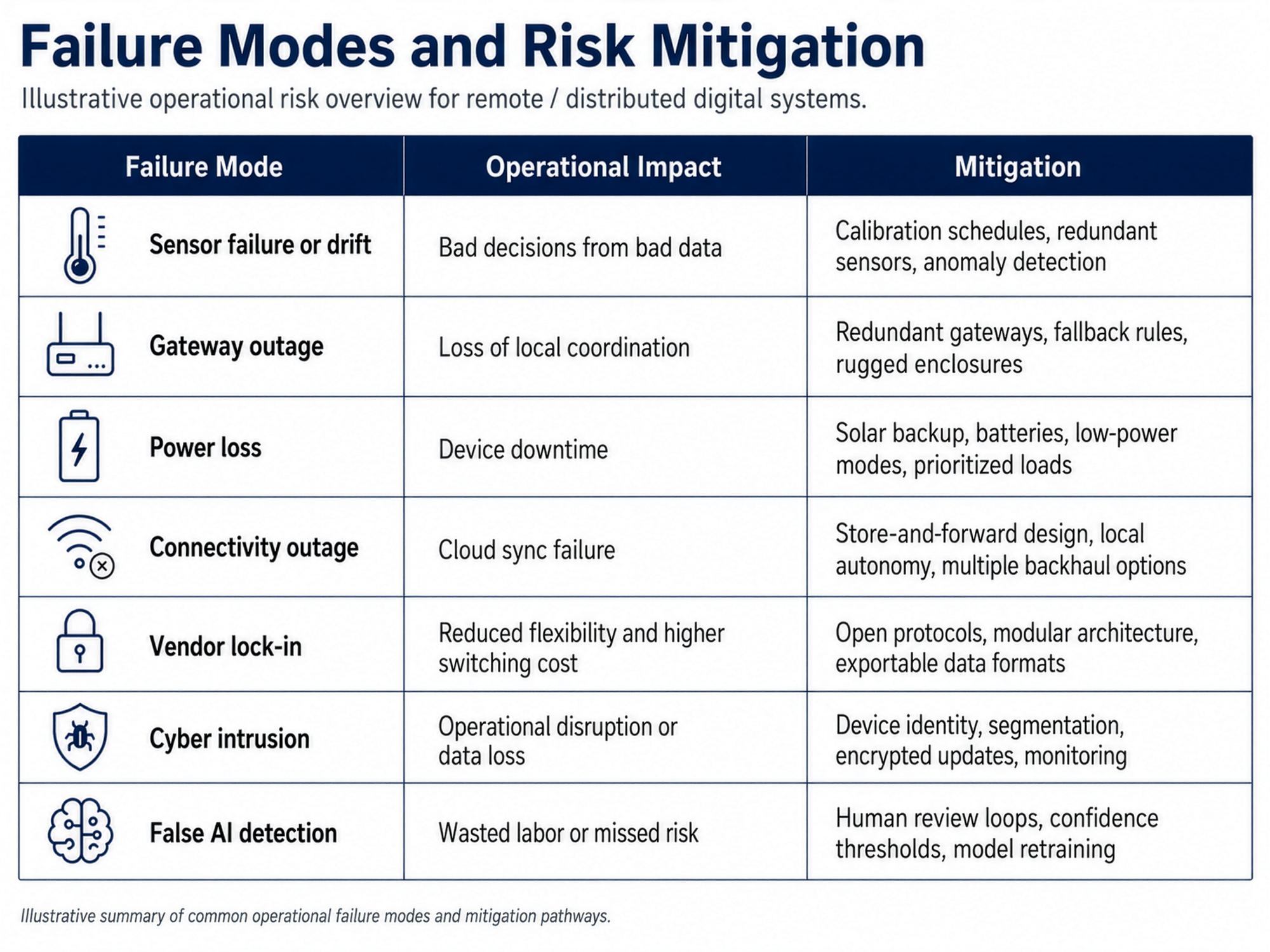
| Failure Mode | Operational Impact | Mitigation |
|---|---|---|
| Sensor failure or drift | Bad decisions from bad data | Calibration schedules, redundant sensors, anomaly detection |
| Gateway outage | Loss of local coordination | Redundant gateways, fallback rules, rugged enclosures |
| Power loss | Device downtime | Solar backup, batteries, low-power modes, prioritized loads |
| Connectivity outage | Cloud sync failure | Store-and-forward design, local autonomy, multiple backhaul options |
| Vendor lock-in | Reduced flexibility and higher switching cost | Open protocols, modular architecture, exportable data formats |
| Cyber intrusion | Operational disruption or data loss | Device identity, segmentation, encrypted updates, monitoring |
| False AI detection | Wasted labor or missed risk | Human review loops, confidence thresholds, model retraining |
Strategic Outlook
Fog computing is likely to become more important as agriculture adopts autonomous equipment, drone fleets, AI-based pest detection, robotic harvesting, smart irrigation districts, distributed greenhouses, environmental monitoring, precision livestock systems, remote aquaculture, and rural energy microgrids. The more agriculture depends on automation, the less acceptable it becomes for every critical decision to depend on distant cloud infrastructure.
The strongest long-term architectures will combine local autonomy with cloud-scale intelligence. Fog nodes will handle immediate operational decisions, local coordination, resilience, and data reduction. Cloud systems will handle historical analytics, model training, fleet management, financial reporting, and cross-site optimization.
The strategic implication is clear: fog computing is not merely an IT upgrade. It is an enabling architecture for resilient, automated, data-driven agriculture in places where centralized cloud dependency is operationally fragile.
Key Takeaways
- Fog computing places processing and decision-making closer to agricultural assets without eliminating the role of the cloud.
- Remote agriculture needs distributed computing because connectivity, power, distance, weather, and maintenance conditions are often difficult.
- The strongest use cases include irrigation, livestock monitoring, greenhouses, crop imaging, pest detection, robotics, water systems, and storage monitoring.
- Benefits include lower latency, resilience, bandwidth efficiency, cloud-cost reduction, data privacy, and operational continuity.
- Constraints include ruggedization, power, cybersecurity, interoperability, data quality, AI drift, and upfront cost.
- Hybrid communications architectures are usually more realistic than single-network solutions.
- Adoption will be strongest where crop value, water cost, labor scarcity, downtime risk, or asset value justify the added infrastructure.
Works Cited
Fagan, Michael, Katerina Megas, Karen Scarfone, and Matthew Smith. IoT Device Cybersecurity Guidance for the Federal Government: Establishing IoT Device Cybersecurity Requirements. NIST Special Publication 800-213. Gaithersburg, MD: National Institute of Standards and Technology, 2021. https://doi.org/10.6028/NIST.SP.800-213
Food and Agriculture Organization of the United Nations. Digital Technologies in Agriculture and Rural Areas: Status Report. Rome: FAO, 2019
Food and Agriculture Organization of the United Nations. “Digital Agriculture.” FAO Investment Centre. Accessed May 20, 2026
Iorga, Michaela, Larry Feldman, Robert Barton, Michael J. Martin, Nedim Goren, and Charif Mahmoudi. Fog Computing Conceptual Model. NIST Special Publication 500-325. Gaithersburg, MD: National Institute of Standards and Technology, 2018. https://doi.org/10.6028/NIST.SP.500-325
IETF. Low-Power Wide Area Network (LPWAN) Overview. RFC 8376. Internet Engineering Task Force, 2018.
LoRa Alliance. “What Is LoRaWAN® Specification?” Accessed May 20, 2026.
LoRa Alliance. LoRaWAN® 1.0.3 Specification. Fremont, CA: LoRa Alliance, 2018.
LoRa Alliance. LoRaWAN® Specification v1.1. Fremont, CA: LoRa Alliance, 2017.
National Institute of Standards and Technology. “NIST Releases Special Publication 500-325, Fog Computing Conceptual Model.” March 16, 2018.
National Institute of Standards and Technology. Agriculture IoT Advisory Board: Sustainable Infrastructure Recommendations. Gaithersburg, MD: National Institute of Standards and Technology, 2023.
OpenFog Consortium. OpenFog Reference Architecture for Fog Computing. Fremont, CA: OpenFog Consortium, 2017.
United States Department of Agriculture. A Case for Rural Broadband: Insights on Rural Broadband Infrastructure and Next Generation Precision Agriculture Technologies. Washington, DC: USDA, 2019.
United States Department of Agriculture. “USDA Releases Report on Rural Broadband and Benefits of Next Generation Precision Agriculture.” April 30, 2019.
Sanders, Christopher E., and Crystal A. Scanlon. “Rural Broadband and Precision Agriculture: A Frame Analysis of United States Federal Policy Outreach” Sustainability 14, no. 1 (2022): 460.