Gravitational Wave Communication: Can You Actually Use Spacetime Ripples to Send a Message?
A lab emitter radiates 10⁻²⁷ watts. LIGO detects black hole mergers at 10⁴⁹ watts. That 76-order gap is why gravitational wave communication is TRL 1.

Status as of May 2026
TLDR: No. As of now, a lab emitter would need to run longer than the age of the universe to send one bit.
1. Summary
Gravitational wave (GW) communication, the use of propagating perturbations of spacetime curvature as a carrier for information, sits at an unusual intersection of confirmed physics, speculative engineering, and a documented history of overstated claims. The underlying phenomenon is no longer in scientific doubt. Since the Laser Interferometer Gravitational-Wave Observatory (LIGO) recorded the binary black hole merger GW150914 on 14 September 2015, the LIGO-Virgo-KAGRA (LVK) network has accumulated approximately 391 detections through its concluded fourth observing run (O4), which ran from 24 May 2023 to 18 November 2025 [1] [2][3]. The European Space Agency (ESA) formally adopted the Laser Interferometer Space Antenna (LISA) on 25 January 2024 for a launch on Ariane 6 in 2035 [4][5]. Third-generation ground observatories, the Einstein Telescope (ET) in Europe and Cosmic Explorer (CE) in the United States, are progressing through site selection and conceptual design with expected operations in the mid-to-late 2030s [6][7][8]. The U.S. Astro2020 decadal survey explicitly endorsed continued investment in next-generation gravitational wave observatories as a national priority [9]. China is independently developing two space-based GW missions, TianQin and Taiji, both targeting the 2030s [10].
Detection, however, is not communication. The two are separated by an asymmetry of roughly forty orders of magnitude in radiated power. Every gravitational wave directly detected by an interferometer has originated in compact-object mergers releasing energy equivalent to several solar masses (on the order of 10^47 joules) at distances of hundreds of megaparsecs. Closed form application of the Einstein quadrupole formula to any plausible engineered emitter, such as a rapidly rotating laboratory mass or a high-frequency mechanical oscillator, yields radiated powers on the order of 10^-27 watts or less, far below the noise floor of any detector that exists or is credibly proposed [11][12]. Established physics does not forbid artificial GW emission, but it imposes a coupling constant (G/c^5 ≈ 2.76 × 10^-53 W^-1) that renders every engineering pathway examined to date many orders of magnitude away from a usable channel.
A subordinate literature on high-frequency gravitational waves (HFGW) in the MHz-to-GHz band has, since the early 2000s, claimed that exotic emitters and detectors could close this gap. The most prominent of these proposals, including the Li-Baker detector concept and various microelectromechanical (MEMS) emitter schemes, were examined by a 2008 JASON Advisory Panel review prepared by the MITRE Corporation for the Office of the Director of National Intelligence. That review concluded that no foreign threat in HFGW is credible and that communication using HFGW is not feasible with foreseeable technology [13]. Independent academic critiques have reinforced this finding. Mainstream HFGW research, in contrast, focuses on detection of cosmological and exotic astrophysical signals (such as primordial black hole mergers and axion superradiance) and is summarized in two Living Reviews in Relativity white papers led by Aggarwal et al. [11][14]. That mainstream work is unrelated to communication.
The near-term strategic outlook is straightforward. No peer-reviewed demonstration of GW communication exists as of now. No publicly disclosed government program in the United States, Europe, Japan, or, on the basis of available open-source evidence, China, is funding GW communication as a deliverable capability. By contrast, the comparator concept of neutrino communication achieved a documented end-to-end demonstration in 2012, transmitting at 0.1 bits per second through 240 meters of rock at Fermilab, and remains many orders of magnitude removed from operational utility [15]. GW communication should be classified by institutional investors and research administrators as basic-science adjacent, technology readiness level (TRL) 1 at best, with no plausible time-to-revenue inside a multi decade horizon.
The principal strategic considerations are therefore not about deploying GW communication systems, but about three secondary effects: (a) the risk that stakeholders treat exaggerated claims as actionable intelligence, which would constitute a resource misallocation and miscalculation hazard; (b) the substantial spillover value of GW science into precision metrology, quantum sensing, vacuum technology, and laser physics, which justifies continued public investment on its own merits; and (c) the strategic logic of penetrating, jam resistant channels for assured communication with submerged submarines and deeply buried facilities, which remains a real requirement that is met today by extremely low frequency (ELF) and very low frequency (VLF) radio, and which GW physics does not realistically address [16] [17]. Public investment should be sustained for science. Capability claims for engineered GW links should be regarded with skepticism unless and until peer-reviewed laboratory demonstrations appear.
Gravitational Wave Communication: A Strategic and Scientific Assessment of a Frontier Concept
1. Executive Summary
2. Contextual Background and Scientific Foundations
- 2.1 The Physics of Gravitational Waves
- 2.2 From Prediction to Direct Detection
- 2.4 Why Gravitational Waves Have Been Considered for Communication
3. Key Players and Stakeholders
- 3.1 Major Scientific Collaborations and Observatories
- 3.2 National Science Agencies
- 3.3 Defense and Intelligence Research Organizations
- 3.4 Private, Philanthropic, and Academic Actors
4. Technical and Operational Considerations
- 4.1 Physics Constraints on Artificial Generation
- 4.2 High-Frequency Gravitational Wave Detection Schemes and the Surrounding Controversy
- 4.3 Modulation, Encoding, and Channel Capacity
- 4.4 Comparison with Other Exotic Communication Concepts
- 4.5 Order-of-Magnitude Summary
5. Economic and Market Dynamics
- 5.1 Current Global Investment in Gravitational Wave Science
- 5.2 Absence of a Commercial GW Communication Market
- 5.3 Adjacent Commercial Opportunities
- 5.4 Classification for Institutional Investors
6. Regulatory Landscape
- 6.1 Spectrum and Propagation Regulation
- 6.2 Export Controls and Dual-Use Considerations
- 6.3 Research Ethics and Openness Norms
7. Geopolitical and Strategic Dimensions
- 7.1 The Strategic Logic of Penetrating, Jam-Resistant Channels
- 7.2 Historical Record of State-Funded Interest
- 7.3 Risk of Strategic Miscalculation
- 7.4 Great-Power Scientific Competition
8. Risk Analysis
- 8.1 Format Selection
- 8.2 Short Horizon: 1–3 Years
- 8.3 Medium Horizon: 3–7 Years
- 8.4 Long Horizon: 7+ Years
- 8.5 Summary Risk Table
- 8.6 The Specific Risk of Resource Misallocation
9. Strategic Recommendations
- 9.1 For Government Science Funders and Research Administrators
- 9.2 For Defense and Intelligence Planners
- 9.3 For Institutional Investors and Deep-Tech Venture Capital
- 9.4 For Senior University and National Laboratory Research Leadership
Conclusion
References
2. Contextual Background and Scientific Foundations
2.1 The Physics of Gravitational Waves
Gravitational waves are propagating perturbations in the metric of spacetime, predicted as a consequence of Einstein's 1915 general theory of relativity and derived in linearized form in his 1916 and 1918 papers on the integration of the field equations [18][19]. In the weak-field limit, the metric is written as g_ μν = η _ μν + h_ μν , where η _ μν is the Minkowski background and h_ μν is a small perturbation. The wave equation for h_ μν admits transverse, traceless solutions propagating at the speed of light, with two independent polarizations (the plus and cross polarizations). The amplitude h, often called the strain, is dimensionless and represents the fractional change in proper distance between freely falling test masses.
The dominant emission mechanism for slowly moving sources is mass quadrupole radiation. The Einstein quadrupole formula expresses the radiated luminosity L_GW as...
L_GW = (G / 5c^5) ⟨ d³Q_ij /dt³ d³Q^ij/dt³ ⟩,
where Q_ij is the trace-free mass quadrupole moment and the angle brackets denote a time average [12][19]. The coupling constant G/c^5 ≈ 2.76 × 10^-53 watt^-1 is the central numerical fact of the field. It is this prefactor, set by fundamental constants, that explains why gravitational radiation is observable only from astrophysical sources involving solar-mass scales of matter undergoing relativistic motion.
Dipole gravitational radiation does not exist in general relativity (its analog would require a time varying mass dipole, which is forbidden by conservation of momentum), in contrast to electromagnetism where dipole radiation dominates. This is the deep reason that gravitational radiation is so much weaker than electromagnetic radiation for any system involving comparable masses, sizes, and frequencies.
 John D
2.2 From Prediction to Direct Detection
For nearly six decades, Einstein's prediction remained without observational confirmation. The first compelling indirect evidence came from Russell Hulse and Joseph Taylor's 1974 discovery of the binary pulsar PSR 1913+16, whose orbital decay matched the rate predicted by gravitational radiation losses to within experimental precision and earned the 1993 Nobel Prize [20]. Direct detection required interferometers of unprecedented sensitivity. After several decades of development, the Advanced LIGO detectors at Hanford and Livingston achieved a strain sensitivity of approximately 10^-23 per square root hertz at 100 Hz and recorded GW150914 on 14 September 2015, with a combined signal-to-noise ratio of 24 [1][21]. The Nobel Prize in Physics 2017 was awarded to Rainer Weiss, Kip Thorne, and Barry Barish for this work.
Subsequent observing runs progressively broadened the catalog. O1 (2015–2016) and O2 (2016-2017) yielded eleven confirmed events, including the binary neutron star merger GW170817 [22], which was the first multi-messenger gravitational wave event. O3 (2019–2020) brought the cumulative count to approximately ninety. O4, conducted 24 May 2023 to 18 November 2025, was the longest single observing run in the field's history and ran in three segments (O4a, O4b, O4c); the most recent updated Gravitational-Wave Transient Catalog, GWTC-4.0, reports 218 confident detections through O4a alone, with 173 additional candidate events from O4b and O4c under analysis [3][23]. The Virgo detector in Italy and KAGRA in Japan have joined LIGO at various points in this sequence. As of February 2026, the cumulative total stands at approximately 391 detections [23]. A brief intermediate run, IR1, is planned for late 2026, and the fifth full run (O5) is currently planned for 2027–2031 subject to funding reassessment [2].
The decisive analytical point is that every gravitational wave detected by LVK has been astrophysical in origin. The signals correspond to binary compact-object mergers with luminosities transiently exceeding 10^49 watts, equivalent to several solar rest-mass energies converted to gravitational radiation over fractions of a second. At Earth, the strain amplitudes are on the order of 10^-21, the smallest displacements ever measured in physics. The detectors observe these signals by laser interferometry over kilometer-scale baselines (4 km for LIGO).
No laboratory-scale source can approach these conditions. A simple application of the quadrupole formula to a rigid bar of mass 1000 kg, length 1 m, rotating at 1 kHz, yields a radiated power on the order of 10^-27 watts; the strain produced at a distance of 100 m would be of order 10^-40, more than seventeen orders of magnitude below current detector noise [12]. Even cumulative integration over the age of the universe could not extract such a signal against quantum and thermal noise. No realistic improvement in materials, drive systems, or detector technology has been shown to recover this deficit.
Two strategies have been advanced to circumvent the quadrupole bottleneck. The first is to use very high frequencies (MHz to GHz), exploiting the strong frequency dependence of luminosity. This is the basis of the HFGW community's proposals, including Dehnen-style piezoelectric crystal oscillators and Baker's MEMS arrays. However, increasing the operating frequency cannot compensate for the limits on mass density and confinement at small scales; the resulting estimates of emitted power and detector sensitivity, in the most prominent proposals, were found to be in error by approximately 30 orders of magnitude in the 2008 JASON review [13]. The second strategy is to invoke conversion between gravitational and electromagnetic waves in strong static magnetic fields, the Gertsenshtein effect originally proposed in 1962 [24]. The conversion efficiency is bounded by the ratio of magnetic to Planck energy densities and is exceptionally small under realistic laboratory conditions, although the inverse process (cosmological GW conversion to photons in galactic magnetic fields) is a recognized topic of mainstream cosmology research [11][14].
2.4 Why Gravitational Waves Have Been Considered for Communication
Despite the foregoing, three properties of gravitational radiation continue to attract speculative interest as a communication medium. First, gravitational waves interact extraordinarily weakly with matter, with the result that they pass essentially undamped through dense bodies. A wave propagating through the entire Earth loses a negligible fraction of its amplitude. This property is in principle attractive for communication with submerged submarines and deeply buried command-and-control facilities, requirements that today drive the use of ELF and VLF radio systems [16][17]. Second, gravitational waves propagate at the speed of light, providing no latency disadvantage relative to electromagnetic signaling. Third, because no known mechanism scatters or jams them at receivable power levels, a hypothetical GW channel would be immune to electromagnetic countermeasures.
These properties, however, are inseparable from the same weak coupling that makes generation infeasible. The detector problem and the emitter problem are not independent: any process strong enough to generate a detectable artificial signal would, by reciprocity, deposit energy in the detector at unmanageable levels. The penetration advantage that motivates the concept is mathematically equivalent to the generation problem that prevents its realization.
3. Key Players and Stakeholders
3.1 Major Scientific Collaborations and Observatories
The LIGO Scientific Collaboration, the Virgo Collaboration, and the KAGRA Collaboration, jointly organized as the LIGO-Virgo-KAGRA (LVK) network, are the dominant operators in the field. LIGO comprises two 4-km interferometers, operated jointly by Caltech and MIT under U.S. National Science Foundation award PHY-2309200 [25]. Virgo, located near Pisa, is operated by the European Gravitational Observatory consortium. KAGRA, located in the Kamioka mine, joined the network during O4 and represents the first cryogenic, underground detector to participate in coordinated science observations [3]. LIGO-India, an additional ground-based detector in the LIGO network using donated hardware, is under construction and is expected to extend the global baseline for source localization.
Looking to the next generation, the European Einstein Telescope is a proposed triangular underground interferometer with 10-km arms, with candidate sites in Sardinia (Sos Enattos) and the Meuse-Rhine Euregio across Belgium, the Netherlands, and Germany. The ET Collaboration was formally founded in 2022, the project was placed on the European Strategy Forum on Research Infrastructures roadmap in 2021, and observations are targeted for 2035 [6][26]. Cosmic Explorer is the corresponding U.S. concept, with 40-km L-shaped arms; in March 2024 the NSF Mathematical and Physical Sciences Advisory Committee subcommittee chaired by Vicky Kalogera recommended NSF adoption, and the NSF subsequently awarded approximately US$9 million in coordinated proposals for the project [7][8]. The Astro2020 decadal survey of the National Academies of Sciences, Engineering, and Medicine endorsed the next-generation ground-based gravitational wave program as a high priority [9].
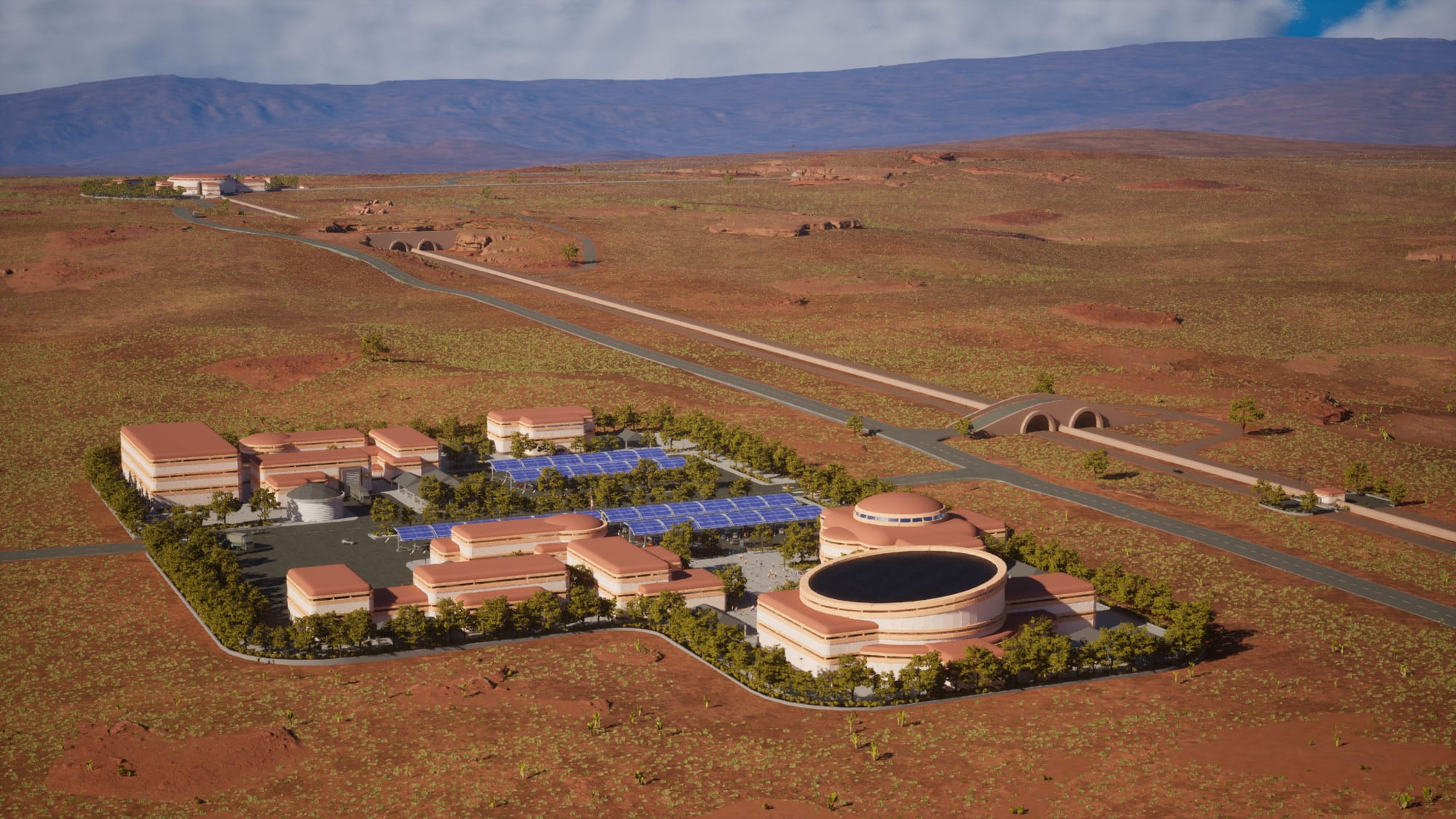
In space, LISA, with three spacecraft separated by 2.5 million km in a heliocentric trailing orbit, was formally adopted by ESA on 25 January 2024 with a launch planned in 2035 [4][5]. NASA signed a memorandum of understanding with ESA in March 2024 covering laser systems, telescopes, and charge management devices [27]. U.S. participation came under question following the administration's FY2026 budget request issued in 2025, which proposed reductions to NASA's science directorate; ESA Director of Science Carole Mundell publicly identified LISA, EnVision, and NewAthena as among the missions most affected [27]. As of mid-2025, the European side proceeded with prime contractor selection (OHB System AG) and the 2035 launch target was maintained.
China is independently developing two space-based GW projects: TianQin, led by Sun Yat-sen University and using a geocentric orbit with 100,000-km arm length, and Taiji, led by the Chinese Academy of Sciences and using a heliocentric configuration with arm length larger than LISA's. Both target the 2030s for launch and are designed to overlap with LISA in the millihertz band, with potential for coordinated joint observations [10][28]. Japan's DECIGO concept (Deci Hertz Interferometer Gravitational Wave Observatory) is a longer-term proposal targeting the 0.1–10 Hz band between LISA and ground detectors.
3.2 National Science Agencies
The U.S. National Science Foundation has been the primary funder of LIGO since the 1990s and remains the principal sponsor of Cosmic Explorer development. NASA contributes hardware and science to LISA. ESA funds LISA as part of its Cosmic Vision 2015–2025 large-mission program [4]. The Italian Istituto Nazionale di Fisica Nucleare (INFN) leads on Virgo. Japan's Ministry of Education, Culture, Sports, Science and Technology (MEXT) funds KAGRA. China's Ministry of Science and Technology and National Natural Science Foundation of China (NSFC) support TianQin and Taiji. The U.S. Department of Energy participates in some adjacent precision measurement work but is not a primary GW funder.
3.3 Defense and Intelligence Research Organizations
Open-source evidence for active defense or intelligence funding of GW communication research is sparse. The most significant documented episode is the 2008 JASON review titled High Frequency Gravitational Waves, JSR-08-506, prepared by Eardley and colleagues at the MITRE Corporation for the Office of the Director of National Intelligence, which assessed claims by external proposers (notably R. M. L. Baker, Jr. and collaborators) and concluded that "no foreign threat in HFGW is credible, including: communication by means of HFGW, object detection or imaging," and that the underlying physics analyses contained errors of many orders of magnitude [13][29]. The U.S. Defense Intelligence Agency's Advanced Aerospace Weapon System Application Program (AAWSAP) included, among 38 Defense Intelligence Reference Documents released under FOIA in 2022, a paper titled "High-Frequency Gravitational Wave Communications" authored by Baker [30]. The technical content of that document does not have peer-reviewed standing, and its substance has been criticized by the JASON panel and by independent academic critics [13].
Historical Soviet and Russian work on gravitational radiation, principally associated with V. B. Braginsky's group at Moscow State University and L. P. Grishchuk's theoretical contributions on relic gravitational waves and detection limits, was scientifically substantial but has no documented operational communication application. Reports of contemporary Russian programs on engineered GW emission cannot be substantiated from open sources. China has a substantial mainstream GW astronomy program through TianQin and Taiji and through the Li Baker theoretical detector concept developed by F. Li at Chongqing University, but the assertion that there is a Chinese state program for HFGW communication is not supported by peer reviewed evidence and was specifically dismissed by the JASON panel [13]. The mainstream LVK-equivalent Chinese investment in space-based detectors is real, substantial, and unrelated to communication.
3.4 Private, Philanthropic, and Academic Actors
Private and philanthropic funding plays a smaller role in GW science than in some adjacent fields, but is not absent. The Simons Foundation has supported related fundamental physics work; the Heising-Simons Foundation supports related precision measurement programs. The Max Planck Institute for Gravitational Physics (Albert Einstein Institute) at Hannover and Potsdam is a leading academic center, as are the LIGO Laboratory at Caltech and MIT, the University of Glasgow's Institute for Gravitational Research, INFN, Cardiff University, the Australian National University, Tsinghua University, and Sun Yat-sen University. Theoretical work on HFGW detection is concentrated at CERN's Theoretical Physics Department (V. Domcke and collaborators), at the University of Western Australia (M. Goryachev, M. Tobar), at Northwestern University (N. Aggarwal), and at several European institutions participating in the Ultra-High-Frequency Gravitational Wave (UHF-GW) initiative summarized in the Aggarwal et al. white papers [11][14]. No company is presently in a commercial GW communication market because no such market exists.
4. Technical and Operational Considerations
4.1 Physics Constraints on Artificial Generation
The quadrupole formula provides the cleanest expression of the central engineering problem. For a system with effective non-spherical kinetic energy E_ns and characteristic dynamical frequency f, the radiated GW power scales heuristically as P_GW ~ (G/c^5)(E_ns f)^2 in order-of magnitude form [12]. Substituting fundamental constants, the prefactor (G/c^5) is approximately 2.76 × 10^-53 watts per (joule × hertz)^2. This is the irreducible inefficiency of any mass-quadrupole emitter.
Consider a notional laboratory emitter: a dumbbell of mass 1000 kg, length 1 m, rotating at 1000 Hz. Such a system, if it could survive the centripetal stresses, would have a third time derivative of the quadrupole moment of order MR^2 ω ^3 ≈ 10^13 kg m^2 s^-3 and would radiate approximately 10^-27 watts of gravitational power [12]. The strain produced at a distance of 100 m would be of order 10^-40, more than seventeen orders of magnitude below current detector noise floors of 10^-23 per square root hertz [21]. Even cumulative integration over the age of the universe could not extract such a signal against quantum and thermal noise. No realistic improvement in materials, drive systems, or detector technology has been shown to recover this deficit.
Two strategies have been advanced to get around the quadrupole bottleneck. The first is to use very high frequencies, which increases the dynamical factor in luminosity but does not compensate for the loss of available mass at small scales. The most prominent engineering-oriented proposals (Baker et al., Dehnen-style piezoelectric crystal arrays) were found in the 2008 JASON review to overstate available emission and detector sensitivity by factors approaching 10^30 [13]. The second strategy invokes Gertsenshtein-type photon-graviton conversion in strong magnetic fields. While astrophysically interesting (in galactic and intergalactic magnetic fields acting on a stochastic background), this mechanism is not a viable basis for an engineered emitter, because achievable laboratory magnetic field energy densities are negligible compared to the Planck scale energy densities that would be required [11][24].
4.2 High-Frequency Gravitational Wave Detection Schemes and the Surrounding Controversy
A distinction must be drawn between two communities of HFGW research. The mainstream community, represented by the Aggarwal et al. (2021) white paper in Living Reviews in Relativity and its 2025 update, addresses detection of GWs in the MHz to GHz range with the goal of probing cosmological phase transitions, primordial black hole mergers, and exotic axion physics. This work involves detector concepts including bulk acoustic wave resonators, optically levitated sensors, microwave cavities, and inverse-Gertsenshtein conversion in strong magnetic fields, and is published in peer-reviewed venues including Physical Review D, Physical Review Letters, and Living Reviews in Relativity [11][14][31][32]. Even with optimistic projections, none of these schemes can detect any artificially generated signal proposed in the engineering literature to date.
A separate community, principally associated with R. M. L. Baker, Jr., F. Li, and collaborators, has advanced what is known as the Li-Baker detector concept, claiming sensitivity to strains of order 10^-30 to 10^-32 through perturbative photon flux generation in a microwave Gaussian beam crossed with a static magnetic field [33]. Detailed peer-reviewed critique exists. The 2008 JASON review concluded that the underlying analyses confused the Gertsenshtein and Li effects and overstated sensitivity by factors of approximately 10^30 [13]. Independent academic work has identified diffraction problems with embedded reflector designs that the proposed detectors would face in practice [34]. The Li-Baker concept has not been experimentally validated, and as of May 2026, no operational Li-Baker detector exists.
The analytically honest position is that the mainstream HFGW detection community is engaged in legitimate fundamental physics research with cosmological motivations, while the engineering-oriented HFGW communication proposals do not meet the burden of proof that would justify treating them as a credible technology development pathway.
4.3 Modulation, Encoding, and Channel Capacity
In the absence of any operating emitter, modulation and coding for GW communication exist only as theoretical exercises. Proposals in the speculative literature include on-off keying of phased MEMS arrays, frequency modulation of cyclotron-resonant emitters, and pulse-position coding using arrays of synchronized resonators. Each proposal assumes a generation source whose existence is not established. None has been tested.
Channel capacity is best examined in the Shannon framework. Even granting an artificial emitter with strain h at the receiver, the achievable information rate is bounded by C = B log_2(1 + S/N) where B is the channel bandwidth and S/N is the signal-to-noise ratio in the detector. Because plausible artificial strains are many orders of magnitude below detector noise floors, S/N is far less than unity over any realistic bandwidth, and C is effectively zero. No proposal has demonstrated otherwise in a peer-reviewed setting.
4.4 Comparison with Other Exotic Communication Concepts
Neutrino communication is the most useful comparator because, like GW communication, it relies on weakly interacting carriers that can penetrate matter. Neutrino communication was demonstrated end-to-end in 2012 by the MINERvA collaboration at Fermilab, which used the NuMI beamline and the 170-ton MINERvA detector to send a digital message through 240 meters of rock at a decoded rate of 0.1 bits per second with a 1 percent bit error rate over a total distance of 1.035 km [15]. The experiment used a multibillion-dollar accelerator complex and one of the largest detectors of its kind in the world. The authors explicitly noted the substantial improvements in beams and detectors that would be required for practical applications. Even with optimistic scaling, neutrino communication is at least many decades from a deployable capability.
Quantum communication, by contrast, is a maturing technology with operational satellite (Micius) and terrestrial quantum key distribution networks. Quantum communication does not penetrate matter in the way that gravitational or neutrino radiation does; it generally still relies on electromagnetic carriers. The strategic logic for quantum communication is therefore not penetration but secrecy through quantum-mechanical detection of eavesdropping.
GW communication is qualitatively further from realization than neutrino communication. Where MINERvA achieved a low-rate but real channel, no GW link of any rate has been demonstrated. Investors, planners, and administrators should weight the comparison accordingly.
 John D
4.5 Order-of-Magnitude Summary
It is useful to gather the orders of magnitude in one place. The energy per bit of a representative electromagnetic communication system (such as a deep-space Ka-band downlink) is on the order of 10^-19 to 10^-15 joules per bit at the antenna, depending on coding and distance. A neutrino link of the MINERvA type required of order 10^15 protons on target to deliver each bit, equivalent to roughly 10^5 joules of beam energy per bit even before counting the accelerator infrastructure. A notional GW link using a 1000-kg, 1-m, 1-kHz emitter would require running the emitter for longer than the age of the universe to deliver a single bit of information at the noise floor of current detectors. The energy efficiency disparity, on the order of 10^40 between electromagnetic and notional GW links, is the central technical fact of this report.
5. Economic and Market Dynamics
5.1 Current Global Investment in Gravitational Wave Science
Global public investment in GW science is best characterized as substantial but disciplined. LIGO's initial construction cost approximately US$300 million in the 1990s, with subsequent upgrades (Advanced LIGO, A+) and operations bringing cumulative NSF investment over three decades into the low billions of dollars [25]. Virgo's construction and operations have been funded principally by INFN and CNRS, with comparable cumulative investment scaled to European contributions. KAGRA's construction was funded principally by MEXT, with reported costs of approximately ¥16.4 billion (roughly US$160 million) for the underground civil engineering and detector hardware.
For next-generation projects, public estimates available in 2026 include: LISA, with a total ESA cost-to-completion expected in the range of €1.5–2 billion, plus NASA contributions of comparable magnitude; the Einstein Telescope, with construction cost estimates by the ET Collaboration in the range of €1.7–2.0 billion, of which the Dutch government has committed €870 million plus €42 million for preparatory work; and Cosmic Explorer, for which the NSF MPS subcommittee endorsement in March 2024 was accompanied by approximately US$9 million in coordinated three-year proposals supporting design work, with full construction costs projected on the order of US$1.6 billion [6][7][8][26].
These figures are dwarfed by global spending on electromagnetic communication infrastructure but are competitive with other major fundamental-physics facilities. None of this funding is directed at GW communication. All of it is directed at GW astronomy and fundamental physics.
5.2 Absence of a Commercial GW Communication Market
There is no commercial market for GW communication. No company offers products. No revenue is recognized. No venture capital fund of which this analysis is aware has named GW communication as a thesis area. The patent literature contains a small number of speculative filings, including a U.S. Navy patent (US10322827B2) for a "High Frequency Gravitational Wave Generator" by S. Pais and a corresponding application (US20180229864A1), but neither of these patents corresponds to a demonstrated device, and they have attracted scientific skepticism comparable to the JASON criticism of the broader HFGW communication proposals [35].
For a commercial market to emerge, three conditions would need to be met in sequence. First, a peer-reviewed laboratory demonstration of artificial GW emission at a detectable amplitude would have to be published and independently replicated. Second, the demonstrated emission would need to be controllable enough to encode information at a rate exceeding alternative technologies on at least one operational metric (e.g., penetration depth). Third, the system cost would need to fall to a level competitive with existing exotic-channel alternatives for the same application. None of these conditions is plausibly within reach in any time horizon that institutional investors normally consider.
5.3 Adjacent Commercial Opportunities
The absence of a GW communication market should not be confused with the absence of commercial value in GW research. The technical capabilities developed for GW detection have generated and continue to generate substantial spillover. Precision laser interferometry, large scale ultra-high vacuum systems, vibration isolation, and quantum-limited measurement technology developed for LIGO have applications in semiconductor metrology, geodesy, navigation-grade inertial sensing, and quantum technology development. Squeezed light technologies developed for LIGO's quantum noise reduction are increasingly central to the broader quantum sensing ecosystem. Multi-messenger astronomy capabilities depend on coordinated infrastructure that itself drives data science and time-domain astronomy innovation, with potential commercial application in space situational awareness and earth observation.
Cosmic Explorer's projected vacuum system, with 80 km of meter-diameter beam tubes, would be the largest ultra-high vacuum facility in the world if constructed and is driving development work on cost-reducing vacuum technologies in collaboration with CERN and Fermilab [7][8]. These spillover technologies are the realistic vector of commercial value from GW science. They do not depend on the speculative communication application.
5.4 Classification for Institutional Investors
For institutional investors evaluating deep-tech portfolios, GW communication should be classified as follows. Technology readiness level: 1 (basic principles observed and reported, with no evidence that the principles can be engineered into a system at the required performance levels). Time-to-revenue: indefinite, with no plausible inflection point within twenty years. Capital intensity if pursued: extremely high. Risk profile: dominated by fundamental physics constraints, not by execution risk. Adjacent investment opportunities in GW science (precision metrology, quantum sensors, vacuum technology) are at substantially higher TRLs and are appropriate for portfolios with longer time horizons. The communication application itself should not be the basis for any investment thesis
6. Regulatory Landscape
6.1 Spectrum and Propagation Regulation
The International Telecommunication Union (ITU) Radio Regulations allocate spectrum within the electromagnetic spectrum from approximately 8.3 kHz upward. Gravitational waves are not electromagnetic radiation and do not fall under the ITU framework. No international body has jurisdiction over gravitational wave emission for communication purposes, because no such emission is recognized as occurring at engineering-relevant levels.
In the unlikely event that artificial GW emission became feasible, novel regulatory questions would arise. The wavelengths of plausible HFGW signals (centimeters to meters in the GHz range) overlap with established radio communication bands, but the mechanism of interaction is fundamentally different. Whether an artificial GW emitter would constitute a regulated radio frequency device under existing national frameworks (e.g., 47 CFR in the United States) is undecided as a matter of law. Whether the ITU would treat such emission under its existing allocations or under a new framework is similarly undecided. The regulatory vacuum, while not currently a constraint on research, would need to be filled if any communication application matured to deployment.
6.2 Export Controls and Dual-Use Considerations
Existing export control frameworks do not specifically address GW communication equipment because such equipment does not exist as a recognized category. However, several existing controls apply to underlying technologies. The Wassenaar Arrangement controls high-power lasers, ultra-high vacuum systems, precision interferometers, and certain cryogenic technologies, all of which are central to GW detection. Within the U.S. system, the International Traffic in Arms Regulations (ITAR) and Export Administration Regulations (EAR) similarly control these underlying technologies under various Export Control Classification Numbers (ECCN) including 6A005 (lasers), 2B229 (vacuum equipment), and others.
These controls have practical effect on the international collaboration that defines GW science. LIGO, Virgo, KAGRA, and LISA are deeply international, and components and technical data flow across borders under specific authorizations. The Cosmic Explorer collaboration includes UK, German, and Japanese participants whose contributions are subject to applicable export licensing.
For the specific case of HFGW communication research, the JASON panel's 2008 finding that no foreign threat is credible has the practical effect of de-prioritizing export control attention to this niche [13]. If a credible artificial emission demonstration were to appear, dual-use considerations would intensify rapidly, particularly because of the implications for assured second-strike communications discussed in Section 7.
6.3 Research Ethics and Openness Norms
Fundamental gravitational physics operates under strong norms of openness. The LIGO Open Science Center publishes interferometric strain data on a delayed basis. The LVK collaborations have institutionalized rapid public alerts for candidate events through NASA's General Coordinates Network, with 283 public alerts processed during O4 [3]. GWTC catalogs are publicly available [23]. These openness norms are protective against fringe claims, because they enable independent replication and critique, and they are part of the reason that the HFGW communication proposals have been able to be assessed and largely dismissed in the open literature.
Any future emergence of credible artificial GW emission technology would create tension with these norms, because national security considerations would likely lead to classification of certain results. This tension would resemble that experienced in cryptography research, lasers, and certain quantum information areas. No present regulation specifically addresses the case.
7. Geopolitical and Strategic Dimensions
7.1 The Strategic Logic of Penetrating, Jam-Resistant Channels
The strategic appeal of GW communication rests on the requirement, real and enduring, for assured communication with hidden or hardened assets. The most-discussed cases are command and control of submerged ballistic missile submarines (SSBNs) and communication with deeply buried command facilities. These requirements are met today by ELF and VLF radio systems, which exploit the fact that lower-frequency radio waves penetrate further into seawater [16][17]. The U.S. Navy's ELF system, decommissioned in 2004 after the introduction of improved VLF capability, operated at approximately 76 Hz and could reach SSBNs at operational depths but transmitted only at extremely low data rates (reportedly approximately three letters every fifteen minutes) [16][36]. A special type of brevity code is utilized for this limited bitrate; one such example was the Titan ultra deep submersible by OceanGate to explore the Titanic wreckage. China is reported to have built one of the world's largest ELF facilities for similar purposes [17].
These systems have well-known limitations: large physical antennas (tens of kilometers), low data rates, one-way communication, and vulnerability of transmitter sites to attack. A communication channel that could deliver kilobit-per-second rates to a submerged submarine at any depth, anywhere in the world, with no surface buoy and no surface transmitter, would have profound strategic implications. The penetration property of gravitational waves seems to offer this, which is the underlying reason the topic has periodically attracted defense-research attention.
However, the analytical conclusion of Sections 2 and 4 holds: the penetration property is inseparable from the weak coupling that prevents generation. A GW signal strong enough to be detected through the Earth would require a source emitting at power levels that no known technology approaches. As of May 2026, ELF and VLF, supplemented by satellite communication when submarines briefly approach the surface and by acoustic and blue-green laser systems for short-range work, remain the practical solutions to the strategic requirement.
7.2 Historical Record of State-Funded Interest
State interest in GW for strategic purposes has been intermittent and small in scale relative to mainstream GW astronomy investment. The 2008 JASON review remains the most consequential publicly available assessment in the U.S. context [13]. Its conclusion that no credible threat exists has had the durable effect of constraining U.S. government investment in HFGW communication. The DIA's AAWSAP program, active in the 2008–2010 timeframe, commissioned external assessments of various exotic propulsion and communication concepts including HFGW; FOIA releases in 2022 made some of these documents available to the public [30]. None of the documents constitutes a programmatic commitment, and the substantive content has been criticized as scientifically deficient by mainstream physicists.
Reports of Chinese state interest in HFGW communication, often citing F. Li's work at Chongqing University, must be interpreted carefully. China's substantive GW investment is in mainstream astronomy through TianQin and Taiji and is openly published [10][28]. F. Li's theoretical work on HFGW detection has been published in peer-reviewed journals (notably the European Physical Journal C in 2008) [33]. Some Western commentators have inferred from the existence of this research, and from collaboration between Chinese theorists and Western HFGW proponents, that China is pursuing operational HFGW communication. The JASON panel explicitly rejected this inference on physical grounds [13]. The mainstream LVK equivalent Chinese investment in space-based detectors is real, substantial, and unrelated to communication.
7.3 Risk of Strategic Miscalculation
The most consequential strategic risk in this domain is not that any party develops a GW communication capability but that any party comes to believe an adversary has developed one. Exaggerated technical claims, if taken seriously by national-security decision makers, can drive both defensive countermeasure investment in nonsensical directions and offensive program investment in physically infeasible technology. The 2008 JASON review was, in part, an attempt to inoculate the U.S. national security community against precisely this risk [13].
The continuing salience of this risk derives from the existence of a small but persistent body of HFGW communication advocacy, often presented in venues outside the peer-reviewed mainstream and supported by patents and commercial entities that have not produced operating devices. Senior decision makers without physics backgrounds may find it difficult to distinguish this advocacy from legitimate frontier science. Institutional epistemic hygiene, including reliance on peer-reviewed assessments such as the JASON report and the Aggarwal et al. white papers, is the practical defense.
7.4 Great-Power Scientific Competition
The broader competition in gravitational wave science is real and reflects the general structure of great-power technology competition. The United States led the field through LIGO and continues to lead through Cosmic Explorer. Europe leads in space-based detection through LISA and in third-generation ground-based detection through the Einstein Telescope. China is building credible independent space-based capability through TianQin and Taiji. Japan and India contribute through KAGRA and LIGO-India respectively. This competition has the structure of conventional scientific competition, with significant spillover into precision measurement and quantum technology, and is generally beneficial in its consequences. GW communication is not a meaningful axis of this competition.
8. Risk Analysis
8.1 Format Selection
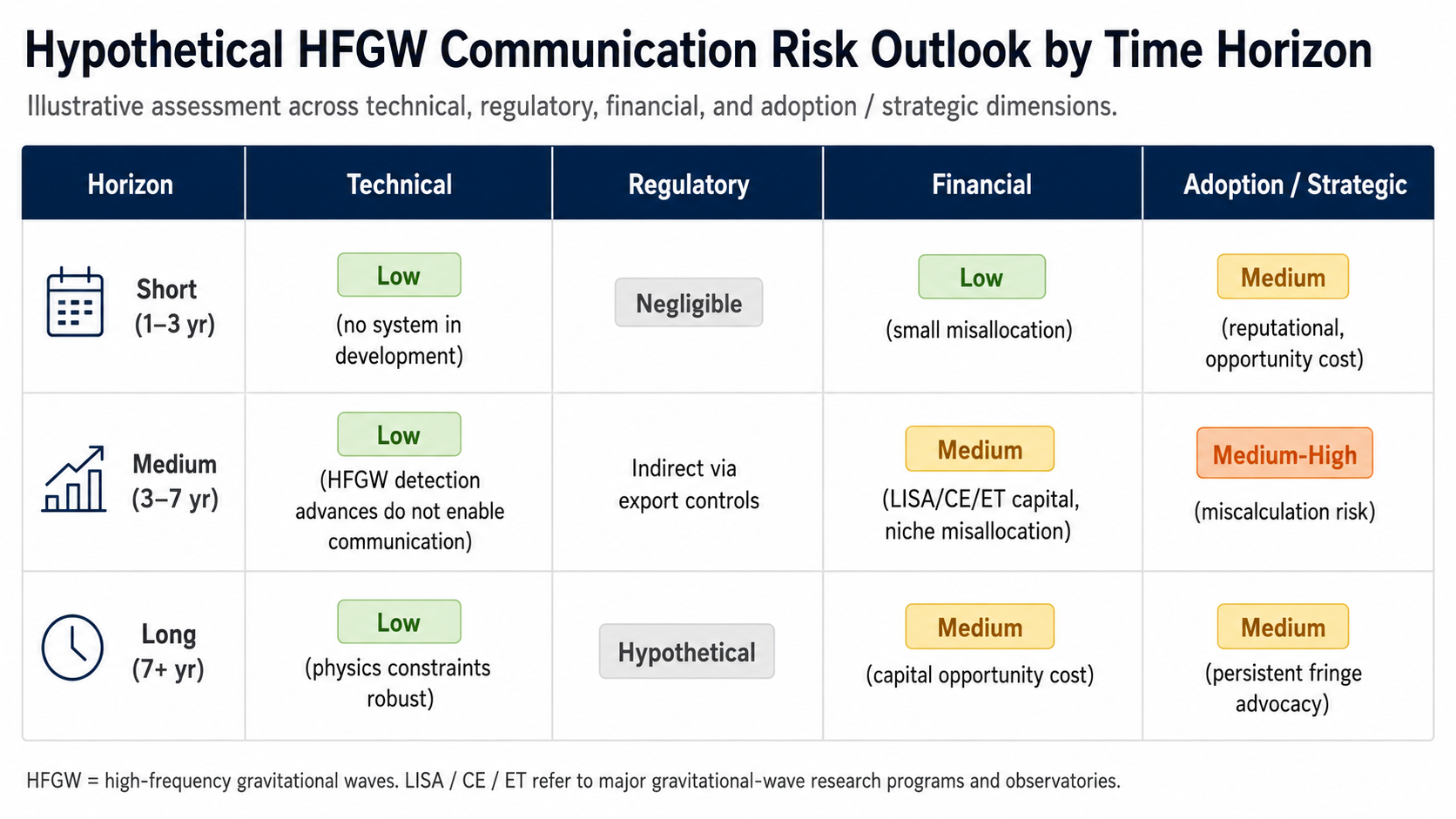
The dominant constraints are fundamental physics constraints that do not respond to engineering effort or capital. Accordingly, this section presents a structured prose risk discussion organized by time horizon and by category, followed by a compact summary tabular view. The field's central risk (physical infeasibility) is a a closed boundary condition.
8.2 Short Horizon (1–3 Years)
In the technical category, the short-term risk is negligible because no GW communication system is in development. The principal concrete technical risks in the broader field are upgrade delays and sensitivity shortfalls in O5 commissioning at LIGO, Virgo, and KAGRA, and continued slippage of the U.S. funding decision on Cosmic Explorer. Neither bears on communication.
In the regulatory category, there is no near-term regulatory risk because the field has no regulatory exposure. The exception is that adjacent technology export controls (vacuum systems, lasers, precision interferometry) may tighten in response to broader geostrategic developments, which could affect international collaboration.
In the financial category, the short-term risk is concentrated in the proposed NASA budget reductions to LISA participation, which could force ESA to seek alternative arrangements; this risk does not affect GW communication but does affect the broader field's progress [27]. Speculative private capital flows into HFGW communication ventures could continue to fund non-productive activity, but the dollar amounts involved are small relative to other deep-tech segments.
In the adoption category, the principal risk is resource misallocation. Where institutional investors, defense planners, or science administrators are persuaded by speculative claims to fund non-credible work, the opportunity cost is real even if the absolute amounts are modest. Reputational damage to organizations that fund such work is also a non-trivial concern.
8.3 Medium Horizon (3–7 Years)
In the technical category, the medium horizon brings the start of next-generation observatory construction (ET, CE) and continued operations of LVK, with substantial increases in detection rate. None of this advances GW communication. Mainstream HFGW detection research, if it produces a confirmed detection of a stochastic background, would represent a transformative physics result but would not bear on the engineering of communication channels.
In the regulatory category, the medium horizon may bring increased attention to dual-use questions in precision metrology and quantum sensing, which could indirectly affect GW researchers through expanded export control regimes. The case for specific regulation of GW emission devices remains absent.
In the financial category, the LISA, ET, and CE construction phases will absorb substantial public capital. Private capital in adjacent quantum sensing and precision metrology is likely to grow. Misallocation risk to GW communication ventures could increase if a high-profile defense industrial entity makes claims of HFGW capability without peer-reviewed support.
In the adoption category, the principal risk over this horizon is that adversary intelligence services may, on the basis of fragmentary intelligence, conclude that a peer competitor is developing GW communication and initiate response programs. This is the strategic miscalculation risk discussed in Section 7.3.
8.4 Long Horizon (7+ Years)
In the technical category, the long horizon may bring qualitatively new physics results from LISA, ET, and CE that change the boundary conditions of the field. These results might include detection of a cosmological GW background, observation of intermediate-mass black holes, or anomalies that motivate new theoretical frameworks. None of these results is likely to make laboratory GW emission feasible, because the quadrupole-formula bottleneck is robust against most plausible modifications of fundamental physics.
In the regulatory category, the long horizon may see the emergence of a regulatory framework if any peer-reviewed laboratory demonstration of artificial GW emission occurs, but the probability of such a demonstration remains very low on this horizon.
In the financial category, the long horizon should bring substantial commercial returns from spillover technologies (precision sensing, quantum technology, vacuum systems) even if no direct GW market emerges.
In the adoption category, the long-horizon risk is generational. Continuous low-level advocacy for GW communication, if it persists in patent and government-procurement channels without peer-reviewed substantiation, may continue to absorb attention disproportionate to its scientific credibility.
8.5 Summary Risk Table
8.6 The Specific Risk of Resource Misallocation
The most consequential risk identified by this analysis is resource misallocation. This risk is bidirectional. On one side, well-intentioned defense or intelligence funding directed toward HFGW communication research that is not physically credible diverts capital and attention from problems with tractable physical solutions. On the other side, excessive defensive skepticism toward all frontier physics research, motivated by past disappointments in this niche, could deprive legitimate fundamental science of resources. The analytical position that minimizes both errors is to follow peer-reviewed literature, to weight the JASON-style consensus on infeasibility of artificial generation, and to maintain robust support for mainstream GW astronomy and HFGW detection research on cosmological grounds
9. Strategic Recommendations
9.1 For Government Science Funders and Research Administrators
Sustained investment in mainstream GW science is justified on the basis of its established scientific productivity and its substantial spillover into precision measurement, quantum technology, and vacuum engineering. Specifically:
Funders should complete the Cosmic Explorer decision process in line with the March 2024 NSF MPS subcommittee recommendation and the Astro2020 decadal endorsement [7][9]. Continued commitment to LISA, including replacement strategies if U.S. participation is reduced, is warranted on the basis of unique low-frequency science access [4][27]. Continued support for the Einstein Telescope through the European Strategy Forum on Research Infrastructures process should be maintained [6]. LIGO-India should be brought to operational status to extend the global baseline.
Funders should specifically maintain support for the mainstream Ultra-High-Frequency Gravitational Wave research community (Aggarwal et al. and successor collaborations) for cosmological physics motivations [11][14]. This community is institutionally distinct from the HFGW communication advocacy community.
Funders should not allocate resources to engineered GW communication research absent peer-reviewed demonstration of credible emitter or detector technology. Proposals making strong communication claims should be evaluated against the JASON 2008 findings and against subsequent peer-reviewed critique [13][34]. Funders should commission updated independent assessments of HFGW communication claims on a five-year cadence to maintain analytic currency and to inoculate against fringe-driven misallocation.
9.2 For Defense and Intelligence Planners
Defense planners should treat GW communication as a non-credible capability development pathway for the foreseeable future. Resource allocation to engineered GW communication programs is not warranted on technical grounds. Strategic communication requirements (assured second-strike, submerged-submarine command and control, deep-underground facility command) should continue to be met through layered ELF, VLF, satellite, blue-green laser, and acoustic systems, with continued investment in improving the data rate, survivability, and physical security of these established channels.
Intelligence planners should maintain analytic awareness of foreign HFGW research, with the explicit understanding that mainstream Chinese, European, and U.S. research in this area is directed at fundamental physics, not communication. Reports of adversary HFGW communication programs should be evaluated against the physics constraints summarized in this report and in JASON 2008 [13]. The principal intelligence risk in this domain is strategic miscalculation driven by uncritical reception of exaggerated capability claims.
Counterintelligence planners should be aware that the persistent fringe HFGW communication advocacy community in the United States and Europe has, at intervals, attracted attention from foreign intelligence services for reasons that include legitimate scientific interest, technology denial efforts, and possible influence operations. Standard analytic discipline applies.
9.3 For Institutional Investors and Deep-Tech Venture Capital
Institutional investors and venture capital firms should classify GW communication as outside the investible technology landscape. No company in this niche has a demonstrated technology, an addressable market, or a credible time-to-revenue. Patents in the area, including the Pais Navy HFGW generator patents, should not be accepted as evidence of feasibility absent peer reviewed validation [35].
Where investor interest in the broader gravitational wave science ecosystem is appropriate to portfolio strategy, the realistic investment vectors are: quantum sensing and squeezed-light technology spinning out from interferometer instrumentation; precision metrology and inertial sensing developments; ultra-high vacuum technology with semiconductor manufacturing applications; and data infrastructure and time-domain astronomy software with potential dual use in space situational awareness. These adjacencies have TRLs in the range of 4–7 and time-to revenue horizons in the 3–10 year range, substantially closer to investible parameters.
9.4 For Senior University and National Laboratory Research Leadership
University and national laboratory leadership should maintain support for fundamental GW research at the levels established through Astro2020 and equivalent decadal planning processes [9]. The scientific productivity of the field is high and its training impact on doctoral students in physics, engineering, and computational science is substantial.
Research leaders should be alert to the reputational risk associated with HFGW communication advocacy entering institutional research portfolios through low-quality channels. Patent licensing offices, sponsored research administrators, and faculty awards committees should apply standard peer-review-based evaluation criteria to proposals in this area. Where industrial sponsors or government agencies seek collaboration on HFGW communication topics, faculty should be free to engage on terms that preserve normal publication and peer-review processes.
Leaders should support cross-disciplinary education that helps senior decision makers in adjacent disciplines (defense studies, public policy, finance) develop the physics intuitions necessary to distinguish credible from non-credible claims in frontier physics. The persistence of HFGW communication advocacy is in part a failure of physics communication, and the academic community has both the capacity and the responsibility to address it.
10. Conclusion
The terrain has shifted substantially over the past decade in gravitational wave science, and not at all in gravitational wave communication. Direct detection has moved from theoretical possibility in 2014 to routine practice in 2026, with nearly four hundred detections in the catalog and a global network of ground-based and space-based detectors maturing on a clear roadmap [1][3][23]. The cosmological and astrophysical science return has exceeded what most planners anticipated a decade ago. Third-generation ground observatories and LISA are on track to deliver order-of-magnitude further improvements in the 2030s [4][6][7].
What has not changed is the fundamental physics constraint on artificial generation of gravitational waves at useful power levels. The quadrupole formula's coupling constant of G/c^5 is among the smallest dimensional combinations in nature, and the resulting energy efficiency of any conceivable engineered emitter remains many orders of magnitude below any threshold that could support a communication channel. The 2008 JASON assessment of HFGW communication remains substantively unchallenged by any peer-reviewed work in the intervening seventeen years [13]. The mainstream HFGW detection community, while pursuing legitimate and important physics, does not present any pathway to communication.
The realistic indicators a reader should monitor over the coming five to ten years are: (a) the progress of LVK O5, IR1, and any subsequent runs, with continued detection rate growth; (b) the LISA, ET, and CE construction milestones, with particular attention to the resolution of U.S. participation questions on LISA; (c) the publication trajectory of the UHF-GW community, including any first detection of stochastic backgrounds or exotic point sources in the MHz-to GHz band; (d) the appearance, or continued absence, of any peer-reviewed laboratory demonstration of artificial GW emission at any amplitude. Of these, only the last would constitute a meaningful update to the analysis presented here. The probability of such a demonstration in this window is low.
For senior readers in any of the audience categories addressed by this report, the analytical message is consistent. Gravitational wave science is one of the great success stories of twentieth and twenty-first century physics and should be supported on those terms. Gravitational wave communication is, at present, neither a near-term threat, a near-term capability, nor a near-term investible technology, and should be treated as such. The discipline required is to support the science, monitor the relevant indicators, and decline to be persuaded by claims that the field's central physical constraints have somehow been circumvented in the absence of peer-reviewed evidence. That discipline, more than any specific program or budget decision, is the principal contribution that institutional leadership can make in this domain.

References
[1] Abbott, B. P., Abbott, R., Abbott, T. D., et al. (LIGO Scientific Collaboration and Virgo Collaboration). (2016a). Observation of gravitational waves from a binary black hole merger. Physical Review Letters, 116(6), 061102.
[2] LIGO Scientific Collaboration. (2026). IGWN observing plans. Laser Interferometer Gravitational-Wave Observatory.
[3] LIGO-Virgo-KAGRA Collaboration. (2025, November 18). LIGO–Virgo–KAGRA Collaboration successfully wraps up its fourth observing run. California Institute of Technology.
[4] European Space Agency. (2024, January 25). Capturing the ripples of spacetime: LISA gets go-ahead. ESA Science and Exploration.
[5] Amaro-Seoane, P., Audley, H., Babak, S., et al. (2017). Laser Interferometer Space Antenna. arXiv:1702.00786.
[6] Maggiore, M., Van Den Broeck, C., Bartolo, N., et al. (2020). Science case for the Einstein Telescope. Journal of Cosmology and Astroparticle Physics, 2020(03), 050.
[7] Kalogera, V., et al. (2024, March). Report from the NSF MPS Advisory Committee Subcommittee on next-generation gravitational-wave detector concepts. U.S. National Science Foundation, Mathematical and Physical Sciences Directorate.
[8] Evans, M., Adhikari, R. X., Afle, C., et al. (2021). A horizon study for Cosmic Explorer: Science, observatories, and community. arXiv:2109.09882.
[9] National Academies of Sciences, Engineering, and Medicine. (2021). Pathways to discovery in astronomy and astrophysics for the 2020s (Astro2020 Decadal Survey). National Academies Press.
[10] Gong, Y., Luo, J., & Wang, B. (2021). Concepts and status of Chinese space gravitational wave detection projects. Nature Astronomy, 5, 881–889.
[11] Aggarwal, N., Aguiar, O. D., Bauswein, A., et al. (2021). Challenges and opportunities of gravitational-wave searches at MHz to GHz frequencies. Living Reviews in Relativity, 24, 4.
[12] Maggiore, M. (2007). Gravitational waves, volume 1: Theory and experiments. Oxford University Press.
[13] Eardley, D., et al. (2008). High frequency gravitational waves (JASON Report JSR-08-506). The MITRE Corporation, prepared for the Office of the Director of National Intelligence.
[14] Aggarwal, N., Aguiar, O. D., Blas, D., et al. (2025). Challenges and opportunities of gravitational-wave searches above 10 kHz. Living Reviews in Relativity, 28.
[15] Stancil, D. D., Adamson, P., Alania, M., et al. (2012). Demonstration of communication using neutrinos. Modern Physics Letters A, 27(12), 1250077.
[16] Federation of American Scientists. (n.d.). Extremely low frequency communications program. Nuclear Forces Guide.
[17] Funaiole, M. P., Hart, B., & Bermudez, J. (2021). Does China have an effective sea-based nuclear deterrent? ChinaPower Project. Center for Strategic and International Studies.
[18] Einstein, A. (1916). Näherungsweise Integration der Feldgleichungen der Gravitation. Sitzungsberichte der Königlich Preussischen Akademie der Wissenschaften zu Berlin, 688–696.
[19] Einstein, A. (1918). Über Gravitationswellen. Sitzungsberichte der Königlich Preussischen Akademie der Wissenschaften zu Berlin, 154–167.
[20] Hulse, R. A., & Taylor, J. H. (1975). Discovery of a pulsar in a binary system. Astrophysical Journal Letters, 195, L51–L53.
[21] Abbott, B. P., Abbott, R., Abbott, T. D., et al. (2016b). GW150914: The Advanced LIGO detectors in the era of first discoveries. Physical Review Letters, 116(13), 131103.
[22] Abbott, B. P., Abbott, R., Abbott, T. D., et al. (2017). GW170817: Observation of gravitational waves from a binary neutron star inspiral. Physical Review Letters, 119(16), 161101.
[23] LIGO Scientific Collaboration, Virgo Collaboration, & KAGRA Collaboration. (2025). GWTC-4.0: Population properties of merging compact binaries. arXiv:2508.18083.
[24] Gertsenshtein, M. E. (1962). Wave resonance of light and gravitational waves. Soviet Physics JETP, 14, 84–85.
[25] LIGO Laboratory. (2026). About LIGO. California Institute of Technology and Massachusetts Institute of Technology.
[26] Punturo, M., Abernathy, M., Acernese, F., et al. (2010). The Einstein Telescope: A third generation gravitational wave observatory. Classical and Quantum Gravity, 27(19), 194002.
[27] NASA Astrophysics Division. (2024, January 25). LISA formally adopted by European Space Agency. NASA Science.
[28] Luo, J., Chen, L.-S., Duan, H.-Z., et al. (2016). TianQin: A space-borne gravitational wave detector. Classical and Quantum Gravity, 33(3), 035010.
[29] Aftergood, S. (2008, December). JASON study debunks gravitational wave 'threat.' Federation of American Scientists, Secrecy News.
[30] Baker, R. M. L., Jr. (2010). High-frequency gravitational wave communications [Defense Intelligence Reference Document, Advanced Aerospace Weapon System Application Program]. U.S. Defense Intelligence Agency.
[31] Bringmann, T., Domcke, V., Fuchs, E., & Kopp, J. (2023). High-frequency gravitational wave detection via optical frequency modulation. arXiv:2304.10579.
[32] Domcke, V. (2023). Electromagnetic high-frequency gravitational wave detection. Proceedings of the 57th Rencontres de Moriond Electroweak Interactions and Unified Theories. arXiv:2306.04496.
[33] Li, F., Baker, R. M. L., Jr., Fang, Z., Stephenson, G. V., & Chen, Z. (2008). Perturbative photon fluxes generated by high-frequency gravitational waves and their physical effects. European Physical Journal C, 56(3), 407–423.
[34] Woods, R. C., Baker, R. M. L., Jr., Li, F., et al. (2012). Diffraction from embedded reflectors in Li-Baker HFGW detector. Physics Procedia, 38, 500–511.
[35] Pais, S. C. (2019). High frequency gravitational wave generator (U.S. Patent 10,322,827 B2). U.S. Patent and Trademark Office.
[36] Wikipedia contributors. (2024). Project Sanguine. Wikipedia, The Free Encyclopedia.