
Dream Chaser Spaceplane (2026): Reusability, Cargo Return, Commercial LEO Logistics, and Market Viability
Dream Chaser could become a key low-g cargo return vehicle for ISS and commercial stations, if late-stage testing succeeds.

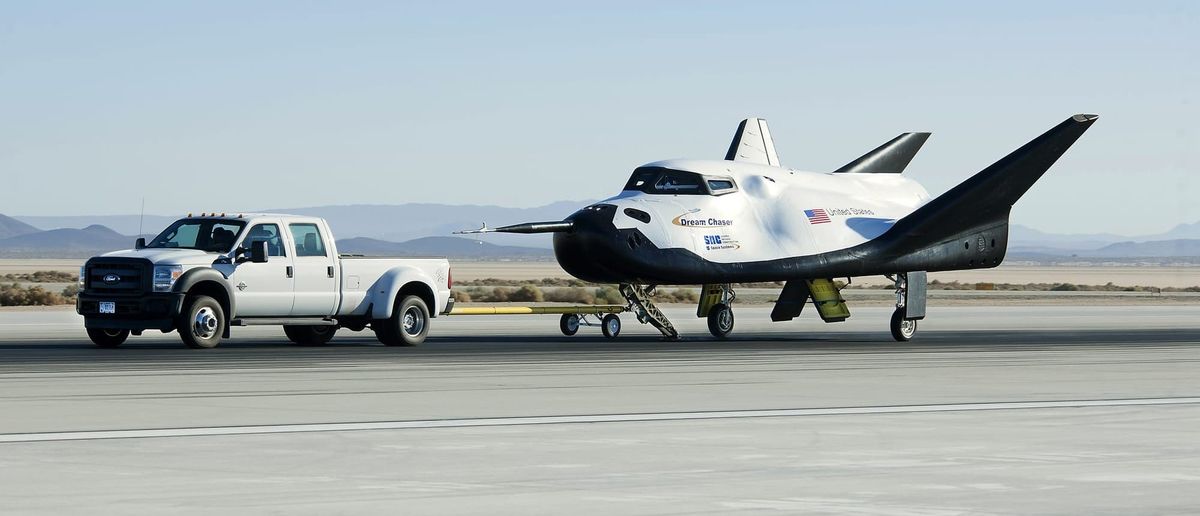
Dream Chaser Spaceplane: Low-G Cargo Return, ISS Logistics, and the Future of Commercial Space Stations
Summary
Dream Chaser is a reusable lifting-body cargo spaceplane being developed by Sierra Space, with design lineage traceable to the HL-20 concept studied by NASA [1] at Langley. The program was originally advanced by Sierra Nevada Corporation [2] through NASA’s commercial crew effort, later repositioned as a cargo system for the International Space Station [3] under Commercial Resupply Services-2. Its core proposition is not simply “reusability,” but a specific combination of reusable lifting-body return, low-g reentry, runway landing, and meaningful cargo downmass. Those attributes distinguish it from disposable freighters and from capsule systems that return by splashdown or, in the case of crew capsules, are optimized primarily for astronauts rather than logistics. [4]
As of May 2026, Dream Chaser has not yet flown an orbital mission. In September 2025, NASA and Sierra Space modified the resupply contract so that the next major step becomes a free-flight demonstration targeted for late 2026 rather than an initial ISS cargo mission. In April 2026, Sierra Space said the vehicle had completed launch acoustic testing at Kennedy, and secondary reporting indicated remaining work centered on final tile installation, integrated software/vehicle testing, and mission-specific preparation for a year-end orbital debut. That places the program at a consequential transition point: no longer a near-term ISS cargo operator, but not merely a paper concept either. It is now a late-development transportation system whose strategic relevance depends on whether flight operations can validate its differentiated return model. [5]
Why the vehicle matters is broader than one spacecraft. NASA’s own oversight reports have emphasized that the agency currently depends on SpaceX [6] Dragon for cargo downmass, while upmass redundancy is also under pressure because both Dragon and Northrop Grumman [7] Cygnus have recently relied on Falcon 9 launch services in the interim. NASA’s low-Earth-orbit strategy simultaneously seeks a transition from ISS to commercial stations, continuous human presence in orbit, and a diversity of transportation providers. In that context, Dream Chaser is strategically important if it becomes a second U.S. cargo-return provider with aircraft-like recovery and acceptable turnaround economics. It remains strategically constrained if its operational complexity, schedule slippage, or cost structure negate those benefits. [8]
The central analytical judgment of this report is therefore balanced. The strongest case in favor of Dream Chaser is that it addresses a real logistics gap: fast, gentle, runway-based cargo return for science, time-sensitive hardware, and later commercial-station support. The strongest case against it is that the market may not reward that extra capability enough to offset the added technical, regulatory, and operations burden relative to simpler capsule systems with already-proven cadence. [9]
Program Evolution and Strategic Context
Dream Chaser’s heritage is unusually direct. NASA’s HL-20 concept was a lifting-body spaceplane intended to achieve lower entry heating and acceleration than capsule-type vehicles while retaining the ability to land on a conventional runway. That design logic, explored extensively at Langley, became the conceptual foundation for Dream Chaser’s modern form. In practical terms, the program inherits not just an outline shape, but an operating philosophy: use body-generated lift to widen recovery options and to reduce the severity of return loads on people or payloads. [10]
Institutionally, the vehicle began as part of NASA’s post-Shuttle commercial crew effort. NASA’s Office of Inspector General noted that spacecraft designs from Boeing [11], Sierra Nevada, and SpaceX were selected in 2012 for further development under Commercial Crew Integrated Capability, but that in 2014 NASA ultimately awarded Commercial Crew Transportation Capability contracts to Boeing and SpaceX. Dream Chaser therefore lost the direct path to become one of NASA’s certified crew vehicles, but it did not disappear; instead, the atmospheric test campaign and systems work carried over into the cargo version. [12]
That pivot became tangible in late 2017. NASA described Dream Chaser’s successful free-flight landing test at Armstrong as a major milestone under the Commercial Crew Program, and explicitly linked the data from that flight to the final design of the cargo version for station missions. NASA also stated at the time that the cargo variant was intended for at least six supply missions and would capitalize on runway return to bring back experiments and other cargo. In effect, the 2017 test served as the bridge between the crew-era design and the cargo-era business case. [13]
NASA’s cargo procurement strategy is the second essential context. In 2016, NASA selected Sierra Nevada alongside Orbital ATK and SpaceX for CRS-2. The reason was not simply additional tonnage. NASA’s commercial cargo model has consistently prioritized dissimilar redundancy: different vehicles, different operating modes, and different industrial suppliers, so that a failure or shortfall in one chain does not halt ISS logistics. Dream Chaser fit that strategy because it offered a third architecture alongside Dragon and Cygnus, plus return capability that Cygnus lacks. [14]
The original post-award plan was ambitious. NASA stated in 2020 that Dream Chaser would provide a minimum of six cargo missions, that its pressure-test article had validated suitability for repeated launches and returns, and that Sierra engineers were using the article to develop and verify refurbishment operations between flights. Those statements were strategically important because they framed Dream Chaser not as a one-off demonstrator, but as a reusable logistics asset with an intended service model. [15]
The current status, however, marks a clear rephasing. NASA announced in September 2025 that Dream Chaser development would be best served by a free-flight demonstration targeted in late 2026. Sierra Space’s April 2026 acoustic-test announcement and Aviation Week’s April 2026 reporting together suggest a program in the final stages of qualification, but still working through exactly the sort of integrated software, thermal-protection, and mission-readiness tasks that often separate “hardware built” from “system operational.” That matters strategically because Dream Chaser now sits between development and service entry, with future NASA logistics relevance contingent on a successful demonstration rather than already-assured mission cadence. [5]
Technical Architecture and Operational Model
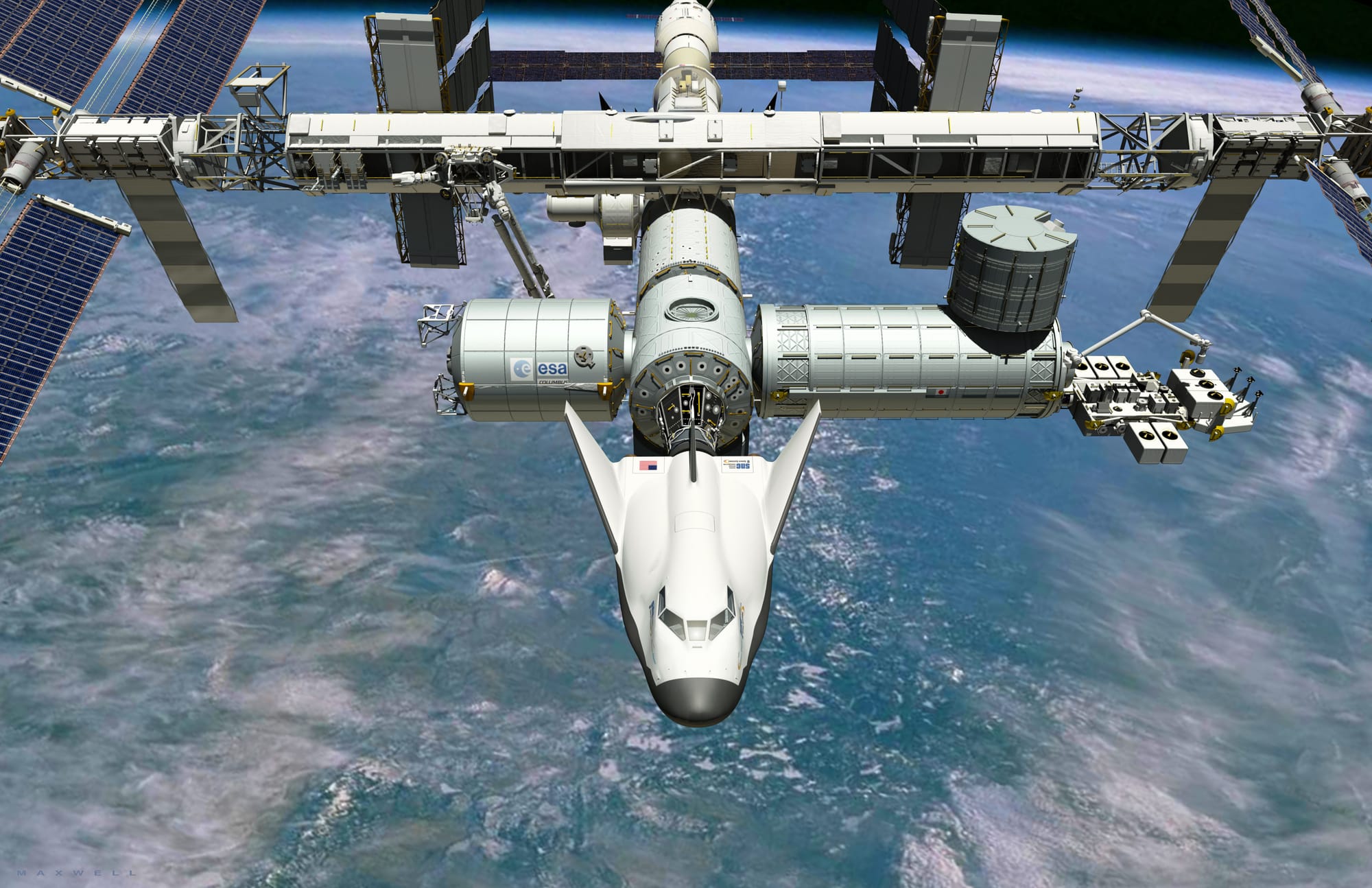
Dream Chaser is not a single vehicle in the narrow sense; it is a cargo system composed of the reusable spaceplane and the expendable Shooting Star cargo module. NASA describes the system as two major elements, with Dream Chaser designed for reuse up to 15 missions and Shooting Star designed to carry pressurized and unpressurized cargo, provide mission support, and then be disposed of before reentry. NASA also states that solar arrays mounted on the cargo module and Dream Chaser’s wings deploy during the autonomous rendezvous phase. This modular architecture is central to the design: expensive atmospheric-return hardware is reused, while the disposable module absorbs one-time logistics and trash-disposal functions. [16]
The launch and approach profile is equally distinctive. NASA’s mission overview says Dream Chaser launches with folded wings inside a 5-meter fairing atop a Vulcan rocket from Cape Canaveral, conducts autonomous rendezvous, performs far-field and near-field demonstrations, and is then grappled by Canadarm2 for berthing to the station. NASA’s 2023 overview further states that the first ISS mission profile was expected to deliver more than 7,800 pounds of cargo, with later missions designed for up to 11,500 pounds, attachment durations up to 75 days, and return capability of more than 3,500 pounds of cargo and experiment samples while disposing of more than 8,700 pounds of trash via the cargo module. Cargo could be loaded as late as 24 hours before launch, and a scrub could permit a new launch attempt in as little as 24 hours. [17]
The return phase is the program’s signature feature. NASA states that Dream Chaser can land 11 to 15 hours after departure from station, with daily landing opportunities if weather criteria are met, and that it is intended to glide to a runway landing at Kennedy before transfer to the Space Station Processing Facility for inspection, cargo offload, and refurbishment. Sierra Space and its commercial partners have repeatedly emphasized the system’s low-g return profile; Sierra’s own 2025 Merck announcement highlighted runway access at fewer than 1.5g, while other Sierra materials and aerospace reporting have described this as materially gentler than nominal capsule returns. For payload classes where hours matter, or where saltwater exposure and ocean recovery are undesirable, that is a non-trivial operational feature rather than a cosmetic one. [18]
From a technical-risk perspective, however, the same features create a more complex integration burden than a basic capsule. The thermal-protection system must support repeated high-temperature reentries; NASA sent the vehicle through thermal-vacuum testing in Ohio in late 2023, Sierra and Oak Ridge publicized work on a reusable TPS in 2024, and by April 2026 Sierra was still installing the final set of thermal-protection tiles while preparing integrated flight-software testing. That sequence indicates progress, but it also shows where technical closure remains hard: Dream Chaser must integrate TPS integrity, aerodynamic control, autonomy, propulsion, runway approach, and post-flight refurbishment into one repeatable process. [19]
Operationally, Dream Chaser also inherits dependencies that shape its economics and schedule. The current launch path is tied to United Launch Alliance [20] Vulcan; the vehicle’s first flight now serves as a free flyer rather than a live ISS cargo call; and U.S. reentry operations require FAA vehicle-operator licensing in addition to site licensing. The Federal Aviation Administration [21] has stated that Sierra Space is applying for a vehicle operator license for Dream Chaser reentries at the Shuttle Landing Facility, and that successful environmental review does not by itself guarantee license issuance because safety, risk, and indemnification requirements must also be met. In other words, the system’s operating model depends not just on spacecraft readiness, but also on maturing a launch-reentry-ground-processing enterprise. [22]
Comparative Value Proposition
The main operational argument for a lifting-body logistics system is selective but real. NASA’s archived HL-20 materials explicitly identify lower entry heating and acceleration and greater cross-range than capsules as core advantages of the lifting-body approach. Applied to Dream Chaser, those advantages translate into lower-g return, runway recovery, and faster access to payloads after landing. Sierra Space’s 2025 Merck collaboration announcement makes the commercial implication explicit: the company is targeting biopharma and other sensitive payload classes on the theory that smooth reentry and immediate runway access are logistically valuable. For fragile science, rapid post-flight handoff, and high-value return cargo, those advantages are technically meaningful. [23]
They are not universally meaningful. If a mission’s economic objective is lowest-cost bulk supply, not premium return handling, then Dragon and Cygnus already cover much of the problem space. Dragon autonomously docks, routinely delivers several thousand pounds of cargo, and returns critical science and hardware after splashdown. Cygnus is an established upmass vehicle and adds reboost capability, even though it cannot return cargo. Dream Chaser is therefore not best understood as a blanket replacement for these systems. It is better understood as an option for the subset of missions where downmass quality, recovery speed, and runway accessibility may matter enough to justify added complexity. [24]
Starliner and the Space Shuttle are useful but limited comparators. Starliner shares the runway-adjacent value logic of non-ocean return, but it is fundamentally a crew transportation system rather than a dedicated cargo freighter, and NASA is still working through corrective actions after its troubled 2024 crewed test flight. The Space Shuttle, by contrast, proved that runway-returned orbital cargo and large-scale reusable vehicle operations were possible, but it did so with an architecture and cost structure far beyond what Dream Chaser is attempting. Dream Chaser is therefore neither a mini-Shuttle nor a Dragon clone. Its ambition is narrower: premium cargo logistics, not heavy-lift orbital construction or routine crew transport. [25]
| Vehicle | Reusability | Landing Mode | Cargo Return Capability | Launch Dependency | Development Maturity | Strategic Advantages | Key Limitations |
|---|---|---|---|---|---|---|---|
| Dream Chaser | Reusable spaceplane; Shooting Star expendable module | Runway landing | Yes, plus disposable trash return via module | Current path tied to Vulcan | No orbital flight yet; late-2026 free-flight demo targeted | Low-g return, runway recovery, mixed cargo types, potential second U.S. downmass provider | Long development cycle, TPS/software/runway certification burden, licensing and launch dependencies |
| Cargo Dragon by SpaceX | Reusable capsule architecture | Ocean splashdown | Yes | Falcon 9 | Fully operational cargo provider | Proven cadence, autonomous docking, current NASA downmass backbone | Splashdown recovery logistics, no runway recovery |
| Cygnus by Northrop Grumman | Expendable | Destructive reentry | No return; disposal only | Falcon 9 at present while new launcher matures | Fully operational cargo provider | Proven ISS upmass, reboost capability | No downmass capability; interim dependence on Falcon 9 |
| Starliner by Boeing | Reusable crew module | Land landing | Limited cargo alongside crew/test missions | Atlas V path for current system | Corrective-action and certification phase | Autonomous docking, land recovery, possible mixed crew/cargo utility | Not a dedicated cargo freighter; propulsion and certification issues remain |
| Space Shuttle | Partially reusable orbiter system | Runway landing | Very large return and upmass capability | Shuttle stack | Retired | Demonstrated aircraft-like orbital logistics at scale | Extreme cost, complexity, and manpower burden |
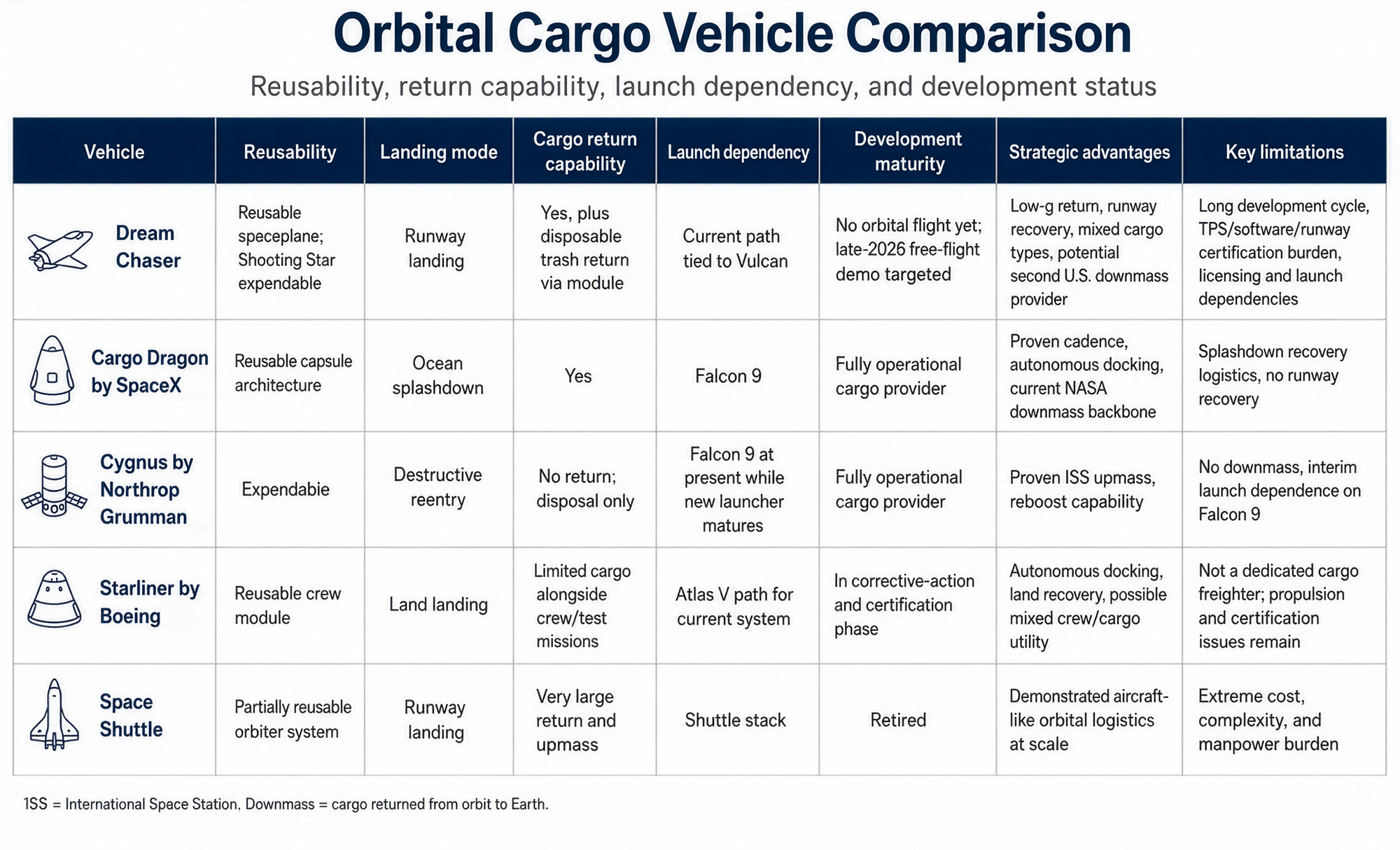
The capability comparisons above combine NASA OIG contractor data with current NASA and industry status reporting. The table is most useful as a qualitative benchmark: Dream Chaser’s main differentiator is return mode and logistics profile. [26]
Market Economics and Strategic Significance
Dream Chaser’s near-term business case is anchored by NASA, not by an already-mature private market. That is not a weakness unique to Sierra Space; it is the normal condition of low-Earth-orbit transportation economics. NASA’s 2024 low-Earth-orbit strategy explicitly argues for continuous human presence in orbit, diversity of providers, and a phased transition from ISS to commercial stations. In March 2026, NASA further stated that it expects future commercial-LEO transportation demand on the order of two crew missions and four to five cargo missions annually. If that demand materializes, a differentiated cargo-return vehicle has a plausible role. If it does not, Dream Chaser may remain tied to a narrower government-demand base. [27]
The strongest medium-term strategic rationale is its fit with emerging commercial stations. NASA is backing a phased transition toward commercially owned stations and has kept multiple destination concepts in play, including work associated with Axiom Space [28], Blue Origin [29], and Starlab Space [30]. A reusable vehicle that can deliver cargo, remain attached to a destination, and then return sensitive payloads directly to a runway is potentially useful to those stations. But this remains contingent twice over: Dream Chaser must reach operations, and the stations themselves must mature on time. NASA’s OIG has repeatedly warned that the agency still faces significant risk of a gap in low-Earth-orbit destination availability after ISS, and that destination readiness remains uncertain in current deorbit and transition planning. [31]
 John D
On the commercial-demand side, the most credible differentiated use cases are research return and high-value manufacturing logistics rather than commodity cargo. Sierra Space’s 2025 Merck announcement is important because it shows the company is already marketing Dream Chaser to biopharma as a premium-return platform. NASA’s own in-space production and microgravity-manufacturing materials likewise identify pharmaceutical crystallization, advanced materials, and terrestrial manufacturing applications as a target growth area for a commercial LEO economy. That does not prove a large market exists today. It does show that Dream Chaser’s low-g runway-return pitch is aligned with the most plausible classes of cargo that might pay for special handling. [32]
The harder question is whether that differentiation becomes a durable economic moat. Publicly available sources reviewed for this report do not establish a transparent recurring per-flight cost or turnaround cost for Dream Chaser that would allow a direct apples-to-apples comparison with Dragon or Cygnus. That matters. Without proven rapid refurbishment and predictable launch access, a reusable runway-return system can become operationally elegant but commercially narrow. In practical terms, Dream Chaser’s best chance at durable advantage is not winning the lowest-cost bulk-cargo segment. It is owning the premium segment where time-sensitive downmass, low-g return, and runway access command real willingness to pay. That is a plausible market thesis, but not yet a demonstrated one. [33]
The broader strategic significance is nonetheless material. FAA materials explicitly describe Dream Chaser as a reusable reentry vehicle intended to provide payload and cargo return services to potential government and private-sector users. Sierra Space, for its part, has publicly framed the system as relevant to civilian and national-security operations. Those statements support a cautious conclusion: Dream Chaser may have government responsiveness value beyond ISS, especially for rapid-return or specialized-orbit logistics, but public evidence for a sustained defense or allied-sovereign mission pipeline remains limited. The strategic case is therefore potential, not proof. [34]
Risks and Scenarios
The principal risks around Dream Chaser are visible in the program record: multiple schedule shifts, a rephased first orbital mission, continuing integrated test activity, FAA licensing work still in process, dependence on a specific launch and landing ecosystem, and a wider low-Earth-orbit market whose post-ISS shape is not settled. Those risks do not make the system unsound; they do mean the burden of proof has moved from design intent to operations. [35]
| Risk Category | Description | Severity | Likelihood | Mitigation Pathway |
|---|---|---|---|---|
| Technical | TPS durability, integrated software, autonomous approach, reentry control, and runway landing must all close simultaneously in a reusable architecture | High | Medium-High | Successful late-stage qualification, free-flight data, incremental certification before ISS cargo operations |
| Programmatic | Extended development timeline and contract rephasing indicate significant schedule risk before operational service | High | High | Narrower flight-test objectives, phased certification, stronger milestone discipline |
| Financial | Large capital intensity and dependence on NASA-related demand may strain business economics if cadence stays low | High | Medium-High | Secure additional government and commercial payload customers, improve turnaround rates |
| Market | Commercial-station demand and broader LEO manufacturing demand remain uncertain through the 2030 transition | High | Medium | Align with premium-return payload classes; avoid assuming mass-market cargo demand |
| Operational | Vulcan availability, ground processing, refurbishment flow, and landing-site constraints could limit cadence | High | Medium | Build schedule margin, qualify multiple landing/recovery pathways, streamline post-flight processing |
| Competitive | Dragon’s proven cadence and capsule simplicity exert continuing price and reliability pressure | High | High | Compete on return quality and response time, not only on generic upmass |
| Regulatory | FAA vehicle-operator licensing and reentry-site approvals remain required for routine operations | Medium-High | Medium | Maintain early regulator engagement and close safety/risk documentation |
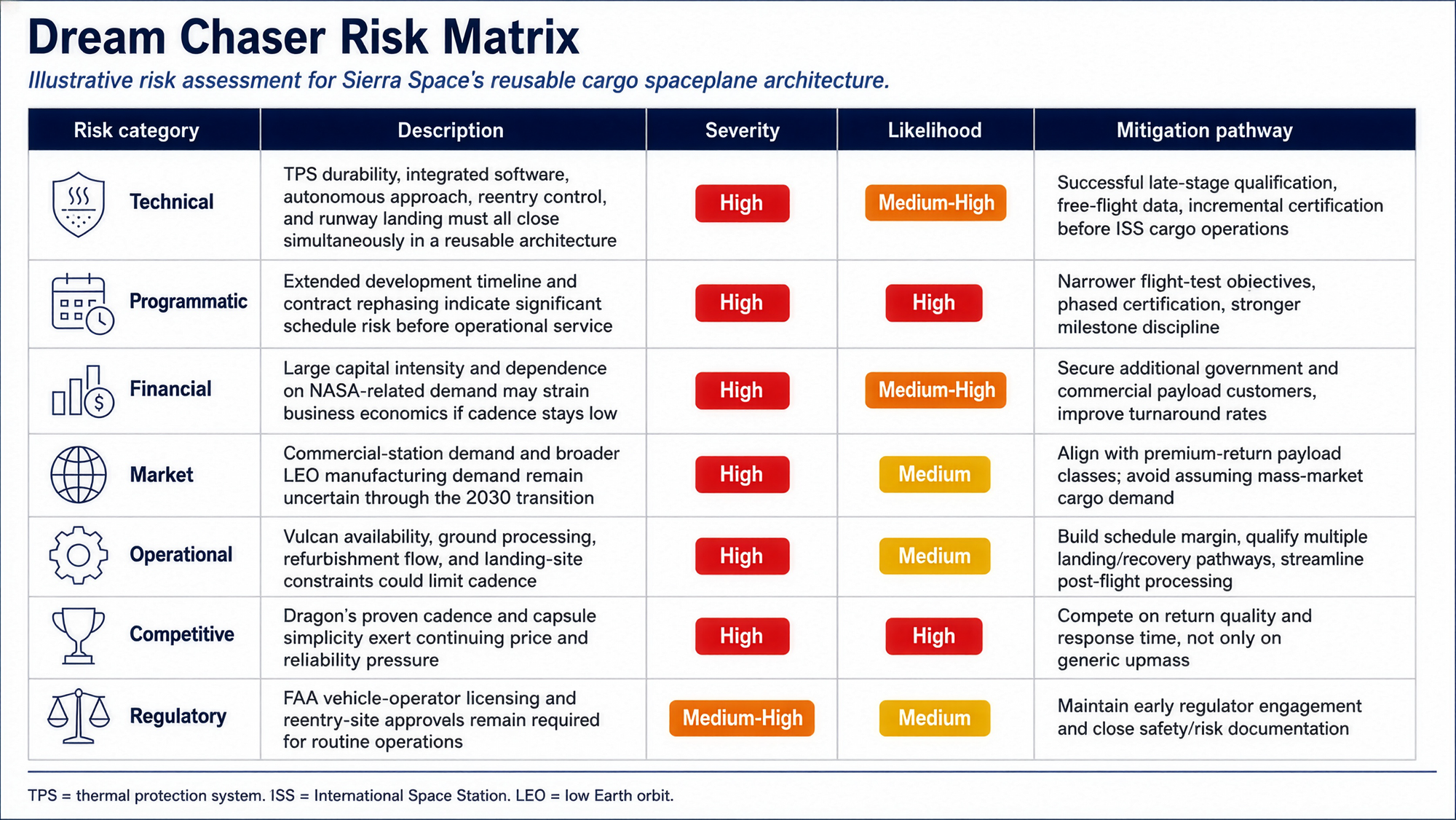
This matrix is an analytical assessment grounded in the cited development, certification, transport-diversity, and licensing record rather than a formal Sierra Space or NASA risk register. [35]
The scenarios below use current anchors: a late-2026 free-flight target, ISS retirement planning around 2030, NASA’s stated interest in future commercial-LEO transport demand, and continuing uncertainty around commercial destination readiness. [36]
| Scenario | Key Assumptions | Trigger Events | Market Implications | Strategic Implications |
|---|---|---|---|---|
| Base case | Dream Chaser completes a successful demo, reaches NASA cargo service later in the decade, and supports early commercial stations selectively | Clean late-2026 free flight; follow-on NASA tasking; at least one viable commercial destination emerges | Premium niche in sensitive return cargo and mixed ISS/CLD logistics | Sierra Space becomes a useful but modest-scale logistics provider with real strategic relevance |
| Optimistic case | Reuse and refurbishment work better than expected, commercial stations need differentiated return logistics, and more non-NASA customers materialize | Rapid turnaround after first flights; proven low-g payload value; sustained 4–5 cargo flights/year market takes shape | Dream Chaser becomes the preferred platform for high-value research return and manufacturing logistics | Sierra Space gains a durable role in the commercial LEO infrastructure stack |
| Pessimistic case | Further delays, limited station demand, or lower-cost capsule competition prevent scale | Flight-test slip, licensing or integration setbacks, CLD delays, Dragon retains dominant cost/cadence position | Demand remains too thin to support meaningful cadence or broad fleet buildup | Dream Chaser remains a capable but niche platform, or a demonstration vehicle with constrained commercial impact |
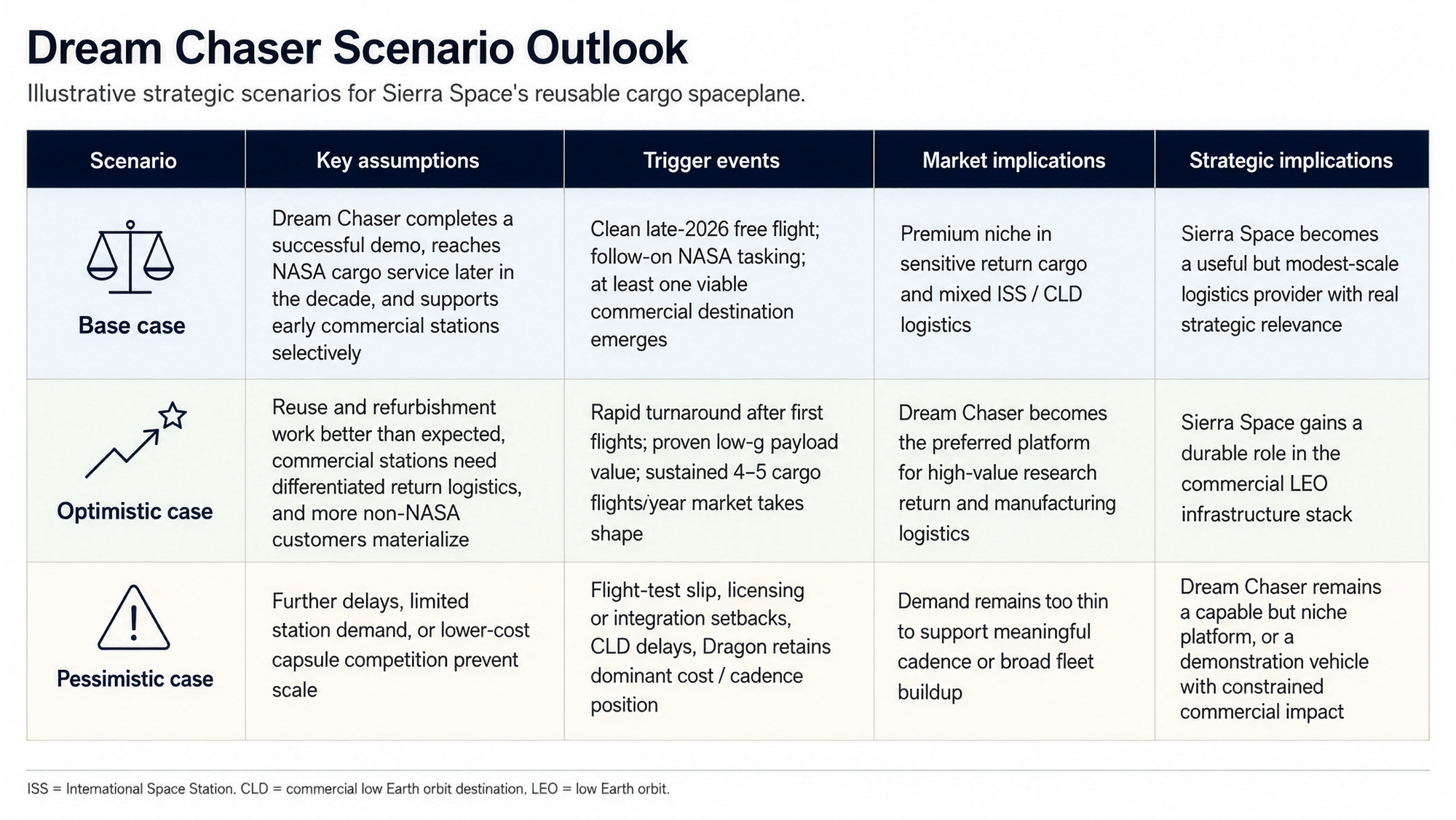
On current evidence, the base case is more plausible than the optimistic case, and the pessimistic case cannot be dismissed. The reasons are straightforward: Dream Chaser is technically credible and visibly progressing, but it has not yet crossed the decisive threshold of orbital demonstration, and the wider commercial-station economy it could serve remains developmental rather than mature. [37]
Conclusion
Dream Chaser should be assessed neither as a straightforward Shuttle successor nor as a guaranteed commercial breakthrough. It is better understood as a strategic experiment in whether a reusable lifting-body spacecraft can occupy a genuinely differentiated logistics niche inside a commercializing low-Earth-orbit architecture. The strongest argument in its favor is that it addresses a real unmet need in U.S. orbital logistics: gentle, quick-access, runway-based cargo return that could matter disproportionately for scientific payloads, biopharma, materials production, and later commercial-station operations. The strongest argument against it is that this premium-return niche may be too narrow, or too price-sensitive, to overcome the cost, complexity, and schedule burden of operating a reusable lifting-body system against simpler capsule competitors. [38]
Dream Chaser becomes strategically important under four conditions. It must first complete the late-2026 flight demonstration successfully. It must then show that runway return produces operational value, not just technical novelty. Third, Sierra Space must convert that value into repeat business, whether from NASA, commercial stations, or high-value payload customers. Finally, the post-ISS LEO economy must actually mature into a multi-provider transport market rather than a single-provider or low-cadence environment. If those conditions are met, Dream Chaser could become an important logistics layer in the next phase of orbital infrastructure. If they are not, the vehicle is likely to remain a capable but constrained platform whose elegance exceeds its market reach. [39]
Open questions and limitations
Can Sierra Space convert a successful free-flight demonstration into routine, certifiable logistics operations rather than a one-off technical milestone?
Can refurbishment and turnaround economics support enough cadence to justify a reusable runway-return system?
Will commercial low-Earth-orbit destinations mature quickly enough to create sustained non-NASA demand?
Will the FAA licensing path and landing-site ecosystem scale smoothly beyond initial missions?
Public source material still does not provide a transparent recurring-cost model for Dream Chaser, so claims of cost superiority over capsule systems cannot yet be substantiated.

References
NASA, “Sierra Space’s Dream Chaser New Station Resupply Spacecraft for NASA” (2023). [17]
NASA, “Dream Chaser Spaceplane Pressure Test Article Arrives at Kennedy Space Center” (2020). [15]
NASA, “Free Flight Completes Crucial Milestone for Dream Chaser” (2017). [13]
NASA, “HL-20” archived project materials. [10]
NASA, “NASA, Sierra Space Modify Commercial Resupply Services Contract” (2025). [40]
Sierra Space, “Dream Chaser Spaceplane Successfully Completed Milestone at NASA’s Kennedy Space Center” (2026). [41]
Aviation Week, “Sierra Set For Final Dream Chaser Spaceplane Preflight Test Series” (2026). [42]
NASA Office of Inspector General, “Final Report: Commercial Resupply Services to the International Space Station” (2018). [43]
NASA Office of Inspector General, “NASA’s Management of Risks to Sustaining ISS Operations through 2030” (2024). [44]
NASA Office of Inspector General, “NASA’s Management of the International Space Station and Efforts to Commercialize Low Earth Orbit” (2021). [45]
NASA, “NASA Finalizes Strategy for Sustaining Human Presence in Low Earth Orbit” (2024). [46]
NASA, “Commercial Space Stations” and related commercial-station materials. [47]
NASA Ignition, “Low Earth Orbit Transportation” request-for-information summary (2026). [48]
Federal Aviation Administration, “Sierra Space at Shuttle Landing Facility and Vandenberg Space Force Base Proposed Operations” and “License Review Process.” [49]
Federal Aviation Administration, “FAA Issues Commercial Space Reentry Site Operator License for Huntsville International Airport” (2022). [50]
NASA, “NASA’s SpaceX 32nd Commercial Resupply Mission Overview” (2025). [51]
Northrop Grumman, “NASA Commercial Resupply Mission NG-24” (2026). [52]
NASA, “NASA Releases Report on Starliner Crewed Flight Test Investigation” (2026) and “NASA, Boeing Modify Commercial Crew Contract” (2025). [53]
NASA, “In Space Production: Applications Within Reach,” “In Space Production Applications,” and related low-Earth-orbit manufacturing materials. [54]
Sierra Space, “Sierra Space to Advance Cancer Research on Inaugural Dream Chaser Spaceplane Mission” (2025). [55]
NASA, Space Shuttle reference and Shuttle-era fact materials. [56]