
Mountain Pass Rare Earth Mine: Can MP Materials Rebuild America’s Mine-to-Magnet Supply Chain?
Mountain Pass and MP Materials are rebuilding a U.S. rare-earth-to-magnet chain, but China, costs, and heavy rare earths remain the test.


1. Summary
1.1 The strategic situation in brief
The Mountain Pass mine is the only rare earth element mining and processing operation of scale in the United States and one of a small number of facilities outside China that produces separated rare earth oxides rather than merely shipping unprocessed concentrate abroad [1][14]. In 2025 the mine produced a record 50,692 metric tons of rare earth oxide in concentrate and a record 2,599 metric tons of separated neodymium-praseodymium (NdPr) oxide, the latter more than doubling year over year [3]. Those figures are material at the level of the U.S. economy, but they are modest against a global market in which China alone reported roughly 270,000 metric tons of mined output in 2024 and controls an estimated 85 to 90 percent of the world's rare earth processing and the large majority of permanent-magnet manufacturing [1][2][9].
The defining development of the past eighteen months is the conversion of Mountain Pass and its operator from a commodity concentrate exporter into a vertically integrated, state-backed national champion. Until April 2025 MP Materials derived more than 70 percent of its revenue from selling concentrate to a single Chinese customer, Shenghe Resources, which is also one of its largest shareholders [14][33]. After China imposed retaliatory tariffs and expanded export controls in 2025, MP halted those shipments and accelerated a pivot to domestic refining and magnet making [14]. In July 2025 the U.S. Department of Defense (DoD) took a preferred-equity position that, on an as-converted basis, made it the company's largest shareholder at roughly 15 percent, and it layered on a ten-year price floor of 110 dollars per kilogram for NdPr, a loan for heavy rare earth separation, and an offtake commitment for future magnet output [4][10][11]. Apple followed with a 500 million dollar agreement for recycled magnets, and J.P. Morgan and Goldman Sachs committed one billion dollars to finance the second Texas magnet plant [5][24].
1.2 Principal judgments
The central judgment of this report is that Mountain Pass has been substantially de-risked on the demand and financing side while remaining exposed on the cost and execution side. The DoD price floor transfers a large share of commodity-price risk from MP Materials to the U.S. taxpayer, and the combination of government, Apple, and General Motors offtake gives the downstream magnet business a contracted demand base that few mining-adjacent ventures enjoy [4][5][6]. Available evidence indicates this is one of the most consequential industrial-policy interventions in U.S. critical minerals to date, and it marks a shift from grant-based subsidy toward direct equity and guaranteed pricing [12].
The countervailing judgment is that the economics of separated rare earths and finished magnets remain structurally disadvantaged relative to Chinese incumbents, which is precisely why a price floor was necessary. Chinese NdPr prices fell to roughly 63 dollars per kilogram in mid-2024 before a supply-driven rebound, well below the 110 dollar floor [19][21]. The price floor is therefore not a marginal support; it is a standing subsidy that, on current market prices, would require ongoing government payments [4]. Execution risk is concentrated in the ramp of magnet manufacturing, heavy rare earth separation, and the achievement of cost parity with Chinese producers, a target the DoD itself set as a five-year objective in 2022 and which remains unverified as achieved [7].
The third judgment concerns the strategic clock. U.S. statute requires that, beginning January 1, 2027, certain magnets used in defense systems be free of Chinese-origin content at every stage of production, yet no fully scaled domestic mine-to-magnet chain yet exists, and the F-35 program has acknowledged continued reliance on Chinese magnets [9][30]. Mountain Pass and the Texas plants are the principal vehicle through which the United States hopes to close that gap, but the timeline is tight and the heavy rare earth bottleneck, in elements such as dysprosium and terbium where China's dominance is near total, is the hardest part of the problem [9][1].
1.3 Most consequential quantitative findings
The figures that most shape the strategic picture are the following. China holds approximately 44 million metric tons of the world's roughly 90 million metric tons of identified rare earth reserves and produced about 270,000 metric tons in 2024 against a U.S. figure of roughly 45,000 metric tons of concentrate [1]. U.S. net import reliance for rare earth compounds and metals was about 80 percent in 2024, an improvement from greater than 95 percent in prior years, attributable largely to the Mountain Pass ramp [1]. The DoD's commitments total a 400 million dollar equity investment, up to 350 million dollars in further preferred stock, a 150 million dollar loan, a 110 dollar per kilogram NdPr floor for ten years, and a ten-year magnet offtake [4][10]. MP Materials' 2025 revenue was 224.4 million dollars, small relative to those commitments, which underscores that the company is being valued and financed on future capacity rather than current cash flow [3].
The Mountain Pass Rare Earth Mine: Strategy, Economics, and the Reindustrialization of the U.S. Rare Earth Supply Chain
1. Summary
- 1.1 The Strategic Situation in Brief
- 1.2 Principal Judgments
- 1.3 Most Consequential Quantitative Findings
2. Contextual Background
- 2.1 Discovery, Geology, and the Resource Base
- 2.2 Collapse and Revival: From Molycorp to MP Materials
- 2.3 The Global Supply Chain and the Strategic Significance of Rare Earths
- 2.4 The Texas Downstream Dimension
3. Key Players and Stakeholders
- 3.1 MP Materials: Corporate Structure and Ownership
- 3.2 Government Actors
- 3.3 Customers and Offtake Partners
- 3.4 Chinese State and Corporate Actors
- 3.5 Allied Governments and Capital Markets
4. Technical and Operational Considerations
- 4.1 From Ore to Oxide: Mining and Separation
- 4.2 From Oxide to Metal to Magnet
- 4.3 The Heavy Rare Earth Bottleneck
- 4.4 Recycling as a Complementary Feedstock
- 4.5 Environmental and Tailings Management
5. Economic and Market Dynamics
- 5.1 Pricing Structure and Volatility
- 5.2 Cost Competitiveness Versus Chinese Producers
- 5.3 The Role of the Price Floor and Contracted Demand
- 5.4 Financial Performance and Capital Structure
- 5.5 Demand Drivers and Market Concentration
6. Regulatory Landscape
- 6.1 Mining and Environmental Permitting
- 6.2 Federal Industrial-Policy Instruments
- 6.3 Trade Measures, Tariffs, and Export Controls
- 6.4 The 2027 Defense-Content Mandate
7. Geopolitical and Strategic Dimensions
- 7.1 China’s Dominance and Its Use as Statecraft
- 7.2 The 2025 Escalation
- 7.3 Allied Resilience Strategy and Friend-Shoring
- 7.4 Defense Supply-Chain Exposure and Scenarios
8. Risk Assessment
- 8.1 Approach
- 8.2 Structured Risk Matrix
- 8.3 Risks Better Treated Through Narrative
9. Strategic Recommendations
- 9.1 For U.S. Policymakers and Defense Procurement Officials
- 9.2 For Institutional Investors
- 9.3 For Corporate Strategists and Procurement Leaders in Magnet-Dependent Industries
10. Concluding Judgment
References
2. Contextual Background
2.1 Discovery, geology, and the resource base
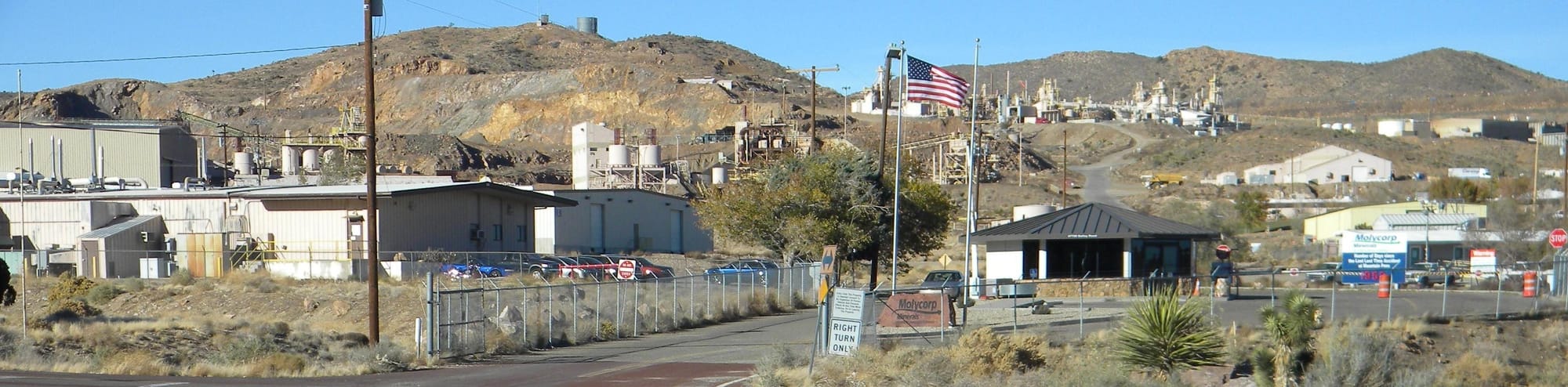
The Mountain Pass deposit was identified in 1949 by prospectors who, searching for uranium, detected radioactivity that proved to originate not from uranium but from a rare-earth-bearing carbonatite [27]. The principal ore mineral is bastnaesite, a rare-earth fluorocarbonate, which the U.S. Geological Survey identifies as the primary product mined at the site [1]. The Mountain Pass carbonatite is geologically distinctive: it is one of the richest known bastnaesite deposits in the world, with ore grades historically reported in the range of several percent total rare earth oxide, far above the grades typical of the ion-adsorption clays and monazite-bearing sands that supply much of global production. The deposit is rich in the light rare earth elements, particularly cerium, lanthanum, neodymium, and praseodymium, and comparatively poor in the heavy rare earth elements such as dysprosium and terbium. This compositional fact is central to the asset's strategic profile: Mountain Pass can supply the light rare earths that dominate magnet alloys by mass, but it does not natively yield the heavy rare earths that magnets require for high-temperature performance, which is why heavy separation and alternative heavy feedstocks remain an unsolved part of the puzzle [1][9].
The USGS estimates total U.S. rare earth reserves at approximately 1.9 million metric tons and broader identified resources at about 3.6 million metric tons, a figure that includes Mountain Pass alongside monazite-bearing heavy-mineral sands in the southeastern United States and mixed rare-earth compounds produced in the western states [1]. These numbers should be read as reserve-and-resource estimates subject to revision as exploration and reporting standards evolve, and the USGS itself notes periodic revisions to national figures [1].
2.2 Collapse and revival: from Molycorp to MP Materials
Mountain Pass was, for several decades in the late twentieth century, the dominant global source of rare earths, until Chinese production undercut it on cost and the mine's operations were curtailed and ultimately suspended in the early 2000s. The most recent boom-and-bust cycle is instructive. The previous operator, Molycorp, raised capital and invested heavily in a modernization program known as Project Phoenix during the price spike that followed China's 2010 export disruptions, building advanced crushing, cracking, and separation facilities together with a paste-tailings system and an on-site combined heat and power plant [27]. When rare earth prices collapsed after the 2011 peak, Molycorp's high debt load and cost structure proved unsustainable, and the company entered bankruptcy in 2015 [15].
The asset's revival came through a credit bid. An investor group led by James Litinsky's JHL Capital Group had acquired Molycorp bonds during the distress, and in 2017 a consortium principally comprising JHL and QVT Financial, with the Chinese rare-earth firm Shenghe Resources holding a minority, non-voting interest, acquired the Mountain Pass operation out of bankruptcy for approximately 20.5 million dollars [15]. In 2020 the operating entity merged with Fortress Value Acquisition Corporation, a special-purpose acquisition company, and began trading on the NYSE under the ticker MP, raising on the order of 545 million dollars in the process [15]. This origin story has two enduring consequences: the company's leadership came from finance rather than from traditional mining, which shaped its aggressive, capital-markets-oriented strategy, and the Shenghe relationship created an early commercial dependence on China that the company has since worked to unwind [14][15].
2.3 The global supply chain and the strategic significance of rare earths
Rare earths comprise the fifteen lanthanide elements plus yttrium and, in some classifications, scandium [31]. Their strategic significance lies less in geological scarcity, since the elements are relatively abundant in the Earth's crust, than in the concentration of economically viable deposits and, more decisively, in the concentration of processing and magnet-making capacity [31][1]. The supply chain has four broad stages: mining of ore, separation of mixed concentrate into individual rare earth oxides, reduction of oxides into metals and alloys, and fabrication of those alloys into finished components, above all neodymium-iron-boron and samarium-cobalt permanent magnets. China dominates every stage downstream of the mine. The International Energy Agency reports that China is the leading refiner for nineteen of twenty strategically important minerals, with an average market share around 70 percent, and that it processes between 60 and 90 percent of the world's rare earths depending on the element [2].
Rare earths are critical inputs across three domains that define contemporary economic and military competition. In defense, permanent magnets actuate control surfaces, drive precision-guided munitions, and power radar and sonar systems; a single F-35 fighter is reported to contain on the order of 900 pounds of rare earth materials [30]. In clean energy, NdFeB magnets are essential to the most efficient electric-vehicle traction motors and to direct-drive wind turbines [6][2]. In advanced manufacturing and consumer electronics, the same magnets appear in robotics, industrial motors, and devices, which is the basis of Apple's interest in a domestic recycled supply [5]. The consequence is that a small tonnage of material confers disproportionate leverage, and that leverage is concentrated in a single state.
 John D
2.4 The Texas downstream dimension
The Texas connection is the deliberate downstream complement to the California mine. In 2021, in conjunction with a long-term supply agreement with General Motors, MP Materials announced it would build its first metals, alloy, and magnet manufacturing facility in Fort Worth, Texas, with a planned capacity of roughly 1,000 metric tons of finished NdFeB magnets per year, sufficient in principle to supply motors for approximately 500,000 electric vehicles annually [6][22]. That facility, named Independence, occupies about 250,000 square feet, began metal production in 2024, and by 2025 had commenced commercial production of NdPr metal and trial production of automotive-grade sintered NdFeB magnets, drawing refined feedstock from Mountain Pass [23]. The second and far larger Texas project, the 10X Facility, broke ground in the Fort Worth area in early 2026 and is intended, once commissioned around 2028, to lift MP's total U.S. magnet capacity toward an estimated 10,000 metric tons [4][29]. The Texas plants are thus where California ore becomes finished product, and where the national policy objective of a domestic mine-to-magnet chain is to be realized.
3. Key Players and Stakeholders
3.1 MP Materials: corporate structure and ownership
MP Materials operates Mountain Pass and the Texas magnet facilities as a single vertically integrating enterprise organized around what it describes as upstream (mining and concentrate), midstream (separated oxides and metals), and downstream (magnets) segments [3][23]. Its ownership structure changed fundamentally in 2025. The Department of Defense, through a 400 million dollar purchase of newly authorized Series A preferred stock together with a warrant, holds a position equivalent to roughly 15 percent of the company on an as-converted and as-exercised basis, making the U.S. government the single largest shareholder [4][10][11]. Shenghe Resources, the Chinese firm that had been the principal buyer of Mountain Pass concentrate, remained among the largest shareholders even as the commercial relationship was suspended, a juxtaposition that captures the company's transition from a China-facing to a U.S.-facing orientation [14]. Founder and chief executive James Litinsky retains a central leadership and ownership role inherited from the 2017 acquisition [15].
3.2 Government actors
The DoD is now simultaneously MP Materials' largest investor, a guarantor of its prices, a lender, and a future customer, a concentration of roles that is unusual for a publicly traded U.S. company and that the Federation of American Scientists and others have characterized as a significant departure in industrial policy [10][12]. The Department of Energy and predecessor defense industrial-base programs provided earlier, smaller awards, including Defense Production Act Title III funding such as a 9.6 million dollar award in 2020 toward restoring light rare earth processing and a 35 million dollar award in 2022 toward heavy rare earth separation at Mountain Pass [7]. Congress shapes the demand environment through statute, most importantly the National Defense Authorization Act provisions that, beginning in 2027, bar Chinese-origin magnets from defense systems [9][30]. Oversight bodies, including the Government Accountability Office, have repeatedly flagged the absence of a comprehensive departmental approach to rare earth supply risk [26][32].
3.3 Customers and offtake partners
The demand side of the enterprise rests on a small number of anchor relationships. General Motors signed the first major long-term magnet supply agreement in 2021, intended to feed its electric-vehicle motor programs [6]. Apple's 2025 agreement, valued at 500 million dollars, commits MP to supply magnets produced from 100 percent recycled feedstock at the Texas facility, with shipments expected to begin in 2027 [5]. The DoD's ten-year offtake of output from the 10X Facility provides a government demand floor for the largest planned increment of magnet capacity, although MP has indicated the majority of that output will be syndicated to commercial buyers [4]. This contracted-demand structure is a defining strategic asset and is examined further in Section 5.
3.4 Chinese state and corporate actors
China's dominance is exercised through both state policy and state-linked enterprises. The Ministry of Commerce administers the export-control and licensing regime, while production quotas channel output through a consolidated set of state-controlled groups, of which Northern Rare Earth is the largest and one of the few global refiners to have remained profitable through the 2024 price trough [19][8]. Shenghe Resources, MP's former offtake counterparty and a continuing shareholder, illustrates how Chinese corporate actors were until recently embedded even within the U.S. supply response [14]. The strategic reality is that China's actors set the marginal price and control the technologies and capacity that define the global cost curve [2][9].
3.5 Allied governments and capital markets
Allied governments, principally Australia, Japan, and members of the European Union, are pursuing parallel diversification, with Australia's Lynas Rare Earths the most significant non-Chinese separated-oxide producer [19]. Japan's response dates to its own 2010 experience of Chinese supply coercion and provides a template of stockpiling, substitution, recycling, and overseas investment [25]. Capital markets participants have become decisive: J.P. Morgan and Goldman Sachs committed one billion dollars to finance the 10X Facility, and the equity market's enthusiastic reaction to the Apple and DoD announcements, including a roughly 20 percent single-day stock move on the Apple news, has lowered MP's cost of capital at a critical moment [24][13].
4. Technical and Operational Considerations
4.1 From ore to oxide: mining and separation
Mountain Pass is an open-pit operation that mines bastnaesite ore, crushes and concentrates it through flotation, and then chemically cracks and separates the concentrate into individual rare earth oxides through solvent-extraction circuits [27][1]. The distinction between concentrate and separated oxide is the single most important technical and commercial fact about the asset. Concentrate is a low-value, mixed product that until 2025 was shipped to China for separation; separated oxides such as NdPr oxide are higher-value intermediates that command the prices reported by the USGS, and they are the necessary input to metal and magnet production [1][14]. MP's strategic pivot has been to move as much of its output as possible from the concentrate stage to the separated-oxide stage, and the 2025 results show the effect: NdPr oxide production reached a record 2,599 metric tons, roughly double the prior year, while total rare earth oxide in concentrate grew more modestly to 50,692 metric tons [3].
4.2 From oxide to metal to magnet
The downstream sequence converts separated oxide into rare earth metal, alloys the metal with iron and boron, and processes the alloy into sintered NdFeB magnets through milling, pressing in a magnetic field, sintering, machining, and coating. This is the stage at which Chinese dominance is most complete and at which the United States had, until recently, essentially no commercial capacity. MP's Independence facility in Fort Worth began metal production in 2024 and progressed to commercial NdPr metal and trial automotive-grade sintered magnet production in 2025, with a planned ramp toward roughly 1,000 metric tons of annual finished-magnet capacity [23][6]. The 10X Facility is designed to add a much larger increment, targeting total magnet capacity on the order of 10,000 metric tons once commissioned around 2028 [4]. Whether MP can achieve the metallurgical consistency, yield, and cost required to compete with Chinese magnet makers at scale is the central open technical question, and trial production is not yet proof of competitive commercial production.
4.3 The heavy rare earth bottleneck
High-performance magnets for demanding applications, including defense systems and traction motors, require small additions of the heavy rare earths dysprosium and terbium to retain magnetic strength at elevated temperatures. Mountain Pass ore is poor in these elements, and global separation of heavy rare earths is overwhelmingly Chinese; analysts place China's share of heavy rare earth separation and metallization capacity at well above 90 percent [9][1]. MP received a 35 million dollar DoD award in 2022 specifically to build heavy rare earth separation at Mountain Pass, with new heavy-separation facilities slated for commissioning in 2025, and the 2025 DoD package included a 150 million dollar loan to expand that capability [7][4]. Even so, the heavy rare earth problem is not solved by separation capacity alone; it also requires adequate heavy feedstock, which Mountain Pass does not natively provide in quantity. This is the most acute technical bottleneck in the entire domestic chain, and available evidence does not yet establish that it has been resolved at commercial scale.

4.4 Recycling as a complementary feedstock
The Apple agreement points to recycling as a second feedstock pathway. MP and Apple have piloted recycling technology for several years, and the 2025 agreement contemplates magnets produced from 100 percent recycled rare earth material, with feedstock sourced from post-industrial scrap and end-of-life devices and processed at Mountain Pass [5]. A separate DoD award of 5.1 million dollars to recover rare earths from electronic waste signals federal interest in recycling as a supply-chain hedge [28]. Recycling can reduce dependence on primary heavy rare earth feedstock and improve the sustainability profile of the chain, but its scale is presently limited by the available volume of recoverable magnets, and the USGS continues to characterize domestic rare earth recycling as limited in quantity [1].
4.5 Environmental and tailings management
The modern Mountain Pass operation was rebuilt with an environmental design intended to address the failures of earlier eras, when wastewater pipeline ruptures contributed to the site's regulatory difficulties. Project Phoenix introduced a paste-tailings system that deposits solidified tailings on an engineered liner, an advanced salt-recycle process designed to virtually eliminate wastewater discharge, and an on-site combined heat and power plant supplied by a connection to the Kern River natural gas pipeline [27]. These features reduce water consumption and effluent relative to conventional designs, which is significant given the site's arid setting, although rare earth processing remains chemically intensive and the management of low-level radioactive material associated with thorium in the ore is an ongoing regulatory and operational consideration [27][1]. Environmental performance claims originate substantially with the operator and its engineering contractors, and independent verification of discharge-elimination claims was not located in the course of this research.
5. Economic and Market Dynamics
5.1 Pricing structure and volatility
Rare earth pricing is element-specific and highly volatile, and the value of a mine depends heavily on its basket of payable elements rather than on aggregate tonnage. The USGS reports average 2024 prices that illustrate the dispersion across the basket: neodymium oxide at roughly 56 dollars per kilogram, dysprosium oxide at about 260 dollars, terbium oxide at about 810 dollars, europium oxide at about 27 dollars, and cerium and lanthanum oxides at roughly 1 dollar each [1]. The economic engine of an NdFeB-oriented producer is therefore the NdPr pair and, disproportionately to their mass, the heavy elements dysprosium and terbium, while the light elements cerium and lanthanum, though abundant in the ore, contribute little revenue. This compositional economics explains why Mountain Pass, rich in light rare earths, must reach into separated NdPr and heavy separation to generate value.
Volatility has been extreme. Chinese benchmark NdPr prices fell to around 63 dollars per kilogram in mid-2024, near multi-year lows reached during an oversupply glut, before a supply-driven rebound to roughly 88 dollars per kilogram by August 2025 [19][21]. The rebound was driven less by demand than by supply shocks, including MP's cessation of concentrate shipments to China and disruptions to Myanmar's heavy rare earth feedstock [21]. These swings make standalone rare earth mining a precarious business and provide the rationale for the price floor discussed below.
5.2 Cost competitiveness versus Chinese producers
The fundamental economic challenge is that Chinese producers define the global cost curve and can sustain prices that are uneconomic for most competitors. During the 2024 trough, reporting indicates that only China's Northern Rare Earth and Australia's Lynas retained positive refining margins, and both saw steep profit declines [19][20]. The DoD's 2022 heavy-separation award explicitly required MP to find a path to cost parity with the international market within five years of first production, an acknowledgment that parity was not assured and an objective whose achievement this report could not independently verify [7]. The structural disadvantages include higher labor and environmental compliance costs, the absence of the dense supplier ecosystem that surrounds Chinese magnet makers, and the learning-curve advantage of incumbents with decades of accumulated process knowledge.
5.3 The role of the price floor and contracted demand
The 2025 DoD arrangement reshapes the economics by transferring price risk to the government. The ten-year price floor of 110 dollars per kilogram for NdPr is set well above prevailing market prices, and the mechanism requires the DoD to pay MP the difference between the floor and the market price for qualifying material, including material consumed internally and stockpiled [4][10]. At a market price near 88 dollars, the floor implies a per-kilogram subsidy on the order of 22 dollars, and at the 2024 trough the gap would have been larger [21][19]. This is, in effect, a public guarantee of midstream profitability. Combined with the GM, Apple, and DoD offtake commitments, it gives MP a contracted demand base and a revenue floor that materially reduce the commercial risk of capacity expansion, while transferring that risk to the federal balance sheet [4][5][6].
5.4 Financial performance and capital structure
MP Materials' reported financials remain small relative to its strategic profile and market valuation. Full-year 2025 revenue was 224.4 million dollars, up about 10 percent year over year, with fourth-quarter net income of 9.4 million dollars and adjusted EBITDA of 39.2 million dollars [3]. The company is, in financial terms, being capitalized on the basis of future capacity and policy support rather than current earnings. The capital stack now blends public equity, DoD preferred equity of 400 million dollars with up to 350 million dollars more authorized, a 150 million dollar DoD loan, and one billion dollars of bank financing arranged by J.P. Morgan and Goldman Sachs for the 10X Facility [4][24]. This structure concentrates downside protection in government instruments while preserving equity upside for public shareholders, an arrangement that is favorable to MP and that critics may characterize as socializing risk while privatizing reward [12].
5.5 Demand drivers and market concentration
Demand for NdFeB magnets is driven by electric-vehicle traction motors, wind turbines, robotics and automation, consumer electronics, and defense systems, and the IEA projects continued growth in rare earth demand tied to the energy transition, with China expected to supply a large majority of battery-grade and magnet-grade rare earths well into the next decade absent successful diversification [2]. The market is among the most concentrated of any strategic commodity, with China controlling the marginal supply, the dominant processing capacity, and the bulk of magnet fabrication [2][9]. For a Western producer, this concentration is simultaneously the source of strategic opportunity, because customers and governments will pay a premium for non-Chinese supply, and the source of commercial peril, because the incumbent can move prices to discipline entrants.

6. Regulatory Landscape
6.1 Mining and environmental permitting
Mountain Pass operates under a layered framework of federal and California state permits governing air emissions, water and waste discharge, and the handling of naturally occurring radioactive material associated with thorium in the ore [27][1]. California's environmental regime is among the most stringent in the United States, and the site's history includes regulatory difficulties tied to wastewater management that shaped the design of the rebuilt facility [27]. Permitting timelines and environmental compliance are a structural cost and schedule factor for any U.S. rare earth expansion, and they form part of the cost disadvantage relative to Chinese producers discussed in Section 5.
6.2 Federal industrial-policy instruments
Federal support has evolved through three identifiable phases. The first phase used Defense Production Act Title III grants, including the 2020 award toward light rare earth processing and the 2022 award of 35 million dollars toward heavy rare earth separation [7]. The second phase added offtake-oriented and contracting support. The third and current phase, inaugurated by the 2025 DoD agreement, deploys direct equity, a guaranteed price floor, a loan, and a long-term offtake, a markedly more interventionist toolkit that several analysts regard as a turning point in U.S. critical-minerals policy [4][10][12]. The price floor in particular functions as a quasi-statutory commitment of public funds contingent on market prices, and its long-term fiscal exposure depends on the trajectory of NdPr prices over a decade [4].
6.3 Trade measures, tariffs, and export controls
The trade environment is now defined by escalating, reciprocal restriction. On the U.S. side, baseline tariffs on rare earth metals and certain compounds are modest, with USGS-reported normal-trade-relations rates of around 5 percent for rare earth metals and lower or zero rates for certain oxides, but these were overlaid in 2025 by far higher tariffs in the broader U.S.-China trade conflict [1][14]. On the Chinese side, export controls are the more potent instrument and are examined in Section 7. The interaction of these measures produced the decisive commercial event of 2025: MP judged that selling concentrate into China under tariffs of 125 percent was neither commercially rational nor consistent with U.S. interests, and it halted the shipments that had provided the majority of its revenue [14][33].
6.4 The 2027 defense-content mandate
The most consequential statutory driver is the prohibition, arising from provisions of the fiscal year 2021 and 2024 National Defense Authorization Acts and implemented through a Defense Federal Acquisition Regulation Supplement (DFARS) rule finalized in 2024, on the use in defense systems, beginning January 1, 2027, of sintered NdFeB and samarium-cobalt magnets that were mined, refined, separated, melted, or fabricated in China, Russia, Iran, or North Korea [9][30]. This mandate creates a hard regulatory demand for non-Chinese magnets at precisely the moment when domestic capacity remains immature, and it is the policy force that most directly underwrites the strategic value of Mountain Pass and the Texas plants. The gap between the mandate and present capacity is real: as of recent reporting there is no fully scaled domestic mine-to-magnet chain, and the F-35 program acknowledged continued use of Chinese magnets in 2023 and 2024 [9][30].
 John D
7. Geopolitical and Strategic Dimensions
7.1 China's dominance and its use as statecraft
China's position in rare earths is the product of decades of deliberate industrial policy that prioritized downstream processing and magnet manufacturing, accepted environmental costs, and used scale to drive Western competitors out of business [2][31]. That dominance has repeatedly been converted into geopolitical leverage. The precedent that conditions all current analysis is the 2010 episode, when, following a maritime incident near the disputed Senkaku Islands, China curtailed rare earth exports to Japan; prices subsequently spiked by roughly an order of magnitude, Japan and the United States brought a World Trade Organization case that culminated in a 2014 ruling against China's export restrictions, and Japan launched a multi-year program of stockpiling, substitution, recycling, and overseas investment funded in part by an emergency allocation of around 730 million dollars [25]. The episode demonstrated both the potency of the weapon and its tendency to accelerate the diversification it was meant to forestall.
7.2 The 2025 escalation
The 2025 cycle was more severe and more sophisticated than 2010. In April 2025, in response to U.S. tariff increases, China placed seven medium and heavy rare earths, including samarium, gadolinium, terbium, dysprosium, lutetium, scandium, and yttrium, together with certain magnets, under an export-licensing regime that required case-by-case approval and that disrupted global magnet supply even where the headline element, neodymium, was not directly listed, because finished magnets contain controlled heavy elements [8][17]. In October 2025 China escalated again with a far broader measure modeled on the U.S. foreign direct product rule, requiring foreign entities to obtain Chinese licenses to export products containing more than 0.1 percent Chinese-origin rare earths or made using Chinese extraction, refining, magnet-making, or recycling technology [16][9]. The United States threatened additional tariffs of 100 percent and characterized the measure as a repudiation of prior understandings [18]. A subsequent de-escalation associated with a Trump-Xi meeting led China to suspend the October measures for one year while leaving the April licensing architecture in place, an outcome that relieved acute pressure without removing the underlying instrument [16][8]. The salient strategic point is that China has demonstrated both the capacity and the willingness to extend control extraterritorially through technology-based rules, which raises the stakes for any supply chain that touches Chinese inputs or know-how.
7.3 Allied resilience strategy and friend-shoring
The Western response has coalesced around friend-shoring and critical-minerals partnerships intended to build redundant capacity across allied jurisdictions. Australia's Lynas provides the most significant non-Chinese separated-oxide capacity, Japan contributes processing and offtake demand and a mature diversification playbook, and the United States is anchoring its effort on Mountain Pass and the Texas magnet plants [19][25][4]. The IEA cautions, however, that despite these efforts refining capacity is set to remain highly concentrated in China for the next decade, and that the 2025 export controls have turned long-warned supply-concentration risks into a present reality, which together imply that diversification will reduce but not eliminate dependence within the planning horizon relevant to investors and policymakers [2][34].
7.4 Defense supply-chain exposure and scenarios
The defense dimension is the sharpest. Modern weapons systems depend on permanent magnets for actuators, motors, guidance, and sensors, and the reported 900 pounds of rare earth materials in an F-35 illustrates the intensity of the dependence [30]. The 2027 content mandate creates a binary compliance cliff against a supply base that is not yet ready, and the heavy rare earth elements most critical to military-grade magnets are precisely those over which China's control is most complete [9][1]. Three scenarios bound the strategic outlook.
In a benign scenario, domestic and allied capacity ramps fast enough, aided by recycling and stockpiles, to meet defense needs by the late 2020s and to blunt Chinese leverage.
In a stress scenario, China applies targeted heavy rare earth controls that domestic capacity cannot offset in time, forcing waivers of the 2027 mandate and exposing program delays.
In an adverse scenario, a broader conflict or comprehensive embargo coincides with immature domestic heavy separation, producing acute shortfalls in defense and civilian sectors simultaneously.
Available evidence suggests the stress scenario is the most plausible central case over the next three years, with the benign scenario achievable only on the most favorable execution assumptions.
8. Risk Assessment
8.1 Approach
The risks facing Mountain Pass and the integrated MP enterprise are heterogeneous, and not all of them are well represented by a uniform matrix. The matrix in Section 8.2 captures the risks for which likelihood and impact can be characterized with reasonable discipline across defined time horizons. Risks that are better understood through causal narrative, including the policy-dependence and geopolitical-leverage risks, are treated in the prose of Section 8.3. Likelihood and impact ratings reflect analytical judgment grounded in the cited evidence rather than quantified probabilities, and they should be read as relative rankings.
8.2 Structured risk matrix
| Risk | Horizon | Likelihood | Impact | Leading Indicators |
|---|---|---|---|---|
| Commodity-price relapse below the NdPr floor, increasing the fiscal cost of the DoD guarantee and signaling weak underlying economics | Short term (1–3 years) | High | Medium for MP Materials; higher for the public balance sheet | Chinese NdPr spot prices, Chinese production quota announcements, inventory levels |
| Magnet manufacturing ramp at Independence and the 10X Facility falls behind schedule or fails to reach commercial yield and cost targets | Short to medium term (1–7 years) | Medium to High | High | Reported magnet output versus 1,000- and 10,000-metric-ton targets, customer qualification milestones, commissioning dates |
| Heavy rare-earth separation and feedstock shortages prevent production of defense-grade magnets | Short to medium term (1–7 years) | High | High | Commissioning of heavy-separation lines, dysprosium and terbium production volumes, feedstock supply agreements |
| Failure to achieve cost parity with Chinese producers, resulting in long-term subsidy dependence | Medium to long term (3–7+ years) | Medium to High | High | Unit-cost disclosures, margins excluding price-floor payments, parity benchmarks established by the DoD |
| Permitting, environmental, or radioactive-waste compliance delays affecting expansion plans | Medium term (3–7 years) | Low to Medium | Medium | Permit approvals, regulatory actions, discharge reports, and tailings management disclosures |
| Demand softening in electric vehicles or wind energy reducing commercial magnet offtake | Medium to long term (3–7+ years) | Medium | Medium | EV sales trajectories, motor-sourcing decisions by automakers, GM and Apple volume nominations |
| Customer or financing concentration, including reliance on DoD, GM, and Apple commitments | Short to long term | Low to Medium | Medium to High | Contract renewals, syndication of 10X offtake agreements, financing covenant disclosures, and customer diversification progress |
8.3 Risks better treated through narrative
Three risks resist the matrix format. The first is policy-dependence risk. The enterprise's de-risked profile is substantially a creation of the 2025 DoD package, and that package reflects a particular administration's industrial-policy posture. A future shift in administration priorities, a fiscal retrenchment, or litigation over the propriety of direct federal equity in a public company could weaken the supports that currently underpin MP's valuation and expansion plans [4][12]. This risk is not well expressed as a single likelihood-impact cell because its probability is governed by the political cycle and its impact would be diffuse, operating through cost of capital and investor confidence rather than through a discrete operational failure.
The second is geopolitical-leverage risk, which is genuinely two-sided. China's demonstrated willingness to deploy export controls, and its 2025 move toward extraterritorial, technology-based rules, can harm MP by disrupting equipment, inputs, or heavy feedstock, but it can also benefit MP by raising prices and accelerating customer flight from Chinese supply, as the 2025 price rebound and the surge in customer interest illustrate [8][16][21][5]. Forcing this into a matrix cell would obscure its dual character; the same Chinese action can be simultaneously a threat to operations and a tailwind to demand and pricing.
The third is the 2027 mandate-timing risk, a structured policy cliff rather than a probabilistic event. The statute creates a hard date against which compliance is currently infeasible at scale, and the realistic question is not whether the risk materializes but how it is managed, whether through accelerated domestic ramp, allied sourcing, recycling, stockpile drawdown, or waivers [9][30]. The leading indicators are regulatory rather than market: the pace of DFARS implementation, the granting or withholding of waivers, and disclosures by prime contractors about magnet content in fielded systems [30].
9. Strategic Recommendations
9.1 For U.S. policymakers and defense procurement officials
Policymakers should treat heavy rare earth separation and feedstock, rather than headline mine tonnage or light rare earth oxide, as the binding constraint on national security objectives, and should direct incremental support accordingly. The light rare earth supply problem is on a credible path to resolution through Mountain Pass and the price floor; the dysprosium and terbium problem is not, and it is the element set most exposed to Chinese leverage [9][1][7]. Concretely, procurement officials should expand the heavy-separation loan and offtake mechanisms beyond the current 150-million-dollar commitment, should fund and qualify multiple heavy feedstock pathways including monazite, recycling, and allied imports, and should build a transparent strategic stockpile of dysprosium and terbium metal and magnet blocks to bridge the period before domestic heavy capacity matures [4][28][1].
 John D
On the 2027 mandate, policymakers face a choice between credibility and feasibility. The recommendation is to preserve the mandate as a demand signal while establishing a transparent, time-limited waiver process tied to documented domestic-capacity milestones, so that the statute drives investment without grounding fielded systems. Procurement officials should also diversify the government's industrial bets beyond a single national champion; the concentration of DoD's roles as investor, lender, price guarantor, and customer in MP Materials creates a single point of failure and a governance concern that a second qualified domestic or allied magnet supplier would mitigate [4][12][9]. Finally, policymakers should require independent verification of cost-parity progress against the benchmarks the DoD itself established in 2022, so that the price floor is understood as a bridge to competitiveness rather than a permanent entitlement [7].
9.2 For institutional investors
Institutional investors should underwrite MP Materials primarily as a policy-supported, vertically integrating magnet platform rather than as a conventional mining equity, because the bulk of its de-risking and its valuation premium derive from the DoD price floor and the contracted offtake rather than from current cash flow [4][3]. The price floor caps downside on the midstream NdPr business and gives the equity an embedded put on commodity prices, which is rare and valuable; the corresponding caution is that this support is politically contingent and that a change in administration posture or fiscal conditions is the principal tail risk to the thesis [12][4]. Position sizing should reflect that political beta alongside the usual commodity and execution betas.
The key operational metrics investors should track are not aggregate ore tonnage but the magnet ramp and the heavy-separation milestones: actual finished-magnet output against the 1,000 and 10,000 metric ton targets, customer qualification of automotive-grade magnets, the commissioning and yield of heavy-separation lines, and unit costs disclosed net of price-floor payments, which reveal whether genuine cost competitiveness is being achieved [23][4][7]. Investors should also monitor the degree to which the 10X Facility's output is syndicated to commercial buyers versus absorbed by the DoD offtake, because diversified commercial demand is a stronger long-term value signal than government absorption [4]. Valuation discipline is warranted: at 224 million dollars of 2025 revenue, the equity already discounts substantial future capacity, so the risk-reward turns on execution against the 2027 to 2028 ramp rather than on near-term earnings [3]. For investors seeking exposure to the theme with less single-name and single-policy concentration, allied producers such as Lynas and a basket of downstream magnet and recycling ventures offer diversification against both execution and political risk [19][2].
9.3 For corporate strategists and procurement leaders in magnet-dependent industries
Original-equipment manufacturers in automotive, electronics, robotics, and defense supply chains should treat the 2025 to 2027 window as the period in which non-Chinese magnet supply is being allocated, and should secure long-term agreements now, as General Motors and Apple have done, rather than waiting for capacity to be fully proven [6][5]. Early offtake commitments are the mechanism by which buyers obtain priority access and influence specifications, and the contracted-demand structure that benefits MP is equally a structure through which buyers lock in security of supply. Strategists should simultaneously invest in design-for-recycling and in magnet-light or magnet-free motor architectures as hedges, because substitution and recycling reduce exposure to both Chinese controls and the cost premium of domestic magnets [5][1][2]. Procurement leaders in defense supply chains specifically should map their magnet content to the 2027 mandate's mine-to-magnet provenance requirements now, identify where Chinese content remains embedded, as the F-35 experience shows it can be overlooked, and build qualified alternative sources well ahead of the compliance date [9][30].
10. Conclusion
Mountain Pass, paired with its Texas downstream plants, represents the most serious attempt in a generation to rebuild a sovereign rare earth capability in the United States, and the 2025 interventions have moved the project from speculative to substantially financed and demand backed. The enterprise has been de-risked on price and demand to a degree almost without precedent for a Western mineral producer, through a combination of direct federal equity, a decade-long price floor, and anchor offtake from the government, Apple, and General Motors [4][5][6]. That same fact defines the project's central vulnerability: its viability now rests on sustained policy support and on execution of the hardest parts of the supply chain, heavy rare earth separation and competitive magnet manufacturing, neither of which is yet proven at commercial scale [7][9][23]. The strategic verdict is therefore conditional. If MP and its government partner execute the heavy-separation and magnet ramp against the 2027 to 2028 timeline, Mountain Pass will have meaningfully reduced a critical national vulnerability and validated a new model of industrial policy. If execution slips, the United States will enter the 2027 defense-content mandate dependent on waivers and on the very adversary the mandate was designed to circumvent, with the fiscal cost of the price floor mounting in the interim. The next 24 to 36 months of operating data will determine which outcome prevails.
 John D
 John D
 John D
 John D
1. Cordier, Daniel J. 2025. "Rare Earths." In Mineral Commodity Summaries 2025. Reston, VA: U.S. Geological Survey. https://pubs.usgs.gov/periodicals/mcs2025/mcs2025-rare-earths.pdf.
2. International Energy Agency. 2025. Global Critical Minerals Outlook 2025. Paris: IEA. https://www.iea.org/reports/global-critical-minerals-outlook-2025.
3. MP Materials Corp. 2026. "MP Materials Reports Fourth Quarter and Full Year 2025 Results." Press release, February 2026. https://mpmaterials.com/news/mp-materials-reports-fourth-quarter-and-full-year-2025-results.
4. MP Materials Corp. 2025. "MP Materials Announces Transformational Public-Private Partnership with the Department of Defense to Accelerate U.S. Rare Earth Magnet Independence." Press release, July 2025. https://mpmaterials.com/news/mp-materials-announces-transformational-public-private-p artnership-with-the-department-of-defense-to-accelerate-u-s-rare-earth-magnet-independence/.
5. MP Materials Corp. 2025. "MP Materials and Apple Announce $500 Million Partnership to Produce Recycled Rare Earth Magnets in the United States." Press release, July 15, 2025. https://mpmaterials.com/news/mp-materials-and-apple-announce-500-million-partnership-to-produce-recycled-rare-earth-magnets-in-the-united-states/.
6. MP Materials Corp. 2021. "MP Materials to Build U.S. Magnet Factory, Enters Long-Term Supply Agreement with General Motors." Press release, December 9, 2021. https://mpmaterials.com/news/mp-materials-to-build-us-magnet-factory-enters-long-term supply-agreement-with-general-motors/.
7. U.S. Department of Defense, Office of Industrial Base Policy. 2022. "DoD Awards $35 Million to MP Materials to Build U.S. Heavy Rare Earth Separation Capacity." Washington, DC: U.S. Department of Defense. https://www.businessdefense.gov/news/2022/dod-awards-35-million-to-mp-materials-to build-us-heavy-rare-earth-separation-c.html.
8. Baskaran, Gracelin. 2025. "The Consequences of China's New Rare Earths Export Restrictions." Washington, DC: Center for Strategic and International Studies. https://www.csis.org/analysis/consequences-chinas-new-rare-earths-export-restrictions.
9. Center for Strategic and International Studies. 2025. "China's New Rare Earth and Magnet Restrictions Threaten U.S. Defense Supply Chains." Washington, DC: CSIS. https://www.csis.org/analysis/chinas-new-rare-earth-and-magnet-restrictions-threaten-us-defense-supply-chains.
10. Federation of American Scientists. 2025. "Unpacking the DoD and MP Materials Critical Minerals Partnership." Washington, DC: FAS. https://fas.org/publication/unpacking-dod-and-mp-partnership/.
11. Payne Institute for Public Policy. 2025. "Explainer on the MP Materials-Department of Defense Partnership." Golden, CO: Colorado School of Mines. https://payneinstitute.mines.edu/explainer-on-the-mp-materials-department-of-defense-partnership/.
12. Center on Global Energy Policy. 2025. "MP Materials Deal Marks a Significant Shift in US Rare Earths Policy." New York: Columbia University SIPA. https://www.energypolicy.columbia.edu/mp-materials-deal-marks-a-significant-shift-in-us rare-earths-policy/.
13. Kimball, Spencer. 2025. "MP Materials Stock Rips 20% Higher After $500 Million Apple Deal for Rare Earth Magnets." CNBC, July 15, 2025. https://www.cnbc.com/2025/07/15/apple-mp-materials-magnets-rare-earths.html.
14. Reuters. 2025. "MP Materials Stops Sending US Rare Earths to China Amid Beijing's Tariffs." April 2025. https://www.reuters.com/.
15. Mining.com. 2020. "MP Materials to Go Public in $1.5 Billion SPAC Deal." July 2020. https://www.mining.com/web/mp-materials-to-go-public-in-1-5-bln-spac-deal/.
16. CNBC. 2025. "China Expands Rare Earth Export Restrictions Ahead of Possible Trump-Xi Meeting." October 9, 2025. https://www.cnbc.com/2025/10/09/china-expands-rare-earth-export-restrictions-ahead-of-possible-trump-xi-meeting.html.
17. Al Jazeera. 2025. "China Tightens Export Controls on Rare-Earth Metals: Why This Matters." October 10, 2025. https://www.aljazeera.com/news/2025/10/10/china-tightens-export-controls-on-rare-earth-metals-why-this-matters.
18. Foreign Policy. 2025. "Trump Threatens Tariffs over China's Rare-Earth Export Curbs." October 10, 2025. https://foreignpolicy.com/2025/10/10/china-rare-earth-trump-us-trade-tariff-export-control/.
19. Fastmarkets. 2025. "What Will Happen to Rare Earth Markets in 2025?" https://www.fastmarkets.com/insights/what-will-happen-to-rare-earth-markets-in-2025/.
20. Mining Weekly. 2025. "Eroding Glut of Rare Earths Could Halt Two-Year Price Downtrend in 2025, Analysts Say." January 15, 2025. https://www.miningweekly.com/article/eroding-glut-of-rare-earths-could-halt-two-year-pric e-downtrend-in-2025-analysts-say-2025-01-15.
21. Mining.com. 2025. "Rare Earth Prices at Two-Year High as MP Materials Halts China Shipments." https://www.mining.com/rare-earth-prices-at-two-year-high-as-mp-materials-halts-china-shipments/.
22. Hillwood. 2022. "MP Materials to Build $1.25 Billion Rare Earth Magnet Factory near Fort Worth." https://www.hillwood.com/newsroom/news-articles/mp-materials-to-build-1-25-billion-rare-earth-magnet-factory-near-fort-worth/.
23. Fort Worth Report. 2025. "Fort Worth Manufacturer Begins Producing Rare Earth Magnets." January 23, 2025. https://fortworthreport.org/2025/01/23/fort-worth-manufacturer-begins-producing-rare-ear th-magnets/.
24. J.P. Morgan. 2025. "J.P. Morgan Leads Groundbreaking Rare Earth Magnets Deal." https://www.jpmorgan.com/insights/banking/investment-banking/mp-materials.
25. East Asia Forum. 2025. "Japan Rolls the Dice but China Holds the Cards in Rare Earth Strategy." August 2, 2025. https://eastasiaforum.org/2025/08/02/japan-rolls-the-dice-but-china-holds-the-cards-in-ra re-earth-strategy/.
26. U.S. Government Accountability Office. 2016. Rare Earth Materials: Developing a Comprehensive Approach Could Help DOD Better Manage National Security Risks. GAO-16-161. Washington, DC: GAO. https://www.gao.gov/products/gao-16-161.
27. Mining Technology. n.d. "Mountain Pass Rare Earth Mine Modernisation Project, California." https://www.mining-technology.com/projects/mountain-pass-rare-earth-mine-modernisati on-project-california/.
28. U.S. Department of Defense. 2024. "Department of Defense Awards $5.1 Million to Recover Rare Earth Elements from Recycled Electronic Waste." Washington, DC: U.S. Department of Defense. https://www.war.gov/News/Releases/Release/Article/4033048/.
29. Resource Recycling. 2026. "MP Materials Breaks Ground on Rare Earth Magnet Campus in North Texas." February 27, 2026. https://resource-recycling.com/recycling/2026/02/27/mp-materials-breaks-ground-on-rare-earth-magnet-campus-in-north-texas/.
30. Air & Space Forces Magazine. 2025. "Rare-Earth Uncertainty." https://www.airandspaceforces.com/article/rare-earth-uncertainty/.
31. Humphries, Marc. 2013. Rare Earth Elements: The Global Supply Chain. CRS Report R41347. Washington, DC: Congressional Research Service. https://crsreports.congress.gov/product/details?prodcode=R41347.
32. U.S. Government Accountability Office. 2024. Critical Materials: Action Needed to Implement Requirements That Reduce Supply Chain Risk. GAO-24-107176. Washington, DC: GAO. https://www.gao.gov/assets/880/871168.pdf.
33. MP Materials Corp. 2025. Form 10-Q for the Quarterly Period Ended March 31, 2025. Washington, DC: U.S. Securities and Exchange Commission. https://www.sec.gov/Archives/edgar/data/0001801368/000180136825000019/mp-20250 331.htm.
34. International Energy Agency. 2025. "With New Export Controls on Critical Minerals, Supply Concentration Risks Become Reality." IEA Commentary. Paris: IEA. https://www.iea.org/commentaries/with-new-export-controls-on-critical-minerals-supply-concentration-risks-become-reality.