Blue Origin New Glenn, the BE-4 Engine, and Blue Ring: A 2026 Strategic Assessment
A 2026 strategic assessment of Blue Origin's New Glenn rocket, the BE-4 engine, the 7×2 and 9×4 configurations, and the Blue Ring orbital platform.

1. Summary
1.1 Principal findings
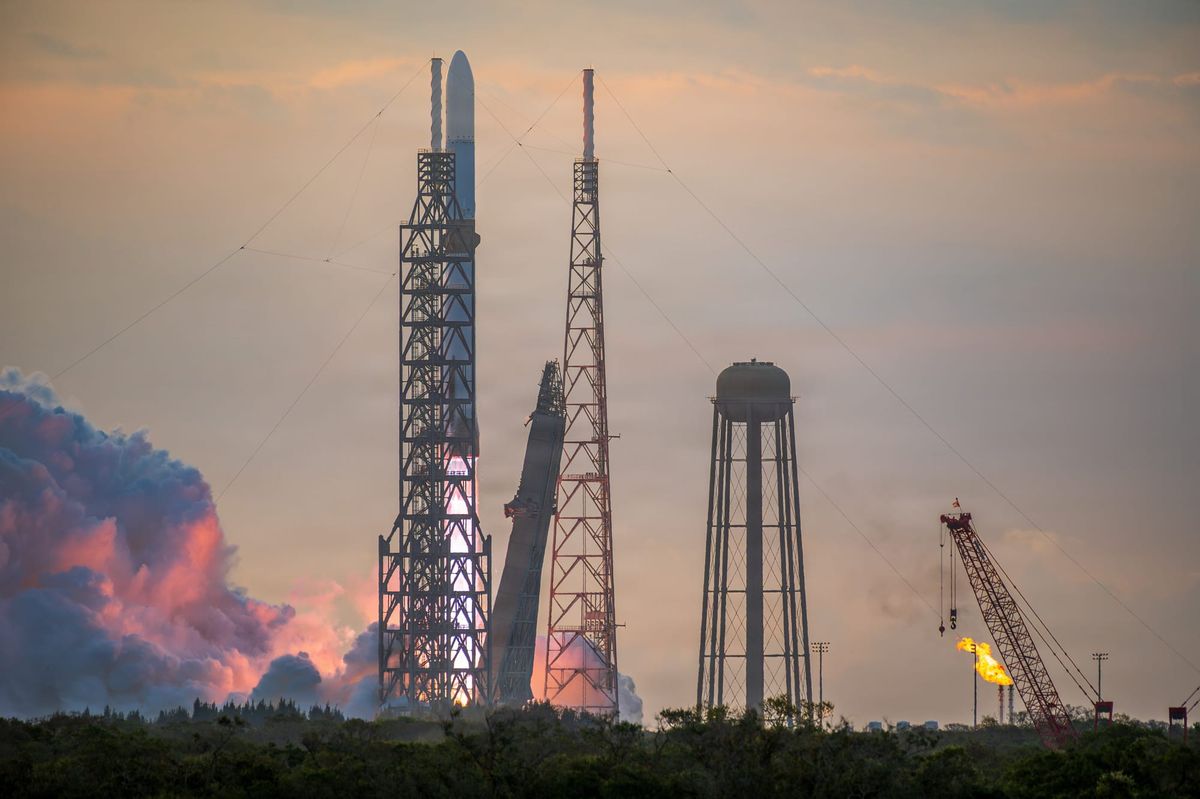
Blue Origin's New Glenn reached orbit on its maiden flight (NG-1) on January 16, 2025, and by April 2026 had demonstrated the two capabilities that define the modern launch business: orbital insertion and reuse of a recovered first stage [1][2][3]. The vehicle is a 98-meter, 7-meter-diameter, two-stage partially reusable heavy-lift rocket powered by seven BE-4 methalox engines on the first stage and two hydrolox BE-3U engines on the upper stage, advertised at 45 metric tons to low Earth orbit (LEO) and more than 13 metric tons to geostationary transfer orbit (GTO) [1][4]. As of late May 2026, however, the program sits at an inflection point that is as much a crisis as a milestone: on May 28, 2026, a fully fueled New Glenn vehicle exploded during a static-fire test at Launch Complex 36 (LC-36), destroying the booster and upper stage and severely damaging Blue Origin's only operational orbital launch pad [5].
The "7×2" and "9×4" designations are confirmed by the manufacturer to be distinct vehicle configurations named for their engine counts: 7×2 denotes seven BE-4s on the booster and two BE-3Us on the upper stage (the operational vehicle); 9×4 denotes a planned super-heavy variant with nine BE-4s and four BE-3Us and an 8.7-meter fairing, announced November 20, 2025 [6][7][8]. The 9×4 is an announced, not demonstrated, capability with no published payload chart, mass, or firm service date [6][7].
1.2 Principal judgments
The central strategic fact about New Glenn is that demonstrated capability and announced capability diverge sharply. Orbital insertion (twice) and booster landing and reflight (NG-2 and NG-3) are demonstrated; high cadence, second-stage reliability, routine engine reuse, and the entire 9×4 vehicle are not [1][2][3]. The April 2026 NG-3 upper-stage failure that stranded AST SpaceMobile's BlueBird 7 satellite, followed five weeks later by the catastrophic pad explosion, indicates that Blue Origin's principal technical risk has migrated from the first stage (now relatively mature) to the upper stage and ground operations [9][5].
The BE-4 engine is the single most strategically significant asset in this architecture because it powers two competing national-security launch vehicles, New Glenn and ULA's Vulcan Centaur, making Blue Origin both a launch competitor to ULA and ULA's sole engine supplier [10][11]. This dual role is a concentration risk for the U.S. assured-access-to-space posture: a BE-4 production or design problem propagates to both vehicles simultaneously.
1.3 Most consequential uncertainties
The most consequential uncertainties are: (1) how long LC-36 will be out of service and whether the May 2026 anomaly traces to the BE-4 propulsion system, which would implicate Vulcan as well; (2) whether Blue Origin can reach the cadence (8–12 flights per year near-term, 100 long-term) its manifest and economics require; and (3) whether the 9×4 will be funded and flown, given that Blue Origin is, for the first time, seeking external capital [5][12][13].
New Glenn, the 7×2/9×4 Configurations, the BE-4 Engine, and Blue Ring: A Strategic Assessment of Blue Origin's Orbital Architecture
1. Summary
- 1.1 Principal findings
- 1.2 Principal judgments
- 1.3 Most consequential uncertainties
2. Background and Strategic Context
- 2.1 Origins of the program
- 2.2 Corporate position and ownership
- 2.3 Long-term objectives and the reusable-launch market
3. Key Players and Stakeholders
- 3.1 Blue Origin and parent ownership
- 3.2 Principal customers
- 3.3 Competitors and their vehicles
- 3.4 Suppliers and government bodies
4. Technical and Operational Assessment
- 4.1 New Glenn vehicle architecture
- 4.2 Recovery and reuse concept of operations
- 4.3 Flight history and demonstrated cadence
- 4.4 The 7×2 and 9×4 configurations
- 4.5 The BE-4 engine
- 4.6 Blue Ring platform
5. Economic and Market Dynamics
- 5.1 Cost structure and price positioning
- 5.2 Addressable market, contracts, and backlog
- 5.3 Manufacturing capacity and constraints
- 5.4 Comparative unit economics
6. Regulatory Landscape
- 6.1 FAA launch and reentry licensing
- 6.2 Mishap investigations
- 6.3 National-security certification
- 6.4 Export control, spectrum, and orbital debris
7. Geopolitical and Strategic Dimensions
- 7.1 Assured access and the BE-4 industrial-base dependency
- 7.2 The shared-engine paradox
- 7.3 Allied and adversary capabilities
8. Strategic Recommendations
- 8.1 For institutional investors and corporate strategists
- 8.2 For defense and government program planners
9. Caveats and Limitations
References
2. Background and Strategic Context
2.1 Origins of the program
Blue Origin was founded in 2000 by Jeff Bezos and operated for its first decade with minimal public disclosure, funded almost entirely by Bezos's personal wealth [14]. The company began orbital-class engine work (BE-4) around 2011–2012 and publicly declared its orbital launch intentions in September 2015, releasing the New Glenn design and name in September 2016 [10][15]. The vehicle is named for John Glenn, the first American to orbit Earth. The first stage was unveiled on the pad in February 2024, and NG-1 launched January 16, 2025, roughly four years later than the company's original 2020 target and after multiple slips [15].
Bezos's funding model is direct and unusual. At the 33rd Space Symposium on April 5, 2017, he stated: "My business model right now for Blue Origin is I sell about $1 billion of Amazon stock a year and I use it to invest in Blue Origin" [16]. By 2024–2026 the company employed roughly 11,000 people, and reporting indicated Bezos had invested at least $10 billion cumulatively [17][18].
2.2 Corporate position and ownership
Blue Origin remains privately held, controlled by Bezos through Bezos Expeditions [19][18]. Industry estimates of its valuation have ranged widely, from $50 billion to $100 billion, though no audited figure exists [19]. In a consequential 2026 development, CEO Dave Limp told staff the company was preparing to accept outside investment for the first time, explicitly because reaching its launch-cadence targets would require "more money than would be available with just one investor" [12][13]. This shift was timed against SpaceX's anticipated mega-IPO [13].
2.3 Long-term objectives and the reusable-launch market
Blue Origin frames New Glenn as infrastructure for its stated vision of "millions of people living and working in space," with lunar ambitions pursued through the Blue Moon lander family [20][21]. On May 19, 2023, NASA awarded Blue Origin a crew-capable lunar-lander contract valued at $3,419,345,052.35 (roughly $3.4 billion) for Artemis V, then targeted for 2029 [22]. New Glenn is the designated launch vehicle for the Blue Moon Mark 1 robotic cargo lander [15].
New Glenn enters a market whose economics were redefined by SpaceX's demonstration that first-stage reuse inverts the cost structure of launch [23]. SpaceX marked its 600th orbital-class landing on April 19, 2026, and flew 165 Falcon launches in 2025, a sixth consecutive annual record [24][25]. New Glenn, Vulcan, Neutron, and Ariane 6 are all responses to that inversion, but only New Glenn and Falcon Heavy are currently operating heavy-lift vehicles with a reusable first stage [26].
3. Key Players and Stakeholders
3.1 Blue Origin and parent ownership
Blue Origin Enterprises, L.P. is headquartered in Kent (Kirkland), Washington, and is led by CEO Dave Limp, who joined in 2023 from Amazon (NASDAQ: AMZN), where he ran the Project Kuiper program [14][27]. Bezos founded both companies; Amazon and Blue Origin are legally separate but overlap on Orbital Reef and on Amazon Leo (formerly Project Kuiper) launch services [18].
3.2 Principal customers
The anchor commercial customer is Amazon (NASDAQ: AMZN), whose Project Kuiper / Amazon Leo constellation contracted 12 New Glenn launches with options for 15 more in April 2022, part of an 83-launch deal that also included Arianespace and United Launch Alliance [28][29][30]. In January 2026 Amazon disclosed it had purchased 12 additional New Glenn launches and 10 additional Falcon 9 launches [31]. Other named customers include AST SpaceMobile (NASDAQ: ASTS), whose BlueBird 7 satellite was lost on NG-3; Telesat (NASDAQ/TSX: TSAT), which signed a multi-launch agreement in 2019 for its Lightspeed constellation; NASA, which flew ESCAPADE on NG-2 and paid roughly $20 million for that launch; and Viasat (NASDAQ: VSAT), which flew a HaloNet communications demonstration on NG-2 [32][33][21][34].
3.3 Competitors and their vehicles
The competitive set includes SpaceX (Falcon 9, Falcon Heavy, Starship); United Launch Alliance, the Boeing (NYSE: BA) and Lockheed Martin (NYSE: LMT) joint venture flying Vulcan Centaur; Rocket Lab (NASDAQ: RKLB), whose medium-lift Neutron targets a Q4 2026 debut; Arianespace (Ariane 6); and Chinese state contractor CASC with the Long March family [26][35][36]. Northrop Grumman (NYSE: NOC) is a national-security launch and satellite stakeholder. Satellite operators SES, Intelsat, and others constitute the GTO customer base New Glenn targets.
3.4 Suppliers and government bodies
Blue Origin is unusually vertically integrated, building its own BE-3 and BE-4 engines [37]. The principal external industrial relationship runs the other direction: Blue Origin supplies BE-4 engines to ULA. Key government stakeholders are the U.S. Space Force's Space Systems Command (SSC), which runs National Security Space Launch (NSSL) certification and procurement; NASA; the FAA's Office of Commercial Space Transportation, which licenses launch and reentry; and the Defense Innovation Unit (DIU) and DARPA, which sponsored Blue Ring's early development [38][39].
4. Technical and Operational Assessment
4.1 New Glenn vehicle architecture
New Glenn stands 98 meters (322 feet) tall with a 7-meter-diameter core [1][15]. The first stage (GS1) is powered by seven BE-4 engines burning liquid oxygen and liquefied natural gas, producing a combined liftoff thrust originally cited at about 3.9 million lbf (roughly 17,100 kN) [1][4]. The expendable second stage (GS2) uses two restartable BE-3U engines burning liquid oxygen and liquid hydrogen, a high-specific-impulse combination optimized for high-energy orbits [4][15]. The 7-meter payload fairing offers roughly twice the volume of standard 5-meter-class fairings, a genuine differentiator for bulky payloads and megaconstellation stacks [4][28]. Published payload performance is 45,000 kg to LEO and more than 13,000 kg to GTO [1][4].
4.2 Recovery and reuse concept of operations
The first stage is designed for a minimum of 25 flights and lands downrange on the Atlantic aboard a landing platform vessel named Jacklyn [1][37]. The naming history is instructive. Blue Origin originally bought a roll-on/roll-off ferry (formerly Sea Chieftain) in 2018, named it Jacklyn after Bezos's mother, spent roughly four years attempting to convert it into an underway landing ship, then scrapped that vessel in 2022 and commissioned a purpose-built barge (Landing Platform Vessel 1), transferring the name Jacklyn to it [40][41][42]. The barge holds position autonomously, is towed by the support ship Harvey Stone, and uses a recovery ROV and remotely controlled transport stands; boosters are returned to Port Canaveral and rotated horizontal via a break-over fixture [43].
4.3 Flight history and demonstrated cadence
- NG-1 (Jan 16, 2025): Reached orbit on the first attempt, injecting the Blue Ring Pathfinder into medium Earth orbit; the first stage was lost on descent at approximately Mach 5.5 and 84,226 ft when engines failed to relight for the reentry burn [1][3][44]. The FAA-overseen mishap investigation closed March 31, 2025, identifying inability to restart the engines as the proximate cause and seven corrective actions [39].
- NG-2 (Nov 13, 2025): Deployed NASA's twin ESCAPADE Mars probes (built by Rocket Lab) and achieved the first successful New Glenn booster landing on Jacklyn, making Blue Origin the second entity after SpaceX to orbit a payload while recovering the booster [1][21][45].
- NG-3 (Apr 19, 2026): Reflew the NG-2 booster ("Never Tell Me the Odds"), demonstrating booster reuse and a second landing, but the upper stage malfunctioned: a cryogenic leak froze a hydraulic line, one BE-3U failed to reach full thrust, and AST SpaceMobile's BlueBird 7 was stranded in an unusable orbit and subsequently de-orbited [9][46][47]. Notably, all seven BE-4 engines on the reflown booster were new; Blue Origin elected to replace them and test upgrades, so the reuse was partial [9][48].
- NG-4 (planned, ~June 2026): Intended to carry 48 Amazon Leo satellites, the first of 24 Leo launches; the vehicle was destroyed in the May 28, 2026 static-fire explosion before flight [5][27].
Demonstrated cadence is therefore three flights in roughly 15 months, against a stated near-term ambition of 8–12 launches per year and a long-term target of 100 per year [23][13]. The gap between demonstrated and claimed cadence is the single largest operational question facing the program.
4.4 The 7×2 and 9×4 configurations
Blue Origin has resolved what was previously ambiguous nomenclature: the designations refer to engine counts per stage. The operational vehicle is the 7×2 (seven BE-4, two BE-3U) [7][8]. On November 20, 2025, days after NG-2, Blue Origin announced the New Glenn 9×4, a super-heavy variant with nine BE-4 first-stage engines, four BE-3U upper-stage engines, and an enlarged 8.7-meter fairing [6][7][8]. The company claims the 9×4 will deliver more than 70 metric tons to LEO, more than 14 metric tons direct to geosynchronous orbit, and more than 20 metric tons to trans-lunar injection [6][7]. Blue Origin stated both vehicles will "serve the market concurrently" [7].
Alongside the 9×4, Blue Origin announced upgrades to the existing vehicle: increasing total first-stage thrust from 3.9 million to 4.5 million lbf by raising each BE-4 from 550,000 to 640,000 lbf, raising combined BE-3U upper-stage thrust from 320,000 to 400,000 lbf, and adding a reusable fairing, a lower-cost tank design, and an improved thermal protection system [7][8][49]. Critically, the 9×4 is an announced capability only: Blue Origin has published no payload chart, total length, liftoff mass, or firm service date, and provided no official timeline, though media reports suggested a possible 2027 entry [6][7]. A CEO-posted scaled comparison depicted the 9×4 as taller than the Saturn V, but no finalized engineering drawing has been released [6][8]. All 9×4 performance figures should be treated as vendor projections.
4.5 The BE-4 engine
The BE-4 is the first large oxygen-rich staged-combustion engine designed and flown in the United States, burning methane (LNG) and liquid oxygen [10][11]. Its original rating was approximately 550,000 lbf (about 2,400 kN) at sea level; in the November 2025 upgrade announcement Blue Origin stated the engine had demonstrated 625,000 lbf on the test stand and would reach 640,000 lbf, with propellant subcooling driving the increase [7][11]. The published deep-throttle floor is 220,000 lbf, and each engine is designed to be reusable [50]. Development began around 2011; the first hot-fire occurred in October 2017, and a BE-4 exploded during testing in mid-2023, damaging a test stand [10]. The engine first flew on ULA's Vulcan (January 8, 2024) before it flew on New Glenn (January 16, 2025) [10].
Production is concentrated at Blue Origin's roughly $200 million Huntsville, Alabama factory, opened February 17, 2020, and tested at NASA Marshall's historic Test Stand 4670 [51][52]. At opening, the factory's stated capacity was 42 engines per year split roughly evenly between the BE-4 and BE-3U, a rate the company expected to take two to three years to reach [53]. Bezos subsequently told a 2025 facility tour that the company would build a BE-4 "every three days," implying roughly 120 per year, though this is a forward-looking target rather than a verified achieved rate [54]. New Glenn uses seven BE-4s per booster; Vulcan uses two per booster [10][53]. By August 2025, ULA CEO Tory Bruno indicated Blue Origin's deliveries had caught up to ULA's needs, joking that Blue Origin "might be an engine or two ahead," a marked reversal from the years of delays that had earlier plagued the program and pushed Vulcan's first flight years past its 2017 engine-readiness promise [11][55]. Engine reuse remains undemonstrated in practice: on NG-3, the first booster reflight, all seven BE-4s were replaced rather than reused [9][48].
4.6 Blue Ring platform
Blue Ring is Blue Origin's multi-orbit logistics, transportation, and hosting spacecraft, unveiled in October 2023 [56]. It is a hybrid solar-electric and chemical-propulsion platform that the company says provides 3,000–4,000 m/s of delta-v and can host more than 3,000 kg of payload (up to roughly 4,000 kg depending on orbit) across 13 ports: 12 ESPA and ESPA Grande radial ports rated to 500 kg each, plus one forward adapter for a primary payload up to about 2.5 metric tons [57][58][59][60]. It is designed to provide hosting, transportation, refueling, data relay, and in-space cloud computing from MEO through cislunar space [56].
The command-and-control architecture comprises in-space data processing, telemetry, tracking and command (TT&C) hardware, and ground-based radiometric tracking; Blue Origin selected ATLAS Space Operations for ground-segment support for the DarkSky-1 mission, using ATLAS's federated network of 7-meter antennas [61][62]. The Blue Ring Pathfinder flew on NG-1 as a non-separating payload affixed to the second stage, validating communications, TT&C, and ground tracking over a roughly six-hour mission [63][44].
Blue Ring's development is anchored by the Defense Innovation Unit, which selected the DarkSky-1 (DS-1) mission to demonstrate commercial orbital-logistics services and access beyond LEO under a 2024 contract; the first operational mission was targeted for a 2026 national-security launch [58][60][62]. A Blue Origin executive characterized the platform as built for the national-security community for "rapid approach against our adversaries on orbit," while noting growing civil interest including from NASA [60].
On the DARPA relationship: Blue Origin received a Phase 1 DRACO study contract of about $2.5 million in April 2021 (alongside Lockheed Martin and General Atomics), but DRACO was a nuclear-thermal-propulsion demonstrator, separate from Blue Ring, and was cancelled in mid-2025 when NASA's FY2026 budget zeroed nuclear-propulsion funding and DARPA concluded that falling launch costs had undermined the cost-benefit case [64][65].
 John D
5. Economic and Market Dynamics
5.1 Cost structure and price positioning
Blue Origin has never published a New Glenn list price. Third-party estimates cluster between $55 million and $90 million per launch, with a frequently cited figure of $68 million attributed to a rival (Arianespace) estimate [66][67][68][69]. At roughly $68 million for 45 metric tons to LEO, New Glenn would offer about twice Falcon 9's expendable LEO mass for a comparable price, with twice the fairing volume [68]. That nominal price-per-kilogram advantage is, however, contingent on routine reuse and cadence that remain unproven, and on a second stage whose reliability is now in question after NG-3 [9].
5.2 Addressable market, contracts, and backlog
New Glenn's backlog is substantial on paper. The Amazon Leo manifest alone is 24 firm launches (12 original plus 12 added in January 2026), plus options [31][27]. Telesat (2019) and AST SpaceMobile (2024) add commercial backlog [33][32]. On the government side, on April 4, 2025 the Space Force awarded New Glenn an NSSL Phase 3 Lane 2 contract as the third (Requirement 3) provider, projected at seven missions worth nearly $2.4 billion, with first assignment no earlier than FY2027 because the vehicle is not yet certified; the same award gave SpaceX nearly $5.9 billion (28 missions) and ULA nearly $5.4 billion (19 missions), across 54 launches from FY25 to FY29 [70][38][71]. New Glenn was previously approved for the less demanding Lane 1 in June 2024 [70]. In the FY2026 (Order Year 2) assignments announced October 2025, Blue Origin received zero missions, with all seven going to SpaceX (five, for $714 million) and ULA (two, for $428 million), explicitly because New Glenn remains uncertified [72][73][38].
5.3 Manufacturing capacity and constraints
Blue Origin states multiple New Glenn vehicles are in production and that it is "building ahead of need" [74]. The binding constraint, however, is physical. As of late May 2026, LC-36 is the company's only operational orbital pad, and it was severely damaged in the static-fire explosion [5]. A planned West Coast pad at Vandenberg (announced April 14, 2026 as SLC-14, distinct from the earlier SLC-9 reference) is intended to add polar capability but is not yet operational [15]. The single-pad dependency is the program's most acute near-term economic vulnerability: the 2016 SpaceX SLC-40 explosion took over a year to fully restore even for a company with multiple pads [5].
5.4 Comparative unit economics
Against competitors, New Glenn's standing is mixed. Falcon 9's marginal cost on a reused booster is estimated at $15–20 million, a figure New Glenn cannot approach without comparable reuse cadence [26]. Vulcan is more expensive and only partially reusable (planned engine-pod recovery) [23]. Ariane 6 is expendable at a target $80–85 million for the Ariane 62 [26]. New Glenn's structural advantage is mass and volume per dollar; its structural disadvantage is that, with three flights in 15 months, it has demonstrated none of the cadence that makes reuse economically meaningful [23]. The Motley Fool's observation is apt: even 27 launches at roughly $70 million would not cover Blue Origin's estimated $2 billion annual payroll, underscoring that the program is not yet a self-sustaining business [17].
6. Regulatory Landscape
6.1 FAA launch and reentry licensing
New Glenn operates under a Part 450 commercial launch license issued by the FAA on December 27, 2024, with a roughly five-year term [39]. The license incorporated flight-safety-system reuse compliance provisions [39].
6.2 Mishap investigations
The FAA has overseen two mishap investigations. The NG-1 investigation closed March 31, 2025, attributing the booster loss to engine-restart failure and requiring seven corrective actions before NG-2 [39]. The NG-3 investigation closed on or about May 22, 2026; the FAA identified the direct cause as a cryogenic leak that froze a hydraulic line and caused a thrust anomaly in the second-stage burn, with nine corrective actions implemented [46][39]. Significantly, the FAA confirmed the May 28, 2026 static-fire pad explosion was "not within the scope of FAA licensed activities" and would not trigger a new FAA investigation, leaving that inquiry to Blue Origin and the Space Force's Space Launch Delta 45 [5][39].
6.3 National-security certification
NSSL certification for Lane 2 requires demonstration flights, major subsystem reviews, and payload-interface verification, and Blue Origin's certification was still in progress as of mid-2026 [38]. NG-1 and NG-2 were designated certification flights; the NG-3 upper-stage failure and the NG-4 pad loss are likely to extend the timeline [74][9][5].
6.4 Export control, spectrum, and orbital debris
New Glenn and Blue Ring are subject to ITAR/EAR export-control regimes governing launch-vehicle and spacecraft technology. Blue Ring's operations across MEO, GEO, and cislunar space implicate FCC spectrum licensing for its communications payloads and TT&C links, as well as orbital-debris mitigation rules; though public sourcing on Blue Ring's specific FCC filings and debris plans is limited.
7. Geopolitical and Strategic Dimensions
7.1 Assured access and the BE-4 industrial-base dependency
The U.S. policy of assured access to space rests on maintaining at least two independent launch providers for national-security payloads, currently SpaceX and ULA, with Blue Origin as the intended third [38][72]. The BE-4 engine creates a hidden coupling in this architecture: both Vulcan and New Glenn depend on it, and both are built around no alternative engine [10][11]. Trade reporting after the May 2026 explosion noted that if the anomaly traced to the BE-4 propulsion system, it "might have a direct impact" on Vulcan, making the dependency concrete [5]. A common-mode BE-4 failure could ground two of the three NSSL providers at once, an industrial-base concentration that policymakers should weigh against the competitive benefits of a shared engine line.
7.2 The shared-engine paradox
Blue Origin is simultaneously ULA's competitor (for NSSL and commercial launches) and its sole engine supplier. ULA CEO Tory Bruno publicly accepted this dependency, and by 2025 reported that Blue Origin's deliveries had caught up to ULA's needs [11]. The arrangement is mutually constraining: Blue Origin must prioritize a competitor's engines, while ULA's flight rate is hostage to a rival's factory. This is an unusual and fragile industrial structure with few precedents in defense procurement.
7.3 Allied and adversary capabilities
China's state contractor CASC is developing the partially reusable super-heavy Long March 9 (targeted around 2030–2033, 150 metric tons to LEO) and the Long March 10/10A crew and lunar rockets (Long March 10A debut targeted 2026), alongside commercial reusable efforts from LandSpace (Zhuque-3) and others [36][35][75]. None has yet demonstrated Falcon-class reuse, but China's launch cadence (50+ per year) and military-civil fusion give it a fast-closing trajectory [23][76]. The U.S. "Golden Dome" missile-defense initiative was cited by Blue Origin as a driver for the 9×4's heavy-lift capacity, linking the variant explicitly to national-security architecture [7]. New Glenn's eventual certification matters for resilience: a third certified heavy-lift provider reduces U.S. dependence on SpaceX, whose 2025 dominance (about 60 percent of Phase 3 Lane 2 launches and the entirety of the FY2026 assignments) is itself a concentration concern [72][73].
8. Strategic Recommendations
8.1 For institutional investors and corporate strategists
Treat Blue Origin as a pre-cash-flow infrastructure bet whose value hinges on cadence, not capability. The capability questions (can it reach orbit, can it land and reuse a booster) are largely answered; the business questions (can it fly 8–12 then 100 times per year, can it make the upper stage reliable, can it restore LC-36 quickly) are not [1][9][5][23]. Specific guidance:
- Anchor any valuation to demonstrated annualized cadence, not manifest backlog. The backlog (24+ Amazon Leo launches, NSSL, Telesat, AST) is real but unpriced and contingent; a manifest is not revenue [31][70].
- Watch three benchmarks that should change the thesis: (1) the LC-36 return-to-flight timeline (a multi-quarter outage materially impairs the Amazon Leo deployment and NSSL certification); (2) a successful, fully reused booster including reused engines (NG-3 replaced all seven, so engine reuse remains undemonstrated) [9]; and (3) two consecutive clean upper-stage performances after the NG-3 cryogenic-leak fix [46].
- The pending external funding round is a double signal: it de-risks the balance sheet but confirms that Bezos's self-funding is insufficient for the cadence targets [12][13]. Price the dilution and the execution risk together.
- For public-market proxies, AMZN's Amazon Leo exposure and RKLB (Neutron, and the ESCAPADE spacecraft builder) offer liquid, if imperfect, ways to express launch-market views; ULA's BE-4 dependency makes Boeing (BA) and Lockheed Martin (LMT) indirect stakeholders in Blue Origin's engine line [21][10].
8.2 For defense and government program planners
Hedge the BE-4 common-mode risk and resist over-rotating to a single dominant provider. Specific guidance:
- Require, as a condition of NSSL Phase 3 certification milestones, transparency into BE-4 production-line segregation and root-cause findings from the May 2026 anomaly, precisely because a propulsion-related cause would implicate Vulcan [5]. Until the root cause is public, treat Vulcan and New Glenn availability as correlated, not independent, for contingency planning.
- Preserve the three-provider Lane 2 structure even though Blue Origin received zero OY2 missions; the strategic value of a third certified heavy-lift provider is resilience against SpaceX concentration, which is now the dominant single-point dependency in the NSSL portfolio [73][38].
- For Blue Ring and on-orbit mobility, sustain DIU/Space Force funding through demonstrated operational flights, but do not assume the 2026 operational mission timeline given the pad loss; build schedule margin [60][5].
- Factor New Glenn's single-pad fragility into assured-access war-gaming. Until SLC-14 at Vandenberg is operational, a single LC-36 event removes New Glenn entirely, unlike SpaceX's multi-pad redundancy [15][5].
- Track China's reusable-launch trajectory as the pacing threat: the relevant metric is not first flight but sustained reuse cadence, which neither CASC nor Chinese commercial firms have yet demonstrated but are funding aggressively [76].
9. Caveats and Limitations
This assessment was prepared in late May 2026, days after the LC-36 explosion, and the root cause of that anomaly was unknown at the time of writing; conclusions about Vulcan coupling are conditional [5]. All New Glenn 9×4 performance figures are unverified vendor projections with no published payload chart or service date [6][7]. Several cadence and production figures (8–12 launches/year, 100/year, "one BE-4 every three days," 42 engines/year) are stated targets, not demonstrated rates, and are flagged as such throughout [53][54][13].

References
- Wikipedia. 2026. "New Glenn." Accessed May 2026. https://en.wikipedia.org/wiki/New_Glenn.
- New Space Economy. 2026. "Blue Origin's New Glenn Rocket Achieves Landmark Booster Reuse on Third Flight, But Payload Enters Off-Nominal Orbit." April 19. https://newspaceeconomy.ca/2026/04/19/.
- Wall, Mike. 2025. "Jeff Bezos' Blue Origin Launches Massive New Glenn Rocket into Orbit on 1st Flight." Space.com, January 16. https://www.space.com/.
- Blue Origin. 2026. "New Glenn." Accessed May 2026. https://www.blueorigin.com/new-glenn.
- Clark, Stephen. 2026. "Blue Origin's New Glenn Rocket Explodes During Prelaunch Testing at Cape Canaveral." Spaceflight Now, May 29. https://spaceflightnow.com/2026/05/29/.
- Foust, Jeff. 2025. "Blue Origin Announces New Glenn Upgrade Plans." SpaceNews, November 20. https://spacenews.com/blue-origin-announces-new-glenn-upgrade-plans/.
- Teslarati. 2025. "Blue Origin Announces Super-Heavy New Glenn 9x4 to Rival SpaceX Starship." November. https://www.teslarati.com/.
- IFLScience. 2025. "Blue Origin's Latest New Glenn Rocket Upgrade Reveals It Will Take On SpaceX's Starship In Height." November. https://www.iflscience.com/.
- Foust, Jeff. 2026. "Third New Glenn Launch Suffers Upper Stage Malfunction." SpaceNews, April 19. https://spacenews.com/third-new-glenn-launch-suffers-upper-stage-malfunction/.
- Wikipedia. 2026. "BE-4." Accessed May 2026. https://en.wikipedia.org/wiki/BE-4.
- United Launch Alliance. 2015. "BE-4 Rocket Engine Fact Sheet." https://www.ulalaunch.com/docs/default-source/news-items/be-4_fact_sheet_web_final_2.pdf.
- Boyle, Alan. 2026. "Jeff Bezos' Blue Origin Space Venture Reportedly Considers Seeking Outside Investment for the First Time." GeekWire, May. https://www.geekwire.com/2026/jeff-bezos-blue-origin-outside-investment/.
- BigGo Finance. 2026. "Blue Origin Opens Doors to Outside Investors for First Time, Eyeing 100 Launches Per Year." May 16. https://finance.biggo.com/.
- Wikipedia. 2026. "Blue Origin." Accessed May 2026. https://en.wikipedia.org/wiki/Blue_Origin.
- Wikipedia. 2026. "New Glenn (program history and configurations)." Accessed May 2026. https://en.wikipedia.org/wiki/New_Glenn.
- Boyle, Alan. 2017. "Bezos Reveals Blue Origin Funding Model." Cited via NASA Watch, "Blue Origin Reveals Some Cost Numbers." https://nasawatch.com/commercialization/blue-origin-reveals-some-cost-numbers/.
- Caporal, Jack. 2024. "How Much Is Billionaire Jeff Bezos Spending on Blue Origin?" The Motley Fool, September 21. https://www.fool.com/.
- StockAnalysis. 2026. "Can You Invest in Blue Origin Stock in 2026?" https://stockanalysis.com/article/invest-in-blue-origin-stock/.
- Bitget. 2025. "Blue Origin Stock Price: Can You Invest in Jeff Bezos's Space Venture?" https://www.bitget.com/wiki/blue-origin-stock-price.
- SpaceTalent / Blue Origin. 2025. "Ground Software Engineer II – Blue Ring (Clearance)." https://jobs.spacetalent.org/companies/blue-origin/.
- NASA. 2025. "NASA, Blue Origin Launch Two Spacecraft to Study Mars, Solar Wind." November 13. https://www.nasa.gov/news-release/.
- Spectrum News 13 (mynews13) and NASA. 2023. "NASA Selects Blue Origin for Artemis V Lunar Lander." May 19.
- SpaceDaily. 2026. "Why Landing a Rocket Now Costs Less Than Throwing One Away." https://spacedaily.com/.
- Wall, Mike. 2026. "SpaceX Shatters Its Rocket Launch Record Yet Again — 165 Orbital Flights in 2025." Space.com.
- Wall, Mike. 2026. "600 Rocket Landings! SpaceX Notches Another Milestone." Space.com, April 19.
- SpaceOdysseyHub. 2026. "Launch Cost Comparison 2026: Falcon 9 vs Vulcan vs New Glenn vs Neutron." https://spaceodysseyhub.com/articles/launch-cost-comparison-2025.
- Boyle, Alan. 2026. "Blue Origin Readies New Glenn Rocket to Launch 48 Amazon Leo Satellites After FAA Clearance." GeekWire, May. https://www.geekwire.com/2026/blue-origin-new-glenn-rocket-amazon-leo-satellites/.
- Blue Origin. 2022. "Amazon Selects Blue Origin's New Glenn for up to 27 Project Kuiper Constellation Launches." https://www.blueorigin.com/news/amazon-selects-new-glenn-for-kuiper.
- Sheetz, Michael. 2022. "Amazon Signs Rocket Deal with Blue Origin, Arianespace, ULA for Project Kuiper Internet Satellites." CNBC, April 5. https://www.cnbc.com/2022/04/05/.
- Foust, Jeff. 2022. "Amazon Signs Multibillion-Dollar Project Kuiper Launch Contracts." SpaceNews, April 5. https://spacenews.com/amazon-signs-multibillion-dollar-project-kuiper-launch-contracts/.
- Wikipedia. 2026. "Amazon Leo." Accessed May 2026. https://en.wikipedia.org/wiki/Amazon_Leo.
- Wikipedia. 2026. "AST SpaceMobile / New Glenn manifest." Accessed May 2026. https://en.wikipedia.org/wiki/New_Glenn.
- Wikipedia. 2026. "Telesat." Accessed May 2026. https://en.wikipedia.org/wiki/Telesat.
- Gebhardt, Chris. 2025. "Blue Origin Launches ESCAPADE on New Glenn, Successfully Lands First Stage Booster." NASASpaceFlight.com, November. https://nasaspaceflight.com/2025/11/ng-2-escapade-launch/.
- Space.com. 2025. "Rocket Lab Delays Debut of Powerful, Partially Reusable Neutron Rocket to 2026." https://www.space.com/.
- Wikipedia. 2026. "Long March 9." Accessed May 2026. https://en.wikipedia.org/wiki/Long_March_9.
- Sacra. 2026. "Blue Origin Funding, News & Analysis." https://sacra.com/c/blue-origin/.
- Congressional Research Service. 2025. "Defense Primer: National Security Space Launch Program (IF12900)." Congress.gov. https://www.congress.gov/crs-product/IF12900.
- Federal Aviation Administration. 2025–2026. General Statements on New Glenn licensing and mishap investigations (NG-1 closure March 31, 2025; NG-3 closure ~May 22, 2026; May 28, 2026 static-fire statement). faa.gov; corroborated by Spaceflight Now and SpaceNews.
- Wikipedia. 2026. "Jacklyn (ship)." Accessed May 2026. https://en.wikipedia.org/wiki/Jacklyn_(ship).
- Wikipedia. 2026. "Jacklyn (LPV1)." Accessed May 2026. https://en.wikipedia.org/wiki/Jacklyn_(LPV1).
- Thompson, Mark. 2026. "Meet Jacklyn, the Barge That Changed Blue Origin's Plans." Universe Today. https://www.universetoday.com/.
- spaceOFFSHORE. 2026. "Jacklyn (LPV1) – Blue Origin Landing Platform Vessel." https://space-offshore.com/blue-origin/jacklyn/.
- Blue Origin. 2024. "Blue Ring Pathfinder Payload Ready for Launch; Blue Origin's New Glenn on Track for This Year." https://www.blueorigin.com/news/blue-ring-pathfinder-payload.
- Foust, Jeff. 2025. "New Glenn Launches NASA's ESCAPADE Mars Mission, Lands Booster." SpaceNews, November 13. https://spacenews.com/new-glenn-launches-nasas-escapade-mars-mission-lands-booster/.
- The Register. 2026. "Bezos Rocket Fell Short After Cryogenic Leak Cut Engine Thrust." May 26. https://www.theregister.com/science/2026/05/26/.
- Lapointe, Ellyn. 2026. "Blue Origin Offers an Explanation for Its Embarrassing Satellite Mishap." Gizmodo, April 23. https://gizmodo.com/.
- Clark, Stephen. 2026. "Blue Origin Launches Third New Glenn Rocket, but Payload Ends Up in Wrong Orbit." Spaceflight Now, April 20. https://spaceflightnow.com/2026/04/20/.
- Modern Engineering Marvels. 2025. "Blue Origin's New Glenn Lands, Readies Super-Heavy 9×4 Upgrade." December 1. https://modernengineeringmarvels.com/.
- Blue Origin. 2026. "Engines." Accessed May 2026. https://www.blueorigin.com/engines.
- Made in Alabama. 2020. "Blue Origin Officially Opens Alabama Rocket Engine Factory." February 18. https://www.madeinalabama.com/2020/02/.
- City of Huntsville. 2017. "Blue Origin Selects Huntsville for New BE-4 Production." https://www.huntsvilleal.gov/blue-origin-selects-huntsville-new-4-production/.
- Foust, Jeff. 2020. "Blue Origin Opens Rocket Engine Factory." SpaceNews, February 18. https://spacenews.com/.
- Payload Space. 2025. "Jeff Bezos Opens Up About New Glenn." https://payloadspace.com/.
- Berger, Eric, and SpaceNews staff. 2020–2025. "Tory Bruno Says the Challenges with BE-4 Are Real but the Engine Is Moving Forward." SpaceNews. https://spacenews.com/tory-bruno-says-the-challenges-with-be-4-are-real-but-the-engine-is-moving-forward/.
- Blue Origin. 2023. "Blue Origin Unveils Multi-Mission, Multi-Orbit Space Mobility Platform." https://www.blueorigin.com/news/blue-origin-unveils-space-mobility-platform.
- Blue Origin. 2026. "Blue Ring." Accessed May 2026. https://www.blueorigin.com/blue-ring.
- Grokipedia. 2026. "Blue Ring." Accessed May 2026. https://grokipedia.com/page/blue_ring.
- Wikipedia. 2026. "Blue Ring." Accessed May 2026. https://en.wikipedia.org/wiki/Blue_Ring.
- Erwin, Sandra. 2026. "Blue Origin Advances Blue Ring Spacecraft Toward 2026 National Security Mission." SpaceNews. https://spacenews.com/blue-origin-advances-blue-ring-spacecraft-toward-2026-national-security-mission/.
- ATLAS Space Operations. 2024. "ATLAS Space Operations to Support Blue Origin's Blue Ring DarkSky-1 Mission." May 1. https://atlasspace.com/.
- Boyle, Alan. 2024. "Blue Origin Plans to Test Blue Ring Space Platform on Pentagon's DarkSky-1 Mission." GeekWire. https://www.geekwire.com/2024/blue-origin-ring-darksky-1/.
- Space Voyaging. 2024. "Blue Ring Secures DoD Mission for Its Maiden Flight." March 21. https://www.spacevoyaging.com/news/2024/03/21/.
- Wikipedia. 2026. "Demonstration Rocket for Agile Cislunar Operations (DRACO)." Accessed May 2026. https://en.wikipedia.org/wiki/Demonstration_Rocket_for_Agile_Cislunar_Operations.
- Hitchens, Theresa. 2025. "DARPA's DRACO Nuclear Propulsion Project ROARs No More." Breaking Defense, June. https://breakingdefense.com/2025/06/.
- Ainvest. 2025. "Blue Origin's New Glenn Launch and Its Implications for the Space Economy." https://www.ainvest.com/.
- Lockett, Will. 2025. "Blue Origin Might Make Starship Obsolete." Medium. https://wlockett.medium.com/.
- Smith, Rich. 2025. "With New Glenn in Its Pocket, Can Blue Origin Compete with SpaceX and Starship?" The Motley Fool / Nasdaq, January 25. https://www.fool.com/investing/2025/01/25/.
- PatentPC. 2025. "Rocket Launch Costs (2020–2030): How Cheap Is Space Travel Becoming?" https://patentpc.com/blog/.
- Hitchens, Theresa. 2025. "Space Force Awards First Next-Gen Critical Launch Contracts to Blue Origin, SpaceX, ULA." Breaking Defense, April 4. https://breakingdefense.com/2025/04/.
- Via Satellite. 2025. "SpaceX, ULA, Blue Origin Receive NSSL Contracts Worth Up to Nearly $14B." April 6. https://www.satellitetoday.com/launch/2025/04/06/.
- Foust, Jeff. 2025. "SpaceX Lands Majority of U.S. National Security Launches Awarded for Fiscal Year 2026." SpaceNews, October. https://spacenews.com/.
- Albon, Courtney. 2025. "Space Force Awards ULA, SpaceX $1 Billion for Seven Launches." Air & Space Forces Magazine, October 3. https://www.airandspaceforces.com/.
- Blue Origin. 2025. "New Glenn Launches NASA's ESCAPADE, Lands Fully Reusable Booster." November 13. https://www.blueorigin.com/news/new-glenn-launches-nasa-escapade-lands-fully-reusable-booster.
- Jones, Andrew. 2024. "China's New Rocket for Crew and Moon to Launch in 2026." SpaceNews. https://spacenews.com/chinas-new-rocket-for-crew-and-moon-to-launch-in-2026/.
- Defense One. 2025. "China Is Working on Reusable Rockets—and a Strategic Leap in Space Power." August. https://www.defenseone.com/ideas/2025/08/.