Gentung Browns Lake Tungsten Mine (2026): Non-China Supply, Defense Demand, and Allied Tungsten Reindustrialization
Gentung–Browns Lake offers investors a strategic U.S. tungsten restart tied to defense demand, but permitting and technical gaps remain.

Summary
Gentung is strategically important, geologically credible, and financially supportable at the corporate level, but still not publicly demonstrated as fully “construction-ready”. Almonty completed the acquisition in November 2025 through two transactions: one for U.S. Tungsten, which held the project rights, and one for Apex, which held additional assets including a plant permit, water rights, and processing equipment. Almonty’s public filings describe Gentung as an advanced U.S. undeveloped tungsten asset, and management has repeatedly targeted production readiness in the second half of 2026. [1]
The strongest independently reviewable technical foundation is the 2012 NI 43-101 technical report for the deposit. That report estimated 7.53 million tonnes at 0.315% WO3 at a 0.10% cutoff, including measured, indicated, and inferred resources, equal to roughly 23,720 tonnes of contained WO3 by calculation. It also argues the deposit is amenable to room-and-pillar underground mining in competent garnet skarn. However, the same report is explicit that no mineral reserves had been established, and that geotechnical work and a feasibility study were still needed to convert resources into mineable reserves. [2]
That tension is central to the project’s investment case. On one side, Gentung sits in a favorable macro backdrop: tungsten remains on the U.S. critical minerals list, the U.S. has had no domestic mine production since 2015, the Department of Defense’s sourcing restrictions tighten again on January 1, 2027, and tungsten prices have risen sharply amid Chinese export controls and broader supply stress. Almonty itself is well financed: it had C$259.9 million in cash on March 31, 2026, and had allocated US$32.1 million from its December 2025 offering to Gentung, of which US$1 million had been spent by March 31, 2026. [3]
On the other side, the main unresolved question is execution maturity, not mineral endowment. Public corporate materials say the biggest barrier is permitting and administration, not technical knowledge or financing. That is plausible for a U.S. project on unpatented claims with federal and state oversight, but public, project-specific operating-permit or federal plan-of-operations record could not be found. As such, the project rights are over unpatented mining claims, surface-management and environmental permitting remain highly consequential. [4]
Relative to other U.S. tungsten projects, Gentung compares well on grade and near-term restart logic, but less well on freshness of public technical disclosure. Compared with Nevada’s Pilot Mountain, which now has a current 2026 Pre-Feasibility Study (PFS), updated resource and reserve statement, and a stated first-ore target of Q4 2028, Gentung appears more like a potentially faster brownfield restart if permitting and technical updates are completed promptly, but currently has a weaker publicly filed modern engineering basis. Compared with Idaho’s IMA mine, Gentung has a larger modern compliant resource base, while IMA remains in active drilling and is still relying on historical non-compliant tungsten estimates plus ongoing drilling aimed at a modern resource. [5]
 NAM Staff
Conclusion: Gentung is a real and potentially significant U.S. tungsten restart candidate, but its public disclosure package still leaves a bankability gap. The most important next step is an updated technical report, plus a project-by-project permit status map and a realistic milestone schedule. Until that appears, the project is better described as strategically promising and plausibly near-term, rather than definitively shovel-ready. [6]
Editorial note regarding an apparent unit-transcription error and disclosure-quality concern:
Almonty’s Gentung–Browns Lake Project is the same Montana property described as the Lentung Tungsten & Garnet Deposit in its 2012 technical report; it is unrelated to the separate Lentung project in Canada. The 2012 report states the resource as 7.53 million short tons, equal to approximately 6.83 million metric tonnes. Almonty’s webpage appears to repeat the 7.53 figure while mistakenly labeling it as metric tonnes, so this report uses the correct, converted figure of 6.83 million metric tonnes [ ! ]
|
Executive Takeaway |
Assessment |
Basis |
|
Strategic importance |
High |
U.S. critical mineral; no U.S. mine since 2015; tighter DoD sourcing
rules start 2027; supply chain stress from China. [7] |
|
Geological credibility |
High |
2012 NI 43-101 resource of 7.53 Mt @ 0.315% WO3; competent skarn
suited to room-and-pillar. [8] |
|
Corporate funding capacity |
High |
C$259.9m cash at Mar. 31, 2026; US$32.1m allocated to Gentung from
Dec. 2025 raise. [9] |
|
Publicly verified technical maturity |
Moderate to low |
Latest verified foundational report is from 2012 and still
pre-reserve; company filings say further technical work and permitting are
required. [10] |
|
Permitting certainty |
Low visibility |
Company says permitting is the key gating item; official public
project-specific permit status was not clear in retrieved sources. [11] |
|
Overall rating |
Promising, but not yet publicly de-risked enough for a “fully ready”
label |
Synthesis of technical, regulatory, and financing evidence. [12] |
Scope, Assumptions, and Method
This report addresses several questions: what the asset is, how strong the resource is, what the likely mine-and-process route is, how close it seems to first production, how it compares with other U.S. tungsten projects, and which evidence gaps still matter most.
First, where current company commentary and older technical documents diverge in tone, this assessment prioritizes the older technical report for resource methodology and the newer corporate filings for ownership, financing, and current strategic intent. Second, because tungsten projects are highly sensitive to permitting, metallurgy, and schedule risk, missing public evidence is considered an analytical gap. [13] [14]
Almonty itself now describes the main barrier as administrative and permitting-related, while its own filings still acknowledge that the project remains subject to further technical work and permitting. [15]
Background and Strategic Context
Almonty completed the Gentung acquisition in November 2025 by purchasing U.S. Tungsten, Inc., which held the project rights, and Apex Garnet Inc., which held associated processing-side assets including a plant permit, water rights, and tungsten equipment. In Q1 2026 financial statements, Almonty recorded the Gentung acquisition as an asset acquisition with C$13.506 million allocated to exploration and evaluation assets, and the Apex transaction as a smaller asset acquisition for US$250,000. The Annual Information Form describes the company’s U.S. interest as the exclusive right to explore, develop, and mine certain unpatented tungsten mining claims in Beaverhead County. [16]
The legal structure is important, on U.S. lands, the Bureau of Land Management manages the subsurface mineral estate for mining claims, while the Forest Service manages the surface on National Forest System lands; in Montana, larger hard-rock mines also require a Department of Environmental Quality (DEQ) operating permit if disturbance exceeds five acres. Federal rules distinguish smaller “notice” activities from a full plan of operations, while the Forest Service separately requires an approved plan where operations will significantly disturb surface resources. Simply “owning the claims” is not the same thing as being cleared to restart a producing mine. [17] [39]
The current strategic argument for Gentung is unusually strong. Tungsten remains on the U.S. critical minerals list. The U.S. has not had domestic mine production since 2015, and the Department of Defense’s restrictions on certain tungsten inputs become tougher on January 1, 2027, expanding from “melted or produced” to “mined, refined, separated, melted, or produced” in covered countries. Reuters also reported that Chinese export controls, lower Chinese mined production, and military demand have pushed tungsten prices to multi-decade highs, tightening the market further. [18]
Almonty is explicitly trying to position itself in that geopolitical opening. It moved its corporate headquarters to Dillon, Montana in April 2026, telling investors that the move would place it closer to U.S. government agencies, defense contractors, and the Gentung project. In its June 2026 Montana-focused article, management said the district last produced tungsten in 1975, that the project retained underground workings, water rights, and the footprint of the old plant, and that the single biggest obstacle to reactivation was “administration,” meaning permitting. Those are directionally favorable signals, but they are still management disclosures rather than independent permit confirmations. [19]
Historically, the district was very productive. The 2012 technical report says the Ivanhoe mine and surrounding district produced significant tungsten for the U.S. strategic stockpile, including 625,107 tons of ore from the Ivanhoe operation yielding concentrate sold to the stockpile, plus 21,150 tons from Lost Creek; it also notes General Electric (NYSE:GE) rebuilt the mill and operated an APT circuit until 1975. That production history strengthens the brownfield-restart thesis because it implies a validated district, a prior processing route, and proven logistical access. [20]
Resource Quality and Technical Basis
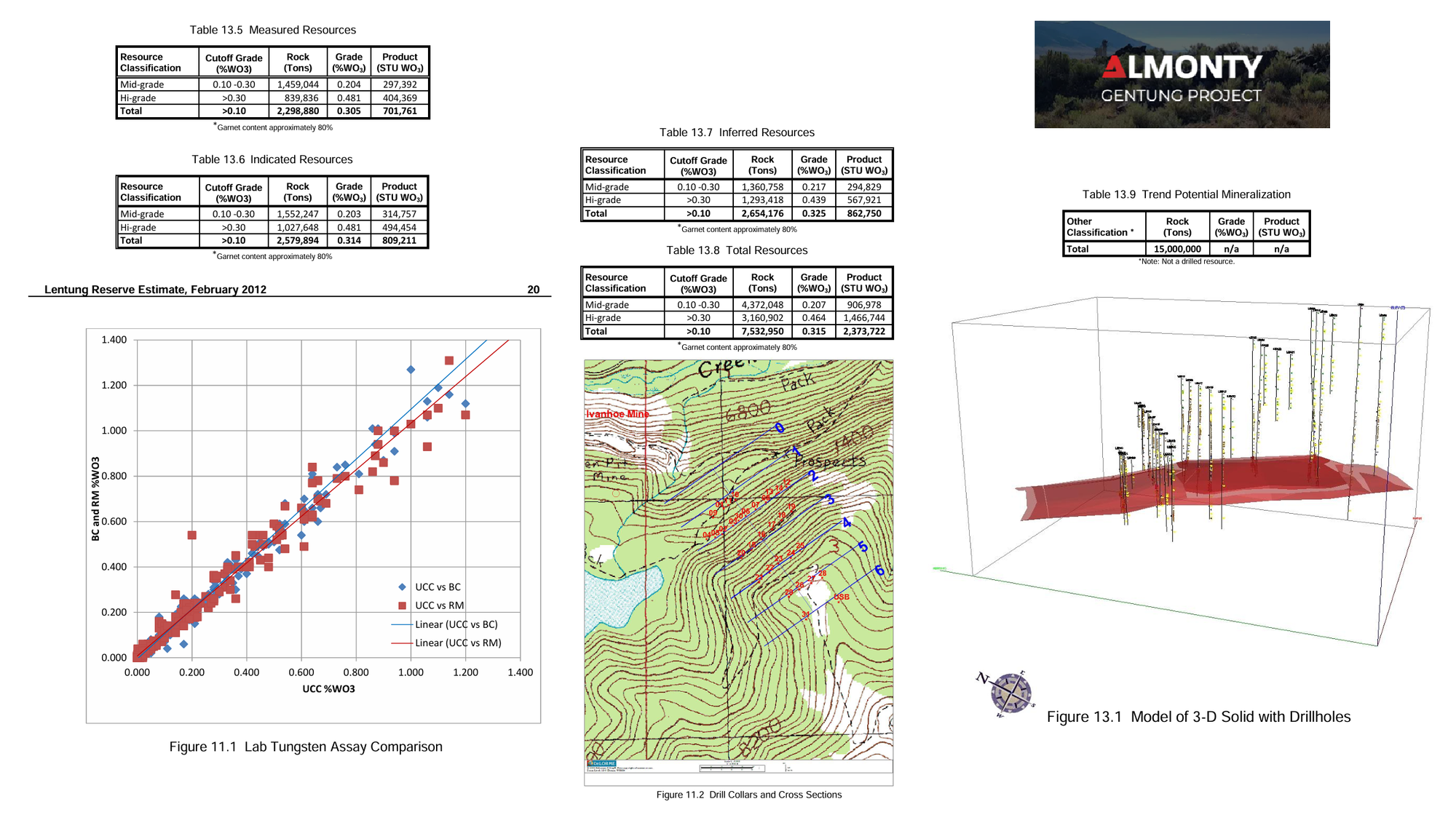
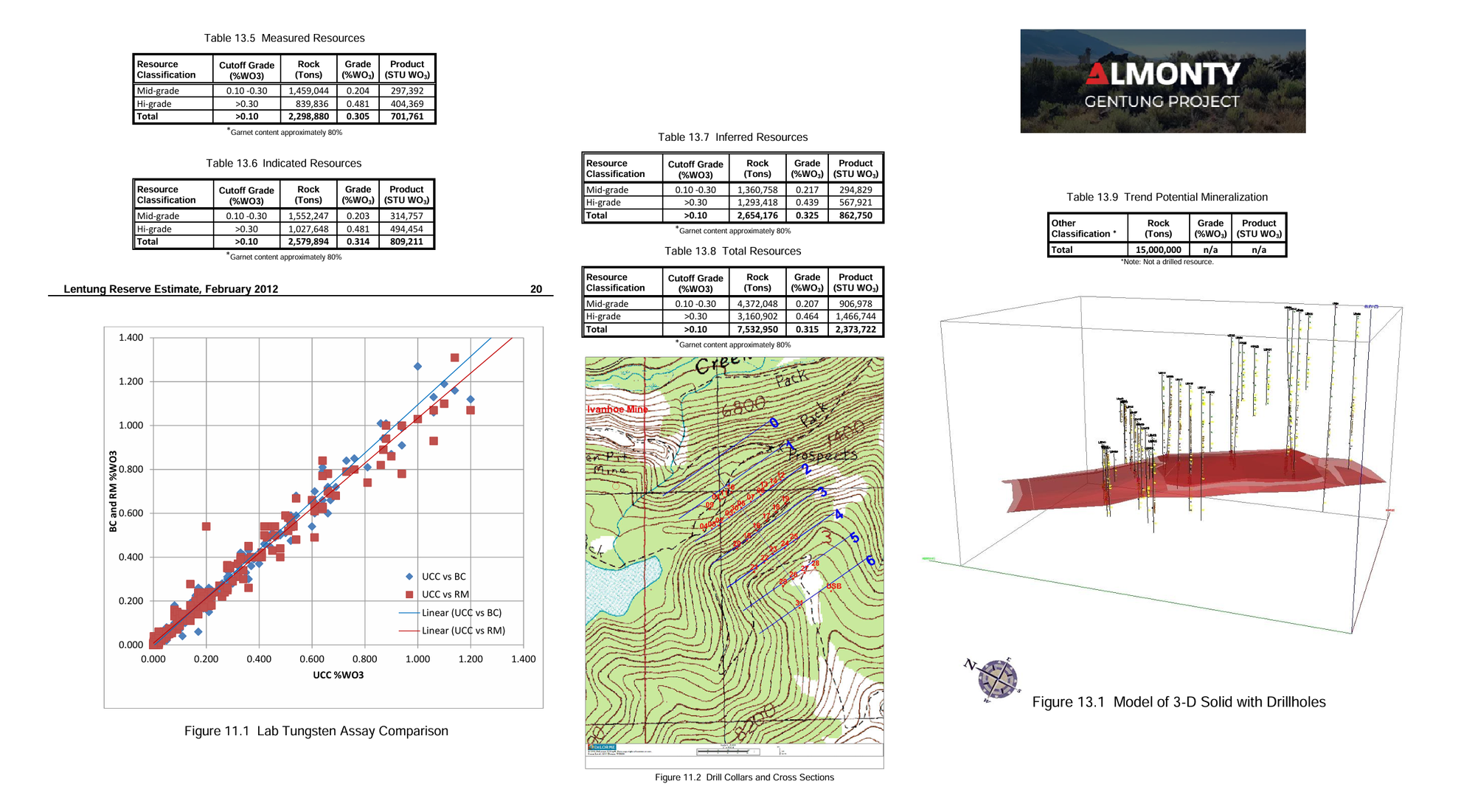
The project’s current publicly accessible technical basis is the 2012 NI 43-101 report on the Lentung Tungsten & Garnet Deposit, which Almonty now presents on the Gentung project page as the project’s technical report. At a 0.10% WO3 cutoff, that report estimated 7.53 million tonnes at 0.315% WO3, broken into measured, indicated, and inferred categories. By calculation, that is about 23,719.5 tonnes of contained WO3. The report also states garnet content is approximately 80% within the skarn zone, which explains why current corporate disclosures emphasize possible garnet by-product recovery. [21]
The resource mix is reasonably balanced for a pre-reserve underground project. The report gives 2.09 Mt measured at 0.305% WO3, 2.34 Mt indicated at 0.314% WO3, and 2.41 Mt inferred at 0.325% WO3. That distribution is helpful because Gentung is not relying almost entirely on inferred material. It also suggests the deposit was drilled densely enough in parts to support mine-planning work, even if not enough to support a modern reserve statement or final design. [8]
Geologically, the deposit is a contact metasomatic garnet skarn hosting scheelite mineralization. The technical report describes the skarn as flat-lying and laterally continuous enough to support large-scale underground extraction, while Almonty’s current project page summarizes the intended method as room-and-pillar underground development in competent skarn rock. The report’s conclusion is plain: room-and-pillar is the “obvious” low-cost, high-productivity mining method for this competent rock mass. [22]
The metallurgical story is encouraging but not yet fully bankable in public form. Almonty’s current Gentung project page states greater than 90% tungsten recovery and 20–25% garnet recovery, and the company’s 2025/2026 public materials repeatedly highlight those figures. That is attractive because by-product garnet can improve economics in a higher-cost U.S. jurisdiction. Metallurgy can be viewed as promising and historically supported, but not yet fully refreshed for an investment decision. [23]
This is the report’s most important caution: the 2012 NI 43-101 does not establish mineral reserves. It states explicitly that the resources “have not been further refined into mineable ore mineral reserves,” and that a geotechnical study plus feasibility study are needed to determine extraction ratio, external dilution, and mineable design. The report also recommends infill drilling and geotechnical work to convert the resource into a mineable reserve. Almonty’s 2025 AIF is consistent with that caution, saying the company is evaluating a path toward production subject to further technical work, permitting and financing. Financing now appears available, but the technical caveat remains highly relevant. [10]
|
Technical dimension |
What is publicly supported |
What remains unclear |
Analytical view |
|
Resource size |
7.53 Mt @ 0.315% WO3 at 0.10% cutoff, about 23,720 t contained WO3. [24] |
No modern publicly filed update after 2012 found in reviewed sources. |
Strong enough to matter nationally, but update needed. |
|
Resource confidence |
Measured + indicated total about 4.43 Mt before inferred material. [8] |
No fresh infill program disclosure tied to a new estimate. |
Better than a purely inferred story. |
|
Mining method |
Room-and-pillar underground in competent skarn. [25] |
Final stope design, pillar sizing, extraction ratio. |
Technically plausible. |
|
Metallurgy |
>90% tungsten recovery; 20–25% garnet recovery in company
materials. [23] |
No recent public feasibility-grade metallurgical package found. |
Positive, but needs modernization. |
|
Reserve status |
No public proven/probable reserve for Gentung found. [26] |
A new S-K 1300 or NI 43-101 reserve statement would close the gap. |
This is the key technical shortfall. |
Development Status, Critical Path, and Peer Comparison
From a capital-markets perspective, Gentung is not capital-constrained in the near term. Almonty raised US$129.375 million gross in December 2025, and the Q1 2026 MD&A shows that US$32.1 million of the net proceeds were allocated to Gentung exploration and development. By March 31, 2026, only US$0.98 million had been spent on that Gentung allocation, while Almonty reported C$259.9 million of cash and a C$169.5 million working-capital position. That suggests the central short-term risk is not funding availability but the sequence of technical and permitting milestones. [27]
The company’s own words reinforce that interpretation. In June 2026, Almonty said the “single biggest obstacle” to first production at Gentung was not technical or financial but administration, by which management meant the layered federal, state, and local permitting processes. That is consistent with the project’s structure on unpatented claims and with Montana’s hard-rock permitting framework. It also means the phrase “production readiness by H2 2026” should be read carefully: management may mean internal readiness to proceed, not necessarily fully permitted commercial start-up. [11] [29]
Production Pathway
--> Historic district and brownfield assets
--> Updated technical report
--> Geotechnical assessment and reserve conversion
--> Mine and process design
--> Federal and state permits
--> Construction and refurbishment
--> Commissioning
--> Commercial production
Where Gentung really needs more public clarity is in the middle of that chain. For a project in the U.S., the path ordinarily includes a new technical report, updated metallurgy, reserve conversion where possible, and a clear permit matrix. [29]
A peer comparison sharpens the point. Pilot Mountain in Nevada now has a 2026 PFS showing 12.1 Mt indicated containing 21,600 t WO3, 11.82 Mt probable reserves containing 20,275 t WO3, an 8-year mine life, and planned first ore in Q4 2028. That project is lower grade than Gentung on a resource-grade basis, but it is more advanced in modern study terms because it now has a current reserve and PFS. IMA in Idaho, by contrast, is a past-producing mine now being drilled aggressively, but its current tungsten story still rests on historical non-43-101 estimates and ongoing drilling aimed at a modern resource. Gentung sits between those two: more geologically de-risked than IMA, but less publicly refreshed than Pilot Mountain. [5]
|
U.S. tungsten project |
Current technical basis |
Resource / reserve snapshot |
Development signal |
What it implies for Gentung |
|
Gentung Browns Lake, Montana |
2012 NI 43-101 resource; no public reserve found in reviewed sources.
[8] |
7.53 Mt @ 0.315% WO3 total resource. [30] |
Almonty targets H2 2026 readiness; says permitting is the main gate. [31] |
High-grade and strategically attractive, but public update gap
remains. |
|
Pilot Mountain, Nevada |
2026 PFS with current resource and probable reserve. [32] |
12.1 Mt indicated containing 21,600 t WO3; probable reserve 11.82 Mt
containing 20,275 t WO3. [33] |
Planned first ore Q4 2028. [34] |
Gentung may have restart-speed advantages, but Pilot has stronger
public engineering support. |
|
IMA, Idaho |
Ongoing drilling; company cites historical non-43-101 tungsten
estimates and aims for a modern resource. [35] |
Historical estimates include 352k tons @ 0.5% WO3 and 1.023M tons @
0.63% WO3; not current compliant tungsten resources. [36] |
Active underground and tailings work. [37] |
Gentung remains the stronger currently compliant tungsten-resource
story of the two. |
A final point on economics: market conditions today are much better than those assumed in Gentung’s legacy technical foundation. The 2012 report used a conservative internal cutoff reflecting a then-normal tungsten environment, while Almonty’s Q1 2026 MD&A says APT prices rose from about US$862.5/MTU at the start of January 2026 to roughly US$3,140/MTU by May 8, 2026. That improves the case for U.S. brownfield restarts in principle. Though, high spot prices do not eliminate permitting risk or automatically validate a capex schedule. [38]
Conclusions, Recommendations, and Next Steps
The strongest conclusion is that Gentung is a credible U.S. tungsten restart candidate with genuine strategic value, not a speculative greenfield concept. The project now sits inside a well-funded tungsten-focused company, the macro backdrop is unusually supportive, and the legacy technical work points to a sizeable and comparatively high-grade resource by U.S. standards. On geology and strategic fit, this is one of the more serious U.S. tungsten stories currently on the board.
The second conclusion is more cautionary and more important for decision-making: the public disclosure package still looks one major step behind the strategic narrative. Almonty says Gentung can move toward near-term production and that permitting is now the main obstacle. Yet the latest independently reviewable technical foundation remains a 2012 pre-reserve resource report, and the company’s own filing language still says the path to production is subject to further technical work and permitting. This means outside analysts should distinguish between project promise and publicly verified project maturity. [40]
Recommendations:
First, Almonty should publish a new NI 43-101 or S-K 1300 technical report summary for Gentung that updates the resource, states whether any reserve conversion is now possible, and sets out a current mining and processing basis. Second, it should disclose a permit-status dashboard showing exactly what legacy permits or rights came with Apex, what needs amendment or renewal, what federal approvals are still pending, and what the critical dates are. Third, it should publish a milestone schedule separating technical readiness, permit readiness, construction readiness, and commercial production. These recommendations follow directly from the gaps in the public record identified above. [41] [42]
The net judgment is that Gentung deserves to be taken seriously, but not simplistically. It is a strategically important, potentially near-term brownfield U.S. tungsten restart opportunity. If Almonty fills the disclosure and permitting gaps, Gentung could become one of the more important U.S. tungsten assets ahead of the 2027 defense sourcing deadline. If it does not, the asset remains strategically valuable but execution uncertain. [43]
 Francesca Mills
 John D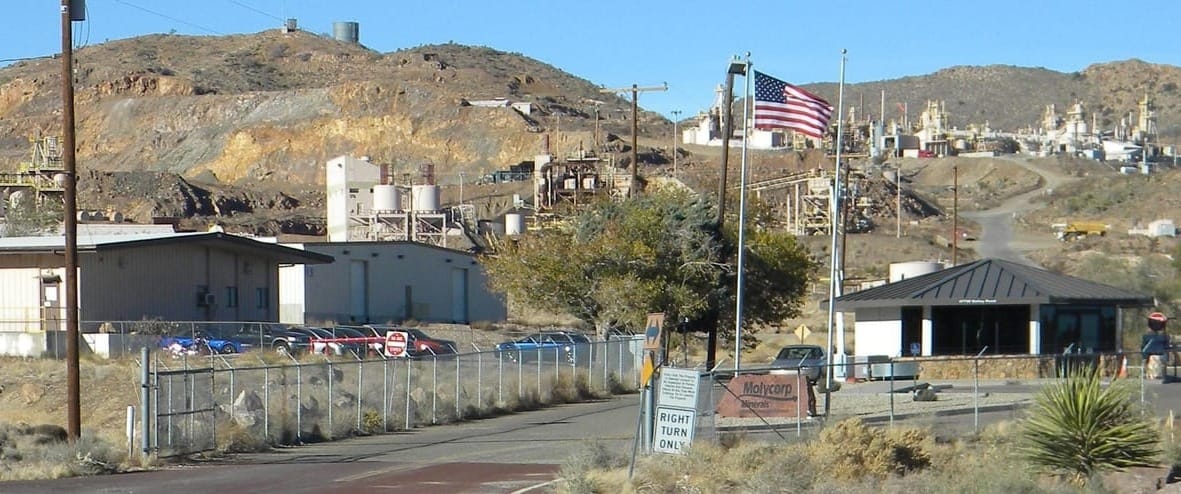
 John D
 John D
 John D
 John D

References
[1] [14] [29] Almonty Industries Inc. (2026, March 18). Annual information form for the year ended December 31, 2025 [Exhibit 99.1]. U.S. Securities and Exchange Commission. https://www.sec.gov/Archives/edgar/data/1670061/000149315226011503/ex99-1.htm
[2] [13] [21] [22] [23] [31] Almonty Industries Inc. (n.d.). Gentung project. Retrieved July 22, 2026, from https://almonty.com/project/gentung/
[3] [7] [18] U.S. Geological Survey. (2026, June 25). What is a critical mineral? https://www.usgs.gov/faqs/what-a-critical-mineral
[4] [11] [15] [40] [43] Almonty Industries Inc. (2026, June 23). Putting Montana’s tungsten district back to work. https://almonty.com/putting-montanas-tungsten-district-back-to-work/
[5] [32] [33] [34] Guardian Metal Resources plc. (2026, June 30). Guardian Metal Resources plc announces Pilot Mountain pre-feasibility study results [Press release]. Nasdaq. https://www.nasdaq.com/press-release/guardian-metal-resources-plc-announces-pilot-mountain-pre-feasibility-study-results
[6] [8] [10] [12] [20] [24] [25] [26] [28] [30] [38] Nelson, D., Nelson, E. E., & Yates, E. A. (2012, March). NI 43-101 technical report of the Lentung tungsten & garnet deposit, Beaverhead County, Montana. Prepared for Tungsten International Inc. https://almonty.com/wp-content/uploads/2025/11/Lentung-43-101.pdf
[9] Almonty Industries Inc. (2026, May 11). Almonty Industries reports first quarter 2026 financial results [Press release]. U.S. Securities and Exchange Commission. https://www.sec.gov/Archives/edgar/data/1670061/000149315226022338/ex99-1.htm
[16] [41] Almonty Industries Inc. (2026, May 11). Unaudited interim condensed consolidated financial statements for the three months ended March 31, 2026 and 2025. https://almonty.com/wp-content/uploads/2026/05/Almonty_FS_Q1_Mar_31_2026.pdf
[17] [42] Bureau of Land Management. (n.d.). Locating a mining claim. U.S. Department of the Interior. https://www.blm.gov/programs/energy-and-minerals/mining-and-minerals/locatable-minerals/mining-claims/locating-a-claim
[19] [27] Almonty Industries Inc. (2026, May 11). Management’s discussion and analysis: Three months ended March 31, 2026. https://almonty.com/wp-content/uploads/2026/05/Almonty_MDA__Q1-26__March_31_2026.pdf
[35] [36] American Tungsten Corp. (n.d.). IMA Mine project. Retrieved July 22, 2026, from https://americantungstencorp.com/project/ima-mine-project/
[37] American Tungsten Corp. (2026, June 9). American Tungsten reports strong drilling results from Lower D-level [Press release]. Nasdaq. https://www.nasdaq.com/press-release/american-tungsten-reports-strong-drilling-results-lower-d-level-2026-06-09
[39] Permitting & Operator Assistance | Montana DEQ https://deq.mt.gov/Permitting