
Who Will Launch ASTS BlueBird Satellites Now? New Glenn Delays, SpaceX, ISRO, and 2026 Cadence Risk
New Glenn’s explosion puts ASTS launch cadence under pressure as SpaceX, ISRO, and other providers become critical backup paths.


TLDR: AST SpaceMobile is not out of launch options, but New Glenn’s Launch Complex 36 explosion damages the company’s best high-volume launch path. SpaceX Falcon 9 can keep the BlueBird deployment moving, ISRO can provide additional launch diversity, and other heavy-lift providers may eventually help, but losing New Glenn for months could compress ASTS’s 2026 launch cadence, increase schedule risk, and make the company’s 45-satellite target harder to achieve.
The company has launch agreements with multiple providers, including Blue Origin, SpaceX, ISRO, and others [1][2]. The problem is cadence. ASTS is trying to move from demonstration satellites to a real space-based cellular broadband network, and that requires launching many large spacecraft in a short period of time.
New Glenn’s Explosion, BlueBird Cadence, and the ISRO/SpaceX Backup Plan
New Glenn was the most volume-efficient launch path for the company’s largest Block 2 BlueBird satellites. AST SpaceMobile previously stated that its Block 2 satellites are compatible with all major launch vehicles, but it specifically highlighted New Glenn’s seven-meter fairing as well-suited for carrying up to eight of the large BlueBird satellites per launch [2]. Blue Origin also described its multi-launch agreement with AST SpaceMobile as a plan to deliver multiple next-generation Block 2 BlueBird satellites to low Earth orbit from Launch Complex 36 at Cape Canaveral [3].
That makes the LC-36 failure a direct launch-supply problem. Blue Origin is facing months of delays after the New Glenn static-fire explosion damaged the launch pad, with a person familiar with the matter expecting at least a six-month disruption, if not longer [4]. If New Glenn’s only operational pad is unavailable for months, then ASTS loses access to the launch vehicle that was supposed to carry the largest batches of BlueBird satellites.
 John D
This does not mean AST SpaceMobile is stranded. In its May 2026 business update, AST said it was targeting approximately 45 BlueBird satellites in orbit during 2026, supported by manufacturing cadence and agreements with multiple launch providers, including Blue Origin, SpaceX, and others [5]. The company also said BlueBird 8, BlueBird 9, and BlueBird 10 were expected to launch in mid-June on a SpaceX Falcon 9 [5]. That makes SpaceX the immediate answer to the question: who launches ASTS next?
SpaceX is not a perfect New Glenn replacement. Falcon 9 is reliable, available, and operationally mature, but New Glenn offered a much larger fairing and better batch economics for oversized BlueBird payloads. AST’s own launch-services announcement emphasized that New Glenn’s seven-meter fairing has roughly twice the payload volume of five-meter-class commercial launch systems and is especially well-suited for the largest Block 2 BlueBirds [2]. Falcon 9 can keep ASTS moving, but it may require smaller batches, more launches, and more schedule coordination.
That distinction is critical. A constellation rollout is not just a question of launch access. It is a question of launch density. If New Glenn can carry up to eight BlueBirds and Falcon 9 carries smaller batches, then losing New Glenn does not merely remove one provider. It reduces the number of satellites ASTS can place in orbit per launch campaign. That creates a cadence gap even if SpaceX performs flawlessly.
ISRO is the next major backup path. In 2024, AST SpaceMobile disclosed launch agreements with Blue Origin, ISRO, and SpaceX, with missions expected across 2025 and 2026 [1]. Spaceflight Now reported that AST expected its next launch at that time to use ISRO’s Geosynchronous Satellite Launch Vehicle before shifting focus to Blue Origin’s New Glenn and SpaceX’s Falcon 9 [1]. This gives ASTS a meaningful non-U.S. launch route and reduces dependence on any single provider.
However, ISRO is also not a one-for-one substitute for New Glenn. ISRO can provide important capacity and geopolitical diversification, especially given AST’s commercial ambitions in India and other international markets, but the key question is whether it can absorb enough BlueBird launches quickly enough to offset a prolonged New Glenn outage. ASTS needs repeated launch slots, compatible payload integration flows, enough fairing volume, regulatory alignment, and orbital delivery profiles that match the constellation plan.
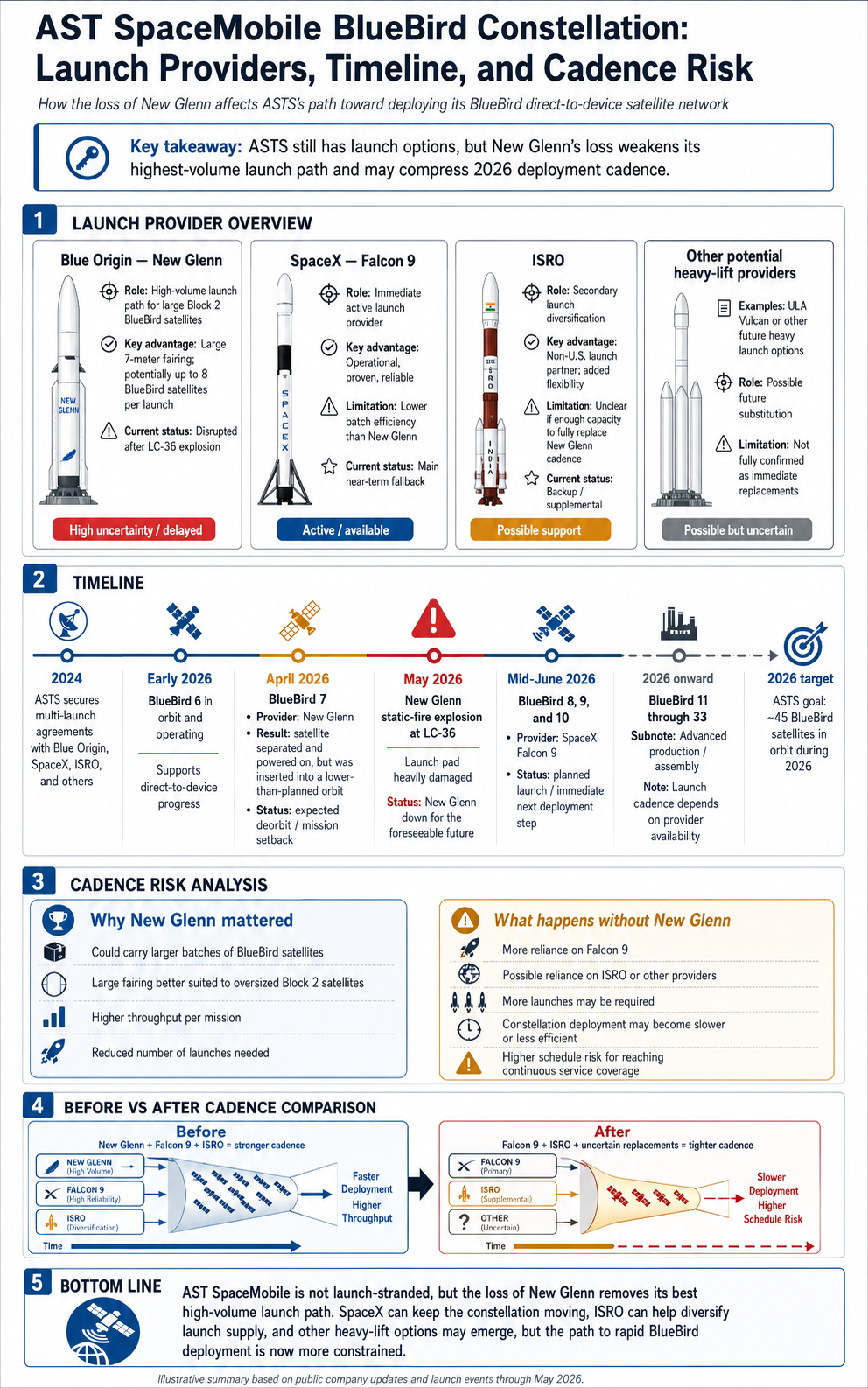
ASTS’s current launch situation became more fragile because the New Glenn pad explosion followed another New Glenn-related setback. On April 19, 2026, AST’s BlueBird 7 launched on New Glenn but was placed into a lower-than-planned orbit by the rocket’s upper stage. AST said the satellite separated and powered on, but the orbit was too low for sustained operation using its onboard thruster technology, so the satellite would be de-orbited [6]. The company expected the cost of the satellite to be recovered under insurance [6]. Via Satellite later reported that AST expected a $155 million to $160 million asset write-off in the second quarter and had filed insurance claims covering a portion of the satellite and launch costs [7].
The important point is that BlueBird 7 was not a failure of AST’s antenna technology. The satellite separated and powered on. The issue was orbital delivery. That matters because it suggests the constellation thesis did not break at the spacecraft level, though it did expose ASTS to launch-provider execution risk. A month later, New Glenn’s static-fire explosion turned that launch-provider risk into a much larger capacity problem.
ASTS management has tried to frame this as manageable. The company said BlueBird 6 continues to operate as expected after deploying what it described as the largest-ever phased array in low Earth orbit [5]. It also said BlueBird 11 through BlueBird 33 were in advanced production and assembly, with phased arrays completed through BlueBird 28 [5]. That means the manufacturing side of the business appears to be scaling. Launch capacity is constrained globally.
This is the heart of the issue: ASTS may be building satellites faster than the post-New Glenn launch market can comfortably absorb them.
That does not mean the 45-satellite 2026 target is impossible. ASTS said it had contracted launch capacity to meet its target, and Via Satellite reported management’s position that the satellites were designed to be launch-vehicle agnostic [7]. The company has also pointed to other heavy-launch possibilities beyond SpaceX and Blue Origin. Via Satellite reported that AST mentioned United Launch Alliance’s Vulcan as a possible configuration capable of carrying five BlueBirds and said AST has been developing other heavy-launch providers outside SpaceX and Blue Origin [7].
Vulcan is therefore a logical candidate to watch, but not a guaranteed near-term answer. ULA’s Vulcan also uses Blue Origin BE-4 engines, which may attract extra scrutiny after New Glenn’s failures, even though the New Glenn static-fire explosion could have involved ground systems, vehicle integration, tanking, software, or other non-engine causes. A shared engine family does not automatically mean a shared failure mode, but it does mean customers and regulators will pay attention.
There are also broader alternatives in the global launch market, including Ariane 6 and Mitsubishi Heavy Industries vehicles, but practical substitution is never simple. Large satellites are designed around payload adapters, vibration environments, fairing dimensions, deployment mechanisms, integration schedules, regulatory approvals, and insurance terms. “Vehicle agnostic” does not mean “instantaneously interchangeable.” It means the company planned for flexibility. That flexibility now has to be exercised under pressure.
The likely near-term sequence is therefore straightforward. First, SpaceX launches BlueBird 8, 9, and 10 on Falcon 9 in mid-June if the schedule holds [5]. Second, ASTS leans on its existing multi-provider launch agreements, especially SpaceX and ISRO, to preserve as much 2026 cadence as possible [1][5]. Third, the company evaluates whether Vulcan or other heavy-lift providers can take some of the missions originally expected to flow through New Glenn [7]. Fourth, ASTS waits for clarity on Blue Origin’s investigation, pad damage, and New Glenn return-to-flight timeline.
The investment-market issue is that the stock may react not only to whether ASTS can launch, but whether it can launch fast enough. Direct-to-device satellite broadband depends on coverage density. A few satellites can prove the technology and support limited demonstrations. Dozens of satellites are needed for broader service availability. AST previously said its next-generation Block 2 BlueBirds are designed to deliver up to ten times the bandwidth capacity of earlier BlueBirds and support the goal of continuous cellular broadband coverage [2]. Via Satellite reported that AST needs 45 to 60 BlueBird satellites in orbit to provide continuous service [7].
That creates a brutal execution clock. If New Glenn is down for six months, ASTS may still launch some satellites. If New Glenn is down for a year, the company may need to rebuild the entire launch sequencing logic for its 2026 and early 2027 constellation rollout. That could affect commercial service timing, partner milestones, government-service expectations, revenue recognition, and investor confidence.
The bullish case is that ASTS already prepared for this. It did not rely on one launch provider. It has SpaceX, ISRO, Blue Origin, and other launch options. It has a strong cash position, scaled manufacturing, major mobile network operator relationships, and satellites designed to fit multiple vehicles [5][7]. If SpaceX and ISRO can absorb enough launches, and if Blue Origin returns faster than expected, the company may still preserve much of its deployment plan.
The bearish case is that New Glenn was the highest-throughput option, and losing it compresses the entire schedule. Three BlueBirds on Falcon 9 is useful, but it is not the same as high-volume New Glenn batches. ISRO can help, but it may not be enough to replace New Glenn’s capacity quickly. Vulcan or other vehicles may be possible, but they introduce new integration and scheduling constraints. Under that scenario, ASTS still becomes a real company, but its constellation arrives later than investors hoped.
The most realistic conclusion sits between those extremes. AST SpaceMobile is not launch-stranded, and the BlueBird constellation is not dead. However, the New Glenn explosion likely makes ASTS’s 2026 rollout harder, more dependent on SpaceX, more reliant on ISRO as a serious backup, and more exposed to the launch market’s limited heavy-payload supply.
So, who launches ASTS now?
Immediately: SpaceX.
Strategically: SpaceX, ISRO, and any heavy-lift provider AST can integrate quickly.
Eventually: New Glenn again, if Blue Origin can rebuild LC-36, complete the investigation, restore customer confidence, and return to flight.
ASTS still has a path to orbit. The question is whether that path is wide enough to support the launch cadence its business plan requires.
John D
In reference to the late april 2026 failure-to-orbit ASTS / New Glenn Incident
 John D
 John D
 John D
 John D
References
[1] Robinson-Smith, W. (2024, November 17). AST SpaceMobile secures multi-launch agreements with Blue Origin, ISRO and SpaceX. Spaceflight Now. https://spaceflightnow.com/2024/11/17/ast-spacemobile-secures-multi-launch-agreements-with-blue-origin-isro-and-spacex/
[2] AST SpaceMobile. (2024, November 14). AST SpaceMobile announces launch services agreements to enable continuous space-based cellular broadband service coverage for the United States, Europe, Japan, the U.S. Government, and other strategic markets globally. Business Wire. https://www.businesswire.com/news/home/20241114979308/en/AST-SpaceMobile-Announces-Launch-Services-Agreements-to-Enable-Continuous-Space-Based-Cellular-Broadband-Service-Coverage-for-the-United-States-Europe-Japan-the-U.S.-Government-and-Other-Strategic-Markets-Globally
[3] Blue Origin. (2024, November 14). AST SpaceMobile selects Blue Origin’s New Glenn rocket to deliver next-generation BlueBird satellites to space. https://www.blueorigin.com/news/ast-spacemobile-selects-blue-origin-new-glenn
[4] Sriram, A. (2026, May 30). Blue Origin faces months of delays after rocket explosion damages launch pad. Reuters. https://www.reuters.com/business/aerospace-defense/blue-origin-faces-months-delays-after-rocket-explosion-damages-launch-pad-2026-05-30/
[5] AST SpaceMobile. (2026, May 11). AST SpaceMobile provides business update and first quarter 2026 results. Business Wire. https://www.businesswire.com/news/home/20260511685431/en/AST-SpaceMobile-Provides-Business-Update-and-First-Quarter-2026-Results
[6] AST SpaceMobile. (2026, April 20). AST SpaceMobile addresses today’s orbital launch of BlueBird 7 on the New Glenn launch vehicle [Form 8-K exhibit]. StockTitan. https://www.stocktitan.net/sec-filings/ASTS/8-k-ast-space-mobile-inc-reports-material-event-a79c455a6098.html
[7] Jewett, R. (2026, May 12). AST SpaceMobile confirms target for 45 BlueBirds this year, despite Blue Origin launch failure. Via Satellite. https://www.satellitetoday.com/connectivity/2026/05/12/ast-spacemobile-confirms-target-for-45-bluebirds-this-year-despite-blue-origin-launch-failure/