The U.S. Rare Earth Magnet Supply Chain in 2026: Why Heavy Rare Earth Separation and Metallization Are the Binding Constraints
U.S. magnet capacity announcements top 40,000 tonnes, but domestic dysprosium output is still measured in kilograms. Where the chain actually breaks.

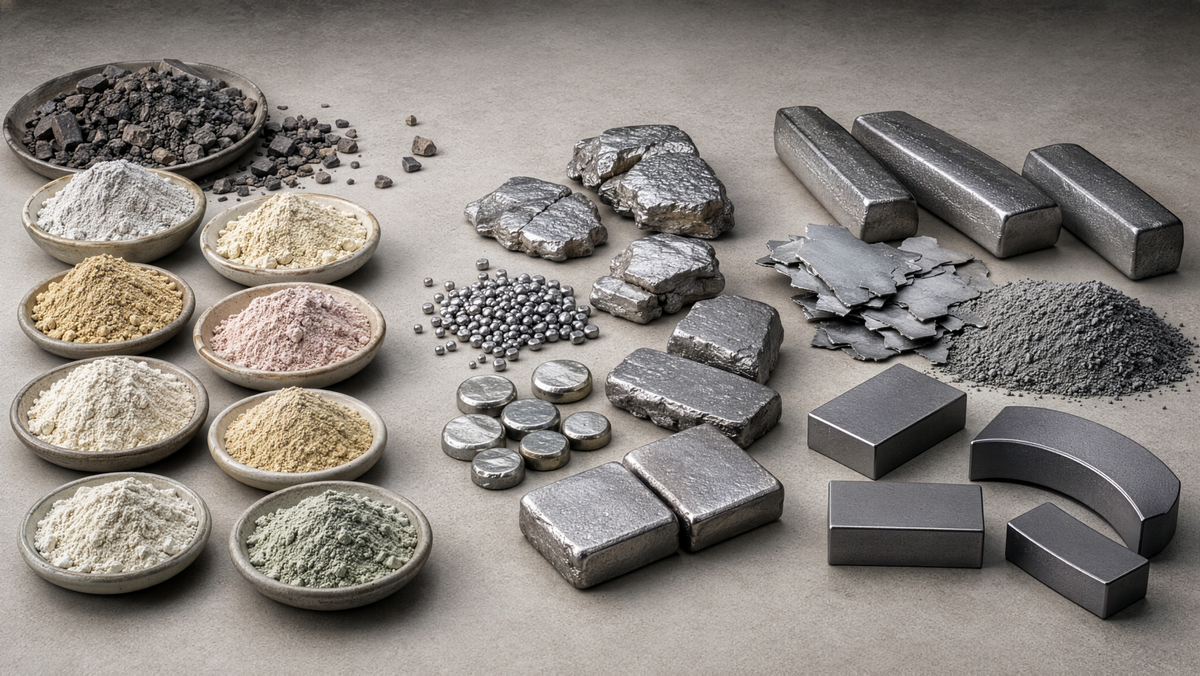
Mapping the Roles, Overlaps, Dependencies, Development Timelines, Technical Readiness, Feedstock Agreements, and Execution Risks of Fifteen U.S. Participants Against Chinese Processing Dominance, Defense Demand, and Federal Industrial Policy.
TL;DR
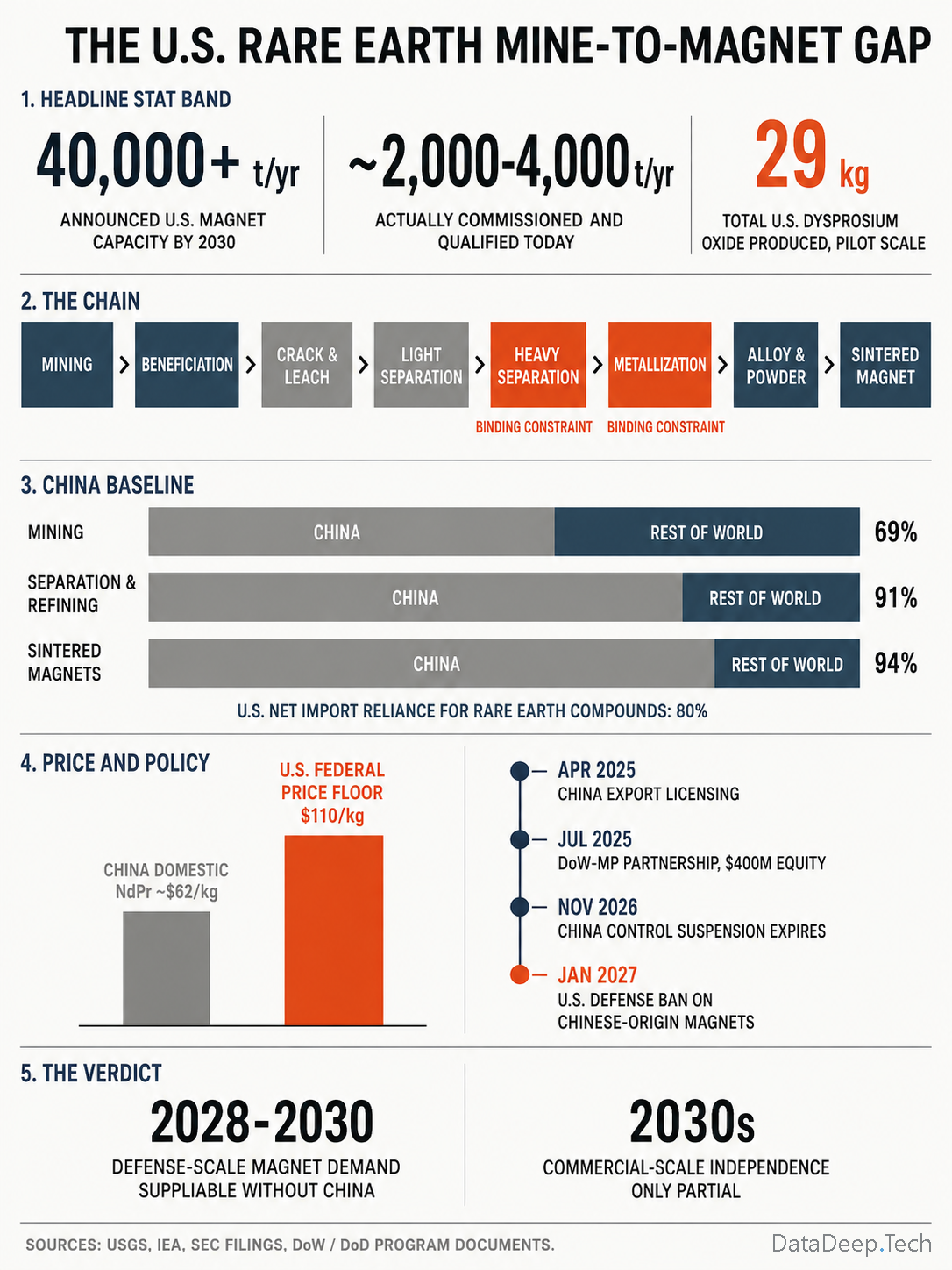
- The binding constraint on the domestic chain is not mining, and no longer light-oxide (NdPr) separation, but the coupled bottleneck of heavy-rare-earth (dysprosium and terbium) separation and rare-earth metallization: through 2025 Energy Fuels (NYSE:UUUU) had produced approximately 29 kilograms of 99.9 percent dysprosium oxide at pilot scale and roughly one kilogram of terbium oxide by early 2026, while announced U.S. sintered NdFeB magnet capacity for 2028 to 2030 exceeds 40,000 tonnes per year [26][27][30].
- Commissioned, qualified U.S. sintered NdFeB output today is in the low single-digit thousands of tonnes, dominated by Noveon Magnetics and eVAC Magnetics, with USA Rare Earth (NASDAQ:USAR) and MP Materials (NYSE:MP) ramping; the fraction of announced magnet capacity backed by a secured, non-Chinese heavy-rare-earth feedstock path is minimal, arguably near zero on a fully qualified basis [11][19][21][26].
- On current trajectory and policy, defense-sector magnet demand (small in tonnage, non-substitutable, and legally walled off by a January 1, 2027 procurement ban) could plausibly be supplied without Chinese-origin material around 2028 to 2030; commercial-scale independence is a 2030s proposition, achievable only partially and only if heavy-separation, metallization, and equipment gaps are closed with allied help and shielded from a Chinese price response [48][49][1].
Rebuilding the United States Rare-Earth Mine-to-Magnet Supply Chain: A Comprehensive Industrial, Strategic, and Investment Analysis of Domestic Mining, Beneficiation, Oxide Separation, Refining, Metallization, Alloy Production, Recycling, and NdFeB and Samarium-Cobalt Magnet Manufacturing
Key Findings
The United States is reconstructing its rare-earth industrial base in an unusual order and under unprecedented federal intervention, but the reconstruction is structurally unbalanced. Downstream magnet-making capacity is being announced and financed far faster than the upstream heavy-rare-earth and metallization capacity that must feed it. The single most consequential fact in the sector is the gap between announced capacity and commissioned, qualified capacity at each stage, and that gap is widest precisely where it matters most.
First, the binding constraint is heavy-rare-earth separation and metallization, and the quantitative evidence is decisive rather than a matter of competing candidates. Domestic dysprosium and terbium oxide production in 2025 and 2026 was measured in kilograms at pilot scale, whereas the magnet plants that require those elements are being sized in thousands of tonnes [26][27][30]. Metallization, the conversion of oxide to metal, is the thinnest domestic capability of all, with essentially one new entrant (Phoenix Tailings) operating at a 200-tonne-per-year nameplate and almost no public technical literature on domestic heavy-rare-earth metal production [33].
Second, aggregate commissioned U.S. sintered NdFeB output that is producing qualified magnets today sits in the low single-digit thousands of tonnes. Noveon Magnetics (approximately 2,000 tonnes per year nameplate) and eVAC Magnetics (first shipments December 2025, ramping to 2,000 tonnes per year) are the operational core, with USA Rare Earth's Stillwater Phase 1a commissioned in March 2026 and MP Materials' Fort Worth line producing on commercial equipment from December 2025 but not expecting magnet revenue until the second half of 2026 [11][19][21][61].
Third, federal policy has become the dominant variable in financeability, through a Department of War price floor of 110 dollars per kilogram of NdPr for MP Materials, direct government equity, and roughly 700 million dollars of Office of Strategic Capital loans to Vulcan Elements and ReElement Technologies (NASDAQ:AREC), but these instruments improve balance sheets without resolving the chemistry-and-tacit-knowledge bottlenecks[1][16].
Details
1. The Mine-to-Magnet Chain as an Industrial System
The chain is a sequence of physically and economically distinct unit operations, and treating "rare earth supply" as one problem obscures where value, difficulty, and chokepoints sit. Mining and beneficiation produce a mixed rare-earth concentrate. The feedstocks in scope for U.S. participants are geologically diverse: bastnäsite carbonatite at Mountain Pass; monazite recovered as a byproduct of heavy-mineral-sands and titanium and zirconium mining, which Energy Fuels processes at grades it reports at 50 to 60 percent total rare-earth oxide [26]; allanite in the Precambrian granite of Halleck Creek, Wyoming; and unconventional coal and carbonaceous-ore hosted occurrences at Ramaco's Brook Mine (NASDAQ:METC) [56][59]. Beneficiation is commodity mineral processing, capital-moderate and technically mature, though gangue rejection economics vary sharply by mineralogy.
Cracking and leaching convert concentrate into a leachable form via sulfuric acid bake or caustic conversion. For monazite, this stage carries a radiological burden: monazite hosts thorium and uranium, and only a small number of U.S. facilities are licensed to handle the resulting streams. Energy Fuels' White Mesa Mill in Utah is the pre-eminent example, being licensed for uranium-bearing material and recovering uranium as a byproduct [26][28]. Separation into individual high-purity oxides is the stage where China's structural advantage is deepest and where the tacit process knowledge is most concentrated. Conventional practice uses multi-stage countercurrent solvent-extraction cascades that can run to hundreds of mixer-settler stages. U.S. entrants are commercializing alternatives: Ucore's RapidSX (OTCM: UURAF) column-based separation, ReElement's ligand-assisted chromatography, and Rare Earth Salts' non-solvent process [24][36][67]. These promise smaller footprints and lower reagent burdens but carry scale-up risk precisely because they depart from proven practice.
Metallization and reduction convert oxide to metal. Neodymium and didymium are produced by molten-salt electrolysis; samarium, dysprosium, and terbium require calciothermic or metallothermic reduction because their oxides are not reduced electrolytically at practical efficiency. This is process engineering combined with tacit craft, and it is the stage where domestic capability is thinnest and least documented. Alloy production follows: strip casting of NdFeB and induction melting of SmCo, with master-alloy and additive management of dysprosium, terbium, cobalt, gallium, niobium, and copper. Powder processing (hydrogen decrepitation, jet milling to 3 to 5 microns, and rigorous oxygen exclusion) and magnet manufacture (aligned pressing, vacuum sintering, grain-boundary diffusion of dysprosium and terbium, machining, coating, and magnetization) are the tacit-knowledge manufacturing disciplines that cannot be bought as equipment [11]. Grain-boundary diffusion in particular allows heavy-rare-earth economy by concentrating dysprosium or terbium at grain boundaries rather than throughout the bulk, and mastery of it separates qualified from unqualified producers.
The samarium-cobalt chain is parallel and partly independent. SmCo5 and Sm2Co17 metallurgy delivers maximum operating temperatures well above NdFeB, with Electron Energy's ultra-high-temperature Sm2Co17 grades rated to 550 degrees Celsius [31]. This performance envelope, and radiation tolerance, make SmCo non-substitutable in traveling-wave tubes, missile actuators, and jet-engine components, but the chain carries cobalt supply exposure and depends on samarium, an element with thin commercial demand and now-constrained supply. Recycling and secondary feedstock (magnet-to-magnet processes, hydrogen processing of scrap, and hydrometallurgical recovery from motors, hard drives, and swarf) are technically real but constrained everywhere by collection logistics rather than by process chemistry.
The commercial-versus-difficulty map is therefore: mining and beneficiation are commodity to moderate; cracking, leaching, and light separation are process engineering with a radiological overlay; heavy separation, metallization, and qualified sintered magnet manufacture are the tacit-knowledge disciplines and the true chokepoints.
 John D
2. The Global Baseline
China's dominance is segment-specific and increases downstream. Per the International Energy Agency, China accounted for about 91 percent of global rare-earth separation and refining production and 94 percent of sintered permanent-magnet production in 2024, against a lower share (roughly 60 to 69 percent) of mining [1][40][52]. The structural reasons are three decades of state-supported capacity accumulation, tolerated environmental externalities, an integrated domestic supply of reagents and equipment, and a deep bench of specialized technicians. The USGS Mineral Commodity Summaries 2026 report U.S. net import reliance for rare-earth compounds and metals at 80 percent, with China supplying an estimated 56 percent of consumption over 2020 to 2023, and 100 percent import reliance for yttrium [40].
China has converted this dominance into an active policy instrument. In April 2025 China imposed export licensing on seven rare-earth elements, including terbium, dysprosium, and lutetium metals, oxides, alloys, and compounds [40][6]. On October 9, 2025 the Ministry of Commerce, through Announcements Nos. 55 to 58 and 61 and 62, expanded controls to additional medium and heavy rare earths, to rare-earth production and processing equipment (Announcement No. 56, which explicitly named strip casters, hydrogen-decrepitation furnaces, jet mills, magnetic-field aligned presses, and vacuum sintering furnaces), and to rare-earth technologies, and asserted extraterritorial reach through a 0.1 percent de minimis rule and provisions covering Chinese persons providing assistance to overseas production [7][65]. On November 7, 2025, via Announcement No. 70, China suspended Announcements Nos. 55, 56, 57, 58, 61, and 62 for one year until November 10, 2026, in exchange for a U.S. suspension of a 50 percent ownership rule; the April 2025 licensing regime remained in force, with general licenses issued to selected exporters [7][9][65]. This is a pause in escalation, not a strategic reversal, and the controls remain on the books, scheduled to potentially resume after November 2026 [10][65].
China's own reciprocal vulnerability lies upstream: it imports substantial heavy-rare-earth feedstock from Myanmar and other sources, so its leverage is not perfectly insulated. The non-China ecosystem is partial. Japan's Shin-Etsu (TYO:4063) and Proterial (formerly Hitachi Metals) hold deep magnet expertise, and ULVAC (TYO:6728) of Japan is the leading Western-aligned supplier of magnet furnaces and strip casters [63]. Europe hosts Vacuumschmelze (VAC) (acquired by Energy Fuels) in Hanau, Germany, the largest magnet producer outside Asia [21]. Australia's Lynas (OTCM: LYSCF) is the most significant non-Chinese integrated producer of separated oxides, and Southeast Asian heavy-mineral-sands suppliers feed monazite chains. What the United States must build versus source from allies is therefore conditioned by these nodes: allied capacity is strongest in magnet-making and light separation and weakest, like the United States, in heavy separation and metallization.

3. U.S. Participant Analysis
Integrated and upstream producers. MP Materials Corp (NYSE: MP) is the anchor of the domestic chain and the only participant operating at commercial scale across mining, separation, and magnet-making. Mountain Pass, California, is the only active U.S. rare-earth mine; MP reported record NdPr oxide production of 2,599 metric tonnes in fiscal 2025, roughly double the prior year, and a record 917 tonnes in the first quarter of 2026, both audited SEC-reported figures [61]. The July 2025 Department of War transaction is the single most consequential policy event in the sector: a 110 dollars per kilogram NdPr price floor for ten years, a 400 million dollar preferred-equity investment making the government the largest shareholder, a warrant potentially taking the stake to 15 percent, a 150 million dollar loan for heavy-rare-earth separation, and a ten-year offtake guaranteeing purchase of all magnets from a planned "10X" facility [1][2][3]. MP is constructing heavy-rare-earth separation at Mountain Pass, designed to process about 3,000 tonnes of feedstock per year prioritizing dysprosium and terbium, with commissioning targeted for the second quarter of 2026 [61]. Its Independence facility in Fort Worth, Texas, began producing NdFeB magnets on commercial equipment in December 2025, with a nameplate of approximately 1,000 tonnes per year expanding toward 3,000 tonnes, and initial magnet revenue expected in the second half of 2026 [61]. MP selected a Northlake, Texas site for the 10X facility in February 2026, a 1.25 billion dollar project targeting 2028 commissioning and roughly 10,000 tonnes per year of total system capacity, and signed a 500 million dollar agreement with Apple in July 2025 for recycled-content magnets with shipments expected in 2027 [62]. MP ceased sales to China to align with the DoW agreement [61].
USA Rare Earth, Inc. (Nasdaq: USAR), public since March 2025 via a SPAC combination with Inflection Point Acquisition Corp. II, is pursuing an integrated model in an unusual order, building magnet manufacturing at Stillwater, Oklahoma before developing its Round Top deposit in Texas [11][12]. It commissioned its Phase 1a commercial magnet line in March 2026, targeting a 600 tonnes per year run rate by end-2026 and 1,200 tonnes per year with Phase 1b in the first quarter of 2027 [11][13]. Round Top is a heavy-rare-earth-enriched rhyolite resource; USA Rare Earth also owns Less Common Metals in the United Kingdom, a producer of rare-earth metals and alloys, and has commissioned a hydrometallurgical demonstration facility in Wheat Ridge, Colorado, targeting separated heavy oxides including dysprosium, terbium, and yttrium with first output targeted for the third quarter of 2026, having secured up to 1.6 billion dollars in contingent CHIPS Program funding for a larger South Carolina facility [13]. The company remains pre-revenue in magnets, and its capacity figures are developer targets, not demonstrated output.

Energy Fuels Inc. (NYSE: UUUU; TSX: EFR) is the most important heavy-rare-earth participant and the pivotal producer for the terbium and dysprosium bottleneck. Its White Mesa Mill in Utah is uniquely licensed to process uranium-bearing monazite, sourced via a partnership with Chemours from Georgia and Florida heavy-mineral sands [26][28]. Energy Fuels commissioned a commercial light-rare-earth (NdPr oxide) circuit and reported qualifying that NdPr with magnet makers; it produced its first kilogram of 99.9 percent dysprosium oxide at pilot scale in July 2025, and, per its December 19, 2025 disclosure, "the Company has produced approximately 29 kgs of high-purity Dy oxide at pilot scale, achieving purities of 99.9%," with its first kilogram of 99.9 percent terbium oxide confirmed by early 2026 and White Mesa producing terbium at roughly one kilogram per week, with commercial-scale dysprosium and terbium targeted for the fourth quarter of 2026 [26][27][30]. In December 2025 its dysprosium oxide passed initial qualification benchmarks of a major South Korean magnet manufacturer [27]. In June 2026 Energy Fuels acquired Vacuumschmelze, the German parent of eVAC Magnetics, for a reported 718 million dollars in cash plus shares, a transaction that vertically integrates a U.S. oxide-and-uranium producer into European and U.S. magnet-making [61].
Ramaco Resources, Inc. (Nasdaq: METC; METCB) is a metallurgical-coal producer developing the Brook Mine near Sheridan, Wyoming, described as the first new U.S. rare-earth mine since 1952, hosting rare earths in carbonaceous ore [56][57]. Its board authorized nearly tripling projected oxide output to about 3,400 short tons per year, and it signed a strategic agreement with the DOE's National Energy Technology Laboratory and received a 6.1 million dollar Wyoming matching grant for a pilot processing facility [56][58]. Ramaco's rare-earth output remains at pilot scale and its processing capability is unproven at commercial scale; the "150-year supply" framing seen in some coverage is a developer and promotional assertion rather than a verified reserve statement [57].
Rare Element Resources Ltd. (OTCQB: REEMF), majority-affiliated with General Atomics (recently won the Collaborative Combat Aircraft (CCA) production contract alongside Anduril), is advancing the Bear Lodge project in Wyoming and a roughly ~63 million dollar demonstration plant in Upton, partly DOE-funded, designed to produce up to 10 tonnes of separated NdPr oxide, with commissioning beginning by end-2025 and ramp-up in the first quarter of 2026 [38][39]. Its commercial target is 2,000 tonnes per year of NdPr oxide by 2030, a developer projection contingent on permitting restart and financing, supported by a non-binding EXIM letter of interest [39].
American Rare Earths Limited (ASX: ARR; OTCQX: ARRNF; ADR: AMRRY) holds Halleck Creek in Wyoming, one of the largest U.S. rare-earth resources by tonnage, with a JORC estimate the company states at 2.63 billion tonnes at approximately 3,292 ppm total rare-earth oxide [59][60]. Its 2025 scoping study for the Cowboy State Mine modeled initial capex of 456 million dollars, a post-tax net present value at a 10 percent discount of 558 million dollars, and a 24 percent internal rate of return, assuming 91 dollars per kilogram NdPr, 1,500 dollars per kilogram terbium, and 400 dollars per kilogram dysprosium; these are modeled figures with stated price assumptions, not demonstrated economics [59][60]. It has a non-binding EXIM letter of interest for up to 456 million dollars and targets startup around 2030 to 2031; it is pre-production, conducting definitive-feasibility drilling as of 2026 [60].
Separation, refining, and metallization. Ucore Rare Metals Inc. (TSXV: UCU; OTCQX: UURAF) is commercializing its RapidSX column-separation technology at a Strategic Metals Complex in Alexandria, Louisiana, targeting mid-heavy and heavy oxides (samarium, europium, gadolinium, terbium, dysprosium) plus NdPr [24][25]. A May 2026 engineering report specified a three-production-line configuration processing up to approximately 9,000 tonnes per year of total rare-earth oxide, with an initial 600 tonnes per year multipurpose machine built first under a Department of War Phase 2 project funded through a 22.4 million dollar Other Transaction Agreement [24]. RapidSX has logged over 6,500 demonstration hours in Kingston, Ontario, but remains unproven at sustained commercial scale; until Louisiana produces saleable oxide and cash flow, it is a promising platform rather than a proven industrial one [24].
ReElement Technologies Corporation, a minority-held affiliate of American Resources Corporation (Nasdaq: AREC), uses ligand-assisted chromatography to refine both recycled feedstocks and mined concentrates, reporting oxide purities above 99.5 percent for neodymium, dysprosium, and terbium at its Noblesville, Indiana qualification facility [36][37]. Its Marion, Indiana "Supersite," a former RCA-Thomson plant, is a four-line Phase 1 buildout with claimed aggregate capacity above 16,000 tonnes per year once fully commissioned, with the first germanium line targeted for the third quarter of 2026 [36][37]. In November 2025 ReElement and Vulcan Elements received a joint 700 million dollar Office of Strategic Capital conditional loan commitment (80 million dollars to ReElement), with the Department of War receiving warrants [16][37]. The status is mixed: ReElement's parent has a history of losses and filing delays, and its high-throughput capacity figures are developer assertions not yet demonstrated at commercial scale [37].
Rare Earth Salts Separations and Refining LLC, a private company in Beatrice, Nebraska, uses a proprietary non-solvent separation process and remains operational at demonstration scale as of 2025 and 2026, with DoD awards including a reported 4.22 million dollars for terbium recovery from recycled fluorescent bulbs [67]. Its capacity remains pilot to demonstration scale and is not publicly quantified in commercial tonnage; as a private company, its claims carry limited disclosure quality [67].
Phoenix Tailings, Inc., private and Massachusetts-based, opened a metallization facility in Exeter, New Hampshire in October 2025, producing neodymium-praseodymium and dysprosium-iron alloy with an initial capacity of 200 tonnes per year and a stated pathway to 500 and then more than 1,000 tonnes per year, a level the company states could supply the entire U.S. defense industrial base [33][34][35]. Its differentiators are a claimed zero-China input, equipment, and technology posture and an emissions-capturing metallization process [33][35]. These are developer assertions; the 500-tonne and 1,000-tonne figures are targets, and the company declines to disclose feedstock sources [34]. Phoenix Tailings is structurally important because metallization is the thinnest domestic capability, and it is one of very few U.S. entities producing rare-earth metal rather than oxide.
Magnet manufacturers. Noveon Magnetics, Inc., private and based in San Marcos, Texas, is the only U.S. producer that has been continuously manufacturing commercial sintered NdFeB magnets, with a nameplate of approximately 2,000 tonnes per year and a stated ability to scale toward 10,000 tonnes [20][19]. Its EcoFlux powder-metallurgy process can run on recycled or virgin feedstock, and its Magnet-to-Magnet process reclaims end-of-life magnets without full chemical separation [19]. Noveon holds multi-year agreements with General Motors and ABB and a five-year binding Nidec off-take exceeding 1,000 tonnes, completed a 215 million dollar Series C in January 2026, and is DFARS and 10 U.S.C. 2533c compliant [18][19][20]. It is the most commercially validated pure-play U.S. magnet maker.
Vulcan Elements, private and North Carolina-based (founded 2023), selected Benson, North Carolina for a 918 million dollar, one-million-square-foot facility targeting 10,000 tonnes per year of sintered NdFeB capacity, backed by a 620 million dollar Office of Strategic Capital loan, a 50 million dollar Commerce Department equity stake, and private capital, part of a 1.4 billion dollar partnership with the U.S. government and ReElement [14][15][16][17]. As of 2025 its actual production output was reported at roughly 10 metric tons with about 30 employees, underscoring the vast distance between a 10,000-tonne announced target and current demonstrated output [14]. Vulcan states its magnets have been independently validated and delivered to defense and technology customers; the 10,000-tonne figure is an announced target contingent on the OSC loan closing and multi-year construction [15].
eVAC Magnetics LLC, a subsidiary of Germany's Vacuumschmelze (VAC), opened its Sumter, South Carolina plant in 2025 and shipped its first U.S. commercial NdFeB magnets in December 2025, targeting 2,000 tonnes per year by the first quarter of 2026 with the ability to scale up to six times that [21][22]. It is supported by a 111.9 million dollar Section 48C tax credit and a Defense Production Act Title III grant, and roughly 90 percent of output is committed to General Motors under a binding long-term supply agreement [21][22][23]. Its feedstock partnership includes Ucore for oxides and Mountain Pass for NdPr, and its parent's pending acquisition by Energy Fuels would reshape its feedstock integration [61]. As a subsidiary of a foreign parent, eVAC benefits from VAC's more than 40 years of magnet expertise, which materially de-risks its qualification path relative to startups.
Electron Energy Corporation (EEC), private and based in Landisville, Pennsylvania, founded 1970, is described as the only remaining vertically integrated U.S. samarium-cobalt producer and is ITAR and DFARS compliant [31][32]. It pioneered ultra-high-temperature Sm2Co17 grades rated to 550 degrees Celsius and supplies traveling-wave tubes, radar, guidance, and aerospace assemblies [31][32]. Its scale is small and defense-focused; it is the single most important node for the SmCo defense chain and a potential single point of failure for that chain.
Arnold Magnetic Technologies is a subsidiary of Compass Diversified (NYSE: CODI), producing high-performance permanent magnets and accounting for 7.8 percent of CODI revenue and 2.4 percent of operating income in 2024 [45]. Its disclosure quality is complicated: CODI disclosed in 2025 non-reliance on its 2022 to 2024 financial statements amid an accounting fraud investigation at an unrelated subsidiary, Lugano, which filed for Chapter 11 in November 2025 and was deconsolidated [43][44][46]. The investigation is confined to Lugano and does not implicate Arnold's operations, but it delayed CODI filings and clouds segment-level visibility for investors [43][46].
Overlaps, dependencies, and empty segments. The overlaps are concentrated in sintered NdFeB manufacturing targeting the same automotive and defense buyers: MP Materials, USA Rare Earth, Vulcan Elements, eVAC Magnetics, and Noveon Magnetics all target overlapping customer sets, with General Motors alone sourcing from Noveon, eVAC, and MP [23]. This raises the prospect that announced capacity, if all built, would exceed near-term qualified demand outside China even as commissioned capacity remains scarce. The dependencies are vertical: Vulcan depends on ReElement for oxides; eVAC depends on Ucore and Mountain Pass; magnet makers broadly depend on Energy Fuels, MP, and Phoenix Tailings for heavy oxides and metal that barely exist yet. The genuinely empty or near-empty segments are domestic heavy-rare-earth metallization at scale and domestic samarium metal production, where public technical literature is almost absent and only Phoenix Tailings, Energy Fuels (oxide, moving toward metal partnerships), and Electron Energy (SmCo end-use) have any presence.
 John D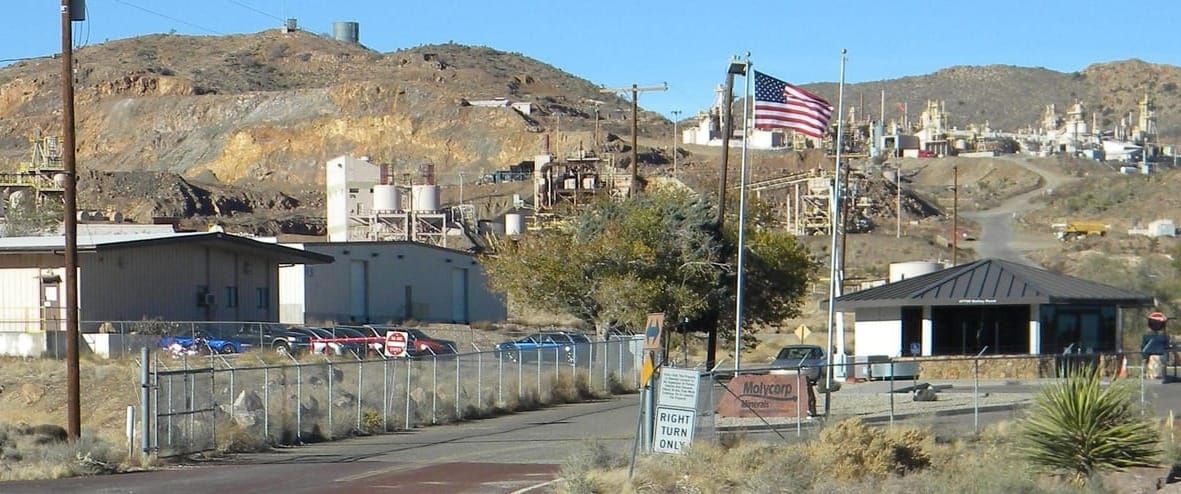
4. Capacity, Timeline, and Technical Readiness
Aggregating participant data exposes the core structural imbalance: announced 2028 to 2030 magnet capacity greatly exceeds the domestic heavy-rare-earth feedstock available at the preceding metallization and separation stages. If MP (10,000 system tonnes by 2028), Vulcan (10,000), USA Rare Earth (1,200 by 2027 and more later), eVAC (2,000 scaling to 12,000), and Noveon (2,000 scaling to 10,000) all reach nameplate, announced sintered NdFeB capacity would approach or exceed 40,000 tonnes per year, comparable to a meaningful share of ex-China world demand [1][11][14][19][21]. Yet domestic dysprosium and terbium oxide production in 2025 to 2026 was pilot-scale kilograms to low tonnes [26][27][30]. The fraction of announced magnet capacity with a secured, non-Chinese heavy-rare-earth feedstock path is therefore very small today, arguably near zero on a fully-qualified basis, rising only as Energy Fuels' Q4 2026 commercial dysprosium and terbium, Ucore's Louisiana lines, and MP's Mountain Pass heavy circuit come online and prove out.
On rare-earth metal (as opposed to oxide) production, the United States stands at an early stage. MP produces NdPr metal and alloy at Fort Worth; USA Rare Earth's Less Common Metals produces metal and alloy in the United Kingdom; Phoenix Tailings produces NdPr and DyFe metal at 200 tonnes per year nameplate [61][13][33]. Beyond these, domestic heavy-rare-earth metal capacity is minimal. This directly undercuts the credibility of the most aggressive announced magnet timelines: a magnet plant without a qualified domestic metal and alloy feed must import metal (today overwhelmingly Chinese) or wait for domestic metallization to scale, which is the least-proven stage.
Assigning an explicit readiness scale to unit operations as practiced by U.S. participants: mining and beneficiation are at commercial readiness (Mountain Pass operating; others pre-production); light-oxide (NdPr) separation is at early commercial readiness (Energy Fuels and MP operating, Ucore and ReElement demonstrating); heavy-oxide separation is at demonstration-to-pilot readiness (Energy Fuels pilot kilograms, Ucore and ReElement demonstration); metallization is at pilot-to-early-commercial readiness (Phoenix Tailings 200 tonnes, MP NdPr metal); alloying and strip casting are at early commercial readiness; and sintered magnet manufacture is at early commercial readiness with a critical qualification gap, since producing a magnet and producing a magnet qualified to automotive or defense specification are different achievements separated by 12 to 24 months of run-at-rate testing [61]. The distinction between chemistry-driven and equipment-driven scale-up risk is sharpest at separation (chemistry and tacit process control dominate) versus magnet-making (equipment, tooling, and workforce dominate).
The equipment problem is itself a bottleneck. Strip casters, hydrogen-decrepitation furnaces, jet mills, magnetic-field aligned presses, and vacuum sintering furnaces are supplied predominantly from China and Japan; ULVAC (TYO:6728) of Japan is the leading Western-aligned furnace and strip-caster maker, with ALD Vacuum Technologies (XAMS:AMG) of Germany, Consarc (Inductotherm Group) in the United States, and NETZSCH and Hosokawa (TYO: 6277) jet mills forming the thin non-Chinese base [63]. China's October 2025 Announcement No. 56 explicitly placed this equipment under export control before suspending it in November 2025, demonstrating that the tooling supply chain is itself a lever Beijing can pull [65]. Vulcan Elements reported that its press and strip caster were among the first made in the United States and that it traced components to avoid Chinese entities of concern, while noting continued dependence on China for spare parts such as strip-caster copper wheels, an illustration of how thin the non-Chinese equipment base remains [64].
 John D
5. Demand
Defense demand is small in tonnage but non-substitutable and regulation-driven. Per-platform rare-earth content figures, most traceable to Department of Defense statements and Benchmark Mineral Intelligence, are cited by Visual Capitalist at around 418 kilograms of rare earths per F-35, about 2,360 kilograms (5,200 pounds) per Arleigh Burke destroyer, and about 4,170 kilograms (9,200 pounds) per Virginia-class submarine; the underlying 920-pound figure for the F-35 traces to a September 2012 Department of Defense internal rare-earth-recycling study submitted to Congress [51][53]. These figures should be treated cautiously: Adamas Intelligence argues that "only one figure bodes reliable and has been repeatedly corroborated: approximately 23 kilograms (50 pounds) of samarium-cobalt (SmCo) alloy per aircraft," used in the Honeywell Integrated Power Package and F-35B lift-system components, plus modest NdFeB, and that the 920-pound figure derives from a classified, data-quality-deficient source [54]. Whatever the precise per-platform mass, the Department of War and Department of Commerce have projected Pentagon permanent-magnet demand could reach roughly 10,000 tonnes per year by 2030, which is why the MP 10X offtake was structured for defense and commercial buyers [51]. The binding feature of defense demand is not volume but the January 1, 2027 statutory prohibition on Chinese-origin content.
Commercial demand is large in tonnage but price-sensitive and substitution-exposed. Electric-vehicle traction motors are the dominant vector; industry estimates cited in the MP transaction analysis put U.S. e-mobility magnet demand near 145,000 tonnes by 2030 [1]. Direct-drive and hybrid-drive wind, industrial motors and robotics (including a highly uncertain humanoid-actuator vector), consumer electronics, and unmanned aerial systems add further demand. The investment risk is that ferrite and rare-earth-free motor architectures are genuine substitution threats: several automakers have announced wound-rotor and ferrite-assisted designs specifically to reduce heavy-rare-earth exposure, so commercial NdFeB demand is not a guaranteed floor in the way defense demand is.

6. Economics and Market Dynamics
Price formation is the sector's central vulnerability. The NdPr benchmark is deficient because it reflects a Chinese domestic price that Beijing can influence through quotas, consolidation, and export policy; the China Rare Earth Industry Association reported NdPr oxide at roughly 61 to 64 dollars per kilogram and dysprosium oxide near 193 to 199 dollars per kilogram as of its May 12, 2026 pricing data, while ex-China contract prices surged dramatically after the 2025 export controls, producing a bifurcated market in which Western ex-China prices for some elements rose by an order of magnitude, with high-purity yttrium oxide reported surging from under 8 dollars per kilogram to as high as 120 to 320-plus dollars per kilogram [1]. The Department of War's 110 dollars per kilogram price floor for MP is roughly double the Chinese domestic NdPr price and functions as both a subsidy and a signal intended to catalyze an ex-China price index [1][4]. Cost structure comparison is unfavorable to U.S. producers at every stage absent policy support: Chinese producers benefit from integrated reagent and equipment supply, scale, tolerated externalities, and byproduct credits. The byproduct-balance problem is acute: any mine-to-magnet model producing NdPr also produces large volumes of cerium and lanthanum for which demand is weak, so cerium and lanthanum disposal or low-value sale drags on project economics, and heavy-rare-earth-enriched feedstocks (monazite, allanite, ion-adsorption analogues) are prized precisely because they improve the value mix.
The strategic price-suppression mechanism has clear historical precedent: after Molycorp's Mountain Pass ramp last decade, Chinese oversupply contributed to a price collapse that bankrupted the operator, and a similar response to a maturing U.S. industry is the central bear case. Mechanically, China could lift quotas and flood NdPr to drive ex-China prices toward its domestic sub-65-dollar level, stranding U.S. producers whose costs sit well above that. The instruments that actually blunt this are the price floor (which transfers price risk to the taxpayer), offtake-with-floor contracts (the MP 10X model), and procurement mandates (the 2027 defense ban), each of which carries fiscal cost or market distortion. Capital intensity per annual tonne is highest at separation and metallization and at integrated magnet plants: Vulcan's 918 million dollars for 10,000 tonnes implies roughly 92,000 dollars per annual tonne of magnet capacity, and MP's 1.25 billion dollar 10X for incremental capacity implies a similar order of magnitude [14][62].
For investors, the decisive test is whether a participant's economics survive a return of NdPr to 2023 levels absent a federal floor. On present evidence, only MP (via its explicit floor) and the defense-anchored positions of Electron Energy and, to a degree, Noveon (through binding multi-year contracts) clearly survive that test; most pre-revenue developers do not, which is precisely why so many are seeking DoW, OSC, EXIM, or price-floor support.
7. Regulatory, Permitting, and Environmental Landscape
Mine permitting timelines are long and are the reason upstream participants lag downstream ones. Federal NEPA review for a new mine on federal land routinely runs many years; American Rare Earths' choice to develop Halleck Creek initially on Wyoming state land is a deliberate strategy to compress permitting to a projected two-to-three-year state timeline and avoid federal NEPA [60]. FAST-41 covered-project status, which Rare Element Resources is pursuing for Bear Lodge, is the principal accelerant available [38]. The radiological licensing burden is a distinct and binding constraint: monazite and other thorium-bearing feedstocks require facilities licensed for source material, and Energy Fuels' White Mesa Mill is effectively the only U.S. facility licensed and operating to process uranium-bearing monazite at scale, a near-monopoly position that makes it structurally central [26][28]. Air, water, and hazardous-waste permitting for separation and metallization facilities is significant but was, on the evidence gathered, navigable at demonstration scale: Phoenix Tailings secured New Hampshire air permits and reported generating under 100 kilograms per month of hazardous waste at Exeter [34]. Recent executive action, including expanded Defense Production Act use and a January 2026 proclamation on processed critical-mineral imports plus a "Project Vault" stockpile announcement, has materially altered the policy timeline even where statutory permitting timelines are unchanged [40]. This dimension is otherwise evidence-moderate and should not be over-read.
8. Government Industrial Policy
Federal industrial policy is now the dominant variable in the sector's financeability, and the instruments in play are unusually direct. The Department of War's July 2025 MP transaction combined equity, a warrant, a loan, a ten-year price floor, and a ten-year offtake [1][2]. The Office of Strategic Capital, funded through the One Big Beautiful Bill Act with a 500 million dollar credit-subsidy tranche said to enable up to 100 billion dollars in loans, committed roughly 700 million dollars jointly to Vulcan Elements and ReElement in November 2025, with the Commerce Department taking a 50 million dollar equity stake in Vulcan and the Department of War taking warrants [16][17][37]. Defense Production Act Title III has funded eVAC and others, with the Department reporting more than 439 million dollars awarded to rare-earth processing and separation projects [22][51]. Section 48C tax credits supported eVAC's 111.9 million dollars [22]. EXIM has issued non-binding letters of interest to American Rare Earths (up to 456 million dollars) and Rare Element Resources [38][60].
The procurement mandate is the sharpest policy lever. Under 10 U.S.C. 4872, as modified by Section 844 of the FY2021 NDAA and Section 854 of the FY2024 NDAA and implemented at DFARS 252.225-7052, the Department of Defense is prohibited, effective January 1, 2027, from acquiring samarium-cobalt and NdFeB magnets (and tantalum and tungsten) if any stage from mining through sintering occurred in China, Russia, Iran, or North Korea [47][48][49]. A recycled-material carve-out exists where milling of recycled material and sintering occur in the United States, and nonavailability waivers are possible on official determination [49]. This mandate is what makes defense-qualified domestic capacity commercially valuable regardless of the NdPr price. Policy durability is itself a risk variable: these commitments span administrations, the OSC and DPA authorities are statutory, and the 2027 mandate is codified, which lends durability, but the price floor and equity stakes are more exposed to reversal, and a future administration could decline to renew offtakes or floors.
9. Geopolitical and Strategic Dimensions
The escalation dynamic of 2025 demonstrated both Chinese leverage and its limits. China's April and October 2025 controls caused documented weeks-long supply disruptions for Western manufacturers and, in the auto sector, threatened production stoppages [8][6]. The November 2025 suspension bought a one-year window to November 10, 2026 but did not remove the April licensing regime, so the durability of any negotiated suspension is low and conditional on broader trade dynamics [7][10]. The central asymmetry is that Chinese leverage bites hardest on U.S. commercial demand, which is large, price-sensitive, and substitution-exposed, while U.S. defense demand is small, non-substitutable, and now legally walled off by the 2027 mandate. This asymmetry shapes the achievable end state. A resilient non-China ecosystem is achievable for defense-scale volumes within the decade, because the tonnages are small, the buyers are mandated, and the price is underwritten. It is only partially achievable for commercial-scale volumes, because those depend on cost-competitiveness that a Chinese price response can undermine and on heavy-rare-earth and metallization capacity that does not yet exist at scale. Allied friend-shoring (Australia's Lynas, Japan's ULVAC, Shin-Etsu, and Proterial, and Europe's VAC) is essential to closing the heavy-separation and equipment gaps that the United States cannot close alone by 2030.
10. Risk Matrix
The following table states, for each material risk, its likelihood, potential impact, and credible mitigations. Compact labels are used here only.
| Risk | Likelihood | Impact | Credible mitigations |
|---|---|---|---|
| Chinese price suppression of NdPr toward domestic sub-65-dollar levels | High | High | Federal price floor (MP model); offtake-with-floor; defense procurement mandate; ex-China price index formation [1][4] |
| Heavy rare-earth (Dy/Tb) feedstock unavailability | High | High | Energy Fuels White Mesa Q4 2026 commercial Dy/Tb; MP Mountain Pass heavy circuit; Ucore Louisiana; allied supply (Lynas) [26][24][61] |
| Separation scale-up failure (RapidSX, chromatography) | Medium | High | Parallel conventional SX at Energy Fuels/MP; staged deployment; DoW/DOE funding de-risking [24][36] |
| Metallization as an unfilled gap | High | High | Phoenix Tailings scale-up; MP NdPr metal; allied metal supply; targeted DPA funding [33][61] |
| Magnet qualification timelines (auto/defense) | High | Medium | eVAC/VAC expertise transfer; Noveon existing qualifications; 12-to-24-month run-at-rate lead times planned [19][61] |
| Equipment and tooling dependency (China/Japan) | High | Medium | ULVAC, ALD, Consarc, NETZSCH sourcing; domestic press/strip-caster builds (Vulcan) [63][64] |
| Workforce and tacit-knowledge scarcity | High | High | Foreign-parent transfer (eVAC); veteran producers (Electron Energy, Noveon); national-lab programs [31][19] |
| Permitting delay (mining) | Medium | Medium | State-land development (Halleck Creek); FAST-41; White Mesa licensed status [60][38][26] |
| Policy reversal (floors, equity) across administrations | Medium | High | Statutory anchoring (2027 mandate, OSC/DPA authorities); codified procurement rules [48][49] |
| Demand-side substitution (ferrite, RE-free motors) | Medium | Medium | Defense non-substitutability; high-performance niches; grain-boundary-diffusion efficiency [52] |
| Capital-markets access for pre-revenue developers | High | High | OSC/EXIM/DPA support; SPAC and equity raises; strategic offtakes [16][60] |
| Single-point-failure at dominant nodes (White Mesa, Electron Energy, MP) | Medium | High | Redundant capacity buildout; strategic stockpiling (Project Vault); allied backup [40][31] |
11. Scenarios
These are forward-looking constructions, labeled as such, each with stated assumptions and observable leading indicators.
In a base case to 2030, the April 2025 Chinese licensing regime persists with periodic suspensions, the 2027 defense mandate takes effect on schedule, and MP, Noveon, eVAC, and USA Rare Earth reach commercial magnet output while Energy Fuels reaches commercial heavy-oxide output. Under these assumptions the United States and allies supply substantially all defense-sector magnet demand without Chinese-origin material by roughly 2028 to 2030, while commercial demand remains 40 to 70 percent import-dependent. Leading indicators that confirm this path: Energy Fuels commercial dysprosium and terbium shipments in 2027; MP heavy-circuit and 10X commissioning; sustained ex-China NdPr pricing above 90 dollars per kilogram.
In an upside case to 2035, allied coordination matures, metallization scales via Phoenix Tailings and partners, recycling contributes a meaningful secondary stream, and cost curves fall enough that commercial demand independence becomes plausible for a majority of non-defense volume. Confirming indicators: a functioning ex-China price index; multiple qualified domestic heavy-metal suppliers; magnet-to-magnet recycling exceeding low-thousands of tonnes annually.
In a downside case, China lifts quotas and suppresses NdPr toward its domestic level after November 2026, pre-revenue developers without floors fail to finance, separation and metallization scale-ups slip, and only the explicitly underwritten defense chain survives. Confirming indicators: ex-China NdPr falling toward 60 to 65 dollars per kilogram; OSC or EXIM conditional commitments lapsing; developer capital raises failing.
Recommendations
For federal policymakers and defense acquisition authorities, the priority is to close the heavy-rare-earth and metallization gap rather than add magnet capacity, because announced magnet capacity already exceeds qualified domestic feedstock. Concretely: extend price-floor or offtake-with-floor instruments beyond NdPr to dysprosium, terbium, and samarium metal, where the bottleneck actually binds; fund a second and third facility licensed to process thorium-bearing monazite so that White Mesa is not a single point of failure; and preserve the January 2027 procurement mandate while building a realistic waiver-and-tracking regime, because the evidence shows domestic qualified supply will not fully exist on that date. The benchmark that should change this stance is domestic commercial-scale dysprosium and terbium output exceeding a few hundred tonnes per year with multiple qualified suppliers; until then, heavy-rare-earth support should take precedence over further magnet subsidies.
For investors and capital allocators, the decisive screen is survival of a Chinese price response absent a federal floor. Favor participants with either an explicit floor (MP), binding multi-year off-takes with creditworthy buyers (Noveon, eVAC via GM), or defense-mandated non-substitutable positions (Electron Energy). Treat announced capacity figures as options, not assets, and discount them to commissioned-and-qualified output; the single most important diligence question is whether a magnet plant has a secured non-Chinese heavy-rare-earth metal feed, which today almost none do. Be especially cautious where disclosure quality is impaired, as with Compass Diversified's Arnold segment during the restatement, or where a private developer's capacity claims rest only on press releases. The threshold that would warrant increased allocation is demonstrated qualified output at rate plus a secured domestic or allied heavy-metal feed.
For industrial buyers, magnet consumers, and project developers, the recommendation is to contract early and vertically. Automotive and industrial buyers should replicate the GM approach of multi-sourcing across Noveon, eVAC, and MP while funding qualification, because qualification lead times of 12 to 24 months are the true schedule risk. Developers should prioritize securing heavy-rare-earth feedstock and metallization partnerships before expanding magnet nameplate, and should design for the cerium and lanthanum byproduct-balance problem from the outset. The benchmark that should trigger capacity expansion is a qualified, contracted heavy-metal supply, not a favorable NdPr spot price.
Bottom line. The binding constraint is heavy-rare-earth separation and metallization, supported by the quantitative gap between kilogram-scale 2025 to 2026 domestic dysprosium and terbium output and the tens of thousands of tonnes of announced magnet capacity that presuppose it. Commissioned, qualified U.S. sintered NdFeB output today is in the low single-digit thousands of tonnes, dominated by Noveon and eVAC with USA Rare Earth and MP ramping. The fraction of announced magnet capacity with a secured non-Chinese heavy-rare-earth feed is minimal. The United States produces rare-earth metal at only pilot to early-commercial scale, which caps the credibility of the most aggressive magnet timelines. Of the fifteen named participants, only a handful (notably MP via its floor, plus the defense-anchored Electron Energy and contract-anchored Noveon) have economics that clearly survive a return to 2023 NdPr pricing without a federal floor. The samarium-cobalt chain requires samarium metal and cobalt that the neodymium chain does not, and essentially only Electron Energy sustains it, with Phoenix Tailings and Energy Fuels positioned to feed it. Magnet-to-magnet recycling is a supplementary stream constrained by collection logistics, not a material 2030 feedstock source at scale. A Chinese price response would mechanically flood NdPr toward its domestic sub-65-dollar level, and only price floors, offtakes, and procurement mandates blunt it. On current trajectory, defense-sector magnet demand could be met without Chinese-origin material around 2028 to 2030; commercial-scale independence is a 2030s proposition, achievable only partially and only if heavy-separation, metallization, and equipment gaps are closed with allied help.
Caveats
Several figures in this report carry epistemic caveats that the reader should weigh. Per-platform defense rare-earth content figures are contested: the widely cited 920-pound F-35 figure traces to a data-quality-deficient 2012 source, and Adamas Intelligence's corroborated estimate of roughly 23 kilograms of SmCo alloy plus modest NdFeB is materially lower [54]. Announced capacity figures for private developers (Vulcan, Phoenix Tailings, ReElement, Rare Earth Salts) rest largely on press releases and funding announcements and are treated here as unverified developer assertions rather than demonstrated output. Company techno-economic and scoping studies (American Rare Earths, Rare Element Resources) are modeled projections whose price assumptions are stated and should not be read as demonstrated economics. Heavy-rare-earth metallization and domestic samarium metal production are genuinely evidence-poor segments with almost no public technical literature, and this report treats them briefly and honestly rather than filling the gap with inference. The Chinese export-control status is a moving target: the October 2025 controls were suspended in November 2025 but remain codified and could resume after November 10, 2026, while the April 2025 licensing regime remains in force. Finally, the Energy Fuels-Vacuumschmelze transaction and MP's 10X groundbreaking were, at the time of writing, recently announced and subject to closing conditions and construction risk, and forward-looking commissioning dates (MP Q2 2026 heavy circuit, Energy Fuels Q4 2026 commercial Dy/Tb, Ucore 2026 Louisiana startup) are company targets rather than achieved milestones.
References
- MP Materials Corp. 2025. "MP Materials Announces Transformational Public-Private Partnership with the Department of Defense to Accelerate U.S. Rare Earth Magnet Independence." July 10.
- Federation of American Scientists. 2025. "Unpacking the DoD and MP Partnership."
- Payne Institute for Public Policy, Colorado School of Mines. 2025. "Explainer on the MP Materials-Department of Defense Partnership."
- Center on Global Energy Policy, Columbia University SIPA. 2025. "MP Materials Deal Marks a Significant Shift in US Rare Earths Policy."
- Bipartisan Policy Center. 2025. "DOD Bets Big on Rare Earth Elements."
- China Briefing (Dezan Shira & Associates). 2025. "China's Rare Earth Export Controls: Impact on Businesses and Industries."
- Pillsbury Winthrop Shaw Pittman LLP. 2025. "China Suspends Export Controls on Certain Critical Minerals and Related Items."
- Center for Strategic and International Studies. 2025. "Rare Earth Export Restrictions One Year Later."
- Global Times / GlobalSecurity.org. 2025. "China Suspends Implementation of Certain Export Control Measures." November 7-8.
- Foundation for Defense of Democracies. 2025. "China Pauses Some Rare Earth Export Curbs While Retaining Levers of Control." November 12.
- USA Rare Earth, Inc. 2026. "USA Rare Earth Achieves Major Operational and Strategic Milestone with Commissioning of Phase 1a Magnet Production at Stillwater Facility." March 26.
- USA Rare Earth, Inc. 2026. Form 8-K, FY2026. U.S. Securities and Exchange Commission.
- Simply Wall St. 2026. "USA Rare Earth (Nasdaq: USAR) Stock Analysis."
- Manufacturing Dive. 2025. "Vulcan Elements Selects North Carolina for $918M Magnet Facility." November 21.
- PR Newswire (Vulcan Elements). 2025. "Vulcan Elements Forges $1.4 Billion Partnership with the United States Government and ReElement Technologies."
- Bloomberg. 2025. "Pentagon Lends $700 Million to Vulcan, ReElement for Magnets." November 21.
- The Center Square. 2025. "Incentive Package of $120.2M, War Department Loan of $620M Buoy Vulcan."
- PR Newswire (Noveon Magnetics). 2026. "Noveon Magnetics Completes $215 Million Series C to Expand U.S. Rare Earth Magnet Manufacturing Capacity." January 19.
- Rare-earth-mining.com. 2026. "Noveon Magnetics: US NdFeB Magnet Maker Profile."
- Noveon Magnetics. 2025. "EcoFlux: Securing a Sustainable Future" and company product disclosures.
- Metal-powder.tech. 2025. "eVAC Ships First Rare-Earth Magnets from South Carolina Facility." December.
- Vacuumschmelze (VAC) / eVAC Magnetics. 2024. "e-VAC Magnetics Receives $111.9 Million Qualifying Advanced Energy Project Tax Credit."
- GM Authority. 2025. "GM EV Magnet Supplier VAC Seeking to Expand U.S. Operations."
- Ucore Rare Metals Inc. 2026. "Ucore Engineering Report Drives Optimized Commercial Deployment Plan for Louisiana Strategic Metals Complex." May 28.
- Investing News Network. 2026. "Ucore Readies for Louisiana 2026 Heavy Rare Earth Element Processing."
- Energy Fuels Inc. 2025. "Energy Fuels Successfully Produces First Kilogram of 99.9% Purity Dysprosium Oxide at its White Mesa Mill." August 21.
- Energy Fuels Inc. 2025. "Energy Fuels' US-Produced 'Heavy' Rare Earth Oxide Successfully Qualified for Use in Permanent Magnets." December 19.
- Energy Fuels Inc. 2025. Form 10-Q, FY2025. U.S. Securities and Exchange Commission.
- Crux Investor. 2026. "Energy Fuels' White Mesa Mill Produces First US Terbium Oxide in Decades."
- Metal Tech News. 2026. "Energy Fuels Produces Terbium at White Mesa." April 1.
- Electron Energy Corporation. 2025. Product and capability disclosures (samarium-cobalt, ultra-high-temperature Sm2Co17).
- Defense Media Network. 2020. "America's Last Remaining Producer of Rare Earth Magnets for Defense."
- AZoMining. 2025. "Phoenix Tailings: Cleaning Up Rare Earth Mining."
- WBUR News. 2025. "One of the Country's Few Rare Earth Processing Plants Opens in New Hampshire." October 31.
- Phoenix Tailings. 2025. "Phoenix Tailings Opens Cutting-Edge U.S. Rare Earth Metallization Facility Entirely Independent from China."
- American Resources Corporation / ReElement Technologies. 2026. "ReElement Technologies Provides Progress Update on Marion, Indiana Refining Campus." June 22.
- Stock Titan. 2025. "ReElement Technologies Forges $1.4 Billion Partnership."
- Rare Element Resources Ltd. 2025. "Rare Element Resources Provides Rare Earth Project Update." November 5.
- Rare Element Resources Ltd. 2025. Corporate Presentation, September.
- U.S. Geological Survey. 2026. Mineral Commodity Summaries 2026 (Rare Earths; Rare Earths Heavy).
- U.S. Geological Survey. 2026. National News Release, February 6.
- Quest Metals. 2026. "US Mineral Supply Chains Remain Exposed to China: USGS Report."
- Compass Diversified. 2025. Forms 8-K, FY2025 (Lugano investigation and non-reliance disclosures). U.S. Securities and Exchange Commission.
- Hartford Business Journal. 2025. "CT Company Discloses Internal Investigation into Subsidiary."
- Seeking Alpha (Pacifica Yield). 2025. "Compass Diversified: Rare Earths Bottleneck an Odd Catalyst." October 15.
- Compass Diversified. 2026. Form 10-Q, Q1 2026. U.S. Securities and Exchange Commission.
- Crowell & Moring LLP. 2024. "DoD Expands Restrictions on Supply Chain for Certain Magnets, Tantalum, and Tungsten."
- U.S. Government Accountability Office. 2024. Critical Materials, GAO-24-107176.
- Acquisition.gov. 2024. DFARS 252.225-7052, "Restriction on the Acquisition of Certain Magnets, Tantalum, and Tungsten."
- Rare Earth Exchanges. 2025. "The Pentagon's Rare Earth Ultimatum: Ban on Chinese Materials by 2027."
- Visual Capitalist (data: Benchmark Mineral Intelligence). 2025. "Visualizing How Rare Earths Power U.S. Defense"; Rare Earth Exchanges, "6 Military Uses of Rare Earth Elements."
- Modern War Institute at West Point. 2025. "Minerals, Magnets, and Military Capability."
- Air & Space Forces Magazine. 2021. "Rare-Earth Uncertainty."
- Adamas Intelligence. 2025. "How Much Rare Earths Does an F-35 Really Contain?"
- WisdomTree. 2025. "The 400-Kilogram Secret Inside Every F-35."
- Ramaco Resources, Inc. 2025. Forms 8-K, FY2025 (Brook Mine). U.S. Securities and Exchange Commission.
- Streetwise Reports. 2025. "Rare Earth Breakthrough in Wyoming Sparks Strategic US Momentum." October 31.
- MINING.COM. 2025. "Ramaco Eyes REE Stockpile at Wyoming Mine." October 27.
- American Rare Earths Limited / MINING.COM. 2025. "American Rare Earths Produces First Wyoming Oxides"; Halleck Creek Updated Scoping Study.
- Rare-earth-mining.com. 2026. "American Rare Earths: Halleck Creek & Wyoming REE Profile."
- MP Materials Corp. 2026. Q4/FY2025 and Q1 2026 results, investor materials, and SEC filings; CNBC and metal-powder.tech reporting on the 10X site selection, Apple agreement, and Energy Fuels-Vacuumschmelze transaction.
- CNBC. 2026. "MP Materials Selects Northlake, Texas for 10X Magnet Facility." February 26.
- Rare Earth Exchanges. 2026. "ULVAC and the Magnet Furnace Equipment Bottleneck." May 1.
- The Wire China. 2026. "Vulcan Elements and the U.S. Magnet Equipment Base." March 15.
- CIRS Group / China Ministry of Commerce. 2025. MOFCOM Announcement No. 56 (rare-earth production and processing equipment export controls) and Announcement No. 70 (suspension).
- MINING.COM / CNBC. 2026. "Energy Fuels Agrees to Acquire Vacuumschmelze." June 23.
- Rare Earth Salts Separations and Refining LLC. 2025. Company disclosures and U.S. House committee testimony of CEO Aaron T. Dowd, June 24.
- International Energy Agency. 2025. Global Critical Minerals Outlook 2025 (China separation, refining, and sintered-magnet production shares).
- China Rare Earth Industry Association / Rare Earth Exchanges. 2026. "China Rare Earth Index Holds High." May 12 pricing data.