What Is SpaceX Starfall? Inside the Disk-Shaped Cargo-Return Capsule SpaceX Just Launched
A briefing on SpaceX Starfall, the disk-shaped reentry capsule now competing with Varda to return cargo from orbit.

Summary
SpaceX's "Starfall" (Project Starfall) is a disk-shaped, uncrewed, mass-producible reentry capsule designed to return up to ~1,000 kg of cargo from orbit. As of June 21, 2026, it has not yet flown. The "Starfall Demo" mission is targeted NET June 23, 2026 aboard a Falcon 9 from SLC-40, Cape Canaveral; SpaceX's own mission page lists a one-hour window opening 6:43 a.m. ET June 23, with a backup at the same time June 24, using booster B1078 on its 29th flight. The vehicle is known almost entirely from FAA and FCC regulatory filings, not from SpaceX itself, which has said nothing publicly.
- Starfall is an early option on SpaceX's industrial-logistics ambitions, not a near-term revenue line. The FAA issued a Final Environmental Assessment and a Mitigated FONSI/Record of Decision on May 15, 2026, approving two test reentries in the Pacific ~1,300 km off California/Mexico. The ROD's stated purpose is twofold: point-to-point cargo delivery on rapid timelines (aligned with DoD Rocket Cargo) and creating a "self-sustaining commercial in-space manufacturing market" offering "safe return from orbit as a service at scale."
- The disk architecture has no onboard deorbit propulsion; both a payload advantage and a strategic constraint. It enables a ~1,000 kg downmass (roughly 30x competitors' typical per-flight return) but makes the capsule dependent on its launch vehicle or a kick-stage to deorbit, narrowing autonomy versus Dragon and Varda's free-flying capsules.
- Vertical integration is the dominant investment theme. By offering launch + return as a bundled service, SpaceX directly undermines standalone returner startups (Varda, Inversion, Atmos) that depend on SpaceX for launch.
 John D
Background
Bloomberg first reported the effort in July 2025 as a confidential internal program. The project surfaced publicly via FAA environmental documents: a Final EA and a Mitigated FONSI/ROD ("Mitigated Finding of No Significant Impact and Record of Decision for SpaceX Reentry Vehicle Operations in the Pacific Ocean"), both dated May 15, 2026, hosted on the FAA Dynamic Regulatory System (drs.faa.gov) and publicized through an "FAA Space Update" on May 29, 2026. The FAA is lead agency; the U.S. Coast Guard is a cooperating agency. Completion of the environmental review does not guarantee a reentry license; the FONSI/ROD page explicitly notes the safety license is a separate step.
The ROD's verbatim Purpose and Need: "The purpose of SpaceX's proposal is to (1) enable point-to-point delivery of critical cargo through space on rapid timelines and (2) create a self-sustaining commercial in-space manufacturing market by offering access to microgravity and vacuum, loiter on orbit, and safe return from orbit as a service at scale." The document frames the capsules as a potential "proliferated successor" to the ISS, scaling station manufacturing experiments to "a self-sustaining manufacturing economy in space," and cites Executive Order 14335 ("Enabling Competition in the Commercial Space Industry," August 13, 2025) and NASA's December 2024 LEO Microgravity Strategy.
3. Key Players and Stakeholders
SpaceX: (NASDAQ: SPCX); vertically integrated across launch (Falcon 9, Starship), satellite broadband (Starlink), and now return. Disclosing shows that its Connectivity segment (primarily Starlink) generated $11.39 billion in 2025, 61% of total sales, rising to 69% in Q1 2026, and was the only profitable division, with $4.42 billion of income. This is the context for treating Starfall as a negligible fraction of the SpaceX thesis.
Competitive landscape (all private; note this). As of mid-2026:
- Varda Space Industries: current market leader. Has flown six W-series capsules on SpaceX rideshares (W-1 in 2023 produced metastable Form III ritonavir; capsules landed in Utah and Australia). Its fifth reentry mission launched on Transporter-15 (Nov 28, 2025). First company to win a special FAA Part 450 reentry license (issued for W-4, valid through 2029, no per-flight resubmission). Raised ~$329M total (Series C $187M, July 2025; Series B ~$90M at a reported ~$500M valuation, April 2024); holds a $60M USAF hypersonics contract. Backers: Founders Fund, Lux Capital, Khosla, Natural Capital, Peter Thiel, Caffeinated Capital.
- Inversion Space: flew subscale demonstrator "Ray" on Transporter-12 (Jan 2025); validated avionics, solar, propulsion and separation systems, but an over-current event on a bipolar junction transistor used to trigger the engine igniter prevented the planned reentry. Unveiled the full-scale "Arc" lifting-body vehicle (Oct 2025), first flight targeted 2026; aims to build hundreds of Arcs/year for a ~2028 constellation. Raised ~$54M total ($44M Series A, Nov 2024); $71M SpaceWERX STRATFI contract; MACH-TB hypersonics work. Backers: Spark Capital, Adjacent, Lockheed Martin Ventures, Kindred Ventures, Y Combinator.
- Atmos Space Cargo (Germany/France): flew Phoenix 1 on Falcon 9 Bandwagon-3 (April 22, 2025) and deployed its inflatable heat shield ("inflatable atmospheric decelerator"), but data from the final descent stage could not be retrieved. Closed a €25.7M ($30M) Series A (April 2026). Phoenix 2 (100 kg payload) NET H2 2026, splashing down near the Azores under a Portuguese reentry license; Phoenix 3 (1,000 kg) targeted late 2028/early 2029. Also launched "Atmos Works" for European government/defense.
- Catalyx Space (San Francisco/India): $5.4M seed (Oct 2025) plus $1.7M pre-seed; building the Rex reentry capsule; completed an airdrop capsule test in 2025; ~20 kg-class demonstrator targeted late 2026.
- Lux Aeterna (Denver): $10M seed (March 2026), $14M total; "Delphi," a ~200 kg fully reusable satellite with a conical heat shield; first flight Q1 2027, recovered in Australia (Koonibba Test Range via Southern Launch). NASA Ames Space Act Agreement plus two CRADAs.
- Reditus Space (Atlanta): $7.1M seed (Dec 1, 2025); ENOS spacecraft, ~40 kg payload, eight-week mission, first flight mid-2026; some DoD hypersonic-data contracts.
Government stakeholders: FAA (Office of Commercial Space Transportation/AST, licensing), FCC (spectrum), AFRL (Rocket Cargo/P2PD), U.S. Space Force, USTRANSCOM, NASA (ISS National Lab, InSPA program).
Technical and Operational Considerations
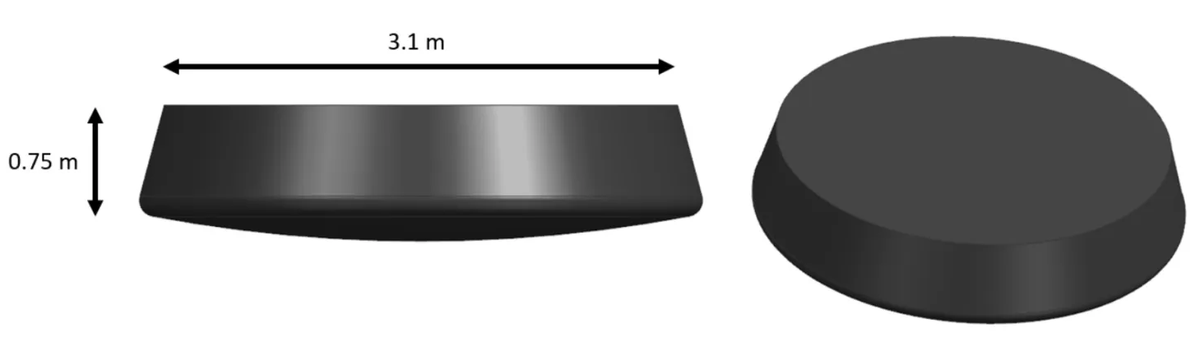
Form factor: Low-profile disk; described by space analyst Dr. Ken Kremer as resembling a "hockey puck or Frisbee".
3.1 m diameter × 0.75 m height, diverging from conical capsules such as Dragon. FAA documents call it "cylindrical." Two parts: an aluminum top plate (~1,400 kg, partially wrapped in thermal protection) carrying maneuvering thrusters, and a carbon-fiber heat shield (~700 kg) covered in TPS and housing nitrogen gas bottles for the thrusters.
Mass budget reconciliation. FAA/KBR figures: dry mass ~2,100 kg (1,400 + 700); payload up to 1,000 kg in a 2.5 × 1.5 × 0.5 m internal bay; total mass ~3,100 kg. The figures are internally consistent (2,100 + 1,000 = 3,100).
Propulsion. No dedicated chemical deorbit propulsion. Relies on the launch vehicle (Falcon 9 or Starship) or an external kick-stage to enter a reentry trajectory. Cold-gas nitrogen thrusters (fed from bottles in the heat shield) for attitude control only. Can fly an orbital-loiter profile or a direct suborbital ballistic trajectory. Deceleration via pilot → drogue → single main parachute; the heat shield is mechanically jettisoned shortly before splashdown; all components are recovered by vessel.
The technical crux. The disk + no-deorbit-propulsion design is a genuine mass/cost advantage for downmass: spreading thermal and aerodynamic loads across a broad surface allows a large payload fraction (~1,000 kg of ~3,100 kg total), versus competitors that currently bring back tens of kilograms per mission (Atmos Phoenix 2: 100 kg; Inversion Arc: ~500 lb; Lux Delphi: ~30 kg payload). But it is also a constraint: without onboard deorbit capability, the capsule cannot freely loiter and independently choose its return the way Dragon (which carries its own propulsion) or Varda's free-flying capsules can. It is tethered to a launch-vehicle or kick-stage event for deorbit, which narrows the autonomous mission set and ties Starfall's economics to SpaceX's own launch cadence. For a captive SpaceX system that dependency is a feature (vertical integration); for an open-market return service it is a limitation.
Telemetry through plasma blackout. Secondary reporting (Tech Times, SatNews) states FCC filings show SpaceX mounting integrated Starlink terminals on the Starfall prototype to maintain a live telemetry link through the reentry plasma-blackout phase, which is the window when ionized air around a hypersonic vehicle blocks conventional RF. FCC experimental STAs 0983-EX-ST-2021 (Starship/Super Heavy) and 1423-EX-ST-2024 (Falcon 9 second stage) explicitly authorized Starlink user terminals to "enable communications during atmospheric entry when ionized plasma around the spacecraft inhibits conventional telemetry frequencies," operating in the 14.0–14.5 GHz band with self-monitoring to cease transmission within 100 ms if interference limits are exceeded.
Heritage. SpaceX has deep reentry/recovery heritage from Dragon. Starfall's specific disk architecture, TPS, parachute sequence, and Starlink-through-blackout link are unproven for this vehicle. The demo flight outcome will be the first direct data point.
Economic and Market Dynamics
In-space manufacturing / microgravity return. Demonstrated commercial demand is thin and largely R&D-stage. Real, flown use cases: Varda's ritonavir Form III crystallization; and NASA InSPA work
Flawless Photonics manufactured more than 11.9 km (seven-plus miles) of ZBLAN optical fiber on the ISS from mid-February to mid-March 2024, including a single day's draw exceeding 1,141 m (3,700 ft), shattering the prior 25 m space record (NASA, sponsored by the ISS National Laboratory with the Luxembourg Space Agency and University of Adelaide); and Redwire (NYSE:RDW) 3D-printing live human cardiac tissue via its BioFabrication Facility. NASA had invested more than $60M across 20+ InSPA awards as of spring 2023. These are demonstrations of feasibility, not yet a self-sustaining market.
Third-party TAM estimates vary widely and should be treated as speculative. The WEF/McKinsey report "Space: The $1.8 Trillion Opportunity for Global Economic Growth" (April 8, 2024) estimated the total space economy at $1.8 trillion by 2035 (upside $2.3T, downside $1.4T), up from $630 billion in 2023; but that figure is dominated by "backbone" (satellites, launch, ~$330B in 2023) and "reach" applications (~$300B in 2023) in communications/PNT/Earth observation, not in-space manufacturing. Dedicated in-space-manufacturing market estimates diverge sharply by source and methodology: commercial market-research firms publish figures ranging from low-single-billions today to tens of billions by the mid-2030s at ~20–30% CAGRs (e.g., Future Market Insights: $6.3B in 2025 → $46.8B by 2036; MarketsandMarkets: $4.6B in 2030 → $62.8B by 2040). These are analyst projections of uncertain reliability, and demonstrated revenue today is a tiny fraction of any of them. Distinguish sharply: Demonstrated demand = pharma crystallization R&D, ZBLAN/bioprinting pilots; Aspirational TAM = the multi-billion/tens-of-billions forecasts.
 John D
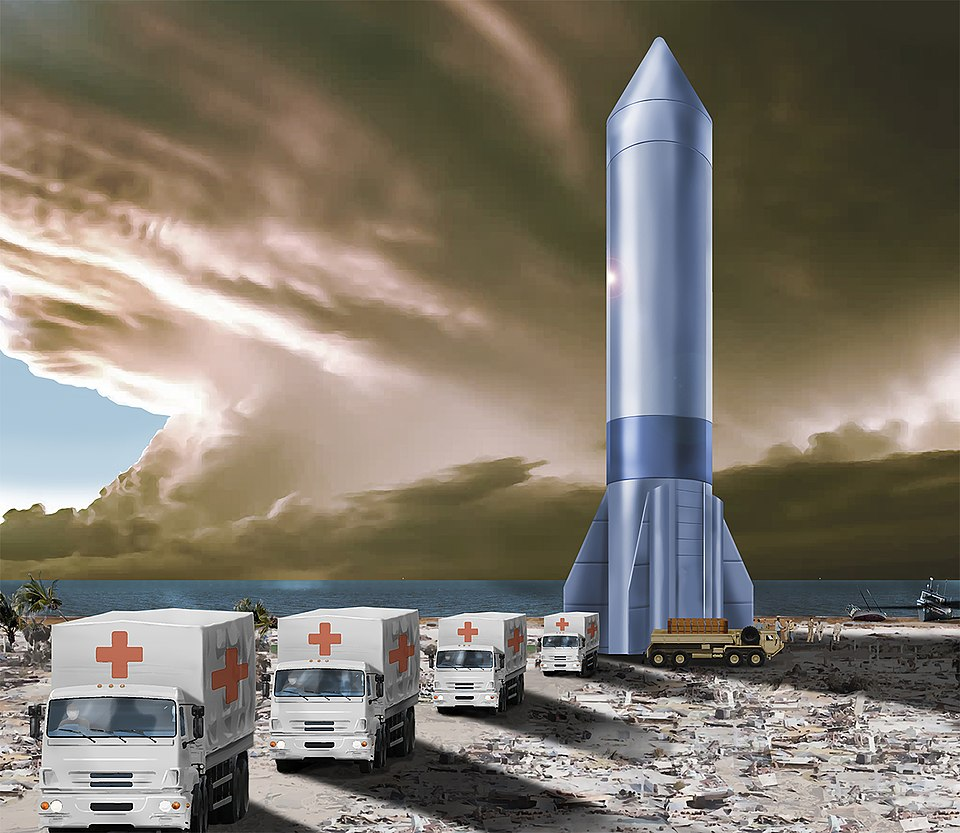
Terrestrial point-to-point cargo (DoD Rocket Cargo). AFRL launched Rocket Cargo as its fourth Vanguard program in June 2021; in January 2022 it awarded SpaceX a five-year $102M contract. The effort became a Space Force "new start" (Point-to-Point Delivery/P2PD) in FY25 with modest funding (FY25: ~$54.2M AFRL + $4M Space Force). The goal: deliver up to ~100 tons (a C-17 load) anywhere in ~90 minutes. AFRL/Space Force officials and SpaceX advisers openly acknowledge deep feasibility and cost skepticism — SpaceX senior adviser Gary Henry compared the doubt to early skepticism of reusable rockets, and analysts note no scenario is cheaper than a C-17 (estimated ~$540,000 for a global delivery) at current launch costs. The Johnston Atoll landing-pad EA (Feb 2025 Notice of Intent) was suspended in July 2025. Rocket Lab won a 2025 REGAL "survivability experiment" award. This is a real program with real (small) budget lines but ASPIRATIONAL operational capability; near-term demand is government-experimental, not commercial.
 Joseph Trevithick
Investing: Starfall is pre-revenue and unproven; it is best understood as an embedded option within SpaceX's broader platform, not a standalone business an investor can value today.
 John D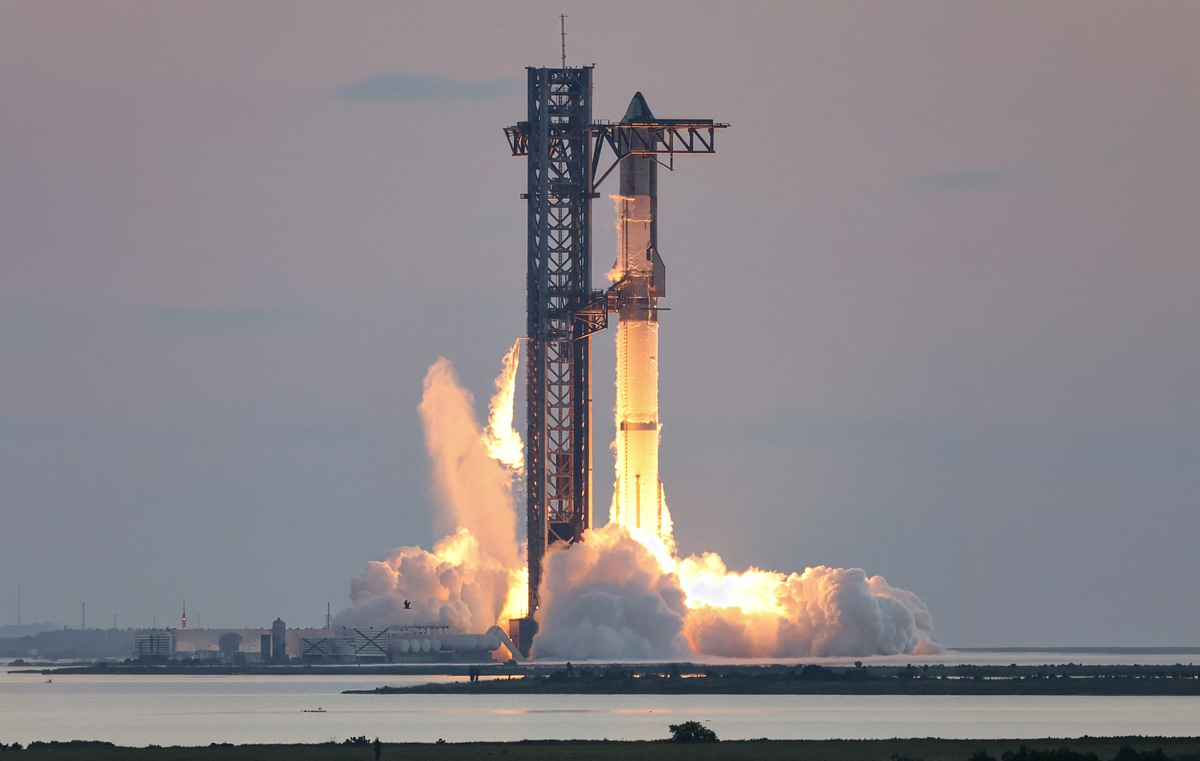
Risks
| Risk | Likelihood | Impact | Mitigations |
|---|---|---|---|
| Demo flight failure/anomaly (reentry survival, parachute sequence, recovery) | Medium | High — it is the only demonstrable data point | Dragon heritage; modest two-flight test campaign; iterative SpaceX design culture |
| Market doesn't materialize (in-space mfg stays R&D-scale) | Medium-High | High | Dual-use (DoD P2PD); SpaceX can cross-subsidize via launch business |
| Regulatory: no reentry license despite completed EA (FAA Part 450) | Low-Medium | High | EA/ROD complete; Varda Part 450 reentry-license precedent |
| Vertical-integration backlash / customer conflict (Varda, Inversion, Atmos are launch customers) | Medium | Medium | SpaceX may keep launching competitors while competing on return |
| Point-to-point cargo proves infeasible/uneconomic vs. C-17 | High | Low-Medium for Starfall specifically | In-space-mfg leg provides an alternate rationale |
| FCC/Starlink-through-blackout telemetry claim unverified in primary sources | — | Low | Strong SpaceX precedent filings (2021, 2024) exist |
Implications for the Technically Informed Investor
Direct exposure to SpaceX/Starfall is available via public markets. As of June 2026, SpaceX is a publicly traded company.
 John D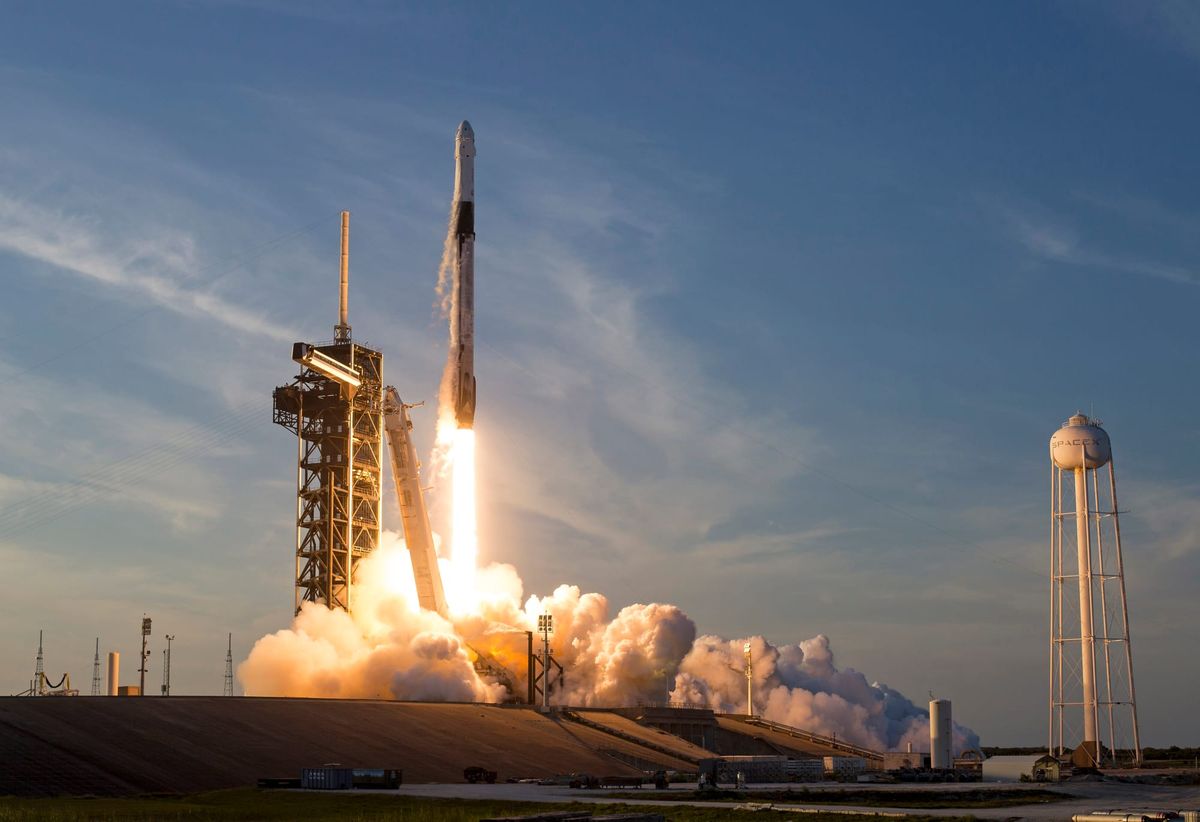
Competitor private exposure: Varda (~$329M raised), Inversion (~$54M), Atmos (~€25.7M Series A); all private, early, and structurally threatened by SpaceX vertical integration. The standalone-returner thesis is materially impaired if Starfall reaches commercial operations, because these firms both buy launch from and now compete with SpaceX.
Adjacent public companies:
- Rocket Lab (NASDAQ: RKLB): launch + space systems; holds an AFRL Rocket Cargo/REGAL survivability award and is developing the reentry-capable Neutron. Genuine but indirect point-to-point exposure; not an in-space-manufacturing play.
- Redwire (NYSE: RDW): the most direct public in-space-manufacturing name (BioFabrication Facility, ZBLAN, Pharmaceutical In-space Laboratory). But heavily loss-making: revenue ~$335M in 2025 with a ~$272M net loss (~-67.5% margin); demand is largely ISS-platform-tied. Shares are volatile (down ~11.5% on the day of the June 2026 SpaceX-IPO).
- Intuitive Machines (NASDAQ: LUNR): lunar/space services; guiding $900M–$1B 2026 revenue and possible positive adjusted EBITDA, with ~$943M backlog. Minimal direct return-from-orbit-manufacturing exposure; primarily a lunar/defense-services story.
- Voyager Technologies (NYSE: VOYG): Starlab commercial station + defense; IPO'd June 2025. In-space-manufacturing exposure is future and station-dependent. Q1 2026 backlog $275.3M; raised 2026 revenue guidance to $230–255M.
- Sidus Space (NASDAQ: SIDU): small-cap satellite manufacturing/services; minimal return-from-orbit or microgravity-manufacturing relevance.
Conditional: Regulatory and Geopolitical
Regulatory. Starfall sits within FAA Part 450 commercial reentry licensing; the EA/ROD addresses NEPA obligations, not the safety license (still required before flight of operational reentries). FCC spectrum authorization governs the Starlink telemetry link. The regime for routine commercial return from orbit is still forming, Varda's special Part 450 reentry license (valid through 2029, no per-flight resubmission) is the emerging template; Lux Aeterna chose Australia for recovery partly because obtaining a U.S. reentry license "isn't easy."
Geopolitical. DoD Rocket Cargo/P2PD ties Starfall-class capability to military logistics and great-power competition; hypersonic reentry data is a recognized US-China competition axis (Varda, Inversion, and Reditus all market hypersonic-test services using their reentry environments). China is advancing parallel return capability: a proposed reusable cargo capsule (10-ton launch mass, 3,500 kg upmass / 2,500 kg downmass, ≥10 reuses, up to one year in orbit) for the Tiangong station, plus the next-generation Mengzhou crew vehicle with cargo-return capacity. In-space manufacturing and return-from-orbit are emerging as strategic-autonomy concerns in both the US (EO 14335, August 2025) and Europe (Atmos's "sovereign return" positioning and European Innovation Council funding).
 John D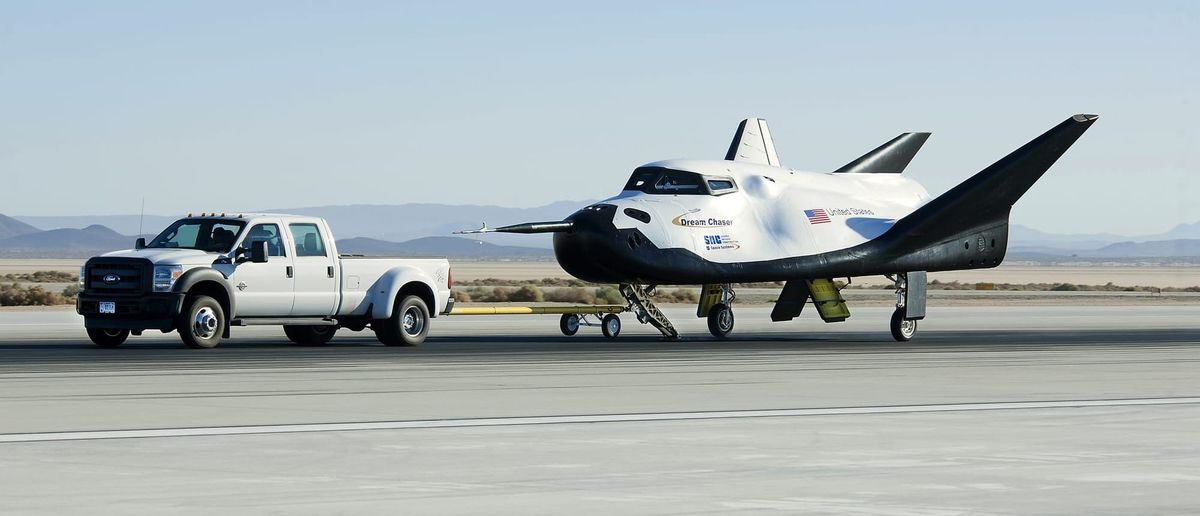
 John D
Primary regulatory sources
- FAA, "Mitigated Finding of No Significant Impact and Record of Decision for SpaceX Reentry Vehicle Operations in the Pacific Ocean," May 15, 2026 — drs.faa.gov, DRSDOCID179523766920260515185428.0002 (FONSI/ROD) and .0001 (Final EA); indexed via faa.gov/space/environmental/nepa_docs.
- FCC Experimental STA 0983-EX-ST-2021 (Starship/Super Heavy Starlink telemetry), apps.fcc.gov/els/GetAtt.html?id=277037.
- FCC Experimental STA 1423-EX-ST-2024 (Falcon 9 second-stage Starlink telemetry), apps.fcc.gov/els/GetAtt.html?id=355143.
- SpaceX, "Starfall Demo Mission," spacex.com/launches/starfalldemo.
Key secondary sources
- Jeff Foust, "FAA documents outline SpaceX plans for Starfall reentry vehicles," SpaceNews, June 1, 2026
- "SpaceX Starfall Demo Flies Tuesday," Tech Times, June 20, 2026
- "SpaceX's Secret 'Starfall' Capsule Wins FAA Approval," SatNews, June 10, 2026.
- WFTV/WDBO (Melonie Holt), June 19, 2026
- WEF/McKinsey, "Space: The $1.8 Trillion Opportunity for Global Economic Growth," April 8, 2024.
- NASA, "Optical Fiber Production" ISS National Lab FY24 Annual Report.
- SpaceNews/Payload/Breaking Defense/Air & Space Forces Magazine - Varda, Inversion, Atmos, Catalyx, Lux Aeterna, Reditus, and Rocket Cargo/P2PD.
- NASASpaceFlight - China reusable cargo capsule and Mengzhou.