Anduril Industries at $61 Billion: Valuation, Revenue, and Execution Risk in 2026
Anduril's $61 billion valuation embeds unit economics not yet proven at scale. An assessment of revenue, contract ceilings, and execution risk.

1. Executive Summary
1.1 Key Findings
Anduril Industries, founded in 2017, has become the most heavily capitalized and most contractually visible of the venture-backed entrants challenging the established U.S. defense-industrial order. As of mid-2026 the company reports a private valuation of approximately $61 billion following a $5 billion Series H round co-led by Thrive Capital and Andreessen Horowitz, roughly double the $30.5 billion valuation it carried after its June 2025 Series G round and more than four times its August 2024 valuation of $14 billion [1][2][3][4]. Cumulative external financing now exceeds $11 billion across eight disclosed rounds, an amount without precedent for a privately held defense entrant [4]. This capitalization is the single most important fact about the company, because its strategy, its risk profile, and its competitive threat to incumbents all derive from the willingness of private capital to fund manufacturing capacity and product development ahead of firm government demand.
The company's central operating premise is a deliberate inversion of the prime-contractor model. Rather than developing systems on cost-plus government contracts against detailed requirements, Anduril builds products using its own capital and intellectual property, then sells finished or near-finished systems at fixed prices, positioning itself as a "defense products company" rather than a "defense contractor" [6][7]. Its unifying asset is Lattice, a software platform for sensor fusion, command and control, and autonomy, is presented as the integrating layer across an expanding hardware portfolio [7]. This software-defined, hardware-enabled orientation is the company's principal claim to differentiation against incumbents whose business is hardware-defined and software-enabled.
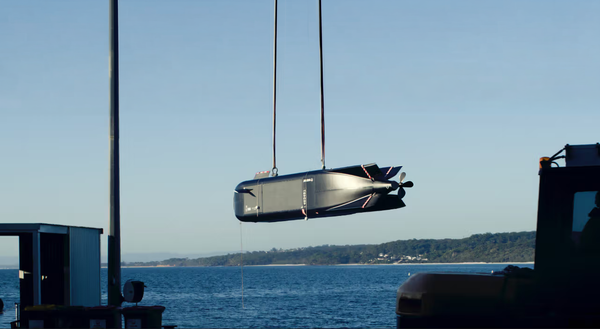
Revenue has grown rapidly from a low base. Available reporting indicates revenue of roughly $1 billion in 2024 and approximately $2.1 to $2.2 billion in 2025, an annual doubling that the company and its investors emphasize [1][4]. Company guidance reported in the press points to revenue near $4.3 billion in 2026, accompanied by losses of roughly $1 billion and no expectation of profitability before approximately 2030 [34]. These forward figures are company-sourced projections and have not been independently verified. The contract base has broadened materially: a U.S. Army enterprise agreement reported at a ceiling of up to $20 billion centered on the Lattice architecture for counter-uncrewed-aircraft missions, the novation of the U.S. Army's Integrated Visual Augmentation System program previously held by Microsoft, selection as one of two competitors in the U.S. Air Force Collaborative Combat Aircraft program, and an Australian sovereign program for Ghost Shark autonomous undersea vehicles valued at roughly 1.7 billion Australian dollars [16][22][11][17][18][19].
1.2 Principal Risks
The dominant risks are financial and structural rather than technological. The valuation embeds expectations of sustained hypergrowth and eventual margin expansion that remain unproven; the company is loss-making and, by reported guidance, will remain so for several years [34]. A significant share of recent revenue growth is concentrated in a small number of very large vehicles, several of which are indefinite-delivery contracts whose headline ceilings substantially exceed obligated funding, so reported totals overstate near-term cash. Independent and critical commentary questions whether a portfolio of many distinct low-cost systems can achieve the unit economics and scale that the valuation implies [33]. Press reporting in 2025 and 2026 has also referenced developmental setbacks, including drone crashes and undersea-vehicle test failures, and has cited government testers questioning the responsiveness of the Lattice software. Policy and adoption risk is significant because the company's trajectory depends on the durability of acquisition-reform initiatives and on continued political support for rapid fielding of autonomous systems.
1.3 Summary of Recommendations
For institutional investors and corporate strategists, the analysis supports treating Anduril as a high-conviction but high-variance position whose value is contingent on execution at Arsenal-1, conversion of contract ceilings into obligated revenue, and an eventual liquidity event; exposure should be sized accordingly and hedged against a defense-tech valuation correction. For policymakers and procurement officials, the analysis supports continued use of flexible acquisition pathways while strengthening independent test and evaluation, preserving competition so that the consolidation problem the company was meant to solve is not recreated in software, and clarifying export and autonomy policy to enable allied sales without diluting controls. These recommendations are developed in Section 9 and tied explicitly to the risks identified in Section 8.
2. Contextual Background
2.1 Origins and Founding Thesis
Anduril was founded on 16 June 2017 by Palmer Luckey, Trae Stephens, Matt Grimm, Brian Schimpf, and Joseph Chen [6][7]. The founding team combined consumer-technology and defense-software lineages: Luckey had founded the virtual-reality company Oculus, which Facebook acquired in 2014; Stephens and Grimm came from the venture firm Founders Fund; and Schimpf and several early engineers came from Palantir Technologies, the data-analytics company that had itself spent years litigating and lobbying for access to defense and intelligence customers [6][7]. The intellectual origin of the company, as recounted in company-aligned histories, was a thesis developed by Stephens at Founders Fund that the defense-acquisition system was structurally resistant to rapid innovation, that incumbent prime contractors had limited incentive to move quickly, and that the most capable engineering talent was concentrated in commercial technology firms that were unwilling to work with the Department of Defense [6]. This narrative is promotional in origin and should be read as the company's framing; nonetheless, its core empirical claims about industrial consolidation are corroborated by independent analysis discussed in Section 2.2.
2.2 The Defense-Technology Inflection
The conditions that enabled Anduril are structural and predate the firm. Since the end of the Cold War the U.S. defense-industrial base has consolidated from dozens of prime contractors to a small number of major producers, and firms with little or no commercial business have come to dominate major programs; one analysis finds that defense specialists accounted for roughly 61 percent of the Department of Defense's major programs by value in 2024, up from a small fraction at the end of the 1980s [29]. This concentration coincided with a widening perception that the United States was losing its qualitative and quantitative edge relative to China, whose announced defense spending reached approximately 336 billion U.S. dollars in 2025, an increase of about 7.4 percent over the prior year [28]. Global military expenditure reached approximately 2.887 trillion U.S. dollars in 2025, the eleventh consecutive annual increase, with the United States, China, and Russia together accounting for roughly 51 percent of the total [28].
A parallel driver is the empirical demonstration, principally in Ukraine, that inexpensive autonomous and semi-autonomous systems can impose disproportionate costs on conventional forces. Analysts across the policy spectrum describe the conflict as the largest live test of drone warfare to date; Ukrainian production of uncrewed aerial systems reportedly reached roughly 2.2 million units in 2024 with higher targets for 2025, and assessments indicate that onboard autonomy can raise strike success rates substantially by reducing dependence on continuous human control and stable communications links [32][38]. These demonstrations reframed mass, attritability, and software-defined adaptability as central rather than peripheral attributes of military capability, and they gave political momentum to initiatives intended to field autonomous systems quickly, most visibly the DoD Replicator initiative discussed in Sections 6 and 7 [24].
2.3 Operating Model and Business Philosophy
Anduril's model rests on three connected choices. First, the company finances product development with private capital and retains the resulting intellectual property, then sells systems at fixed or commercial-style prices rather than developing to government specification on cost-reimbursement terms [6][7]. Second, it treats software as the primary product and hardware as the means of realizing software capability, organizing its portfolio around the Lattice platform so that individual vehicles and sensors are presented as nodes in a common autonomy and command-and-control fabric [7]. Third, it pursues vertical integration and in-house manufacturing at scale, exemplified by the Arsenal-1 facility in Ohio, in an explicit attempt to compress the time between design and fielded production [9][10]. The model's appeal to the DoD is speed and the transfer of development risk to private investors; its vulnerability is that it requires either large recurring procurement or a continuous flow of new capital to sustain the manufacturing overhead it builds ahead of demand. The remainder of this report assesses how durable that bargain is likely to prove.
3. Key Players and Stakeholders
3.1 Leadership and Governance
Executive responsibility is distributed among the founders. Brian Schimpf serves as chief executive officer, Matt Grimm as chief operating officer, and Trae Stephens as executive chairman, while Palmer Luckey functions as the public-facing founder and principal external advocate [6][7]. Luckey's prominence is a strategic asset and a governance consideration in equal measure: his visibility accelerates recruiting, political access, and brand formation, but it also concentrates reputational exposure in a single individual whose public positions, including statements that the United States could spend less on defense by reallocating away from legacy programs, are closely identified with the firm [34]. As a privately held company, Anduril discloses little about its board composition, internal controls, or the rights attached to successive preferred-share classes; this opacity is normal for late-stage private firms but is itself a diligence limitation for outside parties, and it means that governance assessments must rely on inference rather than disclosure.
3.2 Customers and Programs
Anduril's customer base is concentrated in the U.S. DoD and the Department of Homeland Security, with a growing set of allied governments. Early revenue derived substantially from border-surveillance work, where autonomous sentry towers running Lattice were credited with supporting detections and apprehensions along the southern border, a program that evolved from a pilot into a program of record [8]. The company subsequently expanded across services and missions: the U.S. Air Force selected it, alongside General Atomics, for the first increment of the Collaborative Combat Aircraft program [12][13]; the U.S. Army approved the transfer to Anduril of the Integrated Visual Augmentation System program previously held by Microsoft and later awarded prototype work under the successor Soldier Borne Mission Command effort [20][21][22][23]; and a reported U.S. Army enterprise agreement centered on Lattice for counter-drone missions carries a ceiling reported at up to $20 billion [16]. Internationally, the most significant single award to date is the Australian Ghost Shark program for extra-large autonomous undersea vehicles, valued at roughly 1.7 billion Australian dollars over five years [17][19]. These relationships make the U.S. and Australian governments the company's most consequential stakeholders, with the United Kingdom and several European states emerging as prospective customers [35].
 John D
3.3 Investors and Capital Partners
The company's capital base is as strategically significant as its customer base. Founders Fund, associated with Peter Thiel, has participated in nearly every round from seed onward and committed approximately $1 billion in the Series G, described in reporting as the largest single investment in the firm's history [1][2]. Andreessen Horowitz led the Series C in 2020 and has participated in subsequent rounds, and it co-led the 2026 Series H alongside Thrive Capital [2][3][4]. Other reported investors across the financing history include Sands Capital, General Catalyst, 8VC, and Fidelity, indicating a mix of venture, growth, and crossover capital [2]. The concentration of marquee venture investors matters for three reasons: it signals confidence that has helped the company recruit and win business; it creates a powerful constituency with an interest in an eventual public listing or other liquidity event; and it ties the company's fortunes to the broader appetite of private markets for defense technology, an appetite that has expanded rapidly but is not guaranteed to persist through a downturn.
3.4 Competitive Landscape
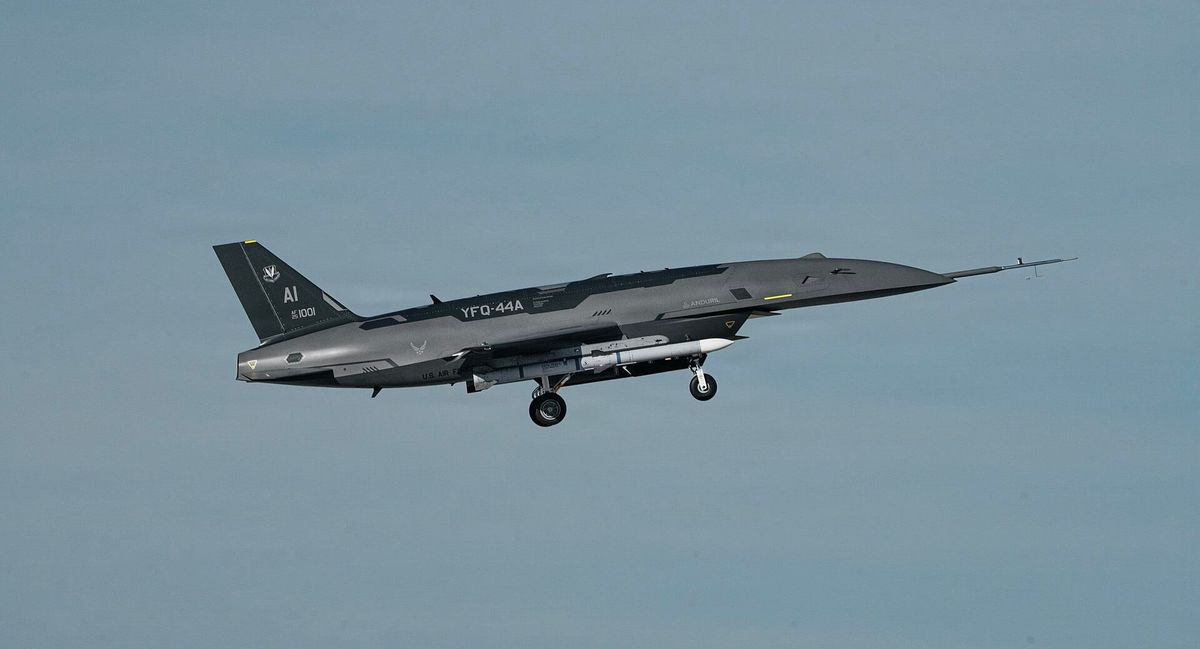
Anduril competes simultaneously against two very different sets of rivals. The first set comprises the traditional prime contractors, including Lockheed Martin, RTX, Northrop Grumman, General Dynamics, Boeing, and L3Harris, whose advantages are scale, program-management depth, security infrastructure, and entrenched relationships, and whose vulnerabilities are slower development cycles and software practices rooted in an earlier era. In specific programs the competition is direct: General Atomics, an established uncrewed-systems manufacturer, is Anduril's counterpart in the Collaborative Combat Aircraft competition, and its YFQ-42A prototype is being evaluated against Anduril's YFQ-44A [13]. The second set comprises venture-backed entrants pursuing adjacent or overlapping niches, including Shield AI in autonomy software, Saronic in autonomous surface vessels, Palantir in data and software integration, and a range of smaller firms, such as Kratos Defense, in counter-uncrewed-systems, electronic warfare, and space. The relationship with these firms is not purely adversarial; in the Collaborative Combat Aircraft flight-test campaign, for example, both Anduril's Lattice and Shield AI's Hivemind autonomy software were flown on the same aircraft, illustrating that the autonomy layer and the airframe are partially separable and that today's partner can be tomorrow's competitor [14]. Anduril's chief executive has publicly characterized incumbent behavior toward new entrants as obstructive, a framing that reflects the contested nature of this competition [36].
 John D
4. Technical and Operational Considerations
4.1 Core Technology Stack
The technological center of gravity is Lattice, which the company describes as an artificial-intelligence-enabled operating system that fuses data from disparate sensors, builds a common operating picture, and tasks or controls uncrewed systems across domains [7][8]. Architecturally, the claim is that Lattice functions as an integration layer that abstracts individual sensors and effectors into interchangeable nodes, so that capability can be added through software updates rather than through new platform development. A related variant, presented as Lattice for Mission Autonomy, is positioned as the onboard autonomy and mission-management software for uncrewed aircraft [14]. The important and only partially answerable question is how much of Lattice's value is truly portable integration software and how much is tied to Anduril's own hardware. The Collaborative Combat Aircraft flight tests, in which a competitor's autonomy software was flown on the same airframe and tasks were completed under both systems, suggest the autonomy layer is at least partly modular, which cuts in two directions: it supports the company's open-architecture positioning, but it also implies the autonomy software does not by itself create an insuperable moat [14].
4.2 Product and Platform Portfolio
The hardware portfolio has broadened from surveillance toward strike, air combat, and undersea missions. In the air domain, the YFQ-44A, derived from the company's Fury design, is Anduril's entrant in the Air Force Collaborative Combat Aircraft program; it completed a first flight reported on 31 October 2025 and entered low-rate production preparation in early 2026 [11][14]. In the munitions domain, the Barracuda family of air-breathing, software-defined vehicles in three size classes is designed for low-cost, high-volume manufacture and has been advanced under the Air Force and Defense Innovation Unit Enterprise Test Vehicle effort [15]. In counter-uncrewed-systems, the reusable Roadrunner-M vertical-takeoff interceptor and associated effectors address the growing demand to defeat hostile drones at acceptable cost. In the undersea domain, the Ghost Shark and Dive-series extra-large autonomous undersea vehicles are the basis of the Australian program and a pitch to the U.S. Navy [17][18]. Additional systems include loitering munitions and small uncrewed aircraft selected for the Replicator initiative, and the Seabed Sentry and related maritime systems pitched for European undersea-infrastructure protection [35]. The breadth of this portfolio is a strategic choice that the company frames as a coherent family unified by Lattice; critics frame the same breadth as a proliferation of distinct systems whose individual volumes may be insufficient to achieve attractive economics, a tension examined in Section 4.4 [33].
4.3 Production and Scaling
The most concrete expression of the company's strategy is Arsenal-1, a manufacturing complex in Pickaway County, Ohio, announced in January 2025. State and company materials describe a facility of roughly 5 million square feet, capital investment on the order of 900 million dollars or more, and a projected workforce in the thousands over a multiyear horizon, characterized by Ohio officials as among the largest job-creation projects in the state's history [9][10]. The company's stated intent is to "hyperscale" production of autonomous systems using common manufacturing infrastructure and software-driven processes, and it reported beginning production of the YFQ-44A at the site in March 2026, which, if sustained, would be an unusually rapid path from facility announcement to aircraft production [9]. Production of undersea vehicles is being established separately, including a Ghost Shark facility in Sydney where the company reported delivering the first vehicle ahead of schedule in late 2025 [19]. These are capability claims that remain to be validated at volume; announcing and partially equipping a large factory is not the same as demonstrating sustained, quality-controlled output at the unit costs the business model assumes, and independent confirmation of throughput and yield is not yet available.
4.4 Independent Assessments and Open Questions
A disciplined assessment must separate demonstrated capability from projection. Several facts are well supported: the company has fielded operational border-surveillance systems, has won competitive selections across multiple services, has flown a jet-powered uncrewed combat aircraft prototype, and has delivered undersea vehicles to an allied navy [8][11][14][19]. Several important claims remain unverified or contested. The proposition that Lattice meaningfully outperforms incumbent command-and-control systems rests substantially on company and customer assertions rather than on published independent test results, and press reporting has cited government testers questioning the software's responsiveness. The proposition that the company can manufacture diverse autonomous systems at low unit cost and high volume is central to the investment thesis but is, as of mid-2026, demonstrated only in early production. Critical commentary has argued that a portfolio of many low-cost systems may be neither readily scalable nor individually profitable, and that the underlying business model may depend on capturing customers through inexpensive hardware before monetizing software and sustainment [33]. These are reasonable hypotheses rather than settled conclusions, and the evidence required to adjudicate them, namely audited unit costs, yield data, and sustainment margins, is not public.
Is Anduril Worth $61 Billion? Revenue, Contract Ceilings, and Execution Risk
5. Economic and Market Dynamics
5.1 Funding and Valuation
Anduril's financing history is one of accelerating round sizes and valuations. Disclosed rounds include a seed of approximately 17.5 million dollars, a Series A near 41 million, a Series B near 127 million, a Series C of approximately 200 million led by Andreessen Horowitz in 2020, a Series D of approximately 450 million in 2021 at a reported valuation near 4.7 billion, a Series E of approximately 1.48 billion in 2022 at a reported valuation near 8.5 billion, a Series F of approximately 1.5 billion in 2024 at a reported valuation near 14 billion, a Series G of approximately 2.5 billion in June 2025 at a reported valuation of 30.5 billion, and a Series H of approximately 5 billion in May 2026 at a reported valuation of 61 billion [1][2][3][4][5]. Cumulative external financing exceeds 11 billion dollars [4]. The pace of valuation expansion, a near-doubling within roughly nine months between the Series G and Series H, is the defining economic feature of the company and the principal source of both opportunity and risk: it reflects genuine commercial momentum, but it also compresses the timeline over which the company must validate the assumptions embedded in the price.
 John D
5.2 Revenue and Contract Base
Reported revenue indicates rapid growth from a low base, from roughly 500 million dollars in 2023 to approximately 1 billion in 2024 and approximately 2.1 to 2.2 billion in 2025; sources differ modestly on the 2025 figure and on the precise growth rate, and these differences are noted rather than resolved here [1][4]. Forward guidance reported in the press points to revenue near 4.3 billion dollars in 2026 alongside losses of roughly 1 billion and an expectation of profitability around 2030; these are company projections and are not independently verified [34]. The contract base has broadened across the U.S. Army, Air Force, Navy, Special Operations Command, and the Department of Homeland Security, as well as allied governments [16][17][22]. An important caution applies to headline contract values: several of the largest figures, including the reported up-to-20-billion-dollar Army enterprise agreement and the approximately 22-billion-dollar ceiling associated with the novated Integrated Visual Augmentation System program, are contract ceilings on indefinite-delivery or long-duration vehicles rather than obligated funding, so they materially overstate near-term revenue and should not be read as committed cash [16][22].
5.3 Market Sizing and Demand Drivers
The addressable market is expanding on the strength of structural demand drivers rather than transient budget cycles [28]. Demand specific to Anduril's portfolio is concentrated in autonomous systems, counter-uncrewed-systems, software-defined command and control, and the recapitalization of munitions stockpiles, all of which have been elevated by lessons from Ukraine and by concern over a potential Indo-Pacific contingency [24][32]. The Replicator initiative, which seeks to field thousands of attritable autonomous systems and explicitly targets countering China's mass, is both a demand signal and a procurement mechanism aligned with the company's product strategy [24]. The size of the realizable opportunity nonetheless depends on whether programs of record and recurring procurement materialize at the scale that current demand rhetoric implies, which is a policy and budget question as much as a market one.
5.4 Unit Economics and Competitive Position
The company's competitive position relative to incumbents turns on whether its vertically integrated, software-led model produces a durable cost or speed advantage. The favorable case is that common software and shared manufacturing reduce marginal cost across a product family, that fixed-price sales transfer development risk to the company in exchange for higher margins on successful products, and that faster iteration yields capability advantages that justify premium positioning. The unfavorable case is that the company is funding manufacturing overhead and a broad product portfolio ahead of demand, that reported losses reflect this structural exposure, and that the unit economics of many distinct low-volume systems are weaker than the integrated-platform narrative suggests [33][34]. The evidence needed to distinguish these cases, principally audited margins and per-unit costs at volume, is not public as of mid-2026. The prudent position is that the model is plausible and partially demonstrated but not yet proven at the scale the valuation requires, and that the burden of proof rests with the coming two to three years of production at Arsenal-1 and conversion of contract ceilings into obligated revenue.
6. Regulatory Landscape
6.1 Acquisition and Procurement Pathways
Anduril's rise is inseparable from a decade of acquisition reform that created pathways better suited to nontraditional entrants. Other Transaction Authority, commercial solutions openings, middle-tier acquisition, and the broader Adaptive Acquisition Framework allow the Department of Defense to contract for prototypes and follow-on production with fewer of the procedural requirements that govern traditional programs, and organizations such as the Defense Innovation Unit were created to lower the barrier to entry for commercial firms [25][31]. These mechanisms have measurably widened the supplier base, but assessments note that benefits are unevenly distributed: established primes report advantages from the framework while some nontraditional vendors continue to find it complex and inflexible, and a 2025 Defense Innovation Board examination addressed the persistent difficulty of scaling nontraditional innovation from prototype to program of record [31]. For Anduril, the durability of these pathways is a first-order dependency, because a retrenchment toward traditional acquisition would erode precisely the structural advantage the company has exploited.
6.2 Export Controls and Compliance
International expansion places the company within the U.S. export-control regime, principally the International Traffic in Arms Regulations and the Export Administration Regulations, alongside the domestic regimes of partner states. Reporting indicates the company is building trade-compliance functions to operate across these regimes and that it has, in at least some cases, structured products to limit export encumbrance; for example, a base configuration of the Fury aircraft has been described as not encumbered by the most restrictive controls, which would allow allied partners to integrate their own sensors and payloads [35]. Export-control posture is strategically consequential because the company's allied-sales ambitions in the United Kingdom, Europe, and the Indo-Pacific depend on the ability to transfer capability without protracted licensing, while the same controls protect sensitive autonomy and sensor technologies. The tension between market access and technology protection is unlikely to be fully resolved and will require case-by-case management, including potential co-development and in-country production arrangements such as the company's Australian and European manufacturing initiatives [19][35].
6.3 Policy and Legislative Drivers
The policy environment is favorable but not unconditioned. Congressional and executive attention to the defense-industrial base, documented in successive analyses of consolidation and resilience, has produced bipartisan interest in broadening the supplier base and accelerating fielding [29][30]. The Replicator initiative provided both political endorsement and a funding vehicle for attritable autonomous systems, with the Department reporting roughly 1 billion dollars allocated across fiscal years 2024 and 2025 and selecting specific systems across tranches [24]. At the same time, autonomy in weapons is governed by DoD Directive 3000.09, updated in 2023, which requires that systems allow commanders and operators to exercise appropriate levels of human judgment over the use of force [26][27]. The net effect is a policy framework that actively encourages the company's general direction while imposing constraints on the most autonomous applications, and the stability of this framework across administrations and budget cycles is itself a variable that affects the company's prospects.
7. Geopolitical and Strategic Dimensions
7.1 Great-Power Competition
The strategic logic that underwrites Anduril's demand is the U.S. effort to sustain deterrence against China at acceptable cost. China's announced defense spending of approximately 336 billion dollars in 2025, growing faster than the global average, and the broad assessment that the People's Liberation Army has fielded capabilities designed to contest U.S. operations in the western Pacific, have produced a U.S. emphasis on affordable mass, distributed sensing, and autonomous systems that can be fielded quickly [28]. The Replicator initiative is the clearest institutional expression of this logic, explicitly framed as a means to counter Chinese mass by fielding thousands of attritable autonomous systems across domains within a compressed timeline [24]. Anduril's portfolio is closely aligned with this priority, and the company has secured positions in Replicator tranches and adjacent programs [24]. The strategic dependency runs both ways: the company benefits from the durability of this threat perception, and any significant change in the perceived urgency of Indo-Pacific deterrence would alter its demand environment.
7.2 Allied and Coalition Dynamics
Allied modernization is the second strategic pillar of the company's growth, and it is advancing on a different cadence than U.S. spending. European military expenditure rose by roughly 14 percent in 2025 as states responded to the war in Ukraine and to uncertainty about the future U.S. force posture in Europe, while spending in Asia and Oceania rose by roughly 8.1 percent [28]. Anduril has converted part of this demand into concrete programs, most notably the Australian Ghost Shark undersea-vehicle program and an emerging European presence that includes a partnership with Rheinmetall and maritime-security offerings aimed at protecting undersea infrastructure following incidents in the Baltic and elsewhere [17][19][35]. Allied engagement also exposes a strategic tension articulated in reporting: the founder's stated prioritization of U.S. interests could complicate sales to partners that seek sovereign control over critical capabilities, and partners increasingly insist on local production, technology access, and freedom from restrictive export encumbrance [37]. The company's response, including in-country manufacturing in Australia and Europe, is an attempt to reconcile allied demand for sovereignty with U.S. control preferences [19][35].
7.3 Doctrine and the Autonomy Debate
The shift toward autonomous and software-defined systems is reshaping doctrine as well as procurement. Evidence from Ukraine indicates that autonomy can substantially increase the effectiveness of inexpensive systems and that decentralized innovation and rapid battlefield feedback can outpace traditional development cycles, but the same evidence cautions against overstatement: analysts note that uncrewed systems have increased rather than reduced demand for human judgment and organizational capacity, and that such systems enhance sensing and striking without being able to hold terrain or perform the full range of military functions [32]. For Anduril, this doctrinal picture is favorable in that it validates attritable, software-defined mass, but it also implies that autonomous systems will be integrated into human-centered force structures rather than replacing them, which constrains the most expansive claims about autonomy and frames the realistic near-term role of the company's products as augmentation rather than substitution.
7.4 Ethical and Normative Considerations
The normative environment surrounding autonomous and artificial-intelligence-enabled weapons is contested and unsettled, and it constitutes a reputational and regulatory variable for the company. U.S. policy requires that autonomy in weapons preserve appropriate levels of human judgment over the use of force, and it favors that standard over the alternative formulation of meaningful human control advanced by some states and civil-society organizations [26][27]. At the international level, discussions under the Convention on Certain Conventional Weapons have proceeded since 2017 without an agreed definition of lethal autonomous weapon systems or a binding instrument, leaving a patchwork of national policies [27]. Anduril operates within the permissive but conditioned U.S. framework and benefits from the absence of binding international constraints, but it is also exposed to the possibility that normative pressure, allied legal requirements, or future regulation could restrict particular applications. The company's public positioning emphasizes human-in-the-loop and human-on-the-loop control, which aligns with current U.S. policy; whether that positioning withstands competitive and operational pressure toward greater autonomy is an open question that the public record does not resolve.
8. Risk Assessment
This section combines a structured matrix with narrative analysis. The matrix is used to summarize discrete, separable risks across horizons and categories, because that format aids comparison. A narrative discussion follows because the most consequential risks are interdependent, in particular the linkage between valuation, capital availability, and execution, which a grid would render artificially discrete.
8.2 Narrative Risk Discussion
The central risk is the coupling of valuation, capital, and execution. The company's valuation embeds expectations of sustained hypergrowth and eventual margin expansion; meeting those expectations requires successful, high-volume, quality-controlled production and the conversion of large contract ceilings into obligated revenue, while continued losses require either a path to profitability or continued access to private capital on favorable terms [3][4][34]. These elements are mutually reinforcing in both directions. Successful execution would validate the valuation, ease capital raising, and fund further capacity; a stumble in production or a slower-than-expected conversion of contracts could coincide with a cooling of private-market appetite for defense technology, raising the cost of capital precisely when the company most needs it. This reflexivity is not captured by treating financial and technical risks as independent cells, which is why the narrative treatment is necessary.
A second cluster concerns concentration and dependency. The company is heavily dependent on the U.S. government as a customer and on the continuation of acquisition-reform pathways and autonomy-favorable policy; it is also exposed to key-person risk around its founder and to the reputational dynamics of building autonomous weapons [26][31][37]. A third cluster concerns the gap between demonstrated and projected capability. Much of the investment thesis rests on claims about unit cost, production scale, and software performance that are, as of mid-2026, only partially demonstrated, and some operational claims are contested in press reporting and not independently verified [33]. None of these risks is disqualifying, and several could resolve favorably, but together they imply a wide distribution of outcomes and justify treating the company as a high-variance proposition rather than a settled success.
9. Strategic Recommendations
9.1 Recommendations for Institutional Investors and Strategists
Investors should treat exposure to Anduril, whether through pre-initial-public-offering secondary markets, venture funds, or eventual public equity, as a high-conviction but high-variance position whose central uncertainties are executional and financial rather than technological. Position sizing should reflect the wide outcome distribution identified in Section 8 and should anticipate the possibility of a broader defense-technology valuation correction; concentration should be avoided and, where instruments permit, exposure should be hedged against sector-wide repricing [3][4][33]. Diligence should prioritize the indicators that most directly test the thesis: obligated rather than ceiling contract values, production throughput and yield at Arsenal-1, evidence of margin progression toward the company's stated 2030 profitability horizon, and independent test results for Lattice and the autonomy stack [16][34]. The modularity demonstrated in the Collaborative Combat Aircraft tests suggests that autonomy software and airframes are partially separable, which creates both partnership openings and the risk of commoditization at the autonomy layer [14].
9.2 Recommendations for Policymakers and Procurement Officials
Policymakers should preserve and refine the flexible acquisition pathways that enabled new entrants while addressing their uneven application, because the evidence indicates that nontraditional vendors still encounter complexity and that scaling from prototype to program of record remains the binding constraint [31]. Procurement officials should pair faster fielding with strengthened independent test and evaluation, given that several operational claims for autonomy software are contested and not independently verified; rapid acquisition should not displace rigorous, transparent assessment of performance and safety [26][33]. A specific structural caution is warranted: the policy goal that motivated support for new entrants was to reduce dependence on a small number of consolidated primes, and officials should ensure that the same concentration is not recreated in software and autonomy by allowing a single vendor's platform to become a de facto standard without competition or interoperability requirements [29]. Finally, officials should clarify export and autonomy policy to enable allied sales and co-production without diluting technology protection or the human-judgment standard in Directive 3000.09, since allied demand increasingly hinges on sovereignty and access terms that current controls complicate [26][35][37].
9.3 Recommendations for Defense Incumbents and Allied Planners
Incumbent prime contractors should treat the company's model as a competitive signal rather than an anomaly, and should prioritize software architecture, open interfaces, and faster iteration in the areas where new entrants have demonstrated advantage, while leveraging their own advantages in scale, systems integration, and sustainment. Selective partnership, including supplying subsystems into Anduril platforms or integrating Anduril software into their own, may be more value-accretive than uniform resistance. Allied planners, particularly in Europe and the Indo-Pacific, should pursue capability access through co-development and in-country production arrangements of the kind already established in Australia, and should negotiate explicit terms on sovereignty, data, and export freedom early, given the tension between U.S. control preferences and allied sovereignty requirements that reporting has identified [19][35][37]. Allied planners should also diversify across suppliers to avoid substituting dependence on a single new entrant for dependence on a single incumbent.
Conclusion
Anduril Industries is a well-capitalized, fast-growing, and strategically well-positioned challenger whose ultimate significance remains uncertain. The verifiable record supports several strong conclusions: the company has attracted financing without precedent for a defense entrant, has won competitive positions across multiple services and allied governments, and has fielded operational systems and flown advanced prototypes [1][4][11][14][19]. The record does not yet support the strongest claims embedded in its valuation, namely that it can manufacture diverse autonomous systems at low cost and high volume, sustain a durable software advantage, and convert large contract ceilings into profitable recurring revenue within the assumed timeline [33][34]. The coming two to three years, dominated by the production ramp at Arsenal-1 and the maturation of major programs, will provide much of the evidence needed to distinguish the favorable from the unfavorable case.

 John D
 John D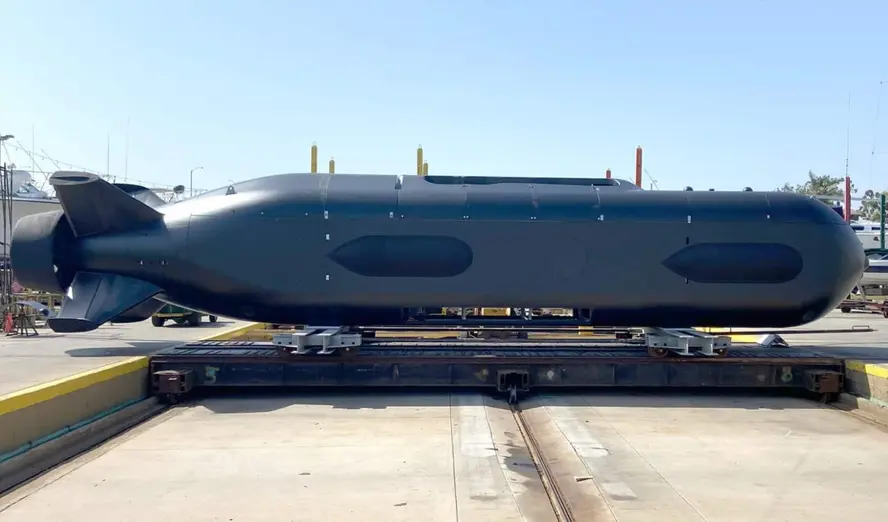
 John D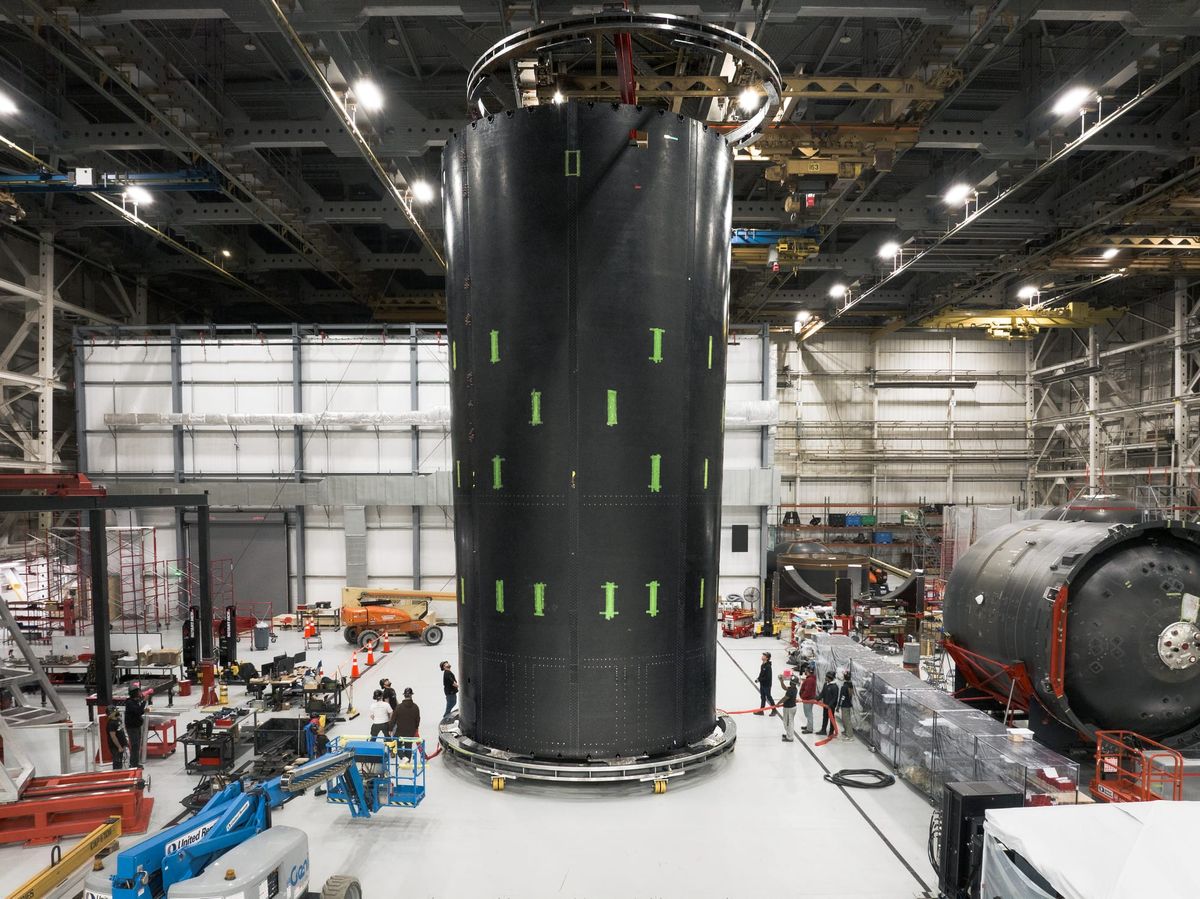
 John D
 John D
 John D